Artículos
The Chairman’s leadership of corruption investigation management
Liderazgo de presidentes de gestión e investigación de corrupción
 M.W Latif muh.wahyudin.latif-2019@pasca.unair.ac.id
S Adam subagyo.adam@fisip.unair.ac.id
B Suyanto bagong.suyanto@fisip.unair.ac.id
M.W Latif muh.wahyudin.latif-2019@pasca.unair.ac.id
S Adam subagyo.adam@fisip.unair.ac.id
B Suyanto bagong.suyanto@fisip.unair.ac.id
The Chairman’s leadership of corruption investigation management
Utopía y Praxis Latinoamericana, vol. 25, no. Esp.2, pp. 378-386, 2020
Universidad del Zulia

This work is licensed under Creative Commons Attribution-NonCommercial-ShareAlike 3.0 International.
Received: 28 March 2020
Accepted: 30 April 2020
Abstract: Corruption crime has recently received more attention from the police. The management of investigating corruption cases is an interesting problem and it has had a big influence on both political and state life. The purpose of this study was to explain and identify the leadership of the team of investigators in the corruption cases investigating management. This research used a qualitative approach combined with a descriptive research method. The results of this study concluded that leadership is a process used by leaders to direct the organization and to provide examples of behavior for their subordinates in the investigation team.
Keywords: Corruption crime, investigations, leadership, police investigators..
Resumen: El crimen de corrupción recientemente recibió más atención de la policía. La gestión de la investigación de casos de corrupción es un problema interesante y ha tenido una gran influencia en la vida política y estatal. El propósito de este estudio fue explicar e identificar el liderazgo del equipo de investigadores en los casos de corrupción que investigan la gestión. Esta investigación utilizó un enfoque cualitativo combinado con un método de investigación descriptivo. Los resultados de este estudio concluyeron que el liderazgo es un proceso utilizado por los líderes para dirigir la organización y proporcionar ejemplos de comportamiento para sus subordinados en el equipo de investigación.
Palabras clave: Crimen de corrupción, investigaciones, liderazgo, investigadores policiales..
INTRODUCTION
Corruption is a problem that occurs in Indonesia. Based on the Corruption Perception Index in 2018, Indonesia ranked 89th out of 180 countries. The value obtained by Indonesia was 38 on a scale of 0 - 100; the lower the value, the more corrupt the country and vice versa. In 2017, Indonesia ranked 96th with a value of 37. An increase of one point in the CPI does not indicate the heavy enforcement of the law about the eradication of corruption. This condition needs to be used as the evaluation material for law enforcement officers when developing a strategy to eradicate corruption (Marnoch et al.: 2014, pp. 302-317).
Changes in the organizational environment of the Indonesian National Police are increasingly complex and competitive, requiring every organization and company involved to be more responsive to be able to survive and continue to grow. To support this organizational change, it is necessary to change the individuals within the organization itself (Campbell & Armstrong: 2013). The process of aligning organizational change with individual change is not easy. Leaders are role models in organizations, so the change must start from the very top level (Jones: 2014, pp. 129-141). Organizations, therefore, need reformist leaders who can be the driving force for organizational change. Up until now, leadership has been an interesting topic to study and research because it is most often observed but little understood (Martin et al.: 2017).
The phenomenon of leadership style in the Indonesian National Police, especially in the management of the investigation of corruption cases committed by the East Java Regional Police, becomes an interesting and major problem in both political and state life. In corruption, leadership style has a strong influence on the path and survival of the Sub-Directorate III Corruption Crime of East Java Regional Police. The role of leadership is very strategic and important in an organization as it is one of the determinants of success in achieving the mission, vision, and goals of an organization. This is a challenge related to developing a clear organizational strategy that depends on the organization on one hand and the leadership on the other (Neyroud: 2011). Along with the rapid development of information technology and Indonesia's unstable economy due to rampant corruption, this could be a source of obstacles for management when investigating corruption.
According to Dalakoura (Dalakoura: 2010), a good leader always motivates his people so then they can have a positive impact on the achievements obtained through their work. Without leadership, the relationship between individual goals and organizational goals may not be in the same direction. This has the consequence that every leader is obligated to pay serious attention when fostering, mobilizing and directing all of the potential employees in their environment. This is to realize organizational stability and to increase productivity that is oriented to the organizational goals (Igboin: 2016, pp. 142-160). The purpose of this study is to explain and identify the leadership within the team of investigators in the management investigating corruption cases in the Sub-Directorate III Corruption Crime of the East Java Regional Police.
Leadership is a process through which the leader is described as giving orders or directing, guiding or influencing the work of others when choosing and achieving the goals that have been determined (Abu Bakar& McCann: 2016, pp. 32-58). Chan and Mak (Chan & Mak: 2014) stated that leadership is the ability toinfluence human behavior and to control people in an organization so then they are following the behavior desired by the leadership of the organization. Leadership is an activity used to influence the behavior of others and the art of influencing human behavior, both that of individuals and that within groups (Dalakoura: 2010). Effective leadership can help organizations to survive situations of uncertainty in the future (McGurk: 2010).
An effective leader must be responsive to change, able to analyze the strengths and weaknesses of his human resources to maximize organizational performance and able to solve problems appropriately (Northouse: 2015). Northouse (Northouse: 2015) also revealed that effective leaders can influence their followers to have greater optimism, confidence, and commitment to the goals and mission of the organization. In leadership, there is a will tied into initiative, progressiveness, and motivation in line with the organization's vision and mission (Jones: 2014, pp. 129-141). According to McGurk (McGurk: 2010), the leadership function includes several functions. First, there is the Instructive Function. This function is a one-way form of communication. The leader, as a decision-maker, instructs the people who are led for them to carry out theirfunctions and goals. The function of the person who leads is only to carry out orders and initiatives related to everything that has to do with the position of command.
Second, there is the Consultative Function. This function is two-way communication to determine decisions. The function of the leader here is as a consultant to listen to opinions, suggestions, and questions from their subordinates regarding the decisions to be taken by the leader. Third, there is the Participation Function. This function is where the leader carries out and activates the people that he leads, in terms of both participating in making decisions and when carrying out the activities that are described according to the main tasks according to their respective positions. This is where the leader is not only participating in the decision- making process in this function but where they also participate in the implementation process.
Fourth, there is the Delegation Function. This function is where the leader, as the highest authority holder, must be willing and able to trust other people, including following their position if they are delegated authority. Fifth, there is the Control Function. Successful and effective leadership can manage the activities of its members in a system of directed and effective coordination. This enables the achievement of shared goals through the activities of guidance, direction, coordination, and supervision. The purpose of this study was to explore the Chairman’s leadership of corruption investigation management in a team.
METHODS
This research is a descriptive study with a qualitative approach. Bogdan and Taylor in Denzin and Lincoln (Denzin & Lincoln: 2014) defined qualitative research as a research procedure that produces descriptive data in the form of written or oral words from people and the observed behavior of the phenomena that occurs. Denzin and Lincoln (Denzin & Lincoln: 2014) suggested that descriptive research emphasizes the data in the form of words, images and not numbers through the application of qualitative methods. Everything collected is likely to be a key to what has been studied. The data source is the subject where the data can be obtained. It can facilitate researchers in identifying data sources.
The researchers used the 3P formula, namely: a) Person (where the researcher asks them about the variable understudy), b) Paper (where the researchers read and study everything related to the research such as archives, numbers, pictures, documents, symbols, etc) and c) Place (the place of the activities related to the research). The determination of the informants as the collective source of the data in this study was conducted purposively. The sample size was determined through a snowball collecting techniques through triangulation (combined) and qualitative data analysis. The results of the study emphasized the meaning of generalization. The following is the background of the informants needed in this study.
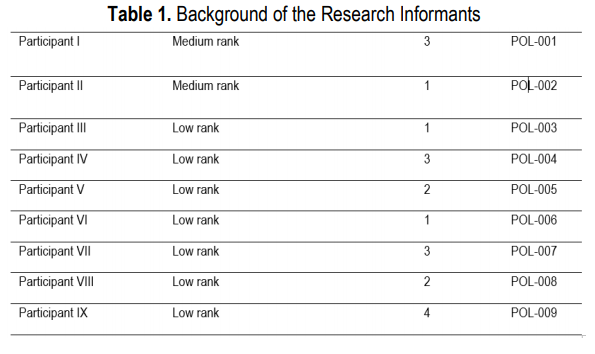
The determination of the focus of the research is more directed at the level of novelty of the information that will be obtained from the leadership situation of the investigative team about the management of investigations into corruption by the East Java Regional Police. This is intended to limit the qualitative study while limiting the research to choose which data is relevant and which data is not relevant.
RESULTS
Activities and standard operating procedures for investigating crimes by the East Java regional police
According to Agunos (Agunos: 2019, pp. 147-152), police investigators, because of their obligations, have the following authority areas: 1) Receive a report or complaint from a person about a crime, 2) Take the first action at the scene, 3) To stop a suspect and examine the suspect's identification, 3) Making arrests and conducting detention, search and seizure, 4) Conducting examinations and the seizure of letters, 5) Taking fingerprints and photographing a person, 6) Calling people to be examined as suspects or witnesses, 7) Bringing in experts who are needed in connection with the examination of the case, 8) Conducting the termination of the investigation and 9) Carrying out other actions according to the law.
Corrupt behavior engaged between the government and private parties are generally carried out within the framework of the programs and companies (Quah: 2017). One of the modus operandi of corruption is to absorb the state budget using a network company owned by the relevant officials where these methods are carried out in a very neat and structured manner. For example, there is the arrangement of auction winning and the ownership of the winning company if it is completely unrelated to the original owner, namely government officials and their networks. This is consistent with what was said by informants POL-001, POL- 002, and POL-003 below:
"This modus of corruption has been built and structured for decades with various tools needed to keep the flow of the project moving from public ownership to private ownership." (POL-001, 2019)
"One of the instruments is the executors who are directly involved in the operations of the companies receiving the tender." (POL-002, 2019)
"... However, it can also be found in slightly haphazard ways, where the company that wins the bid can be directly linked to the owner who is a government official or a member of an elite political party.” (POL-003, 2019)
The investigation or investigative process is part of the operational standards of the investigation procedures according to Pearson-Goff & Herrington (Pearson-Goff & Herrington: 2014). This is where investigators who are aware of and receive reports or complaints about the occurrence of an event that is reasonably suspected of being criminal must immediately carry out the necessary investigative actions. Reports or complaints submitted in writing must be signed by the reporter or the complainant. If the report or complaint is submitted orally, then it must be recorded by the investigator and signed by the reporter or the complainant and the investigator. After receiving a report or complaint, the investigator must provide a letter of receipt of the report or complaint to the person concerned. This is followed by the statements of informants POL-004 and POL-005 as follows:
"... for example, in the government programs within the health sector, companies that "play" are those engaged in the field of pharmacy (procurement of drugs), distributors and marketers of medical equipment, and contractors of health facility buildings". (POL-004, 2019)
Another example of the government programs in education involves companies engaged in the procurement of examination papers, the procurement of stationery and printing to contracting companies that build the educational facilities. In the field of natural resources, related to the companies’ holding licenses,there are quotas and exploration rights. In the field of tourism and culture, it is related to the event organizer in the MICE program (meetings, incentives, conferences, and exhibitions). (POL-005, 2019).
After receiving the surrender of a suspect who has been caught red-handed, the investigator must immediately conduct an examination and other actions involved in the course of the investigation. Investigators who have received the report immediately come to the scene. This can prohibit anyone from leaving so long as the examination there is not finished. In the case of investigating an event that is a criminal offense, the investigator notifies the public prosecutor. If the investigator stops the investigation because there is not enough evidence, if the incident is not a criminal offense or if the investigation is terminated by law, then the investigator notifies the prosecutor, the suspect or his family of the matter.
If the investigator has finished investigating, then the investigator shall immediately submit the case file to the public prosecutor. The investigation is considered to have been completed if within fourteen days the public prosecutor does not return the results of the investigation or if before the deadline has expired, there has been a notification about it from the public prosecutor to the investigator.
Corruption investigation management by the East Java regional police
Corruption is a manifestation of personal dishonesty, the absence of integrity, and the weakness of individual character (Jensen & Hapal: 2018, pp. 39-62). According to Melgar et al. (Melgar et al.: 2010), the absence of good and honest cultural values is suspected to arise in situations where the absorption of the state budget benefits the private sector more than the welfare of the related state officials. This then causes the temptation to commit corruption to arise. When the private sector has an advantage beyond the reasonable limit of 50 percent or more, this is an indication of corruption (Martin: 2017). Gumerov et al. (Gumerov et al.:2016) analyzed three types of corruption in the procurement process. First, there is collusion in the tenders that leads to higher pricing. Secondly, there is the screening of contractors or suppliers to reduce competition and to influence the selection of winners. Third, there is the bribery needed for the officials responsible for choosing the performance winners. This can result in budget inefficiency and low quality. As stated by informants POL-001, POL-002, POL-005, and POL-008:
"Good governance includes it being participatory, accountable, and transparent and involving the rule of law with the substance of policies being able to encourage the people to prosper and to dignify the nation. Transparency, accountability and community participation are the three modes that corruptors most avoid.” (POL-001, 2019)
"With transparency, price markups, auction settings, bribes, and kickbacks are all caught." (POL-002,2019)
"Accountability will open up the veil of program duplication. For example, an order for the auction winner to return a portion of the money to the auction winner in another ministry that won in a similar program shows indications of inter-ministerial program duplication and the involvement of the auction winner by the official giving the order." (POL-005, 2019)
"With public participation, there is the functioning of external controls outside of the government, thus minimizing corrupt practices." (POL-008, 2019).
The Chairman’s leadership of corruption investigation management
The more vigorous cases of criminal acts of corruption in Indonesia demand the active role of police investigators to try to improve their knowledge, abilities, and skills in the field of investigation. This is for them to be able to investigate all cases of criminal acts through selective logging as a form of police participation in terms of eradicating the corruption that has permeated all life in the nation and state. This is explained by the following POL-001 informants:
The success of East Java Regional Police corruption investigators when conducting investigations in the context of eradicating corruption in East Java in particular makes is necessary to have support. This relates to the availability of legal substances, the readiness of the Human Resources (HR), the facilities andinfrastructure as well as the needed investigative facilities, and coordination and cooperation with various parties, especially among law enforcers. There need to be Non-Governmental Organizations (NGOs) and the supervisors and controllers of state finances in every agency, position or office. (POL-001, 2019)
Some obstacles can be elaborated on. This is experienced by the Chief of the Investigation Team about completing the investigation process both externally and internally. Without maximum support from the various legal instruments and instruments that are referred to, the East Java Regional Police corruption investigators cannot contribute to eradicating corruption cases. The POL-004 informant said that:
The National Police as one of the state's law enforcement tools that are given very broad duties and authority by law in terms of law enforcement to carry out investigations of all criminal acts including corruption. This requires maximum quality from the investigators in East Java Regional Police corruption. They need to have adequate technical and tactical skills to be able to enforce the law against criminal acts of corruption. (POL-004, 2019)
Several things can spur the enthusiasm of the investigation team members initiated by both the Chairperson of the investigative team and the East Java Regional Police Institution, including 1) The existence of a good working climate that supports them in improving the performance of the investigation team when resolving a corruption criminal case, 2) There are adequate facilities to support the performance of the investigation team, 3) There is a sufficient budget to support the performance of the team members and 3) In the investigation team, both the team leaders and members are equipped with abilities as well as the further development of their competencies in the context of handling corruption cases. This is if they are given special facilities for capacity building through courses, training, vocational education, and the opportunity if they wish to continue studying.
DISCUSSION
In a government system that tends to be feudal, the power from above is still very influential and feared. This tendency can explain why verbal instructions or orders must be implemented unless the related subordinate wants to lose his position. It can be even worse when the state administrator who carries out the instructions or the directives of superiors also feels entitled to take advantage of the projects that they undertake (Sivakumar: 2014). It is not surprising if the corruption then multiplies because all parties involved seek and prioritize their interests and benefits (Herbert: 2018, pp. 225-249).
Corruption occurs because of opportunities, attitudes, benefits, and the possibility of being found out due to weak control. It is a system involving almost all taking part in the corruption itself (Herbert: 2018, pp. 225- 249). This is formulated as the corruption equilibrium formulated in Jetter et al. (Jetter et al.: 2015). This includes opportunity, attitude, incentive and the probability of detection. Departing from the 4 triggers of corruption, prevention must consider 1) Minimizing the opportunities for corruption, 2) Changing attitudes, 3) Creating a performance-based salary incentive system for civil servants that do not contrast with the private benefits of the winning programs created by the government and 4) Creating a corruption detection system (Quah: 2017).
In a context where a government official has a corporation whose type of business is related to the programs that are under his authority, the official in question will generally elect obedient people to occupy echelon positions in the relevant bureaucracy. Through these subordinates, various matters are arranged, including the type of programs involved, the budget amount, and the winning of tenders. This type of corruption practice is regulated systematically. The scheme begins with planning and includes program setting, budgeting process, and outcomes when absorbing the state budget. The banned bribery law held by the lower- level subordinate employees only allows top-level state administrators to steal more for themselves.
If an investigator can show his identity as a reliable law enforcer when investigating a criminal act of corruption that is currently in the spotlight of the public, they will be able to foster public trust in the investigation of theEast Java Regional Police corruption. This is because the people's trust is the capital used to obtain support and legitimacy to realize individual independence.
CONCLUSION
The results of this study conclude that leadership is a process used to direct the organization and to provide examples of behaviour towards the followers or subordinates in the investigation team of the Sub- Directorate III Criminal Crime of the East Java Regional Police. If there are leaders who can show empathy to all of their subordinates, they will be able to explain their mission interestingly, to show high self-confidence, to be able to improve the image of the organization, to be confident of the ability of their subordinates and to be able to provide opportunities for access for all of their subordinates to achieve the goal of solving recorded cases
One of the activities carried out by the police investigator is to determine the next steps in the investigation. This is also to determine if someone is a suspect by conducting a case. The title of the case itself is an effort carried out by the investigator in the context of dealing with certain criminal acts before they are submitted to the Public Prosecutor. The implementation of the case title by the police can help to find a bright spot in the disclosure of cases that are running or are being handled by the police. In the process of handling cases of investigators, especially police investigators, it is not wrong for them to make decisions as optimally as possible.
The success of a leader in the East Java Regional Police corruption investigation team, especially in law enforcement, and a situation of such a complex corruption cannot be separated because of the factors that affect the internal and external form of opportunities and obstacles. Improving the quality of the leadership of the East Java Regional Police corruption criminal investigation team in the context of law enforcement against criminal acts of corruption is demanded for professionals. This is so then any form of corruption can be handled quickly and thoroughly as expected by making fundamental changes concerning three aspects, namely structural/institutional, human resources, and culture
BIODATA
M.W LATIF: Muhammad Wahyudin Latif is a Student on the Doctoral Program of Human Resource Development at Postgraduate School of Universitas Airlangga, Surabaya, Indonesia. The research area is Leadership, Investigation Management, Administrative Sciences, Political Science, and Public Administration.
S ADAM: Prof. Dr. Bagong Suyanto Drs., M.Si. is a Lecturer and Professor of the Faculty of Social Science and Political Science at Postgraduate School of Universitas Airlangga, Surabaya, Indonesia (main employee). The research area is Leadership, Investigation Management, Administrative Sciences, Political Science, and Social Science.
B SUYANTO: Bagong Suyanto is a Lecturer and Professor of the Faculty of Social Science and Political Science, Universitas Airlangga, Surabaya, Indonesia (main employee). Both professors also serving at the Postgraduate School of Universitas Airlangga, Surabaya, Indonesia. The research area is Political Science and Social Science.
BIBLIOGRAPHY
ABU BAKAR, H & MCCANN, RM (2016). "The mediating effect of leader-member dyadic communication style agreement on the relationship between servant leadership and group-level organizational citizenship behavior". Management Communication Quarterly, 30(1), pp. 32–58.
AGUNOS, JCL (2019). "Investigation and Detective Competencies of the Phillippine National Police in the Province of Bataan". International Journal in Management and Social Science, 7(5), pp. 147–152.
CAMPBELL, TT & ARMSTRONG, SJ (2013). A longitudinal study of individual and organizational learning. The Learning Organization.
CHAN, SCH & MAK, W (2014). The impact of servant leadership and subordinates’ organizational tenure on trust in leader and attitudes. Personnel Review.
DALAKOURA, A (2010). "Differentiating leader and leadership development". Journal of Management Development.
DENZIN, NK & LINCOLN, YS (2014). "Handbook of Qualitative Research". In Physiotherapy (Vol. 88).
GUMEROV, AT, HABIBULLIN, NE, KHODZHIEV, AR, GALEEV, NR & MUKHAMETGALIEV, IG (2016)."Concept and criminological characteristics of corruption criminality". Journal of Legal, Ethical and Regulatory Issues.
HERBERT, WE (2018). "Hindsight, Foresight, and Insight into Global Corruption Issues". Journal of Forensic& Investigative Accounting, 10(1), pp. 225–249.
IGBOIN, BO (2016). "Traditional leadership and corruption in pre-colonial Africa: how the past affects the present". Studia Historiae Ecclesiasticae, 42(3), pp. 142–160.
JENSEN, S & HAPAL, K (2018). "Police violence and corruption in the Philippines: Violent Exchange and the war on drugs". Journal of Current Southeast Asian Affairs, 37(2), pp. 39–62.
JETTER, M, AGUDELO, AM & HASSAN, AR (2015). The Effect of Democracy on Corruption: Income is Key. World Development.
JONES, S (2014). "Distributed leadership: A critical analysis". Leadership, 10(2), pp. 129–141.
MARNOCH, G, TOPPING, J & BOYD, G (2014). "Explaining the pattern of growth in strategic actions taken by police services during the New Labour years: an exploratory study of an English police service". Policing and Society, 24(3), pp. 302–317.
MARTIN, G (2017). "Secrecy’s corrupting influence on democratic principles and the rule of law". International Journal for Crime, Justice and Social Democracy.
MARTIN, HC, ROGERS, C, SAMUEL, AJ & ROWLING, M (2017). "Serving from the top: police leadership for the twenty-first century". International Journal of Emergency Services.
MCGURK, P (2010). "Outcomes of management and leadership development". Journal of Management Development.
MELGAR, N, ROSSI, M & SMITH, TW (2010). "The perception of corruption". International Journal of Public Opinion Research.
NEYROUD, P (2011). Review of police leadership and training. London: Home Office.
NORTHOUSE, P (2015). "Leadership: Theory and Practice (7th Ed.)". In Sage (Vol. 24).
PEARSON-GOFF, M & HERRINGTON, V (2014). Police leadership: A systematic review of the literature. Policing (Oxford).
QUAH, JST (2017). Learning from Singapore’s effective anti-corruption strategy. Asian Education and Development Studies.
SIVAKUMAR, N (2014). "Conceptualizing Corruption : A Sri Lankan Perspective". International Journal of Education and Research.