Artículos
Javanese Lexical Configuration
Configuración Léxica Javanesa
 L Andriany liesna.andriany@fkip.uisu.ac.id
Javanese Lexical Configuration
Utopía y Praxis Latinoamericana, vol. 25, no. Esp.2, pp. 416-426, 2020
Universidad del Zulia

This work is licensed under Creative Commons Attribution-NonCommercial-ShareAlike 3.0 International.
Received: 10 March 2020
Accepted: 25 April 2020
Abstract: This research aims to look at the lexical configuration model in Javanese. The research method is descriptive qualitative research, with data sources obtained from the conversation of the Javanese user community in the city of Yogyakarta and Solo in Central Java province. The results showed that the Javanese lexical configuration of the hierarchical structure consisted of transitive dominance relation, asymmetric domination relation, and symmetrical dominance relation. The analysis also shows that Javanese has a taxonomic branching hierarchy and a merging branching hierarchy. In addition to the taxonomic branchless hierarchy configuration, a branchless hierarchy configuration and proposal session configuration are also found
Keywords: Lexis lexical configuration, javanese, language, hierarchical..
Resumen: Esta investigación tiene como objetivo analizar el modelo de configuración léxica en javanés. El método de investigación es una investigación cualitativa descriptiva, con fuentes de datos obtenidas de la conversación de la comunidad de usuarios de Java en la ciudad de Yogyakarta y Solo en la provincia central de Java. Los resultados mostraron que la configuración léxica javanesa de la estructura jerárquica consistía en una relación de dominación transitiva, una relación de dominación asimétrica y una relación de dominación simétrica. Además de la configuración de la jerarquía sin ramas taxonómica, también se encuentran una configuración de jerarquía sin ramas y una configuración de sesión de propuesta.
Palabras clave: Configuración léxica de lexis, javanés, lenguaje, jerárquico..
INTRODUCTION
Javanese is one of 668 regional languages in the territory of Indonesia. Javanese users are the largest of several regional languages in Indonesia, and Javanese speakers are estimated to reach 75.5 million. Javanese is a regional language used by Javanese, who lives on the island of Java. Not only on the island of Java, the Javanese are used but also spread throughout the regions in Indonesia and even throughout the world, such as in New Caledonia and Suriname. Javanese is included in the Polynesian Malay subgroup and is an Austronesian language family. Javanese in its distinctive characteristics besides being used as a daily communication tool, it is also used to support the culture of its speakers. Culture is manifested in daily life, such as trade, plantation, agriculture, and others. The use of Javanese is determined by the level in social, meaning that Javanese has a varied and complex level of speech (Tamura et al.: 2017, pp. 93-102). The level of speech in Javanese differs from one another depending on who the speaker is and who the speaker is. This research is limited to the relation with Javanese used in daily life so that it can reflect the social context of Javanese society. Studying Javanese is inexhaustible; one of the things that will be discussed is about the meaning contained in Javanese words. Each word has a meaning, a meaning consisting of core meanings and additional meanings. For example, the word head in the Indonesian dictionary means parts of the body above the neck. The part of the body that is located above the neck where the hair grows is the real meaning. Every human and animal has ahead, because the head is a very urgent organ; no human can live without a head. However, if there is a sentence the village head is walking around the village, then information about the word head is different, not the meaning of parts of the body's organs anymore, but it already means the person who leads a village. Here it is seen that the meaning of the word head has shifted. Nevertheless, the meaning of the relationship can still be felt, because what the village head says refers to the highest position in the village administration. The relation between the head and the village head is located at the same place like the one at the top. If the head is located at the very top of the human or animal body and the village head is located at the top in the village government structure. In every language, include Javanese also found a meaningful relation between words. What is meant by the relation between words is the meaning or semantic relation between a word or other language unit with another word or language unit. Cruse (Cruse: 2011) calls this relation of meaning to lexical configuration. This research will discuss lexical configuration in Javanese, and then it will be seen in its relation to social context. Factors related to the sociological situation may be able to determine the linguistic style of Javanese, it is concerned that related to the semantics of Javanese. These different features of other languages can be questioned in various ways. In terms of linguistics, one of the issues that can be questioned is the lexical configuration in Javanese. If the lexical configuration in Javanese can be described, it can be used as one of the input points that can be considered to formulate policies in language planning. It can be briefly said that the discussion of lexical configuration in Javanese that is related to social context is expected to obtain results that have the meaning as input in the development of decisions regarding Javanese linguistics—namely increasing knowledge in the vocabulary mastery of Javanese users in general so that they will be skilled in speaking Javanese with the correct choice of words between related words and understanding the lexical configuration in Javanese. This has great benefits, both for Javanese speakers and people outside of Javanese society. Therefore, this discussion of Javanese is important to be described because Javanese is unique and deserves further investigation as a wealth of languages in the world.
Definition of Lexical configuration
Language vocabulary can consist of several lexical systems. The meaning of the vocabulary can be determined based on a set of relationships. Lehrer et al. (Lehrer et al.: 2012) divided the relation of meaning on homonymy, incompatibility, polysemy, hyponym, antonymy, relational opposites, and component. In connection with the system of meaning relation, Cruse (Cruse: 2011) divided the relation of meaning over conformity (congruence) and the relation of opposition (opposites). Conformity relation consists of a relationof equality (identity), a relation of coverage (inclusion), overlapping relation (overlap), and disjunction. Based on the nature of semantic studies that discuss the relation of meaning or lexical configuration, Cruse (Cruse: 2011) does not talk about the field of meaning or lexical field as contained in semantic books. It was Cruse who first introduced the lexical configuration. According to Cruse (Cruse: 2011), the lexical configuration is formed due to the meaning between lexical items. Furthermore, Cruse added that the relation of meaning occurs because lexical grains have an inclusive meaning, the meaning is tangent, the meaning overlaps, or the meaning is contradictory or complementary to the meaning of another lexical item.
Distribution of lexical configuration
As stated earlier, the lexical configuration was first stated by Cruse (Cruse: 1986). Furthermore, Cruse (Cruse: 2011) stated that lexical configurations could be divided into two types, namely hierarchical structure and proportional series. The hierarchical structure is divided into two groups, namely the proportional hierarchy and the non-branching hierarchy. There are two types of hierarchical structures, namely taxonomy and Moreno. Branched hierarchical structures are of two types, first unbranched hierarchical structures that originate from branched hierarchical structures and, secondly, branched hierarchical structures that do not originate from branched hierarchical structures. The hierarchical structure can be divided into three, namely ranking, tiered, and not tiered. The relation of meaning is divided into three types, namely (script) (frame) and (field). Scripts are relations of meaning that specifically identify the arrangement or sequence of an event. In scripts, the meaning structure is presented sequentially, and the overall arrangement is related. Scripts usually describe daily events or lifestyle, and the subject does not change much (Levin & Hovav: 2017, pp. 248-271). (Frame) is a relation of meaning that identifies the initial relation of concepts (ideas, thoughts, understanding). The frame (frame) consists of elements that are interconnected in a complicated way (complicated) and arranged or built from extensive knowledge. While the field is the relation of meaning that analyzes the semantic relation between names and concepts. The idea of a semantic field originates from the fact that the concept is a case of color and a kinship system. Semantic field analysis is useful to explain therelation of meaning between word lists of a language (Goldberg: 2017, pp. 1-309; Vasiliu: 2018).
METHODS
Configuration of Hierarchical Structure Type
The most fundamental relation in the hierarchical structure is the relation of dominance or vertical relation. Besides that, in a branched hierarchy structure, there must be a relation of difference or horizontal relation. Both relations must be constant in the overall structure of the hierarchy that is full (well-format hierarchies). Also, the branched hierarchical structure requires a relation of difference or horizontal relation. The relation must also remain in the whole structure of the hierarchy that is full of shape. The minimum criteria for a hierarchical structure are a set of related elements and are structured by a vertical relation. The two essential features are asymmetrical and symmetrical. Asymmetric is a vertical relation which must have directional character. For example, if A is greater than B, then B cannot be wider than A. whereas asymmetrical relation means a two-way relation; for example, if C is equal to D, then D equals C (Soames: 2016, pp. 2529-2532).
Branched Hierarchy Structure
There are two types of hierarchical structures, namely taxonomy and meronimi. Taxonomic lexical hierarchies are formed from lexical units at the generic level to the specific level (Cruse: 2011). Vertical relation called taxonomic lexical relation. The relation is a type of hyponym subdivision with a diagnostic framework X is a type of Y. Meronimi is a lexical hierarchical structure whose vertical relation called lexical relation is the relation between lexical units that meaningful overall and lexical units that have meaning parts. According to Lehrer (Lehrer et al.: 2012), the structure of a branched hierarchy is not only divided into two types but alsothree types, but to taxonomy, it is only divided into hyponyms. Moreover, he stated that in the taxonomy, there should not be overlap. As happened in English.
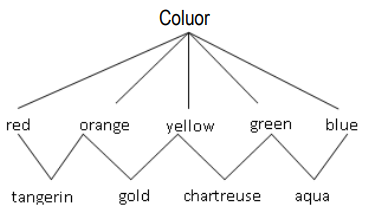
Chart 1. Hyponymy
For example, color in English is an overlapping field. For example, the color of chartreuse is yellowish- green, under the coverage of yellow and green. Also, for example, aqua color greenish-blue functions as a hyponym blue-green.
Branchless hierarchy structure
Unbranched hierarchical structures are of two types, namely (1) unbranched hierarchical structures that originate from branching structures, and (2) branched hierarchical structures do not originate from the structures of a full-branched hierarchy. This can be the basis for the formation of a branchless hierarchy structure if there are lexical units that can include the meaning of units at each level.
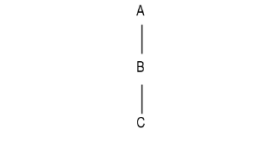
Chart 2. Unbranched hierarchical structure
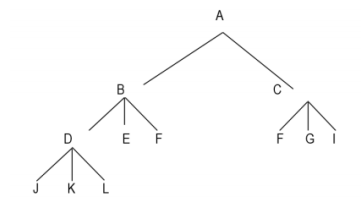
Chart 3. branched hierarchical structure
The unbranched hierarchical structure that is not derived from the hierarchical structure can be divided into three parts, namely (1) ranked, (2) tiered (3) non-tiered. The unbranched hierarchical structure is a lexical hierarchy whose meaning contains a discontinuous scale. Lexical devices whose meaning contains a continuous scale can form a tiered hierarchical structure and a non-tiered hierarchical structure.
Proportional series type lexical configuration
Proportional series can be described as a cell that has six elements, and the relation of the three elements must be such that the fourth element can be determined from the relation of the three elements.
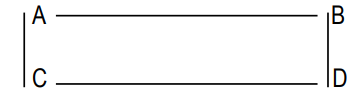
Chart 4. Proportional series
The lexical relation associated with the proportional series is endonym and paronymy. Endonymy is based on uniting the meaning of lexical units into other lexical units. A lexical unit whose meaning contained in another lexical unit is called endonym. Paronymy is a relation between two lexical units whose syntactic categories differ due to the derivation process. Lexical devices that do not form a spiral series (helical chain) and a series of cycles (cycle).
Furthermore, the study of the lexical configuration of the Javanese is based on Cruse (Cruse: 1986) which divided the lexical configuration into two, namely (1) the lexical configuration of the hierarchical structure, andthe proportional series configuration (Hamid: 2018, pp. 1-22).
Data collection by recording people's conversations unknown to the speaker and the listener. It is intended that data can be obtained naturally and not engineered. Location data collection was carried out in central Java, namely Yogyakarta and Solo. Data is collected from conversations in the market, at places of worship, conversations between students during breaks. Speakers also come from various social and religious positions. The community whose data is taken is native Javanese. Then the recording is transcribed into written language. Apart from natural conversations from various circles, other materials also taken from documents in the form of dictionaries. Data analysis techniques with the development model of Miles Huberman (Miles & Huberman: 1994) with continuous data collection activities. The presentation of data is done by collecting data, reducing data, presenting data, and drawing conclusions or verification.
RESULTS
Lexical configuration of hierarchical structures
As explained earlier, hierarchical configurations can be divided into two, namely branching hierarchy configurations and non-branching hierarchy configurations. The hierarchical structure is divided into two types, namely taxonomy and meronimi. It was found that the Javanese in structural relation there are several relations of dominance, among others, as follows.
1. Relation of transitive dominance
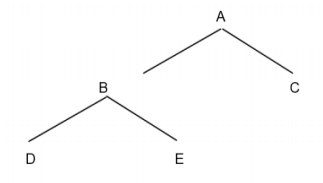
Chart 5. Relation of transitive dominance
If D is a hyponym from B, and B is a hyponym from A, of course D is a hyponym from A. In Javanese, you can see the word Cekel (holding).
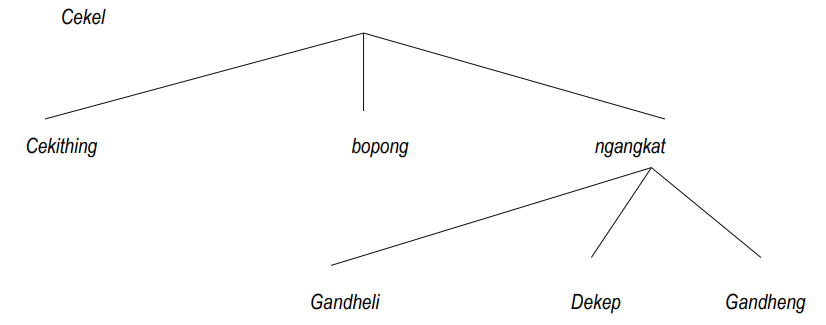
Cekel (grasp) means hand activity that aims to hold the target. In other words, the meaning of cekel can be defined as hand activity with the aim of - holding. Cekthing is holding with fingers, which means the activity of the hand to hold by using the thumb and forefinger; the target is held slightly. Bopong is holding with the whole hand, which means the activity of the hand to hold with the hands looped to the target, the target is raised and pressed into the pelvis. The word Ngangkat means holding with all fingers and soles, which means that the activity of the handholds the target with all fingers and palms attached to the target so that it is raised. Gandheli holds by holding or holding while pulling something. From the chart above, it can be stated that Dekep is the Hyponym of cekel. The word Dekep means catching and gripping something; in other words, both arms gripping something by bringing the target closer to the body. Whereas gandheng means hand holding the target's hand. It can be seen that ghandheng, dekep, ghandheli are hyponymy of ngangkat while ngangkat is hyponymy of cekel. Thus it can be seen that dekep is a hyponym of cekel.
Its use can be seen in the following sentence:
-
Solo athletes are going forward tandhing the mesthi nyek lan connecting the red and white flag dhisik (the Solo athletes if going forward to compete will hold and kiss the red and white flag first).
-
Kacu yellow sing kuwi banjur's telescope strangled with lan around Isah's silence; what kuwi kacune dheweke? (the wet yellow handkerchief was then flicked up and cared for by Isah; was the handkerchief hers?).
I wedi yen taplastik collapsed, flooded by me nyekel not bopong. (I'm afraid that this plastic bag falls, then I hold it in my way).
2. Asymmetry (One-way) Domination Relation
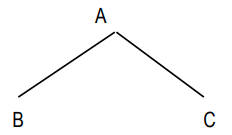
Chart 6. Relation of asymmetric dominance
If B hyponyms of A and A are hyperonyms of B, the relation B and A is called asymmetric. In Javanese can be seen in the activities, opening
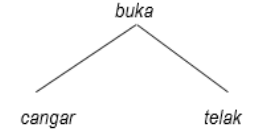
If the hyperonym of cangar of open and open is a hyperonym of cangar, the relation of cangar with open is asymmetrical. Cangar is an involuntary opening of the mouth with two hands, namely by holding both sides of the mouth and pulling it in the opposite direction. Having a meaningful opening of a playing card is done by one hand with the thumb opening the corner of the card and the other fingers pressing it with motivation to know. The hyponym of cangar with open and open is a hyperonym of cangar, the relation of cangar and open is called asymmetric.
Its use can be found in the following sentence.
-
Aku tak nyangarke cucuke, lha kowe sing nyekeli sikile lan nglolohake jamune (I will forcefully open the beak, while you are holding his feet and feed the fixture).
-
Fattah anggone nelak kartu Sarana alon-Orlon wedi yen keno Gambar joker (Fattah open the card slowly he is afraid to get a joker picture card).
3. Symmetry (two-way) dominance relation
Symmetrical relation is two-way is also called homonymy (Florida: 2018; Geeraerts: 2017) for example, X is equal to Y and Y is equal to X, the relation of X and Y is symmetrical.
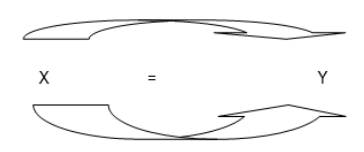
Chart 7. Relation of symmetry dominance
If X is synonymous with Y, then the word Y is synonymous with the word X; in other words, there is a bilateral relation; that is the relation that applies both directions. In Javanese also found the relation of the dominance of symmetry between papah (carrying with guidance by walking slowly) with rampa (carrying by using both hands bent and those brought placed on both hands).
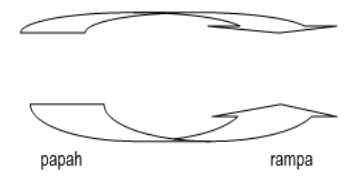
Its use in sentences
-
Kae si doni kok mlakune sajak liyat-liyut mbok dipapah wae wong lagi lara kok. (That, the Doni seemed to walk with totter. Just take it, he was sick)
-
Rikala Ita semaput neng lapangan, age-age Ani ngrampa dhewekw, menyang pos PPPK (When Ita collapsed in the field, Ani immediately took her to the PPPK post).
The word of papah taxonomy in rampai and vice versa in papah taxonomy. Because papah means to bringsick people by supporting it from the side because the target can still run even if limping. Rampa has the meaning of bringing a sick person by placing it on both hands of the perpetrator bent forward. Papah, with a forage has a bilateral relation.
DISCUSSION
Branched taxonomy hierarchy
The taxonomic lexical hierarchy is formed from lexical units at the generic level to the specific level (Cruse: 1986). Vertical relation called taxonomic lexical relation. The relation is a hyponimiic subtype, where diagnostic framework X is a type of Y on diagnostic framework X is taxonomy Y.
In Javanese we can see the word balangi (throw), as follow:
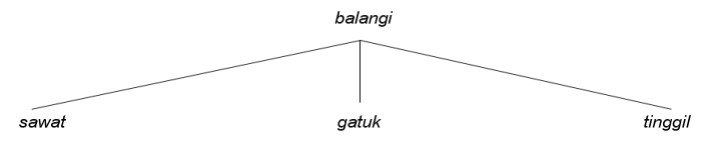
From the component analysis, it can be seen that the word balangi is the superordinate of the word sawat, gutuk, and tinggil. This is indicated by the characteristics of the semantic word balang, which characterizes the words of his subordinates, but not vice versa. The meaning of the word balang is "throw." Therefore, the word balang is to throw a target; the form being thrown is not certain. The word of sawat has the meaning of throwing the target with the form being thrown is stone. While the meaning of the word gatuk is to throw on a stick. And the word tinggil means throwing the target, throwing from above, and right in the middle of the target. Another example can be seen in the word demok, which means to touch. In the chart below, it can be seen that the taxonomy of demok with the words jawil, thothok, cablek, graying, emak-emak, gebrak.
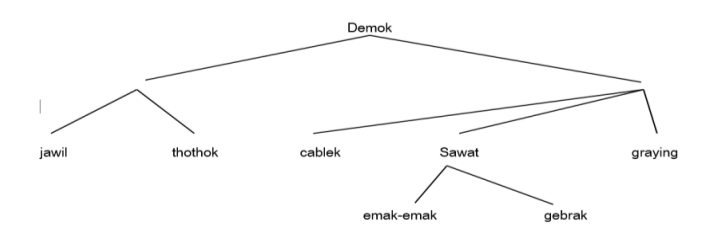
-
Kanggo nyakinake, dheweke banjur ndemok barang mau (To be sure, he then touched it).
-
Sanalika Yanto mbengong karo njawil pundhakku (Yanto immediately yelled while poking my shoulder).
Meronimi branching hierarchy
According to Cruse (Cruse: 1986), meronimi is branched off the lexical hierarchical structure whose vertical relation called meronimi lexical relation. The relation between lexical units, which means overall and lexical units meaning partly (part-whole types), for example, the relation between "door" and "house."
The relation to Javanese can be seen below.
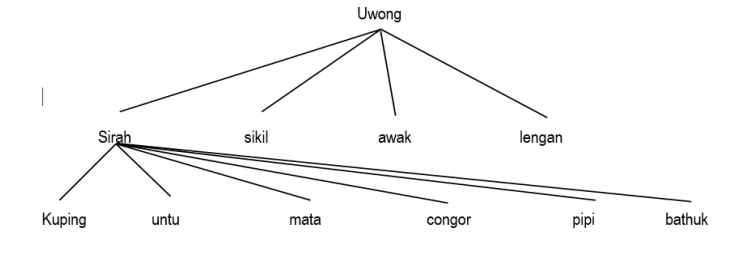
When we say uwong (person), it means already mentioned a part of the whole, so you don't need to mention Sirah (head), and sikil (feet). The relation between kuping (ears) and Sirah (head includes ears, untu (teeth), eyes, etc. The relation between kuping and Sirah is a whole; it means uwong.
Nonbrancing hierarchy
There are two types of branched hierarchical structures; unbranched hierarchical structures derived from branched hierarchical structures, and branched hierarchical structures that do not originate from branched hierarchical structures. A fully formed branched hierarchical structure can be the basis for the formation of a branchless hierarchical structure if there is a lexical unit that can cover lexical meaning at each level.
In Javanese, the kinship system can be found in Javanese families
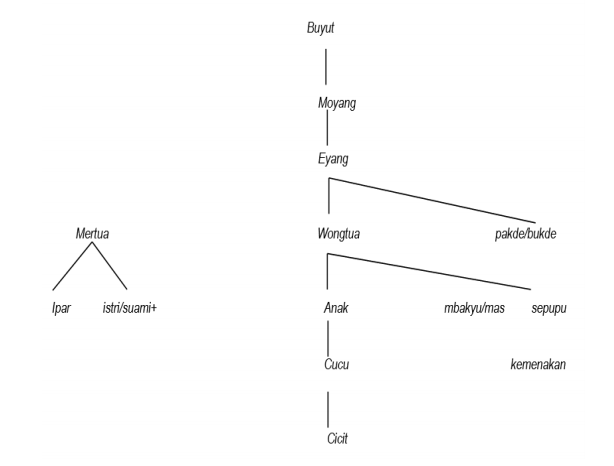
In this kinship system, buyut is the highest position, then eyang, under eyang there is wongtua, after wongtua, under wongtua there is anak, and under anak, there is cucu and the last one is cicit. The lowest position is cicit while the highest position is buyut. This showed the unbranched structure. Kemenakan is a branchless structure of sepupu and pakde/bukde that comes from eyang branched hierarchical structure. Three kinds of unbranched hierarchical structures do not originate from the branched hierarchical structure, namely (1) ranked, (2) tiered, (3) not tiered. The unbranched hierarchical structure is a lexical hierarchical structure whose meaning contains a discontinuous scale. The scale of discontinuity in the lexical hierarchy structure in Javanese can be seen below.
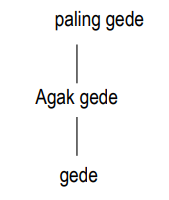
Paling gede hierarchical structure, then agak gede and gede is a lexical structure ranking whose meaning contains a discontinue scale lexical ranking whose meaning contains a discontinuous scale and it can form a hierarchical structure and a non-tiered hierarchical structure
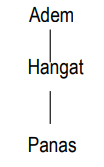
Adem (cold) before reaching panas it first becomes hangat, then after hangat is panas. This is a straight tiered hierarchy. Nothing can happen from Adem without hangat to panas and vice versa.The hierarchical hierarchy can be seen below.
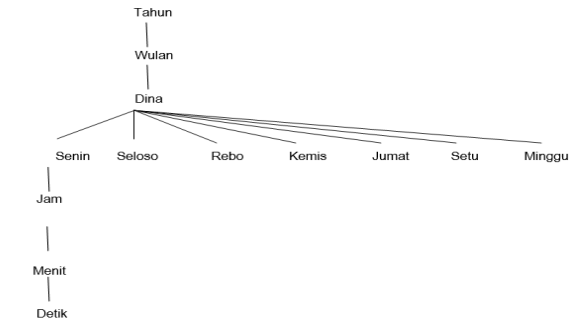
Tahun, wulan, and Dina are hierarchical structures that are not tiered because even though the top structure is tahun later wulan, and then Dina, it does not mean that Dina is a level before wulan and so tahun. Dina is superordinate of Senin, Seloso, Rebo, Kemis, Jumat, Setu, and Minggu. The hierarchical structure of Senin is straight without jam, menit dan detik.
CONCLUSION
Javanese configurations such as hierarchical and series proportional configurations must require the existence of upper classes and subordinate classes. In structural relation, there are several relations of dominance including transitive dominance relation, asymmetric dominance relation, and symmetrical dominance relation (two directions). The taxonomic branch hierarchy configuration in Javanese can be seen in the example of the word baling, which is the superordinate of the sawat, gutuk, and tinggil. The branching hierarchy of meronimi in Javanese also can be seen in the word of uwong (human) be under Sirah, lengan, sikil and also the word of Sirah be under of the words of untu, congor, and bathuk. Unbranched configurations also exist in Javanese and it can be seen in the hierarchical structure of kinship. Likewise with the proportional series configuration, also found in Javanese.
BIODATA
L ANDRIANY: Liesna Andriany is a doctor of linguistics, associate professor and vice-chancellor I for Academic Affairs at Universitas Islam Sumatera Utara, Medan, Indonesia (main employee). Her qualification is Linguist. The research area is Phonetics in languages, linguists, speech and language, grammar and structure of languages.
BIBLIOGRAPHY
CRUSE, A (1986). “Lexical semantics”. Cambridge university press.
CRUSE, A (2011). “Meaning in language: An introduction to semantics and pragmatics”.
FLORIDA, NK (2018). “Javanese Literature in Surakarta Manuscripts: Introduction and Manuscripts of the Karaton Surakarta (Vol. 1)”. Cornell University Press.
GEERAERTS, D (2017). “Lexical semantics”. In Oxford Research Encyclopedia of Linguistics
GOLDBERG, Y (2017). “Neural network methods for natural language processing”. Synthesis Lectures on Human Language Technologies, 10(1), pp. 1-309.
HAMID, MR (2018). “Cognitive foundations of the configuration of the word lexical Study in the lexical approach to the application of theory to contemporary Arabic dictionary”. Mustansiriyah Journal of Arts (MuJA), (49), pp. 1-22.
LEHRER, A, KITTAY, EF, & LEHRER, R (2012). “Frames, fields, and contrasts: New essays in the semantic and lexical organization”. Routledge.
LEVIN, B, & HOVAV, MR (2017). “Morphology and lexical semantics”. The handbook of morphology, pp. 248- 271.
MILES, MB & HUBERMAN, AM (1994). Qualitative data analysis: An expanded sourcebook. sage.
SOAMES, S (2016). “Rethinking language, mind, and meaning”. Philosophical Studies, 173(9), pp. 2529-2532.
TAMURA, N, CASTLES, A & NATION, K (2017). “Orthographic learning, fast and slow: Lexical competition effects reveal the time course of word learning in developing readers”. Cognition, 163, pp. 93-102.
VASILIU, E (2018). “Outline of a semantic theory of Kernel sentences (Vol. 71)”. Walter de Gruyter GmbH & Co KG.