Artículos
Moral and Psychological State of the Student’s Personality During End-of-Term Exams
Estado moral y psicológico de la personalidad del alumno durante los exámenes de fin de curso
 Elmira M. AKHMEDOVA e.m.akhmedova@mail.ru
Nina F PETROVA nina.f.petrova@mail.ru
Svetlana A. PASHINA svetlana.a.pashina@mail.ru
Natalya N. UVAROVA natalya.n.uvarova@mail.ru
Genaz S.-H DUDAEV genaz.dudaev@mail.ru
Elmira M. AKHMEDOVA e.m.akhmedova@mail.ru
Nina F PETROVA nina.f.petrova@mail.ru
Svetlana A. PASHINA svetlana.a.pashina@mail.ru
Natalya N. UVAROVA natalya.n.uvarova@mail.ru
Genaz S.-H DUDAEV genaz.dudaev@mail.ru
Moral and Psychological State of the Student’s Personality During End-of-Term Exams
Utopía y Praxis Latinoamericana, vol. 25, no. Esp.5, pp. 13-21, 2020
Universidad del Zulia
Received: 24 June 2020
Accepted: 30 July 2020
Abstract: The article presents key aspects of the moral and psychological state of the student's personality, as well as examines the characteristics of age and levels of anxiety as factors that affect the moral and psychological state of the students. Throughout the study, it is concluded that these categories, in addition to adaptation to new conditions, are determining factors for the moral and psychological affection of the student's personality.
Keywords: Moral and psychological state, student, stress tolerance, anxiety.
Resumen: El artículo presenta aspectos clave del estado moral y psicológico de la personalidad del estudiante, así como también, examina las características de edad, niveles de ansiedad como factores que afectan el estado moral y psicológico de los estudiantes. A lo largo del estudio, se concluye que estas categorías, además de la adaptación a las nuevas condiciones, son determinantes para la afección moral y psicológica de la personalidad del alumno.
Palabras clave: Estado moral y psicológico, estudiante, tolerancia al estrés, ansiedad..
INTRODUCTION
Modern society needs a stress-resistant person who can overcome any difficulties in different fields of activity. It is important to mold such a person in school and continue their upbringing in institutions of higher education. We should note that the moral and psychological state of the student's personality is a combination of emotional experiences generated at the sensory level of the human psyche upon interacting with objective reality and recognizing personal qualities that influence the mental health of students and manifest themselves in moral activity through a system of psychological protection (Abdrakhmanova et al.: 2017; Boronina et al.: 2001; Gulaya: 2013; Ldokova, Panfilov: 2013; Levitov: 1967). Stress is one of the most important factors that affect the moral and psychological state of a person (Toppo: 2016; Shustova: 2005).
Stress is a response of the human body to overstrain, negative emotions, or simple routine. On the one hand, stress can be useful for a person because the human body under stress produces adrenaline that forces the subject to seek a way out of this unfavorable situation. On the other hand, if there are too many stressful situations, the body weakens, loses its strength and ability to quickly solve pressing issues. Severe stress also affects health, in particular the immune and cardiovascular systems. In addition, stress undermines the moral and psychological state of the student's personality during end-of-term exams. There can be subjective (feelings of anxiety and guilt, fatigue), behavioral (incident danger), physiological (peptic ulcer, high blood pressure), cognitive (ineffective decisions, distraction), and organizational (absenteeism, low academic performance) consequences (Sohn et al.: 2015).
Therefore, it is crucial to resist stress and stick to only positive attitudes. The peak of psychoemotional stress in students falls on the period of end-of-term exams.
End-of-term exams are a serious test for students, especially for freshmen. Their main purpose is to check the level of students' knowledge, skills, and abilities at the end of a certain period. The academic year of a full- time student includes two exams – winter term and summer term. The total number of exams is conditioned by a particular curriculum (there are usually no more than six evaluation tests). The duration of end-of-term exams depends on the regulations and curricula of higher education institutions. As a rule, they last for about 20 days. End-of-term exams are preceded by the period of getting credits, including the completion and delivery of reference papers, reports on practical training, term papers, laboratory research, practical tasks, and tests (Seymour: 2016).
A period of getting credits and end-of-term exams are a rather difficult and stressful time in the life of each student. Anxiety arises even among the most confident and intelligent students. In addition to anxiety, they often face a sense of inferiority, tension, overwork, passivity, irritability, and hot temper.
All of the aforesaid has allowed us to determine the problem of this study – what is the moral and psychological state of the student's personality during end-of-term exams?The article aims at determining the moral and psychological state of the student's personality during end- of-term exams.
METHODOLOGY
While recognizing the humanization of education as the fundamental principle, the modern higher school acts as a system of conditions that ensure the development of personality in all aspects (Orlov et al.: 2004). The emphasis on the student's personal development puts forward a number of problems, including the problem of emotionality (Ahnert et al.: 2012; Hoy: 2007).
Being the fundamental property of the human psyche, emotions are among the main components of one's personality, engage in almost all its structures, and contribute to the regulation of its activity. Emotional characteristics largely determine the relationship between a person and the environment (Englund: 2016).
Nowadays, emotionality characteristic of students as a specific age and social group still belongs to the understudied areas of psychological knowledge.
At the same time, student age as a stage of personal development is a sensitive period for revealing the basic sociogenic potential of a person, whose essential component is emotional relations (Morosanova, Sagiev: 1994). This stage of development is characterized by the maximum inclusion of individuals into various spheres of social relations and activities, which requires the mobilization of all human resources and determines high requirements for their emotional sphere (Baghaei, Ravand: 2016; Hansen, James: 2016; Zotova, Kryazheva: 1979).
A student as a person of a certain age and as an individual can be characterized from the following threeaspects:
- 1. Psychological, which represents the unity of psychological processes, conditions, and personality traits. Its crucial element is mental properties (orientation, temperament, character, skills) determining the course of mental processes, emergence of mental states, and manifestation of mental structures. When analyzing a particular student, it is necessary to consider the characteristics of a given individual, their mental processes and conditions;
- 2. Social, which embodies social relations and qualities conditioned by the student's belonging to a particular social group, nationality, etc.;
- 3. Biological, which includes the type of the highest nervous activity, structure of analyzers, unconditioned reflexes, instincts, physical strength, physique, height, facial features, color of skin, eyes, etc. This aspect is mostly predetermined by genetic background and inborn potential but to a certain extent varies under the influence of living conditions (Fernández, Delgado: 2016).
Let us consider the emotional sphere of a person, which represents a wide range of experiences and feelings. The emotional sphere performs the following functions: stimulative, regulatory, and evaluative, as well as the function of compensating the shortage of information.
The emotional sphere of an individual consists of emotional experiences and feelings.
We should note that experiences are an assessment of the satisfaction of the individual's needs while feelings are an assessment of the ability of a particular object to satisfy a given need of any individual (Suarez- Balcazar: 2014).
The emotional sphere reveals particularly striking differences between people. The specifics of one's personality, character, intellect, interests, and attitudes towards other people are manifested through emotions and feelings. The main differences in the emotional sphere of a person are represented by various feelings, their orientation towards certain objects and human attitudes they express. Being a form of direct experiences, feelings express all human attitudes, including worldview and ideological attitudes, as well as attitudes to the world and, above all, to other people. The emotional life of a person is influenced by temperament, individual stereotypes of emotional response to certain situations and general emotional orientation. Therefore, people find themselves at the intersection of many typologies (Kovalčíková: 2015).
An important feature of emotions and experiences is their dynamics, i.e. the ease and speed of the emotional process, its intensity and stability. Depending on these properties, there are four types of temperament: choleric, phlegmatic, sanguine, and melancholic. It is believed that different temperaments are characterized by various tendencies towards certain experiences and an unequal degree of activity, impulsivity, and stability of the existing emotional relationships. Some people are more inward, while others are outward. Emotions can be more or less expressed through gestures, facial expressions, voice, etc. (Poldrack et al.: 2016).
An essential part of exam preparation is psychological tune-up. Psychological tune-up is the process of creating, maintaining, and restoring the student's mental readiness to pass an exam and get the highest grade. The state of mental readiness is created through the joint effort and vigorous activity of teachers and students.
From the psychological and pedagogical perspective, these concerns comprise the definition of tasks, means, methods, and teaching techniques, as well as the organization of psychological tune-up for exams. To effectively solve these issues, teachers and students should understand the psychological nature of the phenomena under consideration. The state of mental readiness for exams is formed through the intended organization of the student's consciousness and actions based on the expected conditions of the upcoming exam. The organization of the student's consciousness aims at recreating such conditions of the future exam that would cause a positive attitude towards it. We believe that exam preparation should be carried out in conformity with the principle "I must – I can – I want", which characterizes the rational, moral, and emotional basis of the well-formed attitude towards exams. It develops an appropriate state of complete mental readiness. These steps are undertaken in the real-life conditions of exam preparation and embodied in specific actions of students and teachers (Ahnert et al. 2012; Maclellan: 2016).
Hus, students form and develop states that are classified as states of neuropsychic stress in case of strict time limits for completing the given tasks, in case of difficult adaption to learning conditions, in case of emotional and intellectual stress while getting credits and passing exams, in case of expecting low grades on exams, in case of hyper-motivation, as well as in case of prevailing negative mental states (frustration, aggressiveness, anxiety, or rigidity) determined by one's personality traits.
RESULTS
The experiment involved first-year students pursuing a degree in "Psychological and Pedagogical Education" at the North-Caucasus Federal University.
The formative experiment aimed at analyzing the psycho-emotional state of first-year students during end-of-term exams and reducing the level of stress.
Its tasks were as follows:
To conduct a diagnostic study and determine the current level of stress, the severity of neuropsychic tension and anxiety;
To define the level of tension and stress;
To test a new program for stress relief among students during end-of-term exams; To provide specific recommendations for dealing with stress.
The experiment participants were represented by two groups of first-year students from the North- Caucasus Federal University (40 people in total).
Twenty students in both the control and experimental group.
We used the following techniques:
- 1. The questionnaire developed by T.A. Ivanchenko, M.A. Ivanchenko, and T.P. Ivanchenko entitled "Listing stress symptoms". This technique helps identify stress symptoms, independently evaluate their frequency and the degree of one's exposure to the negative effects of stress;
- 2. The Taylor Manifest Anxiety Scale (J. Taylor, T.A. Nemchin's adaptation). This technique was used to measure the level of anxiety;
- 3. Yu.V. Shcherbatykh's comprehensive assessment of stress manifestations.
The first team of the respondents formed the control group, while the second team was included in the experimental group.
During the initial study of the level of tension in the control and experimental group at the ascertaining stage of the experiment, we used the three techniques and obtained the following results presented in Table1.

Due to these techniques, we determined the initial level of tension and stress among first-year students. Table 1 demonstrates that the moderate level of tension prevailed in both the control and experimental group. This fact indicates that activity and tension are closely connected, i.e. students are subject to stress in a positive (strive to achieve something) and in a negative way (problems, concerns). These people consider life as an ongoing struggle that keeps them in the permanent state of stress. The identified level reveals the pronounced tension of emotional and physiological systems of the human body as a response to a strongstress factor that could not be compensated.
We should note that the low level of anxiety was more typical of the control group. These students lived calmly and reasonably and successfully coped with their problems. They experienced no significant but rather moderate stress that could be compensated by the rational use of time, periodic rest, and optimal way out of a certain situation. On the contrary, the high level of anxiety in the experimental group indicates that these students experienced much stress. This level of stress threatens human health and can be overcome with the help of a psychologist or psychotherapist.
Based on the above-mentioned results, we decided that we would test our program on stress relief in the experimental group with the highest level of anxiety.
To implement the formative stage of the experiment, we tested the "Lotus" program to relieve stressduring end-of-term exams on the experimental group.
The objective of the program was to relieve emotional stress and improve the psychological health of its participants.
Its tasks were as follows:
To teach the experiment participants some techniques of psychological self-regulation; To create favorable conditions for productive work on oneself;
To develop one's personal qualities and ensure spiritual harmony. We selected the group form of conducting the experiment.
We tested our "Lotus" program on first-year students of the experimental group, conducted a secondary survey, and obtained the following results presented in Table 2.

Thus, we can conclude that the "Lotus" program had a positive effect on students in the experimental group. Table 2 shows that the moderate level of tension prevailed over the low and high levels. The low level of tension dominated over the high one, which indicates that many students of the experimental group learned to cope with their feelings.
The comparative analysis of the results obtained in the control and experimental group during the ascertaining and final stages of the experiment is presented in Table 3.
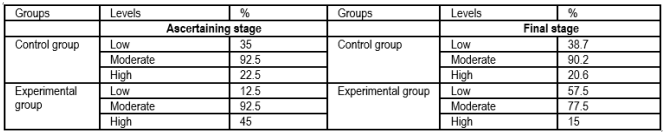
Table 3 demonstrates that students in the experimental group improved their indicators after testing the "Lotus" program. Thus, the moderate level of stress began to prevail over the high one and the low level of stress dominated over the moderate one. Students in the control group did not experience any significant changes and showed roughly the same results at the ascertaining and final stages.
Therefore, our stress relief program and recommendations helped first-year students work on themselves and, for the most part, cope with tension and stress.
CONCLUSION
Throughout the comparative analysis of the data obtained we concluded that the results in question improved after testing the "Lotus" program in the experimental group.
In general, the development and implementation of the above-mentioned program reduced the level of tension among students in the experimental group, which positively affected their moral and psychological state during end-of-term exams.
Within the framework of this article, the factor under consideration is students' environment, namely theconditions of end-of-term exams. To minimize stress, we put forward general recommendations that students should follow to improve their moral and psychological state during end-of-term exams:
- 1. List all the things that cause stress. It will help avoid controversial situations. Students should try to relax and form calm-related psychological patterns.
- 2. Do regular exercise and sports activities to counterbalance nervous activity (dosed walking,jogging, swimming, cycling).
- 3. Find time for activities that give pleasure: chatting with friends, walking in the open air, outdoor recreation.
- 4. Plan short-term relaxation programs using any techniques: auto-training, meditation, breathing, and physical exercises.
- 5. Do not try to do too many things at once. Plan the day and complete the tasks according to their importance, do not do everything at the last moment.
- 6. Keep to a healthy diet.
- 7. Change things that can be changed and accept things that cannot be altered in any way. There is no point in being nervous about something that is impossible to change.
- 8. Live today and be joyful of every single day.
- 9. Avoid unpleasant people. Never get annoyed by talking to people whoever they are. Accept people for who they are. If students have to communicate with an unbearable person, they should be glad that they are not like that. Do not sweat and smile – victory will be yours.
- 10. Interact with interesting people! Do not withdraw into yourself, communicate with unordinary and successful people. Consult with them, ask them how they would solve one or another problem.
- 11. The famous psychologist Louise Hay is convinced that stress is caused by fear. She states, "Stress is not inner harmony. Inner harmony is being at peace with yourself. It is not possible to have stress and innerImportar listaharmony at the same time. When you are at peace, you do things one at a time. You do not let things get to you. When you feel stressed, do something to release the fear, so you can move through life feeling safe. Do not use the word ‘stress’ as a copout. Do not give a little word like ‘stress’ a lot of power. Nothing has any power over you" (Hay: 2015).
Consequently, the results obtained during the formative stage of the experiment allowed us to assess the effectiveness of the developed and tested program. Thus, the objective of this study is considered achieved and the hypothesis has been proved.
BIODATA
Elmira M. AKHMEDOVA: Candidate of Pedagogical Sciences, Associate Professor of the Department of Pedagogy and Educational Technologies, Institute of Education and Social Sciences, North Caucasus Federal University. The author of more than 70 scientific papers. Scientific interests: Pedagogical axiology, The study of value-semantic orientation in the educational space of society in undergraduate psychological and pedagogical directions.
Nina F. PETROVA: Doctor of Pedagogical Sciences, Professor of the Department of General and Applied Psychology, Institute of Education and Social Sciences, North Caucasus Federal University. The author of more than 100 scientific papers. Scientific interests: The study of value-semantic orientation in the educational space of society in undergraduate psychological and pedagogical directions.
Svetlana A. PASHINA: Candidate of Pedagogical Sciences, Associate Professor of the Department of Pedagogy and Educational Technologies, North Caucasus Federal University. The author of more than 30 scientific papers. Scientific interests: Project activity as a means of forming students' social competence.
Natalya N. UVAROVA: Candidate of Pedagogical Sciences, Associate Professor, Acting Rector of Gzhel State University. Scientific interests: professional self-determination, career growth, innovative processes in education, quality of education, image of a teacher, psychological and pedagogical support of education, practical psychology of education.
Genaz S.-H. DUDAEV: Candidate of Pedagogical Sciences, Associate Professor of the Department of Management, Chechen State University. Scientific interests: History and Philosophy of Science.
BIBLIOGRAPHY
ABDRAKHMANOVA, R.Ya., BOGDANOVA, A.Kh., MUKHAMETZYANOV, F.A. (2017). Spetsifikaprofessionalnoi podgotovki budushchego pedagoga-psikhologa [The specific professional training of future educational psychologists]. Integratsiya obrazovaniya, 1, 111-115.
AHNERT, L., HARWARDT-HEINECKE, E., KAPPLER, G., ECKSTEIN-MADRY, T., MILATZ, A. (2012).Student-teacher relationships and classroom climate in first grade: how do they relate to students' stress regulation? Attach Hum Dev., 14(3), 249-263. DOI: 10.1080/14616734.2012.673277
BAGHAEI, P., RAVAND, H. (2016). Modeling local item dependence in cloze and reading comprehension test items using testlet response theory. Psicologica, 37(1), 85-104.
BORONINA, L.N., ViSHNEVSKII, Yu.R., DIDKOVSKAYA, Ya.V., MINEEVA, S.I. (2001). Adaptatsiyapervokursnikov: problemy i tendentsii [The adaptation of first-year students: problems and trends]. Universitetskoe upravlenie, 4(19), 65-69.
ENGLUND, T. (2016). On moral education through deliberative communication. Journal of Curriculum Studies, 48(1), 58-76. https://doi.org/10.1080/00220272.2015.1051119
FERNÁNDEZ, M.S.B., DELGADO, L.M. (2016). Attitude scale of university students towards academic tutoring Escala de actitudes de los estudiantes universitarios hacia las tutorías académicas. Educacion XXI, 19(1), 247-266. https://doi.org/10.5944/educxx1.15586
GULAYA, N.V. (2013). Psikhologicheskie osobennosti razvitiya samoregulyatsii u studentov s negativnymi psikhicheskimi sostoyaniyami [Psychological features of developing the self-control of students with negative mental states]. Aktualnye problemy gumanitarnykh i estestvennykh nauk, 11(2), 257-263.
HANSEN, D.T., JAMES, C. (2016). The importance of cultivating democratic habits in schools: enduring lessons from Democracy and Education. Journal of Curriculum Studies, 48(1), 94-112. https://doi.org/10.1080/00220272.2015.1051120
HAY, L. (2015). The Essential Louise Hay Collection. Carisbad: Hay House Inc, 544 p.
HOY, E. (2007). Work in progress – Pedagogical practices for teaching critical thinking skills to CSET students. 37th Annual Frontiers In Education Conference – Global Engineering: Knowledge Without Borders, Opportunities Without Passports, Milwaukee, WI, F3C-13-F3C-14. DOI: 10.1109/FIE.2007.4417837
KOVALČÍKOVÁ, I. (2015). From dynamic assessment of cognitive abilities to educational interventions: Trends in cognitive education. Journal of Pedagogy, 6(1), 5-21. https://doi.org/10.1515/jped-2015-0001
LDOKOVA, G.M., PANFILOV, A.N. (2013). Psikhicheskie sostoyaniya studentov v uslozhnennykh usloviyakh uchebnoi deyatelnosti [Mental states of students in more complex conditions of educational activity]. Kontsept, 51, 1-11.
LEVITOV, N.D. (1967). Frustratsiya kak odin iz vidov psikhicheskikh sostoyanii [Frustration as a type of mental states]. Voprosy psikhologii, 6, 118-129.
MACLELLAN, E. (2016). Agents pedagogical: Bootstrapping reflexive practice through the psychological resources of self-agency. Journal of Pedagogy, 7(2), 79-96. https://doi.org/10.1515/jped-2016-0012
MOROSANOVA, V.I., SAGIEV, R.R. (1994). Diagnostika individualno-stilevykh osobennostei samoregulyatsii v uchebnoi deyatelnosti studentov [Diagnosing the individual and stylistic features of students' self-control in educational activity]. Voprosy psikhologii, 4, 134-140.
ORLOV, A.A., ISAEV, E.I., FEDOTENKO, I.L., TUREVSKII, I.M. (2004). Dinamika lichnostnogo iprofessionalnogo rosta studenta pedvuza [The dynamics of personal and professional growth of students in pedagogical specialties]. Pedagogika, 3, 53-60.
POLDRACK, R.A., TRIPLETT, W., GORGOLEWSKI, K.J., SABB, F.W., CANNON, T.D. (2016). Aphenomenon-wide examination of neural and cognitive function. Scientific Data, 3(1), 1-12. DOI: 10.1038/sdata.2016.110
SEYMOUR, L. (2016). One point short: Let's not define students by their test scores. Education Next, 16(1), 84.
SHUSTOVA, I.Yu. (2005). Protsess samoopredeleniya starsheklassnikov [The self-determination of senior students]. Pedagogika, 5, 45-48.
SOHN, J.H., KIM, H.E., SEOK, J.W., SOHN, S., CHOI, D. (2015). Effect of emotional arousal on inter-temporal decision-making: An fMRI study. Journal of Physiological Anthropology, 34(1). DOI: 10.1186/s40101-015- 0047-5
SUAREZ-BALCAZAR, Y. (2014). Embracing our principles and moral compass. Psychosocial Intervention, 23(2), 155-157. https://doi.org/10.1016/j.psi.2014.07.001
TOPPO, G. (2016). Game plan for learning: Building on coleman's early theories, new academic competitions motivate students to achieve. Education Next, 16(2), 39-45.
ZOTOVA, O.I., KRYAZHEVA, I.K. (1979). “Nekotorye aspekty sotsialno-psikhologicheskoi adaptatsii lichnosti [Some aspects of the social-psychological adaptation of personality]”, in: M.I. Bobneva, E.V. Shorokhova (eds.), Psikhologicheskie mekhanizmy regulyatsii sotsialnogo povedeniya. Moscow: Nauka, pp. 219-232.