Artículos
Impact of Employee Training and Strategic Alliances on Business Innovation and Survival
Impacto de la formación de los empleados y alianzas estratégicas en la innovación y supervivencia empresarial
 Youseline GARAVITO HERNÁNDEZ ygaravito2@udi.edu.co
Carlos Alfonso MANTILLA DUARTE cmanduar@uis.edu.co
Javier Francisco RUEDA GALVIS jrueda31@udi.edu.co
Johanna Marcela URIBE BERMUDEZ uribe1@udi.edu.co
Youseline GARAVITO HERNÁNDEZ ygaravito2@udi.edu.co
Carlos Alfonso MANTILLA DUARTE cmanduar@uis.edu.co
Javier Francisco RUEDA GALVIS jrueda31@udi.edu.co
Johanna Marcela URIBE BERMUDEZ uribe1@udi.edu.co
Impact of Employee Training and Strategic Alliances on Business Innovation and Survival
Utopía y Praxis Latinoamericana, vol. 25, no. Esp.5, pp. 77-94, 2020
Universidad del Zulia
Received: 05 June 2020
Accepted: 15 July 2020
Abstract: In recent years, the academic literature has demonstrated the importance of analyzing the level of employee training and strategic organizational alliances, as determining factors that contribute significantly to innovation and business survival. Based on factor analysis and the Cox regression model with information from 5,623 spanish manufacturing companies, this article shows that companies that link employees with a doctoral level and promote organizational alliances, especially with universities, achieve a higher level of innovation. Their products and consequently better conditions for business survival.
Keywords: Business survival, human resources, innovation, strategic alliances..
Resumen: En los últimos años, la literatura académica ha demostrado la importancia de analizar el nivel de formación de los empleados y alianzas estratégicas organizacionales, como factores determinantes que contribuyen significativamente a la innovación y supervivencia empresarial. A partir de un análisis factorial y del modelo de regresión de Cox con información de 5.623 empresas manufactureras españolas, el presente artículo demuestra que las compañías que vinculan empleados con nivel doctoral y alianzas estratégicas con universidades, logran un mayor nivel de innovación y mejores condiciones para la supervivencia empresarial.
Palabras clave: Alianzas estratégicas, innovación, recursos humanos, supervivencia empresarial..
INTRODUCCIÓN
Multiple studies and researches analyze the different factors that influence the business survival phenomenon, several of them centralized in identifying representative external variables such as location, competition, industrial sector, economic environment, among many others (Cefis and Marsili, 2012; Coleman, et al., 2013; Ejermo and Xiao, 2014; Gémar, et al., 2016; Loan, 2018; Zhao and Burt, 2018). Regarding the analysis of internal factors for business survival, various works identify innovation as one of the most important variables due to its direct relationship with business growth and profitability, highlighting that innovative new companies are less likely to fail in its first 5 years of existence than those that are not (Caves, 1998; Geroski, 1995; Cefis and Marsili, 2012; Colombelli, et al., 2013; Mazzucato, 2013; Rueda, 2013; Doh and Kim, 2014).
Similarly, the research of Zhang and Mohnen (2013) show that there is a positive influence between innovation and business survival, but only up to a certain level, because the company will not make a profit from this point on, making it an inverted U-shaped relationship. However, other research also concludes that innovation has no direct effect on survival because it demands large economic and technological resources for its implementation, which will not always be available (Jensen, et al., 2008; Buddelmeyer, et al., 2010; Ostergaard, et al., 2011).
On the other hand, the studies by Datta, et al. (2015); Velu, 2015; Ortiz-Villajos and Sotoca (2018); Zhang, et al. (2018); Xia and Dimov (2019) indicate that if there is a positive relationship between these variables, therefore, analyzing this phenomenon with the inclusion of other factors is a necessity for the topic of business administration. For this, the resource-based vision emphasizes the importance of knowledge to achieve innovation and business survival, so it is suggested that the level of training of Employees in the company are factors in achieving these objectives (Yli-Renko, et al., 2001; Thornhill and Amkit, 2003; Esteve-Pérez and Mañez-Castillejo, 2008).
For these reasons, this document investigated how the level of training of employees and strategic alliances with other organizations to achieve Research and Development – R&D activities can contribute to the relationship between innovation and survival of the company, given that previous studies they did not focus on analyzing these relationships (Belderbos, et al., 2015; Maietta, 2015; Gémar, et al., 2016; Ortiz- Villajos and Sotoca, 2018). Therefore, the effects of innovation according to the level of training of employees were studied pro separated from the relationship between strategic alliances and business survival, to carry out a moderating effect analysis between employee training and strategic alliances facts in support of R&D activities, to understand their relationship as factors that promote innovation and business survival.
In this sense, the main contribution of this research is to extend the study of the determining factors of business survival, which is why the study of innovation in this important business phenomenon is deepened, providing empirical evidence that contributes to understanding the effect moderator between the level of training of employees and strategic alliances for R&D based on business survival and innovation
LITERATURE REVIEW
In recent years, the economic crisis has increased the number of companies that have closed down around the world, particularly in the countries of the Organization for Economic Co-operation and Development- OECD and Latin America, more than half of the company fail in their first five years of existence and within the first year, on average, between 20% and 30% of startups disappear (Cefis and Marsili, 2012; Confecámaras, 2018; Loan, 2018). Therefore, academic literature recognizes the great need to study factors that may favor of business survival, taking into account like definition as referring to organizations that have not closed down their operations temporarily or permanently (Box, 2008; Cefis and Marsili, 2012; Ejermo and Xiao, 2014).
Empirical studies have analyzed these factors from different levels like human capital, company age, size, R&D activities, innovation, legal structure, cooperation partners, localization, markets, industry and others (Renski, 2011; Cefis and Marsili, 2012; Coleman, et al., 2013; Ejermo and Xiao, 2014; He and Yang, 2015; Velu, 2015; Rueda y Rueda, 2017). Regarding these factors, the majority of the studies suggests that if a company wants to survive and thrive in a highly competitive, the key is product and process innovation is the solution, because it is a key productivity and growth driver with their own capabilities (Kim and Maubourgne, 2005; Slaper, et al., 2011; Ganotakis, 2012; Rueda, 2013).
However, other documents like those of Scherer and Harhoff (2000); Samuelsson and Davidsson (2009); Buddelmeyer, et al. (2010); Boyer and Blazy (2014) suggest that this correlation could have negative effects, because innovation leads to more risk processes with possibility with skewed returns. Equally, Nevertheless, et al. (2015); Ortiz-Villajos and Sotoca (2018) suggest that these results may be context-dependent, and conclude that this relation is conditioned on the type of innovation undertaken without applying to all companies, even the majority of authors argue that innovation always is an important factor determines for survival in any type of company.
Under the premise that innovation is an important determinant to companies’ survival, Colombelli and Von Tunzelmann (2011): Ejermo and Xiao (2014); Velu (2015); Xia and Dimov (2019) recognizes the importance of continuing to research which factors can affect the relationship between innovation and survival, and based on the definition of product innovation of Cooper (1986); Lager (2002); Oslo Manual (2018), as the introduction of a good or improved service in terms of its characteristics and the process innovation as the introduction of a significant new or improved production or distribution process, this study intends to contrast if product and process innovations affect positively company survival, through the following first hypothesis formulation.
Hypothesis 1: Innovation favors company survival.
From this perspective, DeCarolis and Deeds (1999); Donate and Guadamillas (2011); Tavassoli and Karlsson (2015) argue employees’ training level and strategic alliances favor innovation, but also permits acquiring new internal and external knowledge necessary for innovation activities, because Knowledge-Based View - KBV supports the idea that knowledge is the most important strategic resource for innovation and ensuring a company’s long-term survival; especially since some forms of complex knowledge, such as capabilities or routines can be scarce and difficult to imitate. In this sense, Kocak, et al. (2010); Coleman, et al. (2013) consider that training is fundamental to business survival and conclude that companies with highly training level owners were more likely to survive, but Kangasharju and Pekkala (2002); Acs, et al. (2007) they claim that some entrepreneurs with a high level tend to leave their entrepreneurial projects when their country is experiencing economic growth, since they prefer to be better paid while working in established companies than to continue with their own projects.
On the other hand, most studies investigate the effect of human capital on company survival and measure it through variables related to entrepreneurs’ training level, prior experience in management positions, industry-specific experience, previous startup experience, ambition and motivation for success among others (Keasey and Watson, 1991; Dyke, et al., 1992; Bruderl, et al., 1992; Bates, 1995; Peña, 2002). In this order of ideas and taking into account the research of McGuirk, et al. (2015); Cabrer-Borrás and Belda (2018), who investigated how the training level of R&D employees affect business survival, this study intends to contrast if the high training level of R&D employees affect company survival, for which it is formulated, the second hypothesis;
Hypothesis 2: Hypothesis 2: High training level R&D employees tend to promote companies’ survival.
Likewise, the literature suggests that the training level of R&D employees has a positive influence on innovation, so when companies hire these employees they have better chances to innovate as they demonstrate Van der Vegt and Janssen (2003); Hausman (2005); Hayton (2005); Shipton, et al. (2005), giventheir higher level of knowledge, experience and skills they do that organizations more open to new ideas and to implementing creative innovation in order to solve problems. Consequently, if a company wants to survive it needs innovation activities, which often require employees’ technical knowledge who are the promoter’s innovators and have an influence in companies’ survival, allowing these to increase the likelihood of success and lower the market risk (Hayton and Kelley, 2006; Helmers and Rogers, 2010; Wagner and Cockbum, 2010).
Thus, according with the human capital theory which indicates that training has a positive effect on the probability of survival (Cabrer-Borrás and Belda, 2018), this study intends to contrast to if R&D employees with a high level of training contribute to developing new products or processes necessary for a company survive. For this reason, a third investigative hypothesis is formulated that states the following statement:
Hypothesis 3: The positive influence of innovation on company survival will increase when firms hire R&D employees with high training levels.
With respect to strategic alliances collaboration, literature defines it as collaborative agreements between the company and different strategic partners such as companies in the same group, suppliers, customers, competitors, consultants, universities and research institutions (Yli-Renko, et al., 2001; González, 2014; Stocker, 2019). For internal knowledge within companies is insufficient in order to remain competitive in an environment with a high rate of technological changes, companies need to acquire new resources and capabilities, essential for the development of products and processes required for survival (Nieto and Santamaria, 2007; Tsai, 2009; Artz, et al., 2010; Belderbos, et al., 2015; Velu, 2015).
Likewise, some studies show that companies that maintain strategic alliances with various partners like a customers, suppliers, competitors, research institutions, among others, are more likely to acquire new knowledge, encouraging further innovation (Teng, 2007; Meyskens and Carsrud, 2013), so doing companies achieve more financial benefits and better survival advantages due to increased productive and competitive performance (Baum and Oliver, 1991; Hagedoorn and Schakenraad, 1994; Mitchell and Singh, 1996). Recently, some authors conclude that firms that have partnered with different skills and operating in complementary markets would help the focal firm to access new knowledge, skills and capabilities, thus leading to superior performance and helping the firm to survive in spite of potential problems, including risks of losing information and adaptation difficulties (Amburgey, et al., 1993; Acheampong and Hinson, 2019; Coad and Guenther, 2013; Boring, 2015; Xia and Dimov, 2019).
In this sense, the present study too intends to contrast if strategic alliances affect firm survival, for whicha fourth research hypothesis is proposed that is expressed as follows:
Hypothesis 4: When focusing on strategic alliances that support R&D activities there is a better survival rate.
Therefore, since the majority of research has focused only on studying the effect of strategic alliances incompanies’ survival, this paper seeks to contribute to the literature by focusing the study on how cooperation partners are also important factors of acquiring new knowledge necessary for the company to survive through the development of innovations, being evident that, strategic alliances allows companies to acquire new resources and capabilities to increase innovation and better probability of surviving (Yli-Renko, et al., 2001; Faems, et al., 2005; Nieto and Santamaria, 2007; Arvanitis, et al., 2008; ; Sharif and Huang, 2012; Belderbos, et al., 2015; Velu, 2015). Given the scarcity of papers that study these joint effects, this research pretends to demonstrate a positive relation between strategic alliances in business innovation and survival with the next hypotheses proposition: Hypothesis 5: The positive influence of innovation on company survival will increase when companies possess strategic alliances supporting R&D activities.
METHODOLOGY
Data
To test the influence of selected variables on the survival of companies, this research used the Technological Innovation Panel - PITEC from Spain as an information source, highlighting that it is a database originates in the technological innovation survey made by the National Statistics Institute - INE, which belongs to the General Plan for Statistics on Science and Technology from the European Union’s statistical office - Eurostat. For this study, was selected data between 2010 and 2013 years in order to build indicators of independent variables innovation, high training level, strategic alliances and cooperation variables with data 2010, while for dependent variable - survival, with data 2013, considering 2010 to 2013 like a reasonable time between the implementation of innovations and their effect on the survival of businesses.
In regards to the sample selection the 12,839 manufacturing companies, was selected based on three criteria, first the study considered those companies that in 2013 were within the following 3 categories: temporarily closed, closed or act like the categories relevant to this study, coming to a total of 9,963. On the other hand, we verified that these companies were operating without incidents in 2010 and had more than 10 employees, where the sample ended up with a total of 8,107 companies, and then as a final step, further considered those companies that entered all requested information into the database, for a statistical sample end of 5,623 where 192 companies (3%) did not survive in 2013 and 45% were small businesses, 30% medium sized and 26% were large companies.
Measurements Dependent variable
Having as reference for this research the works of Stearns, et al. (1995); Cefis and Marsili (2012), company survival was measured taking into account the state of incidence closed or not, over a period of at least 3 years with a dichotomous variable, where it was assigned the value 1 if the company closed down (closed permanently or temporarily) and 0 zero if still in operation (active without incident).
Independent Variables
Based The Oslo Manual (2018), which defines innovation as the introduction of a new or significantly improved product, a process, a new marketing method or a new organizational method, the most appropriate method was chosen based on the quality of the data collected, because could be affected to different issues such as the incorrect choice of a subject or object approach and inappropriate collection of qualitative and quantitative data. Equally, for this study has been measured the product innovation and processes, innovation, according to the variables contained in PITEC and innovation measures used in previous studies with dichotomous variables for product and process, assigning the value 1 if the company has innovated and value 0 if not.
Equally, for this study has been measured the product innovation and processes, innovation, according to the variables contained in PITEC and innovation measures used in previous studies with dichotomous variables for product and process, assigning the value 1 if the company has innovated and value 0 if not. In this order of ideas, Product innovation is the introduction of a new product or service (or significantly improved), in terms of its characteristics or in terms of its intended use usually focuses on techniques, materials and/or software (Simonen and McCann, 2008; Hyytinen, et al., 2015; Oslo Manual, 2018).
To measure the level of training of employees in R&D was used the Bantel and Jackson (1989) proposal, where they classified the training level in fixed categories ranging from grade school to doctoral grade based on information provided by the Technological Innovation Panel (PITEC) with the percentage of employees dedicated full-time to R&D activities in the company. PITEC classified the level of training into four categories: PhD, engineers and related, technicians, intermediate vocational training and bachelor, so to measure thelevel of training of employees, we considered the percentage of R&D employees with a doctorate degree and those who were engineers in different fields.
According to the variables contained in PITEC to measure strategic alliances that support R&D activities, we used dichotomous variables with 8 cooperation categories: companies in the same group, providers, private customers, public customers, competitors, consultants, universities and research centers. So, if the company had collaboration agreements with other companies (strategic alliances) was assigned the value 1 (foreign or domestic) or 0 if value if not, whereupon analyze the moderating effect and have obtained an interaction term between the independent variables.
Control Variables
In addition, was considered the inclusion of 5 control variables that could have an effect on Innovation and Survival: size and age, sector, internal and external R&D expenses, while costs were measured using the total percentage of internal and external expenses in R&D in 2010, which is how the database allows access. To measure the sector, a dichotomous variable was created taking the value 1 when the company is engaged in service activities or 0 if not, while the size of the company was measured using the neperian logarithm of the number of employees in the company existed since its incorporation in the market up until 2013 (Acs and Preston, 1997; Zahra, et al., 2000; Pérez-Luño, et al., 2011).
RESULTS AND DISCUSSION
Factor analysis using the principal component method
Factor analysis is a statistical technique of data reduction used to explain the correlations between the observed variables in terms of a smaller number of unobserved variables called factors, where first to reduce the complexity of the model multivariate data analysis techniques were used to describe the global behavior of the data in a few factors (Cabrer-Borrás and Belda, 2018). In the process, factor analysis was implemented using the principal component method where each factor is obtained by means of auxiliary regressions where each variable makes a weighted contribution to each regression to construct a new variable that allows to explain the joint variability and not the individual one. The process led to the following results.
Strategic alliances to support R&D activities
The variables explaining the strategic alliances effect were grouped and analyzed having 8 cooperation categories companies in the same group, providers, private customers, public customers, competitors, consultants, universities and research centers, also analyzed was way they interact with each other. It was found that there is a single factor of association which was called "cooperation" being one of the variables that was introduced for survival analysis.
The initial analysis resulted in a single factor with significance, consultants (PC1), as shown in figure 1, where the selection of the significance was based on those values greater than 1, where Factor 1 explains the importance of cooperating with consultants (PC1).
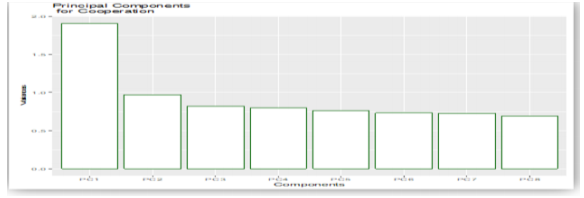
Figure 1. Principal components for strategic alliances to support R&D activities Source: Own elaboration.
Within this identified factor (PC1), the variables presented an element called load or weight that represents the contribution related to the variance within the same factor, the weights of each variables are shown below.
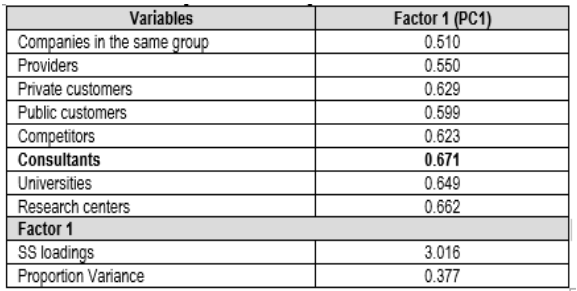
Source: Own elaboration
Among all these, the factor (consultants) allowed us to explain 37.7% of the variance observed in all the associated variables. The Chi Square test showed that 1 factor is sufficient; the Chi Square Statistic Value is 752.1 on 20 degrees of freedom and the P-Value is 2.14e-146.
Moderating effect
The variables explaining moderation of the research effect were grouped in 20 categories in table 2.
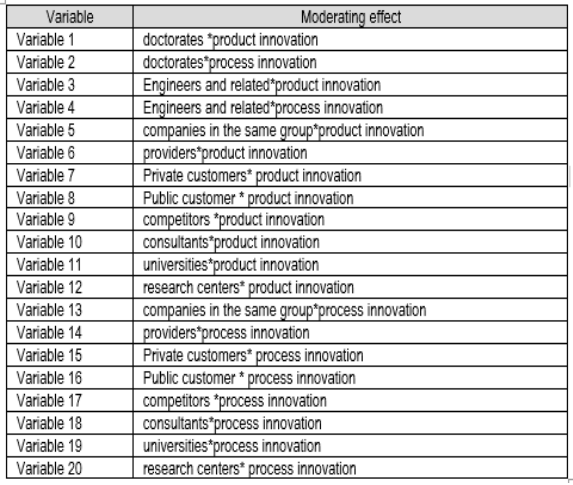
Source: Own elaboration.
For the analysis of variables of the moderating effect (20 in total), six factors were found like figure 2 shows the values that led to their selection.
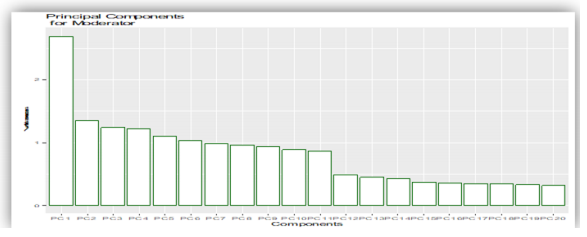
Figure 2. Main components for moderating effect.
Source: Own elaboration.
The contribution of the variables of the six selected factors was described by the weight matrix shown table 3 below
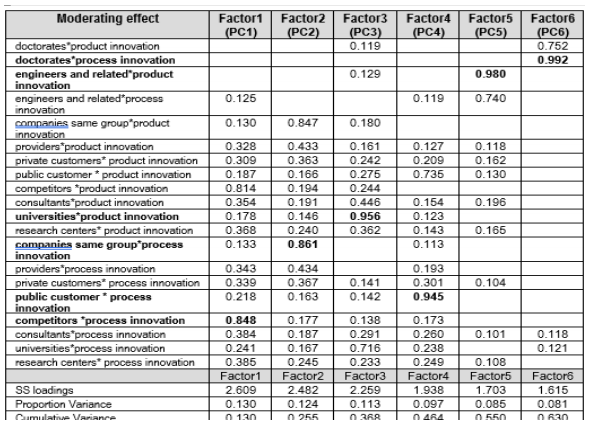
Source: Own elaboration.
As noted, it is possible to define each factor in Table 3 as follows:
-
Factor (PC1): Describes the moderating effect of competitors with process innovation.
-
Factor (PC2): Describes the moderating effect of companies in the same group with process innovation
-
Factor (PC3): Describes the moderating effect of cooperation with universities with product innovation.
-
Factor (PC4): It refers to the moderating effect of cooperation with public customer with innovation.
-
Factor (PC5): Describes the moderating effect of Engineers with product innovation.
-
Factor (PC6): Refers to the moderating effect of Ph. D. with process innovation.
The total proportion of the variance explained through the six factors is 63.0%, where the Chi Square test shows that 6 factors are sufficient and de Chi Square Statistic Value is 25307.93 on 85 degrees of freedom and the P-Value is 0
Other variable
For the variables product innovation, process innovation, internal innovation expenses, external innovation expenditures, doctorate and engineers, the factorial analysis was performed using the principal components method where 2 relevant factors were found. The Factor 1 (PC1) explains the Internal Innovation Expense and Factor 2 (PC2) the Product Innovation as shown in figure 3..
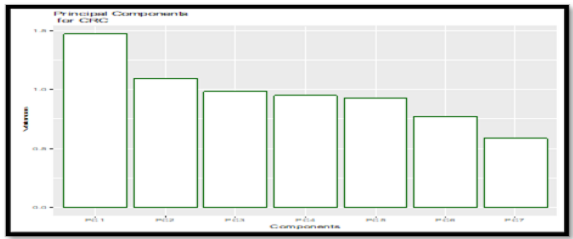
Figure 3. Main components for other variables.
Source: Own elaboration.
The contribution of the variables to the two selected factors is described by the weight matrix in Table 4.
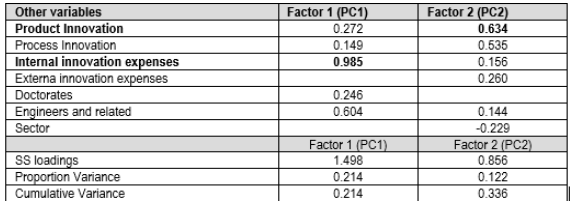
Source: Own elaboration
The cumulative proportion of the variance explained by the factors is 33.6% and the Chi Square Test shows that 2 factors are sufficient. The Chi Square Statistic Value is 110.14 on 8 degrees of freedom and he P-Value is 3.56e-20.
Proportional Hazards Regression Model - Regression COX.
For this study, data were limited because not have information on the survival length for those companies that continued to be active after our period of analysis ended. Therefore, used a proportional hazard model to assess the survival probabilities of these companies and Cox regression model was proposed to analyze companies’ survival and the Breslow method to estimate the functionality of the model (Velu, 2015), results of estimating the coefficients of the model can see in table 5.
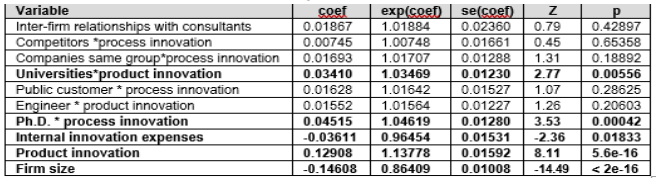
Source: Own elaboration.
At this point it is necessary to test the consistence model. Results are shown below:
-
Concordance = 0.583 (se = 0.005)
-
Likelihood ratio test = 330.7 on 10 df, p=<2e-16
-
Wald test = 322.4 on 10 df, p=<2e-16
-
Score (logrank) test = 321.4 on 10 df, p=<2e-16
The P-Value for all three overall tests are significant, indicating that the model it is valid. These tests evaluate the omnibus null hypothesis that all betas (β) are 0, with a level of significance α = 0.05, the following results were obtained. Firstly, it was demonstrated that product innovation positively favors business survival and that internal innovation expenses affect negatively the survival of companies, results are consistent with research done that concludes that companies with substantial product innovation are less likely to fail, because this type of innovation increases the company’s ability to create new business needed to improve company performance (Wagner and Cockburn, 2010; Cefis and Marsili, 2012; Slater, et al., 2014). On the other hand, internal innovation expenses also affect negatively the survival of companies due to the low economic resources of many companies to promote R&D activities necessary to develop new products required for companies´ survival (Fontana and Nesta, 2009; Paunov, 2012).
Likewise, it was demonstrated that company size has negative effects on survivability, which suggests that changes in company size reduces survival probability. Proving, for example, that when a company goes from small to medium or medium to large, it is more likely to close down, such as Giovannetti, et al. (2011); Stocker (2019) research, who concludes that the size effect is not uniform and may be nonlinear.
Secondly, in relation to the moderating effects, it was shown that the positive influence of product innovation on survival increases when companies maintain cooperation agreements with universities. This is because relationships with universities allow access to specific scientific knowledge, technical teams (such as researchers) or new and sophisticated technological options, which favor the development and innovation of products necessary to promote business survival (Frenz and Ietto-Gillies, 2009).
Likewise, the results show that there is a positive influence of process innovation on business survival when organizations have employees fully committed to R&D activities with a doctorate degree. Since these employees have the required knowledge and skills for the planning, development and coordination of many of the innovations to be done efficiently and effectively (Heavey and Simsek, 2013; Sauermann and Cohen, 2008).
On the other hand, Figure 4 shows the probability of survival of companies in function of time. It is observed that the greater the age, the greater is the probability of survival. Companies with 100 or more years old were excluded from the chart, since that from this point on, the curve behaves asymptotically in the upper axis of the probability and younger companies with less than 10 years of age show a low probability of survival.
From this age on, an accelerated growth is observed in the survival curve and after 50 years, the probability company of survival is close to 90% (figure 4). For example, Mata, et al. (1994) argue that exit rates are expected to decrease as companies mature, because the learning curve may take several years, leading to expect much higher exit rates for a particular cohort in the first years of its life than for older cohorts also operating in the same market at the same time period.
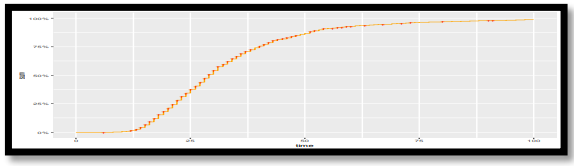
Figure 4: Company survival likelihood according to time.
Source: Own elaboration.
CONCLUSIONS
Numerous studies have analyzed the different factors that influence the survival of companies, where the innovation is more significant because it is one of the most important determinants in company survival, but the lack of consensus in the literature not allowed to investigate deeper the effect of innovation on company survival. Also, according to a knowledge-based view (KBV), companies cannot innovate without acquiring new knowledge with your employees, so, the training, professional training level of employees and strategic alliances are the most important factors to acquire knowledge necessary to innovate, aspects that were validated in this research. With respect to the training level of employees, the effect is undeniable with high training level of R&D employees on company survival, the same as respect to strategic alliances collaboration with the effect of strategic alliances that support R&D activities.
Therefore, this paper demonstrated that product innovation favors the survival of companies which is in accordance with previous studies claiming that companies that innovate through the creation of new products will have a greater market share and will grow faster than those that do not. This is mainly due to the fact that the R&D activities allow companies to develop products that satisfy a need not covered by the market, providing a clear competitive edge over time with more productivity and competitiveness.
On the other hand, it was shown that product innovation will increase a company’s survival when it maintains a strong strategic alliance, particularly with universities, who are they strategic partners for access to various key resources for innovation is possible such as researchers. Access to professionals with high scientific knowledge, technical equipment or new technologies favor the development of new products, with the advantage that relationship does not imply any type of commercial risk since there is a high degree of confidence since universities’ interests are to develop new research products supporting continuous improvement processes in companies.
In the same way, it was demonstrated that process innovation favors survival when companies have doctorate degree employees committed to R&D activities, this is due to their great ability to generate innovative solutions to arising problems in production processes. These findings are consistent with other research which are described in the theoretical framework that demonstrated that the level of employee training contributes to better company performance and survival because they are who really develop and make use of new technologies, creating new products and improving processes.
In contrast, it was shown that internal innovation costs have a negative effect on survivability, since theycan generate liquidity issues and potential market withdrawal, upon inability to meet financial obligations or targets. Therefore, some entrepreneurs access external capital to develop R&D activities in order to reduce the risks associated with internal investment by sharing possible expenses with external investors, banks, financial institutions and resources of universities and government for research.
Similarly, changes in company size reduce survival probability becoming a critical time period, because these changes require improvements in the administrative and operational processes, reflected by the lack of adaptability of many managers regarding the market and unknown conditions that not allow companies to maintain its competitive edge and survive in hard times. It was also demonstrated that companies with greater maturity show the greater probability of survival, because they have greater market consolidation along with extensive experience allowing them to face the day to day circumstances.
The findings in this study have important practical implications at the business level in any type of organization, especially in companies that need to create strategies to innovate and survive, such as SMEs, so creating management policies to appropriate new knowledge and formalize strategic alliances decrease. market risks and allow you to maintain a competitive advantage. Therefore, it is necessary to involve more employees with Ph.D. and focus on R&D, due to its greater capacity to generate and implement creative solutions to problems that demand data analysis and investigative processes with an innovative attitude, demonstrable fact that the most innovative companies in the world invest more in hiring and training of high level in its employees, achieving greater chances of success and survival.
In this sense, invest in hiring Ph.D. It is one of the best investments for companies, as demonstrated by the United States, which is one of the main generators of new scientific knowledge, given that by 2016, close to 2 million full-time workers were researchers associated with companies and innovation generators. The ideal for companies should be to achieve levels close to 1% of their workforce to be in a position to follow the path marked by countries such as Denmark, Iceland, Norway, France or Germany.
Finally, the contribution more important to the literature of this type studies is to build new concepts in regards to the factors that determine company’s survival based on the knowledge-based view KBV, even if the results are conditioned by the source and amount of information used limited to the years taken into consideration in the study and the approach used in measuring variables. That is why, it is recommended as future lines of research studies that can cover a greater number of years of study to companies in different environments and market conditions, especially in Latin American countries where there is a high mortality rate of companies and a few levels of innovation such as hiring and staff with doctoral training.
BIODATA
Youseline GARAVITO HERNÁNDEZ : Ph. D in Business Administration, Complutense University (Madrid, Spain); MSc. in Business Administration, Complutense University (Madrid, Spain); Industrial Engineering, Industrial University of Santander, UIS (Bucaramanga, Colombia), Research professor in business strategy, innovation and business creation in Research and Development University, UDI.
Carlos Alfonso MANTILLA DUARTE : Ph. D (c) in Math and Applied Statistics, University of Granada (Granada, Spain), MSc. in Applied Statistics, University of Granada (Granada, Spain); Specialist in Statistics, Industrial University of Santander, UIS (Bucaramanga, Colombia); Economist, Industrial University of Santander, UIS (Bucaramanga, Colombia), research professor in applied statistics, multivariate statistics, econometrics, big data, data mining and structural complexity and outliers in spatio-temporal process in Industrial University of Santander, UIS.
Javier Francisco RUEDA GALVIS: Ph.D. in Business Administration Antonio de Nebrija University (Madrid, Spain), Magister Financial Sciences Central University (Bogotá, Colombia), Professional Business Administrator Jorge Tadeo Lozano University (Bogotá, Colombia), with 25 years like research professor in Administrative, Economic and Accounting Sciences Faculties at Undergraduate and Postgraduate level in topics Global Organization Environment, Business Plan, Strategic Planning & Direction, Management of Family Business, Innovation, Quality Management and Social Responsibility and others. Research Professor of Research and Development University– UDI.
Johanna Marcela URIBE BERMUDEZ : Specialist in Administration of Educational Informatics, Santander University (Bucaramanga, Colombia); Specialist in Occupational health and safety, Research and Development University, UDI (Bucaramanga, Colombia); Industrial Engineering, Bolivarian Pontifical University, UPB (Bucaramanga, Colombia), university professor with more than 15 years of experience in consulting companies.
BIBLIOGRAPHY
ABDULSALEH, A. M., and WORTHINGTON, A. C. (2013). Small and medium-sized enterprises financing: A review of literature. International Journal of Business and Management, 8(14), 36–54.
Acheampong, G., and Hinson, R. E. (2019). Benefitting from alter resources: network diffusion and SME survival. Journal of Small Business and Entrepreneurship, 31(2), 141–158.
ACS, Z., and PRESTON, L. (1997). Small and medium-sized enterprises, technology, and globalization: Introduction to a special issue on small and medium-sized enterprises in the global economy. Small Business Economics, 9(1), 1–6.
ACS, Z., ARMINGTON, C., and ZHANG, T. (2007). The determinants of new-firm survival across regional economies: The role of human capital stock and knowledge spillover. Papers in Regional Science, 86(3), 367– 391.
AMBURGEY, T. L., KELLY, D., and BARNETT, W. P. (1993). Resetting the clock: The dynamics of organizational change and failure. Administrative Science Quarterly, 38(1), 51–73.
ARTZ, K., NORMAN, P., HATFIELD, D., and CARDINAL, L. (2010). A longitudinal study of the impact of R&D, patents, and product innovation on firm performance. Journal of Product Innovation Management, 27(5), 725– 740.
ARVANITIS, S., KUBLI, U., and WOERTER, M. (2008). University-industry knowledge and technology transfer in Switzerland: What university scientists think about cooperation with private enterprises. Research Policy, 37(10), 1865–1883.
AZAGRA-CARO, J. M., ARCHONTAKIS, F., GUTIÉRREZ-GARCIA, A., and FERNÁNDEZ-DE-LUCIO, I.(2006). Faculty support for the objectives of university–industry relations versus degree of R&D cooperation: The importance of regional absorptive capacity. Research Policy, 35(1), 37–55.
BANBURY, C. M., and MITCHELL, W. (1995). The effects of introducing important incremental innovation on market share and business survival. Strategic Management Journal, 16(S1), 161–182.
BANTEL, K., and JACKSON, S. (1989). Top management and innovations in banking: Does the composition of the top team make a difference? Strategic Management Journal, 10(S1), 107–124.
BATES, T. (1995). A comparison of franchise and independent small business survival rates. Small Business Economics, 7(5), 377–388.
BAUM, J. and OLIVER, C. (1991). Institutional linkages and organizational mortality. Administrative Science Quarterly, 36, 187–218.
BELDERBOS, R., CARREE, M., LOKSHIN, B., and SASTRE, J. F. (2015). Inter-temporal patterns of R&D collaboration and innovative performance. The Journal of Technology Transfer, 40(1), 123–137.
BERGER, A. N., and UDELL, G. F. (1998). The Economics of Small Business Finance: The Roles of Private Equity and Debt Markets in the Financial Growth Cycle. Journal of Banking and Finance, 22(6–8), 613–673.
BORING, P. (2015). The effects of firms´ R&D and innovation activities on their survival: a completing risks analysis. Empirical Economics, 49(3), 1045–1069.
BOX, M. (2008). The death of firms: Exploring the effects of environment and birth cohort on firm survival in Sweden. Small Business Economics, 31(4), 379–393.
BOYER, T., and BLAZY, R. (2014). Born to be alive? The survival of innovative and non-innovative French micro-start-ups. Small Business Economics, 42(4), 669–683.
BRUDERL, J., PREISENDORFER, P., and ZIEGLER, R. (1992). Survival chances of newly founded business organizations. American Sociological Review, 57, 227–242.
BUDDELMEYER, H., JENSEN, P., and WEBSTER, E. (2010). Innovation and the determinants of company survival. Oxford Economic Papers, 62(2), 261–285.
CABRER-BORRÁS, B., and BELDA, P. R. (2018). Survival of entrepreneurship in Spain. Small Business Economics, 51(1), 265-278.
CASSIMAN, B., and VEUGELERS, R. (2002). R&D cooperation and spillovers: some empirical evidence from Belgium. American Economic Review, 92(4), 1169–1184.
CASTAÑEDA-IBARRA, J. (2013). Confort empresarial, zona de riesgo. Una visión desde el empresario mexicano. Facultad de Filosofía y Letras, Universidad de Navarra.
CAVES, R. (1998). Industrial Organization and new findings on the turnover and mobility of firms. Journal of Economic Literature, 36(4), 1947–1982.
CEFIS, E., and MARSILI, O. (2006). Survivor: The role of innovation in firm´s survival. Research Policy, 35(5), 626–641.
CEFIS, E., and MARSILI, O. (2012). Going, going, gone. Exit forms and the innovative capabilities of firms. Research Policy, 41(5), 795–807.
COAD, A., and GUENTHER, C. (2013). Diversification patterns and survival as firms mature. Small Business Economics, 41(3), 633–649.
COLEMAN, S., COTEI, C., and FARHAT, J. (2013). A resource-based view of new firm survival: new perspectives on the role of industry and exit route. Journal of Developmental Entrepreneurship, 18(1), 1350002.
COLOMBELLI, A., and VONTUNZELMANN, N. (2011). The persistence of innovation and path dependence. Handbook on the Economic Complexity of Technological Change.
COLOMBELLI, A., KRAFFT, J., and QUATRARO, F. (2013). Properties of knowledge base and firm survival: Evidence from a sample of French manufacturing firms. Technological Forecasting and Social Change, 80(8), 1469–1483.
CONFECÁMARAS - Red de cámaras de comercio de Colombia. (2018). Determinantes de la supervivencia empresarial en Colombia, cuadernos de análisis económico. from http://www.confecamaras.org.co/phocadownload/Cuadernos_de_analisis_economico/Cuaderno_de_Anаlisi s_Economico_N_14.pdf
COOPER, D. (1986). The role of incubator organizations in the founding of growth-oriented firms. Journal of Business Venturing, 1(1), 75–86.
DATTA, A., MUKHERJEE, L., and JESSUP, L. (2015). Understanding commercialization of technological innovation: taking stock and moving forward. R&D Management, 45(3), 215–249.
DECAROLIS, D. M., and DEEDS, D. L. (1999). The impact of stocks and flows of organizational knowledge on firm performance: and empirical investigation of the biotechnology industry. Strategic Management Journal, 20(10), 953–968.
DOH, S., and KIM, B. (2014). Government support for SME innovations in the regional industries: The case of government financial support program in South Korea. Research Policy, 43(9), 1557–1569.
DONATE, M., and GUADAMILLAS, F. (2011). Organizational factors to support knowledge management and innovation. Journal of Knowledge Management, 15(6), 890–914.
DYKE, L., FISHER, E., and REUBER, A. (1992). An inter-industry examination of the impact of owner experience on firm performance. Journal of Small Business Management, 30(4), 72–87.
EJERMO, O., and XIAO, J. (2014). Entrepreneurship and survival over the business cycle: how do new technology-based firms differ? Small Business Economics, 43(2), 411–426.
ESTEVE-PÉREZ, S., and MAÑEZ-CASTILLEJO, J. (2008). The resource-based theory of the firm and firm survival. Small Business Economics, 30(3), 231–249.
EUROPEAN UNION. (2016). Eurostat regional yearbook 2016. From https://portal.issn.org/resource/ISSN/2363-1716.
FAEMS, D., VAN LOOY, B., and DEBACKERE, K. (2005). Interorganizational collaboration and innovation: Toward a portfolio approach. Journal of Product Innovation Management, 22(3), 238–250.
FONTANA, R., and NESTA, L. 2009. Product innovation and survival in a high-tech industry. Review of Industrial Organization 34(4), 287-306.
FRENZ, M., and IETTO-GILLIES, G. (2009). The impact on innovation performance of different sources of knowledge: Evidence from the UK Community Innovation Survey. Research Policy, 38(7), 1125–1135.
GANOTAKIS, P. (2012). Founders´ human capital and the performance of UK new technology-based firms. Small Business Economics, 39(2), 495–515.
GÉMAR, G., MONICHE, L., and MORALES, A. (2016). Survival analysis of the Spanish hotel industry. Tourism Management, 54, 428–438.
GEROSKI, P. (1995). What do we know about entry? International Journal of Industrial Organization, 13(4), 421–440.
GIOVANNETTI, G., RICCHIUTI, G., and VELUCCHI, M. (2011). Size, innovation and internationalization: a survival analysis of Italian firms. Applied Economics, 43(12), 1511–1520.
GONZÁLEZ, G. (2014). Efectos de la cooperación sobre el desarrollo de innovaciones organizativas. Economía Industrial, 391, 77–86.
HAGEDOORN, J., and SCHAKENRAAD, J. (1994). The effect of strategic technology alliances on company performance. Strategic Management Journal, 15(4), 291–309.
HAUSMAN, A. (2005). Innovativeness among small businesses: Theory and propositions for future research. Industrial Marketing Management, 34(8), 773–782.
HAYTON, J. (2005). Competing in the new economy: the effect of intellectual capital on corporate entrepreneurship in high-technology new ventures. R&D Management, 35(2), 137–155.
HAYTON, J., and KELLEY, D. (2006). A competency-based framework for promoting corporate entrepreneurship. Human Resource Management, 45(3), 407–428.
HE, C., and YANG, R. (2015). Determinants of firm failure: empirical evidence from China. Growth and Change, 47(1), 72–92.
HEAVEY, C., and SIMSEK, Z. (2013). Top management compositional effects on corporate entrepreneurship: The moderating role of perceived technological uncertainty. Journal of Product Innovation Management, 30(5), 837-855. doi: 10.1111/jpim.12033
HELMERS, C., and ROGERS, M. (2010). Innovation and the survival of new firms in the UK. Review of Industrial Organization, 36(3), 227–248.
HYYTINEN, A., PAJARINEN, M., and ROUVINEN, P. (2015). Does innovativeness reduce startup survival rates? Journal of Business Venturing, 30(4), 564–581.
JENSEN, P., WEBSTER, E., and BUDDELMEYER, H. (2008). Innovation, technological conditions and new firm survival. Economic Record, 84(267), 434–448.
KANGASHARJU, A., and PEKKALA, S. (2002). The role of training in self-employment success in Finland. Growth and Change, 33(2), 216–237.
KEASEY, K., and WATSON, R. (1991). The state of the art of small business failure prediction: Achievements and prognosis. International Small Business Journal, 9(4), 11–29.
KIM, W., and MAUBOURGNE, R. (2005). Blue ocean strategy. California Management Review, 47(3), 105– 121.
KOCAK, A., MORRIS, M., BUTTAR, H., and CIFCI, S. (2010). Entrepreneurial exit and reentry of entrepreneurs: Exploratory study of Turkish entrepreneurs. Journal of Developmental Entrepreneurship, 15(4), 439–459.
LAGER, T. (2002). Product and process development intensity in process industry: A conceptual and empirical analysis of the allocation of company resources for the development of process technology. International Journal of Innovation Management, 6(2), 105–130.
LOAN, N. T. (2018). The Effect of Internal and External Factors on the Business Success of Agri-based Exporting Small and Medium Scale Enterprises in Thanh Hoa Province, Vietnam. Journal of Finance and Economics, 6(3), 87–95.
LUNDVALL, B. and JOHNSON, B. (1994). The learning economy. Journal of Industry Studies, 1(2), 23–42. MAIETTA, O. W. (2015). Determinants of university–firm R&D collaboration and its impact on innovation: A perspective from a low-tech industry. Research Policy, 44(7), 1341–1359.
MATA, J., PORTUGAL, P., and GUIMARAES, P. (1995). The survival of new plants: Start-up conditions and post-entry evolution. International Journal of Industrial Organization, 13(4), 459–481.
MAZZUCATO, M. (2013). Financing innovation: creative destruction vs. destructive creation. Industrial and Corporate Change, 22(4), 851–867.
MCGUIRK, H., LENIHAN, H., and HART, M. (2015). Measuring the impact of innovative human capital on small firms’ propensity to innovate. Research Policy, 44(4), 965–976.
MEYSKENS, M., and CARSRUD, A. (2013). Nascent green-technology ventures: a study assessing the role of partnership diversity in firm success. Small Business Economics, 40(3), 739–759.
MITCHELL, W., and SINGH, K. (1996). Survival of businesses using collaborative relationships to commercialize complex goods. Strategic Management Journal, 17(3), 169–196.
NIETO, M., and SANTAMARIA, L. (2007). The importance of diverse collaborative networks for the nevelty of product innovation. Technovation, 27(6), 367–377.
ORTIZ-VILLAJOS, J. M., and SOTOCA, S. (2018). Innovation and business survival: A long-term approach. Research Policy, 47(8), 1418-1436.
OSLO MANUAL. (2018). Guidelines for Collecting, Reporting and Using Data on Innovation.Madrid, España: OCDE - Eurostat.
OSTERGAARD, C., TIMMERMANS, B., and KRISTINSSON, K. (2011). Does a different view create something new? The effect of employee diversity on innovation. Research Policy, 40(3), 500–509.
PAUNOV, C. (2012). The global crisis and firms’ investments innovation. Research Policy. 41(1), 24–35.
PEÑA, I. (2002). Intellectual capital and business start-up success. Journal of Intellectual Capital, 3(2), 180–198.
PÉREZ-LUÑO, A., CABELLO, C., CARMONA, A., and CUEVAS, G. (2011). How social capital and knowledge affect innovation. Journal of Business Research, 64(2), 1369–1376.
QUERO, L. (2008). Estrategias competitivas: Factor clave de desarrollo. Revista Negotium, (10), 36–49.
RENSKI, H. (2011). External economies of localization, urbanization and industrial diversity and new firm survival. Papers in Regional Science, 90(3), 473–502.
ROMERO, A. M., MONTORO, Á., y GARAVITO, Y. (2017). El efecto de la diversidad de género y el nivel educativo en la innovación. Revista de Administração de Empresas, 57(2), 123–134.
RUEDA, J. F. (2013). La innovación como eje de desarrollo empresarial. Revista Gestión & Sociedad. 6(1), 139-146.
RUEDA, J. F. y RUEDA, M. A. (2017). Modelo econométrico de gestión exitosa para la empresa familiar colombiana. Revista Finanzas y Política Económica. 9(2), 319-344.
SAMUELSSON, M., and DAVIDSSON, P. (2009). Does venture opportunity variation matter? Investigating systematic process differences between innovative and imitative new ventures. Small Business Economics, 33(2), 229–255.
SANTORO, M. D., BIERLY, P. E., and GOPALAKRISHNAN, S. (2007). Organizational learning from external sources: new issues and performance implications. International Journal of Technology Management, 38(1– 2), 1–10.
SAUERMANN, H., and COHEN, W. (2008). What makes them tick? Employee motives and firm innovation. National Bureau of Economic Research, Working Paper No. 14443.
SCHERER, F., and HARHOFF, D. (2000). Technology policy for a world of skew-distributed outcomes. Research Policy, 29((4-5)), 559–566.
SHARIF, N., and HUANG, C. (2012). Innovation strategy, firm survival and relocation: the case of Hong Kong- owned manufacturing in Guangdong Providence, China. Research Policy, 41(1), 69–78.
SHIPTON, H., FAY, D., WEST, M., PATTERSON, M., and BIRDI, K. (2005). Managing people to promote innovation. Creativity and Innovation Management, 14(2), 118–128.
SIMONEN, J., and MCCANN, P. (2008). Innovation, R&D cooperation and labor recruitment: evidence from Finland. Small Business Economics, 31(2), 181–194.
SLAPER, T., HART, N., HALL, T., and THOMPSON, M. (2011). The index of innovation: a new tool for regional analysis. Economic Development Quarterly, 25(1), 36–53.
SLATER, S. F., MOHR, J. J., and SENGUPTA, S. (2014). Radical product innovation capability: Literature review, synthesis, and illustrative research propositions. Journal of Product Innovation Management 31(3), 552-566.
STEARNS, T. M., CARTER, N. M., REYNOLDS, P. D., and WILLIAMS, M. L. (1995). New firm survival:industry, strategy, and location. Journal of Business Venturing, 10(1), 23–42.
STOCKER, M. (2019). Survival, growth, and performance of Hungarian international new ventures. Society and Economy, 41(1), 47–64. https://doi.org/10.1556/204.2019.41.1.4
TAVASSOLI, S., and KARLSSON, C. (2015). Persistence of various types of innovation analyzed and explained. Research Policy, 44(10), 1887–1901.
TENG, B. (2007). Corporate entrepreneurship activities through strategic alliances: A resource-based approach toward competitive advantage. Journal of Management Studies, 44(1), 119–142.
THORNHILL, S., and AMKIT, R. (2003). Learning about failure: Bankruptcy, firm age and the resource-based view. Organization Science, 14(5), 497–509.
TSAI, K. (2009). Collaborative networks and product innovation performance: Toward a contingency perspective. Research Policy, 38(5), 765–778.
VAN DER VEGT, G., and JANSSEN, O. (2003). Joint impact of interdependence and group diversity on innovation. Journal of Management, 29(5), 729–751.
VELU, C. (2015). Business model innovation and third-party alliance on the survival of new firms. Technovation, 35, 1–11.
WAGNER, S., and COCKBUM, I. (2010). Patents and the survival of Internet-related IPOs. Research Policy, 39(2), 214–228.
XIA, T., and DIMOV, D. (2019). Alliances and Survival of New Biopharmaceutical Ventures in the Wake of the Global Financial Crisis. Journal of Small Business Management, 57(2), 362–385.
YLI-RENKO, H., AUTIO, E., and SAPIENZA, H. J. (2001). Social capital, knowledge acquisition, and knowledge exploitation in young technology-based firms. Strategic Management Journal, 22(6), 587–613.
ZAHRA, S. A., NEUBAUM, D. O., and HUSE, M. (2000). Entrepreneurship in medium-size companies: Exploring the effects of ownership and governance systems. Journal of Management, 26(5), 947–976.
ZHANG, D., ZHENG, W., and NING, L. (2018). ¿Does innovation facilitate firm survival? Evidence from Chinese high-tech firms. Economic Modelling. https://doi.org/https://doi.org/10.1016/j.econmod.2018.07.030
ZHANG, M., and MOHNEN, P. (2013). Innovation and survival of new firms in chinese manufacturing, 2000- 2006. In: United Nations University, Maastrecht Economic and Social Research and Training Centre on Innovation and Technology Working Paper. No 57.
ZHAO, C., and BURT, R. S. (2018). A note on business survival and social network. Management and Organization Review, 14(2), 377–394. https://doi.org/10.1017/mor.2018.12