Artículos
Development of Student Musician's Methodological Competence in Practice-Oriented University Environment
Desarrollo de la competencia metodológica del estudiante músico en un entorno universitario orientado a la práctica
 Elena Aleksandrovna DYGANOVA dirigerdea@mail.ru
Zilia Muhtarovna YAVGILDINA zilia.javgi@gmail.com
Elena Aleksandrovna DYGANOVA dirigerdea@mail.ru
Zilia Muhtarovna YAVGILDINA zilia.javgi@gmail.com
Development of Student Musician's Methodological Competence in Practice-Oriented University Environment
Utopía y Praxis Latinoamericana, vol. 25, no. Esp.5, pp. 113-125, 2020
Universidad del Zulia
Received: 24 June 2020
Accepted: 25 July 2020
Abstract: The article reflects the experience of solving the issue of developing and implementing efficient pedagogical means into higher education practice. The goal of the study is the academic justification of the process of methodological competence formation in student musicians within a practice-oriented university environment. The study has shown that certain pedagogical conditions are an efficient means of developing the future music teacher's methodological competence in the practice-oriented university environment according to federal state requirements for such a specialist's level of education.
Keywords: Music education, music pedagogy, music teacher, competence.
Resumen: El artículo refleja la experiencia de resolver el problema de desarrollar e implementar medios pedagógicos eficientes en la práctica de la educación superior. El objetivo del estudio es la justificación académica del proceso de formación de competencia metodológica en músicos estudiantes dentro de un ambiente universitario orientado a la práctica. El estudio ha demostrado que ciertas condiciones pedagógicas son un medio eficiente para desarrollar la competencia metodológica del futuro profesor de música en el entorno universitario orientado a la práctica de acuerdo con los requisitos del estado federal para el nivel de educación de dicho especialista.
Palabras clave: Educación musical, pedagogía musical, profesor de música, competencia..
INTRODUCTION
In recent decades, the changes in the Russian social and economic live have caused a fundamental review of the goals of education and the modernization of the entire system. In Russia, specialist training in the field of music education was based on the deep-rooted traditions of music pedagogy. The content of professional training was determined by the personal and activity approach which was manifested in the significant amount of personal lessons with the pedagogue (in piano, singing and conducting), balanced combination of group classes (lectures, seminars, practical lessons) on social and humanities-related, psychological and pedagogical, musical theoretical, musical performing subjects, pedagogical practice and the student musician's independent work. The results of music teachers' training and their level of professional competence fit the times, and music teachers' professional training was difficult and cost-intensive.
The change in sociocultural priorities and education paradigms, the implementation of the system of educational and professional standards, scientific and technological advancements, optimization of music pedagogical education costs and other changes resulted in the need to modernize the training system in the higher education of future music teachers.
Today, Russian professional education is in difficult conditions of a prolonged "reset" of the process of training music pedagogues, in which traditional approaches are replaced by innovative ones while the efficiency of the latter is not always convincing. As a result of transformations, only in the last decade, there was a steady decline in the professional level of graduates with the exception of student musicians who have a sufficient level of self-education culture that allows for personal and professional growth (it is worth noting that there are only a few such specialists). The pedagogical community has faced a difficult task of reducing the imbalance between the real level of university graduates' professional competence and soon achieving the set social and professional requirements for a music teacher in the current conditions (Decree of the Ministry of Education and Science of the Russian Federation: 2018; Decree of the Ministry of Labor and Social Protection of the Russian Federation: 2013; Decree of the Ministry of Labor and Social Protection of the Russian Federation: 2018).
Modernization processes in modern higher education have affected only the "external" visible side of the restructuring of the university educational environment, namely, the redistribution of the academic load from classroom-based to extracurricular in the form of students' independent work and a significant reduction in hours devoted to performing and methodological training of a future music teacher. Currently, the education of music teachers at university for the Bachelor's degree 03/44/05 (the program "Pedagogical Education" with two specializations: Music and additional education) of full-time education demands student musicians to study the following modules for over five years: 1) Sociocultural foundations and information support of the education process, 2) Psychological and pedagogical foundations of professional activity, 3) Theories and technologies of professional activity, 4) Elective subjects, 5) Practice and research work (Kazanskii federalnyi universitet: n.d.).
"Preparing graduates for professional activity in line with the competency-based approach involvesexpanding the share of students' independent work, <...>, increasing the teachers' responsibility for developing the skills of such work, for stimulating students' professional growth and fostering their creative activity and initiative" (Zherebyatnikova: 2012). The peculiarity of the teacher’s modern professional activity lies in the fact that the purpose of the teacher’s activity is to introduce, support, accompany the student and foster the student's education.
At the same time, the essence of modernization, namely, updating the educational environment of the university by introducing practice-oriented and training-based forms of education, using efficient methods and modern educational technologies, creating a professionally-oriented educational environment, – turned out to be almost "not developed" or represented by individual cases of pedagogical initiative in higher musical pedagogical education.
The hypothesis of the study is the assumption that the formation of the student musician's methodological competence will be more efficient if: first, the content of conducting- and choir-related subjects is structured to build educational trajectories of methodological competence formation in student musicians; second, the interaction of subjects of education is organized in the formation of student musicians' methodological competence based on the pedagogue's personal example; third, the practice-oriented environment is created to develop student musicians' methodological experience.
The verification of the assumptions required to set and achieve the following goals of the study:
- 1. Identify the role of methodological competence in the professional training of the future music teacher, determine its structure, content and functions.
- 2. Provide a scientific and theoretical justification for the potential of conducting- and choir-related subjects from the perspective of efficient practice-oriented educational content in the aspect of the formation of the future music teacher's methodological competence.
- 3. Develop, scientifically justify the pedagogical conditions for the formation of the future music teacher's methodological competence in the practice-oriented university environment.
- 4. Conduct an experimental study on testing the pedagogical conditions that ensure the formation of the student musician's methodological competence.
METHODOLOGY
The study was conducted at the Institute of Philology and Intercultural Communication of the Kazan Federal University from 2014 to 2019. The study involved 98 undergraduate students of "Music pedagogical education".
The methodological basis of the study was the competence-based (Bondarevskaia: 2004; Khutorskoi: 2007) and environmental (Manuilov: 2008) approaches that allowed us to study the content of professional education of a music teacher and changes in the process of organizing the educational process. The theoretical background consisted of music and pedagogical works that included theories of the future music teacher's professional training and musical and creative development of the individual (Rohwer, Henry: 2004; Abdullin, Nikolaeva: 2011; Carrillo Aguilera, Vilar Monmany: 2010; Lennon, Reed: 2012; Chagorov: 2014; Kovalev et al.: 2016; Karkina et al.: 2017; Yavgildina et al.: 2019); the study of the challenges of conducting- and choir-related education (Kazatchkov: 1998; Zhivov: 2003; Varvarigou: 2009; Gribkova: 2010).
The study was carried out using a set of theoretical (problem statement, creation of hypothesis and research stages, analysis and synthesis, comparison, concretization, generalization) and empirical methods (pedagogical monitoring of student work results, conversations with students and teachers, student surveys aimed at identifying indicators of future music teachers' methodological competence, analysis and generalization of pedagogical experience, pedagogical experiment).
To assess the efficiency of the developed pedagogical conditions of developing the future music teacher's methodological competence and study its level, practical tasks were used at the establishing and control stages of the experiment. These tasks made it possible to diagnose the level of indicators of the cognitive and procedural criteria through expert assessment.
The implementation of pedagogical conditions in the university educational practice and verification of their efficiency required the organization of an experimental study according to the following program:
- 1. Development of a system of criteria and diagnostic tools for assessing the level of methodological competence of future music teachers;
- 2. Conducting the establishing stage of the experiment that determines the initial level of the future music teacher's methodological competence;
- 3. Organization of the formative stage – the implementation of pedagogical conditions aimed at increasing the level of the future music teacher's methodological competence in educational practice;
- 4. Implementation of the control phase of the experiment that determines the final level of the future music teacher's methodological competence.
RESULTS AND DISCUSSION
1. The role of methodological competence in the future music teacher's professional training.
By the object of labor, objective and means of professional activity, musical pedagogical activity is based on the possession of closely integrated pedagogical, musical performing, instructional, organizational, educational, research and methodological competences. It is worth noting that among the whole list methodological competence is key in professional competence since by possessing it, a music teacher can be successful in all other areas of professional activity.
Methodical competency is the integrated characteristic, set of certain specific characteristics that are shown in the implementation of competences (Loginova et al.: 2018). After content analysis, the scholars L. Mata and C. Dumitru (2010) provide the categories and subcategories of methodological competences: formulation of operational objectives, selection of contents, development of teaching strategies, assessment design strategy, design teaching.
The structure of the future music teacher's methodological competence is represented by cognitive procedural components. The cognitive component is fundamental; it consists of academic-theoretical foundations of the music education content, methods of teaching music subjects and musical and creative personal development, basics of developmental and personality psychology, the main needs and demands of society (The Law on Education, Federal State Educational Standard, Federal State Requirements, Concepts, etc.). The procedural component is modifiable; it is represented by a set of the following positions: methodological (technological) thinking, scientific thinking, assessment and analytical skills (identification, contrasting and comparison of parameters), skills of control and self-regulation of professional behavior in pedagogical, musical performing and creative activities, the skills of pedagogical control and diagnostics, creative independence and artistic will.
According to N. Ololube, methodological competencies could be defined as the procedures of doing something and having enough skill and knowledge to carry out the function. In addition, methodological competencies could further be defined based on their functional elements: to adapt to effective work methods; to analyze the task to be performed; to begin the process; to perform the task and to analyze one's procedures (Ololube: 2006).
Methodological competence is a complex system of a specialist's achievements that fulfills certain functions:
-
informative – the transmission of substantive and metasubstantive content of education;
-
communicative – the organization of educational and creative interaction of the subjects of education (student-student, student-teacher);
-
regulatory – the management of formation and development of special skills, creative abilities and personal traits of the subjects of education;
-
creative – the ability to select many solutions to particular pedagogical tasks; the ability to quickly react and choose the correct course of action outside scripted pedagogical situations;
-
reflective – the assessment of efficiency of one's own achievements on the education route and the results of music pedagogical self-education;
-
prognostic – the determination of prospects for further professional self-education and personal development.
2. The potential of conducting- and choir-related subjects in the aspect of developing the future music teacher's methodological competence.
Today, among all the substantive-procedural educational content of preparing a future music teacher at university in terms of the formation of methodological competence, the most optimal is the block of conducting- and choir-related subjects. Let us consider its educational potential.
First, the educational and professional repertoire is represented by the global vocal, choral and song heritage that is studied based on the pedagogical principles of scientificity and novelty of the educational content, the focus of the learning process on the comprehensive and harmonious development of the student’s personality, systematic and continuous education, fundamental and applied orientation (the connection of education and life).
Second, the content of conducting- and choir-related subjects has clear interdisciplinary connections with all subjects of the musical theoretical, psychological-pedagogical and musical performing cycle which allows one to use the possibilities of a comprehensive system of integrated content for professional training of student musicians in creating an actual practice-oriented educational environment.
Third, the contents of the professions of the choir conductor and music teacher are identical in their key points which allows one to build and implement a practice-oriented strategy for the training performing of future specialists and form student musicians' methodological competence in the main areas of professional activities: pedagogical, musical and, instructional, organizational, educational, research and methodological.
Fourth, student musicians study the main conducting- and choir-related subjects ("Choral class and practical work with a choir", "Choral conducting class and choir score reading") throughout the entire duration of study at university with an unchanged set of teachers which allows one to build a long-term educational strategy for the consistent formation of professional competences including methodological ones.
The implementation of the identified learning potential of conducting and choir-related subjects required the determination of pedagogical conditions that contributed to the achievement of the goal.
3. The pedagogical conditions for the methodological competence formation in student musicians within the practice-oriented university environment.
A set of pedagogical conditions was developed based on the theoretical analysis of literature relevant to the study, the research into the future music teachers' training process at the Institute of Philology and Intercultural Communication of the Kazan Federal University and the generalization of the many years of our own pedagogical experience.
The first pedagogical condition is the structuring of the content of conducting- and choir-related subjectsto build educational trajectories of methodological competence formation in student musicians.
The contents of conducting- and choir-related subjects should be "reformatted" and structured into five didactic components: musical theoretical, musical performing, technological, research and communicative- organizational (pedagogical). Such a structure of the contents of conducting- and choir-related subjects will make it possible to organize the educational process in line with the projective-technological approach and linearly program the educational trajectories of the student musician taking into account their pre-university education and personal-individual characteristics to form the methodological competence.
Let us present the characteristics of the didactic components.
The musical-theoretical component is aimed at equipping a student musician with: a) the theoretical knowledge in the field of music theory, music and choral literature, the history and theory of conducting and choir education and choir art and performance, choral studies, special terminology, theory and methodology of vocal choral work; b) the theoretical basis of the formation of the conducting technique; c) knowledge of artistic styles, movements and their refraction in the choral sound, etc.
The musical performing component should equip the student with a) the skills of performing vocal and choral compositions in different roles: soloist (performing a vocal composition to the accompanist’s play andthe soloist's own accompaniment), choir singer, choirmaster, choir conductor; b) the skills of modeling choral sound in various types of a student's cognitive and creative activities: playing the choral score on the piano, vocal performance of the parts of the choral sections, conducting the performance of the choral score on the piano by the accompanist, conducting the choir in concert.
The purpose of the technological component is to provide the student musician with the technological toolkit: a) technology and psychotechnology of choir singing (mastery of vocal skills and vocal choral technique, methods of mastering the choral repertoire in the rehearsal process, self-regulation skills during concert performances); b) the technology of conducting, types of conducting techniques; c) the pedagogical technologies of working with choir groups (methods of working on a school song, methods of choirmaster's work with a training choir group, methods of independent work on vocal and choral works).
The research component is focused on the student musician's research and methodological activities, namely: a) provision of methods for the development of analytical thinking and research activities; b) study of academic and pedagogical works and performing experience of prominent choir conductors, professional and methodological literature, choir-related literature and school song repertoire, audio and video materials on conducting and choral art; c) the study and testing of the methodological principles of working with choir collectives and working on the vocal choral repertoire; d) the musical theoretical and performing analysis of the vocal choral repertoire; e) the creation of methodological guidance papers on the songs of the school repertoire, on vocal choral works (Akbarova et al.: 2018).
The communicative-organizational (pedagogical) component is aimed at: a) the development of a student musician's skills of planning work with musical performing groups (statement of music, pedagogical and creative tasks); b) equipping the student with the experience of music and pedagogical interaction during the work with training choir groups; c) the formation of skills in independent management of the process of choir rehearsals and the implementation of plans related to the organization of all types of vocal choral work in a group from goal setting to the final result.
The student musician follows the learning trajectories on all the aspects of conducting and choral training with the pedagogue's support which determines the development of the second pedagogical condition – the organization of the pedagogical interaction in the formation of student musicians' methodological competence based on the pedagogue's personal example.
The complex process of forming the future music teacher's methodological competence is based on the educational and pedagogical student-teacher interaction, and the teacher's personal example is the most important component in this process. The foundation of the "pedagogical repertoire" is comprised of five main roles which, in our opinion, the teacher should perform for the teacher’s personal example to be a "standard" of professionalism and a goal for the student musician.
The first role is the teacher as a subject of the process of transferring music and pedagogical knowledge, forming professional competences and organizing this process. The second role is the teacher as a musician- researcher, an author of academic and academic-methodological literature, a participant in scientific conferences, symposia, seminars, competitions, the head of the research work of student musicians. The third role of the teacher is to organize practice-oriented activities of student musicians that involve the teacher creating actual professional or close to professional conditions and allowing students to put into practice the acquired knowledge and competences. The fourth role of the teacher is the subject of a systematic, targeted activity of the united academic teaching staff of music teachers, the subject of collective interaction aimed at achieving a common result. At present, the fifth role is beginning to take shape – the teacher as the subject of globalization and internationalization, the subject of international educational and scientific cooperation.
The training of a student-musician relates to including the teacher in all the student's key educational activities such as performing music, analytical research, organization and pedagogy, methodology and self- education. In the process of educational and pedagogical interaction, the teacher must: first, convey to the student their attitude to the musical art and profession; second, equip the student with professionalcompetences; third, identify, reveal and develop the student's inherent individual characteristics and personal- professional qualities.
The efficiency of the process depends on meeting the third pedagogical condition – the creation of a practice-oriented environment to develop student musicians' methodological experience.
For a student musician, the teacher's personality always remains the "standard" of professionalism and a goal. In view of this, the most remarkable example of the music teacher's methodological competence is the teacher's organization of the student musician's work on mastering the subject "Choral class and practical work with a choir". The content of this subject accumulates and actualizes the content of all subjects of the conducting-choral, musical-theoretical and musical-pedagogical cycle. Lessons in the choir class are held as choir rehearsals wherein the teacher acts as the head of the student choir and a consultant-organizer of the students' choirmaster work. The primary form of organizing the learning process is the "Workshop" technology aimed at demonstrating efficient teaching methods and technologies, sharing the teacher's (choir conductor's) music and pedagogical experience and professional skill through a demonstration with commentary. The student musician, in this case, acts as a choir singer and choirmaster. As a singer, the student builds up vocal choral and singing-auditory skills which will fulfill two functions in the future: personal mastery of vocal technique, the technology of training and developing a singing voice.
One should note that the student’s internal motivation for their own development contributes to thedevelopment of such necessary professional abilities and methodological competences as the development of the music teacher's methodical (technological) thinking, the formation of assessment and analytical skills, development of control and self-regulation skills, development of skills of pedagogical control and diagnostics; the formation of creative independence and artistic will. Working with the choir as a choirmaster, the student gains the following methodological experience: skills with the technology of working on a vocal choral composition, communication skills in the following spheres: visual, verbal, manual, pantomimic, volitional, auditory, musical and expressive.
The student’s practical work with the choir is not limited to the Choral class. Throughout study at university,students carry out vocal choral work while studying the subject "Choral conducting class and choir score reading" in the section "Work on a school song". In modern conditions of the university, students learn this subject in groups which allows one to create actual conditions for modeling specific educational, creative and pedagogical situations. Based on the requirements for the results of vocal choral activities of secondary school students as part of studying the curriculum of the subject "Music", musician students go through a full cycle of work with the song repertoire.
4. An experimental study on testing the pedagogical conditions that ensure the formation of the student musician's methodological competence.
The experimental work on the formation of the future music teacher's methodological competence was carried out at the Institute of Philology and Intercultural Communication of the Kazan Federal University. We conducted monitoring from 2014 to 2019. In total, 98 students – future music teachers were involved in the experiment. There were 50 students in the control group (CG) and 48 students in the experimental group (EG).
During the experimental study, we attempted to identify the trend of methodological competence formationin terms of the cognitive and procedural criteria. The content of the indicators is presented in Table 1
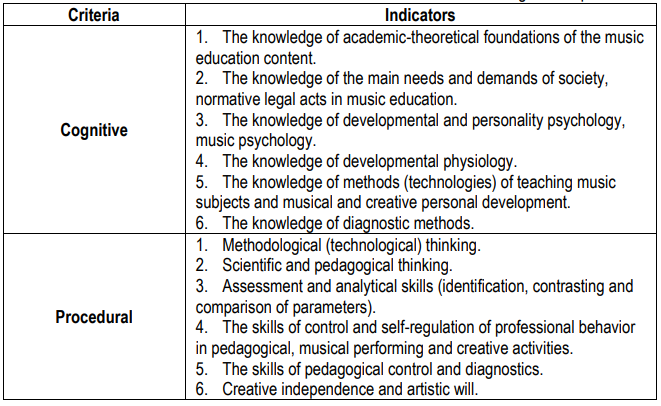
The collection of empirical data on the levels of the future music teacher's methodological competence was carried out through a set of methods. To identify the initial level of methodological competence formation, a survey was conducted to identify the degree of manifestation of the cognitive criterion indicators, and the manifestations of the procedural criterion indicators were determined based on the expert assessment of tasks ("Demonstration a fragment of a music lesson", "Annotation to a vocal choral work"). During the analysis of the results, the levels of methodological competence formation were identified (Table 2).
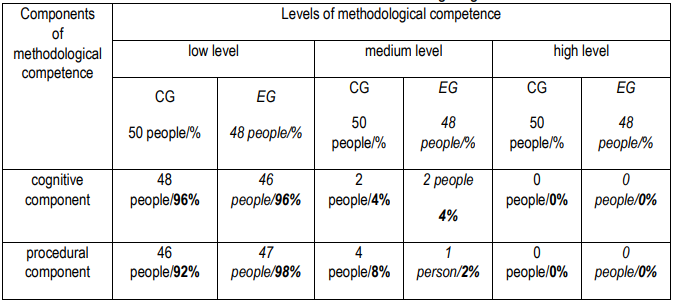
The obtained results allowed us to note the insufficient development of certain indicators: the knowledge of the main needs and demands of society, normative legal acts in music education, the knowledge of methods (technologies) of teaching music subjects and musical and creative personal development and the knowledge of diagnostic methods. A lot of students showed an insufficient level of methodological and academic pedagogical thinking, poor skills of control and self-regulation of professional behavior in pedagogical, musical performing and creative activities.
The data obtained became the starting point for the development, academic justification and implementation in the educational practice of educational conditions aimed at increasing the level of the future music teacher's methodological competence according to regulatory requirements.
In the formative stage of the pedagogical experiment, the organization of the educational process was based on the developed pedagogical conditions. During the implementation of the first condition for organizing the student musician's methodological competence formation, five educational trajectories were designed and implemented in educational practice according to the selected areas (Table 3).
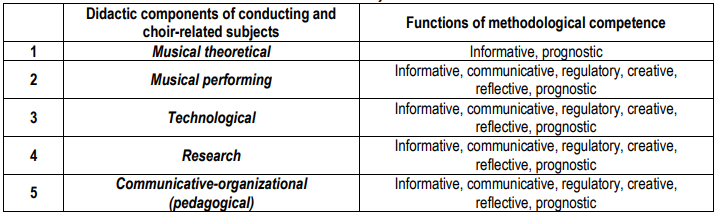
The organization of the methodological competence formation along five educational trajectories was carried out in theoretical and practical forms of student musicians' work. Each educational trajectory was based on the following algorithm: 1) setting the goal (in the description of the expected result), 2) recognition and acceptance of the criteria requirements for the result, 3) determination of the substantial amount of educational information and its concretization, 4) determination of stages and terms, 5) selection of forms and methods of work, 6) demonstration of results, 7) reflection.
The implementation of the second pedagogical condition allowed us to organize the pedagogical interaction between the teacher and the student musician in the gradual logic presented in Table 4.
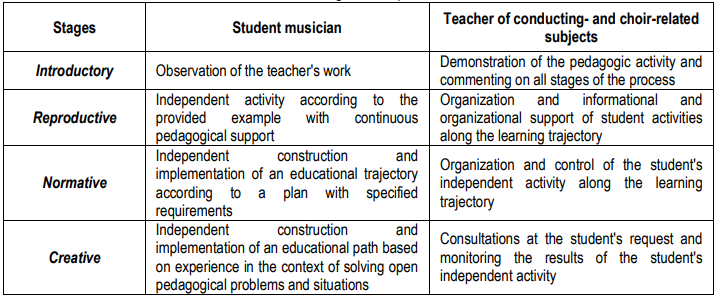
The fulfillment of the third condition allowed student musicians to study the content of conducting- and choir-related subjects in practice-oriented forms (Table 5) and accumulate the experience of methodological competence.
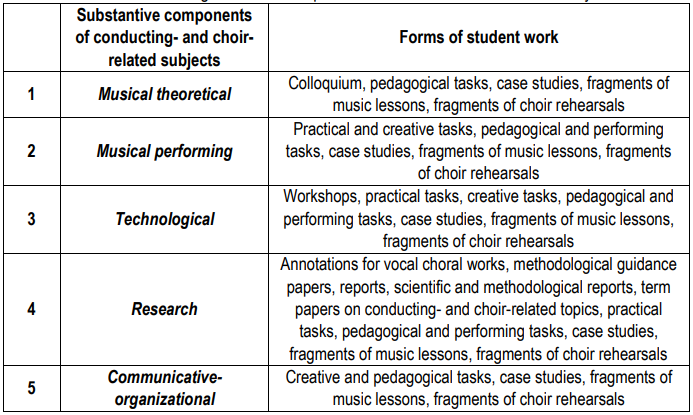
At the control stage of the pedagogical experiment, we summarized the empirical data on the level manifestations of each methodological competence indicator obtained during the pedagogical monitoring of the students' work, analysis and generalization. The results were interpreted first by the manifestation levels of each indicator and then the data were reduced to the level manifestation of the criterion for the formation of methodological competence.
Table 6 contains the results of the levels of methodological competence development of the future music teacher at the establishing and control stages of the experiment.
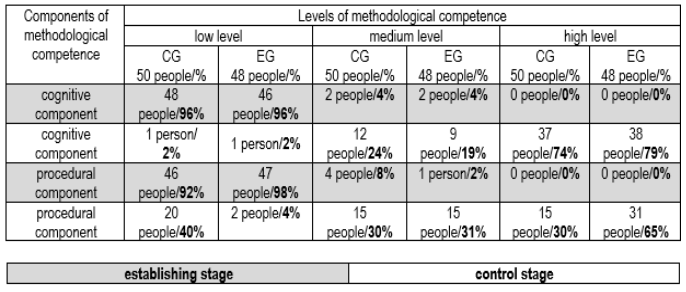
The positive trend in the levels of manifestation of methodological competence components in student musicians of the experimental group proves the efficiency of pedagogical conditions implemented in the educational practice of the university.
CONCLUSIONS
The study made it possible to make several theoretical conclusions:
- 1. The current state of Russian higher education was characterized in the context of training music teachers.
- 2. The role of methodological competence in future music teachers' professional training was identified.
- 3. The structure of the music teacher's methodological competence as part of the cognitive and procedural components and their content was proposed.
- 4. The functions of the music teacher's methodological competence were presented.
- 5. The potential of conducting- and choir-related subjects from the position of an efficient practice-oriented educational content in the aspect of developing the future music teacher's methodological competence was justified.
- 6. The pedagogical conditions of the formation of the future music teacher's methodological competence were defined and scientifically justified.
The experimental study aimed at verifying the efficiency of pedagogical conditions identified the importance of creating certain pedagogical conditions that ensure the development of the future music teacher's methodological competence according to federal state requirements for such a specialist's level of education.
BIODATA
Elena Aleksandrovna DYGANOVA: Candidate of Pedagogical Sciences, Associate Professor, Kazan (Volga) Federal University. In 1998 graduated from the Kazan State Conservatory. N.G. Zhiganova, conducting and choral faculty, specializing in conducting an academic choir, qualification: choirmaster, teacher. In 2014, defended thesis on "The formation of a culture of self-education of the future teacher- musician in the process of mastering conductor-choral disciplines". Currently, associate professor of the Department of Tatar Studies and Cultural Studies, Institute of Philology and Intercultural Communication, Kazan (Volga) Federal University. Scientific interests: musical pedagogy, conductor-choral pedagogy and performance, professional self-education and self-development, musicology.
Zilia Muhtarovna YAVGILDINA: Doctor of Pedagogical Sciences, Professor, Kazan State Institute of Culture. In 1984 graduated from the music department of Kazan State Pedagogical Institute. From 1991 to 2019 worked at the Kazan State Pedagogical University and the Kazan (Volga) Federal University. Author defended her thesis in 1997 on the topic “Tatar children’s folklore as a means of musical and aesthetic education of schoolchildren”, and in 2007 doctoral dissertation on the theme “Development of general music education in Tatarstan (XX century).” Currently, Vice Rector for Research, Kazan State Institute of Culture. Scientific interests: musical pedagogy, art education, aesthetic education, musical folklore.
BIBLIOGRAPHY
ABDULLIN, E.B., NIKOLAEVA, E.N. (2004). The theory of music education: a textbook for higher education teachers’ training institutions. Moscow: Academia Publishing.
AKBAROVA, G., DYGANOVA, E., SHIRIEVA, N., ADAMYAN, A. (2018). The Technology of ScientificСreativity in the Professional Training of the Music Teacher. Journal of History Culture and Art Research, 7(4), 138-145. DOI: http://dx.doi.org/10.7596/taksad.v7i4.1824
BONDAREVSKAIA, E.V. (2004). Paradigmalnyi podkhod k razrabotke soderzhanii akliuchevykh pedagogicheskikh kompetentsii [Paradigmatic approach to the development of the content of key pedagogical competences]. Pedagogika, 10, 23-31 (in Russian).
CARRILLO AGUILERA, C., VILAR MONMANY, M. (2010). The Profile Of The Music Teacher Within The European Higher Education Area: Is A Competence-Based Approach Enough? (Preliminary Results). In Proceedings of the 4th International Technology, Education and Development Conference (INTED), March 8- 10, 2010, Valencia, SPAIN. IATED, pp. 3485-3495.
CHAGOROV, E.N. (2014) Professionalnaya podgotovka pedagoga-muzykanta v vuze [Professional training of music teachers at university]. Vestnik Penzenskogo gosudarstvennogo universiteta, 1(5), 65–68.
DECREE OF THE MINISTRY OF EDUCATION AND SCIENCE OF THE RUSSIAN FEDERATION ofFebruary 22, 2018 No 125 "On the approval of the Federal State Education Standard for higher education – Bachelor's degree program 44.03.05 Pedagogical education (with two specializations)". Available: http://publication.pravo.gov.ru/Document/View/0001201803160007 (date of access: 04.03.2020).
DECREE OF THE MINISTRY OF LABOR AND SOCIAL PROTECTION OF THE RUSSIAN FEDERATION ofOctober 18, 2013 No 544n "On the approval of the professional standard "Pedagogue (pedagogical activity inthe field of preschool, primary general, basic general and secondary general education) (preschool teacher, teacher)". Available: https://rosmintrud.ru/docs/mintrud/orders/129 (date of access 04.03.2020).
DECREE OF THE MINISTRY OF LABOR AND SOCIAL PROTECTION OF THE RUSSIAN FEDERATION ofMay 5, 2018 No 298n "On the approval of the professional standard "Pedagogue of additional education for children and adults". Available: http://publication.pravo.gov.ru/Document/View/0001201808290046 (date of access 04.03.2020).
GRIBKOVA, O.V. (2010). The theory and practice of shaping the professional ethics of a music educator: PhD thesis. The Moscow city teachers' training university, Moscow, 368 p.
KARKINA, S.V., FAJZRAHMANOVA, L.T., GLUZMAN, A.V. (2017). Subject-Oriented Approach in the Professional Formation of the Future Music Teacher. Tarih Kultur Ve Sanat Arastirmalari Dergisi-Journal Of History Culture And Art Research, 6(4), 1071-1077. DOI: http://dx.doi.org/10.7596/taksad.v6i4.1120
KAZANSKII FEDERALNYI UNIVERSITET [Kazan Federal University]. (n.d.). Uchebnyi protsess. Osnovnye obrazovatelnye programmy [Academic process. Main educational programs]. Available: https://kpfu.ru/do/uchebnyj-process/osnovnye-obrazovatelnye-programmy (date of access 02.03.2020).
KAZATCHKOV, S. (1998). The conductor of a choir as an artist and an educator. Kazan: The Kazan State conservatoire, 308 p.
KHUTORSKOI, A.V. (2007). Kompetentsii v obrazovanii: opytproektirovaniia [Competencies in Education: Design Experience]. Moscow: Research and innovation company “INEK”, 327 p.
KOVALEV, D.A., KHUSSAINOVA, G.A., BALAGAZOVA, S.T., ZHANKULB, T. (2016). Formation of VariousCompetencies in the Process of Training the Future Music Teachers at the Present Stage. International Journal of Environmental and Science Education, 11(11), 4175-4183.
LENNON, M., REED, G. (2012). Instrumental and vocal teacher education: Competences, roles and curricula. Music Education Research, 14(3), 285-308.
LOGINOVA, S.L., AKIMOVA, O.B., DOROZHKIN, E.M., ZAITSEVA, E.V. (2018). Methodical competency asa basis of methodical activities of a teacher of the higher school in modern conditions. Revista Espacios, 39(17), 20.
MANUILOV, Yu.S. (2008). Kontseptualnye osnovy sredovogo podkhoda v vospitanii [Conceptual bases of the environmental approach in upbringing]. Vestnik Kostromskogo gosudarstvennogo universiteta. Series: Pedagogika. Psikhologiya. Sotsiokinetika [Pedagogy. Psychology. Sociokinetics], 4, 21-27.
MATA, L., DUMITRU, C. (2010). Operational model for the development of methodological competencies at beginning teachers. Lucrări Ştiinţifice, 53(2/2010), seria Agronomie, 335-338.
OLOLUBE, N. (2006). Methodological Competencies of Teachers: A Study of Nigeria. Academic Leadership: The Online Journal, 4(2), Article 7. Available: https://scholars.fhsu.edu/alj/vol4/iss2/7
ROHWER, D., HENRY, W. (2004). University teachers' perceptions of requisite skills and characteristics of effective music teachers. Journal of Music Teacher Education, 13(2), 18-27.
VARVARIGOU, M. (2009). Modelling Effective Choral Conducting Education Through An Exploration Of Example Teaching And Learning In England: Thesis Submitted for the Degree of Doctor of Philosophy. Institute of Education, London, 296 p.
YAVGILDINA, Z.M., BATYRSHINA, G.I., KAMALOVA, I.F., SALAKHOVA, R.I., SALAKHOV, R.F. (2019).Pedagogical conditions for the creative self-actualization of future art teachers. International Journal of Civil Engineering and Technology, 10(2), 1677-1685.
ZHEREBYATNIKOVA, G.V. (2012). “Obrazovatelnoe prostranstvo vuza: sovremennoe osmyslenie ponyatiya [Educational environment of a university: modern interpretation]”, in: Lichnost, semya i obshchestvo: voprosy pedagogiki i psikhologii: collection of articles based on the proceedings of the 20th scientific and practical conference. Novosibirsk: SibAK, pp. 64-73.
ZHIVOV, V.L. (2003). Choir singing: theory, methodology, practice. A manual for the students of higher education institutions. Moscow: The humanities publishing center VLADOS, 272 p.