Artículos
Potential of Art Classes in Preparing Adolescents and Youth to Participation in Festivals
Potencial de las clases de arte en la preparación de adolescentes y jóvenes para participar en festivales
 Olga Igorevna RADOMSKAYA radomskaya.o.i@mail.ru
Ekaterina Vyachslavovna BOYAKOVA boyakova.katya@bk.ru
Philipp Sergeevich SITNIKOV sitnikov.p.s@mail.ru
Olga Igorevna RADOMSKAYA radomskaya.o.i@mail.ru
Ekaterina Vyachslavovna BOYAKOVA boyakova.katya@bk.ru
Philipp Sergeevich SITNIKOV sitnikov.p.s@mail.ru
Potential of Art Classes in Preparing Adolescents and Youth to Participation in Festivals
Utopía y Praxis Latinoamericana, vol. 25, no. Esp.5, pp. 244-251, 2020
Universidad del Zulia
Received: 24 June 2020
Accepted: 15 July 2020
Palabras clave: Festival, socialización, interés, arte, música, teatro, juventud, adolescentes, escuela, universidad
Keywords: Festival, socialization, interest, art, music, theater, youth, adolescents, school, university
INTRODUCTION
As a cultural phenomenon, a festival has sustainable historical traditions. Festival movement has been rapidly developing for several decades with the active participation of school and university students. Mass art, music, and theater festivals as a specific form of communication are associated with celebrations.
Festivals demonstrate the cultural innovations and the cultural capital of traditions (Barrio, Devesa, Herrero: 2012) and contribute to the stability of society in times of crisis (Derrett: 2009). Moreover, regions attract tourists and demonstrate the uniqueness of local culture by creating festival programs. The great number of festivals around the world creates a competitive creative environment. Researchers note that the saturation of the information space and the commercialization of art lead to the reduction of youth and adolescents’ interest in culture in general and art in particular (Olesina, Stukalova: 2016; Polyudova: 2018). One of the objectives of modern education is to master the effective use of the opportunities of the festival movement for sustainable development and the formation of music, theater, art, and dance skills among the young generation. Sometimes desire or interest is enough for participation in an amateur festival. Festivals for school and university students often take the form of a non-professional event everyone can take part in and demonstrate their abilities. A combination of personal interest and certain skills in the type of activity the festival specializes in presents a great motivation. This is primarily true for art and art-related activities.
A wide range of studies covers the topic of music festivals. The scientific analysis of the effect of choir festivals on the music abilities of primary school students demonstrates that choir and music festivals improve the relationships between students, teachers, and parents and promote the acquisition of music skills and the expansion of students’ outlook in music (Hedden: 2007). In addition to the supporting effect on students’ self- esteem and motivation indicated by many researchers, it is important to note the friendly atmosphere, collective creative activity, and productive interaction between a student and a teacher characteristic of an art lesson (Anttila: 2010). A festival presents a creative space. The effectiveness of preparation for it during lessons depends on the creation of creative interaction and the opportunity for students to listen to music and compose it themselves (Randles, Muhonen: 2015). These conclusions can also be applied to the lessons in other types of art: fine art, theater, dancing, and design. Festivals should become a part of school life and everyday work. They are conducted according to a plan and are adapted for the conditions of each particular school. Special emphasis is put on art festivals. Such festivals are attractive for students of all ages and foster humanism, patriotism, and family values. Moreover, art festivals have a positive effect on personality development and improve empathy.
Internet festivals as a means of creating a special environment of cooperation and interaction of students and teachers are growing in popularity (Bachurina, Iarchikova: 2015). There is also practical experience in holding a four-year festival cycle. Thus, children climb up the ladder towards high art through improving their knowledge of art and developing various talents and leadership skills. Such a festival begins at school lessons where students create their art pieces and then demonstrate them first at regional competitions and then at the state and international levels (Ishaq: 2018). This type of festival involves not only the demonstration of one’s abilities and the joy of participation and being a part of a common festivity but also a competition. This aspect makes a festival more similar to a contest as a competition for the right to become a winner. In our opinion, a festival for children and youth that identifies leaders through criteria-based selection loses its festiveness, emotional immediacy, and the joy of being a part of art.
School festival promotes students’ personal development in a polycultural collective, satisfies their needs for communication and self-presentation, and creates the conditions necessary for self-realization through art. Scientific studies disclose the role of theater, music, and fine art in creating a favorable school environment, as well as the history of holding school festivals. Authors highlight the fact that a festival is a festive event where participants demonstrate their achievements both individually and as a part of a creative team (Koptseva, Razdobarina, Nekrasova: 2014; Savenkova, Olesina et al.: 2019). However, the desire to participate in festivals was found to be higher than the real participation rate. This result was found to berelated to the fear of public speaking (Olesina, Mazanov: 2020). Festivals promote the socialization of children with special educational needs (students with physical and mental disabilities and children with learning difficulties). Equal access for participation in festivals allows children to demonstrate their talents thus solving difficult ethical and pedagogical issues through inclusive practice. The cultural preferences of adolescents and youth in different regions of Russia have been identified in scientific studies. Several articles demonstrate the variety of students’ cultural interests and desire to engage in art and share their achievements with peers (Boyakova, Olesina, Radomskaya: 2020; Boyakova, Radomskaya: 2019).
The goal of our study is to answer the following questions: What is the effect of activities in different typesof art on the potential of students sharing their interests at festivals? What are the preferences of modern adolescents and youth in the sphere of art?
METHODOLOGY
The study was conducted in the form of an online survey that composed questions with answer options provided to choose from. Participation in the survey was voluntary. Multiple choice was available in most survey questions.
The questions, asked in the survey, included one on the students’ preferences in leisure time and favorite extracurricular activity (“How do you usually prefer to spend your leisure time?”). It was important for us to identify whether students’ leisure time incorporated art and if so, what type (“Name your favorite extracurricular activity.”). We also explored what type of art the respondents were learning or would like to learn (“Choose one or two art forms you like doing or would like to try.”) and how their room in a house or a flat was decorated (“What is the way you have decorated your room or your place?”) (Boyakova, Olesina, Radomskaya: 2020; Boyakova, Radomskaya: 2019). The design of personal space represents the preferences of its owner (Fomina: 2019). It always incorporates things that are most dear and significant, such as others’ art pieces or one’s own creations, achievements, and memories. To find out whether adolescents and young people were ready for dialogue, particularly on the topic of art, we asked the question “Do you like to share your interests with friends?”.
However, we did not ask any direct questions on the desire to participate in festivals or on the experienceof such participation. The studies of our colleagues demonstrate that over 90% of school students state their desire to participate in festivals (Olesina, Mazanov: 2020). We hypothesized that the potential of festival participation is found in the preferences of specific types of art, the presence or lack of desire to share one’s interests with peers, and the creation of personal space. The answers to this question will allow teachers and management to find out what school and university students are interested in and what types of art will be successful at festivals.
RESULTS
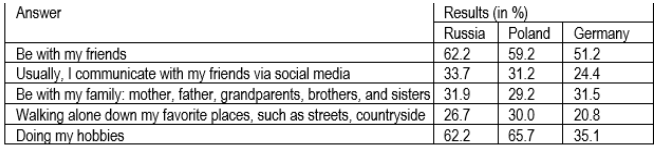
The final sample of study participants included 1,180 people aged from 12 to 21 years old and living in Poland, Germany, and Russia (Moscow). Provided survey questions presented several answer options with the opportunity for multiple choice. Communication with friends and doing one’s favorite leisure time activity were found to be the options most preferable for the majority of the respondents and presented the most popular answer options. Virtual communication was preferred by twice fewer respondents. German youth was found to spend the least amount of time on their favorite activities. The same respondent group was a little less fond of solitude. Overall, the responses of study participants from different countries had few differences (Table 1).
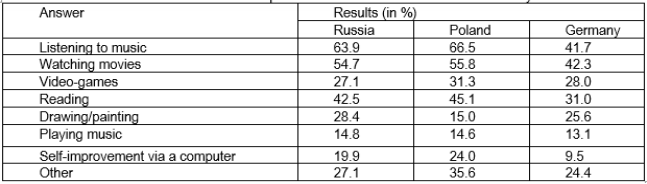
When answering the question “Your favorite extracurricular activity”, the greatest number of the respondents chose listening to music and watching movies. The data acquired from the survey of Russian and Polish adolescents and youth were identical apart from the “drawing” answer option. In Polish youth, artistic creation had a low rating as a pleasant or useful pastime. Polish youth was found to engage in fine arts and music (making music and drawing) less. Russian and German youth was also found to be not very fond of music-making. The ratings of “listening to music”, “watching a movie”, and “reading” answer options acquired in German respondents were a bit lower. We also noted that having the opportunity for multiple- choice German young people generally selected less personal preferences. On average, each German respondent selected 2.2 answer options (while in Polish respondents this number reached 2.9). Therefore, the overall results on the question about after school activities acquired in Germany were more balanced. Similar to virtual communication, computer games attracted from 27% to 31% of youth. Acquiring new knowledge and developing one’s potential via a computer was favored by 19.9% of Russian, 24.0% of Polish, and 9.5% of German participants. Detailed results are presented in Table 2.
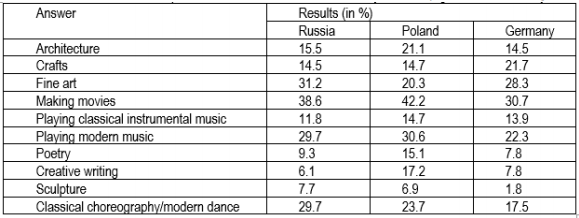
The rating of preferences in artistic activities was acquired through the results of answers to the question “What type of art you do or would like to try?”. Most respondents were attracted by the prospect of connecting their lives with cinema, which was the undisputed winner among other answer options (from 30.7% to 42.2%). Russian youth was also found doing or wanting to try modern music (29.7%), fine art (31.2%), and choreography (dances) (29.7%). Polish youth was interested in architecture (21.1%), modern music (30.6%), and choreography (dances) (23.7%), and German young people mostly selected fine art (28.3%), crafts (21.7%), and modern music (22.3%). Polish respondents were found to be fond of composing poems and prose works. Classical music was twice less popular that modern musical art. Creativity in the fields of sculpture, poetry, and prose was overall not favored. Detailed results are presented in Table 3.
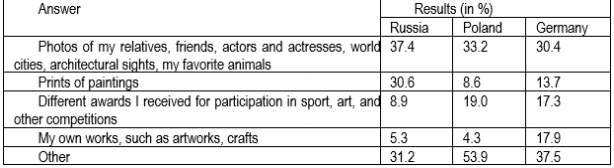
The options most popular among the provided answers to the question on the design of personal space by adolescents and youth were pictures of relatives, loved ones, friends, actors and actresses, world cities, architectural sights, and favorite animals (from 30.4% to 37.4%). Russian survey participants were found to be fond of art reproductions (30.6%). Polish and German respondents liked to see the evidence of their achievements (diplomas, cups, and medals) (19.0% and 17.3%, respectively). German adolescents and young people also gladly included their own creative products into the design of their space. As noted by the respondents, many cups, diplomas, and medals were obtained by them at creative festivals and competitions, as well as as a result of participation in sports competitions. Detailed results are presented in Table 4
When answering the question “Do you like to share your interests with friends?”, most respondents chose the “yes” option. In Germany, this portion of respondents was 71.3%, in Poland – 87.3%, and in Russia – 85.6%.
DISCUSSION
The development of information technology, travel opportunities, and academic mobility of university students expand youth’s perceptions of the multicultural world and the range of their interests in art. Multiple choices in the answers to survey questions demonstrated the broad scope of interests of modern youth and its openness to the world and art. Modern young people have diverse preferences in art and are ready to share them with peers. Choosing direct communication, they show that it is not “smart” technology that is needed for life and creativity but primarily another person able to understand their emotions and aspirations for the future, support and approve their creativity. The acquired data do not confirm the popular opinion that youth prefers virtual communication via computers and gadgets. Young people themselves want to see each other and to enjoy the benefits of live communication when the interlocutor is next to them. The need for communication with relatives and family remains. The high need for solitude is not surprising in the conditions of a high pace of life and a large flow of information, as well as the society’s focus on high achievements. Many people who prefer solitary walks listen to music.
We can see that live festival communication, meeting new people, and getting new positive emotions and impressions will appeal to most respondents. Young people who prefer solitude but actively use the Internet will be interested in virtual festivals that present a special type of creative platform for the exchange of creative experience in online space.
Results in the preference of art types for creativity demonstrate the distribution of selected answers by participants’ regions of residence. Survey results indicate that the modern young generation is interested in entertainment. Although the participants prefer to listen to music in their free time and express the desire to try music-making, they are not motivated to play themselves. The more even distribution of survey answers in Germany compared to Russia (Moscow) and Poland, where the leading options were clearly distinguished from other ones, is worth noting.
Overall, youth mostly chooses passive creative activities: listening to music and watching movies. This finding allows us to predict the popularity of music festivals adolescents and youth will participate in as spectators rather than performers. These data correspond well to answers on favorite pastime activities. Modern adolescents and youth have little interest in composing poems and prose. Most students express the desire to engage in cinematography, which is a testimony of a dream about acting or directorial career. Mostly wanting to listen to music, children in Poland, Germany, and Russia dream about cinematography and wish to draw and dance.
Most students strive for an aesthetically designed object and spatial environment. The respondents who gladly decorate their living space with awards already present active participants of festivals and competitions. They are strongly motivated by the demonstration of their achievements and the expectation of positive evaluation.
CONCLUSION
The data acquired in the course of the study shows that children and youth prefer to engage in art and want to share their creativity with others. Creative festivals present a unique opportunity for the participants to communicate with each other in the language of art and share the results of their artistic activity.
Our study demonstrates that children are more attracted to free-time activities related to such types of art like cinema, modern music, drawing, and modern choreography. It can be concluded that art festivals will be the type of festival most popular in general schools and additional education institutions. Cinema festivals, theater festivals, music and singing festivals, and choreographic festivals will also be in demand.
Festivals promote youth and adolescent socialization. At festivals, children and young people acquire self- confidence, involvement in a common cause, and trust in the world. Their creative potential also improves. Art classes are preserved in school programs and a wide selection of additional education programs is available in clubs. We are convinced that art classes (music, fine arts, theater, etc.) as a part of the educational process and in free time contribute to the desire to present one’s achievements at festivals and share them with other people. In the process of preparation for festivals in an educational organization, music, art, and art history teachers, as well as elementary school teachers, native language and literature teachers, history, technology, and additional education teachers carry out great preparatory work helping students in staging choreographic numbers, songs, plays, readings, etc. Art lessons prepare students for creative self-expression at festivals. During these lessons, children have the opportunity to prepare costumes, decorations for a play or a musical number, make sceneries or posters if needed. Art classes develop the skills of creative communication that are perfected in the process of participating in creative festivals. Communication between children about art and in the language of art gives a powerful impetus to their creative development.
Festivals present collective and individual creative projects carried out by students in schools or universities. Children and youth acquire the skills of continuous participation in a multistage complex process, the ability to withstand stayers’ distance, see not only the close perspective within the participation in a single dance, theater or music number but also a more distant perspective of step-by-step progression through the different stages of preparation, implementation, and presentation of the results of one’s creative work. Cultural and intercultural communication takes place at art, music, and theater festivals. Trustful relations between participants and the jury built at festivals are beneficial since all children must be confident in a positive assessment of their talents. Participants are also rewarded for their participation. Compared to contests, festivals provide the opportunity to demonstrate one’s talents without the fear of being underappreciated. A festival has no losers. A friendly and interested attitude to every participant is an important incentive for participation in a festival.
A festival presents an alternative strategy for acquiring art skills. Art lessons, cultural leisure, the aesthetic transformation of one’s personal space, and the desire to participate in festivals present the ways of culturaldevelopment and effective socialization of a future active citizen not indifferent to their country. Therefore, art festivals foster social and cultural stability in the name of sustainable development.
BIODATA
Olga Igorevna RADOMSKAYA: Candidate of Pedagogical Sciences, Head of the Laboratory for the Integration of Arts and Cultural Studies named after B.P. Yusova, Senior Researcher, Federal State Budget Scientific Institution “Institute of Art Education and Cultural Studies of the Russian Academy of Education”. Scientific interests: an integrated approach to teaching art in educational organizations, the humanization of education, comprehensive educational technologies, psychological and pedagogical aspects of socialization and the development of creative abilities in children and youth by means of art.
Ekaterina Vyachslavovna BOYAKOVA: Candidate of Pedagogical Sciences, Federal State Budget Scientific Institution “Institute of Art Education and Cultural Studies of the Russian Academy of Education”Develops scientific questions of music education, musical development and aesthetic education of children and young people, sociology and psychology of art. Research Author of music didactics, history of music education of preschool children in Russia.
Philipp Sergeevich SITNIKOV: Graduate Student of the Federal State Budget Scientific Institution "Institute of Art Education and Cultural Studies of the Russian Academy of Education." Director, choreographer, teacher of the discipline "Plastic expressiveness" at the theater college. His research interests are in the field of theatrical pedagogy, upbringing and development of a modern actor with new methods of integrating the sensorimotor nature of man, bodily self-knowledge, understanding and revealing personal qualities. The author of a methodology for working with young actors, based on the production of creative expression using non-verbal means of expression.
BIBLIOGRAPHY
ANTTILA, M. (2010). Problems with school music in Finland. British Journal of Music Education, 27(3): 241– 253. DOI:10.1017/S0265051710000215.
BACHURINA, L.A., IARCHIKOVA, N.V. (2015). Internet-festival kak effektivnaia forma razvitiia IKT-aktivnosti pedagoga [Internet festival as an effective form of development of ICT activity of a teacher]. Sovremennye informatsionnye tekhnologii i IT-obrazovanie: sbornik nauchnykh trudov. Ьoscow: Fond sodeistviia razvitiiu internet-media, IT-obrazovaniia, chelovecheskogo potentsiala “Liga internet-media”, 81-87.
BARRIO, M., DEVESA, M., HERRERO, L. (2012). Evaluating intangible cultural heritage: The case of cultural festivals. The societal function of cultural heritage. City, Culture and Society, 3(4): 235-244.
BOYAKOVA, E., OLESINA, E., RADOMSKAYA, O. (2020). Cultural preferences of adolescents and youth in the Rostov region (by research results). Pedagogy of Art, 1: 15—23. DOI: 10.34897/IAECS.2020.1.56702.
BOYAKOVA, E.V., RADOMSKAYA, O. I. (2019). Socio-cultural portrait of a modern teenager and young person (on the example of Moscow students). The World of Science, Culture, Education, 5 (78): 137—139.
DERRETT, R. (2009). How Festivals Nurture Resilience in Regional Communities Paradigms of Analysis. Advances in Tourism Research, 2: 107-124.
FOMINA, N. (2019). About moral and aesthetic preferences of modern school students. Pedagogy of Art, 4: 48-54.
HEDDEN, D. G. (2007). Differences between Elementary Student Participants and Nonparticipants in a Choral Festival. Update: Applications of Research in Music Education, 25(2): 47–58. https://doi.org/10.1177/87551233070250020106.
ISHAQ, A. (2018). World Children’s Festival: The Art of Empathy. The STEAM Journal, 3(2): 3. DOI: 10.5642/steam.20180302.03
KOPTSEVA, T.A., RAZDOBARINA, L.A., NEKRASOVA, L.M. (2014). The historical experience of Russian competitions and festivals for different types of art (for workers in general, further and vocational education). Pedagogy of Art, 1: 1—30.
OLESINA, E., MAZANOV, A. (2020). Festival as a form of self-realization of adolescents in a multicultural society. Kazan Pedagogical Journal, 1: 157-167. DOI: 10.34772/KPJ.2020.138.1.023.
OLESINA, E.P., STUKALOVA, O.V. (2016). Modern Youth - Information Environment - Postmodern Aesthetics – Artistic Text: Problems and Prospects of Interaction. Global Media Journal, S2:20: 1-5.
POLYUDOVA, E. (2018). Current Streams in American Art Education. Cambridge, Scholars Publishing.
RANDLES, C., MUHONEN, S. (2015). Validation and further validation of a measure of creative identityamong USA and Finland pre-service music teachers. British Journal of Music Education, 32(1): 51–70. DOI:10.1017/S0265051714000151.
SAVENKOVA, L. G., OLESINA, E. P., RADOMSKAYA, O. I., ZHGENTI, I. V. (2019). Theater Art In TheInformation Age: Youth Audience Perception Features. The European Proceedings of Social & Behavioural Sciences EpSBS (International conference “Education Environment for the Information Age – 2019”) (EEIA – 2019). 30 September 2019, LXIX(81): 711-722. ISSN: 2357-1330. DOI:https://doi.org/10.15405/epsbs.2019.09.02.81.