Artículos
Source-Based Writing as a Way to Language Acquisition
Escritura basada en la fuente como una forma de adquisición del lenguaje
 Yulia SIZOVA yulya.s.sizova@mail.ru
Marina BLAGONRAVOVA Blagonravova.MA@rea.ru
Yulia SIZOVA yulya.s.sizova@mail.ru
Marina BLAGONRAVOVA Blagonravova.MA@rea.ru
Source-Based Writing as a Way to Language Acquisition
Utopía y Praxis Latinoamericana, vol. 25, no. Esp.5, pp. 290-301, 2020
Universidad del Zulia
Received: 24 June 2020
Accepted: 15 July 2020
Abstract: The purpose of this study was to demonstrate that teaching writing elements based on authentic written sources can be beneficial throughout a Master English course. Paraphrasing and patching are necessary stages in the development of the ability to express your own ideas; Furthermore, adopting a strategy of using a certain amount of plagiarism can be successful in improving the knowledge of a foreign language. Study participants were 111 students who completed their master's courses at 3 leading universities in Moscow, Russia.
Keywords: Plagiarism, master's students, non- linguistic university, paraphrase..
Resumen: El propósito de este estudio fue demostrar que enseñar elementos de la escritura sobre la base de fuentes auténticas escritas, puede resultar beneficioso a lo largo de un curso de inglés maestro. Parafrasear y escribir parches son etapas necesarias del desarrollo de la capacidad de expresar ideas propias; además, adoptar una estrategia de uso de cierta cantidad de plagio puede ser exitoso para mejorar el conocimiento de un idioma extranjero. Los participantes del estudio fueron 111 estudiantes que realizaron sus cursos de maestría en 3 universidades líderes en Moscú, Rusia.
Palabras clave: Plagio, estudiantes de maestría, universidad no lingüística, paráfrasis..
INTRODUCTION
It is generally recognized that foreign language acquisition is becoming increasingly important for conducting international contacts in the epoch of globalization. Less discussed but no less significant is the impact of language learning on personality development. However, it is undoubtedly able to foster developing a broader outlook, an ability to perceive different mentality and values, to acquire critical thinking and communicative skills, as well as an ability to learn, all of which are regarded as most essential competences of the 21st century.
Where the process of learning a foreign language itself is concerned, our time with its ever accelerating progress of science and technology and rapid pace of life, which influences different spheres of professional activities, makes us seek shorter and more efficient ways of achieving results. It is worth looking for the benefits of such kind in both innovative and traditional methods. The purpose of this article is to show that teaching elements of writing on the basis of written sources can prove beneficial in a fairly unfavourable learning environment of a master course in a non-linguistic university.
The theme of using written sources in academic context has been extensively examined. The initial reasonfor interest in this theme was concern about numerous cases of student plagiarism. Comprehensive data on different aspects of this problem can be found in the reports of the project carried out in 2010-2013 in higher educational institutions of 27 countries of Europe (Glendinning: 2014). Funded by European Commission, this project was focused on institutional policies in response to plagiarism, including methods of detection and penalties. A great number of works written by academics from English-speaking countries, mostly from the USA and Canada, investigate the causes of student plagiarism and ways of dealing with it.
The most important thing for us here is that many authors emphasize that text appropriation by studentsdoes not always deserve to be penalized. The general opinion is that students very often resort to exact repetition of someone else’s words and ideas without attribution not because they are willing to defraud but because they lack knowledge and skills necessary to write it in a different way. As Ali R. Abasi and Nahal Akbari put it, such cases are “related to learning rather than ill-intention” (Abasi, Akbari: 2008, p. 268).
Researchers from Anglophone universities note that at the beginning of the course of academic writing word-to word copying is used both by their first language (L1) students and second language (L2) students. The more writing experience they acquire, the fewer cases of plagiarism (Keck: 2014; Pecorary: 2003).
L2 students of North American universities plagiarize more frequently. One of the main reasons for thatis insufficient lexical knowledge, especially the knowledge of academic vocabulary (Davis: 2013; Malmstrom et al.: 2018). One more factor which makes creatively reworking English texts difficult for students from other countries can be differences in national identities determined by sociocultural traditions. The impact of this factor can be particularly strong in students from countries with collectivist culture, where in the learning process memorization and collective work are encouraged and the importance of critical approach is underestimated (Abasi et al.: 2006; Keck: 2014; Pecorary: 2003).
Another adversary factor is that these young people, unlike North-American students, might have had very little writing practice and have not been taught paraphrasing and summarizing, which, along with quotation, are the strategies necessary for avoiding plagiarism (Keck: 2014). A serious problem is that even having been clearly shown the technique of paraphrasing and writing summaries and being able to reproduce the templates demonstrated to them, L2 students do not internalize these skills and are not capable to apply them creatively to source text material (Macbeth: 2010). Besides, they feel lack of confidence about their ability to sufficiently well express the contents of the text in their own words, which makes them, instead of paraphrasing, either resort to copying in the form of direct quoting (Shi: 2008) or to plagiarize (Hyland: 2001).
Sometimes passages from written sources are copied without any changes because a student does not quite understand what he reads, either because the language is too complicated, or the subject is not familiar enough (Howard: 2001). Complete reading comprehension or at least capturing the gist of the text, which is necessary for being able to convey the author’s ideas in a different way may be a major challenge for L2students working with written sources. Still more difficult will be integrating other authors’ ideas in a student’s own piece of writing, which involves a whole number of interconnected tasks and skills (Hirvela, Du: 2013; Gebril, Plakans: 2013; Neumann et al.: 2019).
Perhaps the greatest attention in discussing the academic approach to source-based writing is given to paraphrasing. As it is regarded as a crucial skill for this task, the methods of teaching paraphrasing are continuously explored, shared and discussed. Different authors have different views on what extent of language borrowing should be considered paraphrasing and not plagiarism. Discussing these views, Casey Keck (2006) compares the approach to textual borrowing of L2 and L1 writers. She offers a taxonomy of four paraphrase types, from Near Copy, more often used in summaries from L2 students, to Substantial Revision, which, as she established, is more characteristic of works by L1 authors.
Source-based academic writing with only minor language changes, like omitting some words, using a few synonyms and only slight changes in grammatical constructions, is commonly referred to as patchwriting. Rebecca Howard (2001), who coined this, now tremendously popular term more than twenty years ago, stated that for novice writers patchwriting is a necessary stage on the way to developing the ability to express their own ideas. Other authors recognize that writing from samples and patchwriting can play an important role in learning to write, as it shows language patterns and helps increase vocabulary (Gebril, Plakans: 2016; Wette: 2017). But, as Ali R. Abasi and Nahal Akbari put it, teachers should “help students outgrow the patchwriting stage” (Abasi, Akbari: 2008, p. 279).
In this work we are not going to concentrate on this task. For the reasons coming from characteristic features of our learning situation, to be described below, we are not going to explore the aspects of language acquisition which can hamper or facilitate teaching academic writing. Conversely, we are going to consider how teaching elements of academic writing can facilitate language acquisition.
METHODOLOGY
We did 74-hour master courses of English for professional purposes, in two groups of students of Plekhanov Russian University of Economics, whose majors are finance and management. The official name of our discipline was Foreign language for business and professional communication, which meant that our academic tasks were quite diverse. The program included not only reading texts and listening to recordings on different aspects of finance or management, learning professional vocabulary and writing tests. It also involved role plays, case studies and several presentations.
The management students worked with authentic articles from popular science journals learning to write an abstract. 20 students of the financial faculty finished the course with the presentation of their written paper the size of about 15 pages (19-20,000 characters) on any subject of their choice related to finance and based on any written sources. Such a paper is written at the financial faculty master course every year, by the guidelines issued at Plekhanov university. However, this year we gave them some special preparation for doing this written work. We analyzed grammatical constructions and presented lexical items which could be useful in academic writing. We discussed issues of summarizing, paraphrasing and patchwriting and did corresponding exercises. One more thing which had not been done before was the requirement to present the screenshots of passing their work through the EduBirdie plagiarism checker.
PROCEDURES AND RESULTS
The students of both groups took part in a survey on plagiarism which we recently conducted at Plekhanov (46 master students) and two other Moscow universities, such as Bauman State Technical University (35 master students) and National University of Science and Technology MISIS (30 master students). Totalnumber of pollees was 111, the research was carried out in 2019. The results of our survey on plagiarism are represented in the tables below that yield a relatively complete picture on this issue. The reasons for selecting such a category of students were as follows:
- Firstly, their maturity, which enables them to evaluate their level of achievement in scientific work and in English as well;
- Secondly, those students are concerned with writing their master thesis demanding a thorough research both in native and foreign language.
Before going deeper into details with the three multiple choice question and one ‘Yes/No’ question, it is worth noting that a certain number of students either have partly answered the questionnaire or made some comments to the questions in it.
Questions Analysis
This question has been suggested to uncover the understanding of the issue of plagiarism for our learners. On the other hand, this question gives us an insight into the possibility of appreciation of the master students related to using plagiarism as a means of achieving some practical or academic purpose.
Question 1. In your opinion, what is plagiarism?
-
using another author’s exact words without quoting;
-
using another author’s ideas in a form too close to the original;
-
using information without citing to a particular source.
Most master students responded that it was ’using another author’s exact words without quoting’ and we may suppose that at least some quotations will be used by them in inverted commas and a reference to the source will be out in their papers. But still some percentage of our learners are ready to use ‘information without citing to a particular source’ misrepresenting it as their own findings. The rest respondents marked ‘using another author’s ideas in a form too close to the original’, which shows patchy understanding of academic ethics. The results are reflected in Table 1.

Source: compiled by the authors
Question 2. Do you consider it possible to resort to plagiarism in your academic writings?
- Yes
- No
This question was aimed at identifying the degree of possibility of coming across plagiarism in our master students’ academic papers and the results are registered in Table 2.

Source: compiled by the authors
It can be observed from the table that the biggest percentage of our students consider it possible to plagiarize while performing their tasks in academic writing.
Question 3. “If yes, do you plagiarise because of…”
-
lack of time;
-
the wish to do the assignment in the easiest way;
-
lack of confidence that you can express your ideas as well as another author;
-
other reasons (please specify).
The third question was only addressed to the respondents who answered "Yes" in the second question and it attempts at defining the reasons for using plagiarism by our master students and seeking the ways to eliminate it or use as a knowledge tool for mastering a foreign language. The results can be seen in Table 3.
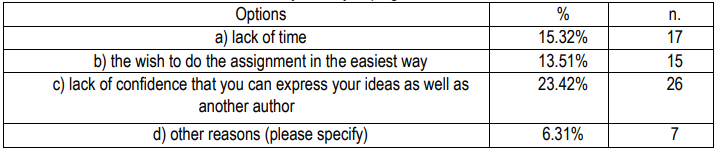
Source: compiled by the authors
The third table illustrates that the majority of master students use plagiarism because they do not consider themselves to be so good at expressing their ideas as other authors. The difference in percentage for “lack of time” and “the wish to do the assignment in the easiest way” is relatively small –1.82% only.
The fact is that practically all of our learners have jobs and work full-time, that is why their answers may sound reasonable on the one hand, but on the other hand it shows that their highest priority is their job, but not studies. And the lowest percentage shows that our master students plagiarise for “other reasons’. Among the specified ones were:
- “I have no ideas of my own upon certain issues”;
- “I wish to write something meaningful, but I cannot do it myself”;
- “All I write myself is trivial and not worth reading”;
- “I often notice that my ideas has already been conceived much better than I can do it”:
- “I am reluctant to recreate the wheel”. Question 4. “If no, you don’t plagiarise…”
-
for moral reasons;
-
for fear of the plagiarism being discovered and you being penalized;
-
for other reasons (please specify).
The fourth question which is addressed only to the respondents who answered "No" to the second question tries to investigate the reasons that prevent our learners from using plagiarism. The results are reflected in Table 4.

Source: compiled by the authors
In Table 4, the majority of our master students reported that they do not plagiarize for moral reasons, which proves their being aware of ethical norms and respecting them. This fact could have been optimistic but for the next figure of 24.32%, which is only slightly less than the percentage in the previous option. These respondents were simply afraid of being discovered and would like to avoid being penalized. And the last 4.5% stated that they do not plagiarise for other reasons which they were asked to specify. Here among the answers were:
-“I never do anything that may tarnish my honor, dignity and reputation”;
- “It is easier for me to express ideas in my own way”;
- “It is a waste of time to search for others’ wordings”;
- “It is a problem for me to translate and even understand what is being written in the primary literature”;
- “It is challenging for me to search for relevant information in a foreign language”;
The qualitative analysis of the data collected during our poll reports that a sound percentage of our master students would like to avoid plagiarism, but plagiarise mostly because of lack of confidence in their ability to express their ideas. And another issue evolving here is the fact that some of them do not do it not for the sake of following ethical norms, but just because they encounter comprehension difficulties while reading authentic texts.
The answers to the questions on plagiarism did not have any great differences with those given bystudents of other European countries (Glendinning: 2014). It is also worth noting that on the whole the Moscow respondents to the survey and our students in particular admitted that they did not know the language well enough to do writing tasks successfully, like learners in the works of researchers which we have mentioned. Other things that our students had in common with the most problematic L2 students of Anglophone universities were the lack of writing experience, insufficient practice of summarizing, rather vague ideas of paraphrasing, and certain sociocultural characteristics which differed Russian students from their Anglo- American peers.
However, all other aspects of learning situation were quite different. The differences were the following:
-Our students did not have any English language environment, which is always a most beneficial factor for language learning;
-While students in North American universities were supposed to have presented the TOEFL or IELTS score sufficient for admissions, the language levels of our students, who had done bachelor courses in different universities, varied mostly from pre-intermediate to intermediate;
-Unlike L2 students abroad whose main occupation there was studies, our students were working and often had a job which made active participating in evening classes rather difficult;
-As a result of the above, they did not see learning English as their primary concern;
-We had little time for working with written sources in class and students did not always find time for working with them at home.In these conditions motivating them was rather problematic. However, the students of the financial facultywere certainly motivated by the need to write the paper, which was necessary for passing the exam. In addition, we convinced the students that for them, already grown up and busy people, it might be the last opportunity in their life when they would be able to give time and effort for purposeful studies of English. In the group of managers students admitted that additional motivating factor was working with authentic materials. In the finance group the sources chosen for their four presentations and their final written work were also mostly authentic.
In both groups working with written texts always involved discussing issues of reading comprehension. Whatever text we read and translated in class, mostly through the practice of interactive guided reading, the main problems were caused by insufficient knowledge of grammar. We often had to give brief grammatical explanations, for instance, of verb constructions in different tenses, in passive and active voices or of morphological characteristics of different parts of speech. We showed how to analyze complicated syntacticstructures, especially in complex sentences, where a subject or a verb can be expressed with a whole phrase, or a long sentence contains a whole chain of relative clauses. Sometimes we had to help understand reference words or to explain elliptical constructions with some elements omitted, or the reasons for inversion. Some syntactic characteristics or some new vocabulary might or might not be intrinsically remembered, but we did not attach great importance to that, as our purpose here was not to teach syntax or lexis. The purpose was to teach how to gain information from the text.
Wherever it was possible because of our strict time limits, we tried to show the students different cognitive strategies suitable for enhancing comprehension of a certain text and to raise awareness of the necessity to work out their own metacognitive strategies. The most important thing was to teach them a wholesome perception of the text instead of translating it word by word with the help of a dictionary, as most of them were accustomed to since school. We also tried to form a habit of guessing the meaning of unknown words from the context and using a dictionary only afterword to make sure that the guess is correct.
We attached great importance to the ability to see the text as a whole because it is critical for developing the ability for summarizing, which involves a certain logical analysis, with selecting essential ideas and discarding minor points. In both groups the practice of summarizing was a major part of our working with written sources. At the beginning of the course we discovered that in our students the skills of summarizing were practically lacking. For example, in the finance group several summaries of the text about world famous accounting scandals written at home after an exhaustive discussion of this text in class demonstrated not only poor writing skills but also surprisingly muddled thinking. After that we gave them detailed explanations of what summarizing is, including examples of paraphrasing and patchwriting and did in class special step by step exercises on summary writing.
In the group of managers the next stages were abstracting, rendering and interpreting graphs and figures. As one of the conditions of successful defense of a master thesis is that a student should have at least two papers published on its topic, and all contemporary scientific journals require an abstract not only in a native language but also in English, we found abstracting to be a relevant activity in our groups.
Even though we consider our master students to be quite mature people not only by their age but knowledge as well, they cannot define the difference between ‘abstract’ and ‘summary’. Our students were very surprised to learn that an abstract is always in front of a scientific paper while a summary is its logical end.
We had to draw their attention once again to the fact that an abstract should be written as a concise descriptive characteristic of a scientific paper, where the topic of discussion of an authentic source is being disclosed, as well as its structure, purpose and aim but without comprehensive developing its entire content. The paper for the trial task was carefully chosen, the abstract deleted, and the students were asked to imagine that it was their scientific work but only lacking abstract. For the first time it was their take-home assignment but despite this the students failed to orderly do it. Unfortunately they failed to show the peculiarities and outstanding features of the authentic paper. Even rather high-level students who adequately understood the contents of the paper given failed to interpret it in a nutshell.
It was rather surprising for us to come across such phrases in their abstracts as: ‘This text is about’; ‘I’d like to give you an overview’ of..’ and even ‘This story is about…’, which really looked childish. And other students otherwise overloaded their abstract with complex sentences and if-clauses that were completely out of place. Later on during the group discussion of their mistakes they admitted that ‘wanted to strike as clever’ and show their knowledge of grammar. Practically all our learners confronted their abstracts with useless collocations and filler phrases such as: ‘In the author’s opinion’; ‘As it was mentioned above’ and etc., and they failed to make their texts sanitized and emotionally neutral.
The trial task on abstract writing demonstrated that our master students in management knew practically nothing about the methods and practices of data compaction. That is why the next two classes were devoted to providing some theoretical background to the group together with practice in using compression, suppression and compensation that appeared to be the most challenging. Fare more than the half of the groupfailed to substitute the authentic author’s modes of expression to their own concise ways to express the same ideas. Some of our students did not even try to paraphrase the authentic text, but simply replicated (copied?) separate sentences from different parts of authentic paper and compiled their abstract in such a way.
Taking into account our management students’ mistakes we had to include one more activity into our English language classroom – paraphrasing. This activity appeared challenging for students whose level of English was lower than the average of the group, because word rotation and the use of synonyms are not always enough for proper paraphrasing, the sentence structure has to be changed, which made it possible to significantly modify the source text. The students with a low level of proficiency in English felt insecure and made grammatical mistakes at first, but later this type of exercise appealed to them and it became a sort of a warm-up to our classes. But before this optimistic and satisfying outcome a great deal of additional exercises for self-practice and group work had been tailored.
Throughout the academic year various topics were covered, such as leading and motivating people, motivation theories, managing change, innovative approaches in management, etc., and for each theme, for each text and authentic article selected there were certain tasks for boosting skillful paraphrasing. For example: ‘Find synonyms/opposites to the words in bold’; ‘Arrange the words in groups according to different characteristics’ (parts of speech, synonyms, opposites, etc.); ‘Highlight in the text / article the words and word combinations related to a certain topic’; ‘Write a short essay using highlighted words and word combinations on a certain topic’; ‘Make the sentences shorter by withdrawing its specified parts’; ‘Recreate the text by keywords’; ‘Elicit the main idea of each paragraph of the authentic text’; ‘Make a plan to the authentic scientific text’, etc.
In the group of finance students our methods of working with written texts were determined by the fact that at the end of the year they were to write a big essay on a financial topic of their choice.
At the time when the students of this group had already been given some theoretical foundations of summarizing, we were studying the theme of securities through different activities. We wrote a vocabulary test on this subject, did a case study on the choice of companies to invest shares, discussed in a role play different opinions on giving financial advice to a customer and prepared presentations for which students were allowed to choose any aspect of the theme of securities that they found the most interesting. Accordingly, for a summary we offered them a short text about different approaches to investing which are typical for men and women. Most summaries were written rather well, with elements of insufficient paraphrasing subsequently discussed.
The next assignment was writing a summary of a longer and more complicated text about active and passive asset management, which was previously read together in class. Here the results were less successful, as the several people who wrote this summary did not quite adequately reflect all ideas and relations between them. Nevertheless, after discussing these drawbacks at the lesson, the students were given a still more challenging task. They were asked to put together the main ideas of this text, the first text about men and women investors and one more text about the gender differences in dealing with money.
The writings presented at the next lesson were most different. There were rather long pieces looking like essays where, apart from the ideas from the given texts, one could see ideas from some other sources or the authors’ own opinions. One work contained three separate short summaries. Some other works pretended to be wholesome pieces but did not have any logical connection between the ideas. However, a student whose summaries had previously demonstrated an appalling lack of logic, this time wrote a text which was quite logical, distinct and coherent. All authors were given some analysis of drawbacks and merits of their works.
The feature rather often seen in our students’ written works was giving the reasons first and the main idea at the end, which is typical for the Russian mentality and the mentality of other East European nations strongly influenced by high context cultures. We explained that more common for the modern practice is the opposite principle of constructing the discourse, when the author starts with the main thing and next comes to the details. We asked them to take it into account in their final paper, within the structure given in the guidelines,which consisted of the introduction, the main body subdivided into at least two or three parts, and the conclusion followed by a list of references and a glossary.
Closer to the end of the course when students already started to prepare their final paper the approach to reading in class got a slightly different angle. From analyzing constructions that hindered reading comprehension the emphasis switched on to language phenomena that could facilitate developing writing skills. For example, we attracted the attention of students to the ways relative pronouns and relative clauses were used. We showed how convenient the use of gerunds and participles could be.
We also gave them some minimum of academic vocabulary, namely different means of establishingconnection between ideas and coherent organization of the text – like, for instance, words for expressing cause and effect, comparing and contrasting, describing problems and analyzing results. We were well aware of the fact that in our conditions we could only expect receptive and not productive use of such vocabulary. At the lessons we gradually presented thematic collections of academic lexis and gave them photocopies of the corresponding pages of the textbook on academic vocabulary, in hope that when writing their paper they would use these pages as reference material. Some words and expressions from these pages could be seen in their ready works.
Encouraging the student-centered approach, we gave them absolute freedom to choose the subject andthe sources. We only recommended finding sources mostly in English. If some sources in Russian were used for background knowledge, we asked students to find corresponding English materials for picking up samples of correct language suitable for expressing their ideas. However, in their works resorting to translation from Russian was sometimes clearly seen. The most typical signs of that were the absence of the verb after the subject or using a dash instead of the verb, wrong word order and wrong choice of a word from a dictionary. Of course, it was inevitable, and in any case their own translation from Russian was better than using electronic translation, which might have also been used by some students, but which is not always easy to identify.
The task we set before the students was to make the idea of the writing clear, explaining the objectives of the writing in the introduction and summing up in the conclusion what the author managed to do. If the paper did not meet these requirements, the student had to modify it according to the teacher’s instructions. One completely ready work was rejected because it was a thoughtless digest of a company’s advertising brochure. The new work from this author, exploring the student’s own authentic professional activities, was prepared very thoroughly and excellently written, on the basis of 28 sources, with 88,1% uniqueness.
Most students of this group work as accountants and auditors. Some of them presented interesting piecesof research into their professional matters. There were works from intermediate/upper intermediate language users, for instance, on innovation and digitalization in auditing (12 sources, 78,7 % uniqueness), and on assessment of liquidity and solvency of a company (8 sources, 90,8% uniqueness). One more student with rather good English collected extensive material on the Islamic banking – interest free banking using loans as investment and sharing profits and losses, showing the reasons for its growing popularity in Europe and prospects for its development in Russia (12 sources, 72% uniqueness).
Several professionally impressive works were written by very weak but very hardworking students. A girl wrote about problems of preparation of consolidated financial statements in accordance with International Financial Reporting Standards and suggested changes in the Russian regulatory documents and some other measures which could bring Russian accounting practices closer to international practice. Judging by the sources that were used, those appeared to be the author’s own ideas (4 sources, 60,5 % uniqueness).
Another weak but diligent student gave a detailed analysis of procedures of the audit of receivables according to the International Standards of Audit adopted in Russia in 2018. He suggested a number of changes in these procedures, which could reduce labour input of audit and increase its efficiency and reliability. Despite a great number of language errors, this paper inspired respect because of its serious approach, independent thinking and overall successful attempt to express complicated ideas in English (9 sources, 68,9% uniqueness).
In this group there were four Chinese students. At the beginning of the course their knowledge of both English and Russian was abominably poor but by the end their English language abilities notably improved. The uniqueness of each of their written papers was more than 80%. Of course, some of the sources they used could have been translated from Chinese, and with translations true uniqueness is hardly possible to establish. Nevertheless, they coped with the task, presenting distinctly enough such themes as financial risk management, the risk of internet banking, empirical analysis of the relationship between monetary policy and stock price in China, and behavioral finance. The student who wrote the latter work, was inspired by the unit in our textbook discussing the factors which influence share prices. In her paper she traced the history of behavioral finance, analyzed its theoretical basis and described its major models (27 sources, all originally English, 88,7% uniqueness).
Finally, two Russian students, whose oral performance was bad in spite of all their effort, produced surprisingly extensive, fluently and coherently written works, without noticeable mistakes. One was a comprehensive study of the world gold market – written on the basis of 39 sources, with 78,5 % uniqueness. The other paper explored Brexit, its influence on European countries and its prospects for the development of British-Russian economic relations. This paper covered 22 sources, with the uniqueness of 58,4 %, the lowest in the whole group. It was written by the student who was 42 years old and graduated from his bachelor program at a technical university about twenty years ago.
In the previous years, when such works were written without special instruction and without plagiarism check, the number of sources used was rarely more than 10, and comparing the names of the sources with the title of the work often aroused suspicions of direct borrowing. The works written in 2019 gave no grounds for such suspicions, and overall, were more meaningful and coherent.
DISCUSSION
The effectiveness of learning through writing has been long recognized, and different aspects of this approach are still being discussed (Marshall, Marr: 2018; Wette: 2018). However, in universities of New Zealand, Canada and other Anglophone countries writing to learn is used as means to teach the contents in different disciplines. Researchers note that writing essays on disciplinary subjects is far more problematic for second language students, but their language problems are not discussed.
The method that we applied certainly has some elements of content-based learning, but it makes the emphasis on language and not on contents. Where the learning objectives are concerned, here it is also relevant to speak about task-based learning (TBL) and problem-based learning (PBL), as our students had a task to accomplish and problems to solve in the process of fulfilling this task.
Thus, it can be said that teaching language for professional purposes by teaching elements of academic writing has something in common with the major recognized methodologies of today without fitting exactly into any of them. Apart from the differences in learning procedures with TBL and PBL, we would like to stress that these methods are focused mostly on oral communication, which is characteristic for the whole communicative approach to contemporary foreign language teaching. As consequence, writing in Russian tertiary education is neglected, and reading receives only minimal attention, whereas both reading and writing are also forms of communication.
About four decades ago, Stephen Krashen (1981) formulated a dichotomy between second language acquisition, which is subconscious, and second language learning, which is conscious. In our time, when the main goal in language education is to develop communicative abilities and fluency is generally valued more than accuracy, educators try to exploit the potential of language acquisition wherever possible. As wrote Rod Ellis (1997) in his book “Second language acquisition”, for acquisition learners must be exposed to samples of language, from which they internalize language structures and acquire linguistic rules. Such exposure can be naturally provided by reading. Working with the text material, analyzing it and putting together itscomponents into a wholesome piece of writing helps retain the acquired language and transform at least some part of receptive knowledge into productive.
CONCLUSION
Our experience confirmed that initial resorting to a certain amount of plagiarism, which is characteristic of most Russian students, and of other students for whom English is not their first language, can be successfully used for enhancing the knowledge of the language. Our work also showed that in foreign language tertiary education it is worth paying more attention to reading and writing, so that in the époque of focusing on communicative approach their great learning potential did not remain untapped. On the one hand, during University master courses we work mainly with persons of ripe years who are mature enough to perceive their English language classes as hard and purposeful work aimed at their academic and professional development, so they take their studies more seriously and may not be entertained in class to the extent the bachelors should be, and development of writing skills and work with authentic scientific sources is fully justified. But on the other hand, in an unfavourable learning environment of a master’s course in a non- linguistic university (full-time job of the learners, evening classes, restricted number of hours for English language classes) it is quite challenging to bring their academic writing skills to perfection and demand a high level of uniqueness in their abstracts and summaries. That is why providing plagiarizm cannot be completely abandoned, but it is possible to minimize its use by paraphrasing and patchwriting.
BIODATA
Yulia SIZOVA:PhD in economics, associate professor, Department of Foreign Languages No. 1, Plekhanov Russian University of Economics, Moscow, Russia. The author of more than 50 studies. Author conducted research on the problems of entrepreneurial ethics, social policy and modern methods of teaching foreign languages in non-linguistic universities. Scientific interests: intellectual work management.
Marina BLAGONRAVOVA:Senior teacher, Department of Foreign Languages No. 1, Plekhanov Russian University of Economics, Moscow, Russia. During her time at, author received three international certificates of a teacher of business English, including Further Certificate for Teachers of Business English (London Chamber of Commerce and Industry). She taught a foreign language, a foreign language of business communication, a foreign language of professional communication, a foreign language of a specialty. The main area of interest is the development of bilingual communicative competence as a whole and its individual components in the framework of teaching a foreign language in a non-linguistic university.
BIBLIOGRAPHY
ABASI, A.R., AKBARI, N. (2008). Are we encouraging patchwriting? Reconsidering the role of the pedagogical context in ESL student writers’ transgressive intertextuality. English for Specific Purposes, 27(3), 267-284.
ABASI, A.R., AKBARI, N., GRAVES, B. (2006). Discourse appropriation, construction of identities, and the complex issue of plagiarism: ESL students writing in graduate school. Journal of Second Language Writing, 15(2), 102-117. DOI: 10.1016/j.jslw.2006.05.001
DAVIS, M. (2013). The development of source use by International postgraduate students. Journal of English for Academic Purposes, 12(2), 125-135. DOI: 10.16./j.jeap.2012.11.008
ELLIS, R. (1997). Second Language Acquisition. New York: Oxford University Press, ninth impression, 137 p.
GEBRIL, A., PLAKANS, L. (2013). Toward a transparent construct of reading-to-write tasks: The interfacebetween discourse features and proficiency. Language Assessment Quarterly, 10(1), 9-27. DOI:10.1080/15434303.2011.642040
GEBRIL, A., PLAKANS, L. (2016). Source-based tasks in academic writing assessment: Lexical diversity, textual borrowing and proficiency. Journal of English for Academic Purposes, 24, 78-88. DOI: 10.1016/j/jeap.2016.10.001
GLENDINNING, I. (2014). Responses to student plagiarism in higher education across Europe. International Journal for Educational Integrity, 10(1), 4-20.
HIRVELA, A., DU, Q. (2013). “Why am I paraphrasing?” Undergraduate ESL writers’ engagement with source- based academic writing and reading. Journal of English for Academic Purposes, 12(2), 87-98. DOI: 10.16/j.jeap.2012.11.05
HOWARD, R.M. (2001). Plagiarism: what should a teacher do? Conference on College Composition and Communication, Denver, CO, 27, 2008.
HYLAND, F. (2001). Dealing with plagiarism when giving feedback. ELT Journal, 35, 375-381.
KECK, C. (2006). The use of paraphrase in summary writing: a comparison of L1 and L2 writers. Journal of Second Language Writing, 15, 261-278. DOI: 10.1016/j/jslw.2006.09.006
KECK, C. (2014). Copying, paraphrasing, and academic writing development: A re-examination of L1 and L2 summarization practices. Journal of Second Language Writing, 25, 4–22. DOI: 10.1016/j.jslw.2014.05.005
KRASHEN, S. (1981). Second Language Acquisition and Second Language Learning. Oxford: Pergamon press, 151 p.
MACBETH, K.P. (2010). Deliberate false provisions: the use and usefulness of models in learning academic writing. Journal of Second Language Writing, 19, 33-48.
MALMSTROM, H., PECORARY, D., SHAW, PH. (2018). Words for what? Contrasting university students’ receptive and productive academic vocabulary needs. English for Specific Purposes, 50, 28-39. DOI: 10.1016/j/esp/2017.11.002
MARSHALL, S., MARR, J.W. (2018). Teaching multilingual learners in Canadian writing-intensive classrooms: Pedagogies, binaries and conflicting identities. Journal of Second Language Writing, 40, 32-43. DOI: 10.1016/j.jslw.2018.01.002
NEUMANN, H., LEU, S., MCDONOUGH, K. (2019). L2 writers’ use of outside sources and the related challenges. Journal of English for Academic Purposes, 38, 106-120. DOI: 10.1016/j.jeap.2019
PECORARY, D. (2003). Good and original: Plagiarism and patchwriting in academic second language writing. Journal of Second Language Writing, 12, 317-345.
SHI, L. (2008). Textual appropriation and citing behaviors of university undergraduates. Applied Linguistics, 31(1), 1–24. DOI: 10.1093/applin/amn045
WETTE, R. (2017). Source text use by undergraduate post-novice L2 writers in disciplinary assignments: Progress and ongoing challenges. Journal of Second Language Writing, 37, 46-58. DOI: 10.1016/j.jslw.2017.05.015
WETTE, R. (2018). Source-based writing in a health sciences essay: Year 1 students’ perceptions, abilities and strategies. Journal of English for Academic Purposes, 36, 61-75. DOI: 10.1016/j.jeap.2018.09.006