Artículos
Comparative Analysis of Implementation Targets of National Projects in Developed Countries Managing Socio-Economic Indicators in Russia
Análisis comparativo de los objetivos de implementación de proyectos nacionales de países desarrollados para la gestión de indicadores socioeconómicos en Rusia
 Tatiana Grigorievna BONDARENKO tatiana-bondarenko@list.ru
Comparative Analysis of Implementation Targets of National Projects in Developed Countries Managing Socio-Economic Indicators in Russia
Utopía y Praxis Latinoamericana, vol. 25, no. Esp.5, pp. 370-378, 2020
Universidad del Zulia
Received: 24 June 2020
Accepted: 25 July 2020
Abstract: The article presents an analysis of the implementation of national projects in development of economically advanced countries, which aim to guarantee the socioeconomic development of the countries in the international aspect. The main components of any national project are configured as a strategic development program. As a result of studying the structure of the objectives, certain successes were revealed that were not planned in their national projects. It is proposed to recommend a review of the planning and implementation approaches of national projects in the Russian Federation in terms of the use of the best practices from other countries.
Keywords: National projects, strategic development plans, socioeconomic development, objectives, achievements of national projects.
Resumen: El artículo presenta un análisis de la implementación de proyectos nacionales en países desarrollados y económicamente avanzados, que tienen como objetivo garantizar el desarrollo socioeconómico de los países en el aspecto internacional. Los principales componentes de cualquier proyecto nacional de un país se configuran como un programa de desarrollo estratégico. Como resultado del estudio de la estructura de los objetivos, se revelaron ciertos éxitos que no fueron planeados en sus proyectos nacionales. Se propone recomendar la revisión de los enfoques de planificación e implementación de proyectos nacionales en la Federación de Rusia en términos del uso de las mejores prácticas de otros países.
Palabras clave: Proyectos nacionales, planes estratégicos de desarrollo, desarrollo socioeconómico, objetivos, logros de proyectos nacionales.
INTRODUCTION
National projects represent development plans of countries and individual regions that are aimed at ensuring the country's breakthrough advancement in the international aspect in terms of science, technology, and socio-economic sphere. Such projects are primarily aimed at improving the country's development rating (macro-aspect), which is expressed in improving the population’s standard of living, creating conditions and opportunities for business (micro-aspect).
To date, one can talk about the first results achieved due to the implementation of national projects in specific territories. These plans and programs are mega projects within the framework of forming development strategies in different countries.
Already today, each country is setting the task of not only developing such plans but also focusing on issues of monitoring and evaluating the effectiveness of the use of budget and extrabudgetary funds allocated for the implementation of national projects. In this case, it is advisable to use the performance-based management technologies which have been already received by some of the countries, included in the programs a few years ago. Their results allow developing and implementing criteria and performance measures of each country in the framework of the ongoing national projects and subprojects.
LITERATURE REVIEW
Quite a lot of research has been done on the formation of strategic development plans (Briol: 2008) and projects (Díaz-Díaz, Pérez-González: 2016). First of all, they note (Serifi, Dašić: 2012) that during this period, the appeal to a tool for solving the country's economic and social problems on a long-term basis, such as national projects, was quite justified and relevant. The emphasis is made on a favorable economic situation to solve priority tasks in the field of economic and social development of the country and its regions (Repenning, Sterman: 2003).
However, there is ambiguity in understanding the place of national projects in the management system. On the one hand, these are strategic planning documents at both the federal and regional levels (Chen: 2003), while on the other hand, this is the level of project approach (Motamedi, Milani: 2011) of the socio-economic development strategy of the country in general, without division into sectors and regions. Finally, national projects can be understood as a new form of structuring state programs in priority areas of economic and social development of the country (Ji et al.: 2018), as well as environmental conservation programs (Smirnova: 2018).
Currently, national projects should most likely be considered as vectors that indicate the main avenues and key tasks of economic and social development, which are essential at this historical turn for the qualitative renewal of the country and the modernization of its economy.
However, in this article, the significance of national projects will be considered as a sign of a tool for managing the economy and social sphere in the long term. The system of national projects allows significantly strengthening the role of the goal-setting function in public administration, improving its monitoring, and, most importantly, controlling the actual implementation. This is why it is so important to learn the experience of other countries in terms of goal setting and apply the gained knowledge to the relevant national subprograms to get a specific planned result.
METHODOLOGY
The research algorithm was as follows:
- At the first stage, it was necessary to assess the uniqueness of national projects of other countries as a tool to develop the economy, infrastructure, demography, health service, ecology, and culture, i.e. the goals and objectives of development programs of the selected countries were analyzed.
- At the second stage, the financial base and resource allocation mechanism were evaluated, which were used to achieve the goals in those areas that were included in the strategic development programs of countries under consideration, and achieved the resulting indicators (qualitatively increased country's capabilities and social achievements)
- At the third stage, the examples of individual countries that showed the correctness of goal setting and formed targets, the chosen mechanism for implementing national projects, and identified implementation problems were considered; all this made it possible to pay special attention to ways of solving the existing problems on the example of other countries to adapt their best practices.
RESULTS
1. The UK’s experience
National Infrastructure Delivery Plan, Methods and sources for National Infrastructure Delivery Plan 2010 to 2015, 2016 to 2021 (GOV.UK: n.d.).
Goal: combining plans for the construction and development of the country's economic infrastructure, residential projects, and social infrastructure for the next five years.
Tasks:
- Supporting growth and creating jobs in the short term in the course of project development, especially in projects where public investment is used to attract private investments.
- Increasing the production potential of economic entities in the long term, both through additional benefits (income) from new infrastructure, and by reducing transaction costs, and integrating labor resources, achieving synergy through cooperation and innovation in the commodity and financial markets.
- Improving the efficiency of economic entities, ensuring GDP growth through greater specialization and economies of scale.
- Increasing international competitiveness by attracting domestic investment and developing further tradewith foreign partners.
- Planned achievements: a common vision and approaches to the development of the main sectors of economic infrastructure, i.e. transport, energy, flood protection, water supply and sanitation, waste management, and communications, were consolidated into a single document for the first time in the practice of public administration. It is assumed that more than 80% of the funding will be fully or partially implemented from the private sector, while the rest
- from the state budget (National Infrastructure Plan: 2014, p. 116; IPE Real Assets: 2020).
- Unplanned achievements: Decrease in the ratio of expenditures to GDP from 1.2 to 0.83%.
2. German experience
Coalition agreements (Solidarity Pacts) of political parties in 1998-2018, Federal government reports on German unity (KFW: n.d.; Deutschland.de: 2017).
Goal: restoration of the East part of the country after the unification of Germany (equalization of the old and new lands).
Tasks of restructuring in East Germany:
- Main task: reducing unemployment.
- Supporting small and medium-sized businesses, promoting business startups, science and innovation; expanding science-intensive technology projects.
- Conducting professional development of employees. Planned achievements:
- More than 65% of all buildings in East Germany have been renovated; due to low-interest loans, mostof the old housing stock has been preserved, and the housing standard has been significantly raised.
- The program has also had positive impact on the newly emerging small and medium-sized enterprise sector; the unemployment rate in East Germany reached a new record low in 2018, falling to 6.9%; in 2018, the GDP per capita in Eastern Germany amounted to 74.7% of the level in Western Germany (IfM Bonn: n.d.).
- Overall, the share of the industrial sector in total gross GDP has grown markedly in the new lands (excluding Berlin) since the mid-1990s, and reached 18.51% in 2016; this means that the gap between the old and new German states (23.84%) is narrowing.Unplanned achievements:
- The surrounding environment and ecological situation benefited from measures in the housing sector modernization that was because in almost all cases of renovation, the improved thermal insulation, as well as modern energy-saving technologies were used.
3. China’s experience
The MIC 2025 project (Institue for Securiry & Development Policy: 2018) includes five state-controlled subprojects.
- Main goal: to catch up with other countries in various economic domains. The model to deepen reformsis as follows:
-
Increasing the overall proportion of Chinese manufacturers in the domestic market to 70% by 2025.
-
Reducing operating costs, production cycles, and scrap rates by 50%.
-
Establishing 40 innovation centers. Tasks:
- Nine priority areas have been identified for ten key industries. Planned achievements:
- The average salary of qualified personnel has more than quadrupled;
- The plan for deep automation of production has led to the fact that half of the production processes were fully robotized; by 2016, China had already become a world leader in the supply of industrial robots, producing 87 thousand units of equipment per year, which was about 30% of the world market.
- According to official Chinese sources, from 2000 to 2018, China's satellite presence has grown almost 10-fold (from 32 to 311 satellites put into orbit).
- In 2018, China created the world's largest high-speed rail network (HSR) with a total length of more than 29,000 km. Chinese high-speed trains can reach a maximum speed of 350 km/h. Rail network covers 33 of the country's 34 provinces.
4. Singapore’s experience
Sustainable Singapore Blueprint 2015 (2015) Singapore's Smart Nation initiative (n.d.)
Goal: implementing strategic national projects will allow reducing rift between the government, business, and citizens, increasing labor productivity, and paying attention to the sustainability of the country's development.
Tasks:
- Improving energy efficiency in several ways, such as introducing rules for the use of energy-consuming appliances for industry, as well as requirements (in terms of energy consumption) for household appliances sold to households.
- Reducing domestic daily water consumption by 10 liters.
- Increasing the volume of internal waste processing, as well as the utilization of recyclable materials.
- Greening residential areas; it is planned that 80% of buildings in Singapore should meet the Green Mark standards by 2030.
Planned achievements:
- Minimum energy efficiency standards have been developed to increase the average energy efficiency of products on the market.
- Water conservation programs have led to a decrease in daily water consumption per capita, and the plan for 2015 has been implemented.Unplanned achievements:
- The goal set in the program for 2015 has been over-fulfilled, and the goal has reached the indicators planned for 2030. In the premises (in private multistoried residential complexes), double waste chutes for waste and recyclable materials were implemented (HDB) . Now, the improved infrastructure allows everyone at home, school, or at work separating waste and reducing the labor-intensive process of further waste recycling.
5. French experience
Programmation pluriannuelles de l’énergie (PPE) (Consultations Publiques: 2020; Updated Energy- Climate Scenario: 2018); French act on energy transition for green growth (Ecologique-solidaire.gouv.fr: 2020)
Goal: ensuring the country's energy security. Tasks:
- Improving energy efficiency.
- Modernizing the nuclear industry from 2019 to 2022.
- Reducing the share of nuclear power.
- Ensuring energy transition for green growth.
Declared achievements of the 2018-2023 program: Planned achievements: 200% increase in energy efficiency:
-
Developing several home improvement platforms by 2018.
-
Growing partial housing reconstruction (energy efficiency management) from 30,000 m2 in 2015 to 130,000 m2 in 2023.
-
Implementing public lighting reconstruction plan, creating 70,000 light points.
Planned achievements: increasing renewable energy sources by 40% that will contribute to the energy efficiency of the territory:
-
Developing infrastructure projects.
-
Developing solar thermal systems and efficient aero-thermal systems (target for energy autonomy in 2030)
-
Achieving the proportion of renewable energy in electricity production to almost 69% due to partial conversion of coal-fired power plants to biomass.
-
Developing renewable energy sources that will allow reducing the conventional generation of electric energy by over 150 GWh.
-
Developing a demand management scenario and energy efficiency measures that will save over 360 GWh of energy in 2023 compared to 2015, in particular, by increasing the use of solar energy and avoiding individual air conditioning.
-
Increasing the share of public transport from current 6 to 11% in 2023, and reducing fossil fuel consumption by an estimated 10% in 2023 compared to 2014.
-
Deploying 225 charging stations to promote the use of renewable energy sources, taking into account the specific problems related to electric vehicle charging.
Unplanned achievements: indicators that appear during the implementation of the above-mentioned tasks:
Creating of approximately 246,000 jobs in 2023 and 413,000 jobs in 2028. increasing monetary income of thepopulation in terms of purchasing power of households by 1.1 points in 2023, and 2.2 points in 2028.
DISCUSSION
Consider the basic component of the developed national projects. The following countries gained historical experience in implementing national projects: Germany started a large-scale development project in 1990; Singapore and the United Kingdom started programs earlier than other countries – in 2009 and 2010, respectively. According to the set goals, national projects can be divided into projects that set multi-objective goals in the development of the country's economic and social infrastructure, as well as mono projects that pursue goals different from others; this is expressed in reducing the vulnerability of a particular sector.
The unplanned successes of countries' national projects also differ, and the main assessment indicators vary depending on the initial tasks. More detailed information on unplanned achievements in various countries is shown above.
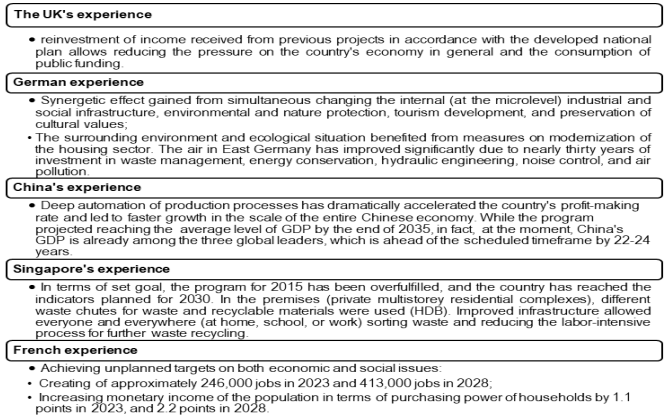
Singapore has shown that the planned indicators were overfulfilled due to the enhancement of all economic processes. China has achieved nontrivial goals in terms of gaining leadership in a certain group ofcountries/sectors. Some of the results achieved by countries can be described as the achievement of socio- economic goals (for example, in the UK, Germany, and France). Achieving environmental effects is claimed only by Germany.
Below are the main recommendations based on the best practices achieved through the projects implemented in other countries. Some of them can be transformed into indicators that are declared in the national development program of the Russian Federation.

CONCLUSION
In the current context, several important areas can be distinguished in national project formation in various countries:
-
State support of developing and modernizing environmental and energy conservation technologies.
-
Active participation of the state in the development of the urban ecosystem and infrastructure.
-
Supporting and stimulating entrepreneurship development.
-
Addressing environmental issues.
-
Searching for opportunities to use artificial intelligence.
It can be assumed that exactly these development areas of countries will remain a priority in the foreseeable future.
BIODATA
Tatiana Grigorievna BONDARENKO:Candidate of Economic Sciences, Associate Professor of Department of International Law, Finance and Economy of China, Senior Researcher of Educational Research Center "Finance", Plekhanov Russian University of Economics. Author of more than 100 scientific studies. Scientific interests: Political Science, International Relations, History, Sociology and Political Science.
BIBLIOGRAPHY
BRIOL, P. (2008). BPMN, the Business Process Modeling Notation Pocket Handbook. Lulu.com.
CHEN, C. (2003). Mapping Scientific Frontiers: The Quest for Knowledge Visualization. London: Springer- Verlag.
CONSULTATIONS PUBLIQUES. (2020). Consultation du public sur le projet révisé de Programmation pluriannuelle de l’énergie (PPE). Available: http://www.consultations-publiques.developpement- durable.gouv.fr/consultation-du-public-sur-le-projet-revise-de-a2127.html
DEUTSCHLAND.DE. (2017). The challenge “Aufbau Ost”. The reunification process is without historical precedent and a national tour de force that cannnot be completed in a few years. Available: https://www.deutschland.de/en/topic/politics/the-challenge-aufbau-ost
DÍAZ-DÍAZ, R., PÉREZ-GONZÁLEZ, D. (2016). Implementation of social media concepts for e-Government: Case study of a social media tool for value co-creation and citizen participation. Journal of Organizational and End User Computing, 28(3), 104–121.
ECOLOGIQUE-SOLIDAIRE.GOUV.FR. (2020). Programmations pluriannuelles de l’énergie (PPE). Available: https://www.ecologique-solidaire.gouv.fr/programmations-pluriannuelles-lenergie-ppe
GOV.UK. (n.d.). National Infrastructure Delivery Plan, Methods and sources for National Infrastructure Delivery Plan 2010 to 2015, 2016 to 2021. Available: www.gov.uk/government/publications
IFM BONN (based on business registration statistics kept by the Federal Statistical Office). (n.d.). In-house calculation and table. Available: // https://en.ifm-bonn.org/statistics/#accordion=1&tab=1
INSTITUE FOR SECURIRY & DEVELOPMENT POLICY. (2018). Made in China 2025 (MIC 2025). Available:https://isdp.eu/content/uploads/2018/06/Made-in-China-Backgrounder.pdf
IPE REAL ASSETS. (2020). Blackstone hires European infrastructure head from Brookfield. Available: https://realassets.ipe.com/news/blackstone-hires-european-infrastructure-head-from- brookfield/10043891.article
JI, L., LIU, C., HUANG, L., HUANG, G. (2018). The evolution of Resources Conservation and Recycling over the past 30 years: A bibliometric overview. Resources, Conservation and Recycling, 134, 34–43.
KFW. (n.d.). “Aufbau Ost” - Reconstruction of eastern Germany. Available: https://www.kfw.de/KfW- Group/About-KfW/Identit%C3%A4t/Geschichte-der-KfW/KfW-Themen/Aufbau-Ost/
MOTAMEDI, D., MILANI, A.S. (2011). Improving damage resistance of a composite pole using a computer experiment strategy. Proceedings of the ICE – Engineering and Computational Mechanics, 164(3), 171–181.
NATIONAL INFRASTRUCTURE PLAN 2014. (2014). London: HM Treasury. Available: https://assets.publishing.service.gov.uk/government/uploads/system/uploads/attachment_data/file/381884/2 902895_NationalInfrastructurePlan2014_acc.pdf
REPENNING, N.P., STERMAN, J.D. (2003). Nobody ever gets credit for fixing problems that never happened: creating and sustaining process improvement. California Management Review, 43(4), 64–88.
SERIFI, V., DAŠIĆ, P. (2012). Characteristics of traditional and contemporary models of organizational structures. In: Proceedings of the 7th International Conference ‘Quality, Management, Environment,Education, Engineering’ (ICQME-2012), 19.09.-21.09.2012, Tivat, Montenegro. Montenegro, Podgorica: Faculty of Mechanical Engineering, 333-339.
SINGAPORE'S SMART NATION PROGRAM. (n.d.). Available: https://www.smartnation.gov.sg/why-Smart- Nation/NationalAIStrategy
SMIRNOVA, E. (2018). Control capability of environmental safety in the context of 'green' construction paradigm. Espacios, 39(22), 40.
SUSTAINABLE SINGAPORE BLUEPRINT 2015. (2015). Urban Solutions. Available: https://www.clc.gov.sg/docs/default-source/urban-solutions/urb-sol-iss-7-pdfs/illustration-sustainable- singapore-blueprint.pdf
UPDATED ENERGY-CLIMATE SCENARIO. ADEME 2035-2050. (2018). Available:https://www.ademe.fr/sites/default/files/assets/documents/energy-climate-scenario-ademe-2035-2050- 010603.pdf