Artículos
Linguistic Picture of the World in the Poetry of M. Kopeev
Imagen lingüística del mundo en la poesía de M. Kopeev
 K.M ABDULLAYEVA entevaldes@outlook.com
A.K TRUSHEV aitmukhamettrushev@yandex.ru
K.S ERGALIEV kuanysh.s.ergaliev@yandex.ru
A.E ERLANOVA ayaulym.e.erlanova@yandex.ru
K.M ABDULLAYEVA entevaldes@outlook.com
A.K TRUSHEV aitmukhamettrushev@yandex.ru
K.S ERGALIEV kuanysh.s.ergaliev@yandex.ru
A.E ERLANOVA ayaulym.e.erlanova@yandex.ru
Linguistic Picture of the World in the Poetry of M. Kopeev
Utopía y Praxis Latinoamericana, vol. 25, no. Esp.6, pp. 14-28, 2020
Universidad del Zulia
Received: 12 July 2020
Accepted: 18 August 2020
Abstract: The goal of the research was to explore the linguistic picture of the world in the works of M. Zh. Kopeev. The main research methods were description, lexical and semantic, linguistic and textological, functional and cognitive, comparative, and stylistic analysis. The research results showed that the linguistic picture of the world and the experience of people living in this society are unique, since the life experience of each nation has its own specifics. Therefore, their conceptual consciousness builds a unique linguistic picture of the world, which results in the formation of the national identity.
Keywords: Cultural units, Language, Linguistic techniques, Literary works, National identity..
Resumen: El objetivo de la investigación fue explorar la imagen lingüística del mundo en las obras de M. Zh. Kopeev. Los principales métodos de investigación fueron descripción, análisis léxico y semántico, lingüístico y textológico, funcional y cognitivo, comparativo y estilístico. Los resultados de la investigación mostraron que la imagen lingüística del mundo y la experiencia de las personas que viven en esta sociedad son únicas, ya que la experiencia de vida de cada nación tiene sus propios detalles. Por lo tanto, su conciencia conceptual construye una imagen lingüística única del mundo, que resulta en la formación de la identidad nacional.
Palabras clave: Identidad nacional, Lenguaje, Técnicas lingüísticas, Obras literarias, Unidades culturales..
INTRODUCTION
The relevance of the study is determined by the growing interest in studying the relationship between culture and language, which at the end of the 20th century led to the emergence of a new branch of linguistics– cultural linguistics. In recent years, cultural linguistics and anthropological linguistics focused on studying the national and cultural specifics of the linguistic consciousness of the representatives of certain languages. To determine the relationship between culture and language, one should identify the universal and the unique in the perception of reality by the people belonging to different linguistic and cultural traditions. The research was carried out within the anthropocentric paradigm of modern linguistics, cognitive and cultural linguistics, studying the person as a linguistic personality, his individual picture of the world, and related problems. The scientific novelty of the study included examining the linguistic picture of the world in the works of M. Zh. Kopeev from a new and previously unexplored perspective – the description of the linguistic picture of the writer’s world based on the literary works created by him. The research goal was to study the linguistic picture of the world in the works of M. Zh. Kopeev. For this purpose, we set the following objectives: to analyze the main research approaches to studying the national and linguistic picture of the world; to reveal the linguistic and cultural potential of Kazakh lexical and phraseological units in the works of M. Zh. Kopeev; to examine the special expressive features of the Kazakh linguistic picture of the world in the works of M. Zh. Kopeev; to identify and explore the lexical and stylistic specifics of his works. The materials for the study included the poetry of M. Zh. Kopeev, primarily, the text in the book “We have lived a lot, but have been happy all this time” [Тірлікте көп жасағандықтан, көрген бір тамашамыз], which was published at the beginning of the twentieth century and reflected the linguistic and cultural situation in Kazakhstan of that time (Tagirova: 2018).
The works of M. Zh. Kopeev are an important part of the Kazakh poetry, which at the beginning of thetwentieth century was taking a new form. The main feature of his poetry is the reflection of the culture of the nation and the true picture of the changes taking place in the Kazakh steppe (Abdullayeva: 2018a). Today the works of M. Zh. Kopeev have been studied from a literary perspective, but his linguistic personality has not become the subject matter of linguistic research yet. In Soviet times, the works of M. Zh. Kopeev were not explored, and it was even forbidden to mention his name. Only recently, scientists took interest in his works. Modern linguistics examines the cognitive orientation based on the principle of “learning about the world within the world of language.” Thus, studying the works of M. Zh. Kopeev from the linguistic perspective meets the requirements of the present. In other words, this article presents the first attempt to study the linguistic picture of the world in the works of the poet (Khayrullina et al.: 2017; Afanasev et al.: 2018).
Having conducted the study, we identified the conceptual spheres of the linguistic personality of M. Zh Kopeev and the specifics of the use of linguistic and cultural units in his poetry. We analyzed the role of the linguistic units in the formation of the linguistic picture of the world and established the national specifics of the Kazakh worldview. We gave the linguistic characteristic of the picture of the world in his works through the national values in his cognition of the world. It was proved that the linguistic picture of the world in the works of M. Zh. Kopeev manifests itself through linguistic units and concepts. The theoretical significance of the study: The research findings and conclusions expanded the theory of the linguistic picture of the world in the Kazakh linguistics. The practical significance of the study: The research findings can be used in specialized courses, seminars, and practical tasts aimed at analyzing the language of the works of M. Zh. Kopeev (Topchy: 2019).
This article consists of several sections: Section 2 contains the literature review, Section 3 outlines the materials and research methods, Section 4 presents the results and discussion, Section 5 summarizes the findings of this study, and Section 6 gives a list of references.
LITERATURE REVIEW
Before analyzing the linguistic picture of the world in the poetry of M. Zh. Kopeev, let us define this term. The linguistic picture of the world is one of the fundamental concepts of cognitive linguistics. W. von Humboldt (2013) was the first to express the idea of a special linguistic vision of the world: he considered the language in close connection with a living organism, and regarded it as a thought-forming organ. According to W. von Humboldt (2013), only language can reveal some very important secrets, all the nuances and manifestations of the essence of the nation. In his article “How language shapes thought”, scientist L. Boroditsky (2011) claims that “language has a special influence on the cognition of the world around us”. Jean- Paul Sartre (1981) expressed a similar opinion: “Since I discovered this world through language, I perceived language as the world for a long time”. Examining this issue in his work “Through the language glass,” Guy Deutscher (2010) pays special attention to the close connections between language and culture (Afanasev etal.: 2019).
Linguists E. Sapir (1921) and B. Whorf (2012) also wrote about language as a way of learning about the reality. According to E. Sepir (1921), “it would be a mistake to believe that we can fully comprehend reality without resorting to language ... Actually, the “real world” is largely unconsciously built on the basis of the linguistic norms of a certain group”. B. Whorf (2012) shares the same opinion. These scientists believe that language is not only a means of transmitting thoughts, but also the basis for their formation, as well as for the diversity of worldviews of different peoples around the world.
The term “the linguistic picture of the world” was introduced into science by L. Weisberber (2004), who claims that it “is formed by coding knowledge about life and the ways of learning about the world by people.” At the same time, he supports the idea of W. von Humboldt (1999) that it is important to study the internal form of language, which creates images of the surrounding reality through human language. This approach represents a holistic theory that makes it possible to learn about the world around us through eyes and language. Speaking about the role of language, L. Weisberber (2004) emphasizes the verbal cognition of the world – passing on a particular worldview, behavior, and lifestyle to the future generation with available linguistic means.
Later, other scientists developed the concept of the linguistic picture of the world. However, since it is a concept with a complex structure, researchers have different approaches to understanding and describing its nature. For example, scientist V. M. Maslova (2007) believes that:
The linguistic picture of the world is the general cultural heritage of the Universe; it is structured and multi- level. This global linguistic image underlies the communicative system of understanding the human inner world and the outer world. It symbolizes the ways of verbal and mental activity, characteristic for a certain period, reflecting its spiritual, cultural and national values.
According to G. A. Brutyan (1973), “the linguistic picture of the world is general information about the internal and external world expressed in living (natural and national) languages.” A. A. Zaliznyak (2006) defines the term “the linguistic picture of the world” as a set of ideas about the world embodied in the meaning of different linguistic units such as lexical units, set phrases, certain syntactic constructions, etc., which form a single system of views or prescriptions (Galiakberova et al.: 2018; Villalobos and Ramírez et al.: 2018; Merkulova: 2019; Rosell et al.: 2020).
In this regard, we should mention Yu. D. Apresyan (1995), who presented his original ideas about the linguistic picture of the world. According to him, speakers of different languages have a different perception of the world due to the prism of the national language, so the concept of reality is different to them in some ways. On the other hand, the linguistic picture of the world refers to the “naive” worldview, quite different from the “scientific” one. Thus, each ethnos has its own special, unique picture of the world, which is reflected in the language. “Language reflects a person’s experience in interacting with the environment, and this experience is objectified in the language in its aggregate integrity, forming the linguistic picture of the world” (Kubryakova: 2003).
Linguistic pictures of the world of various languages differ from each other due to the cultural specifics of different nations. Each language is a unique national system that reveals the worldview of the people and creates their picture of the world. Thus, according to the definition given by E. S. Yakovleva (1996), we understand the linguistic picture of the world as “the model of perceiving the reality” through the language specific to each ethnic group. N. A Potapova (2018) believes that:
To identify the characteristics of a particular culture, first one should analyze the vocabulary of the language, since a person expresses his thoughts through the word, and the latter acts as the manifestation of culture and mentality. However, the word is only one of the many options for representing the world around us. Behind the word, there is a broader concept that encompasses all the options available in the language for representing a unit that is understood by a native speaker and has its own content and a certain expression in the language, primarily at the lexical level.
According to O. S. Anketina (2018), W. von Humboldt’s (1999) theory of the “internal form of language” is the basis for the idea of the linguistic (naive) picture of the world. It is expanded by the postulates of the hypothesis of “linguistic relativity” of E. Sapir (1921) and B. Whorf (2012), as well as the findings of American ethnolinguistics. In addition, these ideas were developed in the neo-Humboldtian concept of “Zwischenwelt” and the modern concepts of the naive picture of the world by Yu. D. Apresyan (1995).
Having studied the scientific papers on this topic, A. Islam (2004) notes that “a person learns about the world around him through thinking, and it is reflected in the human mind. If the truth is comprehended through thought, then language is a tool that consolidates the result of figurative thinking.” Thus, the linguistic picture of the world transmitted through the language represents the summary of the values of the nation and the world as a whole. “The individual speaks a language according to the semantic basis of the same language. Cultural values in a language form the national character and the national mentality through the meaning of the words” (Abdullayeva: 2018b). N. Wali (2007) notes that “the linguistic picture of the world reflects mythological, religious, and logical positivism cognition”. However, B. I. Nurdauletova (2008) believes that “since the picture of the world is a broader philosophical and language category, at the level of a certain nation, the linguistic picture of the world should be considered together with the model of the world in universal knowledge and within the holistic conceptual picture of the world”.
Having analyzed the researchers’ position on this issue, we can conclude that the linguistic picture of the world is a cognitive and psychological reality, which manifests itself in the mental and cognitive activity of the nation, their actions, and verbal behavior. A certain community and its representatives comprehend the reality through their mentality, thus building their own way of life. The picture of the world, reflected in the national mentality, history, traditions, interconnected generations, lives in the human mind. “Consciousness is the result of centuries of mental work of the whole ethnic group or society” (Gorlo: 2007). Next, the picture of the world preserved in this consciousness expresses itself through a system of certain symbols, primarily through the national mentality and artistic works. Therefore, the analysis of the works of art reflecting the national picture of the world allows one to understand these people. The picture of the world in a work of art is determined by studying verbal and artistic means, original language units of the author, illustrating the personal picture of the world formed by the creator of this work.
G. Zh. Snasapova (2003) considers each linguistic and cultural unit in an artistic work as an indicator that defines the linguistic picture of the world. Sh. M. Elemesova (2003) examines the linguistic features of a literary text in connection with the psycholinguistic basis of stylistic, linguistic, and poetic analysis. In our opinion, it is crucial to explore the interconnection between language and culture as only this approach ensures the thorough understanding of the linguistic picture of the world.
When exploring the linguistic and cultural orientation, researchers should combine cognitive and cultural aspects as this allows one not only to determine the integrative nature of linguistic knowledge, but also toidentify the numerous connections in the trinity “Language, Man, and Culture,” which represents the specifics of cultural linguistics, according to G. Smagulova (1998).
An artistic picture of the world may embrace separate concepts that are characteristic of the author’s perception of the world. Therefore, the language here acts as a means of creating a secondary picture of the world belonging to the creator of this work of art. Modern linguistics defines the terms “concept” and “linguistic picture of the world” in different ways. Summarizing all the definitions, we can identify two with opposite meanings: 1) the concept is the key word of spiritual culture; 2) the concept is “the primary term denoting a psycho-mental phenomenon acting as an incentive for speech production. A. Amirbekova (2006) explains these different aspects of the concept: cultural linguistics claims that “the concept is comprehended as a unit that determines the cultural, spiritual, ethical, and social understanding of the world.”
Therefore, the picture of the world must primarily be considered in connection with culture. Then one should explore the individual language of the author, as the cultural concept is perceived as information manifesting itself in the specifics of national culture. A conceptual analysis allows one to reveal the nature of a cultural concept. Its main goal is to identify the symbols of national culture and to explain the essence of general cultural concepts that accumulate knowledge about the linguistic picture of the world.
METHODS
G. T. Karipzhanova (2016) singles out several elements of the national culture in the works of M. Zh. Kopeev: “National culture, national art, religious worldview, and the national cognitive world”. In this regard, the researcher speaks about the linguistic means representing national traditions and customs in the national culture. In turn, relying on the opinion of G.T. Karipzhanova (2016), we analyzed the specifics of the application of the linguistic units denoting hospitality and matchmaking of the Kazakh nation in Kopeev’s works.
Next, we studied the concepts of “life” and “death.” A concept is a notion that has become part of culture. According to N. D. Arutyunova (1988) and V. N. Teliya (1996), “a concept is a semantic development marking linguistic and cultural specifics and characterizing the representatives of this ethnic and cultural group in a certain context”. Scientists examined the conceptual sphere of Russian culture and divided all concepts into several groups. In Kazakh linguistics this work was carried out by K. Zhamanbayeva (1998). This is a scientist who, for the first time in the history of Kazakh linguistics, performed a comprehensive analysis of such concepts as linguistic consciousness, a system of language models, a unique personality, gestalt theory, text structure, artistic discourse, and the concept of sadness.
Conducting linguistic studies, researchers explore various ethical, philosophical, cultural, dominant (priority) aspects related to the internal life of a nation. These include such categories as life, death, truth, beauty, love, good, and evil. According to A. Amirbekova (2006), the concept of “life” is one of these, and it has different aspects in a poetic text. The concept “death” has philosophical significance and represents a complex mental world. Therefore, it reveals itself through diversified information.
In this research paper, we presumed that the concepts of “life” and “death” have certain components, on the basis of which one can fully describe the cognitive nature of these concepts. The poems presenting such components are one of the most significant works of M. Zh. Kopeev. This determined our choice of these concepts while exploring his picture of the world.
G. T. Karipzhanova (2016) divides concepts in the works of M. Zh. Kopeev into the following groups: life, death, fate, humanity, conscience, love, Allah the Almighty, the sun, the moon, a star, and others. They are expressed with words, phrases, set phrases, sentences, the whole text, etc. In our study, we relied on the analysis of G. T. Karipzhanova (2016), with a focus on the concepts of “life” and “death”. To determine the national specifics of these concepts, we considered their linguistic picture, combination, contextual use, semantics, figurative associations, phraseology, and their presentation as part of language templates. This allowed us to reveal the true cognitive meaning of the concepts of “life” and “death”.
Materials
In a work of art, poets and writers build a unique picture of their imagination, creating a novel atmosphere that represents the cutting-edge thoughts of their time. The main feature of M. Zh. Kopeev’s style was his ability to form his own national idea using various linguistic techniques.
The poet’s works reveal the national specifics and the national character of the Kazakh people. For example, in his poem “To those who speak badly about the Kazakhs” [Қазақты жамандаушыларға], M. Zh. Kopeev emphasizes the hospitality of the Kazakh people. To prove this, let us quote the following verses: “For Kazakhs, treating a guest is like Ait or a festivity (Ait is a Muslim holiday of the first meal after fast). When guests arrive, the Kazakh must slaughter cattle... They slaughtered a sheep and gave them syrbaz (a Kazakh national dish, fresh young mutton). And we gave our blessing” [Қазақта қонағасы айт пен тойдай, Отырмас қонақ келсе, бір мал соймай...Сойды да бір сырбаздың басын берді, Қол жайып, бердік бата бізде дайын].
This extract shows the hospitality of the Kazakh people. Hospitality is a special courtesy, respectful attitude of the house owner to the guest. The free-loving nature and generosity of the Kazakh people manifest themselves in their exceptional hospitality. To give a guest appropriate respect and warm welcome, to lay the table [дастарқан] is a long-standing tradition. In this context, “welcoming a guest like God” is a duty for every family [шаңырак]. According to the tradition of the past, the owner of the house, noticing a guest going to the house, depending on the age and the position of the guest, went out to meet the visitor himself or sent older children. They greeted the guest at the place where the horse was tied, helped to get off and led him to the house. In addition, when approaching the village [ауыл], the traveler got off his horse, demonstrating who he was and to whom he was going, and reached the house on foot. The guests’ respectful attitude and reverence demonstrated the high culture of the steppe. Nomads’ traditions and laws of hospitality were the basis for strong ties within the country and maintained social integrity. Hospitality has been preserved by the Kazakh people to this day.
The cultural specifics, distinguishing the Kazakhs from other nations, are an important element of their linguistic picture of the world. For example, in Kopeev’s poem “This Epoch” [“Мына заман”] in the lines “They proposed and ate kurdyuk (tail fat of some breeds of sheep) and liver.” “Екеуі құда болды ”Құдай!” – десіп, Биылғы жыл құйрық пен бауыр жесіп” the words “kurdyuk and liver” [құйрық-бауыр] can be perceived by the representatives of other nationalities as an anatomical term or as a dish. However, not everyone can understand that in Kazakh culture, “kurdyuk and liver” is a tradition connected with matchmaking, a tradition of two families, one of which gives a daughter and the other takes a bride. Although this is a ritual, in reality it plays a special role in the Kazakh national traditions. When matchmaking takes place with the agreement of both parties, they, along with “kurdyuk and liver” exchange special gifts. At the same time, both parties should try this dish. “Kurdyuk and liver” is a recognized symbol of matchmaking – it was fixed as a document. It is clear that such words and phrases as hospitality, to eat kurdyuk and liver [қонақжайлық, құйрық пен бауыр жегізіп] reflect the linguistic picture of the world of the Kazakh consciousness, as well as the culture of the Kazakh mentality.
From ancient times, the Kazakh people, moving to pastures [жайлау] in the summer and returning to the winter quarters, led a nomadic and warlike lifestyle. The traditions of the nomadic people have their own specific features. That is, the migration had its influence on the life of the people. M. Zh. Kopeev writes: “My year is the year of the ram, and in the year of the rooster I was three years old. [Жылым – қой, тауық жылы мен үш жаста]. Also, he says “Summer has come. Rural houses were built. Markets began to work. And this will continue until the autumn. Nomadic Kazakhs settled down on the hills of summer pastures on the shores of Akshakol. They stretched along the entire lake and drink koumiss [Жаз болса ауыл үй боп ыңғай қонып, Қызады базарлары күз болғанша. Басында Ақшакөлдің жаз жайлауда, Көшпелі қазақ болып қырға шықты... Қымызын басын қосып ортаға алған, Жағалай қонып алып судың бойын]. These lines demonstrate that the Kazakhs led a nomadic lifestyle. Turkologist V. V. Radlov wrote in this regard: “Thenature, behavior, traditions, system of thinking, in fact, the whole life and all actions of the people are directly connected with nomadic life.” Thus, we can say that M. Zh. Kopeev describes the features of the linguistic culture of the world in the Kazakh language with the help of traditions specific to the Kazakh people and the national culture that is different from other peoples.
In the works of M. Zh. Kopeev we found the following concepts describing his picture of the world: life, death, fate, humanity, conscience, love, Allah Almighty, the sun, the moon, and a star. This is a set of individual definitions that represent the “cognitive image” of the author. These concepts are the constants for Kopeev’s picture of the world as they can be found throughout his works. These concepts lay creative foundations for other poets and writers. Nevertheless, each artist demonstrates his knowledge and a unique creative world through his mastery. Due to the limitations imposed in the article, we analyzed only some of these concepts. Conceptual analysis was carried out to obtain information about the linguistic picture of the world.
V. I. Postavalova (1988) believes that “conceptual analysis aims to determine common concepts grouped around one symbol, to determine the role of this symbol in the cognitive structure.”
One can single out individual national concepts among universal human ones as the general human culture consists of the elements of national culture. For example, the concept of love manifests itself in different ways for different nationalities. The understanding of love in M. Zh. Kopeev’s works is connected with religious ideas.
At the same time, conceptual analysis is the only linguistic tool that reveals the author’s attitude to the truth and presents the second element of the analysis of an artistic work. For example, M. Zh. Kopeev sharply reacts to the attempts to solve national problems and their criticism. His attitude to the motherland manifests itself through the concept of “humanity.” For example, the poet’s words “when two swords managed to fit into one sheath” [Екі қылыш бір қынға қашан сыйған] convey important meaning.
One of the concepts that is common for all people and plays a central role in their picture of the world isthe concept of “life.” The word “life” [өмір] came into the Kazakh language from the Arabic. Its first meaning is “life”, whereas the second meaning (“human age”, “life expectancy”) has a macro-frame connection with such concepts as “time”, “era”, “fate”, “death.” According to linguistic characteristics, it belongs to this lexical and semantic group. The concept of “life” [өмір] is represented by the following phrases: acting during one’s life, the illusory world [жалған дүние], the joys of life [дүниенің базары], the whole world [дүние жүзі], a short life [қысқа ғұмыр], the mean world [сұм дүние], etc. From a philosophical point of view, “life” [өмір] is a certain period of time granted to a person. Life is not given to man twice. M. Zh. Kopeev describes this phenomenon as follows: “Ishan (the character) left this world, there is no returning after leaving [Ишекем өтіп кетті бұл жалғаннан, Келу жоқ қайта айналып сол барғаннан]” (Kopeev: 2004).
In general, when analyzing the concept of “life” [өмір], we also considered its lexeme “the world” [дүние] from the same lexical and semantic group. The poet depicts the world as a “dark night”: “This world is a cloud without the moon, a dark night [Бұл дүние − айсыз бұлт, қараңғы түн]” (Kopeev: 2003a). According to Muslim beliefs, the Kazakhs divide the world into “another world” [о дүние] and “this world” [бұ дүние]. In Islam, “this world” [бұ дүние] is perceived as “deceptive, mean, and fleeting” [жалған, опасыз, өткінші]. This explains the obscurity and cruelty of this world, which are reflected in the language of M. Zh. Kopeev, who deeply understood the Muslim teaching: Who drank the water of Eternity in this mortal world? This world is not eternal, it is fleeting... Death will spare no one. Whoever is born will surely die. Will a person die of weakness?! This world has no peace like a gusty wind... [Бұл опасыз дүниеде, Мәңгі суын кім ішкен?!.. Дүние опасы жоқ, түбі шолақ,.. Қояды қаза жетсе, кімді аяп; Дүниеден кетпей тұрмас, келсе адам, Өлеме осалдықтан өлген адам?! Бір дұға: өліге де, тіріге де, Хазіретті көріп, естіп білген адам; Бұл дүние тынымы жоқ ескен желдей, Қаңбақтай бір күн еріксіз домалатар. Бір-ақ дем жоқ болады бітерінде, Шолтаңдап шолақ дүние кетерінде] (Kopeev: 2003a).
Sometimes he depicted the world as “terrible”, “cunning”, “deceptive”: It calms everyone in different ways. The mortal world is deceptive. People are fleeting guests, and the mortal world, why are you so swift?! A deceptive life is reasonable. Guys, you can talk a lot, but this life will pass quickly. It will deceive us and pass quickly, making many people sad [Әркімді әр түрменен жұбатады, Сұм дүние алдандырып тастарына; Бұл опасыз, сұм дүние − кімдерден дейсіз қалмаған?! Жүрген жан − бір-біріне аз күн қонақ, Сұм жалған, болармысың мұнша шолақ?! Біреу олай болғанда, біреу – бұлай, Қу заман ойлы-қырлы болып жатыр.Жігіттер, айта берсем, таусылмас сөз, Бұл жалған бәрімізден өтеді тез; Өстіп алдап өтеді мына жалған, Талай жанның көңіліне қайғы салған] (Kopeev: 2003a). Thus, the author highlights the brevity, transience and deceitfulness of life.
In the Kazakh picture of the world, a difficult life is called a “dog’s life”, and difficult moments of life are associated with the image of a “dog”. In the poem “The Dog’s World” [ит дүние] M. Zh. Kopeev uses this very phrase. In the lines “The Dog’s World, why are you so clumsy? You are meek without a mane and a tail, nothing to grab hold of. The Dog’s World, you’re a dervish. You are like a goatling playing on a cliff. Like mercury. You run like a mountain spring [Ит дүние, мұнша неге олақ болдың, Ұстауға құйрық-жал жоқ шолақ болдың. Ит дүние, ойлап тұрсам, диуанасың, Ит дүние, жарға ойнаған лақтайсың, Толқыған керетіңдесынаптайсың! Тасыған таудан аққан бұлақтайсың!]. The phrases “құйрық-жал жоқ шолақ” (short without a mane and a tail, nothing to grab hold of), “диуанасың” (a wandering dervish), “жарға ойнаған лақтайсың” (like a goatling playing on a cliff), “сынаптайсың” (like mercury), “таудан аққан бұлақтайсың” (running like a mountain spring) are the examples of the author’s use of words revealing the nature of the deceptive life. The figurative phrase “the dog’s life” emotionally conveys the cruelty and the fleeting nature of life. The poet expresses the transience and the deceitfulness of the world in the following lines: “This world, if you think about it, is deceptive [Дүние, ойлай берсем, жалған дейдi]. A trial awaits everyone here [Әркім дi әлекке тек салған дейдi]. Chasing the blessings of life till the death [Дүниенi өле-өлгенше қуып-қуып]. In the end, you are standing with your mouth agape, empty-handed [Ауызы аңқиып құр босқа қалған дейдi)] (Kopeev: 2003b).
One of the universal concepts in Kopeev’s picture of the world is the concept of “death”. It is expressed through frame lines, reflecting how the world is perceived by the author. These concepts are also given together with common prototypical meanings through the author’s personal models. The concept of “death” in the works of M. Zh Kopeev is expressed with the lexemes “өлім” (death) and synonymous semantic lexems such as “қаза” (dying), “ажал” (death, decease). In addition to this, there are such phrases as “жан беру” (to draw one’s last breath), “өлу” (to die), “өмірмен қоштасу” (to say goodbye to life), “қайтыс болу” (to perish), “мерт болу” (to fall dead), “үзілу” (to stop suddenly), “мезгіл жетпей солу” (untimely end): “Death comes to all in the same way. We approached the village of the dead. After death, you lose your tongue and jaw. He has also met his death. My red flower fell to the ground, the sun went down at wrong time. A freshly blooming flower withered in the spring [Бұл өлім бірдей келер бар мен жоққа; Тіршілік қызығынан бой алыс боп, Аулына өлгендердің жақындастық; Өлген соң айырыласың тіл мен жақтан; Күнінде қаза жетіп о да өлген; Үзіліп жерге түсті қызыл гүлім, Мезгілсіз батып кетті-ау күндіз күнім?! Піспеген егін жастай орылған соң, Дал болып тоқтап қалды-ау сөйлер тілім! Өлімнің түтіндеген есті желі, Қараңғы бұл дүниені қаптап түні. Көктемде жазғытұрым сола қалды-ау, Үлпілдеп жаңа шыққан жанның гүлі!] (Kopeev, 2003, Vol 2: 158).
In addition, one of the indicators of the concept of “death” is the lexeme “өлік” (dead). It is used to express concepts related to the plane “дала өлік” (dead steppe), “сар дала бейне өлік” (yellow steppe is like dead), “үнсіз өлік – бетпақ шөл” (Betpak desert is speechless like a dead person). Although M. Zh. Kopeev describes the concept of “death”, he does not define it explicitly, but combines incongruous words. That is, when used separately, these words do not form phrases. He creates combinations that give half of the concept: “тірі өлік” (the living dead), “жарты өлік” (half dead).
RESULTS
The linguistic picture of the world reflects not only traditional linguistic elements characteristic of the whole society (proverbs, sayings, phraseological units, etc.), but also non-traditional ideological structures and extra- linguistic facts that come from various fields (Pajdińska & Tokarski: 2010).
The phrases “қонақасы” (treats for the guest), “мал сою” (to slaughter cattle), “бас ұсыну” (to offer the head), “қол жайып бата беру” (to give a blessing), “құйрық бауыр жесу” (to eat kurdyuk and liver), “ауыл үй” (a rural house), “ыңғай қону” (sitting in a line), “Ақшакөл (Akchakol lake), “жаз жайлау” (to stay on summer pastures), “көшпелі қазақ” (a nomadic Kazakh), “қырға шығу” (migration) used in the works of M. Zh. Kopeev represent the Kazakh national knowledge and traditional lifestyle in the mind of the writer. Figurative words help us understand the soul of the author. In addition to that, we can learn the nation’s perspective of the world through the values the author adheres to. These values are considered as the elements making up the linguistic picture of the world.
The linguistic and cultural units examined above are important concepts for the Kazakh people. They are the key element of the spirituality of the nation as they have special significance in the people’s cultural and spiritual life. Let us present these concepts in a chart (Figure 1).
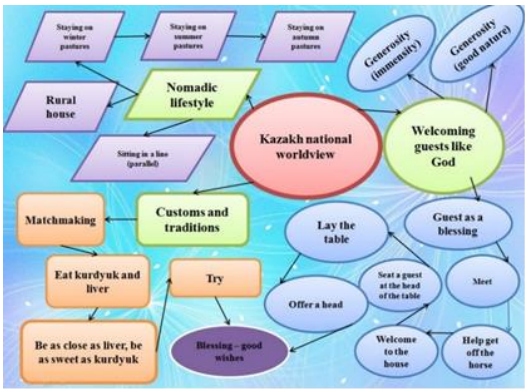
Figure 1. The reflection of the Kazakh national worldview in the picture of the world.
In Figure 1, we tried to present a picture of the world that can be found in a work of art. “Customs and traditions have been formed for centuries in accordance with religion and faith, lifestyle, and specifics of the national structure of each nation. They are the law for social life. They built spiritual wealth and educational experience in the minds of the people. These requirements and rules were obeyed and stringently executed. Traditions and customs have become unquestionable law for the Kazakhs” (Kenzhehmetuly: 2013).
The next concept is “life and death”. This is a cognitive unit that immediately refers to a person. Humanity perceives it differently, despite the fact that it is common for all people. The concept of “life” in the poetry of M. Zh. Kopeev consists of the following logical and language models (Table 1).
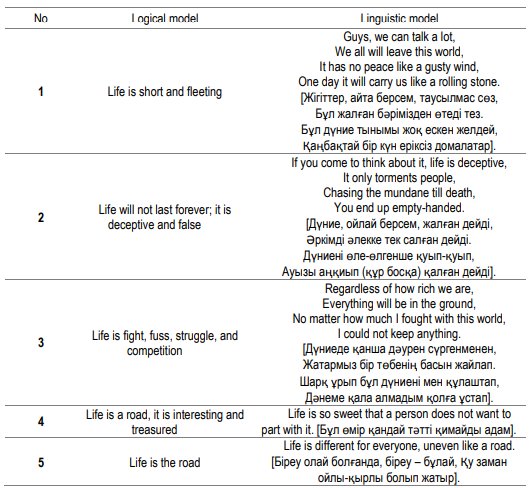
The cognitive nature of the concepts “life” and “death” is revealed through certain components that make them a comprehensive representation of the cognition.
In addition, in the nation’s picture of the world, death is not only an inevitable natural phenomenon, but it also has certain religious content. Man is a biological creature that exists between life and death. Life for a human is as important as death. Having studied the poetry of M. Zh. Kopeev, we defined the following linguistic and logical elements of the concept of “death” in the cognitive world of the ethnos (Table 2).
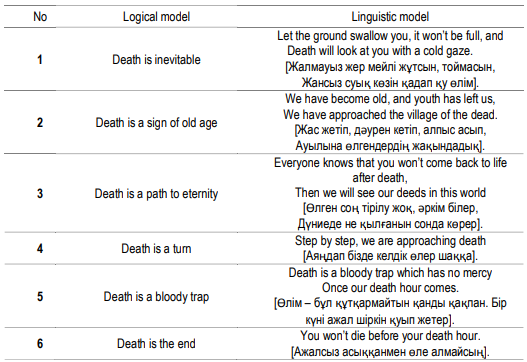
DISCUSSION
In this article, we studied the linguistic picture of the world in the works of M. Zh. Kopeev from a new, relevant, and previously unexplored aspect. To achieve this goal, the following objectives were accomplished:
1. We analyzed the main research approaches to the national and linguistic picture of the world: we determined the theoretical and practical foundations of research and considered the problems of language and cognition within a new scientific paradigm. We explored the basic principles of linguistics, cultural linguistics, and cognitive research in linguistics. We examined linguistic, cultural, and conceptual features of the linguistic units in the works of M. Zh. Kopeev and analyzed their manifestations in his picture of the world.
2. We revealed the linguistic and cultural potential of the lexical and phraseological units in the works ofM. Zh. Kopeev. This included the specifics of the linguistic units in his works characteristic of the Kazakh nation, making up a unique linguistic picture of the world. We focused on the following linguistic units in the works of M. Zh. Kopeev: “treats for the guest” [қонақасы], “to slaughter cattle” [мал сою], “to offer the head” [бас ұсыну], “to give a blessing” [қол жайып бата беру], “to eat kurdyuk and liver” [құйрық бауыр жесу], “a rural house” [ауыл үй], “moving to pastures” [ыңғай қону], “Akshakol” [Ақшакөл], “staying on summer pastures” [жаз жайлау], “a nomadic Kazakh” [көшпелі қазақ], “migration” [қырға шығу]. They are the manifestations of the Kazakh national cognition and the traditional way of life in the cognition of the writer.
3. We studied how the Kazakh linguistic picture of the world is expressed in the works of M. Zh. Kopeev. We established that the main feature of his works is the structure of the system of cultural concepts evolving at the beginning of the twentieth century and the linguistic personality of the writer. We determined the specific concepts used in the works of M. Zh. Kopeev that describe the picture of the world in his language. Having analyzed M. Zh. Kopeev’s works, we defined the concept of “life”: its first meaning is “life”, while the secondmeaning is “the age of a person” and “the whole life”, with a macro-frame connection with the concepts of “time”, “era”, “fate”, “death”, etc. Also, we revealed its role in the middle lexical and semantic group as a linguistic unit. It was established that the concept of “life” was used by M. Zh. Kopeev as phrases: an illusory world, the joys of life, the whole world, a short life, the mean world, a deceptive world, etc. We found out that the concept of “death” in the works of M. Zh. Kopeev is expressed with the lexemes “death” [өлім] and the semantic lexems synonymous to it, for instance, “қаза” (dying) and “ажал” (death, decease). In addition to this, there are such phrases as “жан беру” (to draw one’s last breath), “өлу” (to die), “өмірмен қоштасу” (to say goodbye to life), “қайтыс болу” (to perish), “мерт болу” (to fall dead), “үзілу” (to stop suddenly), and “мезгіл жетпей солу” [untimely end]. We proved that one of the indicators of the concept of “death” in M. Zh. Kopeev’s language was the lexeme “dead” [өлік], which was used to convey concepts in this plane. AlthoughM. Zh. Kopeev describes the concept of “death”, he does not give its full meaning, but combines incongruouswords. That is, when used separately, they do not form set phrases. M. Zh. Kopeev creates combinations that express half of the concept: “the living dead” [тірі өлік], “half dead” [жарты өлік], etc.
4. We identified and studied the lexical and stylistic features of the author’s works: M. Zh. Kopeev skillfullyImportar listaused lexical units, set phrases, and artistic means of language. He applied various linguistic methods, which allowed him to convey the Kazak national idea in a special manner. “For Kazakhs, treating guests is like Ait or a festivity (Ait is a Muslim holiday of the first meal after fast). When guests arrive, the Kazakh must slaughter cattle ... They slaughtered a sheep and gave them syrbaz (a Kazakh national dish, fresh young mutton). And we gave our blessing” [Қазақта қонағасы айт пен тойдай, Отырмас қонақ келсе, бір мал соймай...Сойды да бір сырбаздың басын берді, Қол жайып, бердік бата бізде дайын].
CONCLUSION
This study determined the theoretical and practical foundations of research and considered the problems of language and cognition within a new scientific paradigm. The linguistic and cultural potential of the lexical and phraseological units in the works of M. Zh. Kopeev were also revealed. This article established that the main feature of his works is the structure of the system of cultural concepts evolving at the beginning of the twentieth century and the linguistic personality of the writer. Finally, we identified and studied the lexical and stylistic features of the author’s works.
The findings and conclusions obtained during the study contribute to the theory of the linguistic picture of the world in Kazakh linguistics. The results of the research paper can be used in special courses and seminars, practical tasks aimed at analyzing the language in the works of M. Zh. Kopeev.
BIODATA
K.M. ABDULLAYEVA: K.M Abdullayeva is a doctoral student (PhD) of the Pavlodar State University named after S. Toraigyrov, Pavlodar, Kazakhstan.
A.K TRUSHEV: A.K Trushev is the researcher of life and work of Mashkhur Zhusup Kopeev, Doctor of Philology, Professor. He works at the Pavlodar State University named after S.Toraigyrov, Pavlodar, Kazakhstan.
K.S ERGALIEV: K.S Ergaliev is the Dean of the Higher School of Humanities of Pavlodar State Pedagogical University, PhD in Philology, associate professor. He works at the Pavlodar state pedagogical University, Pavlodar, Kazakhstan.
A.E ERLANOVA: A.E Erlanova is the Master of Education (2013-2015). She works at the Pavlodar state pedagogical University, Pavlodar, Kazakhstan.
BIBLIOGRAPHY
ABDULLAYEVA, K (2018a). “Lingustic cultural units in M. Zh. Kopeev’s poetry. In Science and Education – An Important Factor of Society Development in Modern Conditions: Materials of The 5th International Scientific-Practical Conference.” Karagandy: Kazakhstan, “Kent LTD” LL Printing Office “Doszhan” Publishing Office.
ABDULLAYEVA, K (2018b). “Linguistic picture of the world in the works of M. Zh. Kopeev. The priorities of the world science: experiments and scientific debate: Proceedings of the XVII International scientific conference 4-5 April.” North Charleston, South Carolina: USA, Great Steppe Publication.
AFANASEV, N, DYACHKOVSKY, F, PINIGINA, O, POPOVA, N (2018). “Lexico-semantic group “decoration” in the linguistic picture of the world of the Sakha people.” Amazonia Investiga, 8(22), pp.620-628.
AFANASEV, N, DYACHKOVSKY, F, PINIGINA, O, SLEPZOV, P. (2019). “Semantic relation of the word representing the concept КҮН ‘SUN’ with the concept of time in the Sakha linguistic picture in the world.” Amazonia Investiga, 8(24), pp.152-156.
AMIRBEKOVA, A (2006). “Specifics of verbalization of conceptual structures in the poetic text (on the example of M. Makatayev’s poetry). Dissertation of Candidate of Philological Sciences.” Almaty: Kazakhstan, Atamura Publication.
ANKETINA, O (2018). “Linguistic methods of expressing the category of space in the artistic picture of the world of Ch. Dickens. Dissertation of Candidate of Philological Sciences.” Maykop: Russia, Maykop Publication.
APRESYAN, Y (1995). “The image of the human in the language: an attempt of comprehensive description.” Topics in the Study of Language, 1, pp.38–39.
ARUTYUNOVA, N (1988). “Image/Attempt of conceptual analysis. In Reference and the Problem of Text Formation.” Moscow: Russia, Nauka Publication.
BORODITSKY, L (2011). “How language shapes thought.” Scientific American, 304(2), pp.63-65.
BRUTYAN, A (1973). “Language and the picture of the world.” Philosophical Sciences, 1, pp.108-110.
DEUTSCHER, G (2010). “Through the language glass: why the world looks different in other languages. 1stedition.” New York: United States, Metropolitan Books Henry Holt and Company, LLC.
GALIAKBEROVA, A, ASRATYAN, N, ASRATYAN, Z, MUKHAMETSHIN, A (2018). “Conceptual, Linguisticand Pedagogical Aspects of Humanitarian World Picture.” Journal of History Culture and Art Research, 7(3), pp.43-50.
GORLO, E (2007). “Universal anthroponomic model of poetic discourse. Author’s Abstract of the Dissertation of Doctor of Philological Sciences.” Rostov-on-Don: Russia, Rostov-on-Don Publication.
HUMBOLDT, W (1999). “On Language, On the Diversity of Human Language Construction and Its Influence on the Mental Development of the Human Species. Edited by Michael Losonsky.” Cambridge: England, CUP Publication.
HUMBOLDT, W (2013). “On the difference between the organisms of the human language and on the impact of this difference on the mental development of the human race: Introduction to universal linguistics. Translated from German, 2nd edition.” Moscow: Russia, Librocom Publication.
ISLAM, A (2004). “The linguistic picture of the world in the context of national culture, Author’s Abstract of the Dissertation of Candidate of Philological Sciences.” Almaty: Kazakhstan, Atamura Publication.
KARIPZHANOVA, G (2016). “Conceptual system of the national worldview in the works of M. Zh. Kopeev.” Herald of West Kazakhstan State University Journal, 2, pp.267-275.
KENZHEHMETULY, S (2013). “Kazakh customs and traditions. 2nd edition.” Almaty: Kazakhstan, Atamura Publication.
KHAYRULLINA, R, FATKULLINA, F, MOROZKINA, E, SAGHITOVA, A, SULEIMANOVA, A, VOROBIOV, V(2017). “Language personality in the bilingual context of the national linguistic world pictures.” Man in India, 97(17), pp.1-11.
KOPEEV, M (2003a). “Collection of Works, Vol. 1.” Pavlodar: Kazakhstan, ECO Publication.
KOPEEV, M (2003b). “Collection of Works, Vol. 2.” Pavlodar: Kazakhstan, ECO Publication.
KOPEEV, M (2004). “Collection of Works. Vol. 4.” Pavlodar: Kazakhstan, ECO Publication.
KUBRYAKOVA, E (2003). “On a fragment of the conceptual analysis of the word “memory”. Logical Analysis of Language. Cultural Concepts.” Moscow: Russia, Nauka Publication.
MASLOVA, V (2007). “Introduction to Cognitive Linguistics.” Moscow: Russia, Nauka Publication.
MERKULOVA, N (2019). “Report on Professional Development under the Program" Linguistic-and-DidacticAspects of Translator's Professional Training" within the Framework of the International Scientific-and-Practical Conference" Language Picture of the World in the Mirror of Translation"(VSU-ESIT), Voronezh, 12- 15 December 2018.” Scientific Journal Modern Linguistic and Methodical-and-Didactic Researches, (1), pp.146-150.
NURDAULETOVA, B (2008). “The conceptual image of the world in zhyraus’ poetry. Dissertation of Doctor of Philological Sciences.” Almaty: Kazakhstan, Gylym Publication.
PAJDIŃSKA, A, TOKARSKI, R (2010). “Linguistic picture of the world and creative text.” Slovo a Slovesnost, 71(4), pp.288-297.
POSTAVALOVA, V (1988). “The role of money factor in language: Language and the world map.” Moscow: Russia, Nauka Publication.
POTAPOVA, N (2018). “Paremias with the component “mineral resources” in the Russian thesaurus. Dissertation of Candidate of Philological Sciences.” St. Petersburg: Russia, St. Petersburg Publication.
ROSELL AIQUEL, R; JUPPET EWING, M; RAMOS MARQUEZ, Y; RAMÍREZ MOLINA, R y BARRIENTOSORADINI, N (2020). “Neurociencia aplicada como nueva herramienta para la educación”. En Opción. Revista de Ciencias Humanas y Sociales. Año 36, No. 92: 792-818.
SAPIR, E (1921). “Language: An Introduction to the Study of Speech.” New York: USA, Harcourt, Brace Publication.
SARTRE, J (1981). “The Words. Translated by B. Frechtman.” New York: USA, Mass Market Paperback, Vintage Publication.
SMAGULOVA, G (1998). “National-cultural aspects of related phraseologies.” Almaty: Kazakhstan, Atamura Publication.
SNASAPOVA, G (2003). “Linguistic cultural units in the story of G. Musrepov “Ulpan”. Dissertation of Candidate of Philological Sciences.” Almaty: Kazakhstan, Gylym Publication.
TAGIROVA, T (2018). “A Culture-Specific “Linguistic Picture of the World” in the Organization of Scientific Discourse in a Foreign Language. In the International Science and Technology Conference" FarEastСon" (pp. 19-26).” Gewerbestrasse” Switzerland, Springer, Cham.
TELIA, V (1996). “Russian phraseology: semantic, pragmatic and cultural linguistic aspects.” Moscow: Russia, Languages of Russian Culture Publication.
TOPCHY, O (2019). “Shade palette of color nomination red in the linguistic picture of the world.” Lviv philological journal, (6), pp.209-213.
VILLALOBOS ANTÚNEZ, J y RAMÍREZ MOLINA, R (2018). “El derecho a la autobiografía: dimensión ius- filosófica desde la perspectiva de H. Arendt y P. Ricoeur”. En Opción. Revista de Ciencias Humanas y Sociales. Año 34, No. 18: 1012-1587.
WALI, N (2007). “Theoretical foundations of the Kazakh word culture. Author’s Abstract of the Dissertation of Doctor of Philological Sciences.” Almaty: Kazakhstan, Gylym Publication.
WEISBERBER, J (2004). “Mother tongue and building the spirit (Muttersprache und Geistesbildung. Translated from German, foreword and commentary by O. A. Radchenko. 2nd edition.” Moscow: Russia, URSS Publication.
WHORF, B (2012). “Language, thought, and reality: selected writings of Benjamin Lee Whorf [2nd ed.]: introduction by J. B. Carroll; foreword by S. C. Levinson. (J.B. Carroll, S.C. Levinson, & P. Lee, Eds.).” Cambridge, MA: MIT Press.
YAKOVLEVA, E (1996). “Elements of the Russian linguistic picture of the world (models of space, time and perception).” Moscow: Russia, Languages of Slavic cultures Press.
YELEMESOVA, S (2003). “Linguistic references of national culture in the literary text (on the example of G. Musrepov’s novel “The Kazakh soldier”). Dissertation of Candidate of Philological Sciences.” Almaty: Kazakhstan, Gylym Publication.
ZALIZNYAK, A (2006). “Polysemy in a language and its manifestations.” Moscow: Russia, Languages of Slavic cultures.
ZHAMANBAYEVA, K (1998). “Cognitive foundations of language use: Emotion, symbol, language awareness.” Almaty: Kazakhstan, Gylym Publication.