Artículos
Legal Analysis of State Support for Compatriots Abroad Enshrined in Kazakhstan
Análisis legal del apoyo estatal para compatriotas en el extranjero consagrado en Kazajstán
 Y.A ONGARBAYEV ye.a.ongarbayev@yandex.ru
A.M NURMAGAMBETOV a.m.nurmagambetov@yandex.ru
S.B ZHARKENOVA s.b.zharkenova@yandex.ru
G.G GALIAKBAROVA g.g.galiakbarova@yandex.ru
Y.A ONGARBAYEV ye.a.ongarbayev@yandex.ru
A.M NURMAGAMBETOV a.m.nurmagambetov@yandex.ru
S.B ZHARKENOVA s.b.zharkenova@yandex.ru
G.G GALIAKBAROVA g.g.galiakbarova@yandex.ru
Legal Analysis of State Support for Compatriots Abroad Enshrined in Kazakhstan
Utopía y Praxis Latinoamericana, vol. 25, no. Esp.6, pp. 29-39, 2020
Universidad del Zulia
Received: 12 July 2020
Accepted: 18 August 2020
Abstract: The goal of this article was to study the problematic of legal regulation of state support for the compatriots abroad. The authors applied general scientific methods, as well as special techniques and for studying phenomena and processes. The issues of state support for compatriots abroad, primarily the Kazakh diaspora, were examined from different perspectives. The research results included the consideration of the most positive aspects of legal regulation of support for compatriots, and the development of proposals to be included in the first draft bill in the history of modern Kazakhstan.
Keywords: Compatriots abroad, Diaspora, Draft bill, International experience, Migration..
Resumen: El objetivo de este artículo fue estudiar los problemas de la regulación legal del apoyo estatal para los compatriotas en el extranjero. Los autores aplicaron métodos científicos generales, así como técnicas especiales para estudiar fenómenos y procesos. Los temas de apoyo estatal para compatriotas en el extranjero, principalmente la diáspora kazaja, fueron examinados desde diferentes perspectivas. Los resultados de la investigación incluyeron la consideración de los aspectos más positivos de la regulación legal del apoyo a los compatriotas, y el desarrollo de propuestas para ser incluidas en el primer proyecto de ley en la historia de la Kazajstán moderna.
Palabras clave: Compatriotas en el extranjero, Diáspora, Experiencia internacional, Migración, Proyecto de ley..
INTRODUCTION
Global experience shows that an efficient system of relations with the diaspora abroad is becoming a significant factor in the development of the state.
Migration is increasing strongly in the age of globalization. This evolution corresponds to general trends of a more transparent system of international relations, along with its greater complexity.
Why are states focused on developing policies aimed at their populations abroad? This interest in diaspora policies has gone beyond the academic context, with a wider range of practical actions taken by states and international organizations (Ragazzi: 2014).
Diasporas make a significant contribution to the development of their home countries in various fields. China, Russia, Israel, Armenia, and Turkey actively use the political, economic, and cultural potential of their diasporas.
It should be noted that the life of a diaspora has a dual nature. This feature is characteristic of thedescendants of immigrants who honor the traditions and culture of their country of origin, until later generations blend into the native population, with all the differences between them vanishing (Kymlicka: 1995).
It can be assumed that the diaspora is at a disadvantage compared to the local population. Integration is frequently complicated by poor knowledge of the language, rights, and obligations of that country. However, there are cases when a diaspora develops quite successfully and dynamically in the host country. As a rule, the key role is played by the economic and political influence of the diaspora which allows it to interact and negotiate on national and international issues with the political leaders of their country of residence. This phenomenon is called “Diaspora Diplomacy” (Lyons: 2014), which means collective activity based on the support and involvement of a large number of emigrants that influence the culture, economy and politics of the host country “through mutually beneficial relations that bring the cultures of both sides together”; sometimes they can “influence existing international relations not only between their historical homeland and the country of their residence” (Gonzalez: 2012), but also with other countries. However, the word “diplomacy” can be excluded from this concept. We believe it more viable to use the concept of “Diaspora Lobbying” proposed by Terrence Lions. Also, this approach could be controversial as some states may use the power of the diaspora to their advantage (Ragazzi: 2009).
Modern Kazakhstan aims to create favorable external conditions for the modernization of the country,taking the economy to a new level of innovative development, improving the living standards of the population, and entering the top thirty developed countries of the world. One of the priorities of foreign policy is the comprehensive protection of the rights and legal interests of ethnic Kazakhs living abroad, which is reflected in the Foreign Policy Concept of the Republic of Kazakhstan for 2014-2020.
The Kazakh diaspora is quite big. According to the World Association of Kazakhs, over five million Kazakhs live in 43 countries outside Kazakhstan. The steady strengthening Kazakhstan state shows an increasing interest in the Kazakh diaspora abroad, that huge number of people who, for various reasons, have found themselves outside their homeland, but, despite this, care about Kazakhstan and feel that their lives are part of its future.
In the Address to the people of Kazakhstan, “Kazakhstan-2050 Strategy: A New Political Course for a Successful State,” Nation Leader N. A. Nazarbayev (2017) noted that “the Kazakhs are to play the main role in ensuring the implementation of the new strategic course “Kazakhstan-2050”... If a nation loses its cultural code, then the nation itself is destroyed. This must not happen!” In his article “Looking into the Future: Modernization of Collective Consciousness,” N. A. Nazarbayev (2017) noted that the main prerequisite for the modernization of a new type is the preservation of the country’s culture, its own national code.
According to the Ministry of Labor and Social Protection of the Population of the Republic of Kazakhstan,304,839 families or 1,042,589 people returned to their historical homeland and received the status of oralmans from 1991 to 2019, of these: people of working age accounted for 56.3%, children under 18 years old – 39%, and retired people – 4.7%. In the last two years, the number of ethnic Kazakhs going back to their historicalhomeland tended to decrease more than twice compared to previous years. One of the reasons is the inconsistency, the lack of a clear algorithm for the interaction of state bodies, and the excessive bureaucratization of the procedures.
A significant argument in favor of the further development of state support for compatriots abroad is that Kazakhstan lacks an integrated approach in this area, since there is no single state body with clearly defined functions for comprehensive support for these people, while in many countries special authorized bodies deal with the issues of diaspora policy (e.g. Ministry of Aliyah and Integration, Ministry of Diaspora in Armenia, and State Committee for Work with the Diaspora in Azerbaijan).
As for state support for compatriots abroad and legislative regulation of these aspects of the state’sactivities, some countries have significant experience in interacting with ethnic minorities, which implies the full support of their compatriots abroad by their historical homeland.
The goal of this research is to study the problematic issues of legal regulation of state support for compatriots abroad, as well as to develop relevant proposals based on international experience.
A significant research result is a proposal to develop a Kazakh Card similar to the Green Card (USA) or the Pole’s Card (Poland), which would be done for the first time in the history of the country. This will become not only a document confirming that a person belongs to the Kazakh people, but also an important tool for supporting compatriots living abroad, helping them preserve their ties with their homeland and national cultural heritage.
The key objectives of the study were to analyze the legal framework of the Republic of Kazakhstan and other countries, to determine the norms regulating state support for compatriots abroad, and to study the positive experience of some countries with the purpose of its subsequent implementation in Kazakhstan.
The novelty of the study included the justification of adopting a law regulating support for compatriots abroad, which would be done for the first time in Kazakhstan.
The paper is divided into several sections as follows: Section 2 reviews the literature, Section 3 considersthe international experience in providing legal support to compatriots abroad. Next, we outline the factors and hypotheses of this study in Section 4 and presented the research methodology. Section 5 reports on the data collection and data analysis, while the results are discussed in Section 6. Lastly, Section 7 summarizes the conclusions of this study, with recommendations given in Section 8.
LITERATURE REVIEW
By the mid-1990s most former Soviet republics had adopted basic documents that determined the state policy concerning compatriots abroad. However, having analyzed Kazakhstan legislation, we obtained mixed results.
After the dissolution of the USSR, Russia developed a policy on compatriots for the 25 million people who were left abroad; a policy that has undergone considerable transformation in the last 20 years (Molodikova: 2017).
The issues of the migration of ethnic Kazakhs, as well as why and how ethnic Kazakhs found themselves in other countries should be considered in the context of certain historical facts and conditions. In this regard, G. M. Mendikulova (1997) notes that the Kazakh diaspora is heterogeneous, with a long evolution and different reasons for formation and development in each historical period.
Numerous researchers have studied the terms “diaspora” and “compatriots” and the reasons for their increasing importance (Werner: 2018). For instance, V. M. Skrinnik (2008) defines these terms for compatriots living in both CIS and non-CIS countries. He believes that the concepts of “diaspora” and “compatriots” are not clearly stated in science and can be used interchangeably. Milton J. Esman (1990) understands the modern diaspora as an ethnic minority emerging as a result of migration that remains connected with the country of its origin.
The legal status of the Kazakh diaspora requires legal regulation since Kazakhstan has no special legal act prescribing the support of ethnic Kazakhs living abroad. At the same time, the development and adoption of such a legal act corresponds to the requirements of international law. Article 2 of the UN Declaration on the Rights of Persons Belonging to National or Ethnic, Religious and Linguistic Minorities, adopted on December 18, 1992, proclaims their “right to establish and maintain free and peaceful contacts with other members of their group and without any discrimination with persons belonging to other minorities, as well as contacts across borders with citizens of other states with whom they are connected by national, ethnic, religious or linguistic ties”.
The state support for compatriots should provide legal protection of their interests, ensuring that they have rights equal to the citizens of the country of residence. In addition, they should be able to maintain contact with their historical homeland, to return and to obtain Kazakh citizenship, since the country’s competitiveness depends not only on quantity, but also on the quality of human capital (Zhampeissov: 2013; Villalobos y Ramírez: 2018).
The Law of Kazakhstan “On Migration of the Population” defines the term “former compatriot,” according to which it is a person who was born or previously held the citizenship of the Kazakh Soviet Socialist Republic or the Republic of Kazakhstan and is permanently residing abroad. The definition of the indicated category of compatriots as “former” in the Kazakhstan legislation does not seem appropriate, since when compatriots are granted the status of “former compatriots,” it can be assumed that the Republic of Kazakhstan has a different attitude to these people, not the same as to compatriots.
As we see, the definitions enshrined in the Kazakhstan legislation do not meet today’s requirements, when the world community understands the necessity and significance of the legislative regulation of state support for compatriots abroad in a broader sense.
Considering the term “compatriots abroad” (the Kazakhstan legislation does not define it – author’s note), one should clarify the meaning of the term “compatriot.” A. V. Shipilov (2017), noting the particular importance of this concept, claims that “compatriots” are not only a legal, but also a spiritual category.
The active application of these terms is due to the objective circumstances after the collapse of the USSR.
In this regard, V. Mukomel and E. Pain assume thatthe need to develop a state policy concerning the lives of former USSR citizens, who, after its collapse, were psychologically unprepared to identify themselves with the new state and reconcile themselves with a change in customary social roles, gave rise to the legislative debate on the content of the concept of “compatriots” and the definition of people falling into that category.
Russia’s experience in regulating this issue is of particular interest. For instance, according to paragraph 1 of Article 1 of the Law of Russia “On the state policy of the Russian Federation with regard to compatriots abroad,” compatriots are the persons who were born in one state, live in it and have signs of a common language, history, cultural heritage, traditions and customs or are the descendants of specified persons on the direct descending line. Kazakhstan legislation does not have such a definition of the term “compatriot.”
Moreover, in the Declaration “On supporting the Russian diaspora and patronage of Russian compatriots”, compatriots include all immigrants from the USSR and Russia and their direct descendants regardless of their nationality, ethnicity, language, religion, gender, occupation, places of residence and other circumstances who are not Russian citizens and who explicitly declared their spiritual or cultural and ethnic connection with Russia or any of its entities and confirmed this connection.
V. V. Razdobarov and E. A. Pavlov (2005) note that “Russia’s policy toward compatriots has undergone a generally positive evolution: from misunderstanding and ignoring the problem to its recognition as one of the most important, adoption of legal acts and development of programs to support compatriots”.
Similar conclusions can be drawn for Kazakhstan, a country with a similar recent past. Right now, the policy on the diaspora and state support for compatriots abroad was given a new impetus for development, and the country understands that supporting compatriots, protecting their rights and freedoms is the most important priority in Kazakhstan’s foreign policy.
Next, let us consider international experience in providing legal support for compatriots abroad. This study examines the practices of such countries as Poland, Germany, Israel, and Russia due to the fact that they have formed a clear government policy on this issue. For example, the diaspora abroad is a pressing issue in Poland.
The Poles left their home country at different times in history and for various reasons: economic, political, educational, etc. These various circumstances determined the social status of the Polish community abroad in their countries of residence, their opportunities for promotion, and the ability to preserve knowledge of the Polish language and maintain contact with Poland.
The issues of the Polish diaspora are regulated by a range of officials and government bodies on differentlevels (President, Parliament, Ministry of Foreign Affairs, Ministry of National Education, Ministry of Higher Education and Science, Ministry of Culture and National Heritage, Ministry of Internal Affairs and Administration), as well as non-governmental organizations (Polish Community Association, Help to the Poles in the East Fund, and Semper Polonia Fund).
Today, Poland is one of the leading countries regarding the legislative support for compatriots abroad. The main legislative act in Germany aimed at stimulating the return of compatriots living abroad is theGerman Federal Law on Refugees and Exiles of German Nationality (Gesetz über die Angelegenheiten der Vertriebenen und Flüchtlinge (Bundesvertriebenengesetz – BVFG). Many amendments have been introduced to this act by present.
A key point of the law is the admission of “Russian Germans” to Germany under para 4 of BVFG as compensation for the expulsion, deportation and loss of property during the Second World War and the post- war years. The law defines “Russian Germans” as the Germans of the Russian Empire, the Soviet Union, and their descendants. The group term “Russian Germans” is also extended to ethnic Germans living in the post- Soviet space (Seytkaliev: 2018; et al.: Villalobos: 2019).
The law proclaims that every person can submit their evidence. This provision is very important, since no state has developed a firmly established system for proving that a person belongs to a certain nationality. This is now relevant for Kazakhstan, as there are people who consider themselves to be “ethnic” Kazakhs and want to move to Kazakhstan, but do not have documentary evidence of belonging to the Kazakh nation.
Having analyzed German experience in the return and state support of ethnic Germans, we determined that apart from the government, migrants are supported by a number of public organizations.
As for Israel, several legal acts ensure legal regulation of the repatriation process (the Law “On Return,” the Law “On Citizenship,” the Law “On Foreign Passports,” and the Law “On Entry into Israel”). The significance of the return of Jews to the country is also noted in a specific Law “On Aliya Day”.
According to Section 1 of the Law “On Return,” every Jew has the right to be repatriated to the country. In line with Article 1 of the Law on Citizenship, Israeli citizenship is acquired by repatriation, by residence, by birth, by birth and residence in Israel, by adoption, by granting citizenship. The law establishes that Israeli citizenship can be granted only in accordance with this law.
In Russia, the state support for compatriots abroad is regulated by the Federal Law “On the state policy of the Russian Federation with regard to compatriots abroad,” the State Program for assisting in the voluntary resettlement of compatriots living abroad to the Russian federation, the Decree of the President of the Russian Federation “On the implementation of the state program to assist in the voluntary resettlement of compatriots living abroad to the Russian Federation”.
While the Federal Law determines the concept of compatriots and the priorities of state policy regarding their support, the State Program facilitating the voluntary resettlement of compatriots living abroad to the Russian Federation aims: 1) to stimulate and organize the voluntary resettlement of compatriots to a permanent place of residence in the Russian Federation; 2) to foster the socio-economic development of the regions; 3) to solve demographic problems, primarily in the areas of priority settlement.
The largest Russian organization providing state support for compatriots is the Federal Agency for the Commonwealth of Independent States Affairs, Compatriots Living Abroad, and International Humanitarian Cooperation (Rossotrudnichestvo).
As we can see, Kazakhstan can use the international experience of state support for compatriots abroad to develop its legislation and the state program in this area. Among all countries considered in the article, Russia’s experience is the most relevant and useful for Kazakhstan since these countries have similar historical and economic conditions, and the Russian language is the language of international communication for all peoples republics of the post-Soviet space and their multinational population. In addition to this, the experience of Germany is valuable due to its balanced approach, when the country can, on the one hand, take care of its culture and language and, on the other hand, accurately address certain controversial issues, while the experience of Poland and Israel should be considered regarding the provision of comprehensive support to returnees.
METHODS
Working on this scientific article, we applied general scientific methods (logical, structural and system analysis, synthesis, comparison, abstraction, induction, deduction, and modeling), as well as special techniques and methods for studying phenomena and processes (specific historical, dialectical, formal logical, structural and functional, and comparative legal studies).
The methods of formal logic and the analysis of regulatory legal acts were used to clarify the definitionsin regulatory legal acts.
To explore the state support for compatriots abroad, we analyzed the legislation of Poland, Germany, Israel, and Russia, applying logical, structural and system analysis, synthesis, comparison, abstraction, induction, deduction, and modeling.
The logical method was used to clearly structure the contents of the study and to present the findings.
The method of structural system analysis and synthesis was used to identify the main ideas and provisions which served as the basis for the conclusions drawn. For example, studying practices of different countries, we examined the data provided by various foreign state bodies and public organizations. To consolidate the findings, we first analyzed all the data, determined the main points, and then structured the results according to the issues, and obtained the final information that met the objectives of the study.
The methods of comparison, abstraction, induction, deduction, and modeling allowed us to examine the content of the legislative acts of the studied countries.
Using the comparison method, we identified the most positive aspects in the experience of these countries. Having applied the method of induction, which involved studying the experience of a particular country, we could draw a general conclusion.
All these methods enabled us to formulate the main conclusions of this research paper, namely, thatKazakhstan should develop a law and a state program aimed at legal regulation of state support for compatriots abroad.
Using the method of deduction, we could establish that all the countries studied have special acts aimed at state support for compatriots abroad: for instance, the Federal Law “On the state policy of the Russian Federation regarding compatriots abroad,” the Federal Law of Germany “German Federal Law on Refugees and Exiles of German Nationality.”
In each of these countries the legal regulation of such relations has its own specifics determined by the historical and political conditions of their development. Therefore, when writing this scientific article, we also applied specific historical, dialectic, formal logical, structural and functional research methods, as well as comparative legal studies.
The specific historical method allowed us to identify the historical facts that led to the migration from the countries under study.
In line with the basic principle of the dialectical method of cognition, the research embraced a range of qualitative and quantitative characteristics.
The laws of formal logic were applied to clarify the concepts and definitions presented in international legislation. When examining the content of legal acts of a particular country, for instance, Poland, Israel, or Germany, we found out that the content of the norms and their presentation are fundamentally different from how the understanding of comparable concepts in the legislation of post-Soviet countries (for example, in Russia, where law making has evolved in a manner similar to Kazakhstan). Therefore, we applied the laws of formal logic to understand, interpret, and compare the provisions of the legal acts in the above countries.
RESULTS
The conducted research demonstrated that the phenomenon of “diaspora” has currently acquired a new content, which is due to the expansion of this phenomena and a more frequent use of this term. At the same time, the issues of interaction between diasporas and state authorities have not been studied in detail and are not properly regulated by law. In addition to this, the term “compatriots abroad,” which is directly linked with the content and legal regulation of diaspora relations, is becoming increasingly relevant.
As the country is increasing its independence and national self-awareness, the issues of supporting ethno-identical communities abroad acquire special political, economic, legal, cultural, and demographic significance.
Scholars of diaspora studies argue that we need to recognize the emigration state as an ordinary feature of geopolitics rather than conceptualizing “the emigrant state” and consequentially “the diaspora” as something peculiar and apart from the state (Williams: 2019).
W. Connor notes that the relationship between the diaspora and the state of residence is a key moment in the complex problem of developing the modern structure of the diaspora. He highlights the logical connection between the diaspora and the state of residence, defining the modern diaspora as a part of the nation living outside their homeland (Popkov: 2003).
Migration is a dynamically changing, but steady process, which in the twenty-first century has turned intoa “global issue” widely discussed (Apryshchenko: 2018).
The current state of ethnic migration in Kazakhstan has some problems that we schematically presented in Figure 1.
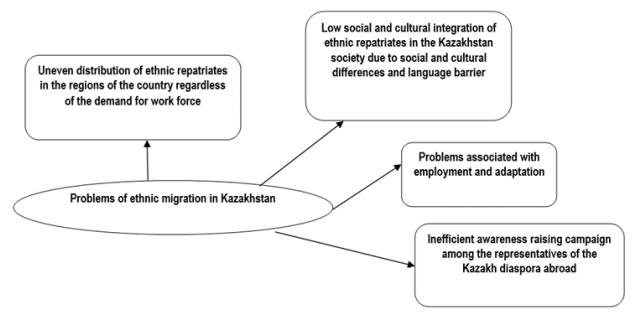
Figure 1. The current state of ethnic migration in Kazakhstan
Thus, the analysis of state support measures of ethnic repatriates in Kazakhstan indicates inconsistencies and poor coordination of the legal mechanisms used.
The diaspora is one of the phenomena of the migration process (Torrealba: 2017). The current changes are due to an undergoing deep transformation of the world, accompanied by large groups of people leaving their historical homeland.
Diasporas are perhaps the most significant confirmation of the success of people’s migration. When migrants manage to integrate safely into the society of the host country, the original goal of migrants is achieved. Adaptation is followed by the consolidation of immigrant ethnic communities – diasporas (Torrealba: 2017).
After several decades of limited mobility to and from the area behind the iron curtain, the Russian Federation recently joined a world of global movement as an immigrant, emigrant, and transition country. Since the collapse of the USSR, Russians abroad have been a significant target group for Russian policy makers and executive bodies. The main trend and direction of Russian policies in this respect is diaspora policies that are mostly relevant for the population of long-term emigrants and their descendants rather than for mobile citizens or circular migrants (Tkach: 2017).
The most developed countries of the world have accumulated a considerable experience of state supportof diasporas (for example, Israel, Germany, and Poland may be called leaders in this field). This justifies Kazakhstan’s focus on the consolidation of compatriots, primarily, on the Kazakhs wishing to return to their historical homeland.
Due to the specifics of the host countries welcoming the entrepreneurship and economic independence, the Kazakhs abroad are prepared for a competitive environment and business activity. This has a great economic potential that must be used for the development of Kazakhstan.
DISCUSSION
At present, Kazakhstan and international researchers pay special attention to the study of the multi-vector diaspora problem. In the early 1970s and 1980s, the historical and comparative analysis and attribution of a particular community to a diaspora were based on the comparison with the criteria of a “classical” diaspora, but later scientists questioned this approach. In their works, J. Amstrong, M. Bruno, R. Cohen, G. Schaeffer, and R. Brubaker proposed various typologies of diasporas which reflected social changes in society. The wider scope of research resulted in the emergence of the concept “compatriot abroad.” The research on the problem of diasporas in Kazakhstan science began at the end of the twentieth century. Despite numerous publications of international researchers (Tirabyan: 2018), this issue has not been properly explored in Kazakhstan due to the lack of legal regulation of state support for compatriots abroad.
At present, the Kazakhstan politicians understand that a responsible approach to the Kazakh diaspora abroad, establishing partnerships with those who are spiritually connected with Kazakhstan, is a moral duty of the country. Recently, the cooperation with the Kazakh diaspora abroad has been facilitated through non- governmental organizations.
This topic has not been explored by Kazakhstan scientists, and this paper is one of the first attempts to examine the problematic issues of the legal regulation of state support for compatriots abroad. Therefore, the conclusions of this article can become the basis for further research.
The practical significance of the study includes the possibility of introducing new information about the political essence and specifics of migration nowadays into political practice. The data obtained can be used to develop a Kazakhstan draft bill regulating the support for compatriots abroad, as well as it can became the basis for further legal, social and political studies.
At present, diasporas themselves are trying to establish the connection with their ethnic homeland. “The pragmatic need for national diasporas to maintain the elements of their own national identity at a sufficientlevel is relevant, as this, in turn, will allow them to resist assimilation challenges that are invariably present to one degree or another in a foreign national environment” (Tagiev: 2009).
Preservation of the ethnic identity that contains national specifics, history, national traditions, and culture strengthens the confidence of the diasporas in their future. “Cultural interaction is one of the most important and qualitative indicators of the relations between states nowadays” (Mukhambetkaliyeva: 2018).
From the moment of becoming independent Kazakhstan has been pursuing the policy of ethnic repatriation that meets the trends of globalization of the world community. This policy aims to use migration flows to strengthen the national security, improve the country’s demographic situation, and to ensure its sustainable social and economic development.
Subparagraph 1) of Article 1 of the Law “On languages in the Republic of Kazakhstan” defines the concept of “diaspora” and establishes the legal basis for the use of languages in the Republic of Kazakhstan, namely, the state’s obligation to create conditions for their learning and development, an equally respectful attitude to all languages used in the Republic of Kazakhstan. However, this law does not regulate the issues of state support for the Kazakh diaspora abroad.
Moreover, we believe that the term “compatriot abroad” should be included in Kazakhstan legislation, replacing the term “former compatriot” enshrined in the current law. This, in our opinion, should strengthen ties between the Republic of Kazakhstan and persons who were born or previously held the citizenship of the Kazakh SSR or the Republic of Kazakhstan and permanently reside abroad.
CONCLUSION
The above proposals should be reflected in a separate regulatory legal act – the Law of the Republic of Kazakhstan “On state support for compatriots abroad,” which should be adopted in the near future and which would meet the needs of the Kazakhstan society, comply with modern trends and, as a result, more clearly regulate the support for compatriots living abroad. We propose that this law should define new concepts (“compatriot abroad,” “state support for compatriots abroad,” “Kazakh Card,” etc.).
This proposal reflects the need to improve interaction not only with ethnic Kazakhs, but also with compatriots abroad who left Kazakhstan in the 1990s, creating favorable conditions for them to maintain their connection with the country.
Therefore, the main result of this work is stating the need to adopt the first bill in the history of modern Kazakhstan aimed at state support for compatriots abroad that would primarily focus on the consolidation of ethnic Kazakhs around their historical homeland and include the proposals developed in this research paper.
BIODATA
Y.A ONGARBAYEV: Yerkin Anuarovich Ongarbayev is the Doctor of Law, Professor, Vice-Rector for Academic Affairs, L.N. Gumilyov Eurasian National University. He was a scientific consultant to three doctoral and seventeen master's theses, two theses of Dr. PhD. He is the author of more than one hundred and twenty scientific works and publications on jurisprudence, as well as public relations.
A.M NURMAGAMBETOV: Amanzhol Magzumovich Nurmagambetov is the Doctor of Law, Professor, Head of the Department of Civil, Labor and Environmental Law of L.N. Gumilyov Eurasian National University. It is engaged in research work, participates in various scientific and practical conferences. He is the author of more than 150 publications on the problems of labour, civil and constitutional law.
S.B ZHARKENOVA: Svetlana Bakhytovna Zharkenova is a Candidate of Legal Sciences, Professor, Department of Civil, Labor and Environmental Law, L.N. Gumilyov Eurasian National University, having about 30 years of work at the university, a member of the Commission on Human Rights under the President of the Republic of Kazakhstan, specializes in the problems of labor, civil and business law. She has published over 90 scientific papers.
G.G GALIAKBAROVA: Guzal Gazinurovna Galiakbarova is PhD, acting Associate Professor, Department of Civil, Labor and Environmental Law, L.N. Gumilyov Eurasian National University. Scientific interests: labor law, civil and civil procedural law. He is the author of more than 55 publications.
BIBLIOGRAPHY
APRYSHCHENKO, V (2018). “Modern migration processes and the model of “convergence”. University Proceedings. North Caucasus Region.” Social Sciences, 4, pp.26-30.
ESTMAN, M (1990). “Ethnic Pluralism and International Relations.” Canadian Review of Studies in Nationalism, 17(1–2), pp.83-93.
GONZALEZ, J (2012). “Diaspora Diplomacy: Philippine Migration and its Soft Power Influences.” USA: Mill City Press.
KYMLICKA, W (1995).” Multicultural Citizenship: A Liberal Theory of Minority Rights.” Oxford: Clarendon Press.
LYONS, T (2014). “Diaspora Lobbying and Ethiopian Politics, Diaspora Lobbies and the US Government: Convergence and Divergence in Making Foreign Policy, (eds) Dewing J., Segura R.” New York: USA, NYU Press.
MENDIKULOVA, G (1997). “The historical fates and fortunes of the Kazakh diaspora. Origin and Development, Monograph.” Almaty: Kazakhstan, Gylym Publication.
MOLODIKOVA, I (2017). “Russian Policy Towards Compatriots: Global, Regional and Local Approaches. In: Nikolko M., Carment D. (eds) Post-Soviet Migration and Diasporas. Migration, Diasporas and Citizenship.” London: United Kingdom, Cham, Palgrave Macmillan publication.
MUKHAMBETKALIYEVA, G (2018). “Kazakhstan and Germany: Experience of cultural-humanitarian cooperation at the end of 20-21 Centuries. News of the National Academy of Sciences of the Republic of Kazakhstan.” Series of Social and Human Sciences, 3(319), pp.124 – 130.
NAZARBAYEV, N (2017). “Course towards the future: modernization of Kazakhstan’s identity”, (Retrieved on12 April 2017). https://www.akorda.kz/en/events/akorda_news/press_conferences/course-towards-the- future-modernization-of-kazakhstans-identity
POPKOV, V (2003). “The Phenomenon of Ethnic Diasporas.” Moscow: Russia, IS RAS Publication.
RAGAZZI, F (2009). “Governing Diasporas.” International Political Sociology, 3, pp.378–397.
RAGAZZI, F. (2014). “A comparative analysis of diaspora policies.” Political Geography, 41, pp.74-89.
RAZDOBAROV, V, PAVLOV, E (2005). “On the situation of compatriots in the CIS countries and their support by the Russian Federation.” Analytical Bulletin of the Federation Council of the Federal Assembly of the Russian Federation “Protection of the rights and interests of compatriots living abroad”, 20(272-1), pp.52-62.
SEYTKALIEV, R (2018). “Emigration of Germans before and after the collapse of the USSR to Germany. Integration and its results.” Scientific and Analytical Bulletin of the IE RAS, 6, pp.99-105.
SHIPILOV, A (2017). “Russian compatriots: the evolution of status, attention and understanding.” The Power Journal, 25(10), pp.129-135.
SKRINNIK, V (2008). “Russia and Compatriots Abroad: Problems of Consolidation and Integration in the New Geopolitical Conditions.” Bishkek: Russia, KRSU Publication.
TAGIEV, A (2009). “The role and place of the diaspora in modern ethnic processes.” (Retrieved on 18 May 2017). http://jurnal.org/articles/2009/hist11.html
TIRABYAN, K (2018). “Diaspora in the political process of modern Russia (on the example of the Armenian diaspora). Dissertation of the candidate of political sciences. St. Petersburg.” (Retrived on 23 Feb 2018) http://elar.urfu.ru/bitstream/10995/66694/1/urfu1945_d.pdf
TKACH, O (2017). “Cultural or Political Diaspora: Approach of the Russian Federation. In: Weinar A. (eds) Emigration and Diaspora Policies in the Age of Mobility. Global Migration Issues 9.” Manhattan, New York City: USA, Springer, Cham Publication.
TORREALBA, A (2017). “Three main approaches of diaspora diplomacy in foreign policy.” Actual Problems of Economics and Law, 2(2), pp.154-169.
VILLALOBOS ANTÚNEZ, J and RAMÍREZ MOLINA, R 2018. “El derecho a la autobiografía: dimensión ius- filosófica desde la perspectiva de H. Arendt y P. Ricoeur”. En Opción. Revista de Ciencias Humanas y Sociales. Año 34, No. 18: 1012-1587.
VILLALOBOS ANTÚNEZ, J; RAMÍREZ MOLINA, R and DÍAZ-CID, L 2019. “Bioética y biopoder: Perspectivas para una praxis pedagógica desde la ética de Álvaro Márquez-Fernández”. En Utopía y Praxis Latinoamericana, Revista Internacional de Filosofía y Teoría Social. Año 24, No.87: 65-77.
WERNER, N (2018). “Compatriots as an element of the policy of “soft power.”” Political Science Issues, 3, pp.161-175.
WILLIAMS, P (2019). “Emigration state encounters: The everyday material life of a diaspora technology.” Political Geography, 68, pp.1-11.
ZHAMPEISSOV, D (2013). “Legal Aspects of Ethnic Repatriation: Comparative and Juridical Analysis.” Middle East Journal of Scientific Research, 15(6), pp.794–803.