Artículos
Diagnosis of Intrapreneurship-Based Professionalism to Bridging the Culture Gap Innovation Approach
Diagnóstico de la profesionalidad basada en el intraemprendimiento para cerrar el enfoque de innovación de brecha cultural
 I DJASTUTI indijastuti@undip.ac.id
A KUSUMAWARDHANI amiekwardhani@live.undip.ac.id
M MAHFUDZ mahfudz.fe.undip@gmail.com
U UDIN udin_labuan@yahoo.com
I DJASTUTI indijastuti@undip.ac.id
A KUSUMAWARDHANI amiekwardhani@live.undip.ac.id
M MAHFUDZ mahfudz.fe.undip@gmail.com
U UDIN udin_labuan@yahoo.com
Diagnosis of Intrapreneurship-Based Professionalism to Bridging the Culture Gap Innovation Approach
Utopía y Praxis Latinoamericana, vol. 25, no. Esp.6, pp. 50-60, 2020
Universidad del Zulia
Received: 12 July 2020
Accepted: 18 August 2020
Abstract: This study aims to analyze the attitude of the entrepreneur orientation of the company's employee auxiliaries (EOS) and the attitude of entrepreneur leadership (ELQ) employees of the target company with importance-performance analysis (IPA). The samples are employees who have a business which is determined using non-probability sampling techniques. The data are analyzed by applying structural equation modelling (SEM) with 24 AMOS program. The findings of the study using the IPA approach show that there is no gap between perception and expectation of the respondents.
Keywords: Competitive advantage, Innovation, Organizational Learning, Professionalism culture..
Resumen: Este estudio tiene como objetivo analizar la actitud de la orientación emprendedora de los auxiliares de empleados de la empresa (EOS) y la actitud de los empleados de liderazgo emprendedor (ELQ) de la empresa objetivo con el análisis de importancia- desempeño (IPA). Las muestras son empleados que tienen un negocio que se determina utilizando técnicas de muestreo no probabilístico. Los datos se analizan mediante la aplicación de modelos de ecuaciones estructurales (SEM) con el programa 24 AMOS. Los resultados del estudio que utiliza el enfoque IPA muestran que no existe una brecha entre la percepción y las expectativas de los encuestados.
Palabras clave: Aprendizaje organizacional, Innovación, Profesionalismo Cultural, Ventaja Competitiva..
INTRODUCTION
At current prices, the agricultural sector accounted for 14.43 per cent of Gross Domestic Product (GDP). Indonesia's agricultural workforce remains the largest position capable of absorbing 38.07 million people, or 34.6% of the workforce of 100 million national workers. PT Perkebunan Nusantara IX, currently operating in Central Java province with a total of 15-unit Gardens Work Gardens 1 Agrowisata unit and 8-unit Sugar Factory (PG), officially manages four main commodities such as rubber, sugar, tea, and coffee. Also, the firm has produced many downstream goods such as Kopi Luwak, Banaran Premium Coffee, Kaligua Tea, Semugih Tea, Sugar 9 and Syrup Pala. The business unit that has seen beautiful visitors because of its unique character has been established as a regional agro-tourism, such as the Agro Tourism Gardens Kaligua, Agro Tourism Gardens Semugih, Scenic Gardens Jollong, Kampoeng Kopi Banaran, Central Park Balong, Banaran 9 Resort, Travel Agro Gardens Semugih, Agro Tourism Sondokoro, Sugar Factory Pangka, Sugar Factory Gondangan Winangoen and Banaran 9 Coffee & Tea. PT Perkebunan Nusantara IX will grow into a rubber plantation corporation with a backbone industry (width closer to 50,000 ha) and a sugar sector as one of the cornerstones of the company's revenue.
Central Java Province is one of the relationship trends among the Smallholder Plantations PIR KKPA (Primary Cooperatives Members) or AABA (Adopted Father Lift). This relationship is a collaboration between the corporations and a collective cooperative within which it belongs to the farmers. Cooperative is a partnership to try together those who are vulnerable and always developed in the spirit of selflessness in such a way that each person may fulfil his or her responsibilities as a participant and is compensated in proportion to his or her use for the organization. The partnership approach emphasized in the construction estates in favour of the small people.
The issue in this analysis is the cultural significance of intrapreneurship (Corporate Intrapreneurship) companies on Perekebunan PT Nusantara IX (Persero) needs entrepreneurial qualities in their business. The behaviour of entrepreneurial leaders of work units auxiliaries who plays as an employee PTP IX (Persero) needs identification, importance, and implementation (Expectations and Perceptions) means how important is the work unit performance businesses built (which depicts Hope) and how well does the work unit performance businesses built (which depicts Perception). Thus, the company can determine managerial behaviour should be increased or decreased to amplify the desired corporate culture and to achieve its goals.
Importance performance analysis (IPA) theory or the theory of interest and performance analysis is amethod developed by Martilla and James in 1977 (Martilla & James: 1977, pp. 77-79). IPA is used to assess the company's interest and results. IPA is used in the future to develop an effective company strategy to identify areas that need to be concentrated to be repaired, maintained or eliminated.
At IPA, factors analyzed for visualization in a Cartesian diagram separated into four regions or quadrants, which attributes to improve - the main priority (A), maintain performance - priority achievement (B), attributes to maintain - low priority (C) and attributes to de-emphasize - priority end (D). Positioning an attribute into four regions depends on the average value of the overall attributes.
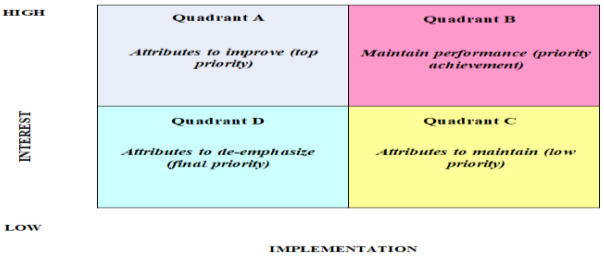
Figure 1- Diagram Matrix Importance Performance Analysis (IPA) (Martilla & James: 1977, pp. 77-79)
There are two characteristics, according to Pererva et al. (Pererva et al.: 2018, pp. 1-10) can determine a sustainable competitive advantage: durability and imitability. Durability is the durability of the core competencies company from obsolescence, while imitability is the durability of the core competencies of a competitor who wants to imitate. Wingate et al. (Wingate et al.: 2019, p. 147) describes the capability of the company could potentially create a competitive advantage that has staying power if it has four criteria: unique, rare, too expensive to replicate, and the absence of a replacement.
According to Handayani et al. (Handayani et al.: 2017, pp. 398-406), having a sustainable competitive advantage is the continuous adaptation to patterns and external events, as well as ability, competence, and internal resources; and effectively formulate, implement, and evaluate strategies that take advantage of these factors.
Organizational learning means continuous testing experience and transforms the experience into knowledge that is accessible to the entire organization and relevant to its core purpose (Ng et al.: 2016, pp. 11-32). Learning organization that continuously change themselves to manage knowledge, use of technology, to empower people, and extend the learning to better adapt and succeed in a changing environment (Udin et al.: 2019, p. 25; Ahmad & ahmad, 2019, pp. 746-778; Ríos et al.: 2019, pp. 407-419; Ríos et al.: 2020, pp. 452-468). Aina and Solikin (Aina & Solikin: 2020, pp. 288-297) defines the learning organization as an organization that can create, acquire, and transfer knowledge and modifies the behaviour of the organization to reflect new knowledge and insights.
The transformation of organizational culture is a strategic change process from input to output competitiveness through internal processes (Bakhri et al.: 2018, pp. 172-178). Harvey et al. (Harvey et al.: 2018, pp. 51-110) suggested that to be able to adapt to the market changes and the company should create a way to transform the competence of organizational culture associated with the operational transformation, the transformation of corporate self-renewal and strategic transformation.
Innovation refers to the process that follows the conception of a new idea and involves several people,each of which offers different suggestions and contributions. Goffin and Mitchell (Goffin & Mitchell: 2016) defines innovation as: Innovation = Invention + conception + Exploitation.
In line with the increasing emphasis on creativity and innovation in the world of work, organizations are facing the challenge to cultivate new ideas and effectively transform this creative new idea into innovative products. According to Pinchot (Pinchot: 1985), innovation is required to match the competitors increased productivity. He showed that the favourable findings often discarded because such innovations do not seem to correspond to the organization's core competencies.
Intrapreneurship is a relatively new concept that focuses on employees of companies that have many of the attributes of entrepreneurs. Entrepreneurship is a person in the company who take risks in an attempt to solve a given problem. The main difference between entrepreneurs, intrapreneurs is that intrapreneur are employees, and employers are free, and the leader of the operation. Intrapreneurship is the change initiative taken in continuing concern by people who work in the organization.
The term entrepreneur in the business world certainly is not foreign. Etymologically, entrepreneur means the entrepreneur, one who is a smart or talented and innovative entrepreneurial activity both recognize new products, determine how the production of new products, draw up operational management of the procurement of products, market products, and set up his business capital system.
METHODS
The data in this study are primary data and secondary data. Primary data are collected directly from the field, which is obtained by observation, surveys, and interviews or provides a list of questions. This study uses a measurement tool EOS, and ELQ distributed to work units that employees of PT Perkebunan Nusantara IX (Persero). Secondary data is data obtained from the corporate environment. EOS is used to measure theoverall entrepreneurial environment in a company. EOS will be studied in the critical dimensions of corporate entrepreneurship, while ELQ entrepreneurial aims to study the behavior of managers and top management of the target company's work unit.
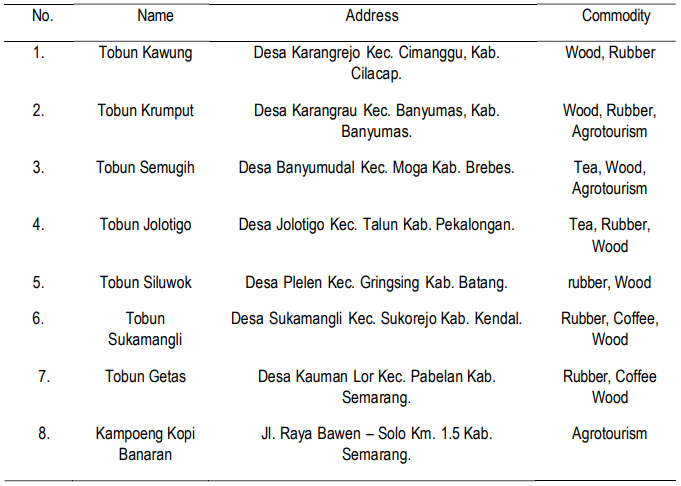
The target company is PT Perkebunan Nusantara IX, with 8 test sample units of the subsidiaries (the main business) with the details given in Table 2. In each of the goal Enterprises distributed in 8 Unit of Work PT Perkebunan Nusantara IX, took 40 Enterprises inmates who position as employee and business leaders established, for a total of 200 respondents taken by purposive (non-probability sampling), but the data can be processed as many as 190.
The method of analysis used in this research, utilizing IPA Theory (Importance Performance Analysis). Quadrant analysis or Importance Performance Analysis (IPA) is a descriptive analysis technique introduced by John A. Martilla and John C. James in 1977 (Martilla & James: 1977, pp. 77-79). Importance Performance Analysis is an analytical technique used to identify critical performance factors that should be shown by an organization. Questions that are qualitative quantified and measured using a Likert scale. According to Husein Gursoy and Guven (Gursoy & Guven: 2016, pp. 152-162; Ahmad & Sahar, 2019, pp. 1540-1543) scoring on each item, the question of the issues examined was measured by the Likert scale, the scale associated with the statement of one's attitude toward something.
Furthermore, at this stage of the analysis and interpretation of the results of analysis and discussion ofthe data obtained and processed. It will examine the culture of entrepreneurial PT Perkebunan Nusantara IX (Persero), whether by the dimensions of Intrapreneurship. The researcher also analyzes the nature of entrepreneurial leadership at PT Perkebunan Nusantara IX (Persero). From the results of the analysis carried out will be known that the actual corporate culture and corporate culture are expected. According to the creator EOS and ELQ that Neal Thornberry (Thornberry: 2006), both the gauge is a measuring instrument that has been tested reliability and validity, and is often used to measure the dimensions of Corporate Entrepreneurship in big companies such as Mott's, Siemens and Sodexho.
RESULTS
In each of Enterprises assisted scattered in 8 Unit of Work PT Perkebunan Nusantara IX, taken 40 Enterprises inmates who serve as employees and business leaders built, for a total of 200 respondents taken by purposive (non-probability sampling), but the data can be processed as many as 190. Based on data from 190 respondents, gender, there are as many as 157 men and 33 women in total. While the level of education was 51.05 percent high school (SMA), the bachelor's degree (S1) was 32.63 percent, and the diploma degree was 14.21 percent. Based on age, the largest age group of 36-40 years is 34.74%, the age group of 31-35 years is 26.32%, and the age group of 26-30 years is 19.47 %.
Analysis IPA (Importance Performance Analysis)
EOS attributes divided into two dimensions: Dimensions Attitude/Personality Dimensions employee and boss attitude on aspects of business development. Questions asked of respondents was as follows:
Eos1.The orientation of the company (EOS) Dimensions Attitude / Personality Tops: (1) In a positive communication with superiors concerning things that could be done better; (2) It effectively convince your boss on business ideas; (3) communicate-kan conditions better company in the future, if the need to make changes; (4) Delivering to subordinates in which the company's position against competitors; (5) To motivate subordinates to think of innovative ways to beat the competition; (6) Supporting the suggestions of subordinates for the betterment of the company; (7) To encourage subordinates to innovate in carrying out the work; (8) Showing enthusiasm when subordinates learn new skills; (9) Support employee initiatives to realize their ideas; (10) To motivate employees to think to find ways of working; (11) Provide time to help employees find ways to improve products and services; (12) Create an atmosphere that supports continuous improvement; (13) Expect subordinate to constructively mengiidentifikasi and solve problems across the organization; (14) Support subordinates in pushing for changes for the betterment of the work.
Eos2.The orientation of the company (ESQ) Dimensions boss attitude on aspects of business development: (1) Taking into account the competitors' weaknesses and find ways to take advantage of their weaknesses; (2) Take the time to develop new business; (3) Listen to and act on consumer complaints; (4) Encourage thinking to find new and better ways to carry out the work; (5) Looking for creative ways to organize and use of assets and resources of the company; (6) Eager to find new ways to grow the business; (7) Ensure that the interests of consumers in mind when we make changes in the organization; (8) Actively seek new business opportunities; (9) To ensure that we have the right team to take advantage of business opportunities bar; (10) To encourage organizations to be more flexible so quick to react when emerging business opportunities; (11) To analyze the resources, processes, and workflows for better results for companies and consumers.
EQL1.Entrepreneur Leadership (EQL) Tops Attitude Dimensions: (1) Trying desperately to build an innovative culture within the company; (2) To encourage entrepreneurial behaviour / and take the entrepreneurial risks; (3) Reacting quickly to eliminate organizational barriers that can disrupt business; (4) Encourage open communication and sharing of ideas across the functional units; (5) Provide the latest information on industry trends and competitor strategies; (6) Actively encourage business improvement suggestions from all components of the organization; (7) Perform real action to implement the various suggestions for improvements; (8) Make the organization always focuses on its core business, but also to support new business initiatives; (9) Set aside money outside the regular budget for financing and supporting innovative ideas;
Difference Analysis Expectations and Perceptions in Entrepreneurial Dimension Orientation
From the results of the normality test, calculations have been done using the One-Sample Kolmogorov- Smirnov test, the average perception, and above-average expectations ESQ Kolmogorov Smirnov statistic values obtained at 0.098 and 0.082 with a value of 0.092 and Asymp. Sign Asymp. Sign at 0.200. Because ofthe values for the mean expectation ESQ Asymp.Sign greater than 0.05, and it can be concluded that the data were normally distributed. Then, test different tests using a Paired sample t-test. The result of the Paired sample t-test for differences in perceptions and expectations of above-average entrepreneurial orientation can be seen in Table 3. The value sig (2-tailed) in Test Paired sample t-test showed that the value of 0.763 means probabilities value> 0.05. So this study can conclude by approving H0 and denying Ha, implying there is no difference between the perceptions of the understanding of entrepreneurial orientation.

Difference Analysis Expectations and Perceptions in Dimension Entrepreneurial Leadership
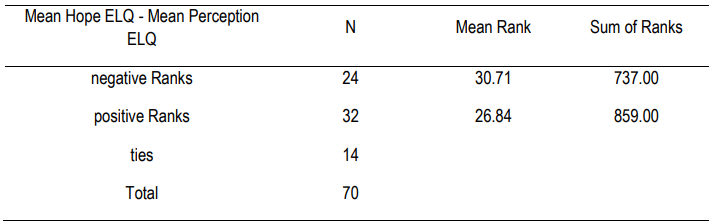
From the results of the normality test, calculations have been done using the One-Sample Kolmogorov- Smirnov test, the average perception, and the average expectation of ELQ Kolmogorov Smirnov statistic values obtained at 0.177 and 0.202 with a mean value for the variable perception Asymp. Sign at 0.00, and variable expectations mean Asymp. Sign at 0.00. Because of the values for the mean expectation ELQ Asymp.Sign smaller than 0.05. It can be concluded that the data are not normally distributed. Then testing different tests using the Wilcoxon Signed Ranks Test Test Statistic. Test Results Statistics Wilcoxon Signed Ranks Test for differences in perceptions and expectations EQL dimensions are shown in Table 5. From the results of the output Rank (Table 4), 24 respondents experienced a decrease in perception and expectation.
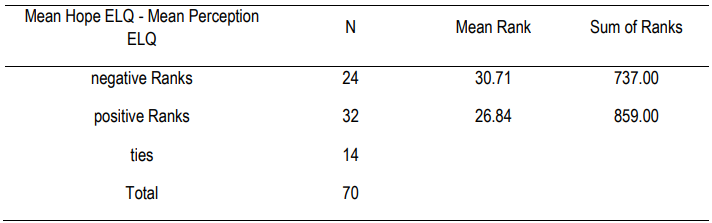

Based on the statistical test output in Table 5, note Asymp. Sig (2-tailed) worth 0616. Because the 0.616 value is more significant than 0.05, it can be concluded that accept H0 and reject Ha. This means that there is no gap between the perceptions and expectations of respondents in judging.
Important Performance Analysis (IPA) for the orientation of the Company (EOS) at Dimensions Attitude / Personality Tops
Overall assessment of the Orientation attribute Companies (EOS) Dimensions Attitude / Personality Tops produces an average attribute value totalling 87 250 and in the category of Very Good. It can be concluded that attribute the behaviour performed by the manager/supervisor by what is expected by the company's employees in aspect orientation (EOS) Dimensions Attitude / Personality Tops. Of the value of Performance Rate and Importance Rate obtained from the weighting of the processing results of questionnaires carried out in the criteria for each item, then searched averaged to obtain the value of importance and the level of performance next in the plot into Cartesian diagram foresee the distribution of attributes.
Important Performance Analysis (IPA) for Entrepreneur Leadership (EQL) in Dimension Attitude Tops Total attribute evaluation Leadership Entrepreneur (EQL) Dimensions Attitude Tops provides an average value of 79 525 attributes in the Good category. It can be inferred that the actions conducted by the manager/supervisor are credited in keeping with what employees in the Leadership aspect Entrepreneur (EQL) Dimensions boss attitude. Of the value of Performance Rate and Importance Rate obtained from the weighting of the processing results of questionnaires carried out in the criteria for each item, then searched averaged to obtain the value of importance and the level of performance next in the plot into Cartesian diagramforesee the distribution of attributes.
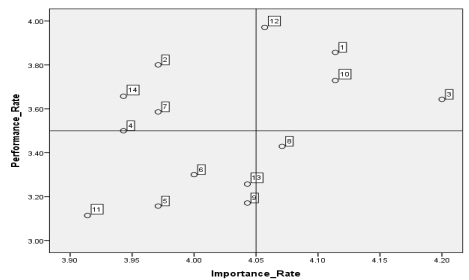
Figure 3- Diagrams of IPA to attribute Orientation firms (EOS) at Dimensions Attitude / PersonalityTops.
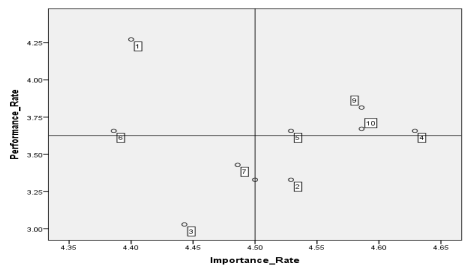
Figure 4- Diagrams of IPA for Entrepreneur Leadership Attributes (EQL) in Dimension Attitude Tops.
Full Analysis Model Structural Equation Model (SEM)
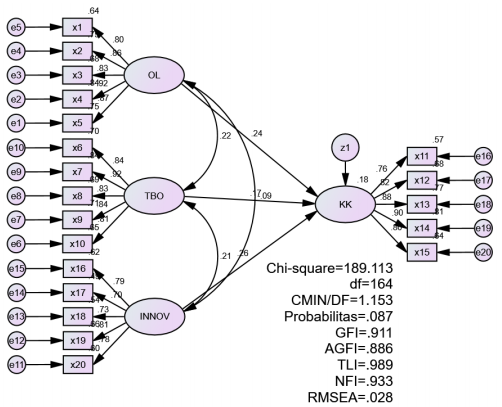
Figure 5- Test Results Full Model Structural Equation Model (SEM)
Having obtained the full model SEM study, further testing is done in conformity with the cut-off value of Goodness of Fit with the results shown in Table 6.
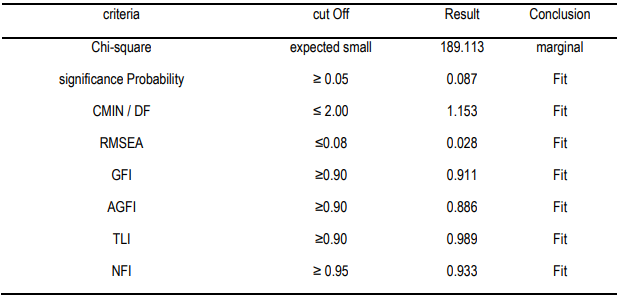
Table 6 reveals that the chi-square check on the complete model obtains research results at a value of 189.113 below the chi-square table with a degree of freedom of 98 at a sense point of 147.010 of 5 percent. A probability value of 0.087 is more significant than 0.05, which is a suitable threshold value means goodstandard probability values. The GFI value of 0.911 on the 0.90 scale, which is the minimum value, implies that the GFI value has a good value.
DISCUSSION
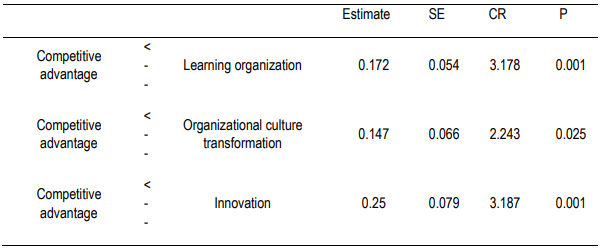
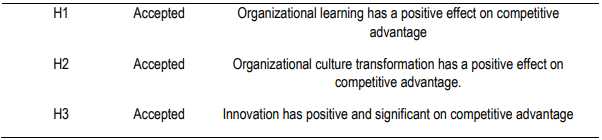
From the calculation through the confirmatory factor analysis and structural equation modelling in this study, it may otherwise accept that it is also supported by the values of fitness goodness which have shown results that fit, although some testing fit goodness has shown marginal, the model is still acceptable.
This study can then use t-Value with a significance level of 0.05 to do hypothesis checking. The system T-Value, AMOS 24, is the value of the model's Critical Ratio (CR) on Regression Weights. Testing criteria is if the value of t-Value or value (CR) ≥1.967 or a probability value (P) ≤ 0.05 (in AMOS indicated by***) and then HO rejected if the values and the research hypothesis is accepted.
CONCLUSION
Keeping because of the findings of the aforementioned studies, this study has several practical implications. Firstly, this study proposed the idea of “content innovativeness” utilizing contextual information from online tourist review websites about Muslim friendly practices offered by the hotels in Indonesia. The online tourist reviews were collected and analyzed to extract information about the quality of hotel services, ratings, and overall experience of the tourists. There is a need to redefine the concept of generativity, particularly in the context of the smart tourism system. Issues like negative reviews and sustainability areimportant to address in this regard. Sustainability deals with the user-oriented review’s reliability and accessibility of information generativity. Controversies like information security, privacy, reliability, and data ownership may affect information generativity in the long run, especially for the smart tourism system. Therefore, smart tourism system operators need to understand information generativity as it is likely to impact the customer’s reviews. LinkedIn may provide an excellent example of this, how they maintain their relationships without imposing on others.
The findings of this study are equally important for the hotel industry, the findings of this study revealed that although Muslim friendly practices do not have a significant impact on customer satisfaction an indirect impact was observed through relative service quality. Therefore, it is important to implement Muslim friendly practices, along with luxury and lavish services in the Indonesian hotel industry to increase customer satisfaction.
BIODATA
INDI DJASTUTI: Indi Djastuti is a senior lecturer at the Management Department of Diponegoro University. Her position is Associate Professor in Business and Economics Faculty of Diponegoro University (main employee). Her research focuses on Innovation Management, Leadership and Knowledge Management.
AMIE KUSUMAWARDHANI: Amie Kusumawardhani is a senior lecturer at the Management Department of Diponegoro University. Her position is Assistant Professor in Business and Economics Faculty of Diponegoro University. She finishes her Ph.D. at the University of Wollongong. Her research focuses on Trust, Business Development, Innovation Management, Leadership and Knowledge Management.
MAHMUD MAHFUDZ: Mahfudz Mahfudz is a senior lecturer at the Management Department of Diponegoro University. He is an Assistant Professor in the Business and Economics Faculty of Diponegoro University. He finishes his Ph.D. in Institut Teknologi Bandung. His research focuses on Trust, Business Development, Leadership, Knowledge Management, and Employee Creativity.
UDIN UDIN: Udin Udin is a young researcher at the Human Resource Management of Universitas Muhammadiyah Yogyakarta. He recently finishes his Ph.D. in Management Department of Diponegoro University. His research focuses on Organizational Effectiveness, Organizational Learning, Leadership, Knowledge Management, and Employee Performance.
BIBLIOGRAPHY
AHMAD, I., & AHMAD, S. (2019). “The Mediation Effect of Strategic Planning on The Relationship Between Business Skills and Firm’s Performance: Evidence from Medium Enterprises in Punjab”, Pakistan. Opcion, 35(24), pp. 746-778.
AHMAD, I., SAHAR. (2019). “Waste Management Analysis From Economic Environment Sustainability Perspective”. International Journal Of Scientific & Technology Research 8(12), pp. 1540-1543.
AINA, Q, & SOLIKIN, I (2020). “Entrepreneurship and Intrapreneurship: How Supporting Corporate Performance”. Review of Integrative Business and Economics Research, 9, pp. 288-297.
BAKHRI, S, UDIN, U, DARYONO, D, & SUHARNOMO, S (2018). “Diversity Management and Organizational Culture: Literature Review, Theoretical Perspectives, and Future Directions”. International Journal Of Civil Engineering And Technology, 9(1), pp. 172-178.
GOFFIN, K, & MITCHELL, R (2016). “Innovation management: effective strategy and implementation”. Macmillan International Higher Education.
GURSOY, A, & GUVEN, B (2016). “Effect of innovative culture on intrapreneurship”. International Journal of Business and Social Science, 7(1), pp. 152-162.
HANDAYANI, S, UDIN, SUHARNOMO, YUNIAWAN, A, WAHYUDI, S, & WIKANINGRUM, T (2017). “ASystematic Literature Review of Managing Workplace Diversity for Sustaining Organizational Competitive Advantage”. International Journal of Mechanical Engineering and Technology, 8(12), pp. 398-406.
HARVEY, J, BOLINO, MC, & KELEMEN, TK (2018). “Organizational citizenship behavior in the 21st century: How might going the extra mile look different at the start of the new millennium”. Research in personnel and human resources management, 36, pp. 51-110.
MARTILLA, JA, & JAMES, JC (1977). “Importance-performance analysis”. Journal of Marketing, 41(1), pp. 77-79.
NG, TW, LAM, SS, & FELDMAN, DC (2016). “Organizational citizenship behavior and counterproductive work behavior: Do males and females differ?”. Journal of Vocational Behavior, 93, pp. 11-32.
PERERVA, P, NAGY, S, & MASLAK, M (2018). “Organization of marketing activities on the intrapreneurship”. Mind Journal, (5), pp. 1-10.
PINCHOT, J (1985). “Intrapreneuring Harper and Row”. New York.
RÍOS PÉREZ, J., CRISSIEN BORRERO, T., RAMÍREZ MOLINA, R., VILLALOBOS ANTÚNEZ, J., LAYRABY, N., & RAMOS MARQUEZ, Y (2020). “Current state of agricultural units: as a phenomenon and complexity”. Utopía y Praxis Latinoamericana. Revista Internacional de Filosofía Iberoamericana y Teoría Social, 25(2), p.452-468.
RÍOS PÉREZ, J., RAMÍREZ MOLINA, R., VILLALOBOS ANTÚNEZ, J., RUIZ GÓMEZ, G & RAMOSMARTÍNEZ, Y (2019). “Elements, resources and capacities of agricultural production units: from a thoughtful analytical approach”. Utopía y Praxis Latinoamericana. Revista Internacional de Filosofía Iberoamericana y Teoría Social, 24(6) p. 407-419.
THORNBERRY, N (2006). “Lead like an entrepreneur: McGraw Hill Professional”.
UDIN, U, SUHARNOMO, S, RAHARDJA, E, & HANDAYANI, S (2019). “The Effect Of OrganizationalLearning, IT Capability And Employee Adaptability On Job Performance: A Moderation Model”. Espacios, 40(42), p. 25.
WINGATE, TG, LEE, CS, & BOURDAGE, JS (2019). “Who helps and why? Contextualizing organizational citizenship behavior”. Canadian Journal of Behavioural Science/Revue Canadienne des sciences du comportement, 51(3), p. 147.