Artículos
Preferred Thinking Styles of Gifted Students and the Implications for Curriculum Development
Estilos de pensamiento preferidos de estudiantes dotados y las implicaciones para el desarrollo curricular
 Z.K ELLALA ziyad.ellala@aau.ac.ae
J ABU-ATTIYEH jamal.abuattiyeh@aau.ac.ae
E.M. ALGHAZO emad.alghazo@aau.ac.ae
Z.K ELLALA ziyad.ellala@aau.ac.ae
J ABU-ATTIYEH jamal.abuattiyeh@aau.ac.ae
E.M. ALGHAZO emad.alghazo@aau.ac.ae
Preferred Thinking Styles of Gifted Students and the Implications for Curriculum Development
Utopía y Praxis Latinoamericana, vol. 25, no. Esp.6, pp. 90-102, 2020
Universidad del Zulia
Received: 17 July 2020
Accepted: 18 August 2020
Abstract: A sample of 250 students (121) males and (129) females in grades 10-12 participated in this study of their preferred thinking methods. The Methods of Thinking Assessment, which was prepared by Sternberg and Wagner (1991), was used as the data gathering tool. Analysis of data revealed that the preferred methods of thinking were in descending order; legislative, external, hierarchical, judicial, conservative, anarchist, local, internal, monarchic, and global. Also, analysis of data revealed significant differences in all dimensions of the overall score being better for female students; however, no significant differences were found about grade level.
Keywords: Learning styles, Preferred thinking methods, Thinking methods, Thinking styles..
Resumen: Una muestra de 250 estudiantes (121) hombres y (129) mujeres en los grados 10-12 participaron en este estudio de sus métodos de pensamiento preferidos. Los métodos de evaluación del pensamiento que fueron preparados por Sternberg y Wagner (1991) se utilizaron como herramienta de recopilación de datos. El análisis de los datos reveló que los métodos de pensamiento preferidos estaban en orden descendente; legislativo, externo, jerárquico, judicial, conservador, anarquista, local, interno, monárquico y global. Además, el análisis de los datos reveló diferencias significativas en todas las dimensiones de la puntuación general que es mejor para las alumnas
Palabras clave: Estilos de aprendizaje, Estilos de pensamiento, Métodos de pensamiento preferidos, Métodos de pensamiento..
INTRODUCTION
An individual’s learning style is crucial in the way one accumulates information and adapts to the surrounding world. According to Dunn and Dunn (Dunn & Dunn: 1992, pp. 7-12), an individual’s learning style is considered to be the way a person processes, internalizes and concentrates on new material. The educational environment is one of the most fundamental places in which an individual student best discovers their preferred style to retain and absorb the most from their surroundings or environment to learn. In conjunction, the teacher’s role in that environment is to be a major enhancer in that various teaching mechanisms and techniques are used to target differentiated student learning styles to support high achievement, greater academic success, establish student identity, and overcome obstacles of learning difficulties to reduce student failure. The gifted and the talented represent a national resource and a key factor for renaissance and progress. This category of the populace cannot reach its full potential for contributions if it is not nurtured by well- informed interventions.
The concept of thinking methods is one of the relative concepts that have emerged recently. The methods in general and the methods of thinking in particular help in a real understanding of the abilities and preparations of individuals. The methods of thinking greatly affect attitudes, problem-solving, and decision making (Peterson et al.: 2016, pp. 123-140). Sternberg (Sternberg: 1999) notes that in our lives, we need to use thinking methods at home, in education, and at work. If these methods are taken into account in schools, universities, and professional businesses, students or individuals will do the work they need most.
Thinking styles
Thinking Styles refer to the methods and techniques preferred by the individual in the recruitment of his/her abilities, acquiring knowledge, and organizing ideas and expressing them in line with the tasks and attitudes that present themselves to the individual. The preferred style of thinking when dealing with social attitudes in various aspects of life is different from the style of thinking used when solving scientific issues, which means that the individual may use several styles of thinking that might change over time (Sternberg: 1999; Annía et al.: (2019), pp. 1357-1372).
The styles of thinking differ from strategies of thinking in that the methods are more general and stable in the individual as a distinctive way of processing information, many situations, and mental problems. While the strategy is less general and may apply to certain mental problems, and include certain mental processes that occur either sequentially or slowly to achieve a goal or accomplish a certain task. According to Meltzer (Meltzer: 2018), every individual has a particular style of thinking. The style of thinking measures the cognitive and linguistic preferences of individuals and their levels of flexibility in working and dealing with others. One of the modern and important theories in the field of thinking styles, which was presented in 1997 was Sternberg’s theory of thinking styles published in a book entitled Thinking styles. According to this theory, the methods of thinking differ in five dimensions, and each dimension includes a set of methods representing a total of thirteen methods which are as follows:
-
Methods of thinking in terms of form: include the Monarchic method, Hierarchical method, Anarchist style, and Minority style.
-
Methods of thinking in terms of function: include Legislative, Executive, and Judicial styles.
-
Methods of thinking in terms of level: include the Global and Local methods.
-
Methods of thinking in terms of trend and tendencies: include the Liberal method and the Conservative method.
-
Methods of thinking in terms of domain: include the internal method and the External method.
A study Sternberg (Sternberg: 1999) was done to investigate the truthfulness of the predictability of the list of thinking methods in light of some mental abilities and the level of academic performance on a sample of (199) students at a United States High School of Excellence. The results showed a positive correlation between the thinking methods legislative and judicial compared to scholastic achievement, analytical thinking, and creative thinking. There were negative differences between functional thinking and academic achievement. Students' academic performance can be predicted through their thinking methods, and thinking methods are partly independent of mental ability.
Kolb (1984) developed four ideas concerning learning styles:
-
Converging learners prefer practical application; hence they like technical tasks and dealing with ideas. They are characterized by abstract conceptualization, and their learning styles tend to experimentation.
-
What he characterized as a divergent learning style is displayed in those who prefer visualization and have strong imaging abilities, prefer group work and are open to different types of people, open to feedback, and are characterized by using concrete experience and reflection when observing.
-
Assimilating learners like clear, logical information and tend to analyze and prefer concepts and abstractions to people. Their learning styles show the use of reflective observation along with abstract conceptualization and reflective observation and active experimentation.
-
Accommodating styles of learners tend toward practicality, are intuitive and like challenges. Like Assimilators, they like active experimentation but like concrete experience.
LITERATURE REVIEW
The Hussein study (Hussein: 2018, pp. 367-406) aimed to examine three critical questions about the learning styles of gifted students in comparison to those of non-gifted students. Data collected from the study indicated that gifted students had the highest rate of preference for visual and kinesthetic learning styles than any other type, while non-gifted students most preferred the auditory learning style. The researcher also found there to be statistically significant differences in all learning styles between gifted and non-gifted students. Based on whether these differences existed due to varying factors, the study concluded no significant differences of p= 0.05 or higher between differences in gender or the interactions between grade and gender, although the researcher found statistically significant differences between the learning styles and grade level. It has been shown by the Al Mane', (Al Mane': 2005, pp. 201-215) study that when students’ preferred learning styles are implemented when working, students are more likely to have greater positive outlooks and hold higher motivations for learning. In an atmosphere of harmonious unity, the classroom environment is more likely to flourish in enhancing learning and offer new opportunities for effective communication between the educator and their students. Understanding the principles behind what sets apart the learning styles of both gifted students, defined as those exhibiting outstanding abilities and capabilities for higher performance and non-gifted students alike is an interdisciplinary branch of study that can contribute to further evaluation of the most effective ways to teach within an institution for all parties involved. This can be done through the preparation of curriculum standards, developmental approaches in augmenting student success and fulfilling the demands of students by cultivating their eagerness to learn.
The Altuna and Yazici study (Altuna & Yazici: 2010, pp. 198-202) focused on existing learning styles of gifted and non-gifted students in Turkey. Two prominent study instruments were used, including a data collection form measuring student success and additional demographics. There were higher test scores among gifted students compared non-gifted students. The auditory learning style was preferred by non-gifted students. Gifted females rated higher test scores than males at a significant level. With regards to grade level, the kinesthetic learning style was the most preferred among 8th-grade students teacher engagement in the motivation of their achievement within the classroom.
Dunn and Dunn (Dunn & Dunn: 1992, pp. 7-12) researched the learning styles of students at three basic achievement levels (low, moderate, and high) and cross-compared the results of each. The results showed that students of low achievement had a higher preference for the auditory learning style over those students of moderate and high achievement whose preference was for both sensory and kinesthetic learning styles. The study instrument included a questionnaire (VARK) that assessed 901 students, female (676), and male (225). It showed a preference for a modality when learning and exhibited significances in learning style preference among gender. Females preferred visual learners were (46%) followed by auditory learners (27%), reading and writing (23%), and kinesthetic (4%). Males of the study sample had preferred visual learning (49%), followed by reading/writing (29%), auditory learning (17%, and kinesthetic (5%). The Dilekli (Dilekli: 2017) study examined the relationship between critical thinking skills and learning styles of 225 gifted students’ ages 9-15 years old at the Science and Art Centres of Turkey. They used the Kolb Learning Style Inventory and the Critical Thinking Scale. Results implied that gender was not significant among learning styles of students, but was a significant variable for critical thinking skills. Also, gifted student learning styles were perceived as having existing relationships among critical thinking skills via the Critical Thinking scale.
Objectives
The objective of the current study is to learn the preferred thinking styles of gifted students in grades (10-in Al-Ain and to assess the differences of statistical significance in the methods of preferred thinking among gifted students in grades (10-12) according to gender (male and female), and the grade level (10-12). More specifically, the study aimed at answering the following questions:
- 1. What are the preferred thinking styles of talented students in grades 10 to 12 in Al-Ain?
- 2. Are there any statistically significant differences in the preferred thinking methods of gifted students, due to the gender variable (male, female)?
- 3. Are there statistically significant differences in the preferred thinking styles of gifted students due to the variable of grade level (10, 11, and 12)?
METHODS
The present study adopts the descriptive analytical approach to answer its questions. This approach is based on describing the preferred thinking methods of the gifted students related to the study and then analyzing them to reach the appropriate results.
Participants
Participants were 250 students (121) males and (129) females in grades 10, 11, and 12. Of these, 87(35%) were tenth-grade students, 82 (33%) were eleventh graders, and 81 (32%) were twelfth-grade students.
Instrumentation
The instrument that was used in this study is the modified version of the List of Thinking Methods of Sternberg (Sternberg: 1999), which was designed to measure thinking methods of individuals in different age groups using Sternberg’s Self-Control Theory. The list measures thirteen thinking methods and consists of a list of sixty-five single words (five words for each method), and it takes twenty-five minutes to work through the list. The instrument is a self-report method that asks individuals to report on the mode of thinking that they use during the performance of a task using a 7-point type Likert scale. The list does not have a total score. However, each subscale is treated separately. Table (1) shows the areas of thinking methods and the item number that relates to it.
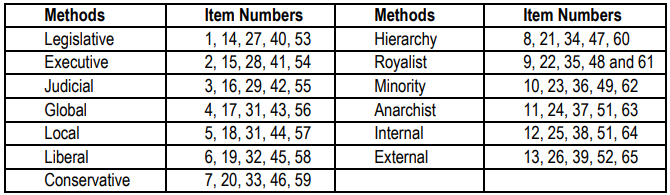
Validity and Reliability of the Instrument: the validity of the instrument was verified using the method of the veracity of the vocabulary on a sample of (60) students from the tenth grade through the twelfth grade by calculating the correlation coefficient between the degree of each individual and the total score of the dimension. The values of correlation coefficients ranged from 0.66 to 0.83, all of which are high, positive, and functional, indicating that the list of thinking methods has a high degree of validity. Reliability was verified by using the Cronbach’s alpha method and a reapplication interval of (13) days from a sample number of (60) students from the tenth through twelfth grade. Table 2 shows the reliability coefficients that were reached.
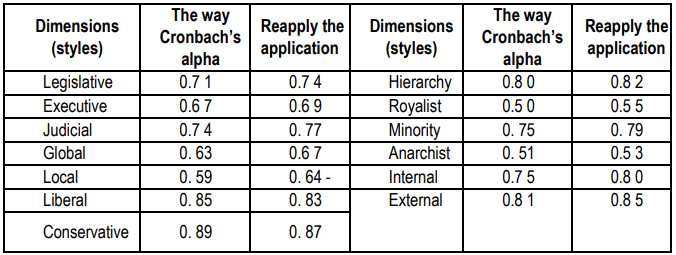
It is clear from the table (3) that all values of stability coefficients using the Cronbach’s alpha method and the re-application function at level 0.01, are high and positive, indicating the stability of the list. All values of stability coefficients are high and positive, indicating a high level of stability.
Procedures
Survey instruments were administered with the permission and assistance of the principles of regular education schools in the United Arab Emirates. Four hundred and fifty surveys were sent to schools with a letter assuring students confidentiality and anonymity. The completed surveys were returned during three consecutive weeks. Two hundred and ninety-seven (297) surveys were returned, and 47 of them were not used because of missing information. The final sample included surveys from 250 participants which represented about 66% of those distributed.
RESULTS
Question 1: What are the preferred methods of thinking for gifted students in grades 10 through 12 in Al Ain City?
By looking at table 3, It is clear that the preferred patterns of thinking in the sample of the study were ranked in descending order as follows: legislative, external, hierarchical, executive, judicial, liberal, conservative, anarchist, monarchic, local, internal, minority, and global. The thinking of the first group tends to be more toward innovation, planning, and design when problem-solving. In second place are those with an External thinking style; this is a group with a tendency towards working as a team and forming social relationships in helping to solve problems. The Hierarchical thinkers in third place tend to complete many things at once using systems, realism, and logic. Executive thinking in fourth place are people that tend to follow the substantive rules and the application of laws and realism. Those demonstrating Judicial thinking styles tend to judge others and their work; they evaluate rules and write critical articles and provide guidance. Liberal thinking in sixth place are thinkers who search for answers beyond usual laws and attitudes. In seventh place, we find Conservative thinking which is those who uphold laws, show a.
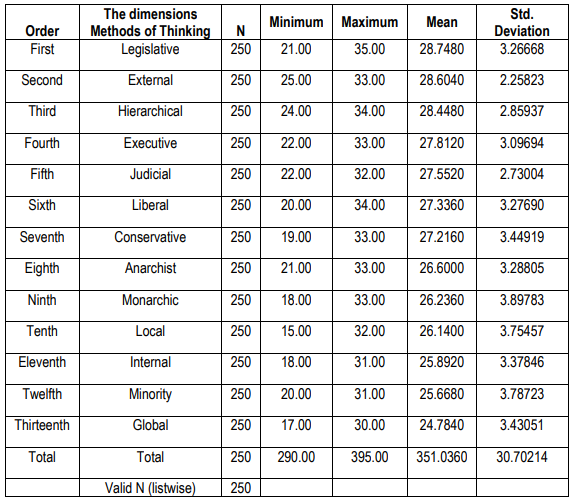
Reluctance towards ambiguity and prefer the minimal possible change. Next were those with Anarchist thinking whose users were confused and hated the system, and whose motives were difficult to explain. Those in ninth place, the Monarchic thinking are characterized by flexibility, tolerance, and weak cognition using means of reaching maximum power. Tenth place is local thinking which demonstrates practical attitudes and details. Internal thinking ranked eleventh and showed individualization, internalization, internal focus, and analytical analysis, followed by bottom-line thinking. Minority thinkers in twelfth place tend to do many things at once, but they have concerns about priorities and hold that many contradictory goals are of equal importance. Global thinking which is directed towards dealing with abstract issues, change, and innovation came in thirteenth place.
Question 2: Are there any statistically significant differences in the preferred thinking methods of gifted students, due to the gender variable male, female?
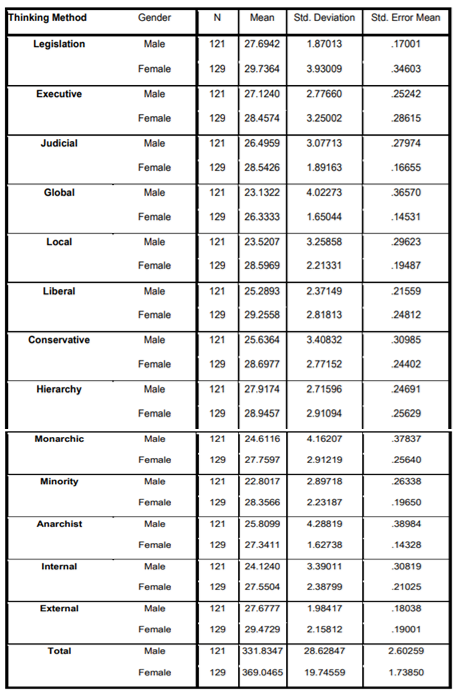
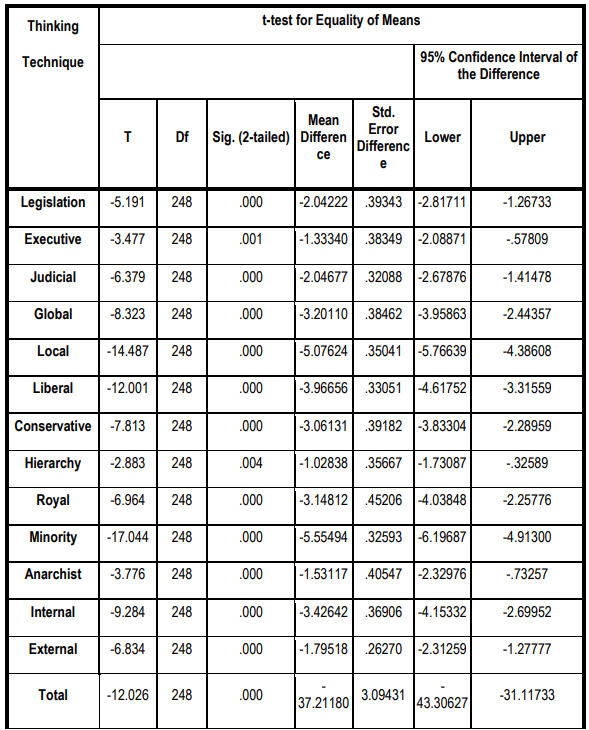
Tables 4 and 5 show that there is a difference between the averages on the dimensions and the total score according to gender. The purpose is to discover if the differences are statistically significant. The table indicates that there are statistically significant differences in favour of females whose average performance is higher in all modes of thinking. This indicates that females have higher performance in innovation, planning, design, problem-solving, socialization, teamwork, solving social difficulties, problem-solving, the ability to multitask, to sequence, in realism and logic, following objective rules, applying laws and realism, the ability to judge others and their actions, evaluate rules, write critical articles, and to provide guidance. This indicates that females more than males show greater tolerance and a propensity towards practical attitudes and details, a tendency toward flexibility with attitudes in favour of practical situations and details, the realization of many contradictory goals, the handling of abstract issues, and change and renewal. It can be explained to management and supervisors that the guidance and supervision teams in the female schools are better trained and more qualified than the supervisors in the male schools.
Some studies, however, (Rais et al.: 2018, pp. 64-68) indicate that gender was a significant variable in thinking styles. Nevertheless, other studies (Dewi & Tandyonomanu: 2018) of gifted students’ thinking styles found that there was no relationship between gender and critical thinking styles. The findings of our study agree with many studies (Nadya et al.: 2019) but contradict with other studies (Bonney & Sternberg: 2016, pp. 191-222).
DISCUSSION
Question 3: Are there statistically significant differences in the preferred thinking styles of gifted students due to the variable of grade levels (10-12)?
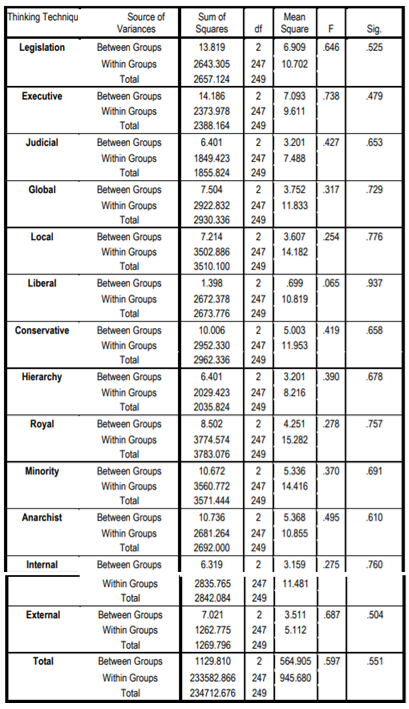
Table (6) shows that there are no statistically significant differences in the preferred thinking styles of giftedstudents due to grade level (10-12). This indicates that the method of teaching the curriculum and training inthinking styles are very close, and there is no difference among grade levels. Additionally, there is no difference in the interest of the family, teachers, or school administration in the educational attainment at these grade levels.
CONCLUSION
The purpose of this study was to examine the preferred thinking methods of students who are gifted in the UAE. The results showed that the preferred methods of thinking were, in descending order; legislative, external, hierarchical, executive, judicial liberal, conservative, anarchist, monarchic, local, internal, oligarchic, and global. There is a difference between the averages on the dimensions and the total score according to gender. The study indicates that there are statistically significant differences between the averages on all dimensions and the total score in favour of females where their average performance is higher in all thirteen modes of thinking. The method of teaching the curriculum and training in thinking styles is very close to grade levels, and no difference was found among grade levels. It should be mentioned that teaching at this stage is with the same teachers. The emphasis on critical thinking in recent years takes into account not only thinking methods but also learning methods like that of Kolb. Curriculum development and classroom practices should take into account both thinking and learning styles, in particular when critical thinking is considered.
Conducting similar studies with larger samples and comparing the results with studies of non-gifted students will give better results that will help to generalize the findings. Searching for other variables, such as socio-cultural background and their past learning experiences during the compulsory education period, and their effects on gifted students’ critical thinking skills will shed light both on how to understand and how to develop their critical thinking processes.
Research recommendations
1. Assess the preferred thinking methods of gifted students at all levels of education in the school, to provide the content of courses and curricula according to these methods, and to use teaching methods, educational activities and various assessment methods that take into consideration the differences in the preference of thinking methods among these students.
2. Train teachers on how to teach and evaluate students in different categories (gifted, ordinary,with different disabilities and learning difficulties) in light of preferred thinking methods to help them overcome their academic problems and cognitive deficiencies.
3. Avoid traditional methods of teaching and assessment and integrate modern methods and strategies such as preferred thinking styles and preferred learning methods.Importar listaCreate a personal profile for each student at the beginning of each academic year, showing the cognitive and social characteristics, preferences, preparations, personal interests, preferred thinking, and learning methods.
BIODATA
Z.K. ELLALA: Ziyad Kamel Ellala is an Assistant Professor in the Department of Humanitiesand Social Sciences at Al Ain University of the United Arab Emirates, UAE. He has a PhD in Special Education from the University of Jordan. He carries expertise in academic teaching and special education. His main area of research interests is student excellence, talent, and giftedness.
J ABU-ATTIYEH: Jamal Abu-Attiyeh is an Assistant Professor in the Department of Humanities and Social Sciences at Al Ain University of the United Arab Emirates, UAE. He specializes and has an M.A in Special Education from the College of Charleston in South Carolina. Later he studied at Miami University of Oxford, Ohio, and obtained his PhD in Educational Leadership. His main area of research interest coincides with giftedness as well as language acquisition.
E.M. ALGHAZO: Director of the Special Education and Applied Psychology Programs in College of Education, Humanities and Social Sciences at Al Ain University of the United Arab Emirates, UAE. His research interests include learning disabilities and assessment of special needs.
BIBLIOGRAPHY
AL MANE', A (2005). “Learning Styles Favored by Students' Elementary Schools and Common Teaching Methods in Riyadh Schools, Saudi Arabia: a field study”. Derasat Journal, Educational Science, 3(2), pp. 201- 215.
ALTUNA, F & YAZICI, H (2010). “Learning Styles of the Gifted Students in Turkey”. Rocedia Social and Behavioral Sciences, (9), pp. 198–202.
ANNÍA GONZÁLEZ, M., VILLALOBOS ANTÚNEZ, J., RAMÍREZ MOLINA, R & RAMOS MARTÍNEZ, Y (2019).“Capacidades dinámicas frente a la incertidumbre: una mirada desde la gestión universitaria”. Revista Venezolana de Gerencia (RVG), 24(88), pp. 1357-1372.
BONNEY, CNR, & STERNBERG, RRJ (2016). “Learning to think critically”. In Handbook of research on learning and instruction, pp. 191-222. Routledge.
DEWI, DK, & TANDYONOMANU, D (2018). “Convergence vs. Divergence Learning Style Study of Critical Thinking”. In 2nd International Conference on Education Innovation (ICEI 2018). Atlantis Press.
DILEKLI, Y (2017). “The relationships between critical thinking skills and learning styles of gifted students”. European Journal of Education Studies.
DUNN, R, & DUNN, K (1992). “Teaching Secondary Students through Their Individual Learning Styles: Practical Approaches for Grades”, pp. 7-12. Boston: Allyn and Bacon.
HUSSEIN, HB (2018). “Effectiveness of a proposed program for teaching elementary school mathematical concepts in light of gifted students’ learning styles”. Journal of Educational & Psychological Sciences, 19(01), pp. 367-406.
MELTZER, L (Ed.). (2018). “Executive function in education: From theory to practice”. Guilford Publications.
NANDYA, P, SUBANDI, S, & MUNZIL, M (2019). “The Effect of Guided Inquiry Strategy and Kolb’s LearningStyle on Higher-Order Thinking Skills”. Jurnal Pendidikan Sains, 7(3).
ETERSON, ER, RUBIE-DAVIES, C, OSBORNE, D, & SIBLEY, C (2016). “Teachers' explicit expectations and implicit prejudiced attitudes to educational achievement: Relations with student achievement and the ethnic achievement gap”. Learning and Instruction, 42, 123-140.
RAIS, M, ARYANI, F, & AHMAR, AS (2018). “The influence of the inquiry learning model and learning style on the drawing technique of students”. Global Journal of Engineering Education, 20(1), pp. 64-68.
STERNBERG, RJ (1999). “Thinking styles”. Cambridge university press.