Artículos
Effect of Parent Support on Engagement Through Need Satisfaction and Academic Buoyancy
Efecto del apoyo de los padres en la participación a través de la satisfacción de necesidades y la flotabilidad académica
 M. ROHINSA rohinsa.meilani@gmail.com
S. CAHYADI surya@unpad.ac.id
A. DJUNAIDI a.djunaidi@unpad.ac.id
T.B. ZULRIZKA ISKANDAR zulrizkaiskandar@unpad.ac.id
M. ROHINSA rohinsa.meilani@gmail.com
S. CAHYADI surya@unpad.ac.id
A. DJUNAIDI a.djunaidi@unpad.ac.id
T.B. ZULRIZKA ISKANDAR zulrizkaiskandar@unpad.ac.id
Effect of Parent Support on Engagement Through Need Satisfaction and Academic Buoyancy
Utopía y Praxis Latinoamericana, vol. 25, no. Esp.6, pp. 144-153, 2020
Universidad del Zulia
Received: 12 July 2020
Accepted: 14 August 2020
Abstract:
The purpose of this study is to test the model of the influence of support from parents on engagement through basic psychological needs satisfaction on middle school students. Participants in this study were 1352 students. The hypothesized model demonstrated a good fit with the data (RMSEA = .058; CFI = .993; NFI = .991; GFI = .961). It can be concluded that engagement can be formed by parents’ support through the mediation of internal processes within students. The findings reinforce the importance of the role of parents as part of the social context to fulfil basic psychological needs.
Keywords: Academic buoyancy, Basic need satisfaction, Engagement, Parent support..
Resumen:
El propósito de este estudio es probar el modelo de la influencia del apoyo de los padres en el compromiso a través de la satisfacción de las necesidades psicológicas básicas en los estudiantes de secundaria. Los participantes en este estudio fueron 1352 estudiantes. El modelo hipotético demostró un buen ajuste con los datos (RMSEA = .058; CFI = .993; NFI = .991; GFI = .961). Se puede concluir que la participación se puede formar dentro de los estudiantes. Los resultados refuerzan la importancia del papel de los padres como parte del contexto social para satisfacer las necesidades psicológicas básicas.
Palabras clave: Apoyo de los padres, Compromiso, Flotabilidad académica, Satisfacción de necesidades básicas..
INTRODUCTION
Referring to the Self Determination Theory (SDT) (Ryan & Deci: 2017, pp. 1-25), all individuals have basic psychological needs, such as the needs for competence, autonomy, and relatedness. This basic psychological is owned by all humans without exception, including junior and senior high school students in Indonesia. This must be met by the environment, meaning that these basic psychological needs can only be met through individual interactions with others, one of which is from parents. No individual can fulfil his own basic psychological needs. It is the environment that facilitates the fulfilment of basic psychological needs in a person, through three forms of treatment: they are autonomy support, structure support, and involvement support.
When a person experiences a figure from his environment giving these three forms of support, he/she will be able to influence one's judgment about himself/ herself which is related to the three basic psychological needs in themselves. Someone's assessment of him/her is a determining indicator of whether or not basic psychological needs are met in that person. If the basic psychological needs in a person are fulfilled, it means that the person assesses that he/ she has a sense of competence, a sense of autonomy, and a sense of relatedness. This basic psychological need satisfaction is needed so that a person can function optimally, in various areas of his life, including the education area.
With the existence of basic psychological need satisfaction in a person, then the individual will have intrinsic motivation. This intrinsic motivation will further lead to the achievement of quality learning. Conceptually, when someone understands that he/she has basic psychological need satisfaction, not only has intrinsic motivation but is more resilient when faced with difficulties and difficulties (Ryan & Deci: 2017, pp. 1-25).
Martin & Marsh (Martin & Marsh: 2009, pp. 353-370) states that every student in a school without exception must have experienced academic barriers and challenges that are typical of everyday conditions at school (for example, in facing low grades, completing assignments, overcoming repetitive pressures and having difficult assignments and abundant material). This condition is experienced by all students throughout all levels of education, especially when students are in adolescence (12-18 years) because at this time academic expectations will change to become more complex and students will increase their responsibilities (Cheung et al.: 2018, pp. 389-399). To deal with this, students need the ability or capacity in themselves to be able to overcome the problems, setbacks, and daily academic challenges or called academic buoyancy (Martin & Marsh: 2008, pp. 53-83).
Academic buoyancy is considered as a predictor of student engagement (Tarbetsky et al.: 2016, pp. 61- 71). Academic buoyancy is considered an important predictor of engagement because, at this time, there is a lot of decreased engagement caused by the inability of students to overcome the academic problems they face.
So far, researchers have not yet found research that examines context factors simultaneously, that is, from family and their influence on engagement through meeting the basic psychological needs and academic buoyancy of students. Therefore, the purpose of this study is to examine the model of the influence of support from parents on engagement through Basic psychological need satisfaction and academic buoyancy in middle school students in Indonesia.
LITERATURE REVIEW
Parent Support
Throughout culture, parents represent the most significant figures in child development. Not only are parents usually the most important figures in providing resources for a child, but they also play a major role in creating the social and emotional context, faced by children during the years of their character formation ( Buffet al.: 2017, pp. 423-434). Deci et al. (Deci et al.: 1989, pp. 580-590) mention that parents can do certain ways or behaviours to facilitate children's motivation at school, through basic psychological need satisfaction. The concept of SDT does not explicitly give the term about how parents provide support for their child's basic psychological needs satisfaction. In this study, researchers will use the term Parent support to describe how parents facilitate children's motivation at school by meeting basic psychological needs. From the perspective of SDT, caring for children, or providing support for children's motivation can be done by paying attention to three dimensions.
The three dimensions of parental support are autonomy support, characterized by the opportunities givenby parents to their children to make a decision, for example by allowing children to manage their learning time, choose additional courses according to the interests or needs of children, or choose extracurricular activities which are considered important and desirable by children. Autonomy support from parents is also marked by parents who do not impose their opinions but take time to dialogue with children. For example, when making a rule, or when asking a child to take any action, the parent will explain the background why a prohibition or rule is applied at home. Why is it a good or bad action to be done by a child?
Involvement support in the form of expressions of affection, attention shown by parents to their children, parents enjoy being together with their children by taking the time to talk or do activities together with children. Showing sympathy by providing comfort when children complain or experience problems at school. Besides, this support can also be in the form of parents showing interest in the activities carried out by their children.
Structure support, marked by the instrumental support provided by parents, means that parents remain a reliable figure when children need help, parents can be a place for children to ask questions, ask for help or exchange opinions when children have difficulties, parents can be relied on when children require an explanation of something that may not yet be understood. Another form of structural support that can be done by parents is to provide feedback on the behaviour carried out by their children. The feedbacks given do not focus on evaluating children for faults. However, it is more focused to provide input on what children need to do to achieve the expected results. Another form of structural support provided by parents can be the consistency of parents in applying the rules to their children at home which include the consistency of the consequences that will be received by children when implementing or not implementing these rules. When referring to the concept of SDT, in carrying out care for their children, parents must demonstrate support for autonomy, support for the structure, and support for involvement altogether.
Basic Need Satisfaction
Based on SDT, human behaviour is influenced by the interaction of individuals with social contexts. Social contexts in different environments such as family, school, and work can hinder or provide opportunities for individuals to meet their basic psychological needs to be independent, competent, and connected with others. (Ryan & Deci: 2017, pp. 1-25) state that every individual will carry out activities, achieve goals, and establish relationships with others who can support the fulfilment of their basic psychological needs. In other words, each person will look for experiences that will meet the competence, autonomy, and relatedness needs of their environment. Based on the experience gained from the environment, individuals will assess whether their basic psychological needs are met or not. From these experiences, a person will cumulatively build views about themselves. These views or assumptions about self are not perceptions of self that quickly disappear, but rather long-lasting beliefs that shape real reality in a person and guide one's actions Pitzer & Skinner: 2016, pp. 15-29; Ryan & Deci: 2017, pp. 1-25; Ramírez et al.: 2018, pp. 2076-2101).
When individuals experience their basic psychological needs are met, the individual will have feelings: 1) Sense of Competence will develop a feeling that they can manage and take action, otherwise not having a sense of competence will threaten the feeling that the individual can take action. Sense of relatedness is formed when individuals have experiences that include two things, and they are experiencing others can be responsive and sensitive to themselves and at the same time are also able to be responsive and sensitive. 3) The sense of Autonomy refers to feelings of willingness and willingness concerning performing a behaviour(Deci et al.: 1989, pp. 580-590; Deci & Ryan: 1994; Ryan & Deci: 2017, pp. 1-25; Villalobos et al.: 2019, pp. 65-77).
Academic buoyancy
Academic Buoyancy is defined as the ability of students to succeed in overcoming academic setbacks and challenges that are typical of day-to-day conditions at school (for example, facing low grades, completing assignments, overcoming repetitive stresses and difficult assignments). (Collie & Martin: 2017, pp. 199-210; Datu & Yang: 2018, pp. 278-283; Yun et al.: 2018, pp. 805-830) in their article explain the definition of academic buoyancy, the explanation is considered more in line with what is measured in the Academic Buoyancy Scale.
Engagement
Pal Skinner & Belmont, (Skinner & Belmont: 1993, pp. 571-581) define engagement, as continuous behavioural engagement in learning activities, there is energy, enthusiasm, focus accompanied by positive emotions and away from apathy. Engagement is not just momentary participation but must include consistent and ongoing participation. In a recent study (Skinner & Pitzer: 2012) consider engagement as an integrated construct, meaning that describing engagement involves integrating emotional and behavioural components. Skinner & Pitzer (Skinner & Pitzer: 2012) divide engagement into two aspects or components, which consist of behavioural engagement and emotional engagement. Behavioural engagement is described by the existence of an action initiation, effort, persistence, intensity, attention, absorption, and involvement in learning activities. Emotional engagement is described by enthusiasm, interest, enjoyment, satisfaction, pride, vitality, and zest in facing learning activities.
The hypotheses of this study
- 1. Model of the influence of Parent and Teacher Support on Engagement through Meeting Basic Psychological Needs and Academic Buoyancy fit with empirical data.
- 2. There is an influence of support from parents on engagement in middle school students.
- 3. There is an influence of parental support on the fulfilment of basic psychological needs in middle school students.
- 4. There is an influence of support from parents on academic buoyancy in middle school students.
- 5. There is an influence of meeting the basic needs of academic buoyancy in middle school students.
- 6. There is an influence of meeting the basic needs of engagement in middle school students.
- 7. There is an influence of academic buoyancy on engagement among middle school students
METHODS
Participant and School Setting
The participants were 1352 students (634 junior high school students and 718 high school students; 757 females and 592 males; M age = 14.6 years) who came from 12 junior and senior high schools in Bandung, Indonesia). Permission to conduct this study was obtained from the university’s institutional review board, the school district, the school principal, and the physical education teachers. Besides, parental consent and child assent forms were obtained from all participants before starting the study.
Parent Support
Parents as Social Context Questionnaire from (Skinner & Pitzer: 2012), is used to measure students’ perceptions of their parents’ behaviour in providing autonomy support, structure, and involvement. These measuring instruments consist of 3 dimensions consisting of 20 indicators (example: “parents care about me.”). There are four choices of answers that are Not Conforming (NC), Less Conforming (LC), Sufficient Conforming (SC), and Very Conforming (VC).
Basic Psychological Needs Satisfaction
Basic needs Satisfaction in General-Scale (BNSG-S) compiled by (Ryan & Deci: 2017, pp. 1-25) is used to measure the extent to which students perceive themselves to have a sense of autonomy, a sense of relatedness and a sense of competence. This measuring instrument consists of 3 dimensions consisting of 17 indicators (for example: “in general I feel free to express my ideas and opinions”). There are four choices of answers that are Not Conforming (NC), Less Conforming (LC), Sufficient Conforming (SC), and Very Conforming (VC).
Academic Buoyancy
Academic Buoyancy Scale (Martin & Marsh: 2008, pp. 53-83) used to measure students’ comprehension of themselves can solve things related to their daily learning activities. This measuring instrument which consists of 4 items regarding students’ perceptions of their ability to cope with everyday academic problems at school (e.g. “I will not let academic stress overwhelm me”). There are four choices of answers. They are not conforming (NC), less conforming (LC), sufficiently conforming (SC), and very conforming (VC).
Engagement
Engagement questionnaire from (Skinner & Pitzer: 2012) is used to measure students’ comprehension about themselves can solve things related to their daily learning activities. This measuring instrument consists of 4 items regarding students’ perceptions of their ability to cope with everyday academic problems at school (e.g., “I work hard when I start something new in class”). There are four choices of answers. They are not conforming (NC), less conforming (LC), sufficiently conforming (SC), and very conforming (VC)
RESULTS
Data Analysis
In this study, an analysis technique was carried out using the Structural Equation Model, using Lisrel 8.70. Before conducting SEM analysis, the level of compatibility between the data obtained and the model is examined, the validity and reliability of the measuring model. Furthermore, a structural model test is performed to determine the level of coefficient significance of the structural model. Evaluation of the suitability of the measurement model was tested using confirmatory factor analysis (CFA).
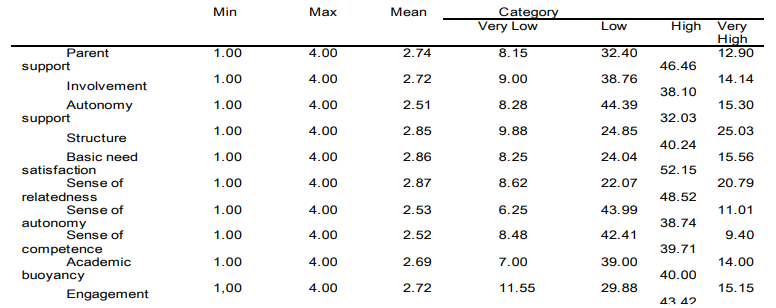
Table 1 illustrates that overall students perceive the support provided by their parents in the high category. This means that students perceive that their parents have demonstrated behaviour in the form of Involvement, Structure, and Autonomy support when interacting with them. This condition is also illustrated through the scores on the three dimensions of parental support; they are Involvement, Structure, and Autonomy support, which are highly perceived by most students. Overall, students appreciate that they have basic psychological needs satisfaction. The results of this study also showed that students generally had a high sense of competence, a sense of relatedness, and a sense of autonomy. Overall, students appreciate that they can deal with everyday academic problems at school. Overall, students appreciate that they have shown high involvement in daily learning activities in class both in the form of behaviour and emotions.
Structural Model Measurement Result
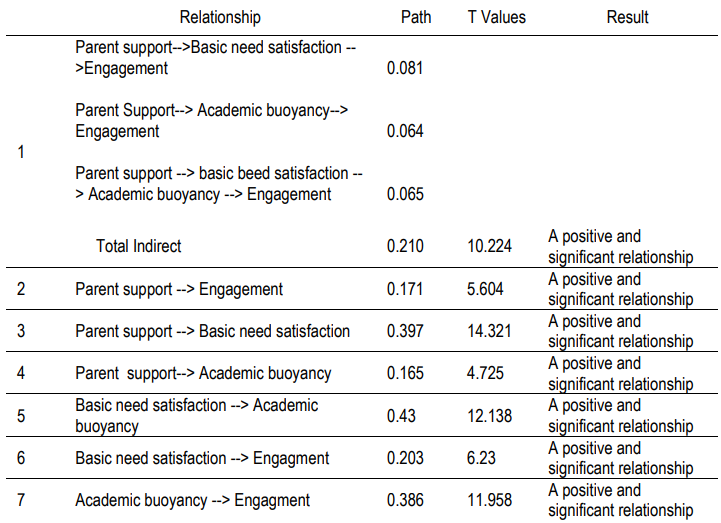
The measurement model test results (CFA) conducted on each variable indicate that each model of Parental Support, Basic Psychological Need Satisfaction, Academic Buoyancy, and Engagement as a construct is an integration of its dimensions, fit with data. After the model compatibility test is fulfilled, the next step is to evaluate or test the measurement model to find out the relationship between latent variables and some of the indicators, by evaluating the validity and reliability of the measurement model. The results obtained indicate that the indicators used as a measure of parental support, basic psychological needs satisfaction, Academic buoyancy, and Engagement have good, consistent, and trustworthy reliability. The hypothesized model demonstrated a good fit with the data (RMSEA = .058; CFI = .993; NFI = .991; GFI =.961). The results of the full structural model estimation using the Latent Variable Score are presented in the following table.
DISCUSSION
In general, the empirical model that tests student engagement reviewed based on parent support and basic needs satisfaction and academic buoyancy match data. The results of this study indicate that parental support plays a role in basic psychological need satisfaction, basic psychological need satisfaction plays a role in eliciting students' ability to overcome daily academic problems that they face or termed Academic buoyancy abilities, and in the end with Academic buoyancy, students will become involved with learning activities in class, or termed Engagement.
From the results of testing the second hypothesis, which aims to see the effect of parental support on engagement, it was found that parental support has a significant positive effect on Engagement. Through the results of this study, it is evident that parental support has a significant direct effect on the involvement of middle school students in their learning activities in the classroom. As the party with the most intense relationship with children early in life, parents have a role in Engagement. Parental support has a significant positive effect on student engagement in classroom learning activities, meaning that the more students appreciate that their parents support themselves, the more students will have engagement with their learning activities in class.
This is supported by the results of this study indicate that in general respondents appreciate that they have shown high involvement in daily learning activities in the classroom both in the form of behaviour and emotions. This means that overall students assess themselves as having tried to achieve success in class, for example, by doing the best possible tasks, participating in class discussions, and listening to the explanations in class carefully. They also rate happy and enjoy learning activities in class. Students in this study also perceive that their parents’ behaviour shows support during their interactions with them.
From the results of testing the third hypothesis which aims to see the effect of parental support on basic psychological needs satisfaction, it was found that parental support was proven to have a significant positive direct effect on students’ basic psychological needs satisfaction. These results prove that parental support has a significant role in meeting the needs of students' satisfaction. The results of this study prove the concept that Autonomy Support, Structure Support and Engagement Support from parents who are given simultaneously will supply nutrients to meet the basic psychological needs of children and will provide energy for the development of healthy children (Ryan & Deci: 2017, pp. 1-25).
The results of this study are in line with the results of previous studies which state that if the involvement of parental support is given along with the autonomy support and structural support from parents, it will affect students’ perceptions about themselves, that is living up to their sense of competence, sense of autonomy and sense of relatedness. Through the experiences provided by the environment (parental support), students will cumulatively build their views of themselves, whether they live in having a feeling of competence, a feeling of autonomy, and a feeling of being attached to people in the surrounding environment. When students appreciate that they appreciate having a sense of competence, a sense of autonomy, and a sense of relatedness, it means that the psychological needs of the student have been fulfilled.
Parental support is proven to have a significant positive direct effect on students’ basic psychological needs satisfaction. The results of this study indicate that overall students in this study appreciate that their parents provide support when interacting with them, and overall students appreciate that their basic psychological needs are met. This means that the more students appreciate that their parents provide support to them, the more students will appreciate that their basic psychological needs are being met.
The fulfilment of basic psychological needs in a person can be an important nutrient for healthy psychological development. Ryan and Deci (Ryan & Deci: 2017, pp. 1-25), explain that the fulfilment of the three basic psychological needs will lead to energy directed at the goal, generating intrinsic motivation in carrying out an activity that is needed so that individuals can function optimally in their lives.
From the results of testing the fourth hypothesis, which aims to see the effect of parental support on Academic buoyancy, it was found that parental support had a significant positive direct effect on Academicbuoyancy. This result is in line with what was stated by Martin and Marsh (Martin & Marsh: 2006) that parents are a factor that can affect their child's academic buoyancy.
Parental support has a significant positive direct effect on Academic buoyancy, meaning that the more students experience their parents providing support to themselves, the more students will have academic buoyancy abilities. This is supported by the results of this study which show that overall students appreciate that their parents provide support for themselves and overall students appreciate that they have academic buoyancy.
The results in this study indicate that all students appreciate that they have the ability of academic buoyancy or the ability to deal with everyday academic problems at school. These results illustrate that overall students assess they have characteristics to be more able to overcome the academic challenges they experience, such as facing bad grades, facing task pressures. Students do not consider challenges as a threat and do not let failure reduce their confidence. Students can cope with the stresses of schoolwork and are more able to control the situation they face. Students know what they need to do to correct their failures. Students appreciate that even though they experience obstacles, challenges, or academic problems at school, it does not affect themselves and their confidence in undergoing their learning activities.
The fifth hypothesis test results from this study indicate that the basic psychological needs satisfaction has a significant positive direct effect on academic buoyancy, meaning that the more students experience that their basic psychological needs are met, the higher their academic buoyancy abilities will be. This is supported by the results of this study which show that overall students appreciate that their basic psychological needs are met, and students also appreciate that they have high academic buoyancy abilities. The results of this study indicate that although overall students appreciate that their basic psychological needs are met, students perceive that they lack a sense of competence and sense of autonomy.
The sixth hypothesis test results from this study indicate that the basic psychological needs satisfaction has a significant direct effect on Engagement. This means that the involvement of students in the form of behaviour and emotions in learning activities in the classroom is significantly influenced directly by the fulfilment of basic psychological needs in students. The results of this study support the view of Self Determination Theory from Ryan and Deci, which states that the fulfilment of basic psychological needs in a person will determine the engagement of learning activities in the classroom. Based on the SDT framework, optimal human functioning depends on fulfilling the three basic psychological needs (Ryan & Deci: 2017, pp. 1-25). SDT stipulates that the fulfilment of basic psychological needs is a nutrient that is very important for individual development.
Basic psychological needs satisfaction has a significant positive direct effect on engagement, meaningthat the more students experience that their basic psychological needs are met, the more students will have engagement with their activities in class. This is supported by the results of this study which show that overall students appreciate that their basic psychological needs are met, and students also appreciate that they have a high level of engagement with their learning activities in class.
From the results of testing the seventh hypothesis, which aims to see the effect of academic buoyancy on engagement, it was found that Academic buoyancy has a significant positive direct effect on engagement. The results of this study confirm the theoretical concept that academic buoyancy can predict student engagement in academic activities in the classroom ( Jang et al.: 2016, pp. 27-38).
Academic buoyancy has a significant positive direct effect on engagement, meaning that the higher the academic buoyancy of students, the more students will have an engagement in learning activities in the classroom. The results in this study indicate that all students appreciate that they have the ability of academic buoyancy or the ability to deal with everyday academic problems at school. Overall, students also appreciate that they have the management of activities in their class.
The results of this study indicate that overall students appreciate that even though they experience obstacles, challenges, or academic problems at school, it does not affect themselves and their confidence inundergoing their learning activities. Overall, the students appreciate that they have managed to overcome their academic problems constructively. The success of students in overcoming daily problems at school will provide energy to students to continue to show effort, perseverance, initiative, and intensity in giving attention to learning activities in class, having enthusiasm, can maintain their interest when dealing with learning activities in class.
CONCLUSION
Overall, it can be concluded that engagement can be formed by parent support through the mediation of internal processes in students; they are basic psychological need satisfaction and academic buoyancy. The findings of this study reinforce the importance of the role of parents as part of the social context in providing autonomy support, structure, and involvement for students, to fulfil basic psychological needs, academic buoyancy, and student engagement.
BIODATA
M. ROHINSA: Meilani Rohinsa is a Candidate Doctor at the Faculty of Psychology at Universitas Padjadjaran, Indonesia. Her speciality is educational psychology. She has worked extensively with Academic Buoyancy and Engagement. The research area is educational psychology.
S. CAHYADI: Surya Cahyadi is an Associate Professor at the Faculty of Psychology at Universitas Padjadjaran, Indonesia. His speciality is educational psychology. He has worked extensively with Self- Regulated Learning. Various articles and publications in the field of educational Psychology were delivered at National and International seminars and journals.
A. DJUNAIDI: Achmad Djunaidi is a Senior Associate Professor at the Faculty of Psychology at Universitas Padjadjaran, Indonesia. His speciality is Clinical psychology. He has worked extensively with the projective Test in Indonesia. Various articles and publications in the field of clinical Psychology were delivered at National and International seminars and journals.
T. ZULRIZKA ISKANDAR: Zulrizka Iskandar is a professor at the Faculty of Psychology at Universitas Padjadjaran, Indonesia. His speciality is Environmental Psychology. Various articles and publications in the field of Social Psychology were delivered at National and International seminars and journals and various mass media. Consistency of activities carried out by the author in the field of research and community service, namely the field of Social Psychology and Environmental Psychology. Various awards have been received by the writer and the government of the Republic of Indonesia.
BIBLIOGRAPHY
BUFF, A, REUSSER, K, & DINKELMANN, I (2017). “Parental support and enjoyment of learning in mathematics: Does change in parental support predict change in enjoyment of learning?”. ZDM, 49(3), pp. 423-434.
CHEUNG, KC, MAK, SK, & SIT, PS (2018). “Resolving the attitude–achievement paradox based on anchoring vignettes: evidences from the PISA 2012 mathematics study”. Asia Pacific Education Review, 19(3), pp. 389- 399.
COLLIE, RJ, & MARTIN, AJ (2017). "Adaptive and maladaptive work-related motivation among teachers: A person-centered examination and links with well-being". Teaching and Teacher Education, 64, pp. 199-210.
DATU, JAD, & YANG, W (2018). "Psychometric Validity and Gender Invariance of the Academic Buoyancy Scale in the Philippines: A Construct Validation Approach". Journal of Psychoeducational Assessment, 36, pp. 278-283.
DECI, EL, CONNELL, JP, & RYAN, RM (1989). "Self-Determination in a Work Organization". Journal of Applied Psychology, 74(4), pp. 580-590.
DECI, E, & RYAN, R (1994). "Intrinsic Motivation Inventory (IMI)". University of Rochester.
JANG, H., KIM, E. J., & REEVE, J. (2016). "Why students become more engaged or more disengaged during the semester: A self-determination theory dual-process model". Learning and Instruction, 43, 27–38.
MARTIN, AJ, & MARSH, HW (2006). "Academic resilience and its psychological and educational correlates: A construct validity approach". Psychology in the Schools, 43(3).
MARTIN, AJ, & MARSH, HW (2008). "Academic buoyancy: Towards an understanding of students’ everyday academic resilience". Journal of School Psychology, 46(1), pp. 53-83.
MARTIN, AJ, & MARSH, HW (2009). "Academic resilience and academic buoyancy: Multidimensional and hierarchical conceptual framing of causes, correlates and cognate constructs". Oxford Review of Education, 35(3), pp. 353-370.
PITZER, J, & SKINNER, E (2016). "Predictors of changes in students’ motivational resilience over the school year". International Journal of Behavioral Development, 41(1), pp. 15-29.
RAMÍREZ MOLINA, R; VILLALOBOS ANTÚNEZ, J & HERRERA, B (2018). “Proceso de talento humano en la gestión estratégica”. Opción. Revista de Ciencias Humanas y Sociales, 34 (18) pp. 2076-2101.
RYAN, RM, & DECI, EL (2017). "Self‑Determination Theory: An Introduction and Overview". Self- Determination Theory: Basic Psychological Needs in Motivation, Development, and Wellness, pp. 1–25.
SKINNER, EA, & BELMONT, MJ (1993). "Motivation in the classroom: Reciprocal effects of teacher behavior and student engagement across the school year". Journal of Educational Psychology, 85(4), pp. 571–581.
SKINNER, EA, & PITZER, JR (2012). "Developmental dynamics of student engagement, coping, and everyday resilience". In Handbook of Research on Student Engagement.
TARBETSKY, AL, COLLIE, RJ, & MARTN, AJ (2016). "The role of implicit theories of intelligence and ability in predicting achievement for indigenous (Aboriginal) Australian students". Contemporary Educational Psychology, 47, pp. 61–71.
VILLALOBOS ANTÚNEZ, J; RAMÍREZ MOLINA, R y DÍAZ-CID, L (2019). “Bioética y biopoder: Perspectivas para una praxis pedagógica desde la ética de Álvaro Márquez-Fernández”. Utopía y Praxis Latinoamericana, Revista Internacional de Filosofía y Teoría Social, 24(87), pp. 65-77.
YUN, S, HIVER, P, & AL-HOORIE, AH (2018). "Academic buoyancy: Exploring learners’ everyday resilience in the language classroom". Studies in Second Language Acquisition, 40(4), pp. 805–830.