Artículos
Public Office and People Co-Administration in Local Development Planning
Oficina pública y coadministración de personas en la planificación del desarrollo local
 S. ROENGTAM sataro@kku.ac.th
Public Office and People Co-Administration in Local Development Planning
Utopía y Praxis Latinoamericana, vol. 25, no. Esp.6, pp. 154-166, 2020
Universidad del Zulia
Received: 12 July 2020
Accepted: 14 August 2020
Abstract: This study focus on the appropriate approach to promote the engagement of citizens in the local development planning process. It uses interviews and focus group discussions with relevant groups. It was found that local government structures have been characterized by low centralization and high levels of connectedness. Besides structure, organizational culture has been considered to reinforce citizen engagement to be institutionalized in local development planning. Local government creates processes that can support citizens and community organizations. Finally, the local development planning presented by this study highlights the role of citizen engagement and local governance.
Keywords: Citizenship, Co-Production, Local development plan, Public engagement..
Resumen: Este estudio trata sobre el enfoque apropiado para promover la participación de los ciudadanos en el proceso de planificación del desarrollo local. Se utilizaron entrevistas y discusiones de grupos focales con grupos relevantes. Se encontró que las estructuras del gobierno local se han caracterizado por una baja centralización y altos niveles de conexión. Además de la estructura, se ha considerado que la cultura organizacional refuerza el compromiso ciudadano. El gobierno local crea procesos que pueden apoyar a los ciudadanos y las organizaciones comunitarias. Finalmente, la planificación del desarrollo local presentada por este estudio destaca el papel del compromiso ciudadano y la gobernanza local.
Palabras clave: Ciudadanía, Compromiso público, Coproducción, Plan de desarrollo local..
INTRODUCTION
A local development plan is an administrative tool to solve the problems of, or to develop communities. Generally, local development plans are formed by local governments and other people from various sectors in the area, as they work together in analyzing and synthesizing the data and information needed for determining the plan. They join collectively in a search for solutions, taking joint responsibility, and learning together. People living in local communities must have the right to determine their future. They will need to participate in all management processes of the local community to collectively learn about and develop ways to solve their domestic problems. The basis of local community development planning is to encourage all sectors of the local community to consider and then make decisions that offer the most appropriate ways to solve the problems facing the community. They should use their local knowledge of the community as a part of their participation. Theoretically, all who have a relationship within the sectors of the local society have the right to engage independently in creating local power and in the development of their community on the basis that all parties have equal dignity and are consistent with the local context (Wildemeersch et al.: 2014).
Generally, a local community is a social mechanism that plays an important role in implementing local,community, and local development plans. They can manage their own space concerning natural resource management, management of community welfare systems, etc., as community mechanisms help to promote fairness. Therefore, the development of the local development planning process, in this way, is a balancing act between the power of local government and the local communities. The natural power of the people that exist within the community must be certified. There are many differences in the ecological culture of each community, and these should be focused on during decision-making, rather than focusing only on the power of local government (Smith et al.: 2015).
However, local development planning is often controlled by the working mechanisms of the local governments, including government agencies, which may lead to them being centralized local development plans. The only viewpoint in making plans is the view of local government officials, including politicians. The operation will have characteristics that mean the public policy has been set but cannot be effectively and appropriately used to solve the problems in local society. As society consists of various organizations, it is desirable for the process of preparing a local development plan to have a political framework and also a positive attitude towards the value of the people in society. Local values can guide a development plan in the right direction, allowing it to step out of the dimension of centralized authority, increasing the power and role of the people and organizations to participate in the implementation of "their" local development plan. In this manner, "engagement" between the state and the people, in the local development planning process, requires an equal working relationship. This can effectively reduce disparities and be fair to every dimension in society (Rogers & Marion: 2011).
The process of transforming local development planning requires the operation process in the "Public Sphere", and this is a significant approach to improving local development planning. It is important to adopt a basic belief that all people, politicians, civil servants, businessmen, and civil society are equal and have an equal right to take part in community development. Opportunities for all sectors to participate in the planning process equally are controlled for problem determination, analysis, creation choices, evaluation, and termination of the development plan (Fischer: 2016, pp. 111-122). By providing opportunities for participation, local agencies can influence citizens’ competence in civic activity. Local development planning extends beyond the design and function of local authorities (Ombler et al.: 2016, pp. 20-27).
This study would like to discover the appropriate approach to promote the engagement of citizens in the local development planning process. Case studies from Thailand are selected. The scope of the research should be able to present concepts and practices that can lead to the creation of a local development plan. These concepts and practices could be able to determine guidelines, especially for Thailand, in improving the local development processes in such a way that comprehensively and successfully enhances all parties’ engagement in these processes.
Theory
Local development planning refers to plans where all sectors have jointly defined their practices and responsibilities for problem solving and local development as a form of operation that can harness the power of change for all (Tholen: 2016, pp. 237-253). The participants have the co-responsibility to solve problems by co-analyzing the activities and co-operating according to the capacity of each area (Radnor: 2014, pp. 402– 423). Resources such as social capital, cultural capital, and local wisdom of the community can be used for creating a development process and create informal learning for all sectors. This will lead to building a strong community that will inspire self-improvement (Klijn & Koppenjan: 2016; Ramírez et al.: 2018; Ramírez et al.: 2020).
Improvement of the local development plan must come from the cooperation of the local government and everyone in the area. They should develop a suitable local development plan which can be used to solve problems effectively and to truly benefit the people. Comparing to the present, generally, the processes of the local development plan are controlled by public offices. The plan often aims to respond to state offices' interest than local communities' interests. This has a significant effect on the problem of inequality in various fields. This crisis will create injustice and social equality. The lack of participation in local development planning, all processes in creating a local development plan are concentrated in the local government, which is composed of politicians and government officials. Local development plans are typically created top-down. They are based on evidence from local government offices in supporting the decision. This makes plans lack reasonableness and cannot be used to solve the problem or to create development. The results cannot bring about fairness and equality in various fields for people in society (Sutherland et al.: 2017; Korkut et al.:2015).
Local development plans made by this concept will severely affect the long-term development of the local administration because the problems and needs of society are increasingly complex, and both current and future problems will arise in different areas. Therefore, the use of a centralized local development plan, designated only for the local government to take responsibility, will not be appropriate in the future, because there is insufficient potential to adapt it to solve the specific problems of the various areas (Mervio: 2015).
A local development plan implemented by transferring the power of local government to the people in the local community will create a balance of operations consistent with the current conditions and circumstances in the area (Meijer: 2015, pp. 1156–1172). The people should have the right to share responsibility with the local government. They should be able to engage in policy formulation, implementation, and evaluation, including co-decision making in the termination of development of public policies, which may affect their quality of life. Shaping a local development plan in this direction will lead to changes in the roles and powers of all relevant parties. In the power relations between different parts of society, the focus is to adjust the relationship between the bureaucracy and people from a vertical relationship to become more horizontal (Reed & Abernethy: 2018, pp. 39–56).
Therefore, the local development plan implemented by transferring the power of the local government to people in the local community will create a balance of operations that is consistent with current conditions and circumstances in the areas. They should have the right to share with the local government their responsibility to manage their communities and society. They should be able to engage in policy formulation, implementation, and evaluation, including co-decision making in termination or development of public policies, which may affect their quality of life. Creating a local development plan in this direction will lead to changes in the roles and powers of all relevant parties. It is the power relations between different parts of society. The focus is to adjust the relationship between the bureaucracy and people from vertical relationships to be more horizontal.
METHODS
A qualitative methodology was applied. This study started from the context of local development planning of 20 local governments in 4 provinces of the northeastern of Thailand. These offices are purposively selected. The criteria are they ever were rewarded by government agencies and other organizations in citizen engagement in drafting local development plans. Desk study would be applied to provide an overview of local development planning.
The second step is data collection and analysis to present the concepts and practices of the case studies in applying co-production in making the plan. Data collection would be done by interview and focus group discussion. There are three groups of key informants, such as civil society leaders, local executives, and high- level officials, and the government officials who supervise local administrative organizations. Then, the collected data would be analyzed by the content analysis method to indicate the key success factors of making the plan. Finally, all relevant data would be synthesized to formulate a model that can explain how co- production can promote citizen engagement in local development planning, which can be a guideline for other purposes.
RESULTS
Concepts and practices on citizen engagement promotion
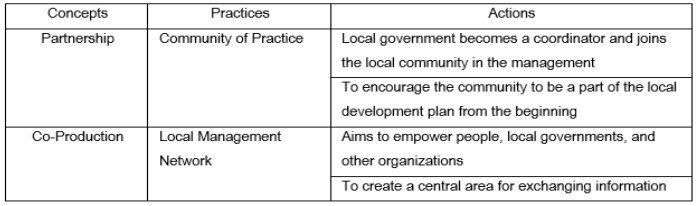
Partnership, the local governments create a mutual consultation process. All methods, following the process of "Community of Practice", continuously are taken place to support people's participation. Through this process, people can directly negotiate and advise government agencies about their problems and needs and those of their communities. These activities will provide improvements and provide both sides with more significant opportunities to make decisions together. Through these activities, the local government and people can strengthen their mutual understanding. When local governments can be actively involved with local people, they will be able to understand their needs and expectations. It will also help establish trust between the government agencies and the people.
This is a change in the working of local governments from their traditional management style. Almost of decision-making local planning are only responsibilities of the public office, other parties and people hardly have chances to participate in these, to be more participatory management. The local government comparatively becomes a coordinator and joins the local community in control more than the director. It is a concept that creates conditions that allow all parties to participate. This is a change from the hierarchical, bureaucratic relationship between local government, the people, and other sectors. The new model is a triangle of relationships between local government, people, and communities, all of which are responsible participants in the implementation of local development planning, in all contexts. They are partners in the preparation and delivery of public services. This is especially useful for community-based planning as it encourages people in the community to provide 'self-service' public services and reduce the dependence on public service provisions. It provides an extension to the public, and other sectors as locals can check and play roles in the local government's management process, especially participating in local government decision making. This can increase the chances of people being able to make decisions that can bring in public knowledge to improve the efficiency and effectiveness of the local development plan.
The main objective of this practice is to encourage the community to be a part of local developmentplanning at the beginning. This can be done through meetings to find out the needs of the community by itself. The role of the local government will change to focus on the role of the network coordinator and promoting the implementation of the community. This role defines the pattern of new relationships among local governments, community organizations, stakeholders, and people. All of them will have a mutually supportive role. Theyhave several responsibilities, from identifying the problem to the evaluation of the impact of public service provisions.
In summary, the local governments focus on working with the people aiming to directly respond to the economic and social needs of the local community. It allows citizens the opportunity to participate in local decision-making, and it will lead people to be able to investigate the performance of local government. This will help improve their quality of life.
Co-Production, the government adjusts internal procedure of practices to take part in providing public services in the form of partnerships in which local government service is a concept aimed to provide citizens and other sector organizations with opportunities to participate in management operations. The goal is to promote a local management network. The group consists of individuals and organizations that can join the local development plan, providing a network that is better able to respond to the needs of local communities in the area.
By this practice, the local government has been transcended because it focuses on creating practical guidelines of participation and shared responsibility among the people and the local government. Therefore, they propose a new working model. The process creates opportunities for citizens to join the local development plan. Local administration is a concept that aims to empower people, local governments, and other organizations in the area working together to create sustainable development. The local government in this study is motivating people to participate in local development plans at every step, from development to implementation. It includes responsibility for the evaluation of the development approach. There is a diverse range of practices for strengthening civic engagement in decision-making processes.
To deal with such problems more efficiently, local governments in this study suggest that there is a need to change the perceptions of the local government with people. It is a way to help pass the power of the government to the public. This is a way to change the relationship between local government and the people in the area. There is a new relationship since this concept attempts to encourage people to have the opportunity to participate directly in public policy decisions of local government organizations. By focusing on the opposite views of the two groups, the local government often views that people have little knowledge, and they are usually not very active in public policy participation. From the views of people, they often see that local governments often break away from the community. So, there is not enough understanding of the local community's needs and problems. As a result, the operations of the local administration cannot be reaching the targets because it cannot create a cooperative network to make it works better.
Encouraging change in the management concept of local administrative organizations, the localgovernments in this study have moved away from the local government being the centre of development planning. It creates a central area for exchanging information beyond that which local governments would generally have. It can bring about recognition and mutual understanding of the problems and the needs of the local community. The knowledge of the needs of each party will be driven through public dialogue at all stages of local development planning. This will support local government in formulating policies and plans that respond to the needs of the local community. A better response is accompanied by more transparency and the ability to prevent failures within the plan.
Key success factors
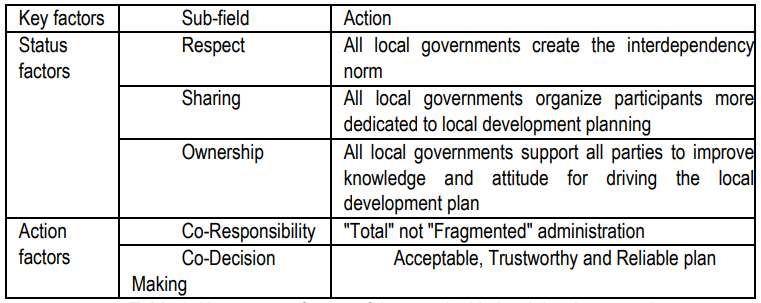
From the concepts and practices of successful case studies, the study found that there are two critical success factors. They are "Status Factors" and "Action Factors." There are also some sub-keys of success. They can be analyzed and presented as follows. The status factors arise from the results of the changing status of local governments. The study shows that they have adjusted their viewpoints regarding people and other community organizations. That is, they have accepted the increased roles of these elements in local development planning. They have allowed engagement in the process through every step, from the beginning to the evaluation stage (Weisz & Clark: 2011, pp. 281–287). This is the changing of local governments because they can work with people and other agencies closer than in the past. They have tried to move away from "office-based administration" with the local government having full authority in local development planning. They try to work with the community to facilitate this process. They try to mobilize planning to be 'area-based administration' with local government having equal authority with the other parties and people (Moon: 2017, pp. 1–16). The study analysis indicates that the adjustment of local governments can be achieved due to three sub-key factors as follows.
• Respect, all local governments create internal regulations for making interdependency norm. They construct networks that can connect to people in the community. These networks are in the form of public gatherings. This is a new management system formed by cooperation between local governments and agencies. They are adaptable and mobilize a variety of resources, such as knowledge, social capital, and technologies from various sources, which can reinforce new learning processes for the community (Farr: 2016, pp. 654–672).
• Sharing, all local governments change some regulations to organize participants who are dedicated to local development planning. This allows them to effectively use and share resources, along with the capital inputs needed to collectively produce results. They may create a mutual agreement that helps to define how activities should be carried out (Mayekiso et al.: 2013, pp. 186–199).
• Ownership, every department of local governments has been assigned missions to improve knowledgeand the attitude of the people. To create sustainable and robust development, ownership by the people and community organizations is significant, as it can encourage and promote the participation of people in all sectors. It can support the creation and accumulation of knowledge that is conducive to local development. This direction requires the cooperation of all sectors to continuously develop ownership. It can link family, community agency, religious institutions, and local government agencies, so they are molded together to form a crucial factor in the success of the local development plan (Kasraian et al.: 2015, pp. 290–301; Trousset et al.: 2018, pp. 44-69).
In summary, from this study, the local government needs to act as manual action. It must help allow the people an opportunity to develop into citizens. They can take responsibility for implementing to implement the local development plan together with the local government. All parties have the rights to share interest, liability, and accountability. The local development plan must be based on the partnership among all actors. It cannot be made by operations of local government and government agencies like the past.
The action factors, the study found that the role of local governments and other parties have been changed to be able to carry out a local development plan to respond to the needs of the wider community. Their practices are to promote the responsibilities of citizens and community organizations in the process of local development planning. Local government must define roles, powers, duties, and procedures, in practice to support the citizens and groups. They must be genuinely responsible (Czischke: 2016, pp. 55–81).
Two sub-key factors are integrated with creating the action factor. They are as follows.
• Co-Responsibility, all local governments arrange regulation to promote the role of people in community organization groups to be able to join in local development planning by themselves or to delegate their representatives to take responsibility for local development planning, at all stages. They do not want to have the participation of the people in the form of public hearings or public committees. They want to promote themas responsible participants in producing the local development plan. This requires that all processes of the local development plan have to be considered in "Total," not as "Fragments" of administration (Garbaye & Latour: 2015, pp. 1-19). Therefore, the local government, citizens, and other organizations in society cannot be separated within the policy process. They have to participate in the form of a "Local Development Planning Management Partnership." (Wijnhoven, Ehrenhard, & Kuhn: 2017, pp. 30-42)
• Co-Decision making: all local governments design processes for citizens and sectors, and they can use the methods to make consultations with them. These processes will be operated in a respectful atmosphere and with acceptance of each other, being used to promote the sharing of opinions, debate, and reasonable discussion. The discussion will create mutual agreements in choosing good alternatives (Mees, Crabbe & Driessen: 2017, pp. 827–842). These are the most appropriate approaches to implement local development planning since they develop plans that are accepted, trustworthy, and reliable for everyone.
This study found that local government creates processes that can effectively support citizens and community organizations to engage in decision making for local development planning. There are six steps of co-decision making, which local government design as follows. The first step will be started by joint examinations. The real needs of the local community and society are collected and analyzed to obtain the right information and to address the public's needs. The second is mutual consultations to assess the condition of the problem or requirements of the society to get the issues that are needed to be used in local development planning. The third is sorting, selection, and presentation of supporting reasons to check and prioritize the needs for local development planning, which can respond to the needs of the society. The fourth is to create "The Middle Area" to open opportunities for each party to offer alternative solutions or return to the selected requirements. This can lead to the creation of mutually agreed-upon solutions. The local government acts as a mediator for making resolutions of problems. The fifth is the formation of a formal agreement. All parties can select the best options for making local development plans. All parties can discuss the details to conclude together. They will choose one of the best alternatives from the many options offered. Local government and others must make decisions together in terms of voting. The sixth is the regulation co-making. This step is settled to determine authority and the responsibility of all parties within the local development plan. The regulation is the job classification. It shows parties' duties in local development planning. This one can adequately support the implementation of the planning because it can protect obstacles that may be happened during the operations.
All of these results can be displayed on relationships among factors that are found by the analysis as figure 1.
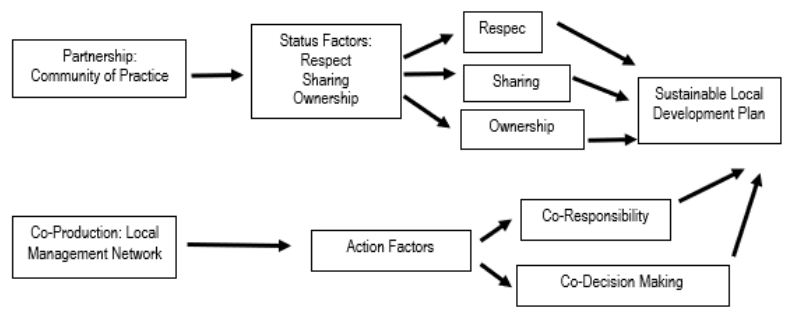
Figure 1. A model of enhancing sustainable development plan
DISCUSSION
The results of successful case studies can happen because all local governments have changed their organizations from 'Official Space' to 'Public Space'. This provides an area for making interaction and collaboration among local governments and other parties in the local communities. The public space established by all local governments in relevant to adaptive governance and adaptive capacity (Tuurnas, et al.: 2015, pp. 370–382). It provides the basic concept of examining the actors, in making collaborative governance, responds to uncertainty, and change. It focuses on the social and the physical, as well as the ability to mobilize the current situation. It includes structures of institution and governance, human and social capital, and knowledge management. It can create connections and interactions among people, community organizations, and local governments (Buciuni & Finotto, 2016: pp. 2010–2023). The public space can be the area where all parties can share their capacities, such as knowledge, experience, networks, transparency, trust, commitment, leadership, legitimacy, accountability, collaboration, and flexibility (Osborne et al.: 2016, pp. 639–653). The public space refers to the area of knowledge sharing in support of decision-making processes in local development planning. In this context, positive engagement in public space is a core element of effective local development planning. The open space is extended into the planning, implementation, and evaluation. Users of public services, or people, can take a more active role here, through either citizen participation or other mechanisms, to develop and improve the local development plan. The public space in this study offers joint activity between professionals, the public, and service users (Kleef et al.: 2017, pp. 1044-1055 ).
These results display the empowered engagement of people and community organizations in local development planning. All local governments fully intend to motivate people and other organizations to engage in the planning process (Fledderus: 2015, pp. 642–653). The multiple independent actors contribute to the delivery of public services and multiple processes of the public policy-making system. Citizen engagement is linked with the idea of collaboration between non-state and state actors (Howlett, et al.: 2017, pp. 487–501 ). Also, Graeme Worboys (Worboys et al.: 2018) emphasized that citizen engagement allows the citizen to be involved in the production of public services that are delivered through a professional and managed public organization. Engaging with people will always be a necessary feature of the development and implementation of social needs. The reason being namely: engagement processes enable a better understanding of problems that innovation might address. Second, citizens can be the source of innovative ideas; the engagement processes can uncover them. Third, engaging citizens enable contributions from varied and sometimes unexpected sources, which introduces divergent thinking; these diverse perspectives add particular value when we are trying to solve tough problems. Fourth, the development and implementation of the decision-makingprocess are related to that innovation. Fifth, many of the challenges that require social innovations need the participation and cooperation of citizen and depend on fundamental changes to behavior and attitudes.
Engagement primarily describes a process within local development planning. (Joshi & Moore: 2006, pp. 31-49). The involvement of people is a renewal of social and organizational action in new public policy. Local development planning also requires the participation of stakeholders for policy analysis and policy-making. Citizen engagement is usually recognized as an important indicator of success. In local development planning, engagement of the citizens is an important measure, challenging the power relation, and should include collaboration, participants, equality and no hierarchy (Bell & Pahl: 2018, pp. 105-117). The government structures have been characterized by low centralization and structure; organizational culture has been considered to reinforce citizen engagement to be institutionalized in local development planning.
Local governance, these results present the importance of local government reform. That is, the change from "Government" to "Governance." These local governments can move from "Closed Administrations" to "Open Administrations." They look towards and prioritize outside parties more than the traditional local administration, which focuses on the local offices as the priority (Rinkinen & Harmaakorpi: 2017, pp. 1–17). Policy tools are the techniques for governance that involve and use an authority in the provision of goods and services in society. Local governance provides public or private services through a set of policy tools. Indeed, it can provide service deliveries by enhancing and facilitating the citizen-based provision of public goods and services (Greenhalgh, et al.: 2016, pp. 392–429). Although local governance has emerged and has developed as a concept that emphasizes citizen engagement in policy delivery. It includes citizens and professional organizations to collaborate with government agencies in the management the public service delivery.
Local governance indicated by case studies represents relationships between government and citizens as a form of providing public services. Local governance is based on the activities of the citizen and the local government, or the consumer and professional provider of public services (Pestoff: 2006, pp. 503–519). It aims to motivate the improvement of the efficiency of public services, the effectiveness of public policies, and to promote other important social goals, such as citizen empowerment, participation, and democracy (Harrison & Waite: 2015, pp. 502-520). Citizen involvement in the provision and governance of public service is used as a supportive factor for citizen engagement in public services. Local governance can create discussion and deliberation concerning the general conditions that include dialogues, interaction, and deliberation among local governance and non-state actors.
Therefore, the local governance in this study is an instrument of reform that will be met with varying degrees in public services. It can help public officials working together with people in public service deliveries, which can respond to the specific needs of the community. Local governance can also be a powerful source of ideas and inspiration for social innovation and the bureaucracy, emphasizing the necessity of participation in local governance (Poocharoen & Ting: 2015, pp. 587–614). Local governance in public affairs has gained prominence as a means of collaborating between local government and citizens to promote democratic values such as transparency and accountability. The use of participation and citizen engagement is the main objective of local governance reform. Also, local governance is the most promising way to involve the public and center public management on the citizen. This informs the argument that local government, whether domestic or institutional, should be handled through a collective decision-making process (Lam, et al.: 2017, pp. 3601–3610). The local government transformation presented by this study highlights the role of citizen engagement in local development planning reform.
CONCLUSION
Conceptually, local development planning is a co-administration among local service agents, public administrators, citizens, and community associations. Local development planning consists of citizen involvement or engagement and bureaucratic responsiveness. From this understanding, local developmentplanning makes the government more open to collaboration by involving various actors (Chen, et al.: 2015, pp. 96-114).
The local development planning of this study is seen as a means of changing the power to deal with problems. The monopoly held in the hands of government officials and local politicians changed with the transfer of power to the people, altering the primary relationship between the people and local government (Nind, et al.: 2017, pp. 387–400). Local development planning is made by collaboration between the people and local government agencies to perform services and provide local administration. It is a new form of local development planning. That is, the local government engages with the public directly in local governance decisions for the plan. It creates a unique perspective on the relationship between the government and society (Wolsink: 2017, pp. 1–20; Bell & Pahl: 2018, pp. 105-117).
Local development planning in this study is a way to encourage people to participate and co-manage improvement in the conditions that help build a better future for their community (Vamstad: 2015, pp. 1173– 1188). It is assumed that everybody has a natural desire to be involved in the policy process. Public participation will influence policy outcomes. There is a belief in the concept of pulling together all sectors involved or inclusiveness in local development planning. As a result of the co-decision-making, mutual understanding through the process of discussion can lead to accepted conclusions among them. This process can be used to design public policies and local development plans that produce excellent results (Trousset, et al. 2015, pp. 44-69).
Finally, the local development planning in this study respects diversity in community participation. This is because it is a concept that drives the general public in the community to take responsibility for their way of life through the process of encouraging people in the community to consider and deal with various public issues together. (Bezdek: 2013, pp. 3-54). It is the most crucial factor in achieving more significantly more excellence in local development. As John Stewart Mill suggests, the political participation of the people will cause power to solve problems for the best society (Merkelsen: 2011, pp. 631-645).
BIODATA
S. ROENGTAM: Sataporn Roengtam is an associate professor in the Public Administration Department, Faculty of Humanities and Social Sciences, Khon Kaen University, Thailand. He has a Ph.D. in Integrated Sciences from Thammasat University, Thailand in 2006. His research interests are decentralization, public policy, governance, and digitalized governance, co-production, citizenship, smart civic education, citizen engagement, and civil society development. He is a member of some political sciences and public administration societies and associations also.
BIBLIOGRAPHY
BELL, DM & PAHL, K (2018). “Co-Production : Towards a Utopian Approach”. International Journal of Social Research Methodology, 21(1), pp. 105-117.
BEZDEK, L (2013). “Citizen Engagement’ in the Shrinking City: Toward Development Justice in an Era of Growing Inequality”. St. Louis University Public Law Review, 33, pp. 3-54.
BUCIUNU, G & FINOTTO, V (2016). “Innovation in Global Value Chains: Co-Location of Production and Development in Italian Low-Tech Industries”. Regional Studies, 50(12), pp. 2010–2023.
CHEN, J, KERR, D, TSANG, S & Sung, YC (2015). “Co-Production of Service Innovations through Dynamic Capability Enhancement”. The Service Industries Journal, 35(1-2), pp. 96-114.
CZISCHKE, D (2018). “Collaborative Housing and Housing Providers : Towards an Analytical Framework of Multi-Stakeholder Collaboration in Housing Co-Production”. International Journal of Housing Policy, 18(1), pp.55–81.
FISCHER, HW (2016). “Beyond Participation and Accountability: Theorizing Representation in Local Democracy”. World Development, 86, pp. 111-122.
FARR, M (2016). “Co-Production and Value Co-Creation in Outcome-Based Contracting in Public Services”. Public Management Review, 18(5), pp. 654–672.
FLEDDERUS, J (2015). “Does User Co-Production of Public Service Delivery Increase Satisfaction and Trust? Evidence from a Vignette Experiment”. International Journal of Public Administration, 38(9), pp. 642–653.
GARBAYE, R & LATOUR, V (2016). “Community and Citizenship in the Age of Security: British Policy Discourse on Diversity and Counter-terrorism since 9/11”. French Journal of British Studies, 1, pp. 1-19.
GREENHALGH, T, JACKSON, C, SHAW, S & JANAMIAN, T (2016). “Achieving Research Impact through Co-Creation in Community-Based Health Services : Literature Review and Case Study”. The Milbank Quarterly, 94(2), pp. 392–429.
HARRISON, T & WAITE, K (2015). “Impact of Co-Production on Consumer Perception of Empowerment”. The Service Industries Journal, 35(10), pp. 502-520.
HOWLETT, M., KEKEZ, A., & POOCHAROEN, O. O. (2017). “Understanding co-production as a policy tool: Integrating new public governance and comparative policy theory”. Journal of Comparative Policy Analysis: Research and Practice, 19(5), pp. 487-501.
JOSHI, A & MOORE, M (2006). “Institutionalized Co-Production : Unorthodox Public Service Delivery in Challenging Environments”. Journal of Development Studies, 40(4), pp. 31-49.
KASRAIAN, L, SAMMON, D & GRACE, A (2016). “Understanding Core IS Capabilities throughout the IS / IT Service Co-Production Lifecycle”. Journal of Decision Systems, 25, pp. 290–301.
KLEEF, DV & EJIK, C (2016). “In or Out : Developing a Categorization of Different Types of Co-Production by Using the Critical Case of Dutch Food Safety Services”. International Journal of Public Administration, 39(13), pp. 1044-1055.
KLIJN, EH & KOPPENJAN, JFM (2016). “Governance Networks in the Public Sector”. Oxon: Routledge.
KORKUT, UM, KESI, BK, GREGG, C & HENRY, R (eds) (2015). “Discursive Governance in Politics, Policy,and the Public Sphere”. New York: Palgrave Macmillan.
LAM, B, ZAMENOPOULOS, T, KELEMEN, M & NA, JH (2017). “Unearth Hidden Assets through Community Co-Design and Co-Production”. The Design Journal, 20(Sup1), pp. 3601–3610.
MAYEKISO, T, TAYLOR, D & MAPHAZI, N (2013). “A Public Participation Model for Enhanced Local Governance”. Africa Insight, 42(4), pp. 186–199.
MEES, H, CRABBE, A & DRIESSEN, PJ (2017). “Conditions for Citizen Co-Production in a Resilient, Efficient and Legitimate Flood Risk Governance Arrangement, a Tentative Framework”. Journal of Environmental Policy & Planning, 19(6), pp. 827–842.
MEIJER, A (2015). “Co-Production in an Information Age : Individual and Community Engagement Supported byNew Media”. VOLUNTAS: International Journal of Voluntary and Nonprofit Organizations, 23(4), pp. 1156– 1172.
MERKELSEN, H (2011). “Risk communication and citizen engagement: what to expect from dialogue”. Journal of Risk Research, 14(5), pp. 631-645.
MERVIÖ, MM (2015). “Management and Participation in the Public Sphere”. IGI Global.
MOON, MJ (2017). “Evolution of Co-Production in the Information Age : Crowdsourcing as a Model of Web- Based Co-Production in Korea”. Policy and Society, 37(3), pp.1–16.
NIND, M, et al. (2017) “TimeBanking: Towards a Co-Produced Solution for Power and Money IssuesIn Inclusive Research”. International Journal of Social Research Methodology, 20(4) pp.387–400.
RAMÍREZ MOLINA, R., LAY, N & SUKIER, H (2020). “Gerencia Estratégica para la Gestión de Personas del sector minero de Venezuela, Colombia y Chile”. Información Tecnológica, 31(1), pp. 133-140.
RAMÍREZ MOLINA, R; VILLALOBOS ANTÚNEZ, J & HERRERA, B (2018). “Proceso de talento humano en la gestión estratégica”. Opción. Revista de Ciencias Humanas y Sociales, 34 (18) pp. 2076-2101.
OMBLER, J, RUSSELL, M & RIVERA-MUÑOZ, G (2016). “Local Councils and Public Consultation: extending the reach of democracy”. Policy Quarterly, 12(4), pp. 20-27.
OSBORNE, SP, RADNOR, Z & STROKOSCH, K (2016). “Co-Production and the Co-Creation of Value in Public Services : A Suitable Case for Treatment ?”. Public Management Review, 18(5), pp. 639–653.
PESTOFF, V (2006). “Citizens and Co-Production of Welfare Services”. Public Management Review, 8(4), pp. 503–519.
POOCHAROEN, O & TING, B (2015). “Collaboration, Co-Production, Networks : Convergence of Theories”. Public Management Review, 17(4), pp. 587–614.
RADNOR, Z (2014). “Operationalizing Co-Production in Public Services Delivery : The Contribution of Service Blueprinting”. Public Management Review, 16(3), pp. 402–423.
REED, MG & ABERNETHY, P (2018). “Facilitating Co-Production of Trans disciplinary Knowledge for Sustainability: Working with Canadian Biosphere Reserve Practitioners”. Society and Natural Resources, 31(1), pp. 39–56.
RINKENEN, S & HARMAAKORPI, V (2017). “The Business Ecosystem Concept in Innovation Policy Context: Building a Conceptual Framework”. Innovation, 31(3), pp. 1–17.
ROGERS, J & ORR, M (2011). “Public Engagement for Public Education: Joining Forces to Revitalize Democracy and Equalize Schools”. Stanford, California: Stanford University Press
SMITH, ZA, DESHAZO, J & LANHAM, L (2015). “Developing Civic Engagement in Urban Public Art Programs”. Lanham, Maryland: Rowman & Littlefield Publishers.
SUTHERLAND, WJ, SHACKELFORD, G & ROSE, DC, (2017). “Collaborating with Communities: Co- Production or Co-Assessment?”. London: Cambridge University Press
THOLEN, B (2016) “Drawing the Line: On the Public/Private Distinction in Debates on New Modes of Governance”. Public Integrity, 18(3), pp. 237-253.
TROUSSET, S, et al. (2015). “Degrees of Engagement: Using Cultural Worldviews to Explain Variations in Public Preferences for Engagement in the Policy Process”. The Policy Studies Journal, 43(1), pp. 44-69.
TUURNAS, SP, STENVALL, J, RANNISTO, P & HARISALO, R (2015). “Coordinating Co-Production in Complex Network Settings”. European Journal of Social Work, 18(3), pp. 370–382.
VAMSTAD, J (2015). “Co-Production and Service Quality : The Case of Cooperative Childcare in Sweden”. VOLUNTAS: International Journal of Voluntary and Nonprofit Organizations, 23(4), pp. 1173–1188.
WEISZ, H & CLARK, E (2011). “Society-Nature Coevaluation: Interdisciplinary Concept for Sustainability, Geografiska Annaler: Series B”. Human Geography, 93(4), pp. 281–287.
WILDEMEERSCH, BB, MARIA, D & DORDRECHT, GB (2014). “Civic Learning, Democratic Citizenship and the Public Sphere”. New York: Springer.
WIJNHOVEN, F, EHRENHARD, M & KUHN, J (2015). “Open government objectives and Participation motivations”. Government Information Quarterly, 32(1), pp. 30-42.
WOLSINK, M (2017). “Co-Production in Distributed Generation: Renewable Energy and Creating Space for Fitting Infrastructure within Landscapes”. Landscape Research, 43, pp. 1–20.
WORBOYS, LG (2015). “Concept, Purpose and Challenges: Protected Area Governance and Management”. Canberra: ANU Press.