Artículos
Effect of Using Social Media on Word of Mouth Advertising for Tourism Industry
Efecto del uso de las redes sociales en la publicidad de boca en boca para la industria del turismo
 LEILA. ANDERVAZH leila.andervazh@srbiau.ac.ir
EBRAHIM. ALBONAIEMI ebrahim.albonaiemi@gmail.com
MARSHA. ZARBAZOO marshazarbazoo@gmail.com
LEILA. ANDERVAZH leila.andervazh@srbiau.ac.ir
EBRAHIM. ALBONAIEMI ebrahim.albonaiemi@gmail.com
MARSHA. ZARBAZOO marshazarbazoo@gmail.com
Effect of Using Social Media on Word of Mouth Advertising for Tourism Industry
Utopía y Praxis Latinoamericana, vol. 25, no. Esp.6, pp. 197-207, 2020
Universidad del Zulia
Received: 12 July 2020
Accepted: 14 August 2020
Abstract: This study aimed to investigate the impact of using social media on word of mouth advertising with an emphasis on the mediating role of brand equity in the tourism industry. The purpose of this study is applied type and in terms of the method is a survey. The data gathering tool in this study is the standard questionnaire of Andrew. In this study, face and content validity were used to evaluate the validity of the questionnaire. Findings of a critical ratio value (T-value ranging from -1.96 to 1.96) resulted in a 99% be positive and significant.
Keywords: Brand equity, Social media, Tourism, Word of mouth advertising..
Resumen: Este estudio tuvo como objetivo investigar el impacto del uso de las redes sociales en la publicidad boca a boca con énfasis en el papel mediador del valor de la marca en la industria del turismo. El propósito de este estudio es el tipo aplicado y en términos del método es una encuesta. La herramienta de recopilación de datos en este estudio es el cuestionario estándar de Andrew. En este estudio, se utilizó la validez aparente y de contenido para evaluar la validez del cuestionario. Los resultados de un valor de relación crítica (valor T que varía de -1,96 a 1,96) dieron como resultado un 99% de ser positivo y significativo.
Palabras clave: Publicidad boca a boca, Redes sociales, Turismo, Valor de marca..
INTRODUCTION
Over the past two decades, social media has revolutionized marketing communications and provided new opportunities for user-brand interaction. This interaction is very important for brands because social network users rely on the recommendations, they receive from other users (Schmitt et al.: 2011, pp. 46-59) and this relationship affects the decision-making process (Hinze et al.: 2011, pp. 55-71). Word of mouth advertising is the type of relationships and nodes within the node of people, products, services, places, and nodes that can be used as a communication between the consumer of the product, the service, the company, and a corporate place.
This is a product or service provider and can be a two-way or ordinary one-way article. Tourists as consumers to choose a location for tourism a series of actions can be taken to make the process more efficient. After detecting the need, they evaluated different options and gathered information, and the decision was finally taken (Shiffman & Kanuk: 2006). Tourist's decision to choose a place depends on different factors that can be referred to in Advertising, tourist destination, personality features of tourist, awareness of tourism destinations and word of mouth advertising (2014).
Among these factors, word of mouth advertising, which has one of the most important ways to dominate the market and decision-making of consumers increases, but most marketers Tourism services sight of the fact remained that customers engage with others more effectiveness of marketing activities and even advertising (De Bruyn & Lilien: 2008, pp. 151-163).
To analyze the relationship between social media use and brand equity, we use a theoretical model of cognitive psychology that underlies various studies on information processing and the impact of advertising. According to the above theory, consumers associate communication stimuli with their prior knowledge (Lane& Fastoso: 2016). Therefore, new information is not stored randomly but rather is divided into categories arranged in a concept in the mind of the consumer. For example, in the context of destination as a brand, if the information received matches the consumer's knowledge of the destination, the information is split into the existing program, but if new information is not compatible with consumer knowledge, the structure of the program to absorb new data will change (Stojanovic et al.: 2018). Brand value is a fundamental concept in brand management.
From the marketing perspective of Aaker (Aaker: 2009) brand value describes the brand value inconsumers' minds. And in particular, as a different effect of the impact of brand awareness on consumer response to the brand or as a perceived tool and the overall superiority of a product because of its brand, compared to other brands (Stojanovic et al.: 2018). Previous studies have shown empirical evidence that marketing communications can enhance brand awareness. Recent studies have also shown that social media communication can have a similar effect on program theory (Schivinski & Dabrowski: 2015; Ramírez & Hugueth: 2017; Rincón et al.: 2019).
Daily social network users are increasingly exposed to content about tourist destinations they share with friends (photos, videos, blogs, comments, etc.), which has a significant impact on brand awareness (Halkias: 2015). Although company-generated content is always positive, compared to user-generated content, that may be positive and negative. Some authors argue that both types of content increase brand awareness and help consumers make their purchasing decisions. The consumer first recognizes that there is a tourist destination and then a memory program is created that displays the destination image. Various studies support this analysis in the context of social networks because the content produced or shared by other users indicates stimuli that influence the formation of the target image.
Points out that perceived value can be considered as a set of benefits and costs received. Empirical findings have shown that perceived customer value is more important than customer satisfaction perceived by consumer buying behaviors. Empirical findings have shown that perceived customer value is less than customer satisfaction perceived by consumer buying behaviors, because perceived value occurs in different stages of the decision-making process for the buyer, while customer satisfaction is unanimously an evaluationafter purchase or use. Whatever products have better-perceived value than competitors, it is a source of competitive advantage.
Quality of service is one of the most important factors that have a major effect on consumer satisfaction and loyalty, and especially their verbal advertising (Sweeney et al.: 2008, pp. 344-364). Quality of service and customer experience of this quality are all the perceptions formed by a tourist interacting with a place, company, brand, and product and every time a customer interacts with them directly or indirectly, an experience is formed and this experience is highly personal and indicates his or her participation at various levels (rational, emotional, sensory, physical and spiritual). Meibar and Schacher (1) also believe that customer service quality experience, customer internal and mental response to any direct contact (usually occurring during direct purchase and initiated by the customer) and indirect (including unwanted interactions with company representatives) that will also be effective in generating customer satisfaction and customer image from one place.
Tourism is expressed as a driving force for regional development. Successful tourism can increase government revenue, employment, and destination tourism revenue. How to attract a tourist to visit the destination again or recommend the destination to others is crucial for successful destination tourism development. The first studies of brand valuation in tourism were used for hotels, restaurants (Kim & Ko: 2005, pp. 1480-1486) and airlines (Chen & Tiseng: 2010, pp. 24-34). This study intends to examine the impact of using social media on verbal advertising with the mediating role of brand equity dimensions including brand awareness, image, quality, value perception.
Background research
The results showed that the significant effect of location brand complexity on identity through verbal advertising was greater for residents than for foreign tourists. Also, the significant effect of location brand complexity is greater for foreign tourists than residents, due to satisfaction in verbal advertising. Besides; location brand complexity does not have a positive impact on verbal advertising due to commitment.
Mansouri et al. (Mansouri et al.: 2018, pp. 49-72) examined the impact of service recovery performance on verbal advertising; the mediating role of perceived customer value, customer experience, emotional responsiveness, and brand loyalty. According to the results, high levels of performance in service retrieval influence the verbal advertising of tourists.
Alizadeh et al. (Alizadeh et al.: 2017, pp. 127-143) examined the relationship between media advertising and brand equity from the viewpoints of Tabriz sports stores customers. The results showed that there is a significant positive relationship between media advertising with brand equity (brand loyalty, brand association, brand awareness, and brand perceived quality) from the viewpoints of customers of Tabriz sports stores. Customers' brand equity is affected by advertising media, and this research has concluded.
Severi et al. (Severi et al.: 2014, pp. 231-258) examined the impact of electronic Word of mouth advertising on brand value about social media. The findings show that there is an indirect relationship between electronic Word of mouth advertising and brand equity dimension. Ismaeil et al. (Ismaeil et al.: 2012, pp. 457-493) examined the effect of love, personality, and brand image on Word of mouth advertising: the case of fashion brands among young consumers. The results showed that only brand image is a Determinant of brand love affecting Word of mouth advertising (WOM) associated with brand personality.
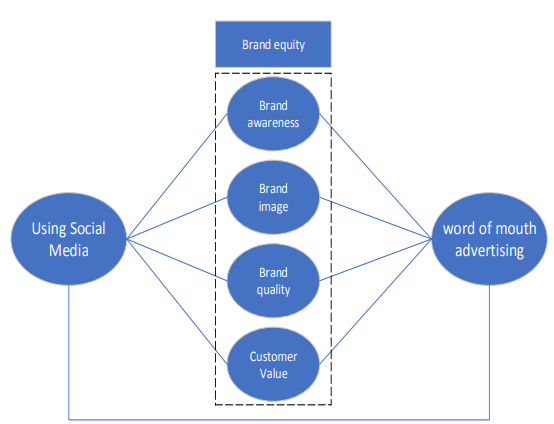
Figure 1. Conceptual Model
Research hypotheses
Using social media affects brand awareness. Using social media affects brand image.
Using social media affects brand quality. Using social media affects customer value.
Brand awareness affects word of mouth advertising.
Brand image affects word of mouth advertising. Brand quality affects word of mouth advertising. Customer value affects word of mouth advertising.
Using social media affects word of mouth advertising.
METHODS
The present study is of applied purpose, in terms of survey method and is of comparative scientific nature. The statistical population of this study includes foreign tourists coming to Tehran. The sample size using Using Kerchezy and Morgan's table was 384 people who were selected randomly. The data collection tool in this study is Andreu et al. (Andreu et al.: 2017, pp. 111-134) standard questionnaire. For the Social Media variable (3 items), the brand equity variable was adjusted to include four dimensions; brand awareness, brand image, brand quality and customer value (16 items), and the Word of mouth advertising variable (6 items). In this study, content validity was used to assess the validity of the face validity questionnaire. In this way, using two forms of CVI, CVR, questionnaires were given to several experts and mentors and consultants and they were asked about the questions that were confirmed by the questionnaire after making the corrections. One of themethods of calculating the reliability is Cronbach's alpha coefficient calculated according to Table 1- above0.7 which indicates the internal consistency of the items and confirmation of reliability.
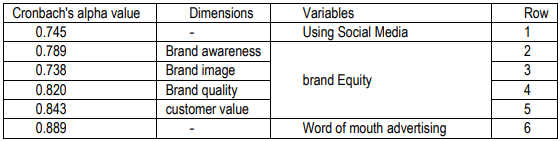
Structural equation modeling was performed using AMOS software version 23 for data analysis.
RESULTS
Convergent validity
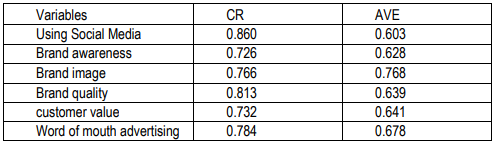
AVE or (mean extracted variance) should be greater than 0.5. The values in Table 2 indicate that (AVE> 0.5) each variable is greater than 0.5, so convergence is achieved. In convergent validity, the composite reliability should be greater than the mean of the extracted variance. (CR> AVE) Given the comparing values of composite reliability and extracted variance, this convergent validity condition is found.
Divergent validity
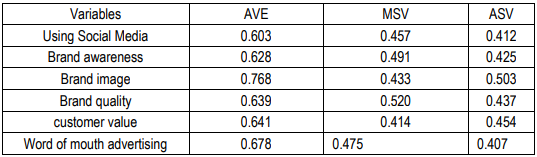
To verify divergent validity, there must be two conditions: the first condition AVE (mean extracted variance) is greater than the MSV (maximum common variance). The second condition AVE (extractedvariance mean) is greater than ASV (mean-variance averaged), which is the second condition given the above table values.
Fornell Larker test
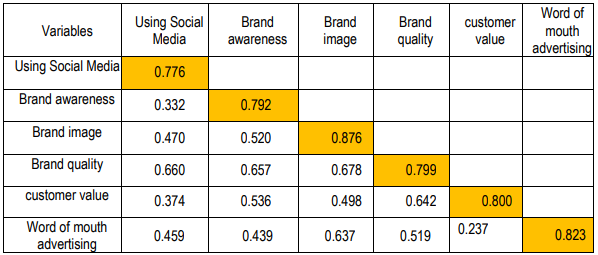
The Fornell-Locker test asserts that a variable should be more scattered among its reagents than the references of other variables at present. Therefore, statistically, the AVE of each variable now has to be greater than its second-highest correlation coefficient with the other variables present.
The divergent validity of the model variables can be deduced from the results of Fornel and Larker tests based on the results of the AVE correlations and the root of this table. Based on the results of the Fornell Larker test, it can be concluded that our model has divergent validity.
Structural Equation Modeling
The model of structural equations after implementation in AMOS software is non-standard and standard as follows.
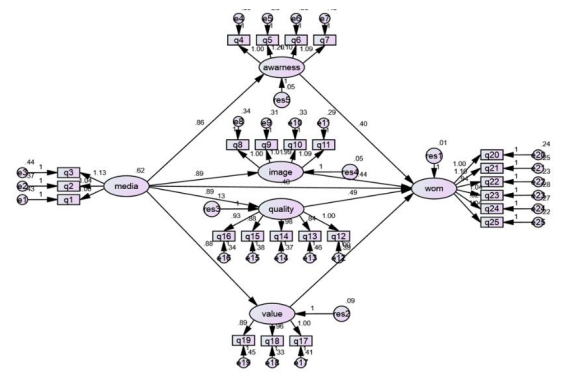
Figure 2. Structural equation model in nonstandard coefficient estimation mode
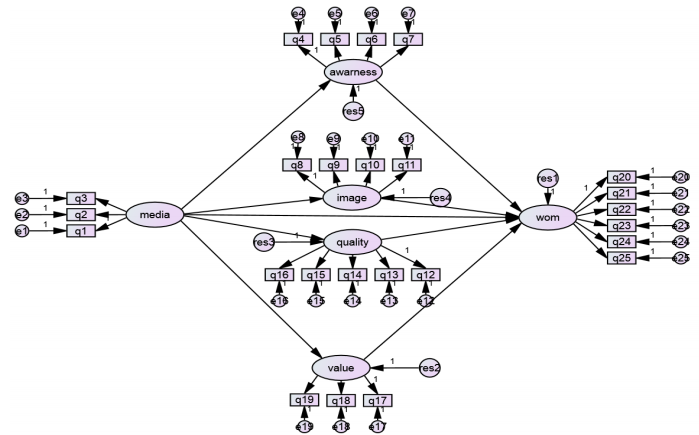
Figure 3. Structural Equation Modeling in Standard Coefficients Estimation
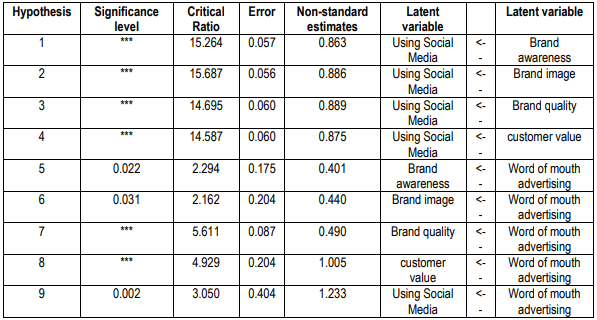
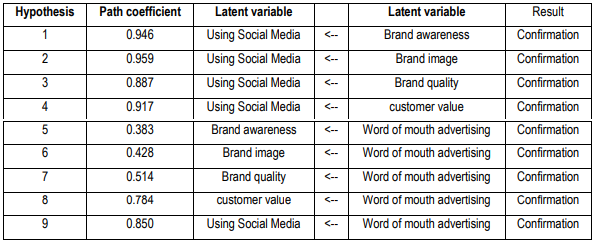

According to Table 7-According to the fit indices, it is shown that our model is a good fit.
DISCUSSION
The findings of the study using the effect of using social media on brand awareness because the Critical Ratio value (T-value 1.96 to 1.96) was not significant, have a positive and significant effect at 99% confidence level with 0.946. This finding is in line with the studies of Stojanovich et al. (Stojanovich et al.: 2018). To raise brand awareness, it is recommended to exchange brand identity value through brand signage, thus creating a more attractive brand personality for tourists who are increasingly exposed to different social media content.
The effect of using Social Media on the brand image also indicated that because the Critical Ratio, or T- value between -1.96 and 1.96, was not present, the effect can be confirmed at a 99% confidence level. And the impact of Using Social Media on the Brand image is 0.956 and its direction is direct. This research finding is in line with the studies of Stojanovich et al. (Stojanovich et al.: 2018). In line with this finding, research is needed to promote destination values that elicit a positive emotional response. Managers should analyze the unique personality of the brand and incorporate these values into their online strategy.
One of the strategies that can be utilized is the so-called "Inbound Marketing", which is about creatingvaluable content that arouses the interest of the audience and stimulates positive emotions. The content that leads to a positive image of the destination creates the desired attitude on the part of consumers. It is also suggested to provide a brand-driven axis of influence for one brand in their respective locations.
Concerning other research findings on the impact of using Social Media on brand quality because the Critical Ratio, or T-value between -1.96 and 1.96, was not confirmed, this effect was confirmed at a 99% confidence level. And the impact of using Social Media on Brand quality was 0.887 and direct. This research finding is in line with the studies of Stojanovich et al. (Stojanovich et al.: 2018). In this regard, it is suggested to increase the publicity of the services provided to inform tourists of the range of services to be provided.
Another finding of the effect of using Social Media on customer value because the Critical Ratio value, or T-value between 1.96 and 1.96, did not confirm the 99% confidence level. And the impact of using Social Media on customer value was 0.917 and direct. This finding is in line with the studies of Stojanovic et al. (Stojanovich et al.: 2018). In explaining this finding, it can be said that the production of appropriate content in different social media as a communication strategy based on active tourism participation through social media is a competitive advantage for the tourist destination, as it promotes the perception of value by tourists.
Another finding from this study indicated that the effect of brand awareness on Word of mouth advertisingwas because the Critical Ratio (T-value) was not between -1.96 and -1.96 and was confirmed at a 95% confidence level. And the effect of Brand awareness on Word of mouth advertising was 0.383 and its directdirection. This research finding is in line with studies Stojanovic et al. (Stojanovic et al.: 2018). In this regard, it is suggested to introduce tourists to the attractions, history, and culture of the country at the end of the trip.
CONCLUSION
The effect of Brand image on word of mouth advertising because the Critical Ratio value, or T-value between 1.96 and 1.96, did not result in a 95% confidence level of confirmation. And the intensity of the brand image's impact on Word of mouth advertising was 0.428 and its direction was direct. This finding was consistent with the studies of Stojanovich et al. (Stojanovich et al.: 2018). Improving Brand image by using products and services tailored to the needs and wants of the tourist, it is recommended to prioritize the indicators that the tourist has in mind.
Another finding of the effect of brand quality on Word of mouth advertising, because the Critical Ratio, or T-value between -1.96 and 1.96, did not support the 99% confidence level. And the intensity of the influence of Brand quality on Word of mouth advertising was 0.514 and direct.
This finding is in line with studies by Stojanovic et al. (Stojanovich et al.: 2018). In explaining this finding it can be said that brand identity has a good relationship with Brand quality and customer value. Tourists value destination quality because most of them include the quality of accommodation, tourist attractions, infrastructure, and security. Therefore, it is crucial to meet the tourist needs to enhance these aspects.
Another finding was that the effect of customer value on Word of mouth advertising was confirmed at 99% confidence because the Critical Ratio value (T-value between - 1.96 and 1.96) was not. The impact of customer value on Word of mouth advertising was 0.784 and its direction was direct.
This finding was in line with the studies of Stojanovic et al. (Stojanovich et al.: 2018). Improving the Customer Experience of Using Tourism Products and Services By highlighting the tourist at the destination, checking the needs of the tourist at the destination, and providing accurate tourist guidance in this regard. The latest finding was that the effect of using Social Media on Word of mouth advertising was confirmed at 95% confidence because the Critical Ratio, or T-value between 1.96 and 1.96, was not. The impact of using Social Media on Word of mouth advertising was 0.850 and its direction was direct. This finding is consistent with the studies by Stojanovic et al. (Stojanovich et al.: 2018). It is suggested to eliminate negative verbal advertising among visitors to destination products and services and to create a context for positive verbal advertising.
BIODATA
LEILA ANDERVAZH : She holds a Ph.D. in Business Administration, Marketing Orientation, which was awarded in 2014. He is a full-time faculty member of the Department of Business Management, Islamic Azad University, and holds the rank of Assistant Professor. She has written authoritative scientific books and articles in this field and is currently the director of the Department of MSc and Ph.D.
EBRAHIM ALBONAIEMI: He was born in 1958 in Tehran. After finishing high school in Iran, He chose the UK for the start of his higher education. Following the completion of his studies in England, he left for India to study for post-graduation degree and in 1987 he could achieve a Master's degree in business. Finally, in 1991, he received his Ph.D. in Business Administration from the University of Puna. Returning to his home country, he became a faculty member of Iran state-run University and later started cooperation with the Islamic Azad University; and ever since 1993, He has been working in prestigious public and private universities. He is currently a full-time faculty member of the Persian Gulf University, the International Branch. Moreover, He has authored more than 35 international and domestic articles and has participated in several both domestic and international conferences and seminars. In addition to his academic and teaching positions, he has been a counselor to various ministries of Iran. There are also some major private companies of the country working with him as professional advisor.
MARSHA ZARBAZOO: She was born in 1977. She holds three bachelor degrees in accounting, public management and business management from Azad University and Master of business management (marketing) from the same institute. She is currently engaged as PhD candidate of business management in Azad University. Her academic and professional positions include: teaching in Azad University and University of applied science and technology, founder and manager of an institute of tax and accounting services, CEO of an international business company.
BIBLIOGRAPHY
AAKER, DA (2009). “Managing brand equity”. Simon and Schuster.
ALIZADEH, M, NAGHSHI, S (2017). “Investigating the Relationship between Media Advertising and Brand Equity from the Perspective of Tabriz Sport Shop Customers”. Sociological Studies, 10 (34), pp. 127-143.
CHEN, CF TSENG, WS (2010). "Exploring customer-based airline brand equity: evidence from Taiwan", Transportation Journal, 1, pp. 24-34.
DE BRUYN, A, & LILIEN, GL (2008). “A multi-stage model of word-of-mouth influence through viral marketing. International”. Journal of Research in Marketing, 25(3), pp. 151-163.
ERFAN, S, KWEK, C, (2014). "The Impacts of Electronic Word of Mouth on Brand Equity in the Context of Social Media”. Sociological Studies, 12, pp. 231-258.
HALKIAS, G (2015). “Mental representation of brands: a schema-based approach to consumers’ organization of market knowledge”, Journal of Product & Brand Management.
HINZ, O, SKIERA, B, BARROT, C, & BECKER, JU (2011). “Seeding strategies for viral marketing: An empirical comparison”. Journal of Marketing, 75(6), pp. 55-71.
Stojanovic, I, Andreu, L, & Curras-Perez, R (2017) "Effects of the intensity of use of social media on brand equity: An empirical study in a tourist destination". European Journal of Management and Business Economics, pp. 111-134.
ISMAEIL, A, SHAHI, M, (2012)." The study of the effect of love, character, and brand image from the mouth: the case of fashion brands among young consumers". European Journal of Management and Business Economics, pp. 457-493.
KIM, AJ, KO, E. (2012). "Do social media marketing activities enhance customer equity? An empirical study of luxury fashion brand". Journal of Business Research, 10, pp. 1480-1486.
LANE, VR, & FASTOSO, F (2016). “The impact of repeated ad exposure on spillover from low fit extensions to a global brand”. International Marketing Review.
MANSOURI, M, FERESHTEH, M, MOHAMMAD, M, FATEMEH (2017). “Investigating the Impact of Recovery Services on Verbal Advertising; The Role of Mediating Customer Perceived Value, Customer Experience, Emotional Response, and Brand Loyalty”. Journal of Tourism Management, 39, pp. 49-72.
RAMÍREZ MOLINA, R & HUGUETH, A (2017). “Modelo de comunicación productiva para las organizaciones de salud pública en Venezuela”. Opción. Revista de Ciencias Humanas y Sociales, 33(83), pp. 305-335.
RINCÓN, Y; SUKIER, H; CONTRERAS, J & RAMÍREZ MOLINA, R (2019). “Responsible CommunicationStrategies for Small and Medium-Sized Enterprises”. Opción. Revista de Ciencias Humanas y Sociales, 35(89-2), pp. 1208-1234.
SCHMITT, P, SKIERA, B, & VAN DEN BULTE, C (2011). “Referral programs and customer value”. Journal of Marketing, 75(1), pp. 46-59.
SCHIVINSKI, B, & DABROWSKI, D (2015). “The impact of brand communication on brand equity through Facebook”. Journal of Research in Interactive Marketing.
SHIFFMAN, LG, & KANUK, LL (2006). “Consumer Behavior, Eighth Edition”. London: Prentice-Hall Publication.
STOJANOVIC, I, ANDREU, L, & CURRAS-PEREZ, R (2018). “Effects of the intensity of use of social media on brand equity”. European journal of management and business economics.
SWEENEY, JC, SOUTAR, GN, & MAZZAROL, T (2008). “Factors influencing word of mouth effectiveness: receiver perspectives”. European Journal of Marketing, 42(3-4), pp. 344-364.