Artículos
Interdisciplinary Teaching in Law: Study on Indonesian Law Schools
Enseñanza interdisciplinaria de derecho: estudio sobre las escuelas de derecho de Indonesia
 IMAN PRIHANDONO iprihandono@fh.unair.ac.id
DEWI SANTOSO YUNIARTI dewisantosoyuniarti@gmail.com
IMAN PRIHANDONO iprihandono@fh.unair.ac.id
DEWI SANTOSO YUNIARTI dewisantosoyuniarti@gmail.com
Interdisciplinary Teaching in Law: Study on Indonesian Law Schools
Utopía y Praxis Latinoamericana, vol. 25, no. Esp.6, pp. 268-277, 2020
Universidad del Zulia
Received: 12 August 2020
Accepted: 17 August 2020
Abstract: The study by legal scholars and educators argue that an interdisciplinary approach in teaching law is inevitable. This article seeks to analyze two questions: being first, to what extent law schools in Indonesia adopt interdisciplinary subjects into the curriculum. Second, to what extent these interdisciplinary subjects are relevant to the government’s Industry 4.0 Roadmap. This study analyses the curriculum of law schools, both in private and public universities across Indonesia, as well as making the comparison with other universities in ASEAN. These samples of law schools represent three major regions of Indonesian archipelagos; these are the eastern, central and western region.
Keywords: Indonesia, Interdisciplinary, Law school, Legal education..
Resumen: El estudio realizado por especialistas en derecho y educadores argumenta que el enfoque interdisciplinario en la enseñanza del derecho es inevitable. Este artículo busca analizar dos preguntas: en primer lugar, en qué medida las facultades de derecho en Indonesia adoptan materias interdisciplinarias en el plan de estudios. Segundo, hasta qué punto estos temas interdisciplinarios son relevantes con la Hoja de ruta de la Industria 4.0 del gobierno. Este estudio analiza el plan de estudios de las facultades de derecho, tanto en universidades privadas como públicas de toda Indonesia, y también compara con otras universidades de la ASEAN. Estas muestras de facultades de derecho representan tres regiones principales del archipiélago de Indonesia, estas son: la región oriental, central y occidental.
Palabras clave: Educación jurídica, Facultad de derecho, Indonesia, Interdisciplinaria..
INTRODUCTION
Over the past few decades, academic legal research has become more and more interdisciplinary. The traditional notion of law as a self-contained conservative discipline are gradually abandoned in order to deal with the rapid influx of technology, creativity, and innovation. Today, legal academics are identified in economics, social sciences, and politics – subjects that are most commonly intertwined with legal issues (Arban: 2018). Legal scholars and practitioners also realize that the job of most lawyers is to assist others with the portion of the legal system that addresses a particular issue in that person’s life. In order to understand legal problems, lawyers often need to examine them from the perspective of multiple disciplines (Connolly: 2003).
The openness to incorporate interdisciplinary studies has its roots on legal epistemology. Basically, law studies can be classified into two major parts; being first, the science of dogma and the basic legal concepts, and second, the application of the law. Interdisciplinary studies, which focus on law and society, science and technology, is categorized into the second group, that is the application of the law. Some universities have long developed subjects such as "law and science", "law and technology", "law and medicine", "economic analysis of law", and other interdisciplinary collaboration in law and social sciences – humanities. This trend does not benefit legal education alone, though; it also imparts essential knowledge to other fields that increasingly require legal foundations and frameworks. Therefore, it is likely that interdisciplinary education will become an even larger part of the curriculum for a variety of academic programs (Academic alliance: 2018).
Most interdisciplinary law courses today imparted the virtue of technology and innovation, whilst balancing it with social studies - how to make technological advancement beneficial for the society, and how the law should deal with technology and innovation. Engaging in a broad-based interdisciplinary course is especially crucial in helping to equip future lawyers with the knowledge and practice, which eventually increases their capacity to understand diverse legal problems (Donald et al.: 1998). To create a law that is sustainable and business-minded, inputs from economic and technological disciplines are needed. Openness to science and technology for legal studies aims to support and ensure good administrative and judicial processes byways of incorporating technology to the studies of law. Further, the shifting of workmanship to machinery also triggers law practitioners to develop the knowledge and skills that is irreplaceable to robots as technology advances. Therefore, interdisciplinary teaching ultimately aims to strengthen their role in this decentralized world (Villalobos & Ramírez: 2018; Sulistyowati: 2019).
Interdisciplinary studies, such as “law and technology”, “law and economy”, and “law and humanities”, are especially crucial as the world today is facing the Industrial Revolution 4.0. The term refers to the fourth industrial revolution in manufacturing and industry. It includes major innovations in digital technology, biology and hardware automation, and also implies that cyber-physical systems can make their own basic decisions, hence becoming increasingly self-ruling. Industry 4.0 is identified for these five key technological advances: Internet of things; artificial intelligence; human-machine interface; robot and sensor technology; and 3D printing.
Industry 4.0 is expected to result in very rapid and wide transformations in businesses across the globe. Developing countries like Indonesia needs to be well prepared to join this new trend. In early 2017, the Government of Indonesia had launched the "Making Indonesia 4.0" roadmap, setting it as an important element on the national agenda. This program becomes the key to encourage added value and high- technology downstream industries to become a competitive player in the new global context. In order to become a competitive player at global level, Indonesia is required to develop and integrate technology, information and communication sectors, which would lead to a more efficient economy as well as higher quality output (Indonesian investment coordinating board: 2019). In doing so, it involves stakeholders from various segments, including the government, industry players, industry associations, technology companies, as well as research and higher education institutions. Indonesia's roadmap also Industry 4.0 is expected to result invery rapid and wide transformations in businesses across the globe. Developing countries like Indonesia needs to be well prepared to join this new trend. In early 2017, the Government of Indonesia had launched the "Making Indonesia 4.0" roadmap, setting it as an important element on the national agenda. This program becomes the key to encourage added value and high-technology downstream industries to become a competitive player in the new global context. In order to become a competitive player at global level, Indonesia is required to develop and integrate technology, information and communication sectors, which would lead to a more efficient economy as well as higher quality output. In doing so, it involves stakeholders from various segments, including the government, industry players, industry associations, technology companies, as well as research and higher education institutions. Indonesia's roadmap also involves ten cross-sectorial national initiatives, one of which is to boost the improvement of the quality of human resources (Indonesian ministry of the industry: 2019).
In the "Making Indonesia 4.0" roadmap, there are five sectors that are named as priority sectors: food and drinks; automotive; textile; electronics; and chemicals. These sectors are key sectors in the world economy, and Indonesia aims to score among the leading global players in these sectors. These sectors are envisaged to boost the country's exports in the future and increase the contribution of the manufacturing sector to Indonesia's gross domestic product (GDP). The implementation of Industry 4.0 aims to achieve the national expectation, that is to bring Indonesia upward to join the group of 10 world’s largest economies by 2030, returning the industry net export rate to 10 percent, doubling the labour productivity rate over the labour costs, and allocating 2% of GDP to the research and development and technology innovation fields.
To this end, the role of interdisciplinary courses is crucial to create qualified human resources to face the demands of Industry 4.0. This is not only in the sense that local human resources need upgrading so that their jobs will get replaced by automated machinery but even further, to have them equip with overarching knowledge of diverse studies to cope with the massive integration in various aspects.
Legal studies today is facing the need to reform; courses offered needs to be amended in order to promotethe “Making Indonesia 4.0”, to face Industry 4.0. This ought to be done by proliferating more interdisciplinary courses in the law curriculum. Despite the law, by its very nature, is almost always interdisciplinary, given that they provide instruction in the law “of” something, yet the actual “interdisciplinary” offerings at most law schools are limited and least attractive in reality.
This paper looks at to what extent Indonesian law schools embrace interdisciplinary learning thus far. Furthermore, it also seeks to discuss to what extent the interdisciplinary subjects offered by law schools are compatible with the government’s “Making Industry 4.0” roadmap.
METHODS
This paper examines the interdisciplinary (ID) subjects that are offered by law schools in Indonesia, and on whether these subjects are compatible with the industry 4.0 demands. Samples are taken from eighteen reputable public and private law schools in Indonesia. These law schools are chosen based on the 2018 law school rankings issued by the Ministry of Research, Technology, and Higher Education (Indonesian ministry of research: 2018). Comparatively, curricula from seven reputable law schools in ASEAN countries are also taken as samples. These law schools are chosen based on the 2019 QS World University Rankings for law schools (QS World University rankings, law: 2019). The Indonesian law schools chosen as samples represent three main part of the Indonesian archipelago, these are the western area (Sumatra and Java); the central area (Sulawesi, Bali, Nusa Tenggara); and the eastern area (Maluku).
Further, this paper will also examine courses offered by law schools from other ASEAN countries; theseinclude Malaysia (3), Singapore (2), Thailand (1), and the Philippines (1). This comparative approach is employed to see whether interdisciplinary learning in Indonesia has been in par with other law schools in other ASEAN countries. This research uses empirical methods–curricula from the sample law schools are collected,categorizing the courses into the interdisciplinary courses; and finally, re-grouping these subjects into courses that support the demands of Industry 4.0 (ID 4.0), and finally presenting the results in tables and graphs to present results and conclusion (Godden & Dale:2000).
The ID subjects are determined based on the definition of “interdisciplinary”, which is “the interaction among two or more disciplines” (Oecd: 2017). Likewise, interdisciplinary can be “a knowledge view and curriculum approach that consciously applies methodology and language from more than one discipline to examine a central theme, issue, problem, topic, or experience” (Jacobs: 1978). Furthermore, it is “a subject which thinks across disciplines and incorporating diverse perspectives” (Prasetysntoko: 2019). Therefore, subjects which are grouped as ID subjects include those with the level of knowledge, expertise, and content from other disciplines having equal or more weight than that of law. On the other hand, the ID 4.0 courses are determined by its relations to technology and sharing economy, which is basically the determinative factors that drive the Industry 4.0 to come into “existence” (Walter: 2017). Major examples of ID 4.0 are cyber law, economic analysis of law, entrepreneurship, sociology, anthropology, and management (Tokarz: 2003).
RESULTS
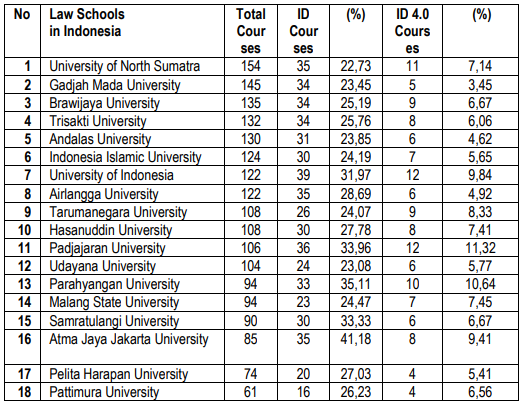
Based on the obtained data on the course offered in samples law schools, it is found that ID courses are evident in all law schools in Indonesia. However, the number of courses–and its percentage–remains low, if compared to the total number of courses offered. It ranges from approximately 35 courses or 30% of the total course to a minimum of around 16 subjects or about 20% of the total course (Rand: 2006). Only a few of these ID courses are then re-classified into the ID 4.0. The results are as represented in Table 1 and Graph 1 below.
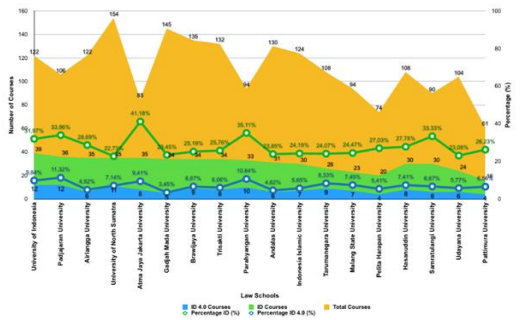
Graph 1.Interdisciplinary and ID 4.0 Courses in Indonesian Law Schools
Based on the above data, the Top 5 law schools that offer the highest number of ID courses in Indonesia are: University of Indonesia (39), Padjajaran University (36), Airlangga University (35), University of North Sumatra (35), and Atma Jaya Jakarta University (35). It is worthy of noting that these universities are all located in the western area of Indonesia (Morton et al.: 2009).
In terms of the percentage of ID courses over the total number of courses offered, the Top 5 Universities are Atma Jaya University (41,2%), Parahyangan University (35,1%), Padjajaran University (33,9%), Samratulangi University (33,3%), and University of Indonesia (31,9%). Four of these law schools are located in the western side of Indonesia, whilst only Samratulangi University is located in the central area of Indonesia.
In average, the number of ID courses offered in the sample Universities is about 30, or at an average percentage of 27,89%. Based on its geographical area, the highest number of ID courses offered is from Universities that are located in the western area of Indonesia (31 courses, 27,97%), followed by the central part of Indonesia (28 courses, 28%) and lastly the eastern part (16 courses, 23%).
With regard to the ID 4.0 specifically, these group only made up an average of 7 courses or about 7% of the total number of courses offered. The Top 3 law schools with the highest percentage of ID 4.0 subjects are Padjajaran University (11,32%), Parahyangan University (10,64%), and the University of Indonesia (9,84%). However, in terms of the number, of course, the Top 3 law schools are Padjajaran University (12), University of Indonesia (12), and University of North Sumatra (11), all of which are also located in the western area (Weinberg& Harding: 2004).
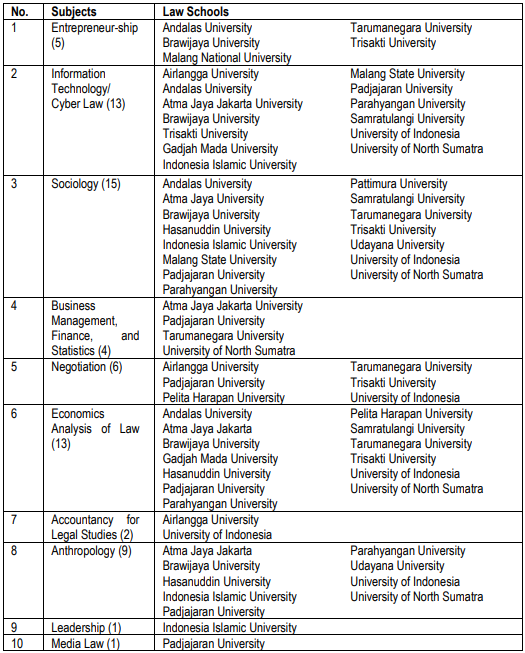
The most prevalent ID 4.0 courses in Indonesian law school are Sociology (15), Economics Analysis of Law (13), and Information Technology/Cyber Law (13). Interestingly, Entrepreneurship, which is as important to foster industry 4.0, is only found in 5 law schools; likewise, Negotiation skills subject is only found in 6 law schools (Wiratraman: 2019). A more detailed list of the Top 10 most relevant ID 4.0 courses is as elaborated in Table 2.
DISCUSSION
As a comparison, the average percentage of ID courses in other ASEAN Universities is 43,4%, or about 32 ID courses offered. This is by far higher than the average of Indonesian Universities. The percentages from highest to the lowest is as follows: Thammasat University (55,68%), Universiti Kebangsaan Malaysia (UKM)(50%), Singapore Management University (SMU) (49,15%), Malaysia Multimedia University (MMU) (42,11%), National University of Singapore (NUS) (41,43%), University of Malaya (UM) (35,29%), and University of Philippines in Diliman (UP Diliman) (30,12%). In terms of the number of courses: NUS (58), Thammasat (49), SMU (29), UKM (27), UP Diliman (25), MMU (24), and UM (12).

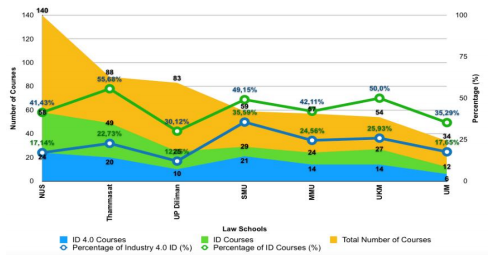
Graph 2.Interdisciplinary and ID 4.0 Courses in ASEAN Law Schools
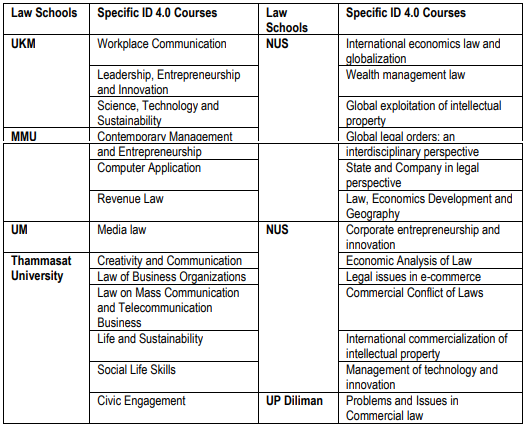
In terms of specific ID 4.0 courses, the average number of courses offered is at 15 courses or about 22,24%. The Top 3 law school with the highest percentage are: SMU (35,59%), UKM (25,93%), and MMU (24,56%). Different ranking applies with regards to the number of courses, as such: NUS (24), SMU (21) and Thammasat (12). Interestingly, there are some unique ID 4.0 courses offered only in some ASEAN Universities, which is not offered in Indonesia, as referred in Table 4 below (Kingsley: 2004).
CONCLUSION
In conclusion, the result of this research shows that:
The number of ID studies in Indonesian law schools is relatively low compared to most other law schools in the ASEAN region. This may indicate that legal education in Indonesia remains following a conservative method of teaching, being very specific and independent from any other studies. With the national agenda on Making Indonesia 4.0, there is a need to have more interdisciplinary studies in law schools across Indonesia;
The average number and percentage of ID studies show that law schools in the west area of Indonesia are offering more ID subjects. This may have been caused by higher economic activities and development in the west area compared to the central and eastern part of Indonesia. A lesson learned from this finding is that there is a need for standardization of curriculum in all law schools, regardless of the area, in order to have more ID courses to foster Indonesia’s readiness to Industry 4.0;
The percentage of ID courses and ID 4.0 subjects in Indonesia is lower by about 20% and 15% respectively if compared to other ASEAN law schools. Although the number of Industry 4.0 related subjects between ASEAN and Indonesian law schools are not that much of a difference, the ASEAN Universities, especially those in Singapore and Thailand, offers more variety of courses that is more relevant with the need of Industry 4.0. There is an urgency for Indonesian law schools to learn from Singapore, Malaysia, and Thailand law schools in order to develop and incorporate more ID and ID 4.0 subjects in their curriculum. Learning from other law schools experience may be achieved in many different ways. One possible way is to invite a law scholar from other universities to teach an ID or ID 4.0 subject.
BIODATA
I PRIHANDONO: is an Associate Professor of Law at the Faculty of Law, Airlangga University, Indonesia. He teaches Public International Law; and Comparative Law. Iman has extensively published articles on the area of international investment, transnational corporations, and business & human rights issues. Apart from teaching, he also sitting as member of the Academic Senate at Airlangga University from 2015 until present. At national level, Iman also a member of Indonesia Higher Education Academic Senate Association, where he actively advocating for interdisciplinary contents in higher education curriculum. Prior to his academic career, Iman was a practicing lawyer. As a lawyer, Iman had involved in many projects which requires collaboration between experts from different expertise and background. He can be contacted at: iprihandono@fh.unair.ac.id
D.S YUNIARTI: was a researcher at Airlangga Institute for International Law Studies. She obtained Bachelor of Law degree from Faculty of Law, Airlangga University, Indonesia. Dewi was a recipient of a number of scholarships where she had the opportunity to interacts and working on projects with experts and students from different studies and background. To enrich her experiences, Dewi had worked as intern at different government and private institutions. These experiences help to build her interdisciplinary skills and working collaboratively in a teamwork. Currently, Dewi is a practicing lawyer, specializing in investment, contract and dispute settlement.
BIBLIOGRAPHY
ACADEMIC ALLIANCE (2018).”Interdisciplinary Collaboration Is Necessary For The Future Of Legal Education”, Academic Alliance.
ARBAN, E (2018). “Interdisciplinary approaches to legal research: law and economics and critical legal studies from a North American perspective “, Academic Alliance.
CONNOLLY, KD (2003). “Elucidating the Elephant: Interdisciplinary Law School Classes”, Washington University Journal of Law & Policy, 11 (3).
DONALD, LC, BURNETT, JR & TWENTY-SECOND EDWARD, H (1998). “Young Lecture in Legal Education: Professionalism: Restoring the Flame”, 158 MIL. Law Review.
GODDEN, L & DALE, P (2000). “Interdisciplinary teaching in law and environmental science: Jurisprudence and environment”. Legal Educ. Rev., 11, 239.
INDONESIAN INVESTMENT COORDINATING BOARD (2019). “Making Indonesia 4.0: Indonesia’sStrategyTo Enter the 4th Generation of Industry Revolution”, https://www.investindonesia.go.id/en/why- invest/indonesia-economicupdate/making-indonesia-4.0-indonesias-strategy-to-enter-the-4th-generation-of- ind.
INDONESIAN MINISTRY OF INDUSTRY (2019). “Bringing the Fourth Industrial Revolution to Indonesia”, http://kemenperin.go.id/download/17421/AT-Kearney---Bringing-the-Fourth-Industrial-Revolution-to- Indonesia AT Kearney National Seminar, 11 December 2017.
INDONESIAN MINISTRY OF RESEARCH (2018). “Technology, and Higher Education, Kemenristekdikti Umumkan Peringkat 100 Besar Perguruan Tinggi Indonesia Non Vokasi Tahun 2018”https://ristekdikti.go.id/kabar/kemenristekdikti-umumkan-peringkat-100-besar-perguruan-tinggi- indonesianon-vokasi-tahun-2018/
JACOBS, HH (1978). “Interdisciplinary Curriculum: Design and Implementation”, 1989; Meeth, L.R., “Interdisciplinary Studies: Integration of Knowledge an Experience”.
KINGSLEY, JJ (2004). “Legal Transplantation: Is This What the Doctor Ordered and Are the Blood Types Compatible-The Application of Interdisciplinary Research to Law Reform in the Developing World A Case Study of Corporate Governance in Indonesia”. Ariz. J. Int'l & Comp. L., 21, 493.
MORTON, L, TARAS, H & REZNIK, V (2009). “Teaching interdisciplinary collaboration: Theory, practice, and Assessment”. Quinnipiac Health LJ, 13, 175.
OECD (2017). “Interdisciplinary: Problems of Teaching and Research in Universities,”Apostel, 1972.
PRASETYSNTOKO, A (2019). “Ekonomi Digital”, Kompas Newspaper, Ed.QS WORLD UNIVERSITY RANKINGS, LAW (2019). accessed at:https://www.topuniversities.com/university-rankings/university-subject-rankings/2019/law-legal-studies, accessed 7 May 2019.
RAND, S (2006). “Teaching law students to practice social justice: An interdisciplinary search for help throughsocial work's empowerment approach”. Clinical L. Rev., 13, 459.
SULISTYOWATI, I (2019). “TANTANGAN PENDIDIKAN HUKUM DI ERA 4.0”, KOMPAS
TOKARZ, KL (2003). “Promoting Justice Through Interdisciplinary Teaching, Practice, and Scholarship: Introduction”. Wash. UJL & Pol'y, 11, 1.
VILLALOBOS ANTÚNEZ, J & RAMÍREZ MOLINA, R (2018). “El derecho a la autobiografía: dimensión ius- filosófica desde la perspectiva de H. Arendt y P. Ricoeur”. Opción. Revista de Ciencias Humanas y Sociales, 34(18), pp. 1012-1587.
WALTER, K (2017). “Law School Case Study: Penn Law’s Interdisciplinary Approach”, Reuters Legal Executive Institute.
WEINBERG, A & HARDING, C (2004). “Interdisciplinary teaching and collaboration in higher education: A concept whose time has come”. Wash. UJL & Pol'y, 14, 15.
WIRATRAMAN, HP (2019). “The Challenges of Teaching Comparative Law and Socio-Legal Studies at Indonesia's Law Schools”. Asian Journal of Comparative Law, 14(S1), S229-S244.