Artículos
Discipline and Student Achievement Based on the Management of Islamic Education Systems
Disciplina y rendimiento estudiantil basados en la gestión de los sistemas de educación islámica
 K. MUNIFAH munifahkediri@gmail.com
U. HAMIDA ulfidina@iainkediri.ac.id
M. FIRMANSYAH firmansyah@yahoo.co.id
S HUDA syamsulhuda@iainkediri.ac.id
A. MUAWANAH muawanahahmad68@gmail.com
R. IRWANDANI irwandani@radenintan.ac.id
K. MUNIFAH munifahkediri@gmail.com
U. HAMIDA ulfidina@iainkediri.ac.id
M. FIRMANSYAH firmansyah@yahoo.co.id
S HUDA syamsulhuda@iainkediri.ac.id
A. MUAWANAH muawanahahmad68@gmail.com
R. IRWANDANI irwandani@radenintan.ac.id
Discipline and Student Achievement Based on the Management of Islamic Education Systems
Utopía y Praxis Latinoamericana, vol. 25, no. Esp.6, pp. 388-403, 2020
Universidad del Zulia
Received: 28 September 2019
Accepted: 25 October 2019
Abstract: This research is focused on developing disciplinary values in implementing good manners and morals in the school environment. Improving work culture based on discipline in the Islamic school (madrasas) environment is the main topic in this study. This research uses a qualitative approach and includes ex post facto research. The results of this study can be concluded that the overall work culture that appears from the attitudes and work behaviors of the madrasas community are: serving, innovative thinking, working hard, active learning, enthusiastic, grateful, confident, disciplined, independent, competitive, to obtain success and excellence.
Keywords: Culture, Discipline, Integration, Religion..
Palabras clave: Cultura, Disciplina, Integración, Religión.
INTRODUCTION
The culture of discipline and hard work is part of the management of the education system which is very influential on the effectiveness of the success of a goal (Abdurrahman et al.: 2018, pp. 34-40). Organizational success depends on how the work behavior of organizational members in carrying out their duties and functions (Ganga-Contreras: 2019, pp. 64-74). Strong discipline can influence individual and organizational performance beyond other factors such as systems, structures, strategies(Sagala et al.: 2019, pp. 753-763), tools, and so on. To produce an effective organization (Rodríguez-Ponce: 2019, pp. 36-46), it is necessary to build a work culture of organizational members by organizational expectations (Sriyakul et al.: 2019, pp. 479- 486).
The success of a country depends on the management of the education system. In this modern age, manners, and morals based on dispute are very necessary (Muñoz-Fritis: 2019, pp. 25-35). Discipline in studying in the learning environment is the main point or key to life. One of the developed countries that succeeded in many achievements was Japan (Lestari et al.: 2019, pp. 15-32). Japanese governments that have succeeded in bringing their country into one of the developed countries in the world are caused by an education system that is disciplined in pursuing knowledge that is based on morals and good manners (Diani et al.: 2019). Honesty, discipline, mutual respect are civilized (Ramadhani et al.: 2019, pp. 137-158) and moral which are continuously carried out from an early age (Diani et al.: 2019; Villalobos et al.: 2019). In Islam, etiquette and moral education are also recommended to be given before children learn about education.
In the learning environment (school) an educational process will not succeed if there is no application of discipline to students (Habibi et al.: 2019, pp. 125-134). Discipline means the ability to do only those that benefit themselves (Felisardo et al.: 2019, pp. 13-24), others, and the environment. However, student discipline in our schools has collapsed a lot. This happens because there is no example of educators and education staff and school principals (Lestari: 2019), on the other hand, because of the fragility of school discipline. The weak attention of schools in enforcing regulations is the cause of the fragility. Therefore, it is time for school administrators to prioritize the establishment of a culture of discipline among students (Habibi et al.: 2019. pp. 125-134) so that students' behavior and achievements become more proud. Discipline is obedience that arises because of awareness and encouragement from within that person (Akbar: 2017, pp. 1-19). On the other hand, order means a set of applicable regulations to create orderly and orderly conditions. From the beginning, students must be introduced to a school environment that respects and upholds discipline. Schools must be able to convince students that good behavior and brilliant achievement can only be achieved by the students' high discipline (Prastowo et al.: 2019, pp. 165-175). Without discipline, school functions will be barren and students' potential will be buried, even many students will get into trouble. Only a few schools succeed in carrying out discipline (Nurdyansyah & Arifin: 2018, pp. 190-192). The fact we can see through portraits of unclean school environments, students who like to smoke, and students fighting. All of that is a mirror of undisciplined and uncultured behavior. If this is the case, it will be difficult for schools to become places for generations of good behavior and achievement.
Madrasas in Islamic Boarding Schools
As an organization, the excellence of Islamic schools is not only determined by factors that appear (tangible) such as the grandeur of buildings, academic degrees, human resources, and completeness of facilities, but more determined by factors that are not visible (intangible), the school culture which includes core values and core beliefs such as jihad, sincerity, Istiqomah, and good deeds (Ommaya: 1995). The background of madrasa growth is based on several reasons including;
-
As a manifestation and realization of the renewal of the Islamic education system
-
Efforts to improve the pesantren system towards an education system that allows graduates to get the same opportunities as public schools
-
The mental attitude of some Muslims, especially students who are fascinated by the western education system as their education system.
-
As an effort to bridge between the traditional education system carried out by the pesantren and the modern education system from the results of acculturation.
Muhammad Tholhah Hasan quoted from Husni Rahim's opinion identifying four characteristics possessed by madrasa, namely:
-
Islamic Character; Its Islamic identity is reflected in its curriculum and educational process. For example, awareness and consistency of Islamic values, holistic educational orientation, and the appearance and educational environment of Madrasas that portray the personality and character of Islam.
-
Populist character; madrasa was born and developed with the support of the community and open to all walks of life. Madrasas are always held in a popular spirit to produce adequate educational outcomes and at the same time care for the fate of others.
-
Diversity of character; madrasa shows the character of flexibility in the implementation of education following the complexity of society
-
Independent character; madrasas can grapple with a variety of challenges almost all borne by its founder and community.
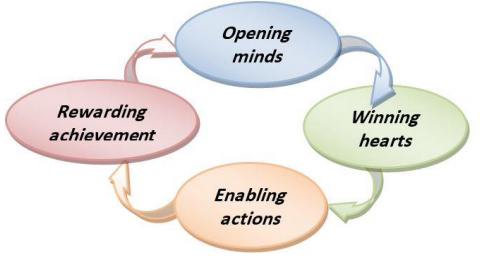
Figure 1. Four Stages of the Change Model (Victor Tan)
According to Conner (Figure 1), to build an organization's work culture, changes must be made especially in the behavior of members of the organization. Victor Tan argues about the four stages of the change model, opening minds, before offering changes related to reason. Winning hearts, related to emotions through respect, attention, communication (Zandi & Haseeb: 2019, pp. 215-227). Possible actions, communication, and confidence that subordinates understand the rationality, goals, and benefits of change. There are four reasons why people do not want to change, they do not know what to do, how to do it, why they have to do it, uncontrolled obstacles.
Based on some of the theories and concepts mentioned above, a framework for thinking about the process of developing organizational values is developed in building a work culture. flow and relationship between several aspects related to the process of developing organizational values in building a work culture to achieve organizational effectiveness (Zaky et al.: 2018, pp. 72-80), depicted in the framework of thinking like figure 2.
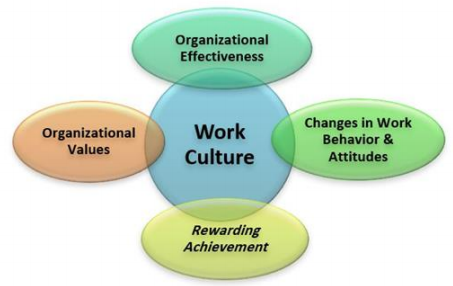
Figure 2. Conceptual Framework Building Work Culture
METHODS
Research Focus
This research is focused on developing disciplinary values in implementing good manners and morals in the school environment. Improving work culture based on discipline in the Islamic school (madrasa) environment is the main topic in this study.
Participants and Research Data
Development of learning systems in an Islamic school environment (MTs Salafiyah Syafiiyah Tebuireng Jombang, MA Al-Hikmah Purwoasri Kediri, and MA Matholiul Anwar Simo Lamongan, including; values developed, dominant values, built work culture, and underlying factors a value can develop. Also, analysis of parties that play a role in the development of organizational values, the implementation of socialization, internalization, strengthening, and control, as well as the strengths and weaknesses that influence the process of building a culture of madrasah work in pesantren is carried out in this research.
Comparison of the Islamic school education system (Tebuireng Islamic Boarding School) and the school education system in Japan is carried out to seek integration of the ultimate achievements of education that have the same goal (Aoki: 2010, pp. 868-872).
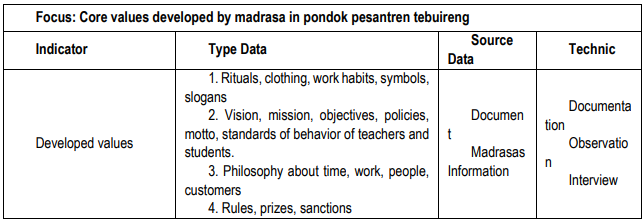
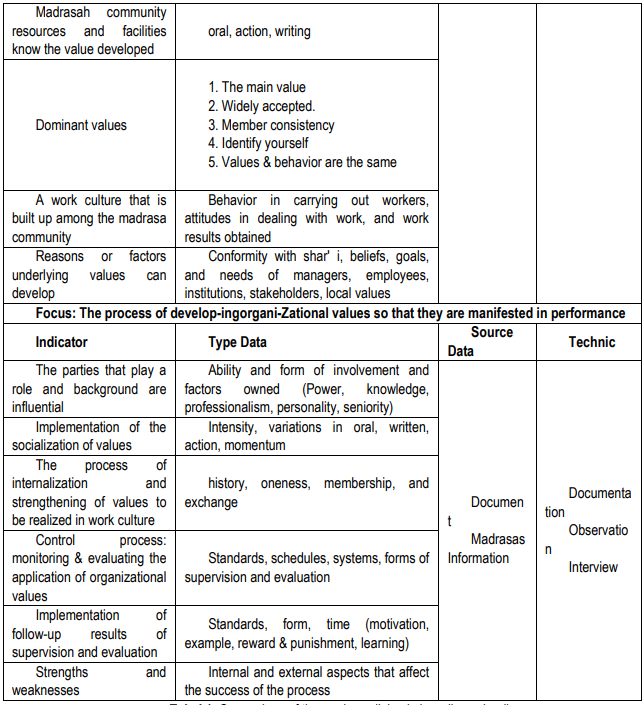
Research Design
This study uses a qualitative approach and includes ex-post facto research, which is research tracing back to an event or event, then trace back to find out the factors that can cause the event. Data and facts are collected from a natural setting in-depth with the hope of obtaining a holistic and in-depth picture of the development of Madrasah values in three private Madrasas in the Islamic Boarding School, namely in MTs Salafiyah Syafiiyah Tebuireng Jombang, MA Al-Hikmah Purwoasri Kediri, and MA Matholiul Anwar Simo Karanggeneng Lamongan.
Because of different background characteristics, this study uses a multicase study design, exactly to determine the definitive limits for other case study parameters that can be determined. Based on a multicase study, this research design uses a constant comparative method. Also, this research uses descriptive qualitative research methods. Qualitative research is necessary to explore phenomena that cannot be quantified that are descriptive such as the process of a work step, the formula of a recipe, the notions of a diverse concept, the characteristics of an item and service, pictures, styles, the procedures for culture, the physical model of an artifact and so on.
Qualitative research can also be categorized as a research method based on the philosophy of postpositivism, used to examine the condition of natural objects, where the researcher is a key instrument, data collection techniques with triangulation, data analysis is inductive or qualitative, and qualitative research results emphasize more meaning than generalization.
Descriptive qualitative research design is intended to describe and describe the phenomena that exist, both natural and human engineering, which is more concerned about the characteristics, quality, interrelationships between activities. Also, descriptive research does not provide treatment, manipulation, or alteration of the variables studied, but rather describes a condition as it is. The only treatment given is the research itself, which is done through observation, interviews, and documentation.
Data Analysis Method
Because this research design is a multi-case study, according to Yin, data analysis is carried out through two stages, individual case data analysis, and cross-case data analysis. Data that has been found both from observations, interviews, and documentation then analyzed through activities that are reviewed, reduced, explained, and concluded inductively through individual case analysis and cross-case analysis. Analysis of individual case data is data analysis in each subject, the data analysis process is carried out together with the data collection process. The analysis is done again after the data collection is complete. Cross-case data analysis is used to compare findings obtained from each case, as well as the process of integrating between cases. The steps taken in the cross-case analysis by adapting from Yin are as follows;
-
Using a conceptual inductive approach that is carried out by comparing and combining conceptual findings from each case.
-
The conceptual findings were used as the basis for compiling conceptual statements or prepositions across cases.
-
Evaluate the suitability of the preposition with the facts referred to
-
Reconstruct prepositions according to the facts of each case.
-
Repeat this process as needed to the limit of saturation.
To obtain precise and objective data, in this study an examination of the validity (trustworthiness) of the data with four criteria as recommended by Lincoln and Guba, namely degrees:
- 1. Trust (credibility), done through continuous observation, triangulation, checking members, and peer discussions.
- 2. Transferability is the result of research in other locations that have the same characteristics and symptoms through the interpretation and interpretation of the research findings described in detail with full responsibility based on real facts.
- 3. Dependency (dependability), done to overcome errors in the conceptualization of research ranging from research planning, data collection, interpretation of findings, and reporting of research results.
- 4. Confirmation, to ensure the results of the research there is a link between data, information, and interpretation, as outlined in the report, carried out through intensive consultation and repeated revisions as well as research seminar activities with several discussion teams, promoters, and research informants.
RESULTS
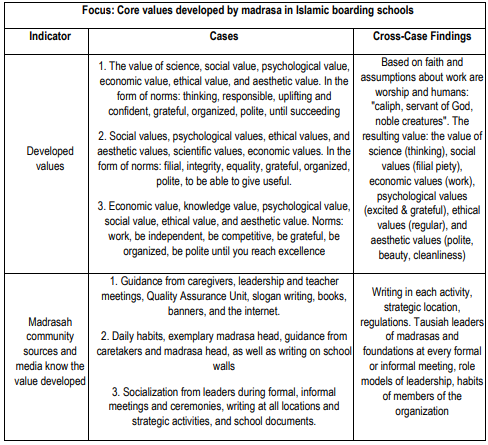
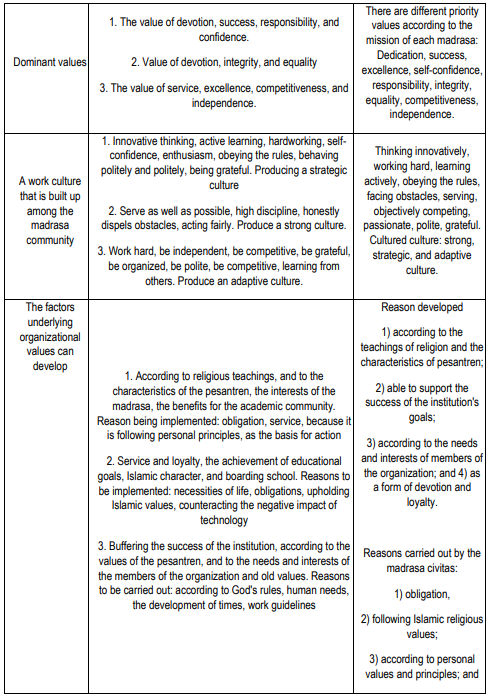
Madrasas in boarding schools develop the same values but different priorities. The main values that madrasas develop in pesantren are the value of Khidmah and supporting the mission. Values can develop in madrassas in pesantren because of the appropriateness of values with the teachings of Islam, the appropriateness of values as a supporter of the success of the institution, and the appropriateness and usefulness of values for individual madrasa civitas and the consistency of each individual.
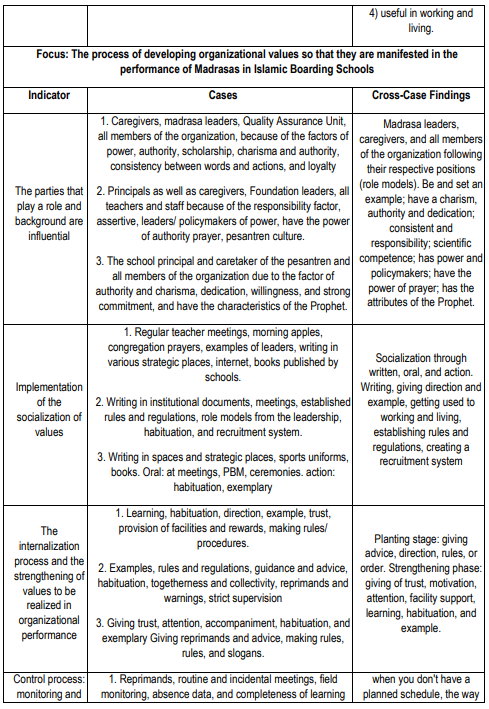
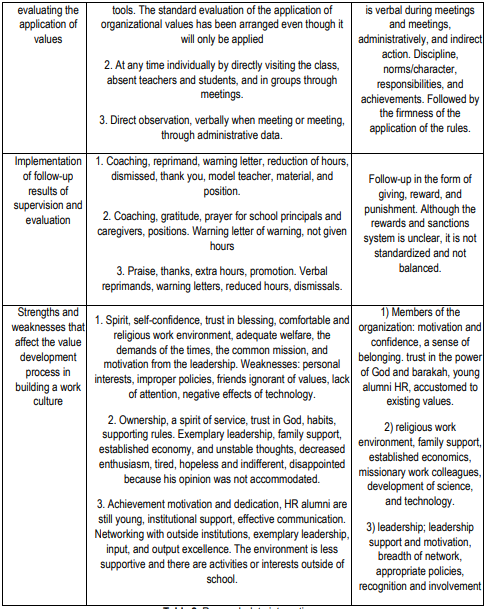
The process of developing madrasa values is carried out through SIPP-value enculturation; socialization, internalization, reinforcement, and control of values. Socialization including written, oral, and action. Internalization of madrasa including feeling, knowing, and action. Strengthening organizational values including providing motivation, example, and learning. Value control including supervision, follow-up, and firm enforcement. The value development process including role model figure, the madrasa community, whether they are leaders or not, is becoming and setting an example; have Harism, authority and dedication; consistent and responsibility; scientific competence; has power and policymakers; have the power of prayer; has the attributes of the Prophet. The value development process is influenced by the strengths, support, weaknesses, and obstacles possessed by each madrasa. The culture developed in madrasas is a strong, strategic, and adaptive culture.
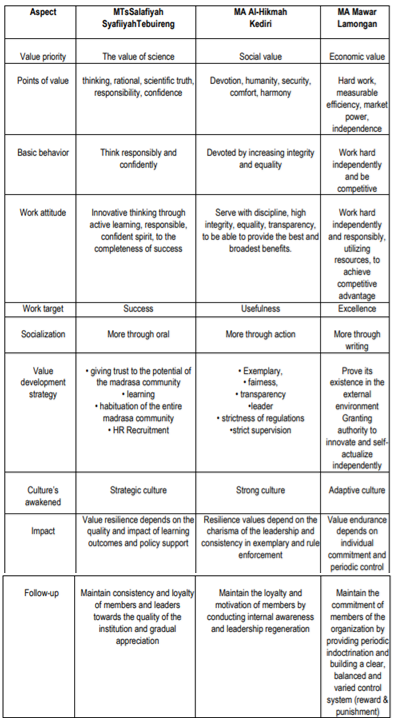
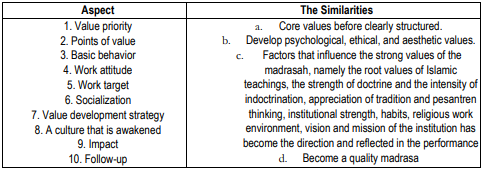
DISCUSSION
It was found that the elements of organizational culture in madrasas in Islamic boarding schools had four layers namely; faith, assumptions, values, and behavior. The findings of this study are termed the "Four Layers of Organizational Culture Elements". Layer I is visible work behavior or culture; layer II is the value or norm governing how to work; layer III is an assumption that is the belief or philosophy that underlies the formation of organizational values; and layer IV is "faith", that is, belief in God and the teachings that underlie and unite the assumptions, values, and work culture of the madrasa community. The findings of the Four Layers of Organizational Cultural Elements can be visualized as in Figure 3.
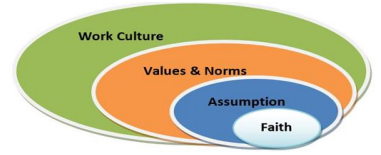
Figure 3. Four Layers of Madrasa Cultural Elements
This finding develops from Edgar Schein's theory which states that organizational culture involves three layers of elements; layer I include artifacts and creations that seem real but often cannot be interpreted. Layer II contains values which are consciousness, affective desires, or desires. Layer III is a basic assumption that people create to guide their behavior. Basic assumptions are elements that cannot be directly observed because they are hidden but the basic assumptions are the main elements forming organizational culture. Artifacts are elements of organizational culture that intersect directly with the external environment. Artifacts are a means to strengthen the understanding, recognition, and inspiration of organizational members to the culture that is developing in an organization that can be seen from the outside.
As an educational institution that is under the guidance of the Ministry of Religion, madrassas in pesantren have also developed the values desired by the Ministry of Religion. This can be compared to the work attitude determined by the Ministry of Religion covering: 1) honest and having high integrity; 2) have ethics, noble morals, and set an example; 3) obey applicable laws and regulations; 4) responsible and accountable; 5) respect the rights of others; 6) loves work and is willing to work hard; 7) increase transparency and coordination; 8) high discipline, and 9) modest in life and life.
When compared with the eighteen values that were developed and agreed upon by leaders, lecturers of S1, S2 and S3, students, and education personnel in the National Seminar and Workshop on the restructuring of character education in 2008, the values developed by madrasas in pesantren have also been able building character which is currently being promoted by some of the character education leaders, which in detail include; observance of worship, honesty, responsibility, discipline, work ethic, independence, synergy, critical, creative, innovative, visionary, respect, caring, sincerity, justice, simplicity, nationalism, and internationalism.
The values developed by madrasas in pesantren are diverse and the same but the priorities are different. The main values of madrasas in pesantren are Khidmah values and values that can support the mission. Because the mission of each madrasa is different, then the difference is only in the priority values according to the mission, some prioritize aspects of science, namely thinking, which prioritizes aspects of economic value that is work, and some prioritize social values, that is, filial piety. Priority values have an influence on the dominant behavior seen in the madrasa community along with the expected result.
Also, this study reinforces Ouchi's theory that there are three conditions for developing organizational culture; first, the existence of the mutual trust. Second, fineness. And third, intimacy. Trust, the understanding, and the nature of leadership towards other people. In this case, five dimensions underlie trust, the existence of integrity, competence, consistency, loyalty, and the nature of openness. Subtlety, which is something very subtle, difficult to describe but can be felt in the relationship between humans and this as a social glue, such as morale, attractiveness, sense of humor, and the existence of reciprocity. Familiarity, which is a healthy element in organizational groups in the form of togetherness among members of an organization. Among the dominant values and by the madrasa mission and united by the elements of faith are the values of responsibility and confidence, the value of integrity and equality, the value of competitiveness, and independence. These values also become the strength of the institution, because it is the key to the success of the institution in building an organizational culture:
Value of responsibility
Responsible is to fulfill the duties and trust given. All tasks given to humans must be carried out as well as possible because humans must take responsibility for the implementation of their duties to those who give them the task, besides that humans must also take responsibility before Allah SWT. The value of responsibility is measured by how much effort someone has in carrying out the given task to achieve the goal. Big responsibilities need to be balanced with hard work and time discipline.
Value of confidence
Every madrasa civitas must be ready to accept duties and responsibilities with confidence. Feeling confident can be a strong motivation for one's success. In a hadith Qudsi, Allah says which means; "I dependon my servant's allegation" that is, with enthusiasm and confidence possessed by humans can get what they want. Humans need to build self-confidence by determining the desired plans and targets and thinking that they can do it
Value of integrity
Integrity value is the strength of attitude in maintaining the principles and ethics of professionalism, maintaining loyalty in carrying out tasks and being able to provide accountability based on honesty. Integrity values include ethical issues, spirituality, prioritizing honesty, and honest values. Integrity and honesty values are a necessity to create a climate. Healthy and conducive work. Realizing the value of integrity and honesty requires the commitment of the entire madrasah community, especially the leadership.
Value of the similarities
Manusia diciptakan oleh Allah SWT mempunyai kelemahan dan kelebihan masing-masing. Hal yang membedakan manusia di hadapan Allah adalah bergantung pada kualitas ketakwaannya. Oleh karena itu, manusia juga harus memperlakukan sesamanya dengan baik dan adil, memberikan tugas dan tanggung jawab sesuai dengan porsinya, memberikan hak-hak mereka sesuai dengan usahanya. Nilai persamaan perlu diterapkan dalam setiap hubungan kerja maupun hubungan sosial lain.
The Holy Prophet established the state of Medina based on a social contract (al ‘aqd al ijtima’i) between the Muslims and the Jews, Christians, and Arabs who settled in Medina. The Medina Charter contains the principles of good interaction between religious adherents, helping one another face enemies who attack the Medina state, uphold justice and defend people who are persecuted, advise one another, and respect religious freedom.
Value of independence
The independence that is emphasized by the Shari'a is the willingness to meet their own needs by working hard to avoid the attitude of begging. In Islamic teachings, begging is a despicable job that must be shunned, except in very forceful circumstances. Islam does not forbid Muslims from accepting other people's gifts, but it becomes a far better and noble giver.
CONCLUSION
Based on data exposure and individual case research findings and cross-case discussion can be concluded that the core values of madrasas in Islamic boarding schools can be pursued with an organizational culture based on four elements of organizational culture. Overall the work culture that appears from the attitudes and work behavior of the madrasa civitas is to think, think innovatively, work hard, learn actively, be enthusiastic, be grateful, obey the rules, be polite, be confident, be disciplined, be independent, and be competitive. Sometimes there is still resistance and violation of values by the madrasa community, therefore intensive socialization and internalization are needed. The process of developing madrasa values so that they are manifested in the work culture of madrasa civitas in pesantren can be supported by a role model figure, namely all madrasa civitas capable of becoming role models capable of being a model of authority and dedication that is high, consistent and committed to responsibility, trust has the power of prayer, and has an honest, trustworthy, transparent, and intelligent. Also, development can be achieved by holding socialization, internalization, strengthening, and controlling.
BIODATA
K. MUNIFAH: She is an Assoc. Prof. and senior lecturer at Faculty of Tarbiyah, Institut Agama Islam Negeri Kediri, Indonesia. Her research is focused on Education especially in Management education. She is a lecturer in the Faculty of Tarbiyah, Institut Agama Islam Kediri, Indonesia.
U. HAMIDA: She is an Assoc. Prof. and senior lecturer at Faculty of Tarbiyah, Institut Agama Islam Negeri Kediri, Indonesia. Her research is focused on Education especially in Religion education and Sufism education. She is a lecturer in the Faculty of Tarbiyah, Institut Agama Islam Kediri, Indonesia.
M. FIRMANSYAH: He is a lecturer at the Faculty of Tarbiyah, Institut Agama Islam Negeri Kediri, Indonesia. His research is focused on Education especially in Science Education. He is a lecturer in the Faculty of Tarbiyah, Institut Agama Islam Kediri, Indonesia.
S. HUDA: He is an Assoc. Prof. and senior lecture at Institut Agama Islam Negeri Kediri, Indonesia. His research is focused on Education especially in Religion education. He is a lecturer in the Faculty of Education and Teacher Training, Institut Agama Islam Negeri Kediri, Indonesia.
A. MUAWANAH: She is an Assoc. Prof. and senior lecturer at Faculty of Tarbiyah, Institut Agama Islam Negeri Kediri, Indonesia. Her research is focused on Education especially in Religion education and Sufism education. She is a lecturer in the Faculty of Tarbiyah, Institut Agama Islam Kediri, Indonesia.
R. IRWANDANI: He is a lecture at Universitas Islam Negeri Raden Intan Lampung, Indonesia. His research is focused on Education especially in Science Education. He is a lecturer in the Faculty of Education and Teacher Training, Universitas Islam Negeri Raden Intan Lampung, Indonesia.
BIBLIOGRAPHY
ABDURRAHMAN, A, SAREGAR, A, UMAM, R (2018). "Assessment toward the Quantum Physics Concept Mastery of the Prospective Physics Teachers". Jurnal Pendidikan IPA Indonesia, 7(1), pp. 34–40.
AKBAR, A (2017). "Islam – science relation from the perspective of post-revolutionary Iranian religious intellectuals". British Journal of Middle Eastern Studies, pp. 1–19.
AOKI, K (2010). "The Use of ICT and e-learning in higher education in Japan". World Academy of Science, Engineering and Technology, 66(6), pp. 868–872.
DIANI, R, HERLIANTARI, H, IRWANDANI, I, SAREGAR, A, UMAM, R (2019). "The Effectiveness of SSCSLearning Model: Its Impact on the Students’ Creative Problem-Solving Ability on the Concept of Substance Pressure". Jurnal Penelitian Fisika Dan Aplikasinya (JPFA), 9(1)
FELISARDO, F, LLINÀS-AUDET, X, AMÉSTICA-RIVAS, L (2019). "Competencias en la formación del administrador : un reto a las instituciones de enseñanza superior en Brasil". Utopía Y Praxis Latinoamericana, 24(4), pp. 13–24.
GANGA-CONTRERAS, F (2019). "Juicios en dilemas éticos por estudiantes de negocios de una universidad estatal chilena". Utopía Y Praxis Latinoamericana, 24(4), pp. 64–74.
HABIBI, B, HARTINAH, S, UMAM, R, SYAZALI, M, LESTARI, F, ABDURRAHMAN, A, JAUHARIYAH, D(2019). "Factor Determinants of Teacher Professionalism as Development of Student Learning Education at School of SMK PGRI in Tegal City, Indonesia". Journal of Gifted Education and Creativity, 6(2), pp. 125–134.
LESTARI, F (2019). "Application Auto-play Media Studio (AMS) 8 for Learning Media of Logarithm Function". International Journal of Engineering & Technology, 8(2), In Press.
LESTARI, F, SARYANTONO, B, SYAZALI, M, SAREGAR, A, JAUHARIYAH, D, UMAM, R (2019)."Cooperative Learning Application with the Method of Network Tree Concept Map : Based on the Japanese Learning System Approach". Journal for the Education of Gifted Young Scientists, 7(1), pp. 15–32.
NURDYANSYAH, N, Arifin, M (2018). "Integration of Islamic Values in Elementary School". Advances in Social Science, Education, and Humanities Research (ASSEHR), 125, pp. 190–192.
OMMAYA, A (1995). "Requirements for a Renaissance of Science in Islamic Polity: A Muslim Neuroscientist’s Perspective". Journal of Islamic Thought and Scientific.
PRASTOWO, R, HUDA, S, UMAM, R, JERMSITTIPARSERT, K, PRASETIYO, A, TORTOP, H, SYAZALI, M(2019). "The Effectiveness of Environmental Geophysical Learning In Developing Academic Achievement And Conceptual Understanding Of Electrodynamics: Applications Geoelectric Using Cooperative Learning Model". Jurnal Ilmiah Pendidikan Fisika Al-Biruni, 8(2), pp. 165–175.
RAMADHANI, R, UMAM, R, ABDURRAHMAN, A, SYAZALI, S (2019). "The Effect Of Flipped-Problem BasedLearning Model Integrated With LMS-Google Classroom For Senior High School Students". Journal for the Education of Gifted Young, 7(2), pp. 137–158.
RODRÍGUEZ-PONCE, E (2019). "Gobernanza Universitaria : un estudio de caso desde una Facultad de Educación en Chile". Utopía Y Praxis Latinoamericana, 24(4), pp. 36–46.
SAGALA, R, UMAM, R, THAHIR, A, SAREGAR, A, WARDANI, I (2019). “The Effectiveness of STEM-Basedon GenderDifferences: The Impact of PhysicsConcept Understanding”. European Journal of Educational Research, 8(3), pp. 753–763.
SRIYAKUL, T, UMAM, R, JERMSITTIPARSERT, K, DEVELOPMENT, T, CHI, H, CITY, M (2019). "InternalSupply Chain Integration and Operational Performance of Indonesian Fashion Industry Firms : A Supplier to Buyer Approach". Humanities & Social Sciences Reviews, 7(2), pp. 479–486.
ZAKY, R, ISLAMI, E, NUANGCHALERM, P (2018). "Science Process of Environmental Conservation : A Cross-National Study of Thai and Indonesian Pre-service Science Teachers". Journal for the Education of Gifted Young, 6(December), pp. 72–80.
VILLALOBOS ANTÚNEZ, J; RAMÍREZ MOLINA, R & DÍAZ-CID, L (2019). “Bioética y biopoder: Perspectivas para una praxis pedagógica desde la ética de Álvaro Márquez-Fernández”. Utopía y Praxis Latinoamericana, Revista Internacional de Filosofía y Teoría Social, 24(87), pp. 65-77.
ZANDI, G, HASEEB, M (2019). "The Importance of Green Energy Consumption and Agriculture in Reducing Environmental Degradation: Evidence from Sub-Saharan African Countries". International Journal of Financial Research, 10(5), pp. 215-227.