Artículos
Effectiveness of Humanistic Learning Models on Intra and Interpersonal Intelligence
Efectividad de los modelos humanistas de aprendizaje en la inteligencia intra e interpersonal
 D. GASONG dinagasong@ukitoraja.ac.id
A. TODING apriana.toding@ukipaulus.ac.id
D. GASONG dinagasong@ukitoraja.ac.id
A. TODING apriana.toding@ukipaulus.ac.id
Effectiveness of Humanistic Learning Models on Intra and Interpersonal Intelligence
Utopía y Praxis Latinoamericana, vol. 25, no. Esp.6, pp. 491-500, 2020
Universidad del Zulia
Received: 12 July 2020
Accepted: 08 August 2020
Abstract: This study describes the affective aspects of learning that have not yet been developed. Its purpose firstly is to describe the problem of the low ability of students to express their ideas well. Secondly, this study designs a humanistic learning model that can be implemented in lectures so students can get to know themselves and others (intrapersonal and interpersonal). The method used in this study is qualitative. The results of it are as follows: The cause of low intrapersonal and interpersonal intelligence is because so far, only practicing to do things related to knowledge. Students only try to pursue education.
Keywords: Humanistic learning, intelligence, interpersonal, intrapersonal, model development.
Resumen: Este estudio describe los aspectos afectivos del aprendizaje que aún no se han desarrollado. En primer lugar, su propósito es describir el problema de la baja capacidad de los estudiantes para expresar bien sus ideas. En segundo lugar, este estudio diseña un modelo de aprendizaje humanista que puede implementarse en conferencias para que los estudiantes puedan conocerse a sí mismos y a los demás (intrapersonal e interpersonal). El método utilizado en este estudio es cualitativo. Los resultados son los siguientes: la causa de la baja inteligencia intrapersonal e interpersonal es porque, hasta ahora, solo practica hacer cosas relacionadas con el conocimiento. Los estudiantes solo intentan seguir la educación.
Palabras clave: Aprendizaje humanista, desarrollo de modelos, inteligencia, interpersonal, intrapersonal..
INTRODUCTION
Delivering lecture material in front of the class requires strategies or methods that are appropriate to the characteristics of the teaching material. Besides, the thing that is not less important is to pay attention to the aspects of college students. Student conventions three decades ago are no longer the same as student conventions today. Various advances have been made so that the learning model that used to be very useful in use is no longer relevant to the characteristics of current students. In recent years various learning models have been developed, such as active learning, student-centered learning, contextual learning, collaborative learning, constructivist learning. They have been implemented in learning in lecture halls. The learning models are intended so that students actively shape their knowledge. It is expected that students can develop themselves positively and can become whole people.
National education in general aims to educate the nation's life, and also develop Indonesian people. That means that people have faith, and are devoted to God Almighty, noble character, have knowledge and skills, have spiritual health, and have physical health, have an independent personality, as well as a social and national responsibility. Civilized nations can be formed through education. The noble goal of education is to produce a prosperous, civil society. Such an organization does not occur immediately, but rather through a long process, continually being cultivated and grown from an early age. Thus, the world of education is expected to play an essential role in producing a generation of people who are just, civilized, and humane. With the issuance of various government policies and noble goals of education, it is hoped that the Indonesian people today will be better than in previous years. Will be more tolerant, will be wiser. The aim of education is none other than realizing an intelligent Indonesian human and devoted to God Almighty. With education, Indonesian people will appreciate diversity more. It is beautiful to live in peace and harmony in the Indonesian earth. All that can only be produced through education.
Even though various policies and learning models have been attempted, the reality on the ground is that students have not been able to express their ideas and thoughts well. Hopes and goals of education are still very far away. We even witness events that no longer respect the human aspect. We encounter miserable conditions and situations such as the inability of students to express their ideas and thoughts in public politely. The failure of students to express their thoughts and feelings well in front of the class. Found students who do not want to work hard, but want good grades. Students do not have achievement motivation. Found intolerant students. This condition has been found in lecture halls in recent years. Situations like these, become contemplations, to improve the learning model. Perhaps the learning model used is no longer in line with the characteristics of students who were born in an all-round, millennial era. No longer know the typewriter, but only playing with his fingers all can be reached. Therefore, learning models that are appropriate to the characteristics of current students are needed.
The ideals of the nation have not been achieved as in the 1945 Constitution, which is to reach a state that is just, prosperous and prosperous. Education places more emphasis on the cognitive domain and ignores two other aspects, namely the affective dimension, and the psychomotor aspect. That is what underlies and is the background of the implementation of this research. During this time, education emphasizes more on cognitive issues. Lecturers only touch the cognitive elements, and a little psychomotor, so what the lecturer does is provide training, and practice continues. Cognitive and psychomotor aspects have been applied to learning. So that in this research focuses on the affective aspects, specifically how to develop intrapersonal and interpersonal intelligence in education. Research on the emotional elements has been done by many researchers before, but only to find out intrapersonal and interpersonal intelligence. Not yet to provide a model for developing intrapersonal and interpersonal intelligence of students. In this study, an intervention was carried out to perform several actions that could foster intrapersonal and interpersonal intelligence. According to the results of Thomas Stanley's research, the determinants of one's success in the world of work are honesty, discipline, and sociability in the order of 1-3, this element is included in intrapersonal andinterpersonal intelligence (Robles: 2012, pp. 453-465; Villalobos et al.: 2018, pp. 1012-1587; Villalobos et al.: 2020, pp. 984-1018).
Based on the description previously stated, the purpose of this study is to recognize the condition of intrapersonal and interpersonal intelligence of students and to describe the Humanistic learning model to improve Intrapersonal intelligence and interpersonal intelligence. This research is significant because if intrapersonal knowledge and interpersonal intelligence are not grown. As a result, students who later work will be easily discouraged, do not have the creativity, and do not care about others and their environment. Furthermore, they cannot cooperate with people in their profession.
LITERATURE REVIEW
Development
Development can be interpreted as an increase. An attempt is made to improve the ability of individuals, both technical, conceptual, and moral skills to improve quality based on needs through education or training. Thus, development can be done through education, both formal education, and non-formal education and or informal education. Therefore, what can be developed for successful educational purposes is a learning model. The learning model needs to be developed because it must be adapted to the characteristics of the material and students, as well as the times (Robles: 2012, pp. 453-465).
The development of learning models must be a systematic and logical process. Logical in the sense of the developed learning design, must pay attention to the potential and competence of students (Abdul: 2005). The model developed must specify everything that will be implemented in learning activities. Therefore, the development of learning must be more realistic, which can be applied in education. Thus, it can be concluded that the development of learning to improve the quality of the process and learning outcomes, both materially, as well as methods, and their substance. Substantially means teaching materials must be adjusted to the development of student knowledge, while methodologically, and the element is related to the development of learning strategies, theoretically, and practically (Schunk & Zimmerman: 2012).
In researching development, what is done are steps to develop a new product or improve existing products, which can be accounted for development research is to produce new products through development. Thus, what is meant by evolution is a process to make existing potential into something better and more useful. While research development is a process or steps to develop an existing product into a product. It can be accounted for research development must continue to be carried out because it is a systematic, objective, and comprehensive research to be the basis of quality learning along with the progress of science and technology (Segatto & Lafreniere: 2013, pp. 27-35).
Learning model
In carrying out, learning is always based on a model. It is because the function of a learning model is to be a guideline for learners (lecturers) to carry out learning. Also, the learning model is a guideline for the learning designer, in planning, and implementing teaching and learning activities, so that the specified learning objectives can be achieved. Thus it can be concluded that the learning model is a pattern or plan that can be used to operate the curriculum for learning designers, adjusting learning material, which aims to guide students (students) so they can learn in class settings. According to Joyce et al (Joyce et al.: 2003), the learning model is seen as having the most strategic role in efforts to boost the success of the teaching and learning process. Because with the right learning model, the teacher/lecturer is expected to be able to deliver the material appropriately, so students (students) are enthusiastic about learning. Thus, the learning model can be defined as such a pattern or design that summarises the whole process of presenting teaching material,concerning planning, implementation, and learning outcomes carried out by learners (lecturers) with the help of related facilities.
Development of Learning Models
To develop learning models, based on existing learning models. Learning models must be following the characteristics of teaching materials, especially the features of students. The development of learning models is done based on a theory, such as the Behavioristic theory, Cognitive theory, Humanistic theory, and Constructivistic theory.
In developing learning models, there are four four-D stages. Development with the 4-D model was introduced by Rochmad (Rochmad: 2012, pp. 59-73) including (1) define (limitation), (2) design, (3) Develop (development, (4) Disseminate (spread). If it is adopted, it can be called 4-P, which is the definition, design, development, and distribution.
The definition stage is related to the formulation of learning objectives obtained from student analysis, assignments, and concepts. The design phase prepares a prototype of the learning device, which consists of 3 steps, namely (a) preparation of the benchmark reference test, (b) media selection, (c) format selection.
The development phase (development) includes (a) validation of the equipment by experts followed byrevisions, simulations namely the operationalization of teaching plans, (c) limited trials with real students. Disseminate phase (disseminate), namely the stage of using tools that have been developed on a broader scale, for example, in other classes and so on. Also, to test the effectiveness of the use of devices in learning activities.
steps of research and development are (1) potential and problems; (2) data collection; (3) product design;design validation; (5) design revision; (6) product trials; (7) product revisions; (8) usage trials; (9) product revisions; and (10) mass production. Endang Mulyaty Ningsih in Danasasmita (Danasasmita: 2013) uses the ADDIE model, which stands for analysis, design, development or production, implementation or delivery, and evaluation developed by Dick and Cary.
Humanistic Learning
The basic principle of Humanistic learning is meaningfulness. From this principle, knowledge is then developed to humanize humans. Therefore, Humanistic education sees humans as free subjects in determining their direction of life. That means that humans are fully responsible for their own lives, and others.
In humanistic learning, according to UCI Sanusi (Ahmad & Sahar: 2019, pp. 1540-1543; Sanusi: 2013,pp. 123-139), more appropriate methods to use are dialogic, reflective, and expressive. The dialogic approach means students must be able to think together critically and creatively. Thus, educators (lecturers) are not knowledgeable people, but only as facilitators and dialogue partners. While reflective means students must be able to dialogue with themselves.
In Humanistic Learning, lecturers help students to develop themselves, determine attitudes, and sort out the values that will be maintained. The emphasis on Humanistic learning is how to establish communication and personal relationships between individuals and between individuals and groups within the educational community. With intensive relations will produce educational fruits. With links, individuals will develop optimally. For the relationship to develop optimally, it is necessary to always be in an atmosphere of love (unconditional love), a heart full of understanding (understanding heart), and productive personal relationships (personal relationship). Learning is also part of management activity
Intelligence
In general, intelligence means the ability possessed by someone. In full, it can be said that information is the ability of one's soul to solve a problem that is being faced and produce something in society. According to Yunus (Yunus: 2020, pp. 267-271) in his book entitled Frames of Mind: The Theory of Multiple Intelligenceseveryone has multiple intelligences consisting of verbal-linguistic, logical-mathematical, visual-spatial, rhythmic-musical, physical-kinesthetic, interpersonal, intrapersonal intelligence, naturalistic, existential.
Intrapersonal
Armstrong in Kinanti (Kinanti: 2016) this intelligence is interpreted as self-knowledge and the ability to act adaptively based on that knowledge. This intelligence includes having an accurate picture of oneself (one's strengths and limitations); awareness of mood and mind, intentions, motivations, temperament, and desires; and the ability to self-discipline, and self-esteem. Furthermore, Yoanitha Sandry Agustini people who have intrapersonal intelligence are individuals who can experience a variety of passion, enthusiasm, and spontaneity, ready to be assertive, have self-esteem and acknowledge it, can relieve pain in themselves, have something needed to maintain intentions in work and relationships, able to create and relate closely, ready to be alone (Rochmahwati & Afifah: 2018, pp. 239-262; Ahmad & Ahmad: 2018, pp. 44-49).
Gardner in Fitroh et al. (Fitroh et al.: 2018, pp. 136-147) intrapersonal intelligence that is the ability that is related, but leads inward. Intrapersonal intelligence can be known through several characteristics as stated by Campbell in Faizah et al. (Faizah et al.: 2017, pp. 1-7) as follows: (1) Be aware of the emotional area, (2) find ways and solutions to express their feelings and thoughts, (3) develop an accurate model self, (4) motivated to identify and fight for its goals, (5) build and live with a system of ethical values, (6) work independently (7) be curious about big questions about the meaning of life, relevance, and purpose, (8) regulate continuous learning and development of personal goals, (9) trying to find and understand his own inner experience, (10) gain insight into the complexities of self and human existence, (11) try to actualize themselves, (12) empower others (have social responsibility ) (Ahmad & Ahmad: 2019, pp. 746-778; Qodim: 2019, pp. 24-29).
Interpersonal
Interpersonal intelligence is the ability to understand others. Gardner in Veni Septiani, (Septiani: 2013) argues that interpersonal information is the ability to understand others, what motivates them how they work, and how to work with them. Veni Septiani and Ade Dwi Utami (Septiani: 2013; Utami: 2012, pp. 138-152) concluded that interpersonal intelligence is the ability to understand others, see and understand the differences in mood, temperament, motivation, and desire of others as well as the ability to behave and communicate and socialize among many people. The dimensions of interpersonal intelligence include three aspects, namely (1) Social Sensitivity, (2) Social Insight, (3) Social Communication.
METHODS
The method used in this research is descriptive - qualitative research. In carrying out this method, a Humanistic learning approach is used. This research was conducted for two semesters. The research development of the Humanistic learning model to improve intrapersonal and interpersonal intelligence focuses on two stages, namely the preliminary stage, and the formative evaluation stage.
Preparatory phase
At this stage, the researcher will determine the place and subject of the study, arrange a research schedule, and work program.
Formative evaluation stage (formative evaluation):
-
Self-evaluation is the analysis of student characteristics, analysis of materials to be developed,
-
Design is to design a device that will be developed based on student characteristics into a prototype.
-
Prototyping: the results of designing the prototype developed based on a set evaluation are given by peers (expert Review) to obtain a permanent prototype
-
Expert Review, the prototype is validated by colleagues.
-
Implementation, the results of the validation are carried out in lectures
RESULTS
The first activity undertaken in developing a Humanistic learning model to foster intrapersonal and interpersonal intelligence, as stated in the methodology section is to conduct a self-evaluation. Self- evaluation is carried out by distributing questionnaires to students who program Multicultural courses, which consist of 6 parallel classes, and to students who program Literature Appreciation courses in the even semester. The following is an overview of the intrapersonal and interpersonal intelligence of students in Multicultural subjects.
DISCUSSION
The literary image of the landscape performs one more function – psychological. For a long time, it has been noticed that certain states of nature are correlated with human feelings or experiences. Therefore, the landscape details from the earliest stages of the development of literature have been successfully used to create a certain emotional atmosphere in the work and as a form of an indirect psychological image, when the emotional state of the heroes is not described directly, but as it was transmitted through the surrounding nature, and often this technique is accompanied by psychological parallelism or comparison.
So, natural phenomena contribute to a deeper discovery of the inner world of the hero's work. An illustration of the diversity of the state of his characters’ mind, the writer boldly uses the description of a landscape that psychologically coincides with the character’s emotional state. In particular, the depiction of the phenomena of nature in Yakub Zankiev's novel more serve as precursors of sad and disturbing news. For example, the nature describes alarming and terrible of the day of the declaration of war. In a few minutes, the sky clouded with black clouds and unexpectedly, like a bucket, poured heavy rain (Zankiev: 2001, p. 312).
Self-evaluatio
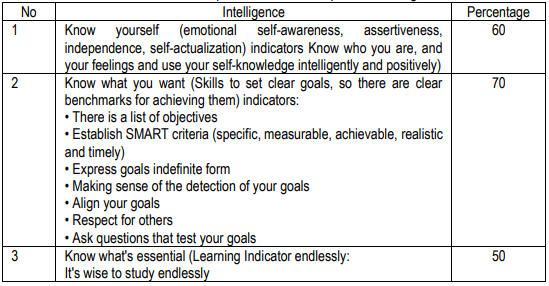
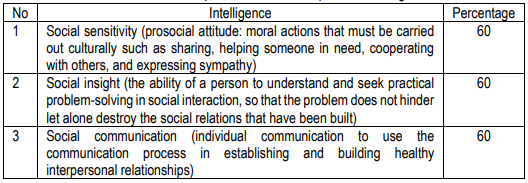
Based on the results of the questionnaire, interviews with several students, and observations of student lectures, it is known that students have not been able to understand themselves and others. Students cannot identify themselves and others well. That is evident from the lack of sensitivity in students, towards others and themselves. Generally, they only blame others if they are not successful rather than reflecting on why this happened. Students want to graduate with good grades, but don't want to work hard. Do the job carelessly, improvise. Students call the lecturer by judging why the class was terrible, so the lecturer shows the original value, which is still below the value obtained. If there is a group assignment, it is time for the presentation of the paper not ready. Meanwhile, if a personal task arrives when they are gathered, many other tasks must be done.
DISCUSSION
Humanistic Learning Model Design
After understanding all conditions, learning design is then made. The design is as follows:
-
Interventions are conducted by giving examples of polite behavior/language in communicating with older people, communicating politely with lecturers.
-
Lecturers responded politely to each WA student. And improve the language and behavior of students in learning
-
As a result, students realize that they have made bad behavior, so they apologize.
-
Lecturers make it a habit to maintain class cleanliness, because all this time students have been throwing tissue carelessly in class, throwing candy packs casually in class, throwing away glass cups in class, sometimes annoying.
Overcoming this bad behavior learning is arranged by way of the lecturer requiring students at each meeting to open a lecture by standing in front of the class opening lectures, providing information related to addresses, starting with 2-3 minutes of silence. After the speech is finished, a student will also come to the front of the class to close the lecture and deliver information related to the current lecture material (this action is similar to a flight attendant who conveys information on a handphone). The way to open and close lectures have been carried and understood at the beginning of talks along with giving lecture contracts. News delivered by students when opening lectures, namely (1) course material to be discussed at the time, (2) length of speech (3) during the speech, students must maintain cleanliness, (4) free cellphone ringing, (5) tolerance of 10 minutes tenure, (6) If students do not heed, students are fined 2000-5000 depending on the class agreement. And the fine is handed over to the class treasurer to be used for class needs, for example forphotocopies of college contracts and so forth. As a result of the intervention that students have begun to be aware of cleanliness and discipline. It means they come to college, as well as to discipline assignments.
Prototype
The models used in Humanistic learning are (1) directing students at the beginning of lectures, what should be prepared in the future in a polite and friendly manner; and (2) giving a positive response to them if they have done their work, for example, if they have That is right, the lecturer gives words like 'great', 'extraordinary', whereas the lecturers are not good, they say 'enthusiasm, you can do it'. Whereas when cornering a lecturer by claiming a bad grade, the original value is shown, so that he realizes that I was only helped so that I could graduate. (3) Give an expression of thanks, for their efforts, and provide an apology for the mistakes of the lecturers. That is a model that can be used to apply learning with a Humanistic approach.
Implementation
In implementing the model to foster intrapersonal and interpersonal intelligence, the following actions are taken:
First, the lecturer prepares lecture material complete with a contract, which contains joint agreements, such as each lecture is opened and closed by a student and provided a 2-3 minutes silence is used to pray. Second, lecturers and students carry out addresses with a commitment to comply with collective agreements. Students implement the skills to open talks with words that have been given at the beginning of the meeting. After the lecture is finished, a student will close the speech with the pattern that has been given. Third, during the speech, if there is a violation that is violated, it will be subject to sanctions. Therefore, students sincerely followed it
As a result of this research, the following is stated:
- 1. Intrapersonal and interpersonal intelligence can be grown through the practice of expressing information in front of friends,
- 2. Intrapersonal and interpersonal intelligence can be developed through providing motivation, and humane greetings
- 3. Intrapersonal and interpersonal intelligence can be developed through discipline and sanctions
- 4. Intrapersonal and interpersonal intelligence can be grown by giving positive responses.
CONCLUSIONS
The conclusion of this research, namely learning conducted by studying Humanistic, is very useful for growing intrapersonal and interpersonal intelligence. The demands indicate that students need attention that can motivate them to work well. With good intrapersonal and interpersonal intelligence, students generate high enthusiasm for achievement and do not give up easily. They work hard without coercion from lecturers or being chased by the deadline. Students are ready to face competition with sportsmanship. The intrapersonal and interpersonal intelligence will be the capital in carrying out tasks, both on campus, and in the world of work. Intrapersonal and interpersonal intelligence enables a person to complete a job or task well. Even though the work might not be perfect, they have to do their job sincerely.
Students must have good intrapersonal and interpersonal intelligence because without this intelligence. They will have difficulty in attending lectures, then later they must complete education, and enter the workforce. They will be able to collaborate, work well with everyone. They also have good intrapersonal and interpersonal intelligence. It is because success in the world of work can largely determine by intrapersonal and interpersonal intelligence. To foster this intelligence, lecturers need to conduct lectures in humanistic ways.
Appreciate the work of students, remember the work is not perfect, and direct to do better, give instructions with the heart, and give the right discussion. They are improving students' work faithfully. The lecturer provides good behavior because the instructor's behavior is very active learning.
Human Learning develops humanizing human learning. Thus, humans are fully responsible for themselves and also for others. That means that with Humanistic education, it is very relevant to foster intrapersonal and interpersonal intelligence. Humanistic can develop a dialogue that needs to evolve with students, reflective, and expressive. In humanistic learning, personal communication and relationships are carried out between individuals, between individuals and the community in the classroom. Carry out tasks with interpersonal communication, interpersonal communication, and community. Intensive relations foster interpersonal sensitivity. With intense connections, individuals develop optimally. In humanistic learning, an atmosphere of understanding, a heart full of love are fostered because the basic principle of Humanism is meaningfulness. It means that meaningfulness results from an intense relationship. Intrapersonal and interpersonal intelligence produced a relation produced. Thus, it is expected for all lecturers to apply Humanistic asking to give lectures. By considering intrapersonal and interpersonal intelligence can be grown. With humanist learning, intrapersonal and interpersonal intelligence can be improved.
BIODATA
D GASONG: Dina Gasong is a lecturer at the Department of Education in Universitas Kristen Indonesia Toraja South Sulawesi from 1991 to present. Her position is Associate Professor at the Department of Education in Universitas Kristen Indonesia Toraja, South Sulawesi, Indonesia.
A TODING: Apriana Toding was born in 1977 in Sumbawa, Indonesia, she received the Bachelor degrees from Universitas Kristen Indonesia Paulus, Makassar, Indonesia in electrical Engineering (2000). She received the M.Eng.Sc degree at Department of Electrical Engineering and a Ph.D. degree at the Department of Electrical and Computer Engineering from Curtin University in 2005 and 2014. From July 2001 to present, she is a lecturer at the Department of Electrical Engineering in Universitas Kristen Indonesia Paulus, Makassar, Indonesia.
BIBLIOGRAPHY
ABDUL, M (2005). “Perencanaan Pembelajaran Mengembangkan Standar Kompetensi Guru”. Bandung: PT Remaja Rosdakarya.
AHMAD, I., & AHMAD, S. (2018). “Multiple Skills and Medium Enterprises’ Performance in Punjab Pakistan: A Pilot Study”. Journal of Social Sciences Research, 7(4), 44-49.
AHMAD, I., & AHMAD, S. (2019). “The Mediation Effect of Strategic Planning on The Relationship Between Business Skills and Firm’s Performance: Evidence from Medium Enterprises in Punjab”, Pakistan. Opcion, 35(24), 746-778.
AHMAD, I., SAHAR. (2019). “Waste Management Analysis From Economic Environment Sustainability Perspective”. International Journal Of Scientific & Technology Research 8(12), 1540-1543.
DANASASMITA, W (2013). “Model pembelajaran dan pendekatannya”. Bandung: Direktori Universitas Pendidikan Indonesia.
FAIZAH, F, KURNIAWATI, Y, & RAHMA, U (2017). “Empati Terhadap Siswa Berkebutuhan Khusus: Ditinjau Dari Jenjang Pendidikan Inklusi Dan Jenis Kelamin”. Jurnal Psikologi Undip, 16(1), pp. 1-7.
FITROH, N, LUKMAN, L, & NURDIN, MNH (2018). “Pengaruh ungkapan syukur dan motivasi terhadap perilaku prososial remaja”. Jurnal Psikologi Sosial, 16(2), pp. 136-147.
JOYCE, B., WEIL, M., & CALHOUN, E. (2003). “Models of teaching”.
KINANTI, KD (2016). “Hubungan Antara Kecerdasan Intrapersonal dan Self-Efficacy Pada Mahasiswa Baru Universitas Negeri Malang”. Skripsi Jurusan Psikologi-Fakultas Pendidikan Psikologi UM.
QODIM, H (2019). “Educating the Information Integration Using Contextual Knowledge and Ontology Merging in Advanced Levels”. International Journal of Higher Education, 8(8), pp. 24-29.
ROBLES, MM (2012). “Executive perceptions of the top 10 soft skills needed in today’s workplace”. Business Communication Quarterly, 75, pp. 453-465.
ROCHMAD, R (2012). “Desain Model Pengembangan Perangkat Pembelajaran Matematika”. Kreano, Jurnal Matematika Kreatif-Inovatif, 3(1), pp. 59-72.
ROCHMAHWATI, P, & AFIFAH, M (2018). “Kecerdasan Interpersonal, Intrapersonal Dan Kecerdasan Emosi Siswa Kelas V Sd Muhammadiyah Ponorogo”. Muslim Heritage, 3(2), pp. 239-262.
SANUSI, U (2012). “Pendidikan kemandirian di pondok pesantren”. Jurnal Pendidikan Agama Islam-Ta’lim, 10(2), 123-139.
SCHUNK, DH, & ZIMMERMAN, BJ (Eds.) (2012). “Motivation and self-regulated learning: Theory, research, and applications”. Routledge.
SEGATTO, BL & LAFRENIERE, K (2013). “Motivational and personality predictors of body esteem in high and low-frequency exercisers”. Journal of Motivation, Emotion, and Personality, 1(1), pp. 27-35.
SEPTIANI, V (2013). “Hubungan kecerdasan intrapersonal dengan kemampuan berbicara siswa”. Bahtera Bahasa: Antologi Pendidikan Bahasa dan Sastra Indonesia, 1(4).
UTAMI, AD (2012). “Peningkatan Kecerdasan Intrapersonal Dan Kecerdasan Interpersonal Melalui Pembelajaran Project Approach”. Jurnal Ilmiah Visi, 7(2), pp. 138-152.
VILLALOBOS ANTÚNEZ, J & RAMÍREZ MOLINA, R (2018). “El derecho a la autobiografía: dimensión ius- filosófica desde la perspectiva de H. Arendt y P. Ricoeur”. Opción. Revista de Ciencias Humanas y Sociales, 34(18), pp. 1012-1587.
VILLALOBOS ANTÚNEZ, J; GUTIÉRREZ, J; RAMÍREZ MOLINA, R; DÍAZ CID, L; RAMOS MÁRQUEZ, Y;ENAMORADO-ESTRADA, J & RUIZ-GÓMEZ, G (2020). “Karl Popper y Heráclito: Antecedentes y problemas actuales de la Filosofía de la Ciencia”. Opción. Revista de Ciencias Humanas y Sociales, 36(92), pp. 984- 1018.
YUNUS, E, SOEKIMAN, JS, & SHICHIYAKH, RA (2020). “Study of Shared Service Implementation to Develop a Successful Leadership Business Management System”. Journal of Critical Reviews, 7(1), pp. 267-271.