Artículos
Mediation in the Multicultural Society of Kazakhstan: Tradition and Modernity
Mediación en la sociedad multicultural de Kazajstán: Tradición y modernidad
 Y. M. ABIYEV y.abiyev@gmail.com
G. R. SHERYAZDANOVA gulmirasheryazdanova@yandex.ru
B. B. BYULEGENOVA b.byulegenova@gmail.com
I. S. RYSTINA l.rystina@gmail.com
B. A. GABDULINA b.gabdulina@gmail.com
Y. M. ABIYEV y.abiyev@gmail.com
G. R. SHERYAZDANOVA gulmirasheryazdanova@yandex.ru
B. B. BYULEGENOVA b.byulegenova@gmail.com
I. S. RYSTINA l.rystina@gmail.com
B. A. GABDULINA b.gabdulina@gmail.com
Mediation in the Multicultural Society of Kazakhstan: Tradition and Modernity
Utopía y Praxis Latinoamericana, vol. 25, no. Esp.7, pp. 14-22, 2020
Universidad del Zulia

This work is licensed under Creative Commons Attribution-NonCommercial-ShareAlike 4.0 International.
Received: 03 August 2020
Accepted: 15 September 2020
Abstract: Mediation is considered as a form of pre-trial conflict settlement as exemplified by both modern mediation councils and traditional mediation institutions in Kazakhstan. The paper considered the multiculturalism as a nation-building liberal theory that seeks the equality rights of ethnic minorities within one civic identity. Based on the analysis of the Multiculturalism Policy Index of Kazakhstan (MPI), a conclusion is drawn on the level of compliance with the rights of ethnic groups in Kazakhstan. The article investigated empirical data of the recent inter-ethnic conflicts in southeastern Kazakhstan that are used to analyze the problems and methods of resolving inter-ethnic conflicts.
Keywords: Civic Identity, Ethnic Identity, Mediation, Multiculturalism..
Resumen: La mediación se considera como una forma de solución de conflictos previa al juicio, como lo demuestran los consejos de mediación modernos y las instituciones de mediación tradicionales en Kazajstán. El documento consideraba el multiculturalismo como una teoría liberal de construcción de la nación que busca los derechos de igualdad de las minorías étnicas dentro de una identidad cívica. Basado en el análisis del Índice de Políticas de Multiculturalismo de Kazajstán (IPM), se llega a una conclusión sobre el nivel de cumplimiento de los derechos de los grupos étnicos en Kazajstán. El artículo investigó datos empíricos de los recientes conflictos interétnicos en el sureste de Kazajstán que se utilizan para analizar los problemas y métodos para resolver conflictos interétnicos.
Palabras clave: Identidad cívica, identidad étnica, Mediación, multiculturalismo..
INTRODUCTION
The multicultural society of Kazakhstan
The Republic of Kazakhstan is a young, post-communist, multicultural state that emerged after the collapse of the former Soviet Union in 1991. The multiculturalism of Kazakhstani society is the result of many historical factors. The history of the multi-ethnic society formation in Kazakhstan is divided into pre- revolutionary and Soviet periods. The first pre-revolutionary period refers to the 16th-19th centuries. At the end of the 19th century, the resettlement policy of tsarist Russia led to the fact that the Russian population made 10-13%, other non-Russian nations making 3%, and the Kazakh ethnic group totaling 81% (Tugzhanov: 2013, pp. 8-12). In the 20th century, the process of polyethnization intensified significantly. Since 1915, the share of representatives of the Eastern Slavs (Russians, Ukrainians, Belarusians) increased to 29.6%, while the population of the native Kazakhs decreased to 65.1% (Zhumasultanov: 2005).
Thus, as many researchers noted, already in the pre-revolutionary period, the population of Kazakhstan consisted of more than 60 nationalities. In the Soviet period, the multi-ethnicization of Kazakhstan increased even more. During the years of Stalinist repression, more than 40 nationalities of the former USSR were deported to Kazakhstan.They were the Germans, Karachays, Kalmyks, Ingushpeople, Chechens, Balkars, Crimean Tatars, Dungans, Koreans, Turks-Meskhetians, etc. In the 1930s, the Great steppe of Kazakhstan turned into the territory of eleven political camps, such as the Gulag, Karlag, Algir. Only from 1930 to 1956,1.5 - 2 million people of 47 nationalities passed through Karlag. These processes took place during the years of collectivization and death by hunger when more than 1 million Kazakhs died in the 1930s. At the same time,there was the mass immigration of Kazakhs to China, Mongolia, Turkey, and Iran. Thus, the modern multiculturalism of Kazakhstan is the result of many historical and tragic events. Now Kazakhstan is a young, multicultural country, the national idea of which is to build a democratic, multi-ethnic state based on the peaceful coexistence of many ethnic identities within the framework of a single civic identity.
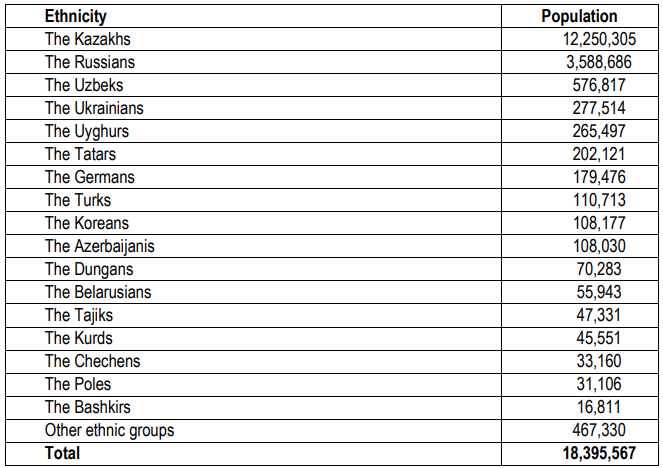
Source: https://ru.wikipedia.org/wiki/%D0%9D%D0%B0%D1%81
LITERATURE REVIEW
The issues of mediation in the current multicultural society of Kazakhstan were extensively studied by N.P. Kalashnikova and N. N. Kalashnikov (Kalashnikova & Kalashnikov: 2017, pp. 88-92). The mediation traditions of biys’ court in former Kazakh society were described by Kazakh enlightener Sh. Sh. Ualikhanov in the 19th-century (Ualikhanov: 1985).
The issues of modern multiculturalism are extensively studied by Western, Russian, and Kazakh scholars. Multiculturalism theories are addressed in numerous publications of Canadian scholar W. Kymlicka (Kymlicka: 2018, pp. 166-178), as well as several scholars covering the debate around contradictions between multiculturalism and postculturalism. Keith Banting and Will Kymlicka (Banting& Kymlicka: 2013, pp. 577-598) comparatively analyzed the Multiculturalism Policy Index (MPI) in 21 Western countries during the period from 1980 to 2010. Akira Igarashi (Igarashi: 2019, pp. 88-100) considered the interaction between multiculturalism and civic identity formation V.P. Busi (Busi: 2014) carried out a positive analysis of multiculturalism in Kazakhstan. Kazakhstan researchers, such as A. Kadyraliyeva et al. (Kadyraliyeva et al.: 2015, pp. 213-224),N. E. Kukusheva (Kukusheva: 2019, pp. 922-943) explored the reality of multiculturalism in Kazakhstan. A.M. Kadyraliyeva was the first who investigated the MPI of Kazakhstan (Kadyraliyeva et al.: 2015, pp. 213-224).E.L. Tugzhanov (Tugzhanov: 2013, pp. 8-12), T.Zh. Zhumasultanov (Zhumasultanov: 2005), Kukusheva (Kukusheva: 2019, pp. 922-943) considered multiculturalism as a theory of national building and suggested expanding the criteria of Multicultural Policy Index (IMP), referring to a comparative analysis of multicultural policies in some western countries and Kazakhstan.
METHODS
In this research, the authors used both theoretical and empirical methods, such as the comparative method, which is widely applied to compare the multiculturalism policy index (MPI) in the world. The descriptive methods were also used, allowing for a historical retrospective to study the demographic, and socio-political processes that took place in Kazakhstan. The authors also widely used statistical data, historical information, content analysis of various historical documents, and data sources.
Mediation is a traditional and modern Kazakh society
Mediation means the procedure for settling a conflict with the help of mediators to achieve a mutually acceptable solution, carried out with the voluntary consent of both parties to the conflict. Thus, mediation is a mechanism for conflict management with the assistance of neutral mediators whose task is to help both parties come to a certain agreement. The mediation has the form of an alternative dispute resolution, it is a voluntary and transparent pre-trial where all parties fully control the decision-making process and the conditions for its settling.
There was a unique institution of mediation in a traditional nomad Kazakh society in the form of a Kazakh court of biys – authoritative people who took responsibility for settling disputes between community members. In our opinion, the main advantage of the court of biys is the absence of formalities and any official routine. The power of biys was based on authority, considered as a patent for judicial practice. The great Kazakh enlightener Sh. Ualikhanov noted that Kazakh biys were engaged in their profession by vocation and had reasons to value their reputation. Otherwise, the dishonest judge could be bypassed without any scandals: no one would turn to him and the case was over (Ualikhanov: 1985).
Interestingly, the biys’ court enjoyed absolute authority among all residents of the Kazakh steppe. In many cases, the Russian population of the steppe preferred the court of Kazakh biys. Historians note a very interesting fact that during the period from 1859 to 1865, 117 appeals of Russians to the court of biys were recorded in the Kokshetaw district. Russian researchers Alenkina& Tursunbaeva remarked that the court ofbiys was quick, oral, fairly fair, and always disinterested, and therefore it was respected not only by the Kazakhs but also by the Russian Cossacks, many of whom addressed to the court of biys. They (the Kazakhs) had excellent legal proceedings and such procedures of investigative and judicial process as many civilized peoples could envy (Alenkina&Tursunbaeva:2017, pp. 3-8). This is the highest evaluation of traditional mediation! Thus, S. Suleimen, Advisor to the Supreme Court of Kazakhstan, noted that there were respected, authoritative people in every village. It was necessary to train them in mediation courses and give them the rank of biys. They would be able to settle the conflict without bureaucracy, trial, using the power of words, and leading people to a common solution. S. Suleimen (Suleimen: 2018). His idea was that this ancestral heritage should be restored in Kazakhstan.
Multiculturalism and Interethnic stability in Kazakhstan
Since gaining independence, Kazakhstan has been known for its inter-ethnic stability. This is confirmed by the absence of wide-ranging inter-ethnic conflicts in the territory of Kazakhstan compared to other post- Soviet republics. In this regard, Kazakhstan often acted as a peacemaker in the regulation of inter-ethnic conflicts, for example, a conflict between Armenia and Azerbaijan regarding Nagorno-Karabakh in 1991 and 2016. Also, the first president of Kazakhstan N.A. Nazarbayev acted as a mediator in the international negotiations of the “Normandy Four” (Germany, Russia, Ukraine, and France) in the regulation of conflicts between Russia and Ukraine when Astana was recognized as the preferred place for negotiations. Kazakhstan also took part in settling the conflict in Syria in 2017, when seven international meetings were held in Astana from January to October 2017, including delegations from Russia, Turkey, Iran, the United States, the United Nations, as well as representatives of the official Syrian government and opposition forces of Syria. These negotiations were called the Astana Process and made a great contribution to the regulation of this armed conflict. The modern Kazakhstani model of multiculturalism, social harmony and national unity are embodied in the national idea of Kazakhstan – “Mangilik El”, which is translated from the Kazakh language as the “Eternal Earth”. The Mangilik El national idea was adopted on April 26, 2016, at the 24th session of the Assembly of the People of Kazakhstan – an advisory body under the President of the Republic of Kazakhstan, consisting of the representatives of various ethnic groups of the Republic. The activities of the Assembly of the People of Kazakhstan are aimed at implementing state national policy, ensuring public safety, and increasing the effectiveness of interaction between the state and civil society institutions in the field of inter- ethnic relations. Branches of the Assembly of the People of Kazakhstan and the House of Friendship are located in all multi-ethnic regions of Kazakhstan. The support of cultures of numerous ethnic groups of Kazakhstan is an important aspect of interethnic stability in Kazakhstan, this support involves creating ethnocultural centers where the national identity of each people of Kazakhstan, its language, traditions, and culture is preserved. According to the Law “On Education” of the Republic of Kazakhstan, there are 88 schools where pupils study in the Uzbek, Uyghur, Tajik, and Ukrainian languages. Overall, the languages of 22ethnicities of Kazakhstan are taught in 108 schools. Moreover, 195 linguistic centers have been opened where the languages of thirty ethnic groups are studied. In Kazakhstan, there are 35 print media published in fifteen languages, television channels broadcast in 11 languages, and 14 ethnic theaters such as German, Korean, and Uzbek theaters. Practicing bilingualism is an important factor in overall interethnic stability. The language policy in Kazakhstan is carried out by the Law of the Republic of Kazakhstan “On Languages in the Republic of Kazakhstan” dated July 11, 1997, which proclaims that, along with the state Kazakh language, Russian is the official language of inter-ethnic communication, which is used equally in state authorities. In addition to the linguistic, socio-cultural aspect of inter-ethnic stability, the political factor is a very important indicator. According to the 2007 constitutional reform, the Assembly of the People of Kazakhstan is the legislative body that has the right to nominate 9 deputies in the Parliament. Thus, the constitution guarantees the representation of all ethnic groups inhabiting Kazakhstan in the highest legislative body of the country. The problems of the coexistence of the representatives of numerous ethnic groups within one civic communityare considered by the theory of multiculturalism. Despite the declared “failure of multiculturalism” regarding the problem with migrants in Western Europe, we think that multiculturalism is the only correct answer to the problem of civil unity theory of many ethnic groups in young multi-ethnic states that stand in the way of nation- building. According to the founder of multiculturalism Kymlickа (Kymlickа: 2018, pp. 166-178), the fundamental issue of multiculturalism is the question – Do majority efforts in nation-building create injustice for minorities? The definition of multiculturalism shows the essence of inter-ethnic relations in young democratic states because equality and justice in interethnic issues are the basis for tolerance and avoiding of inter-ethnic conflicts.
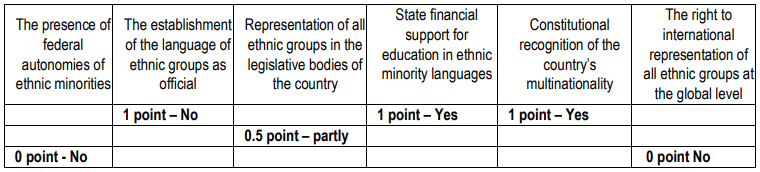
The Multicultural Policy Index (MPI) in Kazakhstan is equal to 3.5 points, where a positive answer corresponds to 1 point (Yes), a partially positive answer corresponds to 0.5 points and a negative answer corresponds to 0 points (No). Kazakhstani researcher A.M. Kadyralieva (Kadyralieva et al.: 2015, pp. 213-224) analyzing the data of the Multicultural Policy Index and calculating it for Kazakhstan (3.5 points,)compared it with Multicultural Policy Index of other countries and concluded that Kazakhstan lagged behind Canada and Great Britain but was ahead of France. N.E. Kukusheva (Kukusheva: 2019, pp. 922-943) considered the multicultural theory as the theory of nation-building for Kazakhstan.
RESULTS
Challenges of mediation in interethnic conflicts in modern Kazakhstan
The Assembly of the People of Kazakhstan was founded on March 1, 1992. The main purpose of this organization is to ensure of inter-ethnic and inter-religious harmony, which is especially important during the nation-building process of the young multicultural country when the state-forming ethnic group was in the minority. Initially, this organization was called the Assembly of Peoples of Kazakhstan, and then in 2007, it was renamed as the Assembly of the People of Kazakhstan, which is an evidence of changes in the principles of national unity, where a single national community is the union of all citizens of Kazakhstan despite the multiplicity of ethnics. In 2011 under the Assembly of the People of Kazakhstan a special mediation center – Mediation Council was created. Currently, in Kazakhstan, there are 829 regional branches in the general mediation network and 13 mediation councils. In 2016 the Memorandum of Cooperation between the Assembly of the People of Kazakhstan and the Supreme Court of the Republic of Kazakhstan was established.
N.P. Kalashnikova and N.N. Kalashnikov (Kalashnikova & Kalashnikov: 2017, pp. 88-92) stated that the memorandum was aimed at taking joint measures for the comprehensive implementation and development of public harmony institutions that contribute to reducing the level of conflict in the society. Voluntary public mediators work as part of the activities of these ethnocultural associations, where disputes in inter-ethnic and intra-ethnic relations can be resolved. In general, this Mediation Council includes deputies of the Parliament of the Republic of Kazakhstan, judges, and representatives of public organizations and state bodies. Currently, Kazakhstan is experiencing the socio-political consequences of the transit of state power. On March 19, 2019,Nursultan Nazarbayev announced the termination of his powers as President of the Republic of Kazakhstan. One of the oldest Soviet and post-Soviet leaders, N.A. Nazarbayev is the president of Kazakhstan for 29 years, demonstrated an example of political longevity. Analysts noted the transit of political power in Kazakhstan was smooth. However, in recent activity, there is some social unrest associated with ethnic clashes. Currently, mediation in Kazakhstan is largely successful owing to the quick resolution of conflicts, the absence of excessive bureaucracy, and high legal costs. The Law “On Mediation” was adopted in Kazakhstan on January 28, 2011.In recent years the mediation has been actively developing in Kazakhstan as a mechanism for settling social, corporate, and labor disputes. For example, the Mediation Center trains professional mediators to use various techniques on conflict management and negotiations. According to statistics provided by the prosecutor’s office, there are only 1,700 professional mediators throughout Kazakhstan. Specialists note that the sphere of commercial, social, and labor contacts has a great eastern need. What place do inter-ethnic conflicts take among others?
DISCUSSION
Despite the high level of inter-ethnic harmony as a whole, in recent times, unfortunately, there have been some cases of outbreaks of inter-ethnic conflicts in Kazakhstan. At the beginning of 2000, Kazakhstan experienced several inter-ethnic conflicts, for example, conflicts with the Chechen Makhmanov family in 2007, local Kazakh-Uyghur conflicts in 2006, and anti-Kurdish conflicts in 2007 in the South Kazakhstan region. These conflicts were identified as domestic criminal ones based on grassroots xenophobia. The largest cases of inter-ethnic conflicts occurred in the eastern and southeastern regions of the country, which are an important oil-producing region (East Kazakhstan Region) and characterized by ethnic diversity and higher population density in the South-East (Zhambyl Region). Also, the conflict between Kazakh youth and people from the Caucasus in Zhanaozen, (Western Kazakhstan) in 1989 which grew into larger riots, as a result of which about 3,000 people returned to the Caucasus. Zhanaozen continues to be a socially tense region even now, because of the socio-economic problems in this oil-producing region of Kazakhstan, the economic inequality between visiting shift workers and the local population. The big ethnic clash between the local population and the Dungans, the third-largest ethnic group living in this territory took place in the Kordai district of the Zhambyl Region on February 7, 2020. As a result of this conflict, 182 persons were injured and 10 people died. The population of this district is multicultural, consisting of 143,827 people, of whom 49.62% (71,374) are the Kazakhs, 9.93% (14,281) are the Russians, 33.81% (48,634) are the Dungans, as well as the Turks (0.71 %), the Uzbeks (0.26 %), the Kurds (0.29%), the Azerbaijanis (2.68%), the Kyrgyz (1.06%), the Tatars (0.18%), and the Koreans (0.11 %). According to Kazakhstani researchers, the cause of this conflict is the accumulated inter-ethnic problems, which, undoubtedly show serious economic, social, and legal issuers in this region, namely, smuggling, drug trafficking, and corruption, the weakness of local law enforcement authorities, which is brewing social and economic tensions. As a result, several serious accusations were raised against the Assembly of the People of Kazakhstan. These accusations include ineffective work on the practical prevention of ethnic conflicts and weak mediation. However, in our opinion, there are several other objective reasons for these ethnic conflicts. In this regard we would like to stress several very important factors:
First, many inter-ethnic conflicts are latent, which makes them difficult to foresee. These conflicts usually have been accumulating for a long time and could be caused by any incident that could flare up and spread very quickly, escalating into mass riots.
Second, all inter-ethnic conflicts occur in rural, densely populated, multi-ethnic areas of Kazakhstan and in compact settlements of ethnic Diasporas of ethnic minorities. In this regard, it should be noted that recently there has been a large increase in urbanization and internal migration from the densely populated South to Central and Northern Kazakhstan. The latter is associated with the transfer of the capital of Kazakhstan from the South (Almaty) to the North (Nur-Sultan), where the level of inter-ethnic tensions is much lower.
Third, these inter-ethnic conflicts are just the tip of the iceberg, behind which there is a set of socio- economic problems such as the low living standards in rural areas, unemployment, high levels of competition for jobs in areas of mass migration of foreign labor, inequality in distribution, weak local governments, and a high level of corruption.
CONCLUSION
There is a need for serious research interest in the preventive measures for inter-ethnic conflicts in Kazakhstan, as “deliberate silencing” and the lack of research and public discourse does not lead to a solution to the problem. As many researchers note, recently, Kazakhstan has lacked full-scale financing of ethnological monitoring and sociological research on the subject of inter-ethnic tension. The issue of mediation is among the important preventive measures of interethnic conflicts, which should serve as an instrument of “people’s diplomacy” and the prevention of acute conflicts. The mediation of inter-ethnic conflicts has its peculiarities because the settlement of inter-ethnic contradictions is not a public sphere. In this regard, there are difficulties in public discussion of such inter-ethnic conflicts, since information is confidential. In our opinion, mediation in a multi-ethnic environment should not be limited only to the activities of Mediation councils within the Assembly of the People of Kazakhstan, but also should revive the traditional mediation institutions that have existed in Kazakhstan since ancient times such as traditional courts of biys, gerontocracy (the power of the elders – Aksakals) among the representatives of different ethnic groups, as well as religious figures, because, often, all representatives of the conflicting ethnic groups are Muslims. Thus, traditional Mediation Councils that are resumed on a new basis in Kazakhstan can become a modern mediation tool, especially in rural areas, where socio-economic contradictions are most noticeable, acting as an effective way to resolve conflicts in the pre- trial order.
BIODATA
Y.M. ABIYEV: Yerkebulan Muratovich Abiyev is a Doctoral student of the Department of Political Science, Faculty of Journalism and Political Science, L.N. Gumilyov Eurasian National University in Nur-Sultan, Kazakhstan. The scientific research topic - inter-ethnic relations in multicultural societies, mediation issues.
G.R. SHERYAZDANOVA: Gulmira Rustemovna Sheryazdanova is a Candidate of Political Science, Associate Professor, who graduated from St. Petersburg University (Zhdanov Leningrad State University) (qualification - philosophy, specialty: teacher of social and political disciplines). She is an Associate Professor, acting as Professor of the Department of Philosophy of the S. Seifullin Kazakh Agrotechnical University. She is an owner of grants of the United States Department of Education, the Bolashak International Scholarship. She is an author of more than 100 scientific works, 3 textbooks on political science and sociology, a textbook in English, monographs, and articles in international peer-reviewed journals included in the Thomson Reuters and Scopus databases. She has the Hirsch index equal to 2. Academic interest sphere: public administration, public service, quality of public service delivery, E-government as an anti-corruption strategy; measuring social identity issues: civic and ethnic identity; nation-building process in post-Soviet countries.
B.B. BYULEGENOVA: Bibigul Beisenbaevna Byulegenova is an Associate Professor, Candidate of Political Science, graduated from the St. Petersburg University (Zhdanov Leningrad State University). Scientific interests: political parties, ethnopolitics, state youth policy. Courses: Theory of Elites, Political Science, Political Leadership, Social Policy of the Republic of Kazakhstan. Author's courses: Political Leadership, Social Policy of the Republic of Kazakhstan. She is an author of several textbooks, monographs, 3 articles in international peer-reviewed journals, indexed in the databases Thomson Reuters and Scopus. The Hirsch index - 2.
I.S. RYSTINA: Indira Sadybekovna Rystina is the Head of the Department of Political Science of the L.N. Gumilyov Eurasian National University in Nur-Sultan, Kazakhstan. She is a Ph.D.in the specialty "6D050200 Politology". Academic title: Associate Professor. Academic interests: political analysis, political culture, youth. Taught courses: Political Science, Theory of Politics, and Modern Computer Programs in Politics, Work with Electronic Databases, Media Business Modeling, Target Audience Management, Political Expertise, Modern World Political Science, Communication Management, and History of Political Research. Author's courses: Modern Computer Programs in Politics, Work with Electronic Databases.
B.A. GABDULINA: Bagysh Akhmetovna Gabdulina is a Candidate of Historical Sciences. Academic rank: Associate Professor. She graduated from the K.D. Ushinsky Petropavlovsk Pedagogical Institute. Scientific interests: political power, public policy, anti-corruption policy. She is an owner of the scientific grant of the State Public Historical Library of the Russian Federation 2015-2018. Courses: Political Science, Ethno- Politics, Political Parties, and Party Systems, Political Power, Political Process in the Republic of Kazakhstan, Qualitative Methods of Political Research, Political Sociology, Eurasian Economic Integration, Modern International Relations, and Global Development, Social Policy, Political Theory and Expertise, State Anticorruption Policy. Author's courses: Ethnopolitics, Priorities of Social Policy of the Republic of Kazakhstan, State Anticorruption Policy, etc.
BIBLIOGRAPHY
ALENKINA, N, & TURSUNBAEVA, N (2017). “Courts of Biys and Aksakals in Kyrgyzstan: What the History Teaches About?”. Russian Journal of Comparative Law, (4), pp. 3-8.
BANTING, K, & KYMLICKA, W (2013). “Is there a retreat from multiculturalism policies? New evidence from the multiculturalism policy index”. Comparative European Politics, 11(5), pp. 577-598.
BUSI, VP (2014). “Multiculturalism in Kazakhstan: Evolution of a Multi-ethnic Society and the Progress of an Effective Intercultural Communication (Bachelor's thesis, Università Ca'Foscari Venezia)”.
IGARASHI, A (2019). “Till multiculturalism do us part: Multicultural policies and the national identity of immigrants in European countries”. Social science research, 77, pp. 88-100.
KADYRALIYEVA, AM, ZHOLDUBAEVA, AK, MUKHANBETA, & ISENGALIEVA, AG (2015). “The origins ofmulticulturalism in Kazakhstan (in the example of South Kazakhstan region)” European Journal of Science and Theology, 11(4), pp. 213- 224.
KALASHNIKOVA, NP, & KALASHNIKOV, NN (2017). “NEW MEDIA TRENDS: FEATURES ANDCHALLENGES”. Proceedings of the International Scientific and Practical Conference “World Science”, 8 (24), pp. 88-92.
KUKUSHEVA, NE (2019). “Multiculturalism: A comparative analysis of western countries and Kazakhstan” Opción, Año, 35(23), pp. 922-943.
KYMLICKA, W (2018). “Minority rights in Robyn Eckersley and Chris Brown (Eds.) Oxford Handbook of International Political Theory”. Oxford University Press, 166-178.
SULEIMEN, S (2018). “The Biys’ court proposed to revive in Kazakhstan”.
TUGZHANOV, EL (2013). “Institute of the Assembly of the People of Kazakhstan in the context of social modernization”. Law and State, 1(58), pp. 8-12.
UALIKHANOV, SHSH, & UALIKHANOV, CHCH (1985). “Note on judicial reform. The court of Biys in the ancient folk form”. Collected Works in five volumes: volume 4. Alma-Ata.
ZHUMASULTANOV, TZ (2005). “The people of Kazakhstan: the current state of the population in the Republic of Kazakhstan”. Almaty.