Artículos
Correlation Between E-Government and Corruption Risks in Kazakhstan
Correlación entre el gobierno electrónico y los riesgos de corrupción en Kazajstán
 Gulmira SHERYAZDANOVA sheryazdang@katu.kz
Roza NURTAZINA Nurtazina_RA@enu.kz
Bibigul BYULEGENOVA bi.bulegenova@enu.kz
Indira RYSTINA indira.rys@enu.kz
Gulmira SHERYAZDANOVA sheryazdang@katu.kz
Roza NURTAZINA Nurtazina_RA@enu.kz
Bibigul BYULEGENOVA bi.bulegenova@enu.kz
Indira RYSTINA indira.rys@enu.kz
Correlation Between E-Government and Corruption Risks in Kazakhstan
Utopía y Praxis Latinoamericana, vol. 25, no. Esp.7, pp. 41-48, 2020
Universidad del Zulia

This work is licensed under Creative Commons Attribution-NonCommercial-ShareAlike 4.0 International.
Received: 09 August 2020
Accepted: 15 September 2020
Abstract: This article is an extension of the theme of e- government as a tool to struggle with corruption. E- government, enabling citizens to directly contact state authorities via the Internet, eliminates contact with officials, thereby reducing their permissive function and the risks of corruption, ensuring transparency and accountability. The purpose of this article is a comparative analysis of the development of e- government in different countries of Europe and Asia, as well as consideration of the correlation between the expansion of e-government functions and the reduction of corruption risks in Kazakhstan.
Keywords: Accountability, correlation, corruption, e- government, transparency..
Resumen: Este artículo es una extensión del tema del gobierno electrónico como herramienta para luchar contra la corrupción. El gobierno electrónico, que permite a los ciudadanos contactar directamente a las autoridades estatales a través de Internet, elimina el contacto con los funcionarios, lo que reduce su función permisiva y los riesgos de corrupción, garantizando la transparencia y la rendición de cuentas. El propósito de este artículo es un análisis comparativo del desarrollo del gobierno electrónico en diferentes países de Europa y Asia, así como la consideración de la correlación entre la expansión de las funciones de gobierno electrónico y la reducción de los riesgos de corrupción en Kazajstán.
Palabras clave: Correlación, corrupción, gobierno electrónico, responsabilidad, transparencia..
INTRODUCTION
E-government is a new paradigm of public administration, displacing the traditional, and paper, bureaucratic paradigm, which, according to Max Weber, is described as “centralization, specialization, standardization and routine”. The e-government paradigm is based on one-window services, where public services are carried out electronically. Thus simplifying, standardizing, anonymizing the public services to citizens, making them much more mobile and transparent (Bondarenko et al.: 2020). The transition from the industrial to the post-industrial stage of development leads to the transformation of the whole life of society, including the economic, social, and political areas. Giving an answer to the question of how relations between citizens and the state are changing, we can confidently say that e-government enhances transparency, accountability, the gap between government and society and the anti-corruption component. The purpose of the article is an attempt to find a correlation between the introduction of electronic public services and the reduction of corruption in Kazakhstan.
LITERATURE REVIEW
According to many researchers, as Bhatnagar and Apikul (2006), Andersen (2009), Elbahnasawy (2014), the potential impact of e-government on reducing corruption is undeniable. Bhatnagar and Apikul (2006) claim that the use of information and communication technology (ICTs) has dramatically changed public services. Bertot et al. (2012) make a general theoretical conclusion about the potential of applying e-government to improve transparency and strengthen anti-corruption actions. Bhatnagar and Apikul (2006) highlight four anti- corruption strategies using e-government. The first one is a prevention strategy, which implies preventive measures of reducing corruption, particularly reducing bureaucracy, simplifying rules and procedures, eliminating intermediary officials, which anonymizes and standardizes the process of providing services and reduces the possibility of abuse of authority and power. The second one is a pressure strategy, which is possible due to the transparency of electronic communications and the ability to monitor the progress of online procedures, requests, appeals to state authorities by citizens. The third is an accountability strategy is implemented by increasing access to information, data publicity, and empowering citizens, publishing government information. The fourth strategy contributes to the development of computer literacy and civic culture of people, which largely eliminates corruption. Among global e-government researches, there is empirical evidence for a clear quantitative correlation between the application of e-government and the reduction of corruption in both developing and developed countries.
Andersen (2009) states that the prevalence of e-government from 10% to 90% means a reduction in corruption from 23% to 10%. Elbahnasawy (2014) claims that “the influence of e-government on the struggle with corruption is clearly positive and empirical results show that e-government is an important tool in the fight against corruption”. Studies of Lio, Liu, and Ou (2011) based on data from 70 countries, from 1998 to 2005, they also come down to the hypothesis that there is “a strong theoretical basis to believe that e-government can promote transparency and accountability and the Internet can be used as a tool to fight corruption effectively”. Later studies such as Knox and Janenova (2019), Mensah and Mi (2019), Kizabekova and Chernyshenko (2020) consider the impact of e-government and electronic communications overall on the development of publicity, transparency and accountability in society. Estonian researcher Karv (2015) examined the correlation factors between the introduction of electronic services and the reduction of corruption in Estonia, a young European country with great success in implantation of electronic government. Ukrainian researcher Melenchuk (2018), following the Estonian analyst, also deduces a possible correlation between electronic public services and a decrease in street corruption.
METHODS
In our study, we relied on the method of the Estonian researcher Karv (2015) in which he uses the method of comparison and distinguishes four factors of correlation of e-government to reduce corruption. These are the elimination of intermediaries between citizens and authorities; increasing transparency; increasing accountability; narrowing the gap between citizens and government officials. The applied method consists in comparing the indicators, and in the influence that they have on other indicators, which is calculated by measuring the key global indicators of public administration efficiency. So, the decrease in intermediaries between citizens and the state is calculated by using an indicator, the number of Internet users and electronic appeals of citizens. The increase in transparency is measured by Transparency International through the Corruption Perceptions Index. Accountability is reflected in the World Bank's Global Governance Indicator – World Government Indicator (WGI). The narrowing of the gap between citizens and government authorities is measured by using the criterion of citizens' trust in the state (Eurobarometer Research). These indicators are closely interrelated, and each of them has a separate effect on reducing the level of corruption. The applied methodology consists in studying the influence of some indicators on others, where the determination of correlation factors is most important. The article makes extensive use of content analysis of various sources of information, documents, and analytical reports.
RESULTS
According to the data of the General prosecutor's office of the Republic of Kazakhstan, the most corrupt areas in Kazakhstan are the government procurement system; licensing area, including state authorities issuing licenses and permits, ministries, committees, departments; control and supervisory authorities (police, Ministry of Internal Affairs, the court of justice, tax and financial, sanitary inspections, customs,); social area of education and healthcare. To reduce corruption, electronic government services were introduced in the following areas: governmental procurement, electronic licensing sectors, electronic business registration, electronic customs declaration, specialized electronic service centres for the issuance of a driver’s license and registration of transport, electronic service in the social sectors.
The first factor influencing the impact of electronic services on petty corruption is the reduction of intermediaries between citizens and the state, the so-called “middle-man”, officials who are obliged to provide state services to citizens without delay. The elimination of “middle-man” was measured using an indicator of the usage of the Internet for interaction with government agencies. Looking through the data, we can see how many people use computers and the Internet to communicate with government services. This indicator of the use of the Internet in addressing government authorities automatically determines the elimination of officials in the chain of interconnections between people and the state. According to data from Tyulyagin (2019), Kazakhstan ranks 44th out of 209 countries in terms of the number of Internet users.
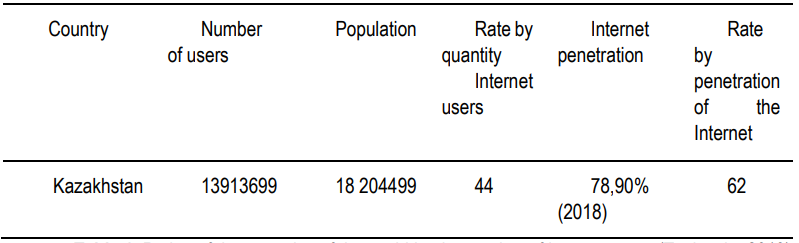
The stated factors speak in favour of the increase in the number of electronic state services that nowadays the registry of state services in Kazakhstan totals 741 items, of which 454, or 61%, are available in electronic form. At the same time, 165 state services are available exclusively in electronic format, including licenses and permitting documents, as well as services for subsidizing entrepreneurship. According to forecasts, the Ministry of Information of Kazakhstan will automate 80% in 2019, and 90% of state services in 2020, the number of documents submitted in paper form will decrease by 110 million documents a year. 90% of state services in Kazakhstan in the next two years will be available online (Gorbunova: 2019). Kazakhstan is systematically digitalizing. In 2013, “the Information Kazakhstan 2020” program was launched, which resulted in significant success in promoting the development rating of the e-government readiness index (EGDI).

(United Nations: 2018)
Also, since the beginning of 2018, the large-scale “Digital Kazakhstan Program” has been implemented in the country. One of the missions of this program includes measures to improve the quality and increase the number of state services provided online, which will reduce bureaucracy and corruption, as well as make government agencies more efficient and public. (State Digital Kazakhstan Program: 2018).
The second very important correlation factor is Transparency, which is calculated by the international rating organization Transparency International (TI). At the moment, there is a gradual growth of Kazakhstan in the corruption perception index. In 2019, Kazakhstan ranked 113 places. It is the best result in the entire history of participation in this world ranking.
According to TI experts, “the main positive changes in this rating are, first of all, associated with the adoption of new anti-corruption legislation, the introduction of public control, the implementation of systematic and consistent work to eliminate the causes and conditions of corruption, and the improvement of providing state services.” (Index of /download/rcsaci/actual-research: 2017). A lot has been done by the government of Kazakhstan in favour of developing transparency over this time. Namely, in 2015, the Internet portal “Open Government for Citizens” was created, which consists of such components as open data, open legal and regulatory instruments, open dialogue, open budgets, as well as an assessment of the effectiveness of state agencies.
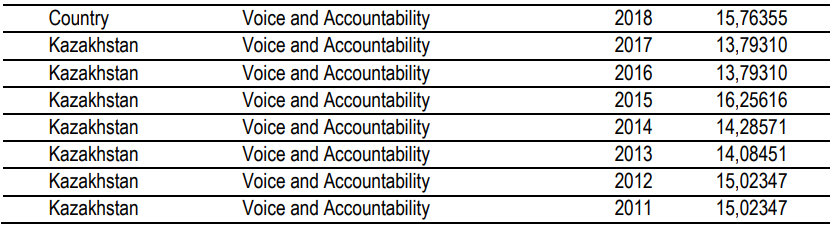
The third important factor arising from transparency is the accountability of state agencies to citizens. An indicator of accountability is the World Government Indicator (WGI), which takes into account such indicators as “Voting rights and accountability to society”. This project is implemented by the World Bank to computing government performance. This indicator is calculated on a 100 scale as we see from Table 3. Kazakhstan so far is gaining only 15-16 percent out of 100.
The fourth correlation factor is to narrow the gap between citizens and government officials and increase citizens' trust in the state. In Estonia, Eurobarometer studies are used to measure this indicator, which is not possible for Kazakhstan. Therefore, we can refer to sociological polls conducted in Kazakhstan about what citizens think about corruption. The results of numerous opinion polls show an increase in intolerance to corruption. An important role is played by the active propaganda of an anti-corruption culture, both among young people and among the adult population, the formation of helplines, where citizens can turn about corruption offences. Also, the Anti-Corruption Agency of the Republic of Kazakhstan introduced a system of rewards for reporting verified facts of corruption, while the amount of reward should be 10% of the amount of the alleged bribe. For example, in the analytical report of the Academy of Public Administration under the President of the Republic of Kazakhstan (Index of /download/rcsaci/actual-research: 2017), it was stated that “the number of people who negatively perceive corruption increased by 20.7% (from 60,7% in 2016 to 81.4% in 2017), the number of people who assess the level of corruption in the country as average and high has decreased (from 72.7% in 2016 to 70.1% in 2017). We can also claim about the increase in the anti-corruption activity of civil societies and, especially, as Kazakhstani researchers Rystina I. (2012), Kukusheva N. (2019) points out among the youth of Kazakhstan. So, in 2017, 55.5% of the population surveyed said they were ready to personally provide support in reducing corruption, when, as in 2016, this figure was 53.1%. In many ways, these changes are the result of the implementation of new approaches to involve society in the anti- corruption movement.
DISCUSSION
As we clear up, through the analysis of these four factors, there is a correlation of e-government in reducing corruption risks. According to the first factor, there is an increase in the growth of Internet users and electronic public services in Kazakhstan, which affect the reduction of intermediaries between citizens and the state, and consequently, the reduction of corruption. According to the second transparency factor, due to the efforts of the state, the introduction of new anti-corruption legislation, the institution of public control, as well as electronic public services, Kazakhstan has made some progress in the Transparency International (TI) rating of corruption perception, ranking 113th in 2019. However, in order to advance in this rating, Kazakhstan needs to struggle with not only petty and administrative corruption but also top corruption at a high level of power and capital (Tsindeliani: 2019). As to the third factor of accountability, electronic communications create a relationship between government agencies and citizens more transparent due to the possibility of electronic appeals, the presence of electronic receptions and electronic blogs of heads of government departments and ministries. According to the fourth factor of increasing citizens' trust in the state, it can be noted that precautions against corruption affect the reduction of the gap between citizens and civil servants and increase the trust of citizens in the state. However, e-government is not the only factor in reducing corruption but is one of the components of the overall fight against corruption. Correlation shows that e-government is effective in the struggle with petty and administrative corruption. Nevertheless, to fight against top corruption, comprehensive state measures are needed, including both preventive and possibly repressive anti-corruption measures.
We can see this from the experience of countries that have not succeeded in developing e-government but have great progress in reducing corruption. In this regard, we can trace the experience of countries like Estonia and Georgia. Estonia is a recognized leader in the development of e-government with the lowest prevalence of corruption. After the collapse of the USSR, Estonia, with a small territory and population, led by a young government, decided that digitalization is the way of modernization and the establishment of a new effective public administration. In 2013, the famous Skype video communication system was created with theparticipation of Estonian specialists. Based on these phased measures, today, Estonia is a leader in the development of e-government, which affects the level of corruption.
Estonia is the least corrupt country in Europe. According to the Transparency International CPI index, the level of corruption in Estonia has been decreasing since 2004 with slight deviations. Thus, digitalization in Estonia, in many respects, ensured transparency of the government, safe data exchange, a healthy and educated population with access to social services, a favourable environment for business, reduction of corruption and bureaucracy (Index of /download/rcsaci/actual-research: 2017). Georgia, being one of the most corrupt countries in Eastern Europe at the beginning of 2000s, today is very successful in the fight against corruption. However, that is more associated with repressive rather than preventive measures. According to the researchers, “up to now, the level of perception of corruption among Georgian citizens is 4%, and only 2% actually faces bribery, while 77% of Georgians are satisfied with the government’s anti-corruption efforts” (Dyusenov & Kabyldin: 2017). However, its progress in the fight against corruption can hardly be associated with the development of e-government, as its digitalization performance is not great. The UN study shows that Georgia falls behind regional and global trends in the development of e-government.
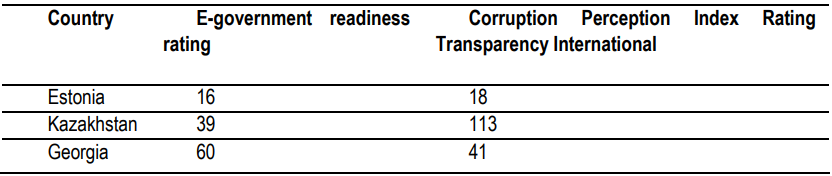
As we can see from Table 4, Estonia is recognized as the leader in the development of e-government, rated 16th among 193 countries of the world, accordingly, rated 18th in the corruption perception index. Georgia, succeeding in the fight against corruption (41st) is not successful in the development of e- government, rated the only 60th. Kazakhstan, occupying a good position in the development of e-government (39th), rated low (113th) in the rating of corruption, but it is a progress compared to previous years.
CONCLUSION
The phenomenon of corruption is as multidimensional and multifaceted as the power itself since corruption is a shadow of power. Many causes of corruption’s emergence, as well as methods to struggle with it, cannot be considered in one study. Based on research in Estonia, we tried to mark variables that correlate with a positive effect on reducing corruption risks in Kazakhstan. In general, the social and economic effect of e-government on the development of the country is enormous. In the economic, this manifests itself in the form of an increase in the index of the simplicity of doing business and competitiveness; in the social sphere in the form of increasing transparency and reducing corruption; in politics in the development of accountability and feedback between the state and civil society. However, there are many factors that reduce corruption, which is not limited to the introduction of e-government. In this regard, we pointed to the experience of Georgia.
The conclusion of this research is that, despite the fact that electronic public services are not the only way to reduce corruption, they are one of the important preventive measures to reduce corruption risks. In this case, we use the term “corruption risks” rather than corruption overall, as these four correlation factors affect corruption risks as a potential possibility of corruption, which we tried to prove using Kazakhstan as an example. Certainly, for the confident conclusions of the correlation between electronic services and the reduction of real corruption the time is needed, because according to experts, it takes longer than one year to assess the impact of the fight against corruption on a state of democracy. From this, we can conclude that inthe historical time perspective, with the development of measures taken by the e-government to develop transparency and accountability, this correlation will be more visible and more distinct for future comparative studies.
BIODATA
Gulmira SHERYAZDANOVA: Gulmira is a Candidate of Political sciences. She occupies position of Associative Professor at Department of Philosophy at Saken Seifullin Kazakh Agrotechnical University. Her research interests are political philosophy, theory of democracy, the role of electronic communications in modern society, e-government of Kazakhstan as an anti-corruption strategy. She teaches Political science, Political and Social science.
Roza NURTAZINA: Roza Nurtazina is a Doctor of Political Sciences. Roza works as a Professor at Department of Political Science of L.N. Gumilyov Eurasian National University. She studies educational policy of the Republic of Kazakhstan in modern conditions; security issues in the Central Asian region; Actual problems of the political science of the Republic of Kazakhstan; legislative law and civil society; Public Relations; information policy. Her latest works are “Discourse on theoretical and methodological approaches to the study of national ideas in Kazakhstan”, “Aspects of Political Science Education and Key Guidelines of the Kazakhstan-2050 Strategy”.
Bibigul BYULEGENOVA: Bibigul Byulegenova is a Candidate of political sciences. She is a professor, author, co-author, and journal reviewer. Bibigul works at L.N. Gumilyov Eurasian National University. She has published 50 scientific papers and developed her own educational courses “Fundamentals of Electoral Law and Process”, “Religion and politics in modern the world”.
Indira RYSTINA: Indira is a PhD, associate professor. She has been working at L.N. Gumilyov Eurasian National University since 2011. Her research interests are socio-political processes of the Republic of Kazakhstan, national security, information security, media and politics, political communication, political research methodology.
BIBLIOGRAPHY
ANDERSEN, TB (2009). “E-Government as an anti-corruption strategy”, Information Economics and Policy, 21(3), pp. 201-210.
BERTOT, JC, JAEGER, PT & GRIMES, JM (2012). “Promoting transparency and accountability through ICTs,social media, and collaborative e‐government”, Transforming government: people, process and policy, 6(1),pp. 78-91.
BHATNAGAR, S & APIKUL, C (2006). “Fighting corruption with e-government applications”, APDIPe-Note, 8, pp. 1–4.
BONDARENKO, T, BORODIN, A, ZHOLAMANOVA, M, PANAEDOVA, G, BELYANCHIKOVA, T & GURIEVA,L (2020). “Investments to the petrochemical sector: the value of the competitiveness of petrochemical companies”, Entrepreneurship and Sustainability Issues, 7(3), pp. 2510-2525.
DYUSENOV, MM & KABYLDIN, AM (2017). Digitalization as a mechanism to reduce corruption risks: An analysis of the experience of Estonia and Georgia. Retrieved from https://www.apa.kz/download/rcsaci/actual- research/.
ELBAHNASAWY, NG (2014). “E-government, internet adoption, and corruption: an empirical investigation”, World Development, 57, pp. 114-126.
GORBUNOVA, A (2019). “90% of public services in Kazakhstan in the next 2 years will be available online”. Retrieved fromhttps://forbes.kz//process/internet/90_gosuslug_v_kazahstane_v_blijayshie_2_goda_stanut_dostupnyi_onla yn/.
INDEX OF /DOWNLOAD/RCSACI/ACTUAL-RESEARCH (2017) “Analysis of the state and trends in the prevalence of corruption at the international and national levels”. Retrieved from https://www.apa.kz/download/rcsaci/actual-research/.
KARV, J (2015). “E-Government and its ability to reduce corruption-The case of Estonia”.
KIZABEKOVA, A. & CHERNYSHENKO, V. (2020). “E-Government Avatar-Based Modeling and Development”, in: Avatar-Based Control, Estimation, Communications, and Development of Neuron Multi- Functional Technology Platforms. IGI Global. pp. 19-34.
KNOX, C & JANENOVA, S (2019). “The e-government paradox in post-Soviet countries”, International Journal of Public Sector Management, 32(6), pp. 600-615.
KUKUSHEVA, N (2019). “Multiculturalism: A comparative analysis of western countries and Kazakhstan”, Opcion, 35, pp. 992 - 943.
LIO, MC, LIU, MC & OU, YP (2011). “Can the internet reduce corruption? A cross-country study based on dynamic panel data models”, Government Information Quarterly, 28(1), pp. 47-53.
MELENCHUK, A. (2018). “Can E-government Combat Corruption? Experience of Poland and Estonia”. Institute of Innovative Governance.
MENSAH, IK & MI, J (2019). “Predictors of the Readiness to Use E-Government Services From Citizens' Perspective”, International Journal of Technology Diffusion (IJTD), 10(1), pp. 39-59.
RYSTINA, I (2012). “Pedagogical Principles of Forming the Political Culture of Kazakhstan Youth”, World Applied Sciences Journal, 20, pp. 29-34.
TSINDELIANI, IA (2019). “Principles of the Public Financial Law as the Means of Legal Regulation of Public Finance”, Journal of Legal, Ethical and Regulatory Issues, 22(5), pp. 1-12.
TYULYAGIN (2019). Retrieved from https://tyulyagin.ru/ratings/rejting-stran-mira-po-kolichestvu-internet- polzovatelej.html#3
UNITED NATIONS (2019). Retrieved from https://publicadministration.un.org/egovkb/en-us/Data-enter
WORLDWIDE GOVERNANCE INDICATORS (WGI) (2018). Retrieved fromhttps://info.worldbank.org/governance/wgi/Home/Reports