Artículos
Rhetorical Categories of Ethos, Logos and Pathos: Sounding Judicial Speech of Lawyers
Categorías retóricas del ethos, logos y pathos: discurso judicial sonoro de los abogados
 M.V. YAKUTINA mvyakutina@fa.ru
L.X MILYAEVA LVMilyaeva@fa.ru
L.Y. TARASOVA LYUTarasova@fa.ru
P.P. ROSTOVTSEVA PPRostivtseva@fa.ru
M.V. YAKUTINA mvyakutina@fa.ru
L.X MILYAEVA LVMilyaeva@fa.ru
L.Y. TARASOVA LYUTarasova@fa.ru
P.P. ROSTOVTSEVA PPRostivtseva@fa.ru
Rhetorical Categories of Ethos, Logos and Pathos: Sounding Judicial Speech of Lawyers
Utopía y Praxis Latinoamericana, vol. 25, no. Esp.7, pp. 111-120, 2020
Universidad del Zulia

This work is licensed under Creative Commons Attribution-NonCommercial-ShareAlike 4.0 International.
Received: 03 August 2020
Accepted: 15 September 2020
Abstract: The article presents a phonetic comparative analysis of sounding judicial speech based on three classical rhetorical categories: ethos, logos, pathos. The material includes authentic audio recordings of court speeches by American lawyers with the necessary professional and general cultural competences in the US Supreme Court, which was reflected at the prosodic level of their speech. The vivid, influencing speech nature based on pathos and ethos, polemic, and suggestive discourse based on logos are reflected not only in the variability of basic frequency but in various dynamic and temporal characteristics, depending on the rhetorical category on which they were based.
Keywords: Ethos, logos, pathos, prosody..
Resumen: El artículo presenta un análisis fonético comparativo del sonido del discurso judicial basado en tres categorías retóricas clásicas: ethos, logos, pathos. El material incluye grabaciones de audio auténticas de discursos de la corte de abogados estadounidenses con las competencias culturales profesionales y generales necesarias en la Corte Suprema de los Estados Unidos, que se reflejó en el nivel prosódico de su discurso. La naturaleza del discurso vívida e influyente basada en el pathos y el ethos, el discurso polémico y sugestivo basado en logos se refleja no solo en la variabilidad de la frecuencia básica, sino en diversas características dinámicas y temporales, dependiendo de la categoría retórica.
Palabras clave: Ethos, logos, pathos, prosodia..
INTRODUCTION
Over the past thirty years, oral judicial speech has become an important interdisciplinary subject of study, which uses scientific data from such areas as legal theory, philosophy, sociology, logic, rhetoric, linguistics, prosody, etc. This article considers a rhetorical approach to the study of judicial argumentation in court in terms of its effective implementation in a court session. Modern court speakers use a rich antique heritage. The forms and methods of ancient rhetoric described by Aristotle include the theory of analytical evidence and the ability to “influence the emotional nature of people, their passions”. In ancient times, public speech in court shifts the emphasis from the legal justification of speech to speech impact, based on the emotions of those present – to ethos and pathos, making judicial speech vivid and polemical. The relevance of this study is determined by the need to develop general legal aspects of the language, which, despite the specifics of each country, are characterized by the general principles of constructing the argumentation of speech in court. The novelty of the study cited in the article is determined by the choice of experimental material, which consists of authentic historical audio recordings of U.S. Supreme Court sessions.
The Supreme Court certainly plays a crucial role in the US legal system and has a significant impact on the country’s political life (Grigorieva: 2017, pp. 109-120; Akim et al.: 2019, pp. 1408-1428). Lawyers acting in this court have vast experience, high professional competence, and high social status. The peculiarity of the material helped to highlight the prosodic characteristics of oral public speech of American lawyers in their refined form. Certainly, lawyers of this level can serve as a standard of judicial speech. The high status and political influence of lawyers are evidenced, for example, by the fact that half of the House of Representatives are lawyers and defenders, and in 2015, 156 out of 435 senators in the Congress were lawyers. In America, there is a clash of interests and rivalry between a large number of political and social groups, the interaction of which gives rise to real political power (Bonica & Chilton: 2015; Bublienė & Jurkevičius: 2019, pp. 1246- 1257), and lawyers-politicians make a great contribution to this struggle.
Several significant extralinguistic factors also influence the speech of American lawyers. The most important of them is the fact that to prepare their speech in court, American lawyers study a large array of litigation practice since, in the USA, the source of law is the statute – case law. As they say in America, lawyers believe in practice, not in theory. Also, the study of the political reasons that gave rise to the source of law is an important stage of the study for lawyers in preparing their speech in court, since when making decisions, the court is influenced by political factors (Frolova et al.: 2019, pp. ; Kolmakov et al.: 2019, pp. 93-107). Thus, the judicial discourse of an American lawyer is based on political-factual reasoning, not on theoretical-legal one. The listed features have a great influence on the content of lawyers’ judicial speech, which assumes a striking polemic nature. This feature brings the nature of modern judicial speech closer to the nature and principles of constructing the public speech of ancient speakers.
Aristotle was one of the first to connect rhetoric with politics and ethics. The rapprochement of political public speech with judicial rhetoric adds vivid controversy and introduces political dispute into the judicial speech norm. As noted by Nikiforova (Nikiforova: 2014, pp. 66-69), already in the introductory part of a court appearance, lawyers determine one of the following roles: a narrator, an interlocutor, or inspirer (animator). This helps to fine-tune one’s discourse to the goals of the statement and make it reasoned, thought-provoking. Expressiveness can be implemented at different language levels – at phonetic, syntactic, and stylistic ones. The integrated use of language tools adds speech emotionality, expressiveness, and imagery. At the prosodic level, for example, for emotional expressive speech, the selection of individual words is widely used, the use of ascending and descending tones that do not meet the known rules, a special slowdown or acceleration of speech pace, psychological pauses, etc.
In this work, the authors relied on the above analysis of the rhetorical components of legal discourse(ethos, logos, pathos) in the studies of other scholars to select the sounding material for phonetic analysis of speech which is based on one of these three components. Therefore, the following scientific review made itpossible to more accurately establish the belonging of that other part of the experimental material to one of the rhetorical categories based on informative and pragmatic speech analysis.
By manipulating the audience’s emotions, the speaker contributes to the formation of a reaction to logical arguments, simultaneously emphasizing that “arousing passions” is not moral, that the speaker builds his speech based on the ethical standards of society. The desire to listen to the speaker is largely determined by the fact of his observance of ethical speech standards and rules. Ethos is a general ability to deal with a communication situation. In general terms, it is “the answer to the question of what and how one can speak in a defensive speech or what cannot be said in a judicial debate”. Despite the importance of other rhetorical components, the first and most important one is ethos (Ivygina et al.: 2019, pp. 288-314; Wildes: 2020, pp. 112-128; Tsvetkova et al.: 2019, pp. 598-612).
The speech content, corresponding to the term “ethos” from theoretical rhetoric, is determined by the speaker’s knowledge of the socio-political, psychological, cultural, and emotional characteristics of the audience. Judicial speech, as to be convincing, must primarily comply with moral standards to arouse the audience’s trust in the speaker. Ethos is an appeal to such moral principles as justice, legality, honesty, moral values of society, as well as historical facts, judicial precedents, moral standards, and rules of law. Ethos is determined by the dichotomy of the just and the unjust.
According to the results of the study by Dickson-La Prade (Dickson-La Prade: 2020), the speaker usescommon sense, argues simply, and uses ordinary, common concepts, values, and vocabulary: people trust this speaker, who uses the language just like everyone else uses the language. The author has identified several principles that are used in ethos-based speech.
An appeal to logos consists in a clear and understandable argumentation of one’s position, structured speech, reference to existing evidence. This verbal impact is achieved by the following argumentative methods: a) mention of testimony, b) listing of reliable details, c) announcing the expert data, d) focusing on statements of fact. Logos is an appeal to the mind, provision of logical arguments (Magsumov: 2019, pp. 215- 221).
Pathos-based influencing judicial speech is characterized by the use of the following rules: a) the use of special lexical units to enhance emotional impact, b) the dramatization and visualization of details and motives of actions, c) the opposition “us-them”, the general – the particular, etc.
Regarding the division of rhetorical categories into the ethos, logos, and pathos, Manzin and Tomasi (Manzin & Tomasi: 2014, pp. 930-941) express an interesting idea that the form of ethos and pathos existence in judicial speech is determined by their inclusion in the framework of the logical component of a speech act: “pure” logos cannot be distinguished. To be reasonable and convincing, the speaker defines his speech strategy based on toposes (argumentative places), which traditionally draw their strength from logos (logic). A logical component of judicial statements should be conceived as a kind of framework that allows intelligently placing ethical and emotional argumentative elements. Also, the size of these elements and the dominance of pathos or ethos may vary depending on the rhetorical strategy of the parties and on the judge’s critical assessment (Sasongko et al.: 2019, pp. 99-117; Rahmadi et al.: 2020, pp. 113-133). This conclusion is of undoubted interest. However, one cannot agree that the performative result of judicial communication is limited to a couple of rhetorical strategies, of which pathos refers to the issue of pain or pleasure and ethos – to the just or the unjust. The authors of the article suppose that legal controversy consists of both ethical and emotional patterns, as well as logical patterns because the evidence-based part of judicial speech is mainly implemented through appeal to reason and logical thinking.
METHODS
The study material was selected from the collection of audio recordings of the US Supreme Court meetings, which included court proceedings of the most famous historical cases from 1963 to 1992. The main study material included the electro-acoustic and partially auditory analysis of sounding texts from the following court cases:
- 1. Edwards vs. Agulliard. On teaching the theory of the divine world creation;
- 2. Gregg vs. Georgia. On the death penalty;
- 3. Gideon vs. Wainwright. On the right to have a legal defense Irons P., Guitton S. (Irons & Guitton: 1993, p. 376).
The US Supreme Court hears appeals on cases from lower courts, therefore, there is no jury trial, but judges, counsels for the defendant, and the plaintiff participate. Judicial speech in this case becomes even more professionally oriented and formalized than in any other American court. This material seems to be the most convenient for studying sounding judicial speech for several reasons. First, the audio recordings are authentic, tape-recorded, and digitized they are historical evidence. Secondly, the judicial speech of American lawyers in the Supreme Court is characterized by speakers’ preparedness and responsibility for fulfilling the task. This makes their speech almost a standard of public judicial speech. Finally, the absence of additional factors, such as an appeal to the jury, when counsels can adapt their speech to the social speech standards of other social groups, less educated and professional, and, as a result, the lack of excessive theatricality.
From the total volume of the sounding text of three court cases, to preserve the unambiguity of research results, middle-aged male announcers, bearers of standard American pronunciation were selected. The total volume of the sounding material was 78 minutes. From this volume, based on stylistic analysis of the pragmatic orientation of the text, specific statements with a duration of 52 to 60 syntagma were selected and divided into three groups according to three different types of speech impact, belief, based on Aristotle’s rhetorical categories: logos, ethos, and pathos.
Even though the main part of the article is devoted to the electro-acoustic analysis, an audit analysis was conducted to identify the general characteristics of the melodic structure of judicial speech, depending on its pragmatics and rhetorical orientation (logos, ethos, pathos). However, this article gives only a few examples of such studies, since the full results of the audit analysis were not included in this article, and its main content will be devoted to the results of the electro-acoustic, instrumental analysis.
An example of an ethos-based utterance:

This passage contains a large number of medium and long pauses, it sounds at an average pace with a low volume level. Intonation characteristics include a wave-like, even scale of a wide range due to the low register, with the most specific low terminal tones (level, low, and rising).
The following utterance is logos-based:

In this utterance, a high level of basic frequency, a downward and wave-like mid-range even scale with a low downward terminal tone, a high level of sound pressure, a slowed-down pronunciation rate, and an average number of short and medium pauses are noted.
The third type of speech impact is pathos-based. For instance:

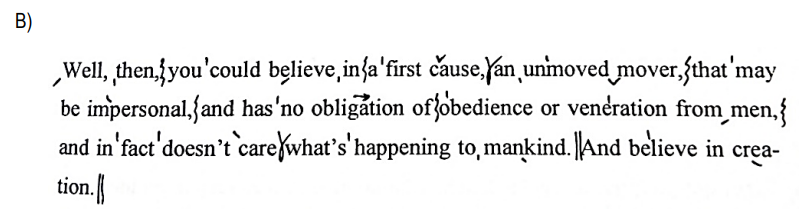
The utterance is characterized by a wave-like even scale of medium and low register, emphatic high smooth, descending-ascending and descending terminal tones, an average sound pressure level, medium and long pauses, medium or fast pace.
Besides the audit analysis, a part of the material (25 min) was electro-acoustically analyzed by Speech Analyzer 3.0.1 SIL International program. The following indicators underwent the indicated type of analysis: melodic, dynamic, and temporal characteristics. Melodic indicators are the maximum and minimum basic frequency (BF), the average BF expressed in hertz (Hz), and the BF range expressed in halftones. Dynamic indicators (energy range and average syllabic pressure) were measured in decibels (dB) by measuring every 20 ms. Temporal characteristics included the average pace (the number of syllables per unit of time), the ratio of phonation to pausation, frequency, and duration of pauses, measured in milliseconds (ms). Pauses were considered as interruptions in phonation (the most recurring form is blank, physical, syntactic pauses) and filled pauses associated with speech planning – hesitation pauses (sound insertion signals or extra stretching of the pre-pausal speech segment). The results obtained were processed in an elementary mathematical- statistical way.
RESULTS
Results of the electro-acoustic analysis. Basic pitch indicators (BF).According to many scholars, basic pitch indicators (BF) are considered the main parameter and one ofthe most significant prosodic indicators for American English as well. Variability of the BF is noted not only depending on the social differentiation of speakers, but also a pragmatic focus of a verbal utterance. For the speech of middle-aged and older men with high social status, which are the trial participants in the US Supreme Court, the average BF rate is 108 Hz (Poletaev: 1998, p. 153). Depending on the rhetorical type of an utterance, the results of the study showed that ethos-based utterances have BF indicators of 104.7 Hz, logos-based utterances – 121 Hz and pathos-based ones – 122.5 Hz. Pathos-based utterances have a more pronounced emotional connotation. The maximum BF range (the difference between the maximum and minimum BF of stressed and unstressed syllables) has also been considered. For “pathos” and “logos” it amounted to 16 and 15.7 Hz, respectively, while “ethos” was noted at 12.7 Hz. A common feature of public judicial speech in court is a super-wide range of the BF. It is also interesting to see in what interval the speech of lawyers in court is implemented:

The table shows that pathos-based judicial speech is more implemented in the positive interval than in the negative one, while “ethos” and “logos” based judicial speech is balanced in the negative and positive BF interval with a small extension of the negative interval. At the level of perception, the pathos-based speech gives the impression of being more expressive and emotional. While logos-based speech is more influential and inspiring. The ratio of the positive BF interval to the negative one in the pathos group is almost twice (1.8 in relative units – r.u.) more than in the logos group (1 r.u.). It is also worth noting that the maximum BF range is most clearly reflected in the introductory part of lawyers’ speech in court, which amounted to 8.7 halftones in the pathos group versus 4.6 halftones in the logos group.
Temporal characteristics
The average speech rate in the pathos group is 5.9 syllables per second (s/s), in the ethos group – 5.2 s/s, speech in the logos group is slower – 4.8 s/s. However, considering the indicative ratio of phonation to pausation and the average value of pauses duration (Table 2 and Table 3), it can be seen that speech in the logos group is pronounced more slowly, but pauses are shorter. At the same time, speech in the pathos group is a little faster, but pauses are longer.


Dynamic characteristics.
Along with the most informative pitch-melodic component, dynamic characteristics serve as an additional marker of American lawyers’ judicial speech, namely the sounding utterances based on rhetorical groups of ethos, logos, and pathos. According to the experimental results, the average syllabic pressure expressed in decibels (dB) in the ethos group was 37 dB, in the logos group – 54.6 dB, in the pathos group– 40.2 dB. It means that utterances based on case-based factual reasoning are pronounced louder by trial participants than in other groups. It should be noted that, as for standard American pronunciation, some scholars. note the dynamic range (in relative units of the average sound pressure) of 1.5 r.u. The results of this study show that in lawyers’ judicial speech, the dynamic range varies from 0.87 to 0.9 r.u. Thus, it can be argued that trial participants use the dynamic means of sounding speechless than the melodic and temporal persuasion means.
DISCUSSION
Correlation of results of the electro-acoustic analysis with the audit analysis.
As indicated above, the experimental material was also subjected to the audit analysis, the description of which was not included in this article; however, it is necessary to provide some results of the auditory (audit) analysis, which found clear evidence during the instrumental experiment.
Below is an example of an instrumental analysis of the prosecutor’s logos-based utterance (figure 1). According to Korolova and Akkurt (Korolova & Akkurt: 2019), the prosody of the prosecutor’s judicial speech emphasizes the logical component, appeal to the listener’s mind, has intellectual expressiveness, based on logic and evidence. In this example, the basic tone movement, melodic pattern, and terminal tones were considered:
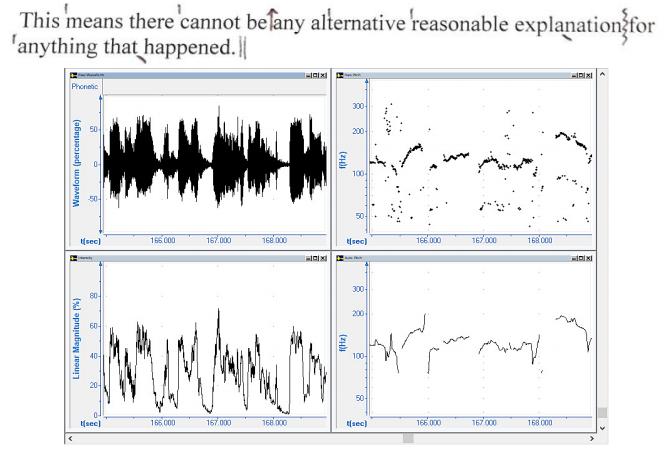
Figure 1. An example of instrumental analysis of the prosecutor’s logos-based utterance.
As can be seen from the illustration (Figure 1), the speaker uses both the upper and lower frequency register equally well (54% and 56%, respectively), descending terminal tones, a wave-like scale, short pauses up to 600 ms, a high level of basic frequency – up to 198 Hz.
CONCLUSION
The results of the electro-acoustic analysis revealed, firstly, the general patterns of judicial speech of American lawyers of high social status in the US Supreme Court. The established prosodic means are the ultra-wide maximum BF against the background of the average BF range. Pausation is variable, depending on the speaker’s speech intentions. In the speech of lawyers, speech tempo also often varies. The dynamic range of sounding speech is average; the maximum range of sound pressure is also average.
Secondly, the research results showed prosodic features of the cultural norm of judicial speech, which is based on the three components of speech impact established in ancient rhetoric – ethos, logos, and pathos. The means of ethos-based speech production are the low and average BF, speech is implemented in the lower BF register, average or slow speech tempo, pausation takes a long time, the dynamic level is low, the tempo is medium or slow. Ethos-based judicial speech conveys a high expert level of the speaker, his competence; it belongs to the speaker – a bearer of public morality, who possesses cultural and ethical norms.
Logos-based judicial speech is characterized by high BF, medium or narrow BF range, pauses are short, pause time is average. Dynamic indicators are high, speech tempo is slower. Such segments of judicial speech express an appeal to the listeners’ minds, transmitting an idea or thought, which should be the subject of active reflection.
Pathos-based speech impact has high BF rates, average or wide pitch range, the dominant type of long pauses, but a short pause time. Speech tempo is faster than in other types of utterances. The volume level is medium. Judicial speech of this kind is distinguished by emotionality, excitement, the speaker introduces novelty and details of the theme and form, has dramatization features.
BIODATA
M.V. YAKUTINA: Graduated from Moscow Pedagogical University in 1994. The postgraduate course at Moscow State Linguistic University in 2002. Candidate of Philology. The author of many scientific articles and the participant of different national and international conferences and workshops. The sphere of scientific interests: forensic language, speech prosody, the prosody of public speech, foreign language education, and teaching methods. Associate professor of the Department of English and Professional Communication at the Financial University under the Government of the Russian Federation.
L. X. MILYAEVA: Graduated from Tulsa Teachers’ Training University named after Leo Tolstoy in 1997. In 2005 got Ph.D. in Philology at Moscow State Linguistic University, then finished a postdoctoral program at the same University. The author of 2 monographs, more than 20 articles and the participant of different conferences, projects, and workshops. The sphere of scientific interests: sociophonology, political discourse, discourse information structure and analysis, prosody, foreign language education, and teaching methods.
L. Y. TARASOVA: Graduated from Moscow State Open Teachers Training University in 1997. Since 2001 was a Senior Lecturer Moscow International School of Business. Since 2013 has been a lecturer in Financial University teaching “Professional Communication in English”. The author of many scientific articles and the participant of different national and international conferences. The sphere of scientific interests: foreign language education and teaching methods, philology.
P.P. ROSTOVTSEVA: Graduated from Moscow State Linguistic University in 1998. In 2013 got Ph.D. in Pedagogy at Moscow Military University. The author of many scientific articles and the participant of different national and international conferences and workshops. The sphere of scientific interests: foreign language education and teaching methods, theory, and methods of professional education and training.
BIBLIOGRAPHY
AKIM, K, KARA-MURZA, G, SAENKO, N, SUHARYANTO, A, & KALIMULLIN, D (2019). “Superhero movie:Breaking the challenges of topics in the modern epos”. [Película de superhéroes: Rompiendo los desafíos de los temas en los epos modernos] Opcion, 35(Special Issue 22), pp. 1408-1428.
BONICA, A, & CHILTON, AS (2015). “The political ideologies of American lawyers”. Journal of legal analysis.
BUBLIENĖ, R, & JURKEVIČIUS, V (2019). “Multiple discrimination and inequality: A comparative analysis of the European court's case law in the context of sustainable business development”. Entrepreneurship and Sustainability Issues, 7(2), pp. 1246-1257.
DICKSON-LA PRADE, D (2020). “Analyzing Ethos and Pathos”.
FROLOVA, I, VORONKOVA, O, ALEKHINA, N, KOVALEVA, I, PRODANOVA, N, & KASHIRSKAYA, L (2019).“Corruption as an obstacle to sustainable development: A regional example”. Entrepreneurship and Sustainability, 7(1), pp. 674-689.
GRIGORIEVA, O (2017). “Constitutional basis for international cooperation of the union of soviet socialist republics”. Giornale Di Storia Costituzionale, 33(1), pp. 109-120.
IRONS, P, & GUITTON, S (1993). “May it please the court”. New York: The New Press. p. 376.
IVYGINA, A, PUPYSHEVA, E, & MUKHAMETSHINA, D (2019). “Formation of sociocultural competence among foreign students”. Journal of Social Studies Education Research, 10(4), pp. 288-314.
KOLMAKOV, V, POLYAKOVA, A, & POLYAKOV, S (2019). “A valuation approach to the Russian liberal establishment consolidation”. Administratie Si Management Public, 2019(32), pp. 93-107.
KOROLOVA, T, & AKKURT, V (2019). “Perceptive peculiarities of the prosody of persuasion: modality in judicial discourse”. Odessa.
MAGSUMOV, TA (2019). “Apprenticeship in secondary vocational schools during the economic modernization in late imperial Russia”. European Journal of Contemporary Education, 8(1), pp. 215-221.
MANZIN, M, & TOMASI, S (2014). “Ethos and pathos in legal argumentation. 8th International Conference on Argumentation”. pp. 930-941. The Netherlands: University of Amsterdam.
NIKIFOROVA, ESH (2014). “The main tactics of the strategy of emotional impact in the American judicial discourse”. Bulletin of the Chelyabinsk State University, 6, pp. 66-69. (in Russa).
POLETAEV, DI (1998). “Social Differentiation of Intonation in a Limited Speech Community”. p. 153. (Doctoral dissertation). Moscow. (in Russa).
RAHMADI, I, HAYATI, E, & NURSYIFA, A (2020). “Comparing Pre-service Civic Education Teachers’ TPACK Confidence Across Course Modes”. Research in Social Sciences and Technology, 5(2), pp. 113-133.
SASONGKO, G, HURUTA, AD, & WARDANI, A (2019). “Does Wagner’s Law exist in a strategic national area?”. Evidence from Kedungsepur - Indonesia, Insights into Regional Development,1(2), pp. 99-117.
TSVETKOVA, M, ARUTYUNYAN, M, SAENKO, N, SHRAMKO, L, & KALIMULLIN, D (2019). “Incorporationof philosophical ideas in science fiction literature”. [Incorporación de ideas filosóficas en la literatura de ciencia ficción] Opcion, 35(23), pp. 598-612.
WILDES, A (2020). “The Unethical Practice of Omitting Language in State Science Standards: Denying Students True Democratic Freedom”. Journal Of Curriculum Studies Research, 2(1), pp. 112-128.