Artículos
Development of Intercultural Competence of Economy Undergraduate Students
Desarrollo de la competencia intercultural de los estudiantes de pregrado en economía
 Olga Andreevna BEZUGLOVA oabezuglova@gmail.com
Liliya Galievna ILYASOVA Lily_Ilyasova@mail.ru
Alina Fasirovna NIGMATULLINA alinushkanigmatullina@gmail.com
Olga Andreevna BEZUGLOVA oabezuglova@gmail.com
Liliya Galievna ILYASOVA Lily_Ilyasova@mail.ru
Alina Fasirovna NIGMATULLINA alinushkanigmatullina@gmail.com
Development of Intercultural Competence of Economy Undergraduate Students
Utopía y Praxis Latinoamericana, vol. 25, no. Esp.7, pp. 362-368, 2020
Universidad del Zulia

This work is licensed under Creative Commons Attribution-NonCommercial-ShareAlike 4.0 International.
Received: 03 August 2020
Accepted: 07 September 2020
Abstract: This article deals with the project method as one of the most effective forms of providing students with skills and abilities that contribute to well-constructed behavior in a situation of intercultural communication based on the use of a foreign language. An active search for relevant tools for the formation of intercultural competencies leads educators to the understanding that students need group, game, role, practice- oriented, problematic, reflective and other forms and methods of teaching. Finally, the project based method as an effective way of developing intercultural competence, is presented in the article from the perspectives of economy undergraduate students.
Keywords: Cooperation, intercultural competence, practice- oriented classes, project method, undergraduate students..
Resumen: Este artículo aborda el método del proyecto como una de las formas más efectivas de proporcionar a los estudiantes habilidades y destrezas que contribuyen a un comportamiento bien construido en una situación de comunicación intercultural basada en el uso de un idioma extranjero. Una búsqueda activa de herramientas relevantes para la formación de competencias interculturales lleva a los educadores a comprender que los estudiantes necesitan formas y métodos de enseñanza grupales, de juego, de rol, orientados a la práctica, problemáticos, reflexivos y de otro tipo. Finalmente, el método basado en proyectos como una forma efectiva de desarrollar la competencia intercultural, se presenta en el artículo desde las perspectivas de los estudiantes de pregrado que se especializan en economía.
Palabras clave: Clases prácticas, competencia intercultural, cooperación, estudiantes de pregrado, método de proyecto..
INTRODUCTION
These days the process of globalization erases many borders and sets new trends in intercultural communication and experience exchange. This means that preparation of a competent specialist in the field of management and economics includes the need for knowledge of a foreign language, but also his or her willingness to carry out professional communication. An active search for relevant tools for the formation of intercultural competencies leads educators to the understanding that students need group, game, role, practice-oriented, problematic, reflective and other forms and methods of teaching. The main idea of this approach to teaching a foreign language is to shift the focus from exercises to the active linguistic solvency of students. This technique of formation of intercultural competence requires special attention.
We noted that of all the existing teaching methods, it is the project method that allows us to adequately solve this problem. Accordingly, it is necessary to turn the practice of the English language into a discussion, research club, which addresses really interesting, practically significant and accessible problems for students, taking into account the peculiarities of the country's culture and, if possible, based on intercultural interaction. There should always be a subject of discussion for the active realization of the potential of practice-oriented classes with elements of introducing the concept of intercultural competence (Spitzberg: 1983; Mergendoller& Thomas: 2001; Bolsunovskaya et al.: 2015; Sadenova et al.: 2017).
What is the implementation process of this method? As described earlier, the basis of project activity is a certain problem, chosen in accordance with the profile and range of interests of students. To come to its solution, students will need not only knowledge of the subject of the English language directly, but also possession of an appropriate volume of various knowledge in the field of culture of the country of the target language, knowledge of traditions and values, knowledge of the etiquette of communication in the studied foreign language, in our case, English. In addition, students must possess certain intellectual, creative, communicative skills (Raven: 1997; Beckett: 2006; Moeller & Nugent: 2014; Vaca & Gómez: 2017; Nurullina et al.: 2018).
Thus, the main idea of this approach is to shift the emphasis from various types of exercises to active mental activity, which requires knowledge of certain language tools for its design. The project method can help to solve this problem and, accordingly, turn foreign language classes into a discussion, research club, in which really interesting, practically significant and accessible problems are solved. This approach in teaching a foreign language will contribute to the formation of intercultural competence and will also allow students to quickly and adequately respond to what is happening in any speech situation associated with solving a problem and making a decision. So, we propose the project method as one of the most effective forms of providing students with skills and abilities that contribute to well-constructed behavior in a situation of intercultural communication based on the use of a foreign language (Blumenfeld et al.: 1991; Ayas & Zeniuk: 2001; Moloney & Harbon: 2005; Ilyasova et al.: 2019).
METHODS
This method is not an innovation in pedagogy, but its use is diverse. Each teacher can use a personal vision in working with students. This makes this method unique and adaptable to any level and specialty of trained students. From the history of the project method, we see that it was introduced by the American scientist John Dewey in the 1920s and to this day it remains an up-to-date teaching approach. The project method refers to problematic situations, which makes it the most attractive for us and determines our choice. The main idea is to solve various problem situations in order to obtain knowledge, and implies the integration of knowledge from various fields of science (Helle et al.: 2006; Ravitz et al.: 2014; Ilyasova et al.: 2019).
The Institute of Management, Economics and Finance of Kazan Federal University was chosen as the experimental base for conducting a series of classes using the project method. We have selected a group ofsecond year management students. Before we started working with students, we conducted a survey that included a number of questions related to their awareness of intercultural competence and the use of intercultural communication skills in the learning process and communication with native speakers.
RESULTS
The first chart demonstrates the definitions that students chose for the concept of “intercultural competence”. It is worth noting that only 44% coped with this task (Fig. 1).
To the question of whether they consider intercultural competence an important factor in communication, 61% of the students surveyed gave a positive answer.
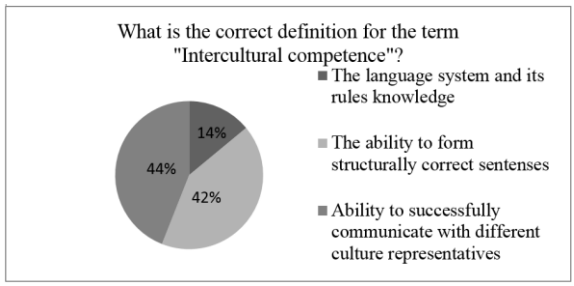
Figure 1
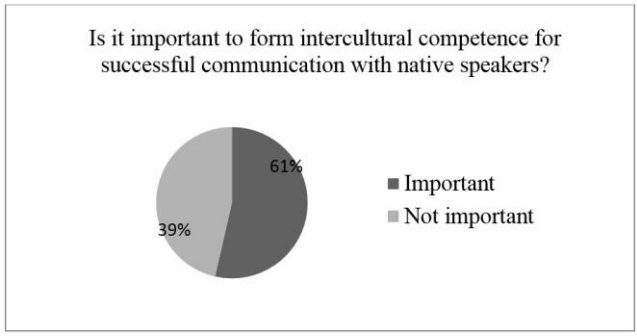
Figure 2
Then this group of students took part in the project work.
DISCUSSION
In the process of using the project method, we identified the following stages of work:
-
Definition of the project topic. For this, a discussion was held, the exchange of views of students and teachers. The topic should be suitable for the training format and suit the teacher, but it should also be of interest to students. This can increase motivation for further project implementation. Our choice - “Marketing strategies: best advertising solutions to promote a product”;
-
Statement of the problem within the selected topic. The problem area needs to be analyzed. A general discussion is also being considered. In our experiment, the necessity of choosing a foreign product wasestablished, since the project should be closely connected with the countries of the language being studied;
-
Drawing up a work plan and determining the form of the project. It must be remembered that the project must organically fit into the time frame allocated for it. The project implementation form should be convenient for students. But the teacher should not feel discomfort when checking the work either. If the result of the project cannot be demonstrated and evaluated, then the motivation for implementation can be extremely reduced. We decided to establish a two-week deadline for the implementation of the project;
-
Collection and processing of information. This category includes assessment, systematization and classification, communicative activity in pairs or groups. After discussing the project and the purpose of the product for which it is necessary to develop an advertising company, the groups are given three to four days to find the necessary information (product history, its development, advertising created for it earlier, determining the target audience);
-
Presentation of the project. It is one of the most important parts for learning. Too many students actively cope with the preparation process and communication within their groups. But they are not always able to draw the right conclusions, and most importantly successfully present the result of their project. Make sure that students correctly understand the presentation process and know what needs to be voiced, and most importantly how (Raven: 1997; Pikeyeva: 2014; Nurullina et al.: 2018).
On the appointed day for the class, an audience with a projector was needed. Since the work on advertising the product was carried out in pairs, students present the same way. Among the evaluation criteria are not only compliance with the topic and the work performed, but also the presentation skills of this project.
Of course, each stage of the project involves interstitial results. They can be actively discussed orrecorded, and then checked by the project coordinator (teacher in our case). The teacher comments and brings to the general discussion issues worthy of attention. He or she can also correct something in the process; see flaws before the presentation of the results. This will help the team to work in the right direction.
Discussion of work in a group with a teacher allows students to build skills such as: the ability to express their thoughts verbally and in writing, correctly form questions and queries in information search engines, mastery of a monologue, dialogue and discussion form of speech communication, interaction with partners in a group, conflict resolution.
CONCLUSION
Obviously, each of the stages of the project is a communication. This helps the teacher achieve the desired goal, since interaction with the goal of solving the main problems, using the foreign language, is the very way that we consider the most effective in building intercultural competence. Having given a similar task, we see that students are actively involved in the formulation, discussion, and in the future, the solution to our chosen problem. A foreign language is used for its intended purpose - the commission of communication in order to solve the problem. Therefore, it follows that the results of project activities are considered not only the skills and abilities we mentioned earlier, but also the formation of intercultural competence (Polat: 2000; Ryndina: 2013; Thomas: 2015).
Also, after the project, we considered it necessary to ask students what was the most difficult part of the project for them in the course of their work. The majority noted that in the process of searching for information, they came across a large number of incomprehensible professional terms and expressions. In the process of processing the slogans of commercials for certain products, students could not catch the puns or historical premises for using these slogans (Sinicrope et al.: 2012; Ravitz et al.: 2014). This indicates the insufficiently developed intercultural competence of student managers and the need to increase this kind of project tasksto form an idea of the culture and traditions in the field of business and advertising in the country of the language being studied (Spitzberg: 1983).
In the course of the study, we confirmed our idea that if the method of project activity is actively used in the pedagogical process, then it is possible to increase the effectiveness of teaching students to communicate in foreign language classes. The tasks set at the beginning of our study were successfully solved.
The method of project has several stages including allocation of duties, group work, presenting the results and assessment, where each of the stages requires active work and responsible attitude from both sides: the teacher and the students. If all the requirements are met, project activities, especially in the field of foreign language learning and intercultural competence developing, can serve as a highly useful teaching tool (Sinicrope et al.: 2012; Nurullina et al.:2018).
Ideas for projects can be diverse and can come from social and cultural issues. This method of project in foreign language lessons contributes to the formation of students' cognitive interest in language learning, the development of independence, the ability to collaborate, the development of creative abilities, communication skills, intercultural communication (Ryndina: 2013; Thomas: 2015; Akhmadullina et al.: 2019).
The article considers the possibility of using the method of project as an effective condition for the formation of professional foreign language communication of students of future economists. It has been shown that the method allows for the proficiency of a foreign language as a mandatory component of professional training in accordance with the requirements of the Federal State Educational Standards. All in all, the project method has great potential for the development of student independence and can be successfully applied in the organization of their independent work in the process of learning a foreign language at the university.
ACKNOWLEDGEMENTS
The work is performed according to the Russian Government Program of Competitive Growth of Kazan Federal University.
BIODATA
Olga Andreevna BEZUGLOVA: born in 1990. In 2013 she graduated from the Institute of Philology and Arts of KFU, direction: Linguistics. Qualification: Master. Theme of the master's thesis: "Juridical terms in English detective novels and tendencies of their translation." Senior Lecturer, Department of Language and Intercultural Communication, IFMK, KFU. Research interests: English teaching methodology, EFL (English as a foreign language), translation theory and practice, comparative linguistics.
Liliya Galievna ILYASOVA: born in 1978. In 2017 she graduated from the Institute of Philology and Intercultural Communication. Leo Tolstoy, KFU, specialization: Pedagogical education, Teaching English in secondary and higher education. Qualification: Master. The theme of the master's thesis: "The difficulty of the text as the basis for the formation of reading skills on the material of educational English texts." Senior Lecturer, Department of Language and Intercultural Communication, IFMK KFU. Research interests: English teaching methodology, pedagogy, EFL (English as a foreign language), linguistics.
Alina Fasirovna NIGMATULLINA: 1993 year of birth. In 2017 she graduated from the Institute of Philology and Intercultural Communication. Leo Tolstoy, KFU, specialization: Pedagogical education, Teaching English in secondary and higher education. Qualification: Master. Theme of the master's thesis: "The formation of intercultural competence of students-economists in the process of teaching a foreign language in the educational space of the university". Fulbright (foreign language teaching assistant), foreign language teacher, Department of English and Foreign Languages, College of Arts and Science, Mississippi Valley State University of Mississippi (Mississippi Valley State University United States), USA. Research interests: EFL (English as a foreign language), methods of teaching English, bilingual education, intercultural communication.
BIBLIOGRAPHY
AKHMADULLINA, R., VALIAKHMETOVA, N., & KHURMATULLINA, R. (2019). “Students - Future TeachersDevelopment of Abilities to Formulate a Problem on the Basis of Critical Thinking Technology”, Proceedings of INTCESS, 6th International Conference on Education and Social Sciences, 366-372.
AYAS K, ZENIUK N (2001). "Project-based learning: Building communities of reflective practitioners." Management learning, 32(1), 61-76.
BECKETT GH (2006). "Project-based second and foreign language education." Beckett, G., H. & PC Miller (Eds.), Project-Based Second and Foreign Language education: Past, present, and future, 1-15.
BLUMENFELD PC, SOLOWAY E, MARX RW, KRAJCIK JS, GUZDIAL M, PALINCSAR A (1991). "Motivatingproject-based learning: Sustaining the doing, supporting the learning." Educational psychologist, 26(3-4), 369- 398.
BOLSUNOVSKAYA LM, PHILLIPS C, KOROTCHENKO TV, MATVEENKO IA, STRELNIKOVA AB,ULYANOVA OS (2015). "Project-based method in teaching foreign language for specific purposes." Procedia- Social and Behavioral Sciences, 215, 176-180.
HELLE L, TYNJÄLÄ P, OLKINUORA, E. (2006). "Project-based learning in post-secondary education–theory, practice and rubber sling shots." Higher education, 51(2), 287-314.
ILYASOVA, L., BEZUGLOVA, O., MUKHHARLYAMOVA, L., & ASHRAPOVA, A. (2019). “Project -basedlearning and cultural diversity”, 6th SWS International Scientific Conference on Social Sciences - Conference proceedings ,6(4), Education and educational research, 164-169.
MERGENDOLLER JR, THOMAS, JW. (2001). "Managing project based learning: Principles from the field." Buck Institute for Education.
MOELLER, JA., & NUGENT, K. (2014). “Building intercultural competence in the language classroom. Unlock the gateway to communication”, Report of the Central States Conference on the Teaching of Foreign Languages.
MOLONEY, R., & HARBON, L. (2005). “Making intercultural language learning visible and assessable”, Proceedings of Intercultural Competence Conference, 1, 281-303.
NURULLINA, GM., MURAVIYOV, AF., MARTYANOVA, AA., & YARMAKEEV, IE. (2018). “Project technologyin the development of communicative competence in schoolchildren: Extracurricular classes of Russian language”, Cypriot Journal of Educational Sciences, 13(4), 461-468.
PIKEYEVA, EN. (2014). “Metod proyektov na urokakh inostrannogo yazyka”, Molodoy uchenyy, 7, 534-536.
POLAT, ES. (2000). "Metod proektov na urokakh inostrannogo yazyka." Inostrannye yazyki v shkole, 2.
RAVEN, J. (1997). “Competence in Modern Society: Its Identification, Development and Release”, Unionville,290, New York.
RAVITZ, J., MERGENDOLLER, J., MARKHAM, T., THORSEN, C., RICE, K., SNELSON, C., & REBERRY,S. (2014). “Online professional development for project based learning: pathways to systematic improvement”, Association for educational communications and technology annual meeting, Chicago, il.
RYNDINA, YU V. (2013). “Iz opyta obucheniya studentov inostrannomu yazyku (na primere modelirovaniya problemnykh situatsiy)” [Tekst], Molodoy uchonyy, 9 (56), 467–469.
SADENOVA AE, ORAZAKYNKYZY F, ANUAR S, YESBULATOVA, R. (2017). "Using innovative technologies in project method of teaching foreign language." Revista espacios, 38(25), 1.
SINICROPE, C., NORRIS, J., & WATANABE, Y. (2012). “Understanding and assessing intercultural competence: A summary of theory”, Research, and Practice.
SPITZBERG, BH. (1983). “Communication competence as knowledge, skill and impression”, Communication Education, 32, 323-329.
THOMAS, J. (2015). “A review of the research on project-based learning”, The autodesk foundation
VACA TORRES, AM., & GÓMEZ RODRÍGUEZ, LF. (2017). "Increasing EFL Learners Oral Production at a Public School Through Project-Based Learning." Profile Issues in TeachersProfessional Development, 19(2), 57-71.