Artículos
Hyponymy as a Contrast Method in the Internet Game “Antiphrases”
Hiponimia como método de contraste en el juego de internet ''Antifrases”
 Yaxing CHEN tchen.yasin@yandex.ru
Tatyana Gennadevna BOCHINA Tatyana.Bochina@kpfu.ru
Li HUA
Yaxing CHEN tchen.yasin@yandex.ru
Tatyana Gennadevna BOCHINA Tatyana.Bochina@kpfu.ru
Li HUA
Hyponymy as a Contrast Method in the Internet Game “Antiphrases”
Utopía y Praxis Latinoamericana, vol. 25, no. Esp.7, pp. 376-382, 2020
Universidad del Zulia

This work is licensed under Creative Commons Attribution-NonCommercial-ShareAlike 4.0 International.
Received: 03 August 2020
Accepted: 07 September 2020
Abstract: The study is based on the Internet game, using antiphrases- puzzles that are created by Runet users playing with precedent units and replacing all the words of the prototype with contrasting ones. The relevance of the study is motivated by the interest of modern linguistics in the phenomenon of the precedent unit. The object of the study is antiphrases and their precedent prototypes, in which contrasting word replacements are made according to the aspect-aspect principle. The article concludes that most often contrastive replacements are made for such groups of co-hyponyms as somatisms, coloratives, names of relatives, zoonyms and names of food.
Keywords: Antiphrase, Co-hyponyms, Contrast, Hyponymy, Opposition..
Resumen: El estudio se basa en el juego de Internet, que utiliza acertijos de frases, creados por usuarios de Runet que juegan con unidades precedentes y reemplazan todas las palabras del prototipo por otras contrastantes. La relevancia del estudio está motivada por el interés de la lingüística moderna en el fenómeno de la unidad precedente. El objeto del estudio son las antifrases y sus prototipos precedentes, en los que los reemplazos de palabras contrastantes se realizan de acuerdo con el principio de aspecto-aspecto. El artículo concluye que la mayoría de las veces se hacen reemplazos contrastantes para grupos de co-hipónimos como somatismos, colorantes, nombres de familiares, zoónimos y nombres de alimentos.
Palabras clave: Antifrase, co-hipónimos, contraste, hiponimia, oposición..
INTRODUCTION
The era of virtual reality has promoted the creation of a new communicative space, which attracts the attention of modern linguists by a number of interesting linguistic phenomena, reflecting the features of the linguistic consciousness of modern linguistic culture carriers. Among them is the “Antiphrases” Internet game, which is very popular on the Runet sites. The rules of this game are quite simple: “some participants in the game replace all components of precedent units with words that are opposing in meaning, while other participants guess the source phrases, or texts” (Bochina: 2011; Farmer: 2017): When I get off a short buson a sparrow day (When I get on a long train at nightingale night); Drink coconuts, swallow partridges, my first night is going away, the proletariat (Eat pineapples, chew grouse, your last day is coming, bourgeois); The black rain is pouring a little quieter, someone is right about something (The white snow is falling a little more audibly, no one is wrong about anything); Defeat has one mother, and victory sometimes has many relatives (Success has many fathers, and failure is always an orphan), etc.
We should note that “playing with words is a universal human activity... People delight in pulling words and reconstituting them in a novel guise, arranging them into clever patterns, finding hidden meanings inside them, and trying to use them according to specially invented rules in enormous diversity” (Bochina et al.: 2018; Qizi: 2020). Thus, the study of game transforms relevant due to the fact that precedent units, which are the prototypes of antiphrases, are closely connected with collective invariant notions and represent the background knowledge that ensures mutual understanding of the speech community members. A previous sour study shows, “in antiphrases, word replacements are not just a conscious distortion of the precedent units’ form in order to create a language game, but an expression of a new denotative or connotative meaning” (Crystal: 2006; Yaxing et al.: 2019).In modern linguistics, many researchers are interested in the study of precedent phenomena and archetypes in terms of their relevance to modern linguistic consciousness (Kulkova et al.: 2015; Saiwuleshi et al.: 2017).
Currently, our antiphrasis file cabinet contains 3048 puzzles with 810 transforms, in which contrast is created through the use of co-hyponyms.
In modern cognitive linguistics, one of the key concepts is categorization, which helps the human consciousness “to incorporate into certain rubrics the infinite variety of its sensations and the objective diversity of the forms of matter and its motion, that is, classifies them and subsumes them under such associations as classes, categories, groups, sets, and categories”(Kubryakova et al.: 1996; Hidayat: 2019). As a result of the lexical categorization, hyponymic connections represent an important type of paradigmatic relationships of lexical units, and their system organized according to the gender-aspect principle. As we know, “hyponymy is characterized by privative oppositions of units, included distribution, and joint subordinate concepts, it is based on the lexical-semantic subordination” (Novikov: 1982; Ozyumenku & Larina: 2018). At the same time, “denotations (extensionality) of words, connected by relations of incompatibility, do not intersect, despite the fact that their significate has a common part - the totality of attributes that make up the significance of their common hyperonym” (Kobozeva: 2000; Bochina & Yaxing: 2018). In this regard, the oppositions of co-hyponyms are characterized, on the one hand, by a non-standard, irregular nature of the opposition; on the other, by the ease of deciphering the contrasted words semantically related in the lexical paradigm.
METHODS
The purpose of this study is to identify the features, characterizing the implementation of the principle of contrasting words connected by hyponymic relationships.
To this end, a combination of the following methods was used in the course of our work: semantic-stylistic, descriptive-analytical, and the methods of component, contextual, cognitive, and linguocultural analyses.
RESULTS
The game is based on various precedent units, which are the main components of the national cognitive base - the complex of knowledge and ideas stored in the “mind” of each member of a lingua-cultural community (Krasnyh: 2002). According to the sources of origin, precedent prototypes are divided into the following groups:1) paremiological units and otherwise sayings: Beasts with enemies is like grass with leaves (A man withoutfriends is like a tree without roots); In your alien land, you are angry with a darling dove (In their alien land, you are glad about your darling crow); 2) the names of literary works and quotes from them: The limping kept coughing half of the winter (The hopping dragonfly kept singing all summer); 3) the names and texts of musical works: There died the old man’s white cow (There lived the old woman’s grey goat); A golden cube stands still in its place (A blue ball spins and rolls); 4) the names of the movies (performances, plays, etc.) and the words of the characters: I go here, I don’t go there. Otherwise, the rain will cause my leg fall (Don’t go there, go here. Otherwise the snow will continue your head fall); Only dorks and geniuses have compote in the evening! (Eitheraristocratsordegeneratesdrinkchampagneinthemorning), etc.
The analysis of our antiphrasis file cabinet shows that the opposition, implemented on the basis of hyponymic relations, in most cases is based on contrasting co-hyponyms. As linguists have repeatedly noted, co-hyponyms “belong to the potential sphere of antonymy” (Karaulov: 1976; Cai et al.: 2019): Gray eyebrows, I forget, and I resurrect, grey eyebrows (Black eyes, I remember, and I die, black eyes); A completed novel about a manual balalaika (An unfinished piece for a mechanical piano); After flying, planes rest under the compass (After mooring, ships set out on a voyage) etc.
We conducted a comparison of antiphrasis puzzles with the original prototypes and revealed the followinggroups of aspect-aspect oppositions (see Table 1).
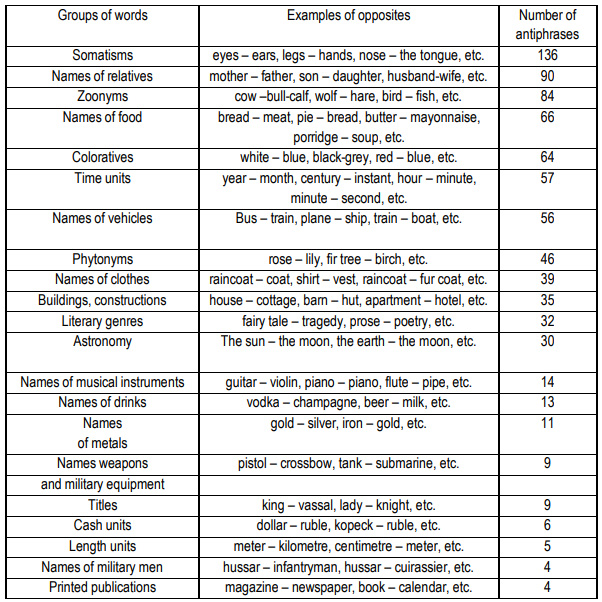
A quantitative analysis of the antiphrase corpus shows that when creating puzzles, the most frequently used contrasting replacements are words belonging to the following thematic groups: somatisms (16.7%): Vasya under the foot (Anna on the neck); Ears getting dry (Eyes getting wet); names of relatives (11.1%): Russian son (American daughter); Fathers of the KGB officers (Children of the spies); zoonyms (10.3%): Lamb the Straight-back (Little Horse the Humpback); The cute swan (The ugly duckling); names of food (8.1%): Meat is not anybody’s leg (Bread is everybody’s head); Certain fruit in another’s place (Every vegetable in its season); coloratives (7.9%):Purple whiskers (Bluebeard); A green mountain ash (A redguelder-rose); time units (7.0%): For ten months the rooster crowed you to die (For two hundred years the cuckoosang me to live); A light stallion is nobody’s sunny moment (A darkmareis someone’s finest hour); names of vehicles (6.9%): A train-like rug (A plane-like carpet); A black plane (A white ship).
The most frequent ones are the following aspect-aspect oppositions: 1) father - mother (35 examples): Goodbye, father, I'm leaving alone (Hello, mother, not all of us have returned); Let father see, let father leave (Let mother hear, let mother come); 2) legs/feet– hands/arms (23 examples): If mothers are carried in our arms, the foreign land will rise (If fathers are trampled underfoot, the fatherland will die); You can untie a bow with two legs (You cannot tie a knot with one hand); 3) uncle - aunt (15 examples): Farewell, you are not my uncle (Hello, I am your aunt); Go away, Uncle Dog, to wake up your granny (Come, AuntyCat, to lull our baby);4) eye - nose (12 examples): Yes, you’ll be late to blow your nose (You won’t have time to blink an eye); Five mothers cannot control a stepdaughter without a nose (Seven nannies cannot control a child with their eyes);A tit will tear off a tit’s nose (A raven will not peck out a raven's eye); 5) eyes - ears (10 examples): Ears are braving up and legs are chilling out (Eyes are afraid to do things, and hands are doing them); He who forgets the new - gets that ear (He who recollects the old – gets his eye out); Decide where to find your ears (Not to know where to hide your eyes), etc.
DISCUSSION
It should be noted that among the co-hyponyms related to groups of names of relatives, titles, and zoonyms, many contrasting replacements are implemented within the framework of gender opposition. According to E.A. Kartushina, “in linguistics, the concept of gender is related to images, qualities, and characteristics of behaviour constructed in the language and fixed in the minds of its speakers, as well as a set of attributes used to describe men and women in a particular sociocultural community” (Kartushina: 2003). In antiphrases of this kind, gender-marked words reflect not only the biological sex contrast (male-female) but also stereotyped qualities: A ring to one brother (Earrings to all sisters); Who knows Aunt Masha? Aunt Masha is unknown to anyone (Who does not know Uncle Stepa? Uncle Stepa is familiar to everyone); Look into the stolen mare's eyes (Don’t look into the gift stallion’s mouth); There is a cow running smoothly (There is a bull calf swinging); The ladies of the four continents (The knights of the forty islands); The story of the living king and two wimps (The tale of the dead princess and the seven knights), etc.
In addition, the contrast of co-hyponyms in antiphrases can be implemented along with the line ‘parents - children’: The giant father left his son, but the giant said nothing (The baby son came up to his father, and thebaby asked); Insolence is your son-in-law who sometimes goes away (Conscience is your mother-in-law who is constantly with you); Tadpole the Homebody (Frog the Traveler); Count up your hens in the spring (Don’t count your chickens before the fall), etc.
Our study of the antiphrasis corpus shows that, when creating puzzles, traditional and widespread co- hyponymic oppositions are often used in Russian linguistic culture (compare traditional premiums: One wolf chases a regiment of sheep; Bread and salt do not scold; You cannot argue with water and fire, etc.). The most common traditional pairs in antiphrasis are the following: a wolf - a sheep, a dog - a cat, bread - salt, a forest - a field, water - fire and some others: Loving sheep means not running in the field (Fearing wolves means not going to the forest); Not only because of a cat’s death, but the cat can also be affectionate (Only because of a dog’s life, the dog can be biting); Bad manners are the salt of flesh (Education is the bread of soul); Some from the field, some with hay (Some to the forest, some for firewood); Throw acorns into the water (pull chestnuts out of the fire); A bucket of honey in a mug of tar (A spoon of tar in a barrel of honey), etc.
A special group of co-homonyms for creating flip-flop puzzles is units of measure (cash units, units of length and time): ruble - dollar, meter - kilometre, day - month, etc. It should be noted that in antiphrases, contrast substitutions of measure units provide a quantitative relativity assessment, any unit may be “more” or “less” relative to another. According to linguist M. Nikitin, “the quantitative semantics of dimensionally- indicative words is relative, the exact measure of the attribute is not essential, it comes into play within the framework of a particular class and requires knowledge of approximate ratios in this class according to the amount of the attribute” (Nikitin: 1996): 1) cash units: On our land, fish is expensive, and the flying is a dollar (Overseas, a heifer costs a halfpenny(half a kopeck), but the ferry costs a ruble); Yes, take one penny (kopeck), but do not touch five enemies (Do not have 100 rubles, but have 100 friends); 2) units of length: Five centimetres underground (Three meters above the sky); 3) units of time: Quickly the years gallop towards us (Slowly the minutes float away), etc. A relative quantitative assessment was traditionally used in the Russian paremiological fund: a year- “something small”: What is promised might take a year, and who is promised might take an age; a year -“something big”: He beat his wife for a day, then he wept for a year.
CONCLUSION
Summing up all the above said, we have come to the following conclusions: anti phrase puzzles are created by transforming precedent units; as prototypes, different types of precedent units with a deep linguistic and cultural potential are used; encryption of the source text is based on the principle of contrast; a quantitative analysis of the antiphrasis corpus shows that when creating flip-flop puzzles, aspect-aspect oppositions are often used, they are realized in more than twenty thematic groups of words.
Thus, aspect-aspect relations, which are the most fundamental paradigmatic semantic relations, are actively used by the authors of antiphrasis puzzles. Anti-phrases created on the basis of aspect-aspect oppositions represent new material for the study of lexical connections in terms of linguoculturology; the identification of possible lexical oppositions in the structure of the hyponymic system allows one to find out which constants of Russian linguoculture remain relevant for the consciousness of modern language speakers.
ACKNOWLEDGEMENTS
The work is performed according to the Russian Government Program of Competitive Growth of Kazan Federal University.
BIODATA
Yaxing CHEN: born in 1990, graduate student of the Department of Russian as a Foreign Language Institute of Philology and Intercultural Communication KFU, direction: linguistics and literary criticism. The theme of the Ph.D. thesis is “The Functioning of Precedent Units in the Internet Game of Antiphrases”. Scientific interests: linguistics, linguoculturology.
Tatyana Gennadevna BOCHINA: born in 1963, doctor of philological sciences, professor. In 2004 she defended her doctoral dissertation on the topic “Contrast as a linguocognitive principle of the Russian proverb”. Head of the Department of Russian as a Foreign Institute of Philology and Intercultural Communication KFU. Scientific interests: lexicology, paremiology, linguoculturology.
Li HUA: born in 1974, candidate of philological sciences, professor, in 2006 she defended her thesis on the topic “Positive aesthetic assessment in Russian: beauty from the perspective of a native speaker of the Chinese language and culture”; Dean, Faculty of Russian Language, Institute of Language and Culture, Shanghai Political and Law University; research interests: linguistics, linguoculturology.
BIBLIOGRAPHY
BOCHINA TG (2011). “The semantic space of online Antiphrases game”, Uchebnye zapiski Kazan, 153(6), 140-149.
BOCHINA TG, YAXING CHEN (2018). "linguo-cultural minimum in the mirror of the “anti-phrases” internet game." филологические науки в мгимо.
BOCHINA TG, YAXING CHEN, LI HUA (2018). “Oppositions of toponyms in antiphrases”, Revista Científica Electrónica de Ciencias Humanas, 14, 185-193.
CAI X, LUO Y, ZHANG Y, YUAN X (2018). "Improving Word Embeddings by Emphasizing Co-hyponyms." In International Conference on Web Information Systems and Applications, 215-227.
CRYSTAL D (2006). “The Cambridge Encyclopedia of Language”, Cambridge University Press.
ES KUBRYAKOVA, VZ DEMYANKOV, Yu G PANKRAC, LG LUZINA (1996). “A short dictionary of cognitive terms”, Filol. fak. MGU.
FARMER G (2017). "Cambridge, Verbal Hiccups and Iambics: Twelve Academic Questions and Language- Games." In Veronica Forrest-Thomson, Palgrave Macmillan, Cham, 55-93.
HIDAYAT AN (2019). "The Effectiveness of Using Hyponym Game on Students' Vocabulary Achievement (A Quasi-experimental Study at the Seventh Grade of SMP Daar El Hikam)." Bachelor's thesis, Jakarta: Fakultas Ilmu Tarbiyah Dan Keguruan UIN Syarif Hidayatullah.
KARAULOV YU N (1976). “General and Russian ideography”, Nauka.
KARTUSHINA EA (2003). “Gender aspects of phraseology in mass communication”: avtoref. dis. kand. filol. nauk.
KOBOZEVA IM (2000). “Linguistic semantics: Tutorial”, Editorial URSS.
KRASNYH VV (2002). “Ethnopsycholinguistics and cultural linguistics: Kurslekcij”, ITDGK “Gnozis”
KULKOVA MA, GALIMULLINA RI (2015). “Human Factor in Paramiology: The Social vs. The Individual”, TheSocial Sciences, 10(5), 586-589.
KULKOVA MA, RAKHIMOVA AE, ZINECKER T (2015). “Hermeneutical analysis of paroemiological texts with semantics of permission”, Journal of language and literature, 6(1), 297-300.
NIKITIN MV (1996). “Course of linguistic semantics”, Nauchnyi centr problem dialoga.
NOVIKOV LA (1982). “The semantics of the Russian language”, Vyssh. shkola.
OZYUMENKU V, LARINA T (2018). "Cultural Semantics in Second Language Teaching: A case study of Russian drug and English friend." INTED2018 Proceedings, 9149-9158.
QIZI KMA (2020). "VERBALIZATION OF THE CONCEPT “WOMAN” IN ENGLISH PHRASEOLOGICALUNITS AND THEIR TEACHING TO STUDENTS." Science and Education.
SAIWULESHI XXX, BOCHINA TG, ABAKUMOVA OB (2017). “Russian proverbs about spouses and marital relationships”, Journal of interdisciplinary research, 7(2), 22-24.
YAXING CHEN, BOCHINA TG, FU J (2019). "OPPOSITIONS OF COLORATIVES AS A MEANS OFCREATING ANTIPHRASES." Revista TURISMO: Estudos e Práticas.