Carátula del artículo
Social Responsibility of Higher Education Students. Motivations for its Development in Times of Covid-19 in Chile and El Salvador
Responsabilidad social de estudiantes de educación superior. Motivaciones para su desarrollo en tiempos de Covid-19 en Chile y El Salvador
 Pedro SEVERINO-GONZÁLEZ pseverino@ucm.cl
Universidad Católica del Maule, Chile
José ROMERO-ARGUETA jesus_romero@ugb.edu.sv
Universidad Gerardo Barrios, El Salvador
José Vicente VILLALOBOS ANTÚNEZ jvillalo4@cuc.edu.co
Universidad de la Costa (CUC), Colombia
Viviana GARRIDO-VÉLIZ vgarrido@ucm.cl
Universidad Católica del Maule, Chile
Utopía y Praxis Latinoamericana, vol. 25, no. Esp.7, pp. 439-452, 2020
Universidad del Zulia
Received: 03 August 2020
Accepted: 15 September 2020
INTRODUCTION
The global pandemic produced by Covid-19 (SARS-CoV2) has led to the development of various investigations related to medicine and health sciences (Adhikari et al., 2020), which seek to discover a vaccine that can be used to combat the spread of the virus and its emancipation. On the other hand, the same cannot be said about the investigations that consider Covid-19 and its relationship with the social sciences and, particularly, education and behavioral sciences.
The consequences of the pandemic that affects the international population today are enormous, due to the increasing number of infected and the number of deaths. On the other hand, the aforementioned health crisis is triggering a deep economic and social crisis, which comparable to the consequences unleashed by the Spanish plague of 1918-1919 (Thomas, 2020) and, with the Great Depression of 1929 (Wich, 2020). What will cause an increase in unemployment, lower wages, and decrease in poverty throughout the planet (Comisión Económica para América Latina, 2019).
The social responsibility of the various sectors and inter-sectors that make up a fabric (Valenzuela, 2020), should seek the deployment of efforts that from the perspective of behavior can deploy strategies linked to ethics that contribute to community’s well-being (Téran Rosero et al., 2017; Ramírez et al., 2018; Villalobos & Ramírez (2018); Villalobos et al., 2020; Hamids, 2020). On the other hand, higher education institutions, due to their inescapable role of training future professionals, should seek to develop both disciplinary and ethical competencies, leading to decision-making that considers the context and well-being of the entire population, also conceived as a social consciousness (Mahmud et al., 2020). So, on the one hand, allows the natural adoption of prevention measures, such as social distancing (Oosterhoff,, Wilson & Shook, 2020), which is the result of a greater understanding of the current reality of the population and the impact of their adequate on inadequate decisions (Lazzerini & Putoto, 2020).
Finally, this investigation’s research questions are: What is the higher educational institutions’ role in relation to socially responsible behavior? What are the characteristics of the social responsibilities of university students in Chile and El Salvador? For which the following research objective has been defined and analyze the social responsibility of university students in Chile and El Salvador.
DEVELOPMENT
Overview and adverse effects of the virus
Covid-19 is a virus that causes respiratory illnesses and high temperatures that can manifest itself from a common cold to a severe acute syndrome (Abodunrin, Oloye & Adesolaet, 2020). Its appearance has motivated the development of a series of investigations that examine that from treatment to its prevention (Schulz, Coimbra-Araújo & Costiche, 2020), the above due to its high transmissibility (Dawood, 2020). Its manifestation dates from December 2020 (Gao, Tian & Yanget, 2020), being first reported in early January as a new coronavirus (SARS-CoV2) whose origin is Wuhan, Hubei Province in China (Bhagavahula et al., 2020), triggering an epidemic in the short term that continues to affect the world population (Sohrabi et al., 2020). Placing everyone on alert, due to its socioeconomic impact (Nicola et al., 2020), which, it is estimated, will be greater the Great Depression of 1929 and the financial crisis of 2008 (Abodunrin et al., 2020). Motivating the authorities to implement strategies that are the result of an absence of antiviral treatment or vaccination (Guo et al., 2020; Stebbing et al., 2020), such as: promoting handing washing, social distancing, restricting movement, quarantining, closure of public and private institutions, among others (Bhagavathula et al., 2020). Immediately provoking the loss of skilled and experienced jobs, reduction of the labor force, increase in poverty, reduction in productivity, among others (CEPAL, 2020).
Now, in Chile, the first case of Covid-19 was notified on March 3, which led to the declaration by the president of the Republic of the State of Constitutional Exception of Catastrophe for the entire country on 18of March 37 new cases of positive Covid-19 were reported at the time (Piñera, 2020a). Leading to the implementation of the Covid-19 Action Plan (Piñera, 2020b: Piñera, 2020c). Later, the considerations regarding total quarantine, sanitary cords, sanitary customs, mandatory isolation and measures of indefinite and temporary validity are published (Gobierno de Chile, 2020). As for education, on March 15 the Ministerio de Educación (Ministerio de Educación, 2020a) publishes the suspension of preschool and school education and, on the other hand, the suspension of face-to-face classes in higher education, such as the delivery of digital platforms, financial funds and strengthening for online education (MINEDUC, 2020b).
In contrast, in El Salvador, the first case of Covid-19 was registered on March 1. For a country with a small territorial extension and significant gravity, it places it in a very unfavorable position compared to other countries on the continent (Trilla, 2020), which is intensified by factors such as: worldwide human and animal transport, trade, agriculture expansion, deforestation and urbanization (Moreiera-Soto, Troyo & Corrales- Aguilar, 2014). Which has caused panic, anxiety and fear (Afonso, 2020). Regrading education, Ministerio de Educación (MINED) of El Salvador paralyzed the educational processes, later the government designed programs and strategies with a territorial scope, which seeks to virtualize classes (MINED, 2020). Which leads to reflection on some aspects that characterize public education, which should improve during the post- pandemic stage.
Between social responsibility and socially responsible behavior. Building bridges
According to Qi (2020). The late publication of Covid-19 cases is the product of habitual thinking, the characteristics of the first groups of experts sent to the zero contagion zone, which is the result of behavior based on old habits, which causes fixation errors (Zhou et al., 2020). This is aggravated due to the behavior of the Chinese scientific community that relativized the true gravity, speed, danger and impact that it is causing to the population (Liu et al., 2020), being socially irresponsible (Saturno-Hernández et al., 2015; Severino- González, Pujol-Cols & Lazzaro-Salazar, 2019), particularly from virologists (Gu & Li, 2020).
On the other hand, responsibility resulting from decision-making and its impact on society can beconceived from the perspective of social responsibility (Terán Rosero et al., 2017; Ramírez; Villalobos & Herrera, 2018; Villalobos, Ramírez & Díaz-Cid, 2019; Severino-González, Martín-Friorino & González-Soto, 2019). That is why the social responsibilities of political leaders are high (Remuzzi & Remuzzi, 2020), due to the impact that they have on the population. In this regard, the responsibility of various actors in society are added, such as the media, who through their distribution channels can generate behavior favorable or unfavorable predisposition of all the political and social events (Tapia and Bouza, 2020).
Finally, the social responsibilities of higher education institutions lay in the training of professionals’excellence, who are characterized by a socially responsible behavior (Severino-González et al., 2019). Which supports the deployment of socioemotional or emotional affective strategies in the context of risks and challenges (Annía et al., 2019; Ríos et al., 2019; Ríos et al., 2020; Valdez-García et al., 2020). Where educational strategies allow for the development of motivations for the respecting the rules of social distancing, using masks, among others; shaping a prosocial attitude and socially responsible behavior (Oosterhoff et al., 2020). Finally, greater social awareness would allow for a drastic decrease in the amount of infected individuals (Mahmud et al., 2020).
METHODS
Design and participants
This article raises the perception of 288 higher education students from Chile and El Salvador through a quantitative approach (Hernandeze, Fernández y Baptista, 2012) of a descriptive and transactional type (Canales, 2006), the instrument is a Likert-type scale, considering a non-probability sample for convenience (Otzen & Manterola, 2017), who were contacted through the snowball technique, failing to expand the numberdue to the health crisis. This investigation allows us to explore the motivations that stimulate the implementation of institutional strategies that contribute to the development of social awareness as a result of the responsibilities that students have in the current Covid-19 health crisis.
Instrument
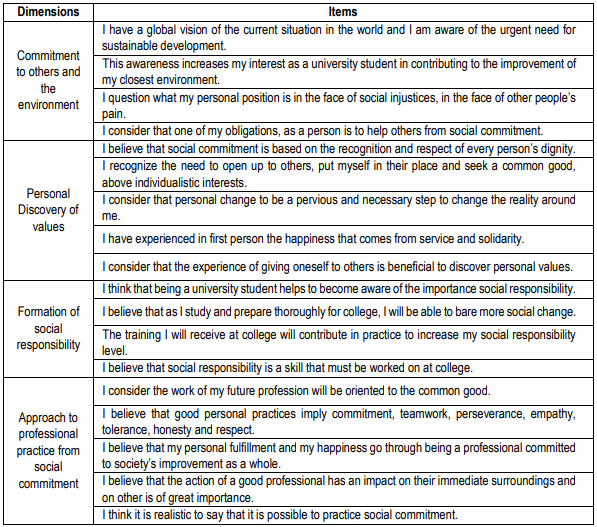
The questionnaire has been designed by García Ramos et al. (2016a), which has been applied in Colombia, Chile, Mexico, and Spain (García Ramos et al., 2016b; García Ramos et al., 2018c; Fonseca et al., 2019; Severino-González et al., 2019). The first section considers: sociodemographic aspects that allow for the sample to be characterized and the second section: a questionnaire with 20 statements, the scale is Likert type, where 1 is the minimum agreement value and 6 is the maximum agreement value. All dimensions have a Cronbach’s alpha greater than 0.8. The initial questionnaire was submitted to AFE, the following instrument resulted as seen in Table I.
Table I. Final instrument
 Source: García Ramos et al. (2016a).
Procedures
The instrument application was developed between November 2019 and February 2020, for which the classrooms accessed themselves on the one hand and on the other, an online survey was completed, due to the health crisis. At all times, its purpose is explained, such as its confidentiality and anonymity. For processing the data, the SPSS18 program was used, for both the descriptive and inferential analyzes. For the internal validation of the data and the questionnaire, AFE, Cronbach’s alpha analysis, among others, were used, applying the corresponding normality tests; explaining in this document only the cases that present statistically significant differences. As for the AFE, the principle components extraction method was used, with Varimax rotation (Montoya Suárez, 2007).
RESULTS
Descriptive characteristics
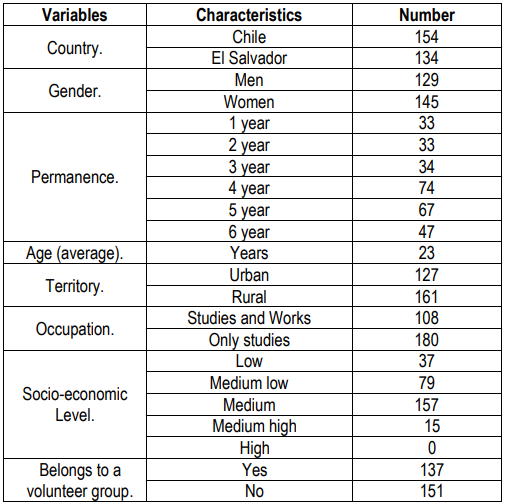
In table II, you can see the characteristics of the 288 students from Chile and El Salvador.
Table II. Characteristics
 Source: Self-made.
Subsequently, the internal consistency coefficients were determined through the application of the Cronbach’s alpha. Personal discovery of values = 0.936, Approach to professional practice from social commitment =0.939, Formation of social responsibility = 0.891 and Commitment to others and the environment = .887, which is considered very high according to Nunnally & Bernstein (1994).
Exploratory Factorial Analysis
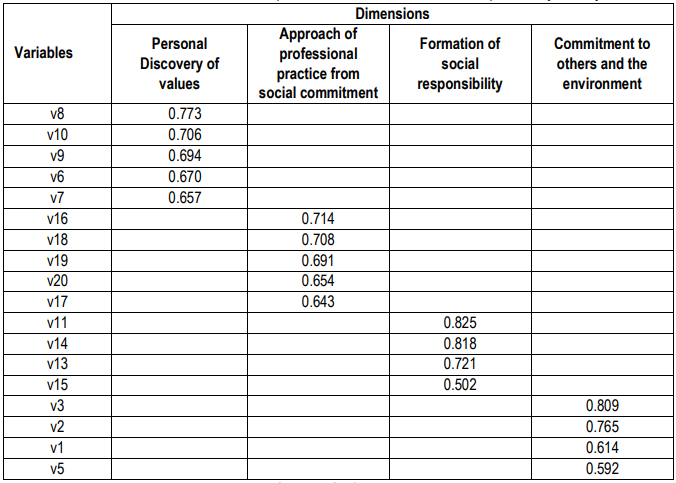
For the development of the EFA, the Kaiser-Meyer-Olkin (KMO= 0.965) was evaluated to determine the appropriateness of an AFE, which allows determining in principle that the aforementioned analysis is pertinent, which is confirmed by the Barlett sphericity test, where Chi2= 4942,918; gl= 158; p<0,0001. To then apply the principal component method and the Varimax extraction. Regarding the characteristics of the final questionnaire. It is made up of 18 items. Dimension 1. Personal discovery of vales (v8, v10, v9, v6 and v7),2. Approach to professional practice from social commitment (v16, v18, v19, v20 and v17), 3. Formation ofsocial responsibility (v11, v14, v13 and v15) and 4. Commitment to others and the environment (v3, v2, v1 and v5). V12 and v4 were eliminated, since they do not contribute to final explanation from the statistical and epistemological point of view of the social responsibilities of university students in Chile and El Salvador. Regarding the total explained variance, it is 79.3% (see Table III).
Table III. Matrix of rotated components of the student social responsibility survey
 Source: Self-made.
Inferential analysis
Source: Self-made.
Next, the mean differences will be analyzed according to the subgroups that make up the samples of this investigation. Previously, the normality test was applied in each case to determine the destruction of the data. This is important in order to determine the proper use of parametric or non-parametric tests.
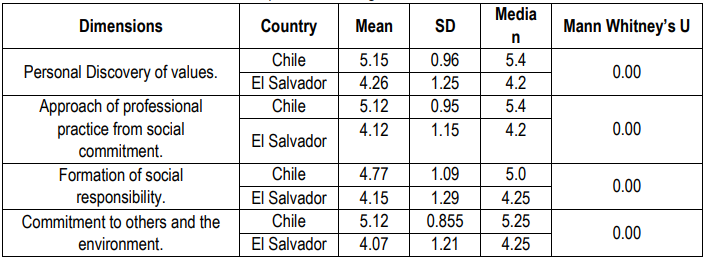
Table IV shows statistically significant differences in each of the dimensions, finding the highest valueswithin the Chilean cases. Now, particularly the highest value is identified in the personal discovery of value dimension, which the result of the efforts developed by the higher education institutions leading to the acknowledgement of the human being from the respect for human dignity perspective (Mean =5.15; SD = 0.96; Median =5.4).
Table IV. Descriptions according to Chile and El Salvador.
 Source: Self-made.
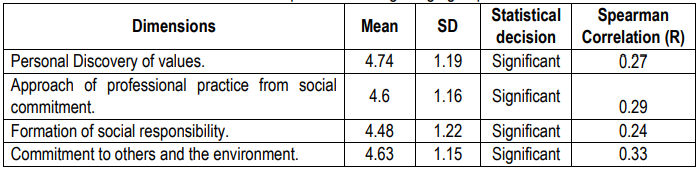
In Table V, it can be seen, for each dimensions, significant correlations are presented, the strongest being the Commitment to others and environment dimension (R= 0.33) and the weakest being the Personal Discovery of values dimension (R= 0.27).
Table V. Descriptions according to age group
 Source: Self-made.
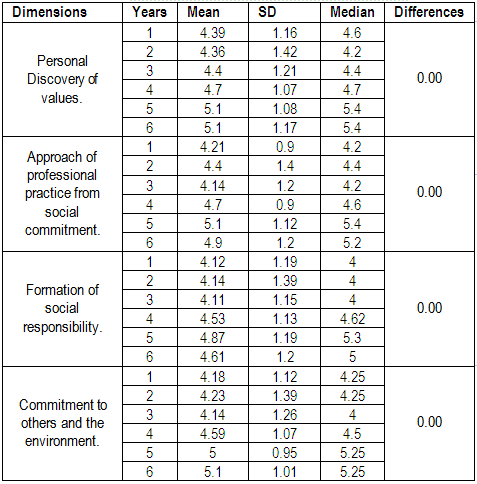
Table VI, it can be seen that in each of the dimensions there are significant differences. For this reason, it can be asserted that the longer the students remain in the respective higher education faculties, the greater the Discovery of their responsibilities both personally and socially by virtue pf professional practice. In addition, they recognize the need in training in social responsibility, as in turn, the greater the commitment they recognize possessing with others and the environment.
Table VI. Description according the year in the institution.
 Source: Self-made.
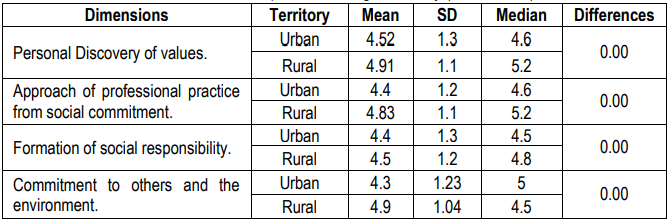
In Table VII, shows significant differences in each of the dimensions. In the Personal Discovery of values dimension (p=0.00), where those from rural areas (Mean =4.91; SD = 1.1; Median =5.2), have a higher valuation tan those who come from urban places. On the other hand, the same happens according to the Approach to professional practice based on social commitment dimension (p=0.00), where those from rural areas (Mean =4.83; Median =1.1; SD=5.2) recognize greater responsibilities than residents of urban areas.
Table VII. Description according to territory (Urban/Rural)
 Source: Self-made.
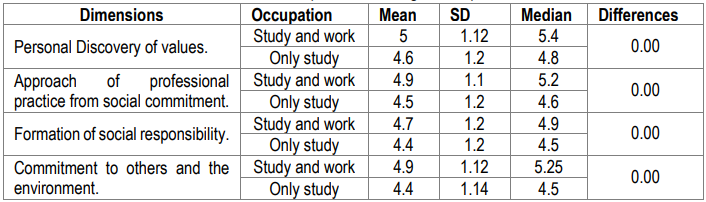
On the other hand, in Table VIII, it can be seen that significant differences are presented in all dimensions, since in all cases the p-values are less than 0.05. It can be identified that the dimension that presents the highest valuation is Personal Discovery of values, particularly of those who declare to study and work (Mean=5; SD= 1.12; Median =4.5). In all cases, the highest values are found to be related to the group that indicates studying and working.
Table VIII. Descriptions according to occupation
 Source: Self-made.
CONCLUSION
The main objective of this article is to analyze the social responsibility of university students in Chile and El Salvador, for which a quantitative study has been carried out, the results of which aim to highlight the importance of comprehensive training for future professionals, considering the current health crisis as a decisive factor that contributes to the implementation of strategies that lead to the development of social awareness and social responsibility of future decision-makers.
Among the results, it can be pointed out that there is a difference in the assessment of social responsibilities that Chilean and Salvadoran university students possess. Where students in Chile acknowledge having greater responsibilities. What should motivate El Salvadoran students to develop actions that intervene their educational model, which allows a better understanding of the context, which can allow for the natural deployment of the measures that are being promoted to decrease the contagion product of the SARS-COV2 transmissibility level, such as confinement, social distance, and use of gloves, masks and alcohol gel, among others.
Finally, public authorities point out that the population must learn to live with Covid-19, because it is a virus that has accompanied the international community for a long period of time. The call is to gradually return to normal activities, not falling into a false triumphalism that leads to the careless product of not considering preventive measures. That is why, it is necessary to promote a safe return leading to the re-sharing of personal and social responsibilities by each of the actors that make up society.
BIODATA
Pedro SEVERINO-GONZÁLEZ: Master in Business Administration, Commercial Engineer, Bachelor of Administrative Sciences from Universidad del Bío-Bío (Chile). Professor Department of Economics and Administration, Faculty of Social and Economic Sciences of the Universidad Católica del Maule. He has published scientific articles in high impact indexed magazines and book chapters in publishers located in Chile, Peru, Mexico, Venezuela, Cuba and Colombia. He has participated as speaker and lecturer in national and international conferences, forums and seminars. Her lines of research are: social responsibility, education and sustainability. He is currently Director of Escuela de Ingeniería Comercial de la Universidad Católica del Maule, Talca (Chile). E-mail: pseverino@ucm.cl, pesevery@gmail.com. ORCID ID: http://orcid.org/0000- 0003-4784-9151. Scholar Google: Pedro Severino-González.
José Vicente VILLALOBOS ANTÚNEZ: Postdoctor in State, Public Policy and Social Peace (Universidad Privada Dr. Rafael Belloso Chacín - URBE, 2015), Postdoctor in Human Sciences (Universidad del Zulia - LUZ, 2015), Postdoctor in Management of Higher Education (URBE, 2011), Postdoctor in Management in Organizations (URBE, 2007). Doctor of Law (LUZ, 2000). Specialist in Financial Management (LUZ, 1998). Lawyer (LUZ, 1987). Bachelor of Philosophy (LUZ, 2000). Professor and Half Time International Researcher, Department of Law and Political Science at Universidad de la Costa, Barranquilla-Atlántico, Colombia. Professor and Researcher at Universidad del Zulia (LUZ), Venezuela. Coordinator of the Diplomat in Bioethics and the Laboratory of Philosophy of Science, Experimental Faculty of Sciences, Universidad del Zulia (LUZ). Guest Professor at the following Universities: Pedro de Valdivia; Católica de Temuco, Los Lagos (Chile);Benemérita Universidad Autónoma de Puebla, México; Católica de Bogotá and Colegio Mayor de Cundinamarca (Colombia). Member of the Research Group: Law, Politics and Society at Universidad de la Costa-COLCIENCIAS. International Speaker and Editor-in-Chief of Opción Magazine. Institutional mail: jvillalo4@cuc.edu.co ORCID ID: http://orcid.org/0000-0002-3406-5000 Personal Mail: jvvillalobos@gmail.com
José ROMERO-ARGUETA: Master in Linguistics Applied to the Teaching of English as a Foreign Language from Universidad Internacional Iberoamericana (Mexico), Bachelor of English Language from the Universidad de Oriente (El Salvador). Full-time professor and researcher of Universidad Gerardo Barrios, Santa María, Usulután, (El Salvador). He has participated as an undergraduate thesis evaluating jury and participated as a speaker in local and international conferences, workshops and forums. His line of research is in the social sciences with an emphasis on English language education, social responsibility and linguistics. E-mail: jesus_romero@ugb.edu.sv, jesusaxon@gmail.com ORCID ID: 0000-0003-4287-1835.
Viviana GARRIDO-VÉLIZ: Project Coordinator of the Vice-Rector's Office for Research and Postgraduate Studies at Universidad Católica del Maule, Talca (Chile). Statistical Engineer and Graduate in Statistics from Universidad de Concepción. She has worked as a teacher in different careers of higher education institutions and has worked as editor in the magazine UCMaule of Universidad Católica del Maule. He has carried out statistical consultancies in projects with external competitive funds, as well as scientometric analyzes and statistical quantitative methodological consultancies in investigations of different areas of study. Email: vgarrido@ucm.cl. ORCID ID: https://orcid.org/0000-0001-5126-360X.
BIBLIOGRAPHY
ABODUNRIN, O., OLOYE, G., & ADESOLA, B. (2020). “Coronavirus pandemic and its implication on global economy”. International journal of arts, languages and business studies, 4: 13-23.
ADHIKARI, S. P., MENG, S., Wu, Y. J., MAO, Y. P., YE, R. X., WANG, Q. Z., ... & ZHOU, H. (2020).“Epidemiology, causes, clinical manifestation and diagnosis, prevention and control of coronavirus disease (COVID-19) during the early outbreak period: a scoping review”. Infectious diseases of poverty 9(1): 1-12. https://doi.org/10.1186/s40249-020-00646-x
AFONSO, P. (2020). “O Impacto da Pandemia COVID-19 na Saúde Mental The Impact of the COVID-19 Pandemic on Mental Healt”. Acta medica portuguesa 33(5): 351-358. https://doi.org/10.20344/amp.13877
ANNÍA GONZÁLEZ, M., VILLALOBOS ANTÚNEZ, J., RAMÍREZ MOLINA, R y RAMOS MARTÍNEZ, Y.(2019). “Capacidades dinámicas frente a la incertidumbre: una mirada desde la gestión universitaria”. Revista Venezolana de Gerencia (RVG), 24(88), pp. 1357-1372
BHAGAVATHULA, A. S., RAHMANI, J., ALDHALEEI, W. A., KUMAR, P., & ROVETTA, A. (2020). “Global,Regional and National Incidence and Case-fatality rates of Novel Coronavirus (COVID-19) across 154 countries and territories: A systematic assessment of cases reported from January to March 16, 2020”. medRxiv. https://doi.org/10.1101/2020.03.26.20044743
CANALES, M. (2006). Metodologías de investigación social. Introducción a los oficios. Santiago de Chile: LOM.
CEPAL (Comisión Económica para América Latina y el Caribe) (2019), Panorama Social de América Latina (LC/PUB.2019/22-P/Rev.1), Santiago.
CEPAL (Comisión Económica para América Latina y el Caribe) (2020). América Latina y el Caribe ante la pandemia del COVID-19: efectos económicos y sociales.
DAWOOD AA. (2020). Mutated COVID-19, May Foretells Mankind in a Great Risk in the Future. New Microbes and new Infections. 35(100673):1-8. https://doi.org/10.1016/j.nmni.2020.100673
FONSECA, I., BERNATE, J., BETANCOURT, M., BARÓN, B., & COBO, J. (2019, October). “DevelopingSocial Responsibility in University Students.” pp. 215-218 In Proceedings of the 2019 11th International Conference on Education Technology and Computers. London: ICETC. https://doi.org/10.1145/3369255.3369275
GAO, J., TIAN, Z., & YANG, X. (2020). “Breakthrough: Chloroquine phosphate has shown apparent efficacy in treatment of COVID-19 associated pneumonia in clinical studies”. BioScience Trends 14 (1): 72-73. https://doi.org/10.5582/bst.2020.01047
GARCÍA RAMOS, J. M., DE LA CALLE MALDONADO, C., VALBUENA MARTÍNEZ, M. C. y DE DIOS ALIJA,T. (2016b). “La formación en Responsabilidad Social y su impacto en diversas carreras universitarias”. Revista de Investigación Educativa 34(2): 435-451. https://doi.org/10.6018/rie.34.2.244271
GARCÍA RAMOS, J. M., DE LA CALLE MALDONADO, C., VALBUENA MARTÍNEZ, M. C. y DE DIOS ALIJA,T. (2018c). “Social Responsibility among University Students: An Empirical Study of Spanish Samples”. Social Responsibility. IntechOpen: 23-37. https://doi.org/10.5772/intechopen.75115
GARCÍA RAMOS, J., DE LA CALLE MALDONADO, C., VALBUENA MARTÍNEZ, M. y DE DIOS ALIJA, T.(2016a). “Hacia la validación del constructo "responsabilidad social del estudiante universitario" (RSEU)”. Bordón. Revista de Pedagogía 68(3): 41-58. https://doi.org/10.13042/Bordon.2016.68303
GOBIERNO DE CHILE (2020). Controles sanitarios. Todo sobre cuarentenas, cordones y medidas de aislamiento. Santiago: Chile.
GU, E., & LI, L. (2020). “Crippled community governance and suppressed scientific/professional communities: a critical assessment of failed early warning for the COVID-19 outbreak in China”. Journal of Chinese Governance 5(2):160-177. https://doi.org/10.1080/23812346.2020.1740468
GUO, Y. R., CAO, Q. D., HONG, Z. S., TAN, Y. Y., CHEN, S. D., JIN, H. J., ... & YAN, Y. (2020). “The origin,transmission and clinical therapies on coronavirus disease 2019 (COVID-19) outbreak-an update on the status”. Military Medical Research 7(1): 1-10. https://doi.org/10.1186/s40779-020-00240-0
HAMID, A. R. A. H. (2020). “Social responsibility of medical journal: a concern for COVID-19 pandemic”. Medical Journal of Indonesia 29(1): 1-3. https://doi.org/10.13181/mji.ed.204629
HERNÁNDEZ, R., FERNÁNDEZ, C. y BAPTISTA, C. (2010). Metodología de la Investigación. México: McGraw-Hill.
LAZZERINI, M., & PUTOTO, G. (2020). COVID-19 in Italy: momentous decisions and many uncertainties. The Lancet Global Health 8(5): E641-E642 https://doi.org/10.1016/S2214-109X(20)30110-8
LIU, Y., GAYLE, A. A., WILDER-SMITH, A., & ROCKLÖV, J. (2020). “The reproductive number of COVID-19is higher compared to SARS coronavirus”. Journal of travel medicine 27(2): 1-4. https://doi.org/10.1093/jtm/taaa021
MAHMUD, M. S., KAMRUJJAMAN, M., JUBYREA, J., & ISLAM, M. S. (2020). “Mathematical Modelling ofSocial Consciousness to Control the Outbreak of COVID-19. https://doi.org/10.20944/preprints202004.0196.v1
MINED (2020). “MINED trabaja en la digitalización de la educación” El Salvador: MINED. Consultado 18 de04 2020 https://www.mined.gob.sv/noticias/item/1015516-mined-trabaja-en-la-digitalizacion-de-la- educacion.html
MINEDUC (2020a). Orientaciones MINEDUC Covid-19. Santiago: Gobierno de Chile.
MINEDUC (2020b). Plan de acción MINEDUC para Instituciones de Educación Superior. Santiago: Gobierno de Chile.
MONTOYA SUÁREZ, O. (2007). “Aplicación del análisis factorial a la investigación de mercados. Caso de estudio”. Scientia Et technica 13(35): 281-286.
MOREIRA-SOTO, A., TROYO, A., & CORRALES-AGUILAR, E. (2014). “Síndrome Respiratorio de Medio Oriente causado por un coronavirus y el Hajj: ¿potencial para una emergencia internacional?” Medicas UIS 27(1): 25-33.
NICOLA, M., ALSAFI, Z., SOHRABI, C., KERWAN, A., AL-JABIR, A., IOSIFIDIS, C., ... & AGHA, R. (2020).“The Socio-Economic Implications of the Coronavirus and COVID-19 Pandemic: A Review”. International Journal of Surgery 78: 185-193. https://doi.org/10.1016/j.ijsu.2020.04.018
NUNNALLY. J, y BERNSTEIN, I. (1994). Psychometric Theory. New York: McGraw-Hill. Inc.
OOSTERHOFF, B., WILSON, J., & SHOOK, N. (2020). “Adolescents' Motivations to Engage in SocialDistancing during the COVID-19 Pandemic: Associations with Mental and Social Health” Journal of AdolescentHealth 1-7. https://doi.org/10.1016/j.jadohealth.2020.05.004
OTZEN, T. y MANTEROLA, C. (2017). “Técnicas de Muestreo sobre una Población a Estudio”. International Journal of Morphology 35(1): 227-232. https://doi.org/10.4067/S0717-95022017000100037
PIÑERA, S. (2020a). Declaración estado de catástrofe. Discurso presentado en el Palacio de Gobierno, Santiago: Chile.
PIÑERA, S. (2020b). Plan para enfrentar el coronavirus. Discurso presentado en el Palacio de Gobierno, Santiago: Chile.
PIÑERA, S. (2020c). Plan para enfrentar el coronavirus. Discurso presentado en el Palacio de Gobierno, Santiago: Chile
QI, Y., DU, C. D., LIU, T., ZHAO, X., & DONG, C. (2020). “Experts' conservative judgment and containment of COVID-19 in early outbreak”. Journal of Chinese Governance 5(2): 1-20. https://doi.org/10.1080/23812346.2020.1741240
RAMÍREZ MOLINA, R; AVENDAÑO, I; ALEMAN, L; LIZARAZO, C; RAMÍREZ, R y CARDONA, Y. (2018).“Principles of social responsibility for the strategic management of the talent human public health organizations”. Revista Espacios, 39(37), pp. 22-27.
RAMÍREZ MOLINA, R; VILLALOBOS ANTÚNEZ, J y HERRERA, B. (2018). “Proceso de talento humano en la gestión estratégica”. Opción. Revista de Ciencias Humanas y Sociales, 34 (18), pp. 2076-2101.
REMUZZI, A., & REMUZZI, G. (2020). “COVID-19 and Italy: what next?”. The Lancet 395(10231): 1125-1228.https://doi.org/10.1016/S0140-6736(20)30627-9
RÍOS PÉREZ, J., RAMÍREZ MOLINA, R., VILLALOBOS ANTÚNEZ, J., RUIZ GÓMEZ, G y RAMOSMARTÍNEZ, Y. (2019). “Elements, resources and capacities of agricultural production units: from a thoughtful analytical approach”. Utopía y Praxis Latinoamericana. Revista Internacional de Filosofía Iberoamericana y Teoría Social, 24(6), pp. 407-419.
RÍOS, J., CRISSIEN, T., RAMÍREZ MOLINA, R., VILLALOBOS ANTÚNEZ, J., LAY, N., y RAMOS MARQUEZ,Y. (2020). “Current state of agricultural units: as a phenomenon and complexity”. Utopía y Praxis Latinoamericana. Revista Internacional de Filosofía Iberoamericana y Teoría Social, 25 (2),pp. 452-468.
RUS, M., SANDU, M. L., & TASENȚE, T. (2020). “Covid-19 crisis in Romania-between perception and attitude”. Technium Social Sciences Journal 6: 69-87.
SATURNO-HERNÁNDEZ, P. J., HERNÁNDEZ-AVILA, M., MAGAÑA-VALLADARES, L., GARCIA-SAISÓ, S.& VERTIZ-RAMÍREZ, J. D. (2015). “Estrategia integral de formación para la mejora continua de la calidad de los servicios de salud”. Revista Salud Pública de México 57(3): 275-283. https://doi.org/10.21149/spm.v57i3.7567
SCHULZ, R. A., COIMBRA-ARAÚJO, C. H., & COSTICHE, S. W. (2020). “COVID-19: A model for studyingthe evolution of contamination in Brazil. arXiv preprint arXiv:2003.13932.
SEVERINO-GONZÁLEZ, P., MARTÍN-FRIORINO, V., & GONZÁLEZ-SOTO, N. (2019). “Responsabilidadsocial. De la toma de decisiones a la educación del carácter: percepciones de docentes y no docentes de un establecimiento educacional chileno”. Revista Estudios sobre Educación 37: 69-90. https://doi.org/10.15581/004.37.69-90
SEVERINO-GONZÁLEZ, P., PUJOL-COLS, L. J., & LAZZARO-SALAZAR, M. (2019). “Responsabilidad socialen un centro público de salud en Chile”. Revista Espacios 40(10).
SEVERINO-GONZÁLEZ, P., VILLALOBOS-ANTÚNEZ, J., CHAMALI-DUARTE, N., VERGARA-PIÑA, G. yGONZÁLEZ-SOTO, N. (2019). “Social Responsibility of University Student and Institutional Educational Policies. Recognizing the Commitments to Society”. Revista Opción 35(90): 1171-1197.
SOHRABI, C., ALSAFI, Z., O'NEILL, N., KHAN, M., KERWAN, A., AL-JABIR, A., IOSIFIDIS, C. & AGHA, R.(2020). “World Health Organization declares global emergency: A review of the 2019 novel coronavirus (COVID-19)”. International Journal of Surgery 76: 71-76. https://doi.org/10.1016/j.ijsu.2020.02.034
STEBBING, J., PHELAN, A., GRIFFIN, I., TUCKER, C., OECHSLE, O., SMITH, D., & RICHARDSON, P.(2020). “COVID-19: combining antiviral and anti-inflammatory treatments”. The Lancet Infectious Diseases 20(4): 400-402. https://doi.org/10.1016/S1473-3099(20)30132-8
TAPIA, M. y BOUZA, J. (2020). “Lo que la pandemia deja al descubierto. El COVID-19 en España”. Espaço e Economia. Revista brasileira de geografia económica IX(17): 1-6.https://doi.org/10.4000/espacoeconomia.10946
TERÁN ROSERO, G. J., MONTENEGRO OBANDO, B. L., BASTIDAS GUERRÓN, J. L., REALPE CABRERA, I. A., VILLARREAL SALAZAR, F. J., & FERNÁNDEZ LORENZO, A. (2017). “Análisis crítico de laresponsabilidad social en entidades de salud”. Revista Cubana de Investigaciones Biomédicas 36(1): 1-10.
THOMAS, S. L. (2020). “The Unprecedented COVID-19 Crisis”. The Journal for Nurse Practitioners 16(4): A9. https://doi.org/10.1016/j.nurpra.2020.02.018.
TRILLA, A. (2020). “Un mundo, una salud: la epidemia por el nuevo coronavirus COVID-19”. Medicina Clínica 154(5): 175-177. https://doi.org/10.1016/j.medcli.2020.02.002
VALDEZ-GARCÍA, J., LÓPEZ CABRERA, M., JIMÉNEZ MARTÍNEZ, M., Díaz Elizondo, J., Dávila Rivas, J. yOLIVARES OLIVARES, S. Me preparo para ayudar: respuesta de escuelas de medicina y ciencias de la salud ante COVID-19. Inv. Ed. Med. 9(35): 1-11.
VALENZUELA, M. T. (2020). “Coronavirus: un desafío global”. ARS Médica Revista de Ciencias Médicas 45(1): 5-6. https://doi.org/10.11565/arsmed.v45i1.1671
VILLALOBOS ANTÚNEZ, J y RAMÍREZ MOLINA, R. (2018). “El derecho a la autobiografía: dimensión ius- filosófica desde la perspectiva de H. Arendt y P. Ricoeur”. Opción. Revista de Ciencias Humanas y Sociales, 34(18), pp. 1012-1587.
VILLALOBOS ANTÚNEZ, J; GUTIÉRREZ, J; RAMÍREZ MOLINA, R; DÍAZ CID, L; RAMOS MÁRQUEZ, Y;ENAMORADO-ESTRADA, J y RUIZ-GÓMEZ, G. (2020). “Karl Popper y Heráclito: Antecedentes y problemas actuales de la Filosofía de la Ciencia”. Opción. Revista de Ciencias Humanas y Sociales, 36(92), pp. 984- 1018.
VILLALOBOS ANTÚNEZ, J; RAMÍREZ MOLINA, R y DÍAZ-CID, L. (2019). “Bioética y biopoder: Perspectivas para una praxis pedagógica desde la ética de Álvaro Márquez-Fernández”. Utopía y Praxis Latinoamericana, Revista Internacional de Filosofía y Teoría Social, 24(87), pp. 65-77.
WICH, S. (2020). “COVID‐19 and Union Prevention”. Management Report for Nonunion Organizations 43(5):3-4. https://doi.org/10.1002/mare.30595
ZHOU, F., YU, T., DU, R., FAN, G., LIU, Y., LIU, Z., ... & GUAN, L. (2020). “Clinical course and risk factors for mortality of adult inpatients with COVID-19 in Wuhan, China: a retrospective cohort study”. The Lancet 395(10229): 1054-1062. https://doi.org/10.1016/S0140-6736(20)30566-3

