Artículos
Physical Fitness Modelling and Sports Motivation for Prospective Pilgrims in Yogyakarta, Indonesia
Modelado de aptitud física y motivación deportiva para potenciales peregrinos en Yogyakarta, Indonesia
 YUDIK PRASETYO yudik@uny.ac.id
SISWANTOYO siswantoyo@uny.ac.id
ZIKRI MUHAMMAD zikri@umt.edu.my
YUDIK PRASETYO yudik@uny.ac.id
SISWANTOYO siswantoyo@uny.ac.id
ZIKRI MUHAMMAD zikri@umt.edu.my
Physical Fitness Modelling and Sports Motivation for Prospective Pilgrims in Yogyakarta, Indonesia
Utopía y Praxis Latinoamericana, vol. 25, no. Esp.10, pp. 31-46, 2020
Universidad del Zulia

This work is licensed under Creative Commons Attribution-NonCommercial-ShareAlike 4.0 International.
Received: 25 August 2020
Accepted: 28 October 2020
Abstract: Health promotion has significance in realizing the implementation of the Hajj pilgrimage to the Holy Land. The purpose of this study is to determine and assess the health promotion conducted through the delivery of body weight circuit training-motivation Interviewing towards physical fitness and the sports motivation of prospective Hajj pilgrims. Based on the results of the study, it can be interpreted that the health promotion for prospective Hajj pilgrims to increase physical fitness and sports motivation is determined as successful, when delivered by combining the physical training (body weight circuit training) and the psychological training (motivation interviewing).
Keywords: Body weight circuit training (BWCT), health promotion, motivation interviewing, physical fitness, sports motivation..
Resumen: La promoción de la salud tiene importancia para realizar la implementación de la peregrinación del Hajj a la Tierra Santa. El propósito de este estudio es determinar y evaluar la promoción de la salud realizada a través de la entrevista de entrenamiento y motivación del circuito de peso corporal hacia la aptitud física y la motivación deportiva de los posibles peregrinos de Hajj. Con base en los resultados del estudio, se puede interpretar que la promoción de la salud para futuros peregrinos de Hajj con el fin de aumentar la aptitud física y la motivación deportiva se determina como exitosa, cuando se realiza combinando el entrenamiento físico (entrenamiento de circuito de peso corporal) y el entrenamiento psicológico (entrevista de motivación).
Palabras clave: Aptitud física, entrenamiento de circuito de peso corporal (BWCT), entrevistas de motivación, motivación deportiva, promoción de la salud..
INTRODUCTION
Health promotion is an effort to increase the degree of health through introducing, disseminating, and "selling" information on health messages and health programmes so that people receive and implement these health messages (Sulaeman: 2013). Health promotion is the process of facilitating people to take control over health determining factors so that their health would be improved (Pavlekovic et al.: 2007). In this study, the researchers are to introduce and provide treatments conducted for prospective Hajj pilgrims through body weight circuit training-Motivation Interviewing towards the improvement of physical fitness and sports motivation.
The Indonesian Hajj health Program aims to improve and maintain fitness and health of prospective pilgrims as stipulated in the national Policy on Hajj health management. However, the unavailability of fundings becomes a major constraint for implementing the policy (Rudyanto et al.: 2019). The constraint could be overcome when each of the relevant institutions can coordinate synergistically and sustainably. Based on health care aspects, there are two types of health promotion, namely: a) preventive and promotive services: services for healthy people keeping this group healthy and improving their health status., b) Curative and rehabilitative Services: services for sick people, recovering them from the illness and becoming healthy all over again (Notoatmodjo: 2010). The scope of health promotion conducted in this training programme is more dominant on the preventive service.
There is evidence of the 21st century reinforcement on the importance of physical activity in public health policies. For example, there are more and more explicit recommendations on the level of physical activity in global health strategies and national physical activity policies and the sustainable and updated position statements from the medical working Group and the availability of sports specialists (Mansfield & Piggin: 2016). Applying the recommendation on prospective pilgrims before their departure to the holy land will provide a lot of significance. However, there are still many prospective pilgrims preparing for physical fitness only when approaching their departure to Makkah. There is currently strong evidence that sports promotion can be a means of improving quality of life for all ages.
However, adherence of sports habits remains low. Because it is considered as a trivial thing, the young people do not exercise regularly and they feel that it does not affect their life. However, this does not apply to the elderly; those with lack sports can have a detrimental effect on their health. Although there are many potential benefits of sports, it turns out that there is strong evidence that the elderly tend to “drop out” or fail to fulfill the recommendations. Based on a study taking samples of some people at the ages of 50 and less, their compliance levels are estimated to range from 50% to 80% during the first 6 months, and fall less than 50% after the first year. Lee et al. later pointed out that older adults may be more appropriate to follow training prescriptions as they have greater attention to their health, and having more available time than their younger counterparts (Czerniewics & Solange: 2004).
Physical fitness is an individual ability to meet the usual needs and unusual demands in everyday life effectively without feeling exhausted and still have the energy left for leisure and recreational activities (Werner: 2011; Villalobos et al.: 2018; Rincón et al.: 2019; Annía et al.: 2019). Physical fitness components are grouped into two, namely health-related physical fitness components and skill-related physical fitness components. The required ones by the pilgrims is health-related physical fitness components, especially the cardiorespiratory endurance indicated with VO2 Max. according Huldani et al. (2020) VO2 Max is the maximum volume of oxygen processed by the body during intensive activity as the indicator of the basic physical fitness (Huldani et al.: 2020, pp.9-14). VO2 Max is measured in milliliter per minute per kilogram of bodyweight. Factors that determine VO2 max include cardiorespiratory functions, age, aerobic muscle metabolism, bodyweight, sporting conditions, genetics, and gender.
A successful fitness training programme, of course, uses the appropriate training amount. The training amount is defined in the concept of FITE (frequency, intensity, Time, and Enjoyment). Frequency is the number of training units per units of time. Improving physical fitness requires the training frequency of 3-5times per week. Intensity is a quality showing the training force. In general, the proper physical fitness training is in the intensity of 65%-85% MHR. Time is the duration required in each training. To improve physical fitness it may take 20-60 minutes of training. The last component that has been added in recent years is enjoyment, meaning that someone taking the training can feel joyful, motivated, and obey the training programme (Ahmad& Ahmad: 2018; Naternicola: 2015). Based on the results of observation, there are still prospective pilgrims who spare their time to train, and fully enjoy doing sports. Some say because they are already preoccupied with work, some others already feel healthy, and there are also people lack of knowledge on the model of training that will be done.
The health examination on the prospective Hajj pilgrims should be conducted in relation to the feasibilityto follow the physical training pprogramme before carrying it out. This examination can be shared or separated from the health screening I as the condition for registration as a pilgrim. The examination begins by filling out the application form to conduct physical training programmes and whether or not there are absolute or relative contra-indications in following physical training. Filling the form can be guided by a health officer (nurse or midwife). Burke (2001) states that before the training machine was invented, all weight training used loose weights and body loads (Burke: 2001). The benefit body weight circuit training is that the training does not require special equipmen. People simply train using thir body as the load. There are many training models to improve the physical fitness. The model used in the present research was the bodyweight circuit training considering that it can be done anywhere without requiring a lot of time. Bodyweight circuit training has evolved quite a long time, but lack of understanding of the prospective pilgrims about the effect of this training model results in the lack of people practicing it.
According to Klika & Jordan (2013) there are several things that are to consider in the preparation of the circuit training programme in order to run effectively, namely: (1) The training must be about a large group of muscles of the body, (2) involve a large group of muscles to create the proper aerobic resistance and intensity,(3) involve the whole body in a balanced manner, (4) be adjusted to the needs in terms of its intensity, (5) be safe and in accordance with the trainees, and (6) be easy-to-post switching (Ahmad & Ahmad: 2019; Klika & Jordan: 2013).
According to Notoatmodjo (2010), there are two schools of motivation theories, namely the motivation studied by learning the needs (content theory), and one examined by studying the process (process theory). According to Gunarsa (2004), motivation is divided into two, intrinsic and extrinsic motivation (Gunarsa: 2004). According to Maksum (2011), one's motivation to participate in various sports ranging from: (1) wanting to get pleasure for own satisfaction, (2) gaining confidence, (3) getting social connections with new friends, (4) acquiring new things as experience, (5) getting a success, and (6) improving physical fitness (Maksum: 2011). Mylsidayu Apta (2014) affirms that sports motivation is influenced by internal and external factors (Mylsidayu: 2014). Internal factors include the person's innate, past experiences, ideals, and expectations. External factors include available facilities, infrastructure, training methods, training programmes, instructors, and the environment.
Motivation Interviewing, often referred as MI, is a directional, a patient-centered counselling style aiminig to help patients explore and overcome ambivalence on their behavioral changes (Treasure: 2004). MI combines elements of styles (warmth and empathy) with techniques (e.g. focusing on reflective listening and developing discrepancy). A strong principle of this approach is the highly collaborative relationship between health officers and patients where they deal with problems together. The four main principles in MI technique are expressing empathy, supporting self-efficacy, rolling with resistance, and developing discrepancy. By implementing these four principles, MI can produce an ambivalence-focused response in crucial stages of contemplation and determination, and is valuable if ambivalence occurs in a further phase. Client's gender, ethnicity, and socio-economic status variations seem to have no effect on MI-based study results Brown and Miller, 1993 in (Ahmad & Sahar: 2019; Renaldi et al.: 2011).
The intervention time varies from 30 minutes in one session (Welch: 2011), and 45 minutes in one session (Minet et al.: 2011). Rollnick develops a short motivational interview strategy used in one session (about 40 minutes) in primary care settings (Rollnick: 2013). Prospective pilgrims who are given physical training (bodyweight circuit training) coupled with the administration of Motivation Interviewing is expected to improve their physical fitness and sports motivation, so that the prospective pilgrims could perform Hajj smoothly in Makkah and Madinah, without the dependence to others or the Hajj health officers, as well as mintaining healthy and fit until returning to the Indonesian homeland.
METHODS
Regarding health promotion based on body weight circuit training-motivation interviewing as an effort to increase physical fitness and sports motivation prospective pilgrims, a mixed-method study was employed to determine and assess the health promotion. This research was conducted in Yogyakarta Special Region. The BWCT Programme is implemented as follows: Frequency 3 times per week, intensity 65-80% MHR, Reps 12- 15 times, 2-3 sets, recovery between sessions 30 seconds, inter-set recovery 120 seconds, using 10-12 Posts, rotational from one post to another post starting from overhead arm raise, jogging in place, arm curl, mountain climbing, side leg raise, jumping jack, front arm raise, skipping, side arm rise, balance walk, toe stand, knee curl. It was a 24-time training programme implemented in 8 weeks.
The data were collected through Rockport tests for physical fitness measurements, and in-depth interviews, questionnaires, and documentation to assess sports motivation. Samples were 40 people taken in purposive sampling with male and female with the criteria of registered in the Ministry of Religious Affairs as prospective pilgrims, aged 60-70 years, systolic blood pressure ≤ 160 mmHg, diastolic blood pressure ≤ 100 mmHg, as well as willing to take the training programme. The validity test of the instruments was assissted by the SPSS computer Programme. It was determined that the validity value was 0.900 so that the instrument is considered as valid. In the reliability test, Cronbach’s Alpha coefficient was 0.905 so that the instrument is determined to be reliable. Quantitative data were analysed using means scores to determine the level of physical fitness of prospective pilgrims, and qualitative data were analysed using interactive analysis.
RESULTS
The presents research was conducted in Yogyakarta Special Region covering the area of 3,185.80 km2 that consists of 4 regencies and 1 city, namely the city of Yogyakarta, Sleman Regency, Bantul Regency, Gunungkidul Regency, and Kulonprogo regency. The results of a descriptive analysis on physical fitness, and sports motivation of prospective pilgrims are as follows:

Table 1 shows the minimum pretests score was 15.07, the maximum score was 19.11, the means value was 17.11, and the standard deviation was 1.36. The results of the posttest indicated that the means score of travel time was declined, but not significant because the difference was only -0.006 seconds.

Table 2 displays the minimum pretests score was 15.45, the maximum score was 18.30, the average score was 16.69, and the standard deviation was 0.74. The results of the posttest showed that the means score of travel time was declined meaning that there was an increase in physical fitness. It can be seen from the difference of pretests and posttest scores was -1.89 seconds.

Table 3 depicts there were 5 (25%) respondents categorised as good, 5 (25%) categorised as fair, and 10 (50%) categorised as poor in terms of their physical fitness. It indicated that the physical fitness of the control group in the Pretests was categorised as poor.

Table 4 above presented that there were 1 (5%) prospective pilgrims categorised as good, 9 (45%) categorized as fair, and 9 (45%) categorised as poor, and 1 (5%) categorised as less in terms of their physical fitness. This suggested that physical fitness of the control group in the posttest were at the category of fair.

Table 5 showed that there were 18 (90%) prospective pilgrims categorised as fair, and 2 (10%) categorised as poor in terms of their physical fitness. This indicates that the physical fitness of the experimental group of BWCT in the pretests was categorised as fair.

Table displayed that there were 10 (50%) prospective pilgrims categorised as very good, 9 (45%) categorized as good, and 1 (5%) categorised as fair in terms of their physical fitness. This indicates that the physical fitness of the experimental group of BWCT in the posttest was categorised as very good.

-
Test distribution is Normal.
-
Calculated from data
Table 7 showed that the score of K-S-Z was 1.001 with the probability (p) or significance of 0.269 (P > 0.05) for the physical fitness of the control group in the pretest and the score of K-S-Z was 0.533 with probability (p) or significance of 0.939 for physical fitness of the control group obtained from the posttest. Thus, it can be concluded that the data distribution was normal.

-
Test distribution is Normal.
-
Calculated from data
Table 8 showed that the score of K-S-Z was 1.174 with a probability (p) or significance of 0.127 (P > 0.05) for the physical fitness of the experimental group of BWCT in the pretest and the score of K-S-Z was 0.878 with probability (p) or significance of 0.424 for physical fitness of the experimental group of BWCT obtained from the posttest, Thus, it can be concluded that the data distribution was normal.

Table 9 above indicates that the significance value of physical fitness obtained from the pretest indicates that the Levene Statistic coefficient was 1.254, with the significance of 0.293, and physical fitness obtainedfrom the posttest indicated that the Levene Statistic coefficient was 3.060 with the significance of 0.055. It can be seen that 0.293 > 0.05, and 0.055 > 0.05 determining that the data of the research were homogeneous.

Based on the data of sports motivation (pretest) obtained from 20 people in the control group, it can be seen the results as follows: The minimum score was 96, the maximum score was 107, the means score was 100.05, and the standard deviation was 3.953. Based on the data of sports motivation (pretest), it can be seen the results are as follows: the minimum score was 96, the maximum score was 108, the means score was 101.60, and standard deviation was 3.952 (Refer Table 10).

The results of descriptive statistics on the experimental group of BWCT regarding their sports motivation (pretest) is the minimum score was 96, the maximum score was 106, the means score was 100.70, and the standard deviation was 3.525. In the posttes, descriptive statistics on the experimental group of BWCT determined the minimum score of 109, a maximum score of 127, the average value of 114.60, and the standard deviation of 5.235 (Refer Table 11).

Table 12 captures that there were 6 (30%) prospective pilgrims categorised as very high, and 14 (70%) categorised as high in terms of their sports motivation. This suggests that the sports motivation of the control group in the pretest was high.

Table 13 shows that there were 8 (40%) prospective pilgrims categorised as very high, and 12 (60%) categorised as high in terms of their sports motivation. This suggests that the sports motivation of the control group in the posttest was high.

Table 14 shows that there were 6 (30%) prospective pilgrims categorised as very high, and 14 (70%) categorised as high in terms of their sports motivation. This suggests that the sports motivation of the experimental group of BWCT in the pretests was high.

Table 15 shows that there were 20 (100%) prospective pilgrims belong to the category of exercise motivation very high. This suggests that the sports motivation of the experimental group of BWCT in the posttest was very high.

-
Test distribution is Normal.
-
Calculated from data
Table 16 shows that the score of K-S-Z was 0.885 with the probability (p) or significance of 0.413 (P > 0.05) for the sports motivation of the control group in the pretest and the K-S-Z score of 0.694 with the probability (p) or significance of 0.721 in the posttest inferring that the data distribution was normal.

-
Test distribution is Normal.
-
Calculated from data
Table 17 shows that the score of K-S-Z was 0.639 with significance of 0.809 (P > 0.05) for the sports motivation of the experimental group of BWCT in the pretest and the score of K-S-Z was 0.758 with the probability of 0.613 in the posttest indicating that data distribution was normal.

Table 18 above displays the significance value of sports motivation obtained from the pretest indicates that the Levene’s statistic coefficient was 0.391, with significance of 0.678, and Levene’s Statistic coefficient of 0.999 with significance 0.375 for the sports motivation in the posttest. The results show that 0,391 > 0.05, and 0,999 > 0.05. Thus, this research is determined as homogeneous.
DISCUSSION
Estimated about 98% of Indonesians do Hajj pilgrimage once in a lifetime, due to the allocation of fees and priorities for the first pilgrims. The Hajj period follows the lunar calendar, hence it sometimes falls between spring/summer (extremely high temperature) and autumn/winter (extremely low temperature) in the dry desert climate in Makkah and Medinah (Pane et al.: 2019, pp.11–18). The extreme temperature demands prospective pilgrims to prepare their physical fitness with appropriate health promotion process. Health promotion aims at socialising health programmes for the realisation of Indonesian society that lives culturally in clean and healthy environment, and participate directly in the health movement. To achieve the goal, a good strategy is required. Strategy is a way of achieving the vision and mission of health effectively and efficiently (Wardani et al.: 2016). So far, the health care officers provide only physical training to improve physical fitness without adding the psychological training such as giving motivation to the community. This study provides health promotion by combining both physical and psychological dimensions. According to WHO (2018), health care managements are essential for health promotion, including determining physical activity as the primary and secondary prevention of uncontagious diseases (Who: 2018). Healthcare professionals play the important role in providing training prescriptions and counseling about physical activity, so that clients will become more active.

Figure 1. The result of Rocport test comparison (Control and Experimental BWCT Groups)
In physical fitness variables, the group having the higher average rate of results was the BWCT group with the yield of -1.89 seconds. Prospective pilgrims (Calon Jamaah Haji abbreviated in CJH) found it very interesting to take training because it was their first time to know the BWCT model. CJH assumed that BWCT was carried out by lifting heavy burdens like people training in the fitness centre. The fact was that trainingcan be performed with their own body loads, movements are varied, light, simple, and easy to do both individually and in groups. CJH felt more interested, in the second week they felt benefits such as: stronger feelings, tight muscles, not easily tired, and more balanced body. It can be taken as a conclusion that the BWCT model of training can improve physical fitness of CJH. This is in line with (Woon et al.: 2018) stating that circuit training is the most popular method for building health-related physical fitness. Circuit training for 12 weeks, performed 3 times per week, consisting of post-workout push up, squat, crunch, lunge, Superman, light jumping, running on the spot, foot stamping, steps, and jumping jack can give a significant influence on the improvement of physical fitness.
The Bodyweight circuit training is an effective exercise because all components of the body muscles do the contraction during the movement. By adding the duration of time, it will also be able to train the lungs endurance. The implementation of BWCT with the correct training principle, and regarding the target of large muscle groups is proven in the study to provide stimulation in the muscles so that the body organs perform adjustments or compensation resulting in the increases of physical fitness. By having a fit body, CJH will get a lot of opportunity to perform the Hajj independently. This findings is supported by the the study conducted by Takakura Rie et al. stating that with circuit training that consisted of jumping jacks, wall sit, push ups, abdominal crunch, step-up onto chair, squat, triceps dip on chair, plank, running in place with high knee, lunge, push-up and rotation, side plank right, and side plunk left, performed 2-3 times per week, for 8 weeks, the physical fitness could be improved (Takakura et al.: 2015). Circuit training are performed sequentially from one post to another post, and each station lasts for 30 seconds with a 10 second break between stations.
Sports can increase healthy dynamic and healthy static degrees. Dynamic healthy can be seen in motion which is a characteristic of life that is no life without motion. Human beings are not only caused by a biological urge, but also by psychiatric factors. A person who performs the motion activity in training is actually experiencing physical and psychic events. Encouragement to do motion is life sustaining, and enhancing the ability of motion improves the quality of life (Sumaryanto: 2013). An interesting phenomenon that is currently happening shows that most of the prospective pilgrims are more likely to prepare their spirituality by following the guidance from KBIH, not to maintain or improve their physical fitness. Prospective pilgrims consider themselves as sufficently maintain their physical fitness by following the manasik (guided training for Hajj pilgrimage). However, Hajj is not only related to rituals. There are still many Hajj-related rituals in Medina and Makkah. Many of prospective pilgrims have a low motivation/desire to do training, many others have a high one. For thoese who are low motivated, there are various reasons such as being elderly, having no friend to do training, low mentoring of physical fitness programme, and being busy with management related to Hajj. The motivation of the prospective Hajj pilgrims needs to be increased, not only on the level of having a strong force to do training, but also in the willingness to do training with excited feeling and self-awareness.
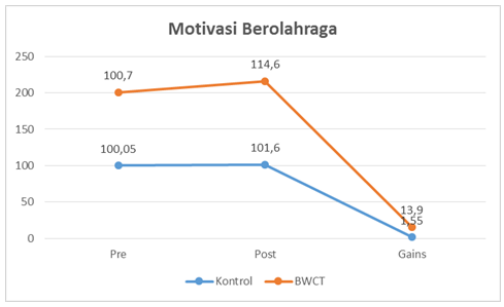
Figure 2. The result of Sports Motivation comparison (Control and Experimental BWCT Groups)
The encouragement or internal motivation of the experimental group of BWCT compared to the control group in taking training was are already high. There are some intrinsic motivation that encourage CJH to take part in the BWCT including self-interest, performance, desire to be fit, and for self-recognition. In addition to intrinsic motivation, CJH taking part in the BWCT was also driven by extrinsic motivation including the presence of professional instructors, clear training programs, making friends, and the supporting infrastructure.
One communication strategy that is gaining attention nowadays in sports psychology is Motivational Interviewing. MI is based on the idea that motivation for behavior change can be developed using conversations that occur between a practitioner (eg coach) and an individual (eg athlete). More specifically, conversations that allow someone to actively support the idea of changing behavior, where they integrate decisions to change, and act autonomously, are considered more effective than direct instruction and 'giving advice' when discussing behavior change (Wierts et al.: 2019).
The results of this study show that Motivational Interviewing affects the increase of sports motivation. This can be seen from a significant difference in high and low motivation to increase physical fitness. Apparently after the administration of MI on the experimental group, there were significant changes in the three aspects of motivation including recognition, ambivalence, and taking steps. The increase of the recognition aspect of prospective pilgrims in the experimental group after being given treatment was significant. This means that prospective pilgrims become increasingly aware that they have problems related to sports behaviour. Then they show a desire to change, and realise that risk would arise if they do not change their bahviour.
In delivering Motivational Interviewing to the CJH, as most are elderly, one must be equipped with “communication skills,” including: low speed of speech, rather loud sound, and the most important is obvious articulation as well as understandable terms (diction). The elderly hearing level is realized as having presbikusis, experiencing a decrease in its neurologic function. Delivering the message should be short, clear, simple, and enjoyable (Winarno: 2011). The better delivery of Motivational Interviewing is when it involves psychologists so that comfortable atmosphere for communication and good interaction can occur.
Prospective pilgrims in the Body Weight Circuit Training-MI Group (the experimental group) were interested in training because BWCT is considered easy to do and is having a clear objective that is to improve physical fitness. In addition, the interest of prospective pilgrims because BWCT is considered as having minimal risk of injury. The benefits that can be obtained by the prospective pilgrims were feeling the body fresher, tight muscles, not easily tired, very good in controlling weight, feeling stronger, and more stamina. When they wake up in the morning, they also feel that their bodies are light.
Based on the results of in-depth interviews conducted with the CJH, researchers are trying to make anintegrated health promotion by looking at the following important points.
The needs for Hajj pilgrims
Elderly-dominated CJH is increasingly experiencing physical setbacks. With the decline, the status of health and fitness is also very calculated when you want to perform Hajj. Therefore, it takes appropriate efforts to maintain and improve of physical fitness so that performing Hajj in Makkah and Medina could be done independently without the dependence to others.
Policy
In terms of health promotion in the level of Puskesmas (District Healthcare), there should be policies made by central, provincial, and local government (both Ministry of Health and Ministry of Religious Affairs). The policy made by the central government is the policy of Ministry of Health. The policy is in the form of regulation on the implementation of Hajj that is contained in Law No. 13 year 2008 stating that the Minister of Health is responsible for the guidance and health services for Hajj, during the preparation and the implementation of the Hajj in addition to the decree of Indonesian Health Minister number442/MENKES/SK/VI/2009 on guidelines for conducting Hajj health. The policy made by provincial and regional governments refers to the central Government to support policies and efforts to improve physical fitness for the CJH. In addition, it is necessary to make policies that is specific about the guidelines of physical fitness of the Pilgrims in order to make the CJH not only healthy but also fit.
The Approach to the Physical fitness Programme
The approach taken is bottom up, although there is a slight top down from the public health office. With this approach, the CJH conducts physical fitness programs from self-awareness, so that there are creative ideas and participation in the implementation. CJH can cooperate with KBIH, most routine agenda of meeting with other friends is in KBIH. Therefore, KBIH will provide a great benefit by conducting training programmes focusing not only on the spiritual, but also on physical fitness training. For the arrangement of programme schedules, meeting venues, training venues, and facilities and infrastructure can be determined by KBIH. There is a slight top-down approach due to the role of Ministry of Health, public health office, or Puskesmas is still needed in providing physical fitness training programs especially related to the avalability of personnels and financing.
Strategy
National Policy on health promotion and regional guidelines of the implementation of health promotion have established 3 (three) basic health promotion strategies, namely advocacy, building atmosphere, and empowerment movement (known as ABE Strategy) strengthened by the partnership, as well as the appropriate methods and means of communication/media. These three strategies must be implemented completely and continuously, so that the prospective pilgrims can afford a healthy life independently (The Indonesian Department of Health).
Hajj Health Promotion Officers
The health promotion officers for Hajj involve personnels from Dinkes (Public Health Office), Puskesmas, UKBM, KUA (The Office of Religious Affairs), KBIH, Colleges, Community Sports Groups, and sports instructors. In conducting health promotion for CJH, Puskesmas and KBIH can involve competent sports instructors, so that CJH is eager to follow physical fitness training. In addition, the Hajj health officers also need to provide Motivation Interviewing so that CJH participating in the training can carry out appropriate training programmes to gain benefits from the increased physical fitness. Giving Motivation Interviewing should be done gradually, starting from the simplest to the more complex.
Facilities and infrastructure
Availability of facilities and infrastructures become very important in health promotion. The place used for meetings could be in the field (outdoor) or in a building (indoor) by considering standardization for fitness training, both breadth and circulation. Training can be done using body weight, and can also use mineral bottles filled with sand as the replacement of dumbbell for weight training. Facilities and infrastructures that are easy to find and use, and clean will give CJH a special interest.
Financing
Health promotion activities will run smoothly if there are clear and adequate financing. To conduct health promotion, financing can be obtained from:
-
Central government
-
Provincial government
-
Regional government/City
-
DP2M DIKTI through higher education provides budget in the form of PPM activities (community service).
Physical Fitness Training
The further development of physical fitness for CJH will be greater through combining physical and psychological aspects. The combination of the ttwo aspects is in the forms of physical training programmes and Motivation Interviewing. Physical fitness training activity is a series of Hajj health training conducted by Puskesmas. In accordance with Decree of Miniter of Health No. 128 year 2004 about the function of Puskesmas as the organiser of physical training for prospective pilgrims applying the functions of:
-
Health-oriented development Centre
-
Community and Family Empowerment Centre
-
Public Health Service Centre
Supporting institutions
Supporting institutions that contribute to the health promotion of prospective pilgrims consist of:
-
IPHI (Ikatan Persaudaraan Haji Indonesia) - Indonesian Brotherhood of Hajj Ties
-
AKHI (Indonesian Hajj Fitness Association)
-
Colleges
Beneficiaries
The benefits received by the CJH include: CJH becomes more aware of the sense of having a fit body, more energetic, more confident, more motivated to do sports, more self-control, better understand physical fitness training, more skilled in doing motion, and becoming more independent.
To simplify of conceptualization, the formulation of health promotion as an effort to improve physical fitness and sports motivation of the prospective pilgrims is as follows:

Figure 3. Health Promotion to improve Phisical Fitness and Sports Movtivation
CONCLUSION
Based on the results of the analysis and discussion above, it can be concluded that the health promotion by combining physical aspects (body weight circuit training) and the psychological aspect (motivation interviewing) was appropriate for prospective Hajj pilgrims. In addition, the process of health promotion needs to be done synergistically to realize the better beneficiaries in regards of policy, infrastructure, personnels/officers, maintenance, approach, strategy, financing, institutional, with the support of various parties like KBIH, IPHI, AKHI, and colleges.
BIODATA
Y PRASETYO: He was born in Magelang, Central Java, August 15, 1982. Has been a lecturer at the Faculty of Sport Science since 2005. Undergraduate education in sports at the Faculty of Sport Science, Universitas Negeri Yogyakarta, Sports Health Masters Program in Airlangga University's postgraduate program, Doctoral Program in Health Counseling Development / Community Empowerment-Health Promotion at Sebelas Maret University in Indonesia. Manager of the Medical Journal of Medikora as Editor in Chief. Establish cooperation with the University of Yamanashi Japan in 2016, and at Kasetsart University Thailand in 2018. Completed research in more than 30 projects, and wrote more than 5 books. International journal publications indexed, and have other experiences at the international level.
SISWANTOYO: He is a Professor at the Faculty of Sport Science since 1999. He was born in Bantul, Yogyakarta, and 10 March 1972. Undergraduate sports education at the Faculty of Sports and Health Education at the Teacher Training and Education Institute, Sports Health Master’s Program at the Airlangga University Postgraduate Program, Sports Medicine Doctoral Program at the University Airlangga Surabaya Indonesia. Visiting Professor at Universiti Malaya, Sports Center in 2013-2014, and at Osmania University Hyderabad India in 2019. Completed research in more than 40 projects, and wrote more than 10 books. Publications of international journals indexed by Scopus. Speakers at international conferences and other experiences at the international level.
Z MUHAMMAD: He is a Senior Lecturer at Faculty of Business, Economic and Social Development, Universiti Malaysia Terengganu, Malaysia. He holds a Bachelor Business Administration, master’s degree in regional planning and development and a PhD in geography. His research interests include urban study, community study, urban geography. He has published more than 100 articles in international journal, local journal and chapter in books
BIBLIOGRAPHY
AHMAD, I., & AHMAD, S. (2018). “Multiple Skills and Medium Enterprises’ Performance in Punjab Pakistan: A Pilot Study”. Journal of Social Sciences Research, 7(4), 44-49.
AHMAD, I., & AHMAD, S. (2019). “The Mediation Effect of Strategic Planning on The Relationship Between Business Skills and Firm’s Performance: Evidence from Medium Enterprises in Punjab, Pakistan”. Opcion, 35(24), 746-778.
AHMAD, I., SAHAR. (2019). “Waste Management Analysis From Economic Environment Sustainability Perspective”. International Journal Of Scientific & Technology Research 8(12), 1540-1543.
ANNÍA GONZÁLEZ, M., VILLALOBOS ANTÚNEZ, J., RAMÍREZ MOLINA, R & RAMOS MARTÍNEZ, Y (2019).“Capacidades dinámicas frente a la incertidumbre: una mirada desde la gestión universitaria”. Revista Venezolana de Gerencia (RVG), 24(88), pp. 1357-1372.
BURKE, ER (2001). Panduan Lengkap Latihan Kebugaran di Rumah. Jakarta: PT RajaGrafindo Persada.
CZERNIEWICS, S & SOLANGE DNCM, (2004). “Hale and Hearty-the Benefits of Exercise in the Elderly”.Johannesburg: Nov/Dec, 22(11) CME.
GUNARSA, SD (2004). Psikologi Olahraga. Jakarta: Gunung Mulia.
HULDANI, AH, ARSYAD, A, PUTRA, AP, SUKMANA, BI, ADIPUTRO, DL, KASAB, J (2020). “Differences inVO2 Max Based on Age, Gender, Hemoglobin Levels, and Leukocyte Counts in Hajj Prospective Pilgrims in Hulu Sungai Tengah Regency, South Kalimantan. Systematic Riviews in Pharmacy, SRP”, 11(4), pp.9-14, doi: 10.31838/srp.2020.4.03.
KLIKA, B & JORDAN, C (2013). High Intensity Circuit Training Using Body Weight. American: American of Sport Medicine.
MAKSUM, A (2011). Psikologi Olahraga Teori dan Aplikasi. Surabaya: Unesa University Press.
MANSFIELD, L & PIGGIN, J (2016). “Sport, Physical Activity and Public Health”. International Journal Of SportPolicy and Politics, 8(4), pp.533–537, http://dx.doi.org/10.1080/19406940.2016.1254666.
MINET, LK, WAGNER, L, LONVIG, EM, HJELMBORG, J, HENRIKSEN, JE (2011). “The effect of motivationalinterviewing on glycemic control and perceived competence of diabetes self management in patient with type 1 and type 2 diabetes mellitus after attending a group education programme: a randomised controlled trial”. Diabetologia: 54, pp.1620-1629.
MYLSIDAYU, A (2014). Psikologi Olahraga. Jakarta: Bumi Aksara.
NATERNICOLA, NL (2015). Fitness Steps to Success. United States: Human Kinetics
NOTOATMODJO, S (2010). “Promosi Kesehatan: Teori dan Aplikasi”. Jakarta: Rineka Cipta.
PANE, M, KONG FIONA, YM, PURNAMA, TB, GLASS, K, IMARI, SH, SAMAAN, G, OSHITANI, H (2019).“Indonesian Hajj Cohorts and Mortality in Saudi Arabia from 2004 to 2011”. Journal of Epidemiology and Global Health, 9(1), pp.11–18.
PAVLEKOVIC, G, DONEV, D & KRAGELJ, LZ (2007). Concepts and Principles in Health Promotion. Germany: Hans Jacobs Publishing Company.
RENALDI, R, SINGARA, TH & HAWAIDAH (2011). “Pengaruh Motivational Interviewing Terhadap Peningkatan Motivasi dan Berkurangnya Gejala Putus Opioid Peserta Programme Terapi Rumatan Metadon (Ptrm)”. Makasar.
RINCÓN, Y; SUKIER, H; CONTRERAS, J & RAMÍREZ MOLINA, R (2019). “Responsible CommunicationStrategies for Small and Medium-Sized Enterprises”. Opción. Revista de Ciencias Humanas y Sociales, 35(89-2), pp. 1208-1234.
ROLLNICK, S & MILLER, WR (2013). Motivational interviewing: Helping People Change. New York: The Guilfold Press.
RUDYANTO, CH, DAMAYANTI, R, JUNADI, P (2019). “Preparing Fit and Healthy Pilgrims In Order to Be Able to Perform Hajj Optimally Through Health Policy In Indonesia”. Indian Journal of Public Health Research and Development, 10(8), pp.1415-1419. https://doi.org/10.5958/0976-5506.2019.02096.5.
SULAEMAN, ES (2013). Promosi Kesehatan: Teori dan Implementasi di Indonesia. Surakarta: UNS Press.
SUMARYANTO (2013). Eksistensi Olahraga dalam Perspektif Filosofis dan Kebermaknaannya dalamKehidupan. Yogyakarta: UNY.
TAKAKURA, R, MASAYOSHI, K & TSUBOTA, Y (2015). “The Effects of A Short Term High-Intensity Circuit Training Exercise In University Students”. Int J Physiother. 2(4), pp.602-609, ISSN: 2348–8336.DOI https://doi.org/10.15621/ijphy/2015/v2i4/67739.
TREASURE, J (2004). “Motivational interviewing”. Advances in Psychiatric Treatment Aug 2004, 10(5), pp.331-337.
VILLALOBOS ANTÚNEZ, JOSÉ VICENTE & GANGA CONTRERAS, FRANCISCO (2018). “Tecnoempresay Tecnocimiento: Una Perspectiva desde la Bioética Empresarial”. Revista Fronteiras: Journal of Social, Technological and Environmental Science. Vol. 7, No. 3: 214-230. Unievangélica Centro Universitario, (Brasil).
WARDANI, IKA, N, YANIK, M & MURTI, A (2016). Buku Ajar Promosi Kesehatan Untuk Mahasiswa Kebidanan. Jakarta: Trans Info Media.
WELCH, G (2011). “Motivational interviewing delivered by diabetes educator: Does it improved blood glucose control among poorly controled type 2 diabetes patients”? Diabetes Res Clin Pract, 91(1), pp.54-60.
WERNER, WK, HOEGER & SHARON, AH (2011). Lifetime Physical Fitness and Wellness. Wadsworth: United State of America.
WHO (2018). Promoting Physical Activity In The Health Sector; Current status and success stories from the European Union Member States of the WHO European Region. Denmark: WHO Regional Office for Europe.
WIERTS CM, WILSON, PM, MACK, DE (2019). “Awareness and use of motivational interviewing reported by Canadian university sport coaches”. International Journal of Evidence Based Coaching and Mentoring 2019, 17(1), pp.63-71. DOI: 10.24384/k0xn-af87.
WINARNO, B (2011). “Kebijakan Publik: Teori, Proses, dan Studi Kasus”. Yogyakarta: pen CAPS.
WOON, KJ, CHAN, KY, BEOM, ST, PYO, KY (2018). “Effect Of Circuit Training On Body Composition, Physical Fitness, And Metabolic Syndrome Risk Factors In Obese Female College Students”. Journal of Exercise Rehabilitation, 14(3), pp.460-465. Published online: June 27, 2018, DOI: https://doi.org/10.12965/jer.1836194.097.