Artículos
Patriotic Philosophy Values as a Driving Factor of Development of Kazakhstan
Valores de la filosofía patriótica como factor impulsor del desarrollo de Kazajstán
 Z KABAYEVA Kabaeva_zha@mail.ru
B IMANMOLDAYEVA zamanhankyzy@mail.ru
Z ZHANBAYEVA Zhanbaeva1988@mail.ru
Z MADALIEVA zhanna_madalieva@mail.ru
Z KABAYEVA Kabaeva_zha@mail.ru
B IMANMOLDAYEVA zamanhankyzy@mail.ru
Z ZHANBAYEVA Zhanbaeva1988@mail.ru
Z MADALIEVA zhanna_madalieva@mail.ru
Patriotic Philosophy Values as a Driving Factor of Development of Kazakhstan
Utopía y Praxis Latinoamericana, vol. 25, no. Esp.10, pp. 142-150, 2020
Universidad del Zulia

This work is licensed under Creative Commons Attribution-NonCommercial-ShareAlike 4.0 International.
Received: 30 August 2020
Accepted: 25 October 2020
Abstract: Each nation has its own system of values, which is currently under threat in the context of globalization and integration processes. By way of comparative, qualitative, quantitative and dialectic analysis, the study examines the influence of values of the national philosophy on the development of various spheres of Kazakhstani society and overall development of the country. The results of the study show that the nationally accepted and supported philosophy as set of ethical values, like the Eternal Country, significantly contributes to sustainable development of the country and positively impacts various dimensions of life, including social, economic and cultural spheres.
Keywords: Culture, economics, ethical values, national identity, national philosophy..
Resumen: Cada nación tiene su propio sistema de valores, que actualmente está amenazado en el contexto de los procesos de globalización e integración. Mediante un análisis comparativo, cualitativo, cuantitativo y dialéctico, el estudio examina la influencia de los valores de la filosofía nacional en el desarrollo de diversas esferas de la sociedad kazaja y el desarrollo general del país. Los resultados del estudio muestran que la filosofía aceptada y respaldada a nivel nacional como un conjunto de valores éticos, como el País Eterno, contribuye significativamente al desarrollo sostenible del país e impacta positivamente en varias dimensiones de la vida, incluidas las esferas sociales, económicas y culturales.
Palabras clave: Cultura, economía, filosofía nacional, identidad nacional, valores éticos..
INTRODUCTION
The formation of a particular independent state is characterized by both specific features and general features. It is known that countries in transition have various development paths. The relevance of this issue is determined by the value of the concept of sustainable economic, cultural and social development of the countries and the world as a whole. Today the questions related to the sustainability of national economies are becoming very important (Afanasiev & Shash: 2019). The multi-polar globalization model most fully caters the needs of sustainable development of the world as it considers and brings into balance various national interests united in transnational communities. It aims to preserve the national-cultural and ethnic identity of countries, as well as guarantees the civilizational diversity of the world (Pamyatusheva: 2007).
The socio-economic and cultural problems of developed countries include social inequality, which is the result of the social and cultural gap between the countries (Afanas’ev & Shash: 2020, pp.327-334). For example, this was highlighted by Pierre Pestieau and Mathieu Lefebvre when they were considering the prospects of welfare states (Pestieau & Lefebvre: 2018). In turn, Giovanni Vecchi (Vecchi: 2017) puts forward the thesis on the wealth management lessons for further sustainable prosperity and focuses on questions about the happiness of individual members of society. At the same time, there is criticism of capitalism. Paul De Grauwe (De Grauwe: 2017) considers the departure from capitalism due to the financial crisis, growing income inequality and cultural degradation.
The components that determine sustainable development of countries are being changed. The main economic trend of modern states is innovation. Therefore, it is relevant to search for the opportunities to ensure innovative growth (Potts: 2019). Karolyi (Karolyi: 2015) notes a tendency to change the structure of the global economic process and defines it as a new economy synthesis.
O. Blanchard describes the specifics of the “post-communist transition” as the U-shaped development of socio-economic indicators. In the transition period, he singles out the dominant aspects, namely, redistribution and restructuring (Blanchard: 2003; Karolyi: 2015). In broad terms, this happened to the independent Republic of Kazakhstan; today Kazakhstan is located slightly above the right bottom of the U, which will be illustrated in the study.
The multi-structure nature of the socio-economic system of a country, the modernization processes going on in it require the development of a unified system of values that will become guidelines for the sustainable development of the nation and country (Malysheva: 2014; Villalobos et al.: 2018; Ramírez et al.: 2019). National values are of great importance for determining the potential trajectory of political, social and cultural transformations in a country (Gow: 2017). Values-based national philosophy contains a deep subjective consciousness, is an individual conscious understanding of its cultural identity, is a reflection of an individual value orientation, it directly reflects the value orientation of an individual, his essence is the value of identity (Liu & Sai: 2017). The system of national philosophy values is a social construct that is created by the state in accordance with its goals and objectives that determine the request for a certain type of human behavior, and is used by him in the future to form value orientations of the individual (Bubnova et al.: 2019).
The formation of a national philosophy based on a value system is a long, arduous process, accompanied by both successes and certain disappointments (Malysheva: 2018). And a vital role in the formation of the value system as the basis of national philosophy is played by the political and intellectual elites of the country (Smirnova & Nabokina: 2019).
The set of values of national philosophy is based on patriotism and nationalism, including the economicone, though economic nationalism, if not restrained, is a dangerous business that deprives others of their right to their wealth, seeks to maximize the welfare of the nation at the expense of other countries, and encourages the use of force to achieve national goals (Ali: 2017, pp.90). The elements shape the quality of nation patriotism are limited and influenced by many multidimensional factors, including the geographic environment in which representatives of a particular nation live, the characteristics that they can represent, the social customs that they have, the psychology that they show, and all historical circumstances they are facing. Itforms the spiritual core. It decides the fate of the nation and is crucial for the development of its civilization. Patriotism without cultural roots cannot stand for long. This will ultimately be eliminated or assimilated by a foreign culture (Ouyang: 2017).
During the formation of a post-industrial society, ethical regulation becomes a significant and necessary factor in life, complementing, and sometimes replacing other forms of regulation in all areas of society. The ultimate goal of the economy is to meet the needs of individuals and create conditions for their self-realization. The main task of each participant in the production process is the transformation of general rules and responsibilities of economic activity into a rule of their own behavior (Roslyakova & Razin: 2015). Therefore, national philosophy and values are of high psychological significance. Most people are born in a system of political organization based on a national state and nationality. They are confronted with national philosophy as a social fact (Bayram: 2019).
The correct definition of development should be based on the correct definition of matter. The way a nation interprets matter, gives rise to its ideology or worldview. The ideology of a nation is its mission, and determines nation’s philosophy: values, goals and general attitude to life. The ideology of the nation paves the way for development. The concept of matter of a nation determines its ideology. The ideology of people forms their concept and approach to development. Development concerns not only the control and maximization of matter, but also the values for which this control and maximization is carried out (Ebo: 2018).
After the acquisition of state independence, Kazakhstan moved on to economic and social modernization. Successful conduct of such policies significantly depends on the state of political participation of Kazakhstanis in these processes. Modernization processes involve the active participation of policy actors. One of the priorities of long-term development of Kazakhstan is political stability and unity of society (Mukataeva & Nogaybaeva: 2016).
One of the fundamental steps towards the formation of historical self-awareness and the process of nation-building was the national patriotic philosophy “Eternal Country” ("Mugilik El"), which was most fully voiced in the President's Message "The Shining Road - the Way to the Future" on January 17, 2014 (Kovalskaya: 2016). The patriotic act “Mugilik El” was adopted by the XXIV session of the Assembly of the People of Kazakhstan “Independence. Consent. The nation of a single future” on April 26, 2016 (Auanasova& Nurpeisov: 2016).
The Kazakhstani philosophy is formed by the national patriotic idea of Eternal Country (Satybaldina: 2019). The universal and understandable consolidating values of Eternal Country are civic equality, hard work, honesty, a cult of learning and education, a secular country (Shayakhmetov: 2016).
The system of values of Eternal Country is given on Figure 1.
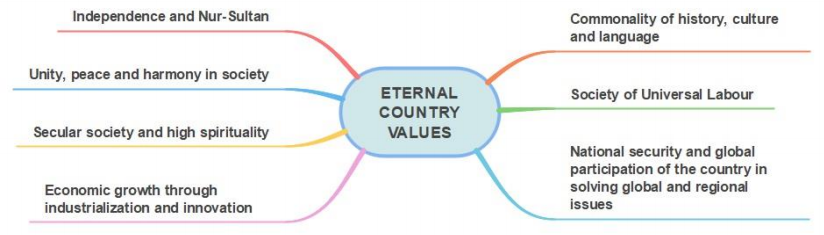
Figure 1. System of values of the Kazakhstani national patriotic philosophy” Eternal Country”.
Source: developed by the authors based on Patriotic Act "Mugilik El" (Patriotic act "Mugilik el": 2016)
Despite numerous studies dedicated to Kazakhstani national philosophy in general and Patriotic Act “Eternal Country” in particular, there’s lack of researches which would evaluate the development of the countryafter the introduction of the national patriotic philosophy ”Eternal Country”.
The aim of the study is to analyze the formation of the market economy of the Republic of Kazakhstan from the perspective of the socio-economic development and based on the comparative analysis of the development of economies of Kazakhstan, where national patriotic philosophy was formulated and generally accepted as national policy, and other republics of the Central Asian region, where such values-based philosophy was not introduced at national level.
The research tasks are to analyze the specific features of the development of the Kazakhstan economy in the context of global development and in the context of the development of the Central Asian countries before and after introduction of national patriotic philosophy ”Eternal Country”, such introduction allowed the country to achieve certain results. The novelty is a philosophical analysis of the growth dynamics of economic and social indicators in Central Asia.
METHODS
The use of systemic-structural and holistic approaches is relevant due to the fact that the subject matter of the analysis is a complex object. From a theoretical perspective, the Kazakh society is an open nonlinear system. The development of the objects (all post-Soviet republics, including Kazakhstan) passed a bifurcation point (1991), which specifically defined the future vector of their development. Thus, the synergetic, comparative, chronological, and phenomenological approaches are used in the study. However, due to the growing research trend to introduce vital parameters into the methodology of modern research, this approach is also found in the study. The research approach selection is based on the fact we are witnesses and participants in the formation and development of independent Kazakhstan.
In our study, we used the Global Competitiveness Reports by the World Economic Forum, other statistics, and the works of economists.
RESULTS
The growth dynamics of economic and social indicators of the Republic of Kazakhstan before and after introduction of the national patriotic philosophy “Eternal Country”
Kazakhstan outperforms neighboring countries of the Central Asian region in many economic and social development indicators. In 2016, two years after the national patriotic philosophy “Eternal Country” was introduced, the country ranked 56th among the developed countries of the world. From a relative point of view, this is not a very low indicator. The success is based on a combination of factors.
The development dynamics of the country was different. At the first stage, there was a survival strategy, which was replaced by the growth strategy. The gradual and progressive development pace was based on the priorities that were wisely set: security and a successful economy were followed by politics and other areas. The first years of the independence of the Republic of Kazakhstan (since 1991) were very difficult: complete economy collapse, unemployment, depressed socio-political sphere. The state had to switch to a market economy and to shift from state ownership to private ownership, as well as to replace the socialist mode of production with the capitalist production mode. In Kazakhstan, this transition was abrupt and immediate. The government subsidies available in the Soviet era disappeared and it was very difficult for the residents to survive during the fledging years, but then the situation gradually normalized. In the same period, the transition to a market economy was slower in some neighboring post-Soviet republics; for many years there were collective farms and other forms of socialist property in these countries. Some post-Soviet republics provided government subsidies for utilities for a long time; this created an obstacle to the successful development of interconnected economic, social and political spheres. Before long, it can be stated that it was the fast transition to a democratic market economy that turned out to be the most optimal. The transition didnot follow any patterns, including the democratic ones. The second specific feature of the formation of independent Kazakhstan was the focus on economic performance rather than political development.
Nowadays, there is a crisis of values in many countries; therefore, the phenomenon of introduction of values-based philosophy in Kazakhstan is interesting. The new socio-political force as the people's trust in national philosophy came to the forefront. That is another specific feature of the formation of independent Kazakhstan. It was the trust of the Kazakh people in national philosophy values that ensured the successful implementation of almost all planned reforms. For example, in many respects, it determined ensured the success of the banking system in the first years of the country's independence.
At the same time, it should be noted that crises are generally systemic; although the crisis in Kazakhstan, as well as in other post-communist countries, could be described as an in-depth systemic recession. This can be explained by the need to move from one system of economic relations to a completely different one, from one form of ownership to another; and at the same time, it is necessary to change the mentality of the population and provide system of values as ground and moral guidelines for sustainable development of society and country.
The national patriotic philosophy ”Eternal Country” introduced in 2014 and nationally adopted in thepatriotic act “Mugilik El” is an important and unique strategic philosophic document of the state. No similar strategic document was presented in the CIS countries that are also going through a difficult period of radical changes, including other developed and developing countries (Abykaev: 2017). History has confirmed that the values-based philosophy facilitated in successful economic, political, social development of Kazakhstan. For example, Kazakhstan ranked first among the CIS countries in the Prosperity Index and 43rd in the global ranking. The economic and social spheres of the country are developing in this direction, and the economy is being completely diversified.
Kazakhstan outperforms neighboring countries in many economic and social indicators. For example, in Kazakhstan, the performance of banking and financial institutions is much better compared to other EACU countries. According to the Global Competitiveness Report 2019, Kazakhstan possesses 55th place (out of 140 countries) and became the leader in the Central Asian region. According to the same report Kyrgyzstan ranks 96th, Tajikistan - 104th and Russian Federation - 43rd.
The investment increased by 10.7%. The social sphere financing is growing in Kazakhstan: budget expenditures on the social sphere (social protection, health care, education, culture, sports, tourism) have increased by 46.5% since 2017 (Gladilina et al.: 2018; Bannikov et al.: 2019). Over the past three years, funding for healthcare, education, culture, etc. has grown by about a half.
According to the 1989 Soviet Census, the population of Kazakhstan was 16.2 million people, but it was more than 18 million people by the end of 2018. Thus, there are demographic trends in Kazakhstan. A steady population growth is observed in the country.
Kazakhstan pursued a policy designed to provide all sectors of its economy and social sphere withdomestic specialists. This is the fourth specific feature of the formation of Kazakhstan.
The successful development of Kazakhstan was determined by the right decisions of the country leadership and the effective introduction of the national patriotic philosophy “Eternal Country”. Besides that, cautious strategies and tactics of the development of all industry sectors, as well as social and political spheres, contributed to the sound policy of the Republic of Kazakhstan.
DISCUSSION
The economic development forecast for Kazakhstan in the context of the global economy
At the same time, the Global Competitiveness Report 2019 presents negative trends and imminent risks. They are associated with gradual monetary policy normalization in Europe and the United States, which is likely to lead to higher interest rates and tightening of credit conditions. In addition, a potential increase in protectionism around the world can indirectly reduce the growth prospects in the region and increase commodity price uncertainty.
It should be noted that Kazakhstan has always attracted a lot of investment compared to other Eurasian and Central Asian countries. This was facilitated by the country's stability and favorable preferential conditions for doing business. Unfortunately, protectionism has affected the economic and social sphere of Kazakhstan; in recent years, there have been tough efforts to combat it.
Kazakhstan is expected to develop on the labor market with the help of reforms that contribute to improving the distribution and retention of qualified personnel (Joshi: 2017).
The study considers positive and negative trends to provide a comprehensive presentation of the socio- economic situation in Kazakhstan. The prevalence of positive trends in the socio-economic development of the country is also proved by such an objective factor as the presence of labor migrants in other countries. Kazakhstan has never “exported” migrants (Fedorov: 2015, pp.105-111).
Admittedly, there are areas that should be improved: protectionism, non-transparency, the poverty of some segments of the population. Currently, Kazakhstan is implementing social policies in three areas: increasing income and supporting low-income segments of the population; solving housing issues of low- income citizens; improving education and health care and the integrated development of regions. To solve these problems, more than 45% of the government expenditures are allocated to the social sphere.
The socio-economic development of the state is most reflected by the following indicators: 1) GDP per capita and 2) HDI (the Human Development Index). Gross domestic product per capita is the country's total GDP divided by the number of inhabitants of a given country. Let us consider the data in Table 1.
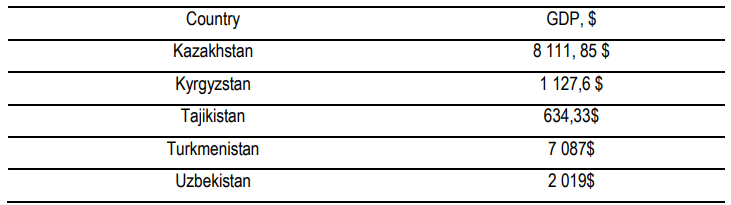
The table shows that Kazakhstan has the highest GDP per capita in the Central Asian region. In 2018, Kazakhstan GDP was 11.166 USD.
The 2018 Human Development Report, published in December 2019, showed that Russia ranked 49th,Kazakhstan - 50th, Uzbekistan and Turkmenistan - 108th, Kyrgyzstan - 122nd, Tajikistan - 125th, India - 129th, Cambodia - 146th. These data demonstrate that in terms of the HDI Kazakhstan outpaces Central Asian countries, as well as the developing countries such as India and Cambodia.
Kazakhstan has a powerful impetus to the development of small and medium-sized businesses; there is a fight against corruption; all socio-economic indicators are improving; residential construction projects are implemented; low-income and young specialists up to 29 years old are provided with housing; student dormitories are being actively built; targeted social assistance is being given to multi-child families; the economy, education, and health care are being successfully digitalized. Thus, all socio-political systemcomponents are being improved. There are countries that can make an abrupt breakthrough and become innovative countries. Kazakhstan has these opportunities provided that an optimistic scenario of socio- economic development is realized. The most important condition for the implementation of this scenario is the right choice of long-term strategic priorities and the development of an effective mechanism for their consistent implementation (Abykaev: 2017).
On a historical scale, Kazakhstan is a teenager: the country is growing and has a tremendous amount of creative energy. Although according to the Global Economic Prospects, there are negative forecasts for developing countries: the growth rates in emerging markets and developing economies are expected to remain restrained and disappointing. It is anticipated that Kazakhstan will demonstrate good results (this is confirmed by the 4.5% GDP growth in 2019, which is much higher than the global average).
CONCLUSIONS
The study demonstrated the development of Kazakhstan, which was reflected in socio-economic indicators, after the introduction and adoption of the national patriotic philosophy “Eternal Country”. The comparative analysis demonstrated that Kazakhstan outperforms neighboring countries of the Central Asian region in many indicators. Countries in transition have various development paths. It should be noted that the study describes both general socio-economic development trends of developing countries and the specific features of the development of Kazakhstan as a result of introduction of values-based national philosophy.
The results of the research show that the nationally accepted and supported philosophy as set of ethical values, like the Eternal Country, significantly contributes to sustainable development of the country and positively impacts various dimensions of life, including social, economic and cultural spheres.
The results of this study can be applied for development of national philosophies for other nations and researches of impact of such philosophies and values on other countries’ aspects of life.
BIODATA
Z KABAYEVA: Zhuldyz is a doctor of philosophical science. She works at the position of professor of Political science and socio-philosophical disciplines Department at Abai Kazakh National Pedagogical University. Her scientific interests are problems of space and time in the epistemological meaning.
B IMANMOLDAYEVA: Bakittizhamal is doctoral student in the specialty "6D020100 - Philosophy" of the Department of Political Science and Socio-Philosophical Disciplines at Kazakh National Pedagogical University. Her scientific interests are domestic history and philosophy, the history of the spread of religions and philosophy on the territory of Central Asia.
Z ZHANBAYEVA: Zhanat is a PhD doctoral at Politology and socio-philosophical Department of Abai Kazakh National Pedagogical University. She studies problems of man in the philosophy of Abay.
Z MADALIEVA: Zhanyl is a Candidate of philosophy. She works as an associate professor of Politology and socio-philosophical disciplines Department at Abai Kazakh National Pedagogical University. Her area of scientific interest includes philosophy of religion, philosophical anthropology and cultural studies. She is the author of more than 80 scientific articles and one monograph.
BIBLIOGRAPHY
ABYKAEV, NA (2017). The priorities of sustainable economic development at the stage of the new (third) modernization of Kazakhstan. Moscow: Economics.
AFANAS’EV, MP & SHASH, NN (2020). “Russian Investments in European Countries: Current State and Future Prospects”, Studies on Russian Economic Development, 31(3), pp.327-334.
AFANASIEV, MP & SHASH, NN (2019). “Russian Federation Cross-Border Investments and Bank Expansion in Russia”, Public Administration Issue, 6(8), pp.105-120.
ALI, AJ (2017). “Economic Nationalism: Philosophical Foundations”, Journal of Competitiveness Studies, 25(2), pp.90.
AUANASOVA, AM & NURPEISOV, EK (2016). Nationwide symbols of Kazakhstan in the implementation of the idea "Migilik el".
BANNIKOV, P, BACHAROVA, M, UALEHAN, CH & MEKISHEVA, A (2019). "Citizens’ budget based on the second revised republican budgets of 2017, 2018 and 2019 of the Ministry of Finance", Retrieved from https://factcheck.kz/18/pravda-i-manipulyacii-v-poslanii-prezidenta-tokaeva-2-sentyabrya-2019-g/.
BAYRAM, AB (2019). “Nationalist cosmopolitanism: the psychology of cosmopolitanism, national identity, and going to war for the country”, Nations and nationalism, 25(3), pp.757-781.
BLANCHARD, O (2003). The Economics of Post-Communist Transition. Oxford University Press.
BUBNOVA, IA, KAZACHENKO, OV & TOKAREVA, EA (2019). “Declaration of values in orders and medals: historical aspect”, Sociological studies, 11(5), pp.131-139.
DE GRAUWE, P (2017). The limits of the market: The pendulum between government and market. Oxford University Press.
EBO, S (2018). “Philosophical perspectives on theories of development for African economies”, in: International Multidisciplinary Scientific Conference on the Dialogue between Sciences & Arts, Religion & Education. Ideas Forum International Academic and Scientific Association, 2(2), pp.209-218.
FEDOROV, K (2015). “Cis countries: key macroeconomic indicators and forecasts”, Eurasian Economic Integration, 3(28), pp.105-111.
GLADILINA, I, YUMASHEV, AV, AVDEEVA, TI, FATKULLINA, AA & GAFIYATULLINA, EA (2018).“Psychological and pedagogical aspects of increasing the educational process efficiency in a university for specialists in the field of physical education and sport”, Revista ESPACIOS.
GOW, M (2017). “The core socialist values of the Chinese dream: Towards a Chinese integral state”, Critical Asian Studies, 49(1), pp.92-116.
JOSHI, V (2017). India's long road: the search for prosperity. Oxford University Press.
KAROLYI, GA (2015). Cracking the emerging markets enigma. Oxford University Press, USA.
KOVALSKAYA, SI (2016). Formation of the general Kazakhstan identity and historical consciousness.
LIU, L & SAI, S (2017). “Chinese Culture Value Identity and Patriotism Spirit”, in: 3rd Annual International Conference on Social Science and Contemporary Humanity Development (SSCHD 2017). Atlantis Press.
MALYSHEVA, OG (2014). “Revolutionary thought in Russia XIX - the beginning of the XX century: encyclopedia”, Vestnik of the Russian Humanitarian Scientific Foundation, 3(76), pp.266-269.
MALYSHEVA, OG (2018). “No needs to cross out all historiographic achievements of the past”, Russian history, 6(11), pp.27-32.
MUKATAEVA, AK & NOGAYBAEVA, MK (2016). "National ideology of independent Kazakhstan “Migilik El”."
OUYANG, K (2017). "Integration of the Patriotism and the Homeland of Mankind." In The Chinese NationalSpirit. Springer, Singapore, pp.173-204.
PAMYATUSHEVA, VV (2007). Socio-philosophical analysis of the implementation of the concept of sustainable development in modern Russia. Moscow.
PATRIOTIC ACT "MUGILIK EL" (2016). Retrieved from https://assembly.kz/ru/news/tri-goda-nazad-na-xxiv- sessii-ank-prinyat-patrioticheskiy-akt-m-gilik-el (in Russian).
PESTIEAU, P & LEFEBVRE, M (2018). The welfare state in Europe: Economic and social perspectives. Oxford University Press.
POTTS, J (2019). Innovation Commons: The Origin of Economic Growth. Oxford University Press.
RAMÍREZ MOLINA, R., MARCANO, M., RAMÍREZ MOLINA, R., LAY RABY, N & HERRERA TAPIAS, B(2019). “Relationship Between social intelligence and resonant leadership in public health Institutions”.Opción. Revista de Ciencias Humanas y Sociales, 35(90), pp.2477-9385.
ROSLYAKOVA, JV & RAZIN, AS (2015). “Moral and ethical prerequisites for economic activity”, Logos et Praxis.
SATYBALDINA, RA (2019). National ideology of independent Kazakhstan "Eternal Country".
SHAYAKHMETOV, N (2016). "Value bases of the national patriotic idea "Mugilik El" as a factor forstrengthening the Kazakhstan identity." Kazakhstan The Republic Of Wine Eurasia Keңistigi: Kazirgi ZamanMen Damu Keleshegi attty.
SMIRNOVA, YV & NABOKINA, ME (2019). “Evolution of social thinking of soviet researchers and ideological politics”, in: The European Proceedings of Social & Behavioural Sciences EpSBS. pp.1399-1405.
VECCHI, G (2017). Measuring wellbeing: a history of Italian living standards. Oxford University Press.
VILLALOBOS ANTÚNEZ, J & RAMÍREZ MOLINA, R (2018). “El derecho a la autobiografía: dimensión ius-filosófica desde la perspectiva de H. Arendt y P. Ricoeur”. Opción. Revista de Ciencias Humanas y Sociales,34(18), pp. 1012-1587.