Artículos

This work is licensed under Creative Commons Attribution-NonCommercial-ShareAlike 4.0 International.
Received: 30 August 2020
Accepted: 25 October 2020
DOI: https://doi.org/10.5281/zenodo.4155525
Abstract: These study findings revealed that internal and external aspects determined parents' subjective wellbeing with children who have post-lingual deafness. Parents with post-lingual deaf children in West Java, Indonesia, were able to cognitively and affectively experience life satisfaction, mainly when their living standards allowed them to satisfy their disabled children's needs. Affection from family and society also provided supports for parents to interact with their post-lingual deaf children. These findings were expected to serve as references for further studies to improve subjective wellbeing in parents with children with post-lingual deafness.
Keywords: Children who have post-lingual deafness, parents, qualitative, subjective wellbeing, thematic analysis..
Resumen: Los hallazgos de este estudio revelaron que los aspectos internos y externos determinaban el bienestar subjetivo de los padres con los niños con sordera poslingual. Los padres con niños sordos post-linguales en Java occidental, Indonesia, pudieron experimentar cognitiva y afectivamente la satisfacción con la vida, principalmente cuando su nivel de vida les permitió satisfacer las necesidades de sus hijos discapacitados. El afecto de la familia y la sociedad también brindó apoyo para que los padres interactuaran con sus hijos sordos post-linguales. Se esperaba que estos hallazgos sirvieran como referencias para estudios adicionales para mejorar el bienestar subjetivo en padres con hijos con sordera poslingual.
Palabras clave: Niños con sordera post-lingual, padres, cualitativo, bienestar subjetivo, análisis temático..
INTRODUCTION
Every individual expects to have a good life. Married couples wish for wellbeing in their married life. Having a child is one form of wellbeing for married couples. A child's presence in the family will positively impact individual life (Bradbury et al.: 2000, pp.964-980). However, it will be different for parents whose child has special needs. Children with special needs are those with significant differences in specific crucial dimensions of their human function. These children are physically, psychologically, cognitively, or socially hindered in optimally achieving their goals, needs, and potentials. One kind of special needs is hearing impairment or deafness. Deafness can be differentiated based on when it first happens: (1) pre-lingual deafness is hearing impairment or hearing loss that occurs before speaking, and linguistic abilities develop, while (2) post-lingual deafness is hearing impairment or hearing loss that happens on children of a certain age whose speaking and linguistic abilities are being developed.
When their healthy child undergoes such degeneration (in this case, post-lingual deafness), parents' happiness will turn into a mixture of feelings; sadness, disappointment, worry, and anger. Some parents even refuse to accept the doctor's diagnosis of their child's condition and live in denial. Having a child with post- lingual deafness is something that they cannot comprehend. It is beyond their conceptual expectation of what a child should be. Generally, parents will feel disappointed and frustrated. All their hopes and expectations are shattered to the ground. Disappointment is usually the first reaction these parents have upon hearing that their child is not what they expected. It will then turn into desperation or frustrations because they assume that a child with post-lingual deafness might harm their self-worth or prestigious status in society. This is the root of parents' tendency to deny that their children have post-lingual deafness (Piccarozzi et al.: 2018, pp.1- 24; Ahmad & Ahmad: 2019, pp. 746-778).
Based on the researchers' observation, there are cases in which parents neglect, abandon, and even disown their children diagnosed with post-lingual deafness. Neglectful behaviors or abandonment, of course, have adverse psychological effects on the children. Such behaviors will adversely affect the children's development, increasing their feelings of insecurity and causing them to be loath themselves or worthless. These children may grow up feeling unaccepted, believing that no one understands them, which may manifest in rebellious behaviors or other unsavory actions. To anticipate this, and prevent it from happening, parents need to be patient and accepting of their children's post-lingual deafness (Ahmad & Ahmad: 2018, pp. 44-49; Jones: 2013, pp.13-19).
Madiyono, Soelaeman, Oesman and Sastroasmoro (1994) noted that parents served 8 functions in developing children's potentials: biological, religious, economic, educational, socialization, effective, protective, and recreational functions. Biological function means that parents should satisfy the biological, physical, and psychological needs of a baby born into their family. Religious function means that parents are responsible for introducing religion and religious life to their children, not only teaching the basic rules but also developing them into religious individuals (Ahmad & Sahar: 2019, pp. 1540-1543; Pashkurov & Razzhivin: 2016, pp.155-164). The educational function is served when parents provide education to their children, including preparing educational instructions, objectives, planning, and management. Parents are also responsible for providing educational funds and facilities, enrichment materials, and other needs to support children's education. Socialization function is parents' responsibility in educating and preparing their children to be useful members of society. The protective function involves parents' duties to protect their children and is closely related to educational and socialization functions. Educating is inherently protective. Educating children will protect them from going astray or deviating from social norms. The affective function involves parents' emotional control while communicating with children. Toddlers are intuitively capable of sensing or feeling their parents' moods and emotions during communication. Recreational function means that parents have to maintain a healthy and warm atmosphere in the family. The recreation function can only be served if parents can provide a peaceful and comfortable atmosphere at home, in which the children will not experience any stress of emotional pressure (Wierts: 2019, pp.63-71).
The description above illustrates that parents play critical roles in satisfying children's needs, instilling religious values in them, providing education, protecting children during their developmental years, mediating children's interaction with other people in their social life, paying attention to children's emotional state, providing a safe and comfortable home, and supporting children until they are old enough to live alone. It is not easy to serve all these functions, especially when the child has post-lingual deafness.
The researchers observed a phenomenon that everyone wishes to have a good life. Parents wish to have children in their family. Having a healthy child is a source of enormous joy. However, if the child then undergoes a loss of hearing, the parents might have various reactions, from accepting to complete denial. Parents whose child has post-lingual deafness should be firm, patient, and persevering for their future. In some cases, this sudden change in life dynamics makes parents feel that they lose their wellbeing. This is why the researchers chose to examine subjective wellbeing on parents of children with post-lingual deafness.
LITERATURE REVIEW
Subjective Wellbeing of Parents with Post-Lingual Deaf Children
Subjective wellbeing refers to subjective life satisfaction and evaluation of relevant life domains, such as job, health, and relationship. It also includes subjective evaluation of positive emotions, such as happiness and involvement, and negative emotions like anger, sadness, and fear. In other words, happiness is a term to refer to positive thoughts and emotions about one's life (Pavot & Diener: 2008, pp.137-152). Andrew & Withey (in Diener: 1994, pp.103-157) argued that subjective wellbeing is a cognitive evaluation and certain levels of positive or negative emotion of an individual. Subjective wellbeing is defined as an evaluation of one's life, which includes life satisfaction as its cognitive component and happiness as its affective component (Diener & Chan: 2011, pp.1-43).
Subjective wellbeing is one's subjective evaluation of his or her life, which includes the concepts of life satisfaction, positive emotions, fulfillment, satisfaction in specific areas such as marriage and job, and low level of negative emotions (Diener & Suh: 2003). Ryan & Diener argued that subjective wellbeing is an umbrella term used to describe the level of wellbeing or happiness an individual experiences according to his or her subjective evaluation of his or her life (Ryan & Diener: 2009, pp.391-406). Veenhouven (in Diener: 1994, pp.103-157) noted that subjective wellbeing is a stage in which an individual feels the quality of his life is as expected and full of joyful emotions. In this study, subjective wellbeing is defined as one's subjective evaluation of one's life, which includes life satisfaction as its cognitive component and happiness as its affective component (Pane et al.: 2019, pp.11–18).
Cognitive component (life satisfaction)
The cognitive component of subjective wellbeing is an evaluation of life satisfaction, which is defined as an evaluation of one's life. Evaluation of life satisfaction can be categorized into (1) Evaluation of general life satisfaction, i.e., respondents' evaluation of their life in general. General life satisfaction is intended to represent the respondents' general and reflective evaluation of their lives (Diener: 2006, pp.397-404). According to Shin & Johnson, general life satisfaction is based on an evaluation process in which individuals examine their life quality based on a set of unique criteria that they set for themselves (Shin & Johnson: 1978, pp.475-492). More specifically, general life satisfaction involves one's perception about comparing their life condition to their unique standard. (2) Evaluation of satisfaction on individual domains, i.e., evaluation that one makes in specific domains of one's life, such as physical and mental health, job, recreation, social relationship, and family (Diener: 2006, pp.397-404). These two components are interrelated. Evaluation of general life satisfaction reflects one's perception of certain aspects of one's life and how culture affects one's positive perspective (Diener et al.: 2000, pp.159-176). Eid & Diener (2004) argued that one would use the information concerning his domain satisfaction to evaluate his life in general.
Affective Component (Happiness)
The affective component in subjective wellbeing is an individual's reaction to life events, which involves positive emotion (affect) and negative emotion (affect). Positive affect or joyful emotion is part of subjective wellbeing that individuals experienced as a reaction to a life that goes as expected (Diener & Oishi: 2005, pp.162-167). Seligman (2005) argued that positive emotion could be categorized into three groups; positive emotion towards the past, the present, and the future (Seligman et al.: 2005, pp.410).
Positive emotion towards the future includes optimism, expectation, belief, and conviction. Positiveemotion towards the present includes happiness, calmness, joy, enthusiasm, and flow. Meanwhile, positive emotion towards the past involves satisfaction, relief, success, pride, and peacefulness. Negative affect (emotion) is an adverse reaction to events that individuals experienced in his life, health, and environment (Diener & Oishi: 2005, pp.162-167). The most common forms of negative emotion are sadness, anger, worry, fear, stress, frustration, guilt, regret, and envy or jealousy (Welch: 2011, pp.54-60).
Based on these descriptions, the researchers concluded that subjective wellbeing was an individual's perception about experiences in his or her life, which consisted of two components, i.e., the cognitive component concerned with life satisfaction and the affective component with the individual's happiness.
METHODS
This study employed a descriptive-qualitative approach through a focus group discussion. The researchers developed the interview guide for the focus group discussion based on Diener's subjective wellbeing theory. Data gathered from the focus group discussion was analyzed using thematic analysis technique, which involved discovering main themes to describe a phenomenon (Fereday & Muir-Cochrane: 2006, pp.80-92). Data validation in this study was conducted through data triangulation using various sources of data (Astuti: 2020, pp.742-760). In this case, the sources of data were focus group discussion and field observation. Focus group discussion was conducted with 10 groups in 5 Schools of Special Needs in Bandung, Sukabumi, Purwakarta, and Majalengka.
Respondents
-
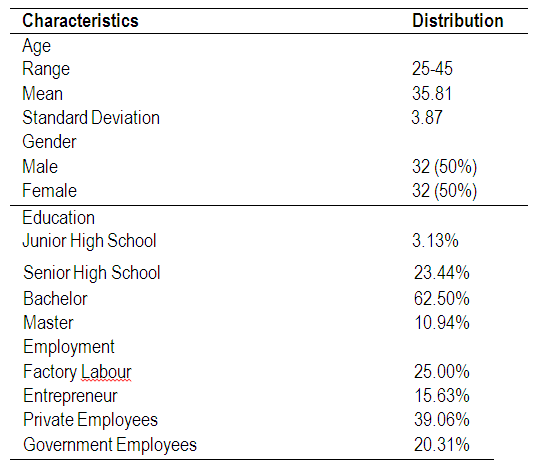
Respondents in this study were 64 parents of children with post-lingual deafness. The respondents should fit specific criteria as follows:
-
Respondents should be the biological father or mother of a child (or children) with post-lingual deafness.
-
Respondents should live together with their spouse and their child (children) with post-lingual deafness.
-
Respondents should be able to communicate in verbal and written form using Bahasa Indonesia.
-
Respondents should reside in West Java, Indonesia. Table 1 displays respondents' demographic characteristics.
Table 1. Respondents’ Characteristics
Procedure
Before focus group discussion was conducted, the researchers performed two steps of preparation: 1) building a team that consisted of a moderator (as the facilitator of discussion), a moderator assistant (to monitor the discussion and help the moderator manage the time, keep the discussion on track, make sure that all questions have been answered, and notice if a respondent is too quiet and has not offered an opinion), a secretary to record the minute of the discussion and the dynamics of the group, respondents’ contact (in this case teachers who knew the respondents), and logistics staff who facilitated the focus group discussion by providing transports, snacks and beverages, and documentation equipment; 2) selecting and preparing the site for focus group discussion (in this case the schools’ halls).
Based on several literature on focus group discussion, the ideal number of respondents for focus group discussion was 7 - 11 people. However, some researchers suggested a smaller number, i.e., 4-7 people or 6-8 people. If the respondents were too few, there would be no exciting variation of opinions. At the same time, too many respondents would reduce each respondent's opportunity for in-depth discussion. The number of respondents could be reduced or increased, depending on the research objective and the available facilities. Considering all these, the respondents in this study were 64 parents of children with post-lingual deafness. These parents were put in 10 groups, six or seven people per group. During the focus group discussion, the questions administered included: (1) respondents' view of their wellbeing, (2) respondents' life satisfaction, (3) respondents' positive or negative affect, and (4) factors that affected respondents' wellbeing.
Analysis
The data were analyzed using thematic analysis to identify, analyze, and report themes or patterns in the data. In analyzing the data, the researchers utilized NVIVO version 12 software to code the qualitative data transcriptions. The steps involved in analysis using NVIVO were: 1) researchers read the transcriptions of focus group discussions and made initial codes (node). The node system was intended to create themes based on the information derived from the data. According to Bazeley & Jackson (2013), this step involved scanning (more in-depth reading of transcription to obtain better understanding) of the initial themes. 2) These initial themes were then grouped to form the main themes (Bazeley & Jackson: 2013). To ensure the validity of data analysis, the inter-rater analysis was conducted. According to Kappa Cohen (in McHugh, 2012), to measure the level of conformity between two dichotomous scores, a scale from -1 to +1 is assigned. Score+1 indicates perfect conformity between the raters. In this study, the inter-rater score was 0.726, which means it had excellent reliability.
RESULTS
Definition of Well-Being according to Parents of Children with Post-Lingual Deafness
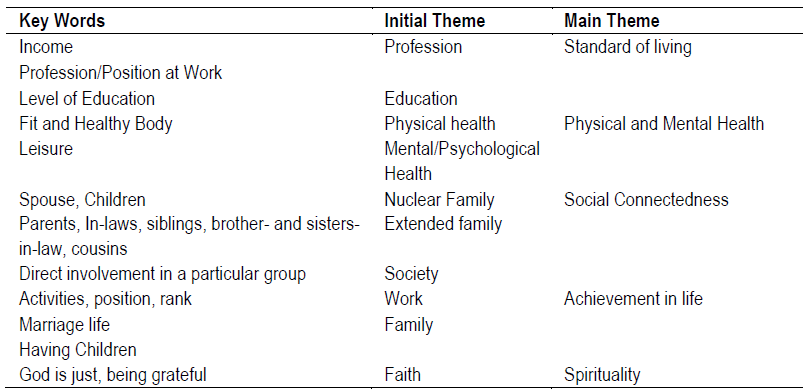
In general, five main themes were derived from the data provided by parents with post-lingual deaf children. The five main themes were standard of living, physical and mental health, social connectedness, achievement in life, and spirituality. These themes emerged from the analysis of respondents' experiences on wellbeing in their daily lives—table 2 displays how these main themes were obtained.
Table 2. Main Themes of Well-Being on Parents with Post-Lingual Deaf Children
Standard of Living
The first principal topic that emerged from respondents' data was the standard of living. The standard of living was defined as respondents' (parents with post-lingual deaf children) perception of their minimum objective condition in life. The standard of living was discovered through two initial themes, i.e., education and profession. The respondents claimed to be satisfied if they were able to use their educational background in raising their post-lingual deaf children. The majority of respondents clearly stated that they could correctly and appropriately educate their children with a sufficient level of education. For instance:
I am happy that I finished my college education and can educate my child, following the knowledge I learned in university (Father, 38 years old, teacher).
Had I not dropped out of school, I would be able to educate my deaf child (Mother, 29 years old, housemaid).
As a parent of a deaf child, I believe that parents' education is essential. I was confused and worried at first when I found out that my child was deaf. I had no idea how to handle it. However, then I remembered a class I took in university on children's education. Now I can use my knowledge to raise and educate my child. (Mother, 37 years old, Government Employee).
As shown above, respondents' statements revealed that education was deemed crucial in educating their children with post-lingual deafness.
The standard of living was also derived from another sub-theme, i.e., profession. The respondents claimed to have a satisfactory standard of living if their income was sufficient to cover living expenses, mainly to satisfy the needs of their post-lingual deaf children, including therapies. Besides, profession and positionat work were a significant determinant of respondents' happiness. This was evident from their responses as follows:
From the income I bring home from work, if we compare the income and the expense, the latter is often more significant. So currently, I have not [achieved wellbeing] (Father, 33 years old, Private Employee).
I am still trying to achieve a state of wellbeing, particularly in terms of finance. The family expenses have increased dramatically because there are additional expenses for my second child. For his therapy, for his school tuition, I have to spend more than that I did for my first child (Mother, 36 years old, Shop attendance).
I believe I have found my wellbeing in my family, but not at work. My job demands a lot from me. It is overwhelming. I even stay at work until very late sometimes (Father, 36 years old, Private Employee).
I work as a marketing staff in a pharmaceutical company, and it is target-based. This target sometimes feels like a burden to me (Father, 35 years old, Pharmaceutical Marketing Staff).
Those statements show that financial capability (income) and position at work determined factors of the satisfying personal standard of living, which in turn affect life satisfaction. Most respondents were still unsatisfied because their income was far from sufficient to support their post-lingual deaf children's needs. Children with post-lingual deafness need further education, such as therapy. Also, respondents' position at work determined their happiness. For instance, some respondents were able to reach their expected standard of living. However, they were unhappy because they had to come home late every day.
Physical and Mental Health
The next theme was physical and mental health. Respondents were satisfied because they were physically and mentally healthy. Physically, the respondents still maintained their fitness, even though they had to exert more energy to teach and raise their post-lingual deaf children. Mentally, respondents still had enough rest and still had time for family recreation. Their statements illustrated this clearly.
So, I need a particular time to rest for a while, but I do not get that at home. My two children always want to play with me, and they are both very energetic. They only stop moving around when they are asleep. I rest whenever they rest. In the morning, I go back to work as usual. So, it sometimes feels like I work non-stop (Father, 41 years old, Private Employee).
My mental wellbeing is maintained when I come home from work. It is my time to take care of myself (Father, 33 years old, Private Employee).
Have time to go out with my family, family recreation (Mother, 32 years old, Government Employee).
Social Connectedness
Social connectedness was one of the main themes emerging from the data. In this context, social connectedness was the feeling of joy that respondents experienced from their relationships with their nuclear family, extended family, and society in general. Respondents felt happy when they received support from the nuclear family, extended family, and society. The importance of family for respondents was evident in their statements:
My oldest child understands the condition of her deaf younger brother. She helps my wife a lot and me. We often learn how to understand her brother (Father, 40 years old, Factory Worker).
My firstborn always says, 'Do not worry, Mom. I am here. I can help you taking care of a little brother(Mother, 39 years old, Factory Worker).
Our children love each other. My husband is also very supportive. We only need to focus our effort on our last child, who suffers from post-lingual deafness (Mother, 39 years old, Private Employee).
Fortunately, her grandmother is willing to teach my deaf child. I am glad that my mother wants to help taking care of my child (Father, 34 years old, Factory Worker).
The extended family, including the grandparents, uncles, aunts, and cousins, always help my child, so do our neighbors—Alhamdulillah (Father, 35 years old, Driver).
Children in our neighborhood are always eager to help teach my child to speak clearly. Even though she cannot hear, their enthusiasm helps to boost her confidence. She is not embarrassed about her condition. She often asks the other children, 'What is this? What is that?'. Most of the time, she cannot pronounce the words clearly, but her friends always teach her patiently. They slowly teach her how to say the words. If there is any word that my daughter cannot pronounce, they always help her. My daughter loves playing with them; she is not embarrassed at all. (Mother, 35 years old, Private Employee).
Respondents stated that family was necessary as the primary source of support, both morally and physically. Besides, positive support and interaction in the community helped the respondents motivate themselves to teach their post-lingual deaf children.
Achievement in Life
Another central theme derived from the data was an achievement in life. Respondents were happy if their spouses did not show lesser affection or compassion towards their post-lingual deaf children. Both parents supported each other in raising the children with post-lingual deafness to adapt to their lives. Also, even though the respondents have children with post-lingual deafness, they could still be productive. It was evident in their responses, as follow:
I believe that my deaf son will succeed in his life (Father, 33 years old, Government Employee).
My husband has been able to forgive and accept this situation. We only hope that our child can accept and be healthy with her disability (Mother, 35 years old, Government Employee).
I often argue with my husband. We fight about work, about taking care of our deaf child (Mother, 32 years old, Private Employee).
I am very grateful, Alhamdulillah, that my employers help me understand my child's condition. They guide my wife and me to prepare everything we need for the time when our child completely loses his hearing (Father, 34 years old, Driver).
Spirituality
Spirituality was another theme that emerged. In this case, spirituality promoted a feeling of happiness and acceptance. This was due to the belief that a spiritual being was protecting the individual. Being grateful for having a child, despite his/her post-lingual deafness, and the ability to learn something positive from that experience would make parents happier. Respondents believed that accepting fate and being grateful for God's blessings had allowed them to be happy. Spirituality was an essential coping mechanism in respondents' lives.
He is taking the positive lessons from His blessings, His gifts of sending a deaf child into our family (Mother, 35 years old, shop clerk).
About praying, I send everything through prayers to Allah. I gradually learned to be calm and make peace with my situation (Mother, 40 years old, private employee).
The positive thing is that I can be grateful for my child’s condition nowadays (Father, 33 years old, private employee).
Respondents' attitude of acceptance and gratefulness concerning their post-lingual deaf children and theirability to reframe their situation through a spiritual lens contributed significantly to their wellbeing.
DISCUSSION
Based on this study's findings, it is undeniable that being a parent for children with special needs requires patience and strength to accept the child's condition. Parents who expect to have children in their lives will be happy when a baby is born to their family. However, their joy may turn sour if the child then undergoes a loss of hearing function (post-lingual deafness). The findings of this study show that parents of children withpost-lingual deafness in West Java, Indonesia may experience cognitive and affective life satisfaction, mainly if their standards of living allow them to satisfy the needs of their post-lingual deaf children. Affective behaviors from the family and society, as well as the pride for what the post-lingual deaf child can achieve, also affect how parents raise them. The findings of this study can serve as a reference for further research and efforts to improve parents' subjective wellbeing with special needs children.
The results showed that in parents who have post-lingual deafness children in terms of cognitive components (life satisfaction/life satisfaction) they measure the satisfaction of (1) the standard of living they have such as work where they will feel satisfied if their income is sufficient to meet the needs of life especially in fulfilling the education of their children who are post-lingual deafness. Also, they will feel satisfied because their position at work can make them have free time to accompany their children; (2) physical and psychological health, parents who have deafness post-lingual children will feel satisfied if they can still maintain the health of family members and have free time to do something they want.
While in terms of the affective component (happiness), parents who have deafness post-lingual children feel happy when their spouse (husband/wife) does not change love their children who experience hearing loss, support each other in the care of their children who experience hearing loss and acceptance from large families (grandparents/uncles/aunts) and the outside environment (neighbors) about the condition of their children who experience hearing loss. Parents who have deafness post-lingual children also feel proud of their children's achievement of hearing loss and when they see the advantages that their child has. On the other hand, with the presence of gratitude and the ability to take lessons in the presence of children who experience hearing loss, make parents happier.
CONCLUSION
It is undeniable that to be a parent to a special needs' child takes one with a special heart. With parents' craving for the presence of children in their lives, who bring them happiness because of being rational is also undeniable but can quickly be shattered by a setback in any of their children's hearing function. From the findings of this study, parents of children with post-lingual deafness in Indonesia can cognitively and affectively experience life satisfaction uniquely if their standard of living enables them to fulfill the needs of their deaf children; the affective feelings of family and community to the affected child also feels their parents with a sense of strength in dealing with such children. Parents' pride and joy in their children's achievements despite their handicap can also shed moments of joy to their lives. Findings in this study can serve as a reference point in further studies and efforts aimed at tackling the wellbeing of parents of special needs children.
BIODATA
D ANGGRAINY: Destalya Anggrainy was born on 10th December 1987 at Bogor in West Java in Indonesia. She completed her first degree in 2009 at Universitas Pendidikan Indonesia (UPI) with a Bachelor’s Degree in Psychology. She later attained her Master’s Degree in 2013, specializing in Special Needs Education from UPI. Her Doctoral Degree is in Psychology from Universitas Padjadjaran (UNPAD). She is a Lecturer of Universitas Kristen Maranatha in the Department Psychology in the Faculty of Psychology. Orcid: https://orcid.org/0000-0003-0034-4770
A ISKANDARSYAH: Aulia Iskandarsyah was born on 20th December 1981 at Bandung in West Java in Indonesia. He is specialized in Clinical Psychology, Epidemiology, and Medical Psychology. He obtained his first degree in 2004 from Universitas Padjadjaran (UNPAD). He later attained his Masters from UNPAD and Erasmus MC University. He has a Doctor's degree in Medical Psychology from VU University in Amsterdam. He is a Senior Lecturer in the Department of Psychology, Faculty of Psychology at Universitas Padjadjaran. Orcid: https://orcid.org/0000-0002-9526-6922
E FITRIANA: Efi Fitriana was born on 28th March 1960 at Jakarta in West Java in Indonesia. She is a specialist in Applied Statistics and Research Methods. She graduated with a bachelor's degree in statistics in 1984 from Universitas Padjadjaran (UNPAD). She later attained her Master's Degree in 1994, specializing in Applied Statistics from Institut Pertanian Bogor (IPB). She completed her Doctor Degree in Research Methods from Radboud University in 2011. She is a Senior Lecturer in the Department of Psychology, Faculty of Psychology at Universitas Padjadjaran. Orcid: https://orcid.org/0000-0003-1659-2672
J SIREGAR: Juke Siregar is a specialist in Developmental Psychology and an Associate Professor of Universitas Padjadjaran (UNPAD). She was born on 18th November 1947 at Tasikmalaya in West Java in Indonesia. She graduated with a Bachelor's Degree in Psychology from Universitas Indonesia (UI) plus a Masters from Institut Keguruan dan Ilmu Pendidikan (IKIP). She completed his Doctor Degree in Psychology from Universitas Indonesia (UI). She is a Senior Lecturer in the Department of Psychology, Faculty of Psychology at Universitas Padjadjaran. Orcid: https://orcid.org/0000-0001-6721-5311
BIBLIOGRAPHY
AHMAD, I., & AHMAD, S. (2018).”Multiple Skills and Medium Enterprises’ Performance in Punjab Pakistan: A Pilot Study”. Journal of Social Sciences Research, 7(4), 44-49.
AHMAD, I., & AHMAD, S. (2019). “The Mediation Effect of Strategic Planning on The Relationship Between Business Skills and Firm’s Performance: Evidence from Medium Enterprises in Punjab, Pakistan”. Opcion, 35(24), 746-778.
AHMAD, I., SAHAR. (2019). “Waste Management Analysis From Economic Environment Sustainability Perspective”. International Journal Of Scientific & Technology Research 8(12), 1540-1543.
ASTUTI, WC (2020). “Negotiating for Meaning and Corrective Feedback in Teacher-Student Interactions”. International Journal of Innovation, Creativity, and Change, 11(12), pp.742-760.
BAZELEY, P & JACKSON, K (2013). “Qualitative data analysis with Nvivo”. SAGE publications limited.
BRADBURY, TN, FINCHAM, FD & BEACH, SR (2000). “Research on the nature and determinants of maritalsatisfaction: A decade in review”. Journal of marriage and family, 62(4), pp.964-980.
DIENER, E & CHAN, MY (2011). “Happy people live longer: Subjective wellbeing contrMothertes to healthand longevity”. Applied Psychology: Health and Well‐Being, 3(1), pp.1-43.
DIENER, E & OISHI, S (2005). “The nonobvious social psychology of happiness”. Psychological Inquiry, 16(4),pp.162-167.
DIENER, E & RYAN, K (2009). “Subjective wellbeing: A general overview”. South African Journal of Psychology, 39(4), pp.391-406.
DIENER, E & SUH, EM (2003). “Culture and subjective wellbeing”. MIT press.
DIENER, E (1994). “Assessing subjective wellbeing: Progress and opportunities”. Social indicators research, 31(2), pp.103-157.
DIENER, E (2006). “Guidelines for national indicators of subjective wellbeing and ill-being”. Journal of happiness studies, 7(4), pp.397-404.
DIENER, E, NAPA-SCOLLON, CK, OISHI, S, DZOKOTO, V & SUH, EM (2000). “Positivity and theconstruction of life satisfaction judgments: Global happiness is not the sum of its parts”. Journal of happiness studies, 1(2), pp.159-176.
FEREDAY, J & MUIR-COCHRANE, E (2006). “Demonstrating rigor using thematic analysis: A hybrid approach of inductive and deductive coding and theme development”. International journal of qualitative methods, 5(1), pp.80-92.
JONES, DW (2013). “Howl's Moving Castle”. Translated by A.Brodotskaya. Moscow: Azbuka. p.448.
MADIYONO, B, SOELAEMAN, EJ, OESMAN, IN & SASTROASMORO, S (1994). “Physical growth of childrenwith ventricular septal defect”. Paediatr Indones, 3(4), pp.16-25.
PANE, M, KONG FIONA, YM, PURNAMA, TB, GLASS, K, IMARI, SH, SAMAAN, G, OSHITANI, H (2019).“Indonesian Hajj Cohorts and Mortality in Saudi Arabia from 2004 to 2011”. Journal of Epidemiology and Global Health, 9(1), pp.11–18.
PASHKUROV, A & RAZZHIVIN, A (2016). “Literary culture: its types and lessons”, European journal of science and theology, 12(2), pp.155-164.
PAVOT, W & DIENER, E (2008). “The satisfaction with life scale and the emerging construct of life satisfaction”. The Journal of Positive Psychology, 3(2), pp.137-152.
PICCAROZZI, M, AQUILANI, B & GATTI, C (2018). “Industry 4.0 in Management Studies: A Systematic Literature Review”. Sustainability, 10(3821), pp.1-24. doi: 10.3390/su10103821.
SELIGMAN, ME, STEEN, TA, PARK, N & PETERSON, C (2005). “Positive psychology progress: empirical validation of interventions”. American psychologist, 60(5), pp.410.
SHABASHEVA, E & IGNATOVICH, Y (2020). “Value component of phraseological meaning (based on the study of Russian and English colour idioms)”. International Journal of Professional Science, (1), pp.13-19.
SHIN, DC & JOHNSON, DM (1978). “Avowed happiness as an overall assessment of the quality of life”. Social indicators research, 5(1-4), pp.475-492.
WELCH, G (2011). “Motivational interviewing delivered by diabetes educator: Does it improved blood glucose control among poorly controled type 2 diabetes patients”? Diabetes Res Clin Pract, 91(1), pp.54-60.
WIERTS, CM, WILSON, PM & MACK, DE (2019). “Awareness and use of motivational interviewing reported by Canadian university sport coaches”. International Journal of Evidence Based Coaching and Mentoring, 17(1), pp.63-71. DOI: 10.24384/k0xn-af87.
