Artículos
Comparative Effect of the Supervision of the Principal and Quality of Organizational Management in School Education
Efecto comparativo de la supervisión del director y calidad de gestión organizacional en la educación escolar
 BAMBANG BUDI WIYONO bambang.budi.fip@um.ac.id
BURHANUDDIN burhanuddin.fip@um.ac.id
MAISYAROH maisyaroh.fip@um.ac.id
BAMBANG BUDI WIYONO bambang.budi.fip@um.ac.id
BURHANUDDIN burhanuddin.fip@um.ac.id
MAISYAROH maisyaroh.fip@um.ac.id
Comparative Effect of the Supervision of the Principal and Quality of Organizational Management in School Education
Utopía y Praxis Latinoamericana, vol. 25, no. Esp.10, pp. 368-380, 2020
Universidad del Zulia

This work is licensed under Creative Commons Attribution-NonCommercial-ShareAlike 4.0 International.
Received: 28 August 2020
Accepted: 31 October 2020
Abstract: Improving the quality of education becomes a priority in the development of the education system in Indonesia. There are many factors that affect the quality of education. Consecutively, there are four variables of the quality of the management substance that influence the school achievement, namely the completeness of facility, the quality of learning process, the administration service, and the teachers quality. As a result, there is a positive influence of supervision and quality of organizational management substance on school performance. Partially, the quality of management substance has stronger influences than the supervision experience of the principals.
Keywords: Education output, organization management, school principal, supervision technique..
Resumen: Mejorar la calidad de la educación se convierte en una prioridad en el desarrollo del sistema educativo en Indonesia. Son muchos los factores que afectan la calidad de la educación. En consecuencia, hay cuatro variables de la calidad de la esencia de gestión que influyen en el rendimiento escolar, a saber, la integridad de la instalación, la calidad del proceso de aprendizaje, el servicio de administración y la calidad de los profesores. Como resultado, existe una influencia positiva de la supervisión y la calidad de la esencia de la gestión organizacional en el desempeño escolar. En parte, la calidad de la esencia de gestión tiene influencias más sólidas que la experiencia de supervisión de los directores.
Palabras clave: Director de escuela, gestión organizativa, resultado en educación, técnica de supervisión..
INTRODUCTION
The principal is one of the most important components of the education system. Achieving the objectives of education and the development of quality of education in schools is determined by the principals. In other words, schools will develop and achieve educational goals maximally if the principals are able to perform their roles and functions properly. The study results of Ross and Gray (2006) showed that school leadership affected collective teacher efficacy, teacher commitment to school mission, school community, and student achievement. The study results of Koech and Namusonge (2012) also showed that there was a correlation between leadership factors and organizational performance.
There are two main roles of principals, namely as leaders and managers of the education. As a leader, the principal has to be able to encourage all the components of the school organization to move towards the goals. Then as a manager, the principal has to be able to empower all school resources effectively and efficiently. The result of the research done by Wiyono (2017c) showed that principal leadership influenced the teachers to work motivation in carrying out their tasks. The teachers work motivation was the main factor determining the effectiveness of teamwork and school development (Wiyono 2017b; Hernández et al.: 2018; Ramírez et al.: 2018; Villalobos et al.: 2016). In addition, the study of Dou et al. (2017) indicated that the principals’ leadership plays important roles in influencing teachers’ work satisfaction and organizational commitment. In line with the finding, the study results of Konya et al. (2015) showed that there was a significant correlation between leader-member communication and organizational commitment. Several research results during the past decade also showed that there was a robust correlation between leadership and effectiveness of the organization (Beach & Reinhartz: 2004; Ramírez et al.: 2019; Ramírez et al.: 2020). Thus, to improve the quality of education in schools, leadership skills and principals management skills should always be improved.
There are several techniques to enhance the leadership skills of the principals, that can be classified into two, namely through pre-service and in-service education. Pre-service education is provided before becoming a principal. Some countries apply different ways of implementing pre-service education for principals. In Indonesia, pre-service education is conducted through education and training for prospective principals. Based on the Minister of National Education Number 28, 2010, each candidate of the principal has to follow the education and training and obtain certificates. The education and training are carried out within 100 hours and field experience practices for three months. Furthermore, there are five main competencies that should be owned by the principals; namely the competence of personality, managerial, supervision, entrepreneurship and social. The education and training are mainly focused on the increase of the leadership competence, which the principals are included in the managerial competence (Department of National Education 2010). The in-service education program is done for the principals after they are carrying out their duties. The program itself is done mostly through educational supervision.
Educational Supervision
Supervision is the process of providing assistance to improve and to enhance the subordinates’ performance in order to achieve goals optimally. Considering the approach, supervision orientation could be classified into three; namely directive, collaborative, and non-directive. Directive supervision emphasizes on the supervisors done through explanation or improvement. Developed personnel tend to accept and follow what the supervisor has said. Non-directive supervision is more focusing on supervised personnel. Supervisors tend to listen and give encouragement. The collaborative supervision is a blend of the directive and non-directive supervisory orientation. Both the supervisor and the supervised personnel should actively participate in and share the responsibility.
There are many techniques that can be applied, either directly or indirectly, whether in groups orindividual. It is straight forward supervision when supervisors and supervised personnel meet directly face-to- face, whereas indirect supervision is implemented through media. Group supervision is a large number ofsupervised personnel administered, while individualized supervision is when personnel are observed individually.
On the other hand, Glatthorn (1990) differentiated into three, namely intensive development, cooperative development, and self-directed development. In line with that opinion, to improve the leadership, Yukl (2002) classified the process into three, namely through formal training, developmental activities, and self-help activities. Developmental activities are programs based on the reflection of experience through workshops, action learning, executive coaching, or personal growth programs. Self-development activity is a development activity done individually through books, videotaped commercial or interactive computer programs. Based on the opinions, it can be concluded that there are various supervision techniques that can be applied to enhance the principal competences. The techniques used can be classified into three; namely supervision by superiors, peers, and independent. Clinical supervision, training and upgrading courses are supervisions done by the superiors. Moreover, group meetings and discussions are collegial supervision techniques. In comparison, self-evaluation and self-development are independent supervisions or self-directed supervision.
The most effective supervision to improve the competence of principals in Indonesia has still become a question. Some of the techniques used in some countries show various results. The research done by Grasso and Haber (2008) showed that training and upgrading programs could raise self-efficacy, self-esteem, and leaders’ leadership skills. In addition to that, Cassel and Shaper (1961) also found out that training programs could enhance the leaders’ leadership and social skills. However, the effect of pieces of training has not yet been seen on school education output. The type of effective training to improve the competence of the leaders is still a question. Additionally, the research by Harris et al. (2001) proved that the type of training held by different authorities showed different results on the subject awareness, knowledge, understanding, and behaviour. Consequently, it needs to be studied further.
Alternatively, a study done by Wiyono (2017b) explained that self-evaluation could increase the transformational leadership of the principals, teachers work motivation, the effectiveness of teachers, and school development. The study, been assessed the impact on schools, was the school development. However, that technique only referred to one type, that was independent development. In comparison, other supervision techniques are still questions. This is what lies behind this research. Through this research, it is expected to find effective supervision techniques to improve the quality of education in schools.
The School Management
The second role of the principals is as an educational manager. Management is derived from the word "to manage" which means to organize, arrange, or manage. In Latin, it is known by the term "manageable" which means to train the horse stepping its feet. It means that the horse shows great ability. Moreover, management can be interpreted as a process of activities which utilize resources, both human and non-human in an organization to achieve the goals effectively and efficiently.
School management is the process of utilizing the existing resources in school organizations, both humans and non-human resources, to obtain educational goals in schools. In general, there are four elements that are contained in the definition of management, specifically: (1) the process of managing activities, (2) the managed resources, (3) the cooperation process, and (4) the aims which will be achieved in the process of structuring activities. In terms of its form, school management can be observed from two sides, namely the process and the substance. The process refers to the functions of management, ranging from planning, organizing, coordinating, to supervising. While in terms of the substance, it refers to the field of school work, which in general can be classified into six, namely the field of teaching, student affairs, personnel, finance, infrastructure, and school relationship with the community.
Moreover, the school management is the main factor that determines school performance. If a school isprofessionally managed, the school will have excellent performance. As a result, it will also show high-quality work results. The study of Wiyono (2017a) implied that the implementation of school-based management had a significant positive effect on the education quality in schools. The more qualified in applying school-basedmanagement, the higher quality of education at schools will achieve. This is in line with the results of Tsereteli et al. (2011), they proved that the school management system predicted students' academic achievement. The system itself determines students’ achievement. What is more, the results of Oluremi (2013) also indicated that the quality of principals' management style had an effect on students’ achievement. The students’ achievement is one of the indicators of the school education output.
The Education Output
School is a system in which there are components of input, process, and output. Input components are elements of organizational system resources that will interact in the transformation process of school organizations, for example, students, teachers, facilities, and other elements. The process component refers to the process of transformation of the school organizations, namely the process of teaching and learning activities in schools. In comparison, the output component is the results of the learning and teaching process. School success can be indicated by the educational output components achieved by the school. In addition, the educational output is an indicator of school quality. The output evaluation is aimed to know the achievement of the educational program. Some elements that show the quality of educational output are students’ academic and non-academic achievement, graduation rates, promotion rates, drop-out rates, and satisfaction levels of parents or communities.
Several research studies above have shown that the quality of the principals affects school education output. Nevertheless, which management components that present a strong influence to the school education output has still become a question. Different studies done in different countries showed various results. Therefore, this research is completed in order to find clear and obvious findings. The main aim of this study is to find out the most influenced supervision techniques that affect school education output. Whilst the secondary aim is to obtain which components of school management give significant influence to the school education output.
The research hypotheses are (1) principal supervision influences the education output, (2) the quality of school management substance influences education output, and (3) there is an influence difference of the principal supervision and the quality of school management substance on the education output. The result of this study is very useful as the foundation to increase the quality of education and develop school organizations. Moreover, it can also be used to expand the theory of management and educational supervision in the school organization.
METHODS
Research Design
The research method used in this study was based on a quantitative approach with exposed facto design. The research was conducted in East Java, Indonesia. The samples were taken from 65 elementary schools in the two cities, namely Batu and Blitar, by using cluster random sampling technique. Each city was taken 57 % of schools representatively. In contrast, the data resource was taken from the principals using questionnaires, interview, and documentation. The results of data collection through questionnaires were confirmed by interviews and documents of school works.
Research Instruments
The research instrument was developed based on the variables studied by observing the basic theory, namely the principal supervision, school management substance, and school education output. The types of the instrument developed in this research were closed questionnaire rating scale type and opened questionnaire.
The supervision instrument was developed based on the theory of supervision techniques that covered 17 items. The technique is classified into three points, they are: (1) the supervision by the superiors including pieces of training, meetings, upgrading, courses, workshop, seminar, and superior supervision; (2) the collegial supervision, for instance, group work meetings, action research, discussions, peer supervision, comparative study, and internship; and (3) the self-directed supervision such as self-evaluation, self- development, and supervision bulletin.
Then, the instruments of school management were expanded based on the theory of organizational management, and that included 30 points. Those 30 points were then classified into five substances of management, namely: (1) the educational program, (2) covering the arrangement and variety of the programs,the teachers, including teachers’ quality, skills, achievement, etc.; and (3) the facility, covering availableclassrooms, a library, a laboratory, and so on; (4) the teaching and learning process, for instance, lesson planning, the use of active student learning, providing guidance for students, and so on; at last (5) the administration service, including administration staff, data, and the quality of administration service.
Following, the instruments of school education output were developed based on school output indicators, and there were six items, namely the achievement of the curriculum target, the promotion to the next grade rate, the drop-out rate, the students' graduation rate, the achievement of the school, and the supports from parents and community towards the schools.
Prior to the use, field trials were conducted to assess the reliability and validity of the instruments. Based on the results of reliability analysis Alpha Cronbach, the reliability coefficient of the supervision instrument obtained was 0.841 ( > 0.7). The result was verified with the result of the analysis of the instrument items known to each item obtained valuer > 0.3. In addition, the reliability coefficient of the school management was 0.866 (> 0.7), and the result of the item analysis of each item obtained value r > 0.3. Thus, it can be concluded that the instruments used were quite reliable and valid. The reliability coefficient of the school education output was 0.584, and the result of the item analysis of each item obtained value r > 0.3. The reliability coefficient of > 0.5 is good for making group decision (Fernandes: 1984). Thus, it can be concluded that all instruments used were quite reliable and valid. Hence, it can be concluded that all instruments were quite valid and reliable.
The Data Analysis Technique
In accordance with the aim of this research, several data analysis techniques were used. Firstly, the descriptive statistic was used to describe the data. Some data analysis techniques used in this study were the mean standard deviation and percentage. Secondly, correlation analysis technique was used to find correlation value among variables. The last, regression analysis technique was used to find the predictive power of independent variables to the dependent variables. The assumption test was used to examine the analysis requirements, and that is Kolmogorof Smirnof to see the normality of the data.
RESULTS
The Effect of The Principal Supervision on School Education Output
The main purpose of this research is to find out the effective supervision techniques that the principal has followed. There were seventeen supervisory techniques studied in this research: (1) workshops, (2) pieces of training, (3) courses, (4) working group meetings, (5) seminars, (6) collegial supervision, (7) supervision bysuperiors, (8) meetings, (9) comparative studies, (10) supervision bulletins, (11) discussions, (12) actionresearch, (13) self-evaluation, (14) upgrading, (15) self-development, (16) internship, and (17) job rotation.
As variables, the result used to see the effectiveness of supervision techniques was the school education output. It was observed from six aspects, namely: (1) the achievement of curriculum target, (2) the promotion to the next grade, (3) the drop-out rate, (4) the number of students’ graduation, (5) the academic achievement, and (6) the supports from parents and community towards the school. The results of the correlation analysis among the variables are presented in Table 1.
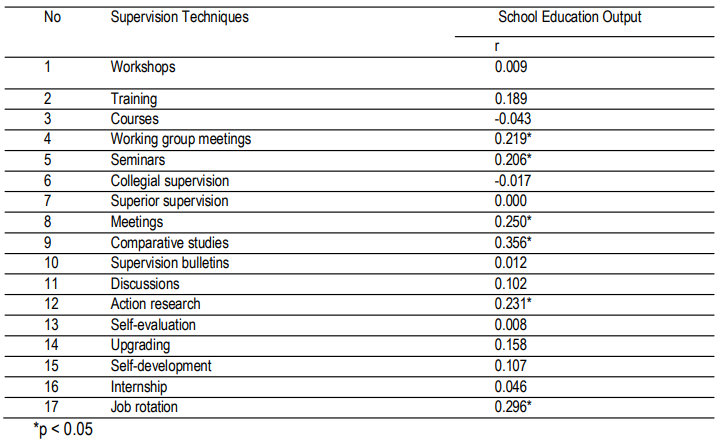
Based on Table 1, there are only six supervision techniques done by principals that have a significantly positive correlation with the school education output; namely working group meetings, seminars, meetings, comparative studies, action research and job rotation. Therefore, it can be concluded that these six techniques mentioned are the techniques that are proven to have a pretty strong correlation with the school education output. The higher the principals’ involvement in the working group meetings, seminars, meetings, action research, and activities in a comparative study, the more achievement reached by the schools is. The job rotation, as one of the elements of management, also has a significant correlation of the school education output. The principals, who have experienced in the job rotation, have a good experience. Therefore he will manage the schools better.
In addition, supervision techniques could be classified into three categories. They were the supervision done by the superiors, collegial supervision technique, and self-directed supervision. Furthermore, some examples of the supervision done by the superiors were workshops, training, courses, superior supervision, seminars, and upgrading. The examples of collegial supervision were comparative study, action research, internship, and job rotation. While self-evaluation, self-development, and supervision bulletins were included in the self-directed supervision technique. The results of the correlation analysis between the supervision techniques and the school education output are presented in Table 2.
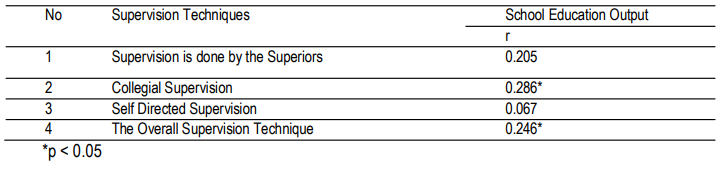
The data in Table 2 indicates that the overall supervision technique done by the principals has a significantly positive correlation with the school education output. Thus it can be concluded that the null hypothesis is rejected, and the alternate hypothesis is accepted. The higher the principals’ involvement during the supervision, the more achievement reached by the school. On the other hand, if it is seen based on the classifications among those three techniques, collegial supervision has the highest correlation coefficient.
The Effect of The Principal Management Quality on The School Education Output
The second research objective is to find out the effect of the principals’ management quality on the school education output. The quality of the principal's organizational management could be observed from five aspects, namely: (1) the educational program, (2) the quality of teachers, (3) the completeness of facilities,(4) the quality of administration service, and (5) the quality of learning process.
Generally, the results of the correlation analysis of the variables are presented in Table 3.
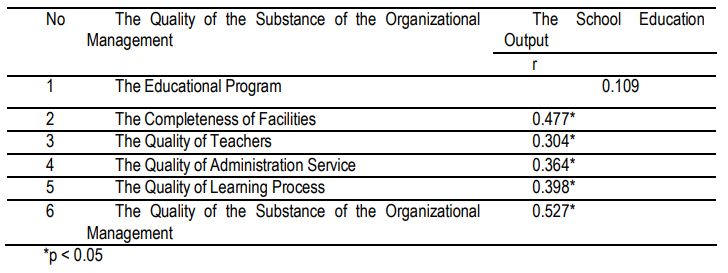
Based on Table 3, it is shown that there are four variables which are significantly positively correlated with the school education output; namely the quality of teachers, the completeness of facility, the quality of learning process, and the quality of administration service whereas, the variety of educational programs does not give significant impacts to the school education output. Thus, it can be concluded that the null hypothesis is rejected, and the alternate hypothesis is accepted. Moreover, the management component that has the highest correlation is the completeness of the facility, followed by the quality of the learning process, the quality of administration service, and the quality of teachers.
When it was thoroughly observed, the relation among the substance of organizational management also showed a significantly positive relationship. In general, the results are shown in Table 4.
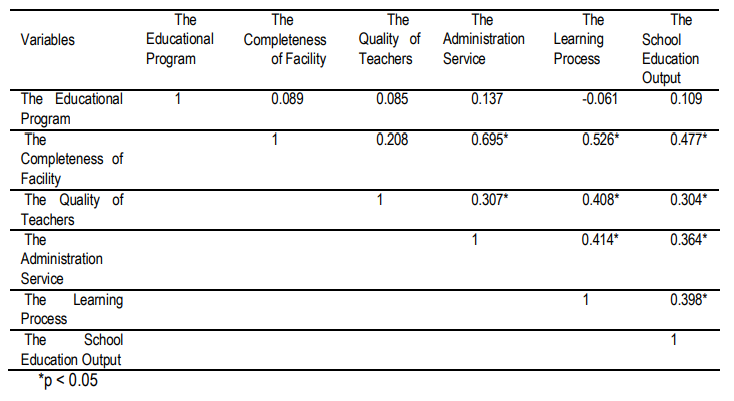
It can be concluded that all of the substance of school organizational management is connected to each other. The completeness of the facility also positively correlated with the quality of teachers, administration service, and learning process. If a school has complete facilities, qualified teachers, good administration service, and better learning process, the school will have better performance and will obtain more achievement. Moreover, the quality of teachers has a significantly positive correlation with the quality of administration service, learning process, and school education output. More achievement will be obtained if a school has qualified teachers, better administration service, and qualified learning process. Similarly, the administration service and the quality of learning process also has a significantly positive correlation with the school education output.
The Effect of The Principal Supervision and The Quality of Organizational Management Substance with The School Education Output
The correlation between the principal supervision and the quality of organizational management substance with the school education output obtained R-value of 0.563, R2 of 0.317, and p-value < 0.01. Thus, it can be concluded that there is a significant positive relationship between principal supervision and the quality of organizational management substance with the school education output, with the determination coefficient of 0.317. The more active the principal follows the supervision and better quality of the management substance, the better performance will be achieved by the school. The coefficients of correlation and beta values of each variable are presented in Table 5.

Based on Table 5, it can be concluded that both supervision technique and quality of organizational management substance influence the school management. Of both variables, the most influential one is the substance of organizational management. The value of predictive power (beta) of the principals who participate in supervision on the school education output is 0.200 or 20% while the value of predictive power (beta) of the quality of the substance of organizational management on the school education output is 0.508 or 50.8%. Thus it can be concluded that the null hypothesis is rejected, and the alternate hypothesis is accepted. There is an effective difference between the supervision and the quality of the organizational management on the school education output. The quality of the organizational management of the principals has a greater influence than the supervision to the school education output.
DISCUSSION
The result of this research indicates that there is a significantly positive correlation between the supervision done by the principals and the school education output. The more active principals participate in the supervisions, the more experience they will obtain. In addition to that, the better quality they have in managing their schools; thus, more achievement will be achieved by the schools. It is in line with Okendu’s study (2012) who also found out that there was a significantly positive correlation between the supervision taken by the teachers and the quality of learning process and the students’ achievement. Moreover, the results of this study are in agreement with Adewale’s research (2014a) that discovered that internal supervision was the best technique to increase the teachers teaching quality. Donkoh and Dwamena’s (2014) also showed that the development of teachers’ professionalism was influenced by the supervision they got. Similarly, Namunga (2017) found out that teaching supervision influenced the quality of the teaching and learning process. In addition to that, it can be determined that the results of this research have proven the results obtained in the previous studies. The more intensive the supervision to subordinates is, the better performance will be achieved; both teachers, administrative staff and principals.
The second result of this research shows that among the supervision techniques followed by the principals, there are six significant techniques; namely working group meetings, seminars, meetings, action research, comparative studies, and job rotations. However, previous studies discovered that there were numerous effective supervision techniques to enhance teachers’ performances. Wiyono et al. (2017) showed that there were seven effective supervision techniques. They were the classroom action research, the teaching demonstration, the working group meetings, the training, the seminars, and the clinical supervisions. The research was done by Adewale (2014b) also proved that there was a significantly positive impact of the class visit supervisions with the students’ academic achievement. It showed that supervision for teachers had different characteristic with the supervision for principals. The supervision for teachers mainly focuses on the improvement of the teaching process. Therefore there are numerous effective supervision techniques which positively influence students’ achievement whereas the supervision for principals emphasises on increasing principals’ skills in managing their schools. As a result, effective supervision techniques are also different.
If we examine further, there are six effective supervision techniques to improve the principals’ performances; namely working group meetings, seminars, meetings, action research, comparative studies, and job rotation. Those six techniques mentioned emphasise on the improvement of the management. Meetings are the most intensively implemented technique that focuses on the area of educational management. School action research, seminars, and comparative studies are held more to improve school management. Likewise, job rotation is one of the strategies used in human resource management to improve the performance of subordinates. Thus, it is also directly related to school management. Therefore, it is understandable that these techniques show significantly positive correlations.
One of the principal's supervisions that influences the school education output is job rotation. The result of this study is in line with the previous study done by Zin et al. (2013) which showed that the rotation influenced the employees’ career path. Oparanma and Nwaekel (2015) also discovered that rotation offered positive impacts on the employees’ performances and organization productivity. Similarly, Kaymaz (2010) found out that job rotation increase employees’ work motivation. On the other hand, the study done by Saravani and Abbasi (2013) showed that job rotation indirectly influenced the employees’ performances through work satisfaction and working skills.
In addition to that, meetings and comparative studies also give positive impact on school education output. Wiyono and Burhanuddin (2015) discovered that working group meetings affected the teachers’ teaching quality. Furthermore, the study by Wiyono et al. (2017) also found out that working group meetings had a significant effect on the teachers’ performances. If we observe from the classification, of the numerous supervision techniques, collegial supervision technique is the most effective one. This result is in accordance with the research done by Wiyono et al. (2015) which showed that collaborative supervision technique basedon humanistic principles, and emphasized on teachers’ activeness was the most effective one to improve the professionalism of teachers in performing tasks. Even though this research was applied for teachers, but the result that the most effective one was the collaborative supervision technique which focused on the teachers’ activeness is similar to the supervision for principals.
The next research result indicates that there is a significantly positive correlation between the substance of organizational management and the school education output. This finding is in line with the results of the previous studies. Moreover, the research result by Wiyono (2017) showed that the school management implementation applied by principals affected the educational quality in schools. The finding is also in accordance with the study of Fornaciari and Arbaugh (2017), which said that to assess the quality of education in schools is measured by not only the outcome but also the process. Oluremi (2013) found out that the principals’ management style, especially when motivating during teamwork, monitoring teachers, and participating in academic activities, influenced students’ performances. If it is compared with the supervision, the quality of organizational management gives significant effects on the school education output. It is also in line with Jawas study (2017) that indicated that leadership practices of principals for instructional improvement were influenced by school condition. Thus, the quality of organizational management is the very important resources that determine students’ achievement. In addition to that, students’ success is the main indicator to determine school education output.
CONCLUSION
The result of this study shows that the quality of organizational management substance significantly affects the school education output. The quality of organizational management substance has strong predictive power on the school education output. The organizational management substance is classified into two, namely resources and activities. Resources include human resources in particular teachers and facilities owned by the schools while activities consist of the teaching and learning process, including lesson planning and administration service. The results have indicated that all of the substances show significant correlations with the school education output. The more qualified organizational management schools have higher achievement than schools reach.
Furthermore, the supervision followed by the principals shows correlations with the school education output though it is not for all techniques. This can happen since the principals’ experience indirectly affects the school education output. Of the several supervisory techniques the principals have ever followed, the techniques that significantly influence are meetings, seminars, action research, comparative studies, and job rotations. This can be explained because the three supervisory techniques are directly related to the performance of the principals' management.
All the organizational management components, specifically human resources, materials, learning process, and administration services, show significant effects on school performance. The more qualified the organization management is, the higher school education output will be. The variables of the educational program did not show significant effects, presumably because the thing observed in this study was mainly on the frequency of preparation and variation of the programs. On the other hand, the process of preparation, content, and other aspects is not thoroughly reviewed; hence it shows less significant results.
Based on the findings of this study, the first step that should be done to improve the quality of educationin schools would be the increasing quality of school organization management. The supervision for the principals should be built-up, but the most appropriate technique has to be selected in order to improve the principals’ performance. The collaborative supervision technique is considered effective since it focuses on the attractiveness of the principals, and it also emphasizes on the management problems.
BIODATA
B.B WIYONO: is a professor in education. He is also a Dean of Faculty of Education Universitas Negeri Malang. He has conducted a number of studies on educational management and leadership, teaching and learning, and educational assessment. He has authored some books and many articles that published in some international journals on the topics.
BURHANUDDIN: is a Doctor in Educational Management. He is an active professional in the field of educational management and leadership. He is an active researcher and a trainer in numerous trainings for principals or teachers. He also.authored many books and published some articles in some international journals on the topics.
MAISYAROH: is a Doctor in Educational Management. She is a researcher in the field of educational management and supervision. She authored many books and published some articles in some national or international journals on the topics as well
BIBLIOGRAPHY
ADEWALE, OS (2014a). “Instructional Improvement of Secondary School Teachers Through Effective Academic Supervision by The Vice-Principals”. Journal of Education and Human Development, 3(2), pp.607- 617. http://jehdnet.com/vol-3-no-2-june-2014-abstract-36-jehd#j_menu
ADEWALE, OS (2014b). “The Positive Effect of Selected Technique of Instructional Supervision on Students’ Academic Achievement in Secondary Schools/High Schools”. International Journal of Humanities and Social Science Invention, 3(1), pp. 22-36. http://www.ijhssi.org/v3i1(version2).html
BEACH, DM & REINHARTZ, J (2004).”Educational Leadership, Changing Schools, Changing Roles”. Boston: Pearson Education Inc.
CASSEL, RN & SHAFER, AE (1961). "An Experiment in Leadership Training". The Journal of Psychology, 51(2), pp.299–305. https://doi.org/10.1080/00223980.1961.9916479
DEPARTMENT OF NATIONAL EDUCATION (2010). "Peraturan Menteri Pendidikan Nasional Nomor 28 Tahun 2010 tentang Penugasan Guru sebagai Kepala Sekolah/Madrasah (Regulation of the Minister of National Education Number 28 Year 2010 on Teacher Assignment as Principal)". Jakarta: Departemen Pendidikan Nasional.
DONKOH, KE & DWAMENA ED (2014). "Effects of educational supervision on professional development: perception of public basic school teachers at Winneba, Ghana". British Journal of Education, 2(6), pp.63-82. http://www.eajournals.org/journals/british-journal-of-education-bje/vol-2issue6november-2014/
DOU, D, DEVOS, G & VALCKE, M (2017). "The Relationships Between School Autonomy Gap, Principal Leadership, Teachers' Job Satisfaction and Organizational Commitment". Educational Management Administration & Leadership, 45(6), pp.959-977. https://doi.org/10.1177/1741143216653975
FERNANDES, HJX (1984). "Testing and Measurement". Jakarta: National Education Planning, Evaluation and Curriculum Development.
FORNACIARI, CJ & ARBAUGH, JB (2017). "Defining and Achieving Student Success at Non-Elite Schools". Organization Management Journal, 14(1), pp.7-21. https://doi.org/10.1080/15416518.2017.1293421
GLATTHORN, AA (1990). "Supervisory Leadership: Introductional Supervision". New York: Harper Collins Publishers.
GRASSO, P & HABER, D (2008). "A Leadership Training Program at A Senior Center". Activities, Adaptation& Aging, 20(2), pp.13–24. https://doi.org/10.1300/J016v20n02_02
HARRIS, A, BUSHER, H & WISE, C (2001). "Effective Training for Subject Leaders". Journal of In-Service Education. 27(1), pp.83–94. https://doi.org/10.1080/13674580100200139
HERNÁNDEZ G. de VELAZCO, Judith J; & CHUMACEIRO H., Ana C (2018). “Acercamiento histórico a la participación ciudadana en Venezuela: Modelo de relación Estado-Sociedad (1958-2012)”. Revista de Ciencias Sociales (RCS). Vol. XXIV, No. 2 , pp. 56-67.
JAWAS, U (2017). "The Influence of Socio-Cultural Factors on Leadership Practices for Instructional Improvement in Indonesian Schools". School Leadership & Management, 37(5), pp.500-519. https://doi.org/10.1080/13632434.2017.1366440
KAYMAZ, K (2010). "The Effects of Job Rotation Practices on Motivation: A Research on Managers in The Automotive Organizations". Business and Economics Research Journal, 1(3), pp.69-85. https://www.berjournal.com/the-effects-of-job-rotation-practices-on-motivation-a-research-on-managers-in- the-automotive-organizations
KOECH, PM & NAMUSONGE, GS (2012). "The Effect of Leadership Styles on Organizational Performance at State Corporation in Kenya". International Journal of Business and Commerce, 2(1), pp.01–12. file:///C:/Users/1dika/AppData/Local/Temp/0cf04a820e79fc0e8fcfa5e588b1b0be7916.pdf
KONYA, V, NASIC, LG & MATIC, G (2015). "The Influence of Leader-Member Communication on Organizational Commitment in A Central European Hospital". Acta Polytechnica Hungaria, 12(3), pp.109-128. file:///C:/Users/1dika/Downloads/The_Influence_of_Leader-Member_Communica.pdf
OKENDU, JN (2012). "The Impact of School Administrative Structure and Adequate Supervision on the Improvement of Instructional Processes". Academic Research International, 2(3), pp.497-504. http://www.savap.org.pk/journals/ARInt./Vol.2(3)/2012(2.3-61).pdf
OLUREMI, FO (2013). "Principals Organizational Management and Students Academic Achievement in Secondary Schools in Ekitistate Nigeri". Singaporean Journal of Business Economic and Management Studies, 2(2), pp.76-84. http://singaporeanjbem.com/VOL_2_(2)_SG.php
OPARANMAL, AO & Nwaekel, LI (2015). "Impact of Job Rotation on Organizational Performance". British Journal of Economics, Management & Trade, 7(3), pp.183-187. http://www.journalrepository.org/media/journals/BJEMT_20/2015/Mar/Oparanma732014BJEMT12051.pdf
RAMÍREZ MOLINA, R; LAY, N; AVENDAÑO, I & HERRERA, B (2018). “Liderazgo resiliente como competencia potenciadora del talento humano”. Opción. Revista de Ciencias Humanas y Sociales, 34(86), pp. 826-854.
RAMÍREZ MOLINA, R., ESPINDOLA, C., RUÍZ, G & HUGUETH, A (2019). “Gestión del Talento Humano:Análisis desde el Enfoque Estratégico”. Información Tecnológica, 30(6), pp. 167-176.
RAMÍREZ MOLINA, R., LAY, N & SUKIER, H (2020). “Gerencia Estratégica para la Gestión de Personas del sector minero de Venezuela, Colombia y Chile”. Información Tecnológica, 31(1), pp. 133-140.
ROSS, JA & GRAY, P (2006). "School Leadership and Student Achievement: The Mediating Effects of Teacher Beliefts". Canadian Journal of Education, 29(3), pp.798-822. https://files.eric.ed.gov/fulltext/EJ756123.pdf
SARAVANI, SR & ABBASI, B (2013). "Investigating the Influence of Job Rotation on Performance by Considering Skill Variation and Job Satisfaction of Bank Employees". Tehnički vjesnik, 20(3), pp.473-478. https://hrcak.srce.hr/index.php?show=toc&id_broj=8424
TSERETELI, M, MARTSKVISHVILI, K, & Aptarashvili, I (2011). "The Impact of Public High School Management System on Academic Achievement". Problems of Education in The 21st Century, 32, pp.121-128. https://www.jbse.webinfo.lt/Contents.PEC.Vol.32.pdf
VILLALOBOS ANTÚNEZ, JOSÉ VICENTE & GANGA, FRANCISCO (2016). “Bioética, dignidad eintertemporalidad de los Bioderechos Humanos”. In Revista de Filosofía. Vol. 83, Nº. 2: 7-24.
WIYONO, BB (2017). "The Effectiveness of The Implementation of Principals' Transformational Leadership in Motivating Teachers to Carry Out Their Profession Duties". International Journal of Learning and Teaching, 3(2), pp.144-147. http://www.ijlt.org/index.php?m=content&c=index&a=show&catid=123&id=577
WIYONO, BB (2017a). "The Effect of School Based Management Implementation on The Education Quality". Advanced Science Letters, 23(9), pp.8612–8616. https://doi.org/10.1166/asl.2017.9939
WIYONO, BB (2017b). "The Effect of Self-Evaluation on The Principals’ Transformational Leadership, Teachers’ Work Motivation, Teamwork Effectiveness, and School Improvement". International Journal of Leadership in Education, pp.1–21. https://doi.org/10.1080/13603124.2017.1318960
WIYONO, BB & BURHANUDDIN (2015). “Effects of The Meetings at Teachers’ Working Group on Teacher’s Teaching Quality”. Journal of Education and Sociology, 6(2), pp.53-63. https://doi.org/DOI:%20dx.doi.org/10.7813/jes.2015/6-2/12
WIYONO, BB, KUSMINTARDJO & SUCIPTO (2017). “The Effective Supervision Techniques That Influence Teacher’s Performance”. Man in India, 97(24), pp.25-33. http://serialsjournals.com/articles.php?volumesno_id=1371&journals_id=40&volumes_id=1060
WIYONO, BB, KUSMINTARDJO & IMRON, A (2015). “Effect of Humanistic Principles Based Active- Collaborative Supervision on Teachers’ Competence”. Acta Scientiai et Intellectus, 1(3), pp.19–26. https://www.actaint.com/form.php?go=october-2015
YUKL, GA (2002). “Leadership in Education. Upper Saddle River: Prentice Hall, Inc”. https://books.google.co.id/books/about/Leadership_in_Organizations.
ZIN, MLM, SHAMSUDIN, FM & SUBRAMANIAM, C (2013). “Investigating The Influence of Job Rotation on Career Development Among Production Workers In Japanese Companies”. International Journal of Business and Society, 14(1), pp.135-148. https://www.questia.com/library/journal/1P3-2989433331/investigating-the- influence