Artículos
Entrepreneurs’ Specific Value Orientations into the Business-Family Sphere
Orientaciones específicas de valores de los emprendedores en el ámbito empresarial-familiar
 JULIA SERGEEVNA MURZINA juliamurzina@bk.ru
VLADIMIR PETROVICH POZNIAKOV vladimirpozniakov@mail.ru
ELENA ALEXANDROVNA MENSH elena.a.mensh@yandex.ru
JULIA SERGEEVNA MURZINA juliamurzina@bk.ru
VLADIMIR PETROVICH POZNIAKOV vladimirpozniakov@mail.ru
ELENA ALEXANDROVNA MENSH elena.a.mensh@yandex.ru
Entrepreneurs’ Specific Value Orientations into the Business-Family Sphere
Utopía y Praxis Latinoamericana, vol. 25, no. Esp.10, pp. 396-409, 2020
Universidad del Zulia

This work is licensed under Creative Commons Attribution-NonCommercial-ShareAlike 4.0 International.
Received: 30 August 2020
Accepted: 25 October 2020
Abstract: This article is devoted to the study of the specific value orientations of Russian entrepreneurs concerning their families and business. Finally, 93 values were identified. Terminal values turned out to be more differentiated in the sphere of business; family values had undivided meanings, and merged with the self-image. An analysis of the instrumental values of family and business showed that they repeat each other by a quarter; otherwise, they were subject-specific. The article proposes a projective technique: the proprietary structure of in- depth interviews, based on prototypical situations that are symmetrical in the life cycle of an organization and a family.
Keywords: Entrepreneurial orientation, Family business, M. Rokeach method, Russian entrepreneurship, Value orientations..
Resumen: Este artículo está dedicado al estudio de las orientaciones específicas de valores de los empresarios rusos con respecto a sus familias y negocios. Finalmente, se identificaron 93 valores. Los valores terminales resultaron ser más diferenciados en el ámbito de los negocios; los valores familiares tenían significados no divisibles y se fusionaban con la autoimagen. Un análisis de los valores instrumentales de la familia y la empresa mostró que se repiten en una cuarta parte; de otra manera, serían específicos del tema. El artículo propone una técnica proyectiva: la estructura propia de las entrevistas en profundidad, basada en situaciones prototípicas que son simétricas en el ciclo de vida de una organización y una familia.
Palabras clave: Emprendimiento ruso, empresa familiar, método M. Rokeach, orientación emprendedora, orientaciones en valores..
INTRODUCTION
At the beginning of 2020, the COVID-19 pandemic came to our world. For the sake of saving human lives, many states have taken unprecedented measures to limit the personal freedoms of citizens to reduce the number of their contacts. As a result, many private enterprises were forced to suspend their operation. Increased unemployment, social tensions and criminalization could be disastrous consequences of such restrictions. However, comprehensive measures (grants for salary payment to employees, deferral of insurance premiums and taxes, deferral of rental payments, etc.) taken by the Government of the Russian Federation to combat coronavirus infection and support the economy have made positive adjustments to this process (small business website, RF Government). Nowadays, the Government is actively working to create a national action plan to restore economic growth, employment and incomes of the population. For this plan to ensure the entry of the Russian economy a growth trajectory, the Government is consulting with representatives of the expert and scientific community, including Russian universities and entrepreneurs. According to the First Deputy Prime Minister of Russia Andrey Belousov, the investment measures together with social measures (support for vulnerable segments of the population), as well as actions to restore the affected sectors of the economy and SMEs will be a core of the national plan; this action plan also makes provision for digitalization and technological development. Thus, one of the priority tasks of the Government is to provide the restoration and growth of small business.
In addition to emergency measures for the economy support, the National Project “Small and Medium- Sized Entrepreneurship and Support for Individual Entrepreneurial Initiatives” does not lose its relevance. The proposed measures are primarily focused on external, financial and infrastructural amendments, which is certainly important. However, while rendering assistance to everyone, there is a high degree of probability that the money will be spent on those companies whose owners did not plan to carry out business activities in the future. Therefore, the questions arise as to which businesses are really promising and whether their support is justified? And which enterprises are already “living last days” in the plans of their owners, so that adaptation and business development in the new economic realities is simply impossible due to the limited or inflexible ideas of their founders?
In connection with the questions posed, the search for answers passes to the sphere of economic and social psychology, within which we must turn to the study of the axiological peculiarities of entrepreneurs. Since values are at the same time ideals, norms, and criteria for evaluating relationships, their study becomes a mechanism for “designing” a new social and economic reality. The investigation of business owners’ value orientations (VO) as regulators of activities can be used in the future to predict the stability of the existence of enterprises, ensuring the adaptability of the business strategy to new external challenges and threats. Considering the possibilities of digital psychology and big-data technology, the analysis of entrepreneurs’ digital footprint allows such studies to be carried out already at present (Murzina & Poznyakov: 2018, pp.6- 21). However, the transfer to the digital format requires primarily in-depth qualitative research enabling to create more accurate research tools and put forward hypotheses.
Currently, there is a problem of psychological study of entrepreneurs’ VO, associated with the fact thatthe tools used either have a sociological background or have a wide context – as meaningful variables of the technique – not related to the specifics of entrepreneurial activities. In view of this, there is no possibility for a deeper study of the peculiarities of the entrepreneurs’ axiological sphere. In addition, it is important to take into account the fact that small business is closely intertwined with the family in its functioning, therefore, the study of entrepreneurs’ VO should be carried out in these two areas. Thus, this research will be aimed at reconstructing the specific features of entrepreneurs’ VO with regard to family and business.
The objectives of the research include:
- 1. - Conducting a theoretical analysis of the study of entrepreneurial orientations (EO) and entrepreneurs’ value orientations (VO);
- 2. - Justifying the use of a proprietary projective tool for the VO research;
- 3. - Collecting data on business owners using in-depth interviews; 4 - Selecting the most significant VOs by frequency analysis;
- 4. - Selecting the most significant VOs by frequency analysis;
- 5. - Comparing the results obtained with M. Rokeach methodology, identifying the general and specific VOs of entrepreneurs.
LITERATURE REVIEW
Entrepreneurial orientation
The concept of entrepreneurial orientation (EO) is quite often used in psychological research today. While describing a close psychological reality, this concept is not a direct synonym for the phenomenon under study, since it correlates with personality traits, or with a behavioral attitude. Nevertheless, this is an important theoretical construct for our study. Let us consider it in more detail.
Miller (1983) proposed the concept of entrepreneurial orientation (EO) based on the definition of an entrepreneurial firm. He stated that “an entrepreneurial firm is one that engages in product-market innovation, undertakes somewhat risky ventures, and is first to come up with ‘proactive’ innovations, beating competitors to the punch”. Covin and Slevin (1989) have built a scale to measure the EO, which comprises three dimensions: risk-taking, innovativeness, and proactiveness. Lumpkin and Dess (2001) expanded it by adding two more dimensions: autonomy and competitive aggressiveness. It is believed that the proactiveness, innovativeness and risk-taking dimensions are the most relevant to an EO. Proactiveness is an opportunity- seeking forward-looking perspective that includes opportunity identification, recognition, evaluation and exploitation. Schumpeter described innovativeness as “a firm’s tendency to engage in and support new ideas, novelty, experimentation, and creative processes that may result in new products, services, or technological processes” (Lumpkin & Dess: 1996, pp.135-172). Risk relates to the uncertainty and potential gains or losses associated with a set of outcomes and strategies. There is often a tendency to take greater risks in return for greater potential rewards.
Later some modifications of this scale were proposed. One of them is the scale of Hughes and Morgan, who used eighteen items to measure the dimensions of entrepreneurial orientation and five items to estimate the business performance of firms at the embryonic stage of development. They have found that uniform effort in all EO dimensions does not generate consistent gains in business performance, and it is essential to organize activities around proactiveness and innovativeness for securing improved performance for such firms (Hernández et al.: 2009; Villalobos: 2015; Kusa, 2016).
Anderson and Covin (2014) focus on the issue of whether EO is an attitudinal construct, a behavioral construct, or both. They propose a formative construction of EO viewing the exhibition of entrepreneurial behaviors and of managerial attitude towards risk as jointly necessary dimensions that collectively form the higher-order EO construct. They present an empirical illustration of our reconceptualization followed by a discussion of future research opportunities.
Developing the idea of EO, Lindsay and Kropp (2015) examine entrepreneurial orientation and values at the individual level. They show the difference in values between entrepreneurs and non-entrepreneurs. It represents an initial effort at developing an Individual Entrepreneurial Orientation (IEO) scale and comparing values of people who had started a business to those who had not.
Santos et al. (2020) demonstrate two emerging dimensions of IEO: passion and perseverance in addition to three core dimensions – risk taking, innovativeness and proactivity. The study shows that these individual characteristics have implications for entrepreneurs as all five dimensions influence firm management through entrepreneurial orientation.
Chih-Hsing and Chiung-En (2020) point out that social mission may influence proactiveness through the mediating mechanisms of innovativeness and effectual and sustainability orientations. Specifically, appropriate risk management is more beneficial for strengthening the relationships between sustainabilityorientation and proactiveness. They describe social entrepreneurial orientation (SEO) as a critical dynamic capability of firms that guides their strategies for achieving market and value co-creation. In particular, social entrepreneurial self-efficacy positively moderates the different relationships among proactiveness, market orientation and value co-creation.
Another approach to explaining the success in entrepreneurship was suggested by Bacq et al. (2016). They confronted the taken-for-granted moral portrait depicted in the extant literature and popular media of the devoted social entrepreneurial hero with a priori good ethical and moral credentials. The authors pointed at reluctant attitude of social entrepreneurs toward entrepreneurship in terms of confidence in their skills to start and manage a business, their perception of entrepreneurship as a desirable career choice and their involvement in their activities.
Additionally, the study by Blumberg (2006) showed that entrepreneurs had a basis for forming a social identity, which was more based on distinction from people in paid labor than on commonality. The study also revealed that the social identity of entrepreneurs was based on conservative values and a resistance to change.
At the same time some scholars argue that entrepreneurial judgment and risk-taking are crucial for entrepreneurial success. The authors claim that entrepreneurs develop different preferences for risk and prediction and their decisions reflect these preferences. The origins of the initial strategic orientations of founders can be traced back to the founders’ individual prior work experiences and perceptions of the new firm’s environment (Markowska et al.: 2019, pp.859–878).
Entrepreneurial judgments are connected to top management’s choices regarding strategic emphases as an important component of firms’ success (Wang et al.: 2020, pp.151-164). The authors examine the relationship between management’s entrepreneurial orientation and its relative strategic emphasis on value- creation versus value-appropriation.
Value orientations of entrepreneurs’ personalities
The value orientations of personality are the subject of our research. The concept of “value-based orientation” originates from the concept of “value”. In the sociological aspect, values are standards or regulators of activity. It is customary to subdivide them into values-norms, values-ideals, values-goals, values- means, etc.
The construct of values was introduced into psychological science by Gordon Allport in 1931. In his theory, Allport relied on the identification of three types of dispositions: cardinal (highly generalized, permeating all actions), central (building blocks of personality, 7-9 characteristics) and secondary (situational, less stable, less generalized). Allport believed that a mature person creates his own philosophy of life based on values. As a result, he created a personality test that, in the context of trait theory, described personality values and measured them. The identified six types of value-based orientations are inherent in all people to varying degrees. These orientations – economic, theoretical, aesthetic, social, political, and religious – are pivotal in human life. For entrepreneurs, accordingly, the economic value-based orientation is the key one.
During the next 40 years, psychology paid relatively little attention to the study of values. Milton Rokeach gave a new impetus to value research and until now, his method is prevalent in economic psychology when analyzing the value-based perceptions of entrepreneurs. In Rokeach concept, value is “an enduring belief that a specific mode of conduct or end-state of existence is personally or socially preferable to an opposite or converse mode of conduct or end-state of existence” (Rokeach: 1968). The value system is a hierarchically ordered construction. Values are divided into terminal (preferred, ideal states of existence, end-state of existence) and instrumental (preferred modes of conduct). At the same time, within these groups, terminal values are subdivided into 1) concrete and abstract ones, 2) values of professional self-realization and the values of personal life. Instrumental values are subdivided into ethical, communication, and business values; individualistic, conformist, and altruistic values; values of self-affirmation and values of acceptance of others.
The group of professional self-realization values includes five values: proactive life, interesting work, social recognition, productive life, and development. The group of personal life values also includes five values: love, good and faithful friends, freedom, happy family life, and pleasures.
According to Schwartz, the Professor at Hebrew University, Israel, and the author of the Schwartz Value Scale (SVS) methodology, the value model represents two axes of measurement, where people’s orientations are concentrated at four poles. The first axis “Social aspect” divides orientation toward innovation and changes, and orientation toward preserving the existing society and its traditions. The second axis “Behavioral aspect” opposes orientation toward other people and consideration of their interests, and orientation toward oneself and striving for one’s own self-realization. According to these orientations, core values are grouped into four sectors (Schwartz: 1992, pp.1–65). Schwartz’s methodology is often used by foreign colleagues to study entrepreneurs’ value orientations.
There has been an increase in the number of psychological value studies in the scientific literature over past three decades (Schwartz: 2012). However, these researchers are more focused on cross-cultural comparison of the content, structure, origin and influence of different value models in cultural contexts.
Cross-cultural studies attempt to identify business owners’ value orientations in different countries that help them run their business successfully (Iaia et al.: 2019, pp.1442-1466). Also, in these publications, a comparison is made between family and non-family firms, their differences and advantages are sought for. These studies provide an insight into the strategic management of family businesses, where, in accordance with the economic and legislative environment, families must plan their actions and choose the best path for development.
Business owners’ VOs are also studied in terms of the impact of religious beliefs on business. These publications help understand whether there is a relationship between religious and spiritual beliefs and sustainable ethical conduct in business (Kavas et al.: 2020, pp.689–700; Astrachan et al.: 2020, pp.637–645; Barbera et al.: 2020, pp.661–673; Abdelgawad et al.: 2020, pp.775-787).
Problem of methods: How to study entrepreneurs’ VO
M. Rokeach methodology, developed in the early 1970s, is still the key one in Russia in the study of the value orientations of individuals, including entrepreneurs. However, in the literature, one can find criticism of this approach associated with the high abstractness of the proposed values and the low reproducibility of results during re-testing. From our point of view, classical theories of values (proposed by Rokeach, Schwartz, Hoftede, Inglehart and others) are more suitable for comparative intercultural, and ethno-psychological studies (examples of such works: Schwartz: 2015), rather than for an in-depth study of a specific social group – a group of entrepreneurs in our case.
Turning to the content of the M. Rokeach methodology, we should note that it includes only five values related to professional self-realization: proactive life, interesting work, social recognition, productive life, and professional development. The category “personal life” also includes five values: love, true friendship, freedom, family security, and pleasure. Is it possible using ten variables to describe all the diversity of the axiological sphere of the entrepreneur’s personality? We think that such a description would be too general.
We assume that representatives of a particular social group, in addition to general, universal valueorientations, have specific ones, associated with the peculiarities of their professional activities and life in general. In this regard, we put forward a research hypothesis: there are specific value orientations of entrepreneurs in the sphere of family and business.
To verify this hypothesis, we have constructed a deep projective interview, the content of which is based on the following theoretical concepts.
Justification of the authors’ approach to the research
Berger and Luckmann (1966) write that the reality of everyday life contains typification schemes, and their language enables to understand this reality. A person’s awareness of a particular situation implies theexistence of “recipes” for activities necessary to achieve practical goals, and “recipes” for relationships that are necessary for solving everyday problems. These schemes are focused on explaining and predicting typical situations of everyday life, they rely on ideas about existing connections and patterns.
Kagan (1997) points out that the application of E. Haeckel’s biogenetic law is an important methodological principle of constructing modern axiology; according to this law, the development of individuals naturally repeats the stages of the species’ development. A person gains peace and integrity, merging with others. Thus, people desire to restore the WE-being in a family where everyone has the same surname and strive to gain the lost integrity. In the organization the desire of the leaders to protect themselves by hiring their relatives implies the desire to gain integrity, to be as one person: the employees’ uniform, the flag, and the logo of the organization. All these factors manifest the deepest need of a person (leader) in WE-being (Kagan: 1997).
As noted by Zdravomyslov (1986), the specificity of the action of value orientations lies in the fact that they are rooted primarily in the subconscious structures of the psychic setup. Smirnov (2002) believes that it is necessary to turn to unconscious layers of the mentality for the study of values. However, the majority of cutting-edge techniques are aimed at identifying the conscious part of ideas, that is, perceived values. In this regard, the distinction between perceived personal values and poorly reflexive value formations is the difficulty in axiometry. This problem can be solved by projective techniques.
METHODS
Trying to overcome the limitation of the Rokeach methodology described above, earlier in our publications we justified the identification of situations-stimuli that are repeated both for the family and for business (Murzina: 2019, pp.225-230). Thus, the description of the life cycle of social systems allowed us to fix three prototypical situations: “birth”, “development”, and “death”. The socio-psychological processes of group dynamics in a small group enabled us to single out three additional prototypical situations: “cooperation”, “leadership”, “conflict resolution”.
Russian entrepreneurs – micro and small business owners – were the object of our empirical study, and content-related peculiarities – entrepreneurs’ value orientations in the sphere of family and business were the subject of our research.
The study sample consisted of 51 people, including 21 males and 30 females; 92% are representatives of the Russian ethnic group. The variables taken into account were: education, religion, marital status, number of children, age, size, sphere and region of business operations.
Data collection was carried out by four qualified interviewers with psychological education (participants of a scientific project supported by the grant of the Russian Foundation for Basic Research) from March 15 to April 25, 2019. Eighty percent of the interviews were carried out in personal contact with the testees, the remaining participants were interviewed by phone (this type of survey was possible only in case of a direct acquaintance with the respondent). The duration of the interview ranged from 40 minutes to 2.5 hours.
Following Milton Rokeach (1968), we assume that within a certain social sphere it is possible to distinguish terminal values (ideal states of existence, or end-state of existence) and instrumental values (preferred modes of conduct). To highlight terminal values, we added another one to the six stimulus situations described above: “sense for myself”. The respondents’ answers to this particular situation will be distinguished by us in the block of “Terminal values”.
Thus, we identified six situations that are stimuli within the framework of a projective individual interview aimed at the reconstruction of entrepreneurs’ value orientations in the sphere of family and business. In accordance with the rules for conducting an in-depth interview, after establishing a confidential psychological contact with the testees, they were asked to recall and describe the real situation, according to prototypical situations Nos. 1-14 (table 1). At first the testees had to tell how their business was created (No. 1). In the process of answering – describing a life situation – the interviewer asked the key questions “Why?”, “Whatwas the most important thing in this situation?”, “What was the main conclusion you made at that moment?” The choice of the key question was determined by the logic of the conversation, the main requirement for which was naturalness and ease. The survey was conducted sequentially by the spheres: business (No. 1– 7), and family (No. 8–14).
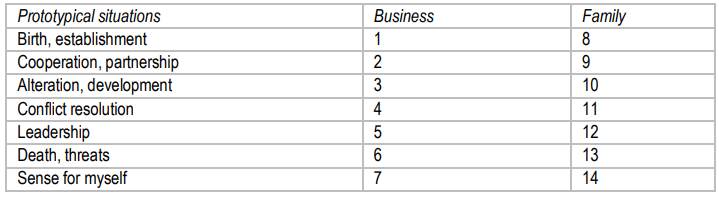
The testees’ responses recorded in the protocols were transferred to the network version of Google-doc, and after that they were subject to processing using the MS Excel software package.
Limitation and study forward
This study has a limitation in terms of the number of samples and the geography of data collection. Business owners are a rather closed group of testees who are reluctant to take part in surveys, especially in in-depth interviews. The geography of data collection is represented mainly by the north-eastern part of Russia, the central regions are in the minority. The researchers plan to work out and formalize the procedure for interviewing testees, while maintaining the logic for comparing prototypical situations of family and business; to expand the geography of data collection, and standardize the methodology. It will be fundamentally important to establish the relationship between the value orientations of business owners with the success of their entrepreneurial activities and the life span of the business.
RESULTS
To verify the hypothesis about the existence of a specific set of entrepreneurs’ value orientations in the sphere of family and business, the units of analysis (phrases and individual words expressed in the form of nouns and verbs, in quantitatively comparable terms) were identified from the respondents’ answers to open questions of the author’s projective technique -.
Table 2 presents the identified entrepreneurs’ value orientations in the sphere of family and business, whose frequency of mention by respondents exceeded 10%, that is, in absolute terms – more than 5 people out of 51 mentioned this value. For reference, we should note that the total number of identified value variables was 213 units.

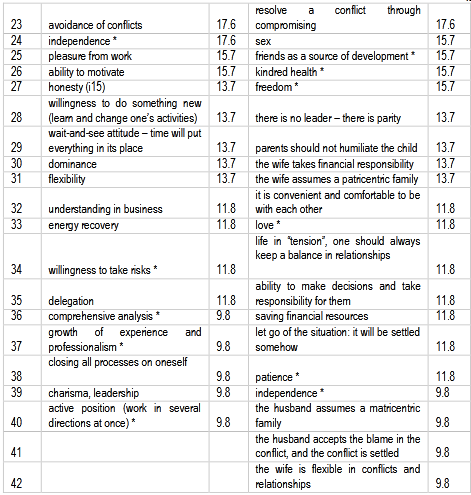
Notes: * - denotes the assignment to the list of terminal or instrumental values in the Rokeach methodology. The boldface type is used in the table for easy detection of coincidences.
DISCUSSION
As mentioned above, we have designed a stimulus situation “sense for myself” to highlight terminal values. The identified values are presented at the beginning of Table 2: they reflect the main meaning of the family and business existence. It can be seen that this kind of values is more differentiated in the business sphere. Entrepreneurs are more aware of the reasons why they created a business and verbalize these reasons, while the family for them represents a poorly understood, archaic level of relationship. In the sphere of business, we can see that business for the sake of profit leads with a great advantage, then with a dying effect: ambitions, self-development, freedom, creativity, and game. The sense of creating a family is: my family is everything for me, a rearward area, and the basis of the entire life. No pragmatic motives are observed: for example, protection, perpetuation of oneself, economic benefit, etc. On the contrary, there are undivided senses – merging with the self-image: family is my everything.
It is easier to study terminal values of business, and, consequently, it is easier to create and change them (for example, when forming corporate culture). While family values are poorly reflected, probably because oftheir deep archetypical roots, and, as a result, they are poorly reconstructed. Therefore, it is more complicated to study and change them.
At the same time, almost half of entrepreneurs noted the priority of family over business. This is a positive trend that finds its confirmation in foreign practice. According to the eastern tradition, the family is the main value: family concerns determine the nature of decisions in business. This principle “Family comes first, business comes second” is the most popular in small business in China.
The content analysis of the values presented by us (Table 2) shows the functional difference in instrumental values. Business values are "I-values": the values of the owner's personal development and the values of change and growth. The values of the family are "WE-values." They are aimed at loved ones, relationships with them, maintaining the integrity and stability of the family as a system. It is interesting to note that in the field of "business" the category of instrumental "wealth values" is not represented. However, turning to the terminal values we see that money has the most significant meaning for the existence of a business. At the same time, in the field of "family" these values become of instrumental level, which indicates their secondary importance. The expression "with one's beloved, even a hut is heaven" found its explanation. For the prosperous existence of a family, money is an "instrument" for achieving the goals, but the true meaning of the family's existence is to receive protection, be accepted and supported. It is confirmed by such terminal values identified during our study as "my family is my back, my foundation, my everything".
Analyzing the level of instrumental values in the sphere of business, we can note that our results fully reflected the EO model (Miller, 1983): risk taking (No.34 – willingness to take risks), innovativeness (No.28 – willingness to do new things, learn and change one’s activities) and proactivity (No.40 – active position, work in several directions at once). Moreover, additional EOs proposed by Santos et al. were also confirmed: two emerging dimensions of IEO: passion (No. 25 – pleasure from work) and persistence (No.10 – perseverance, dedication). At the same time, the measurements of Lumpkin and Dees (1996) were only partially confirmed: autonomy was reproduced in No.24 – independence, but competitive aggressiveness was not revealed. On the contrary, there are substantively opposite VOs: No. 29 – wait-and-see attitude, time will put everything in its place” and No.17 – not striving for business development (work without strain). From our viewpoint, these differences can be explained by the specificity of the Russian mentality: the spirit of collectivism (as opposed to competitive aggressiveness) and slowness. The differences in these variables indicate that even in a market economy, entrepreneurs are more likely to take a wait-and-see attitude rather than an aggressive conquest.
Next, let us present a content-related analysis of instrumental value orientations between business and family. Thus, the following value orientations became common for these two areas: 1) flexibility of behavior, adaptability, 2) the nature of relationships (trust, openness/distance, closeness), 3) dominance, 4) avoidance of conflicts, 5) imposition of financial responsibility, 6) independence, 7) decency and honesty, 8) development, 9) freedom, and 10) resource saving. The resulting intersections tell us that the family and business values repeat each other by about ¼ (10 out of 42, according to Table 2). In all other respects, value variables are subject-specific. At the same time, it is easy to notice that they have a substantial similarity with the Rokeach list of values.
Now, we turn to a comparison of the results obtained. In table 2, next to the specified value orientations, an index is indicated in brackets – showing the correspondence of this element to the list of terminal (t) and instrumental (i) values according to M. Rokeach (1988).
As can be seen from Table 2, in some cases there is complete coincidence (for example, for such values as love, responsibility, development, freedom), in other cases this coincidence is partial (for example, life wisdom, strong will, open-mindedness), when the testees reproduced substantively similar elements with equivalent meaning.
Thus, the Rokeach values coincide by 78% with our results (28 out of 36 values coincided). However, the following eight values have not received their confirmation: 1) the beauty of nature and art, 2) social recognition, 3) the happiness of others, 4) self-confidence, 5) accuracy, 6) intolerance of the shortcomings ofothers, 7) self-control and 8) sensitivity. It may mean that this particular semantic form was not actualized in the context of our research, or, in view of the small number of such responses, they were excluded as “subthreshold”, meaning that they received less than 10% of references.
The analysis of the structural coincidence of the identified value elements is presented in Fig. 1
As can be seen in Figure 1, in the current study most of the reconstructed value orientations correspond to the category of “subject-specific” ones (65 out of 93 units). This fact shows that the spheres of family and business have a number of special value variables that are typical to this particular sphere. Therefore, the use of only universal, uniform variables to study differences in the axiological structure can lead to the “insensitivity” of the research instrument, and its low predictive validity.
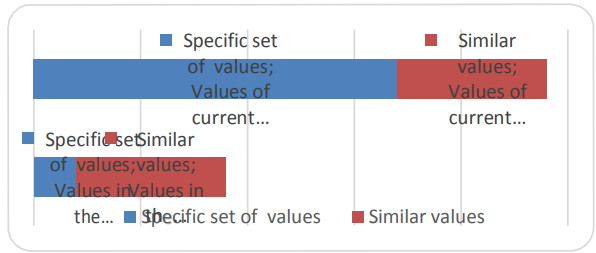
Figure 1. Comparison of the structure of identified values, units.
Thus, the formation of certain ideals, norms and criteria for evaluation makes the mechanism for “designing” a new social reality in the business community. At this stage of the study, we have reconstructed the content of entrepreneurs’ value orientations in two spheres of life. The conducted research made it possible to confirm the hypothesis put forward about the existence of specific value orientations of entrepreneurs in the family and business.
CONCLUSION
In this research, an attempt was made to go beyond the classical methodology of Milton Rokeach, which is a key one in studying value orientations of a person, and to offer a more subject-specific list of terminal and instrumental values. Therefore, the goal of our research was to reconstruct the system of value orientations of small business owners in the sphere of family and business.
The hypothesis about the existence of a specific set of entrepreneurs’ value orientations in the sphere of family and business has found its confirmation. With the help of the developed author’s in-depth interview, 11 terminal values and 82 instrumental values were identified that describe the sphere of family relations and business (with a frequency of mention exceeding 10%). Their content includes most of the list of Rokeach values (direct or indirect coincidence), in other respects the values that we identified have characteristic differences. This made it possible to confirm the hypothesis put forward.
The research results can be used to study the generality and differentiation of the axiological sphere of entrepreneurs depending on the success of their economic activities, forms of management/ownership (family and non-family business), life motivation, religious affiliation, etc.
The presented article is the first step towards describing the specifics of the value orientations of businessowners. An in-depth study of the mechanisms of designing social reality through the formation of the axiological sphere of certain social groups will create an internal resource for the development of small business in Russia.
Acknowledgement
The research was carried out with a financial support of the Russian Foundation for Basic Research (RFBR); Grant No. 19-013-00869.
BIODATA
J.S. MURZINA: is PhD (candidate of psychological sciences) in Psychology (specialty: social psychology), an associate professor of Department of General and Social Psychology in University of Tyumen (Tyumen, Russian Federation). The author substantiates the use of the psychosemantic approach to the study of social relations of the individual. As a part of the dissertation work (2003), a psychosemantic toolkit was developed for studying the ideas about the nature and acceptable ways of organizational interaction. The typology of implicit theories of organizational interpersonal relations is built, the most effective type is highlighted. Currently, Yulia Murzina specializes in the study of the real economic behavior of individuals (representatives of small and medium family businesses). There are numerous publications on the psychology of family business, including 2 articles from the Scopus database. In addition, Yulia Sergeevna has extensive practical experience in real business as a HR Director (from 2004 to 2013) and experience in her own small business. Research interests: Social psychology, entrepreneurship psychology, psychology of family business, psychology of family and family relations, psychology of creativity.
V.P. POZNIAKOV: is a doctor of psychological Sciences (specialty: social psychology), professor, Leading research fellow in the Institute of Psychology the Russian Academy of Sciences (Moscow, Russian Federation), member of the International Academy of Psychological Science (Yaroslavl, Russian Federation).V.P. Poznyakov developed the concept of psychological relations between individual and group subjects of joint life, within the framework of which a series of theoretical and empirical studies of the dynamics of psychological relations between an individual and a group were carried out in the context of changing forms of ownership and socio-psychological characteristics of Russian entrepreneurs. He has published over 300 scientific papers, including textbooks and monographs on social and economic psychology. Research interests: Social psychology, labor psychology, organizational and economic psychology, entrepreneurship psychology, psychological relations, psychology of business interaction.
E.A. MENSH: is the Head of the Department of Foreign Languages and Intercultural Professional Communication in University of Tyumen. Graduated from the department of Foreign Languages and the department of Psychology. Professional and researh interests are intercultural communication, the art of teaching English and psychology. Now is studying the values of entrepreneurs, and how they can combine success in business and harmony in the family.
BIBLIOGRAPHY
ABDELGAWAD, S & SHAKER, Z (2020). “Family firms’ religious identity and strategic renewal”. Journal of Business Ethics, 163(4), pp.775-787. https://doi.org/10.1007/s10551-019-04385-4.
ANDERSON, B. S., & COVIN, J. G. (2014). Entrepreneurial orientation: disposition and behavior. In Handbook of Research On Entrepreneurship. Edward Elgar Publishing.
ASTRACHAN, JH, BINZ ASTRACHAN, C, CAMPOPIANO, G & MASSIMO, B. (2020). “Values, Spiritualityand Religion: Family Business and the Roots of Sustainable Ethical Behavior“. J Bus Ethics, 1(6), pp.637– 645. https://doi.org/10.1007/s10551-019-04392-5
BACQ, S, HARTOG, C & HOOGENDOORN, B (2016). “Beyond the Moral Portrayal of Social Entrepreneurs: An Empirical Approach to Who They Are and What Drives Them”. J Bus Ethics, 13(3), pp.703–718, https://doi.org/10.1007/s10551-014-2446-7
BARBERA, F, SHI, HX, AGARWAL, A & EDWARDS, M (2020). “The family that prays together, stays together: Toward a process model of religious value transmission in family firms”. Journal of Business Ethics, 1(5), pp.661–673, https://doi.org/10.1007/s10551-019-04382-7.
BERGER, PL & LUCKMANN, T (1966). “The Social Construction of Reality”. A Treatise on Sociology of Knowledge. Penguin.
BLUMBERG, BF (2006). “What Distinguishes Entrepreneurs? A Comparative Study of European Entrepreneurs from a Social Identity Perspective. In: Achleitner AK., Klandt H., Koch L.T., Voigt KI”. (eds) Jahrbuch Entrepreneurship 2005/06. Springer, Berlin, Heidelberg. https://doi.org/10.1007/3-540-28361-7_9
CHIH-HSING, SL & CHIUNG-EN, H (2020). “Discovering differences in the relationship among social entrepreneurial orientation, extensions to market orientation and value co-creation – The moderating role of social entrepreneurial self-efficacy”. Journal of Hospitality and Tourism Management, 4(2), pp.97-106. https://doi.org/10.1016/j.jhtm.2019.12.002
COVIN, J. G., & SLEVIN, D. P. (1989). “Strategic management of small firms in hostile and benign environments”. Strategic management journal, 10(1), 75-87.
HERNÁNDEZ de VELAZCO, Judith ; CHUMACEIRO H., Ana C. & Atencio, Edith (2009).” Quality of service and human resources: Case study of a department store”. Revista Venezolana de Gerencia, 14(47), 457– 470.
IAIA, L, VRONTIS, D, MAIZZA, A, FAIT, M, SCORRANO, P & CAVALLO, F (2019). “Family businesses,corporate social responsibility, and websites: The strategies of Italian wine firms in talking to stakeholders“. British Food Journal, 121(7), pp.1442-1466.
KAGAN, MS (1997). The Philosophical Theory of Value. Petropolis (in Russ.).
KAVAS, M, JARZABKOWSKI, P & NIGAM, A (2020). “Islamic Family Business: The Constitutive Role of Religion in Business”. J Bus Ethics 163, pp.689–700. https://doi.org/ 10.1007/s10551-019-04384-5
KUSA, R. (2016). Measuring entrepreneurial orientation in the social context. Entrepreneurial Business and Economics Review, 4(3), 117-129.
LINDSAY, NJ & KROPP, F (2015). “Values and Entrepreneurial Orientation of Early Stage Entrepreneurs. In: Campbell C. (ed) Marketing in Transition: Scarcity, Globalism, & Sustainability”. Developments in Marketing Science: Proceedings of the Academy of Marketing Science. Springer, Cham. https://doi.org/10.1007/978-3- 319-18687-0_45
LUMPKIN, GT & DESS, G (1996). “Clarifying the Entrepreneurial Orientation Construct and Linking it to Performance“. Academy of Management Review, 21(1), pp.135-172.
LUMPKIN, GT & DESS, G (2001). “Linking Two Dimensions of Entrepreneurial Orientation to Firm Performance: The Moderating Role of Environment and Industry Life Cycle”. Journal of Business Venturing, 16(5), pp.429-451.
MARKOWSKA, M, GRICHNIK, D, BRINCKMANN, J & KAPSA, D (2019). “Strategic orientations of nascent entrepreneurs: antecedents of prediction and risk orientation”. Small Business Economics, 5(3), pp.859–878, doi:10.1007/s11187-018-0107-4
MILLER, D. (1983). “The correlates of entrepreneurship in three types of firms”. Management Science, 29(7), 770-791
MURZINA, JS (2019). Identification of prototypical situations in the sphere of family and business for the study of value orientations of entrepreneurs. Proceedings of the All-Russian scientific and practical conference “Psychology of personnel management and social entrepreneurship in the context of changing technological order”. (November 14-15, 2019, Nizhny Novgorod. NNSU by N.I. Lobachevsky), pp.225-230 (in Russ.).
MURZINA, JS & POZNYAKOV, VP (2018). “Digital behavior and personal characteristics of Internet users. Institute of psychology of the Russian Academy of Sciences”. Social and Economic Psychology, 3 (11), pp.6-21. (in Russ.).
ROKEACH, M (1968). Beliefs, Attitudes, and Values: A Theory of Organization and Change. Jossey Bass, Inc. (Jossey Bass Behavioral Science Series).
ROKEACH, M (1988). Rokeach Value Survey. Consulting Psychologists Press.
SANTOS, G, MARQUES, CS & FERREIRA, JJM (2020). “Passion and perseverance as two new dimensions of an Individual Entrepreneurial Orientation scale”. Journal of Business Research, 11(2), pp.190-199. https://doi.org/10.1016/j.jbusres.2020.03.016
SCHWARTZ, SH (1992). “Universals in the content and structure of values: theoretical advances and empirical tests in 20 countries”. Advances in Experimental Social Psychology, 2(5), pp.1–65.
SCHWARTZ, SH (2012). “An Overview of the Schwartz Theory of Basic Values”. Online Readings in Psychology and Culture, 2(1). https://doi.org/10.9707/2307-0919.1116
SCHWARTZ, SH (2015). Handbook of Value. Oxford: Oxford Univ. Press.
SMIRNOV, LM (2002). “An empirical study of basic values”. World of Russia, 1(2), pp.166-183. (in Russ.).
VILLALOBOS ANTÚNEZ, JOSÉ VICENTE (2015). “Tecnociencia, derecho y sociedad: Pilares de unamodernidad inacabada”. Opción. Revista de Ciencias Humanas y Sociales. Vol. 31, N° 76: 5-12
WANG, X, DASS, M, ARNETT DB & YU, X (2020). “Understanding firms’ relative strategic emphases: An entrepreneurial orientation explanation, Industrial Marketing Management”, 8(4), pp.151-164. https://doi.org/10.1016/j.indmarman.2019.06.009.
ZDRAVOMYSLOV, AG (1986). Needs. Interests. Values. Moscow: Politizdat (in Russ).