Artículos

This work is licensed under Creative Commons Attribution-NonCommercial-ShareAlike 3.0 International.
Received: 08 August 2020
Accepted: 25 October 2020
DOI: https://doi.org/10.5281/zenodo.4278392
Abstract: The objective was to determine the acceptance of violence related to sociodemographic characteristics. It was a descriptive and cross-sectional study with 1756 students from the Hermilio Valdizán National University, Huánuco, 2019. A sociodemographic file and attitudes scales on violence against women and in the university environment were applied, with prior consent. The Mann-Whitney and Kruskal-Wallis U test was used for p≤0.05. Acceptance of violence was very low (1.6 [from 1 to 5]). In addition, there were significant differences according to age, sex and other sociodemographic characteristics (p≤0.05). In conclusion, the acceptance of violence differs according to sociodemographic characteristics in university students.
Keywords: Violence, university students, sociodemographic characteristics..
Resumen: El objetivo fue determinar la aceptación de la violencia relacionada a características sociodemográficas. Fue un estudio descriptivo y transversal, con 1756 estudiantes de la Universidad Nacional Hermilio Valdizán, Huánuco, 2019. Se aplicó, previo consentimiento, una ficha sociodemográfica y escalas de actitudes sobre violencia contra la mujer y en el ámbito universitario. Se utilizó la prueba U de Mann- Whitney y Kruskal-Wallis para p≤0,05. La aceptación de la violencia fue muy baja (1,6 [de 1 a 5]). Además, hubo diferencias significativas según edad, sexo y otras características sociodemográficas (p≤0,05). Conclusión, la aceptación de la violencia difiere según características sociodemográficas en estudiantes universitarios.
Palabras clave: Violencia, estudiantes universitarios, características sociodemográficas..
INTRODUCTION
Violence corresponds to one of the immense public health threats in the world (Zamudio, Andrade, Arana& Alvarado, 2017). Violence is one of the most gigantic inconveniences that it exists worldwide, this is shown in different ways in the relational dynamics of the individual, it can be: physical, psychological, sexual, verbal, cultural and structural, among others (García & Fuentes, 2019). However, today, violence corresponds to a phenomenon that seems to have become part of daily life and for which we have learned to live, or rather, to survive. Only when the damage is evident, this is usually recognized as a problem (Jackman, 2002; Hijar, López & Blanco, 1997).
The fact that a climate of acceptance in the face of violence has been established in societies, seems tobe strongly linked to cultural values that value violence as a valid and even “natural” way to resolve conflicts. It is interesting to note that there is a conviction that conservatism, authoritarianism, and acceptance of violence are associated with negative attitudes towards the female sex and minorities of all kinds (Jackman, 2002; Walter, 1989). Likewise, Pinzón, Armas, Aponte and Useche (2019) report that the inconvenience of violence, in any of its forms; it is not pathological, it is learned. This shows that it is society that teaches it and culture that legitimizes violence.
Actually, in different parts of the world, men and women accept violence against women. From various social, political and economic sources; violence against women is invisible and tolerated. Its true impact on the lives of women and on society in general is underestimated, and that has been the trend for several centuries (Vara, 2014). Definitely, attitudes of acceptance of violence against women are evident throughout the world (Vargas, Lila & Catalá, 2015), with figures ranging between 4 and 90% according to the country (De Miguel, 2015; Meil , 2013; Yount, et al., 2014; Gracia, 2014). In the case of women in Latin America, acceptance of violence against women also tends to vary significantly between countries, being around 4.3% in the Dominican Republic, 16.5% in Bolivia, 22.9% in Paraguay and 38.2% in Ecuador (Pan American Health Organization, 2014). In Peru, the social acceptance index towards violence against women is 54.8% (National Institute of Statistics and Informatics, 2016), a value that differs with 70.8% of experienced violence against women (National Institute of Statistics and Informatics, 2015). Then, in light of these findings, it is assumed that the percentages of tolerance towards violence against women are underestimated.
Safranoff (2017), refers that various sociodemographic factors are emphasized as relevant in the formation of acceptance attitudes towards violence: age and gender, education, economic resources, marital status, religion, place of residence and personal satisfaction. Regarding the consequences of these types of violence, Velzeboer, et al., (2003), point out that they are frequently devastating and they are very widespread; which have implications for physical health and psychological well-being, mainly for women and girls. At the same time, they endanger the social development of the different members of the family as a unit of the communities where the affected people are found and of society in general.
Indeed, in the face of this problem, prevention must be aimed at reducing or eliminating them, through media campaigns, education and legal persuasion. That for the Peruvian case, there are violence prevention policies that are aimed at all strata and territories of the country. According to Law 30364, the National Observatory of violence against women and members of the family group designed the National Plan against Gender Violence for the period 2016 to 2021, with the aim of reducing violence against women through the organization and implementation of actions with the participation of all State entities. Based on the monitoring of the achievement of proposed objectives, the results are not as expected, since in 2016, the incidence of violence against women and members of the family group was 10.8%; In 2017 it decreased to 10.6% and in 2018 it increased again to 10.9%, these percentages show the existing gap to reach the expectation of proportions lower than 7.7% by 2021 (Peru: Ministry of the Women and Vulnerable Populations, 2019).
From the analysis of Oviedo (2017), there is evidence of the existence of gender violence (understood as man and woman) in the couple relationships of the students of a university in Bolivia and they live with it in a naturalized way. Faced with such a situation, research for many decades has prioritized addressing issues ofsexual violence with cross-sectional quantitative methodologies, primarily in countries such as Spain, Mexico and Colombia; although there are also studies of epidemiological approaches and public health (Pinzón, Armas, Aponte & Useche, 2019; Villalobos and Ramírez, 2018). The study carried out by De La Cruz, Olarte and Rodríguez (2019), characterize the affective communication of the students of a university in Mexico with aggressive expressions through blows, shoves and obscenities, being associated with the heteronormative system of patriarchal society; the emotions that they least manifest in a public space are sadness and affection because it means a sign of inferiority to them.
The analysis of the complexity of violence in the vulnerable group of university students is little addressed,this is highlighted by Moreno, Sanabria and González (2015) when pointing out this subtle violence, it can be confused simply with teaching-learning processes or with characteristics of the personality that apparently has nothing to do with violent behavior according to gender, such as jokes. Consequently, the study of violence in students is relevant, especially in higher-level institutions, which play a primary role in the formation and diffusion of ideologies (Castells, 2001; Ramírez, Avendaño, Aleman, Lizarazo, Ramírez and Cardona, 2018). Among these ideologies are the rules that subordinate the feminine to the masculine; it means, a type of structural violence where men are located in a superior position, thereby maintaining power asymmetries and gender violence (Confortini, 2006). Against this background, the present research aims to determine the acceptance of violence in relation to sociodemographic characteristics in students of the National University Hermilio Valdizán, Huánuco - Peru 2019.
DEVELOPMENT
Acceptance of violence: conceptual delimitation
The World Health Organization (1996) (Cited in World Health Organization, 2002, p. 5) defines violenceas:
The deliberate use of physical force or power, whether threatening or effective, against oneself, anotherperson, or a group or community, that causes or is highly likely to cause injury, death, psychological harm, developmental disorders or deprivation.
Regarding the acceptance of violence for the purposes of this study, it is understood as the set of attitudes,perceptions, habits and cultural practices that legitimize, help, support and perpetuate the aggressions, damages and suffering that are carried out by symbolic attributions founded on the construction of the male and female gender (Comprehensive Program against gender violence and the United Nations Fund and Spain for the fulfillment of the Millennium Development Goals, 2010).
Below are some definitions of the forms of violence addressed in the university context: Domestic violenceSome definitions of family violence are considered, which try to explain it in a generic way:
-
"It is any act or omission occurring in the family framework by works of one of its components that threatens the life, physical or mental integrity, or the freedom of another component of the same family" (Council of Europe, 1987; cited in Wiborg, et al., 2000, p. 28).
-
“It is a form of structural violence, because for it to occur a certain level of acceptance and social tolerance (supported by culture, law, ideology ...) towards this violence is necessary” (Ramos, 2007, p. 189).
-
"It refers to physical, mental, sexual or other aggressions, carried out repeatedly by a family member, and that cause physical and / or psychological damage and violate the freedom of another person" (Echeburúa, 2003, p 112).
Gender violence
According to the World Health Organization (2018, p. 6) defines it as:
Any act of gender violence that results, or may result in physical, sexual or psychological harm to women, including threats of such acts, coercion or arbitrary deprivation of liberty, whether they occur in public life or in private.
Violence in the university environment
It is conceptualized as the threat or use of physical force or power against other individuals, against oneself, against objects or against a group or community within the university environment (Pan American Health Organization, 1990).
METHODOLOGY
Design and participants
Cross-sectional descriptive quantitative approach with correlational design. All the students from the Huánuco Headquarters participated in the study, enrolled in the 2019 academic year of the 27 Professional Schools of the Hermilio Valdizán National University, which in total was made up of 7,836 students. From this population, it was extracted, through the simple random probability sampling design, a sample made up of 1756 students of the 3rd year of studies from the 27 Professional Schools of the Huánuco Headquarters.
Instrument A sociodemographic record and the following forms previously validated by seven judges were used as data collection instruments: an attitudes scale about family violence adapted from Rigg and O'Leary (1996), with reliability α = 0.847; another scale of attitudes towards gender violence by Chacón (2015), which reached a reliability of α = 0.937; the scale of attitudes towards violence against women in the relationship of Chuquimajo (2000) obtaining a reliability of α = 0.975; and a scale of attitudes about forms of violent expression in the university field of Amórtegui-Osorio (2005), where it obtained a reliability of α = 0.925.
Procedures
Initially, the coordination for field work was carried out: data collection. Subsequently, data collection was carried out through the application of the following instruments: sociodemographic record, scale of attitudes about family violence, scale of attitudes towards gender violence, scale of attitudes towards violence against women in the relationship of couple and scale of attitudes on forms of violent expression in the university field. All participants, prior to the application, signed an informed consent. And, the instruments answered it in their classrooms.
Data analysis
In the descriptive analysis, the qualitative measures of frequency and percentage were used, and in the quantitative measures of central tendency and dispersion. In the bivariate inferential analysis, the Mann- Whitney test was used, and the Kruskal-Wallis test was used in the multivariate analysis. A significance of0.05 was taken into account. In data processing, the statistical package IBM SPSS Statistics 20.0 was used.
RESULTS
Sample general characteristic
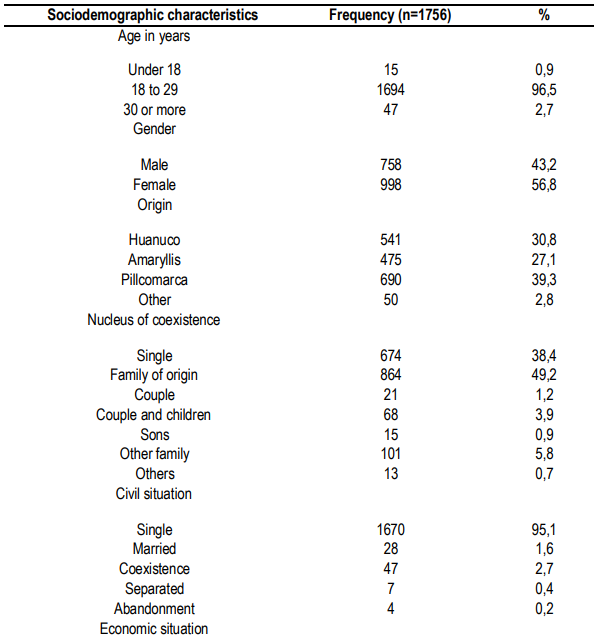
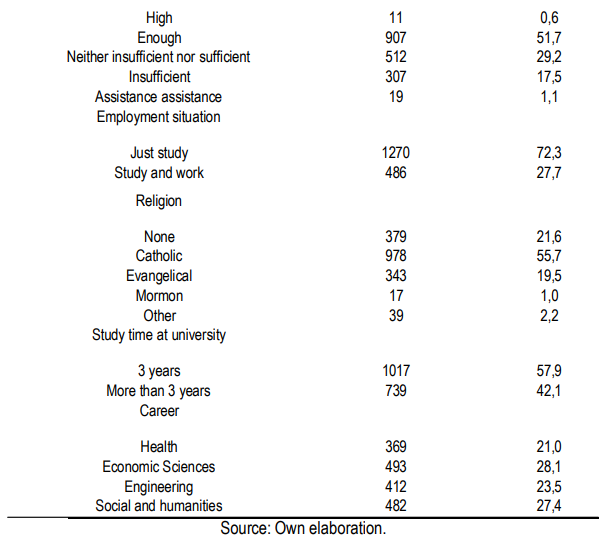
Regarding the sociodemographic characteristics of the university students, the following prevailed: ages between 18 to 29 years, the female sex, the origin of the Pillcomarca district, their nucleus of family coexistence, the civil situation was that of single, sufficient economic situation, their employment situation student, Catholic religion, study time of three years and the predominant professional career was economics (see Table I).
Table I.
Source: Own elaboration.
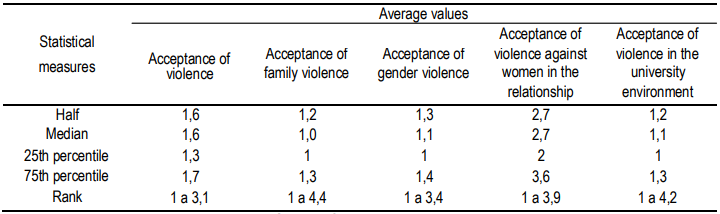
Acceptance of violence from a global analysis reached an average of 1.6 (from 1 to 5). In addition, in the different modalities the acceptance of violence against women in the relationship was higher (2.7), followed by the acceptance of gender violence (1.3) and last place the acceptance of family violence (1,2) and the acceptance of violence in the university environment (1,2) (see Table II).
Table II. Averages of the acceptance of violence and their different modalities in university students
Source: Own elaboration.
Inferential analysis
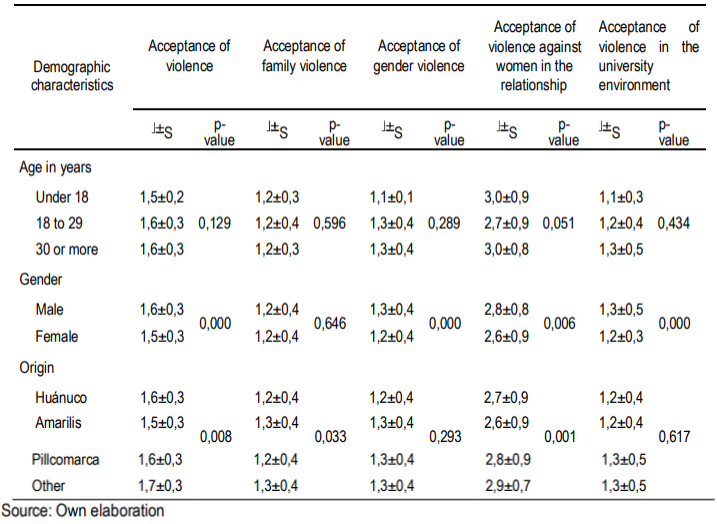
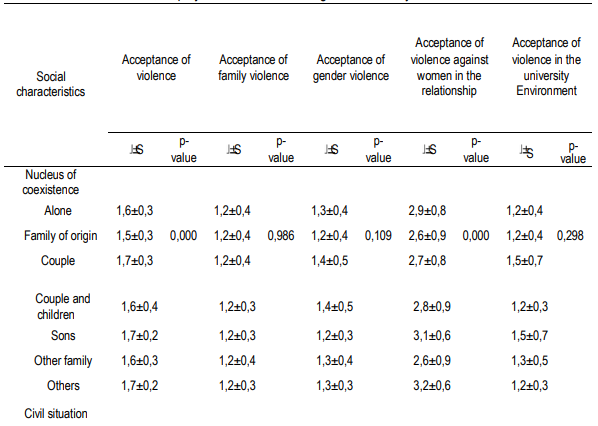
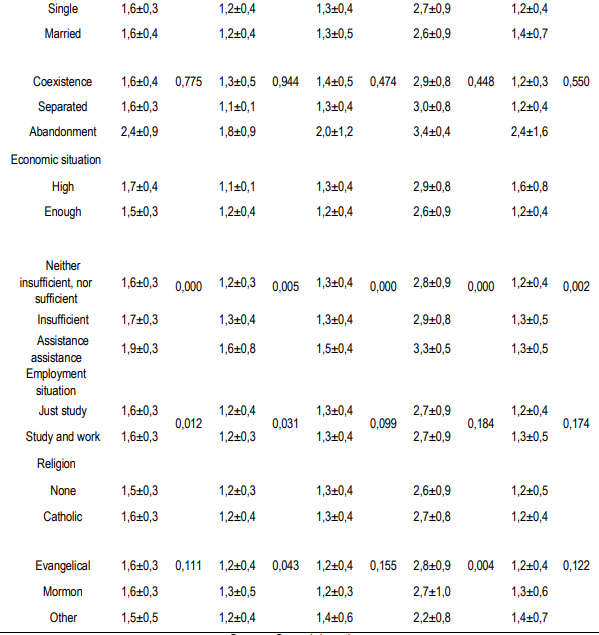
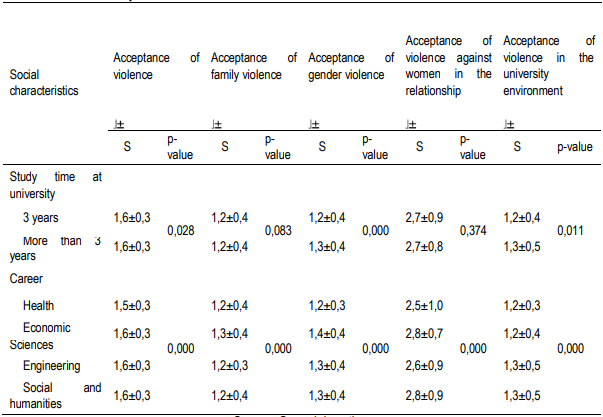
Concerning the inferential analysis, the acceptance of violence against women in the intimate relationship was significantly different according to age (30 years and over); The male sex predominated in the acceptance of general violence and its forms: gender violence, violence against women in the relationship and violence in the university environment; and according to origin, there were significant differences in the acceptance of general violence (other origin), family violence (other origin) and violence against women in the relationship (Pillcomarca), all with p≤0.05 (see Table III) . Likewise, there were significant differences according to family nucleus (children and other people), employment status and religion (evangelical and Mormon), all with p≤0.05 (see Table IV). And significant differences were also found according to study time at the university (more than three years) and professional career (economics, engineering and social sciences and humanities), all with p≤0.05 (see Table V).
Table III. Acceptance of violence and its different modalities according to age, gender and origin in university students.
Source: Own elaboration
Table IV. Acceptance of violence and its different modalities according to nucleus of coexistence, civil situation, economic situation, employment situation and religion in university students.
Source: Own elaboration.
Table V. Acceptance of violence and its different modalities according to study time at the university and career in university students.
Source: Own elaboration.
CONCLUSIONS
In general, the acceptance of violence was very low (1.6 on average [from 1 to 5]), and this differs according to age, sex, origin, nucleus of coexistence, economic situation, work situation, religion, time of study in college and career. Finally, it should be noted that the sample studied (university students) has high normative demands, so it is not uncommon to assume more moderate levels of acceptance and strong pressure to deliver socially desirable responses. In other words, if this study were carried out in other population groups, with lower levels of education and social pressure, the findings would undoubtedly be more worrying.
BIODATA
Ewer PORTOCARRERO MERINO: Doctor in Education, Master in Research and University Teaching, Graduate in Education Specialty Philosophy and Psychology. Attached to the Academic Pedagogical Department of Social Sciences and Humanities. Concytec researcher. Academic Vice-Rector of the National University Hermilio Valdizán, Huánuco (Peru). Email: eportocarrero@unheval.edu.pe, eportocarrero85@hotmail.com, ORCID: https://orcid.org/0000-0003-3920-2999
Clorinda Natividad BARRIONUEVO TORRES: Doctor in Educational Sciences, Master in Educational Management and Planning, Graduate in Education Specialty Philosophy and Psychology. Attached to the Academic Pedagogical Department of Social Sciences and Humanities. CONCYTEC researcher. Principal Professor of the National University Hermilio Valdizán, Huánuco (Peru). Email: clori_bt@hotmail.com ORCID: https://orcid.org/0000-0003-3950-9747
María ORTÍZ-AGUI: Doctor in Public Health (UNFV), Doctor of Science: Nursing (UNSA), Master in Epidemiology (UNHEVAL), Graduate in Nursing, Second Specialization in Health Services Management (UNSA). Professor at the Faculty of Nursing of the National University Hermilio Valdizán (UNHEVAL), Huánuco, Peru. E-mail: maorcru@hotmail.com, ORCID ID: https://orcid.org/0000-0002-5613-7378.
Juan Jua TARAZONA TUCTO: Doctor in Economic and Social Sciences, Master in Management and Business, mention in Project Management; Sociologist. Economist, Professor (hired) full time at the Faculty of Economics of the National University Hermilio Valdizan, Huánuco (Peru). EMAIL: jantart1510@hotmail.com, jjtarazona@unheval.edu.pe; ORCID https://orcid.org/0000-0002-6886-4062
BIBLIOGRAPHY
AMÓRTEGUI-OSORIO, D. (2005). “Violencia en el Ámbito Universitario: El caso de la Universidad Nacional de Colombia [Violence in the University Environment: The case of the National University of Colombia]”. Rev. Salud pública [Jour. Public Health] 7(2): 57-165.
CARLSON, B.E. & WORDEN, A.P. (2005). “Attitudes and beliefs about domestic violence: results of a public opinion survey: I. Definitions of domestic violence, criminal domestic violence, and prevalence”. Journal of Interpersonal Violence 20: 1197-1218.
CASTELLS, M. (2001). Universities as dynamic systems of contradictory functions. En Muller, Johan et al. [eds.], Challenges of globalisation, South African debates with Manuel Castells. Maskew Miller Longman, Cabo (Sudáfrica)
CASTILLO-ACOBO, R.Y. & CHOQQUE-SOTO, S. (2018). “Percepción de violencia y sexismo en estudiantes universitarios [Perception of violence and sexism in university students]”. Revista entorno [Environment magazine] 66: 51-61.
CHACON, A. (2015). Diseño y validación de una escala de actitudes hacia la violencia de género en estudiantes de secundaria de las instituciones educativas emblemáticas de la UGEL 03 [Design and validation of a scale of attitudes towards gender violence in secondary school students of the emblematic educational institutions of UGEL 03]. Lima: César Vallejo University.
CHUQUIMAJO, S. (2000). Actitudes hacia la violencia contra la mujer en la relación de pareja en estudiantes de 5to año de secundaria de Lima Metropolitana (tesis de pregrado) [Attitudes towards violence against women in the intimate relationship in 5th year high school students from Metropolitan Lima (undergraduate thesis)]. National University of San Marcos, Lima (Peru).
CONFORTINI, C.C. (2006). Galtung, Violence, and Gender: The Case for a Peace Studies/Feminism Alliance. En Peace & Change, vol. 31, No: 3. Peace History Society and Peace and Justice Studies Association, Orlando F.L. (EUA).
DALAL, K., LEE, M. & GIFFORD, M. (2012). “Male Adolescents' Attitudes Toward Wife Beating: A Multi- Country Study in South Asia”. Journal of Adolescent Health 50(5): 437-442.
DE LA CRUZ, G., OLARTE, C.A. & RODRÍGUEZ, J. (2019). “Entre golpes y empujones, la comunicación afectiva entre varones universitarios [Between blows and shoves, affective communication between male university students]”. Revista Electrónica de Investigación Educativa [Electronic Journal of Educational Research] 21: 1-9.
DE MIGUEL, V. (2015). Percepción de la violencia de género en la adolescencia y la juventud [Perception of gender violence in adolescence and youth]. Madrid (Spain): Ministry of Health, Social Services
DOUKI, S., NACEF, F., BELHADJ, A., BOUASKER, A. & GHACHEM, R. (2003). “Violence against women inArab and Islamic countries”. Archives of women’s mental health 6(3): 165-171.
ECHEBURUA-ODRIOZOLA, E. (2003). Personalidades violentas [Violent personalities]. Madrid (Spain): Pirámide [Pyramid].
GARCIA, C.D. & FUENTES, P.A. (2019). Violencia estructural y percepción de la misma en estudiantes de la Facultad de Ciencias Jurídicas y Sociales de la Universidad de San Carlos de Guatemala. (Tesis de pregrado) [Structural violence and its perception in students of the Faculty of Legal and Social Sciences of the University of San Carlos de Guatemala. (Undergraduate thesis).]. Universidad de San Carlos de Guatemala [University of San Carlos of Guatemala]. Guatemala (Guatemala).
GRACIA, E. (2014). “Intimate partner violence against women and victim-blaming attitudes among Europeans”. Bulletin of World Health Organization 92: 380–381.
HIJAR-MEDINA, M., LÓPEZ-LÓPEZ, M.V. & BLANCO-MUÑOZ, J. (1997). “La violencia y sus repercusiones en la salud; reflexiones teóricas y magnitud del problema en México [Violence and its repercussions on health; theoretical reflections and magnitude of the problem in Mexico]”. Public Health of Mexico 39(6): 565-572.
INSTITUTO NACIONAL DE ESTADÍSTICA E INFORMÁTICA [NATIONAL INSTITUTE OF STATISTICS ANDINFORMATICS]. (2015). Encuesta Demográfica y de Salud Familiar-ENDES 2014 [Demographic and Family Health Survey-ENDES 2014]. Lima (Peru): INEI.
INSTITUTO NACIONAL DE ESTADÍSTICA E INFORMÁTICA [NATIONAL INSTITUTE OF STATISTICS ANDINFORMATICS]. (2016). Encuesta Nacional sobre Relaciones Sociales ENARES 2013 y 2015 [National Survey on Social Relations ENARES 2013 and 2015.]. Lima (Peru): INEI
JACKMAN, M.R. (2002). “Violence in Social Life”. Annu Rev Sociol 28: 387-415.
JEFFORDS, C.R. (1984). “The impact of sex-role and religious attitudes upon forced marital intercourse norms”. Sex roles 11(5-6): 543-552.
MEIL, G. (2013). Percepción de la violencia de género [Perception of gender violence]. Madrid (Spain): Ministry of Health, Social Services.
MERINO, E.R. (2018). Creencias y actitudes de los estudiantes de enfermería sobre la violencia de género en la Universidad Señor de Sipán 2018. (Tesis de pregrado) [Nursing students' beliefs and attitudes about gender violence at the Universidad Señor de Sipán 2018. (Undergraduate thesis)]. Señor de Sipán University, Pimentel (Peru).
MORENO, S.P., SANABRIA, P.A. & GONZALEZ, L.A. (2015). “¿“Sutilezas” de la discriminación y la violencia basada en el género? Situación de los y las estudiantes de pregrado y posgrado de una facultad de medicina en Bogotá [““Subtleties”of discrimination and gender-based violence? Situation of undergraduate and graduate students of a medical school in Bogotá”]”. Revista Med [Med Magazine] 23(1): 29-39.
MURGA, L.L. (2019). Aceptación de la violencia en el noviazgo y desconexión moral en jóvenes de una universidad de Chiclayo. (Tesis de pregrado) [Acceptance of dating violence and moral disconnection in young people from a Chiclayo university. (Undergraduate thesis)]. Señor de Sipán University, Pimentel (Peru).
NAGEL, B., MATSUO, H., MCINTYRE, K.P. & MORRISON, N. (2005). “Attitudes toward victims of rape effects of gender, race, religion, and social class [”. Journal of interpersonal violence 6: 725-737.
OVIEDO, M. (2017). “Violencia en relaciones de pareja en jóvenes estudiantes universitarios [Violence in dating relationships in young university students]”. Revista Varianza 14 [Variance Magazine 14].
PACHECO, M.J. (2015). “Actitud hacia la violencia contra la mujer en la relación de pareja y el clima social familiar en adolescentes [Attitude towards violence against women in the relationship and the family social climate in adolescents]”. Interacciones [Interactions] 1(1): 29-44.
PAN AMERICAN HEALTH ORGANIZATION. (1990). “Health Conditions in the Americas”. Scientific Publication. No: 524. Washington, D.C. (USA): PAHO.
PAN AMERICAN HEALTH ORGANIZATION. (2002). World report on violence and health: summary. Washington, D.C. (USA): PAHO.
PAN AMERICAN HEALTH ORGANIZATION. (2014). Violence Against Women in Latin America and the Caribbean: A comparative analysis of population-based data from 12 countries. PAHO, Washington DC. (USA).
PERU: MINISTERIO DE LA MUJER Y POBLACIONES VULNERABLES [MINISTRY OF WOMEN ANDVULNERABLE POPULATIONS]. (2019). Observatorio Nacional de la Violencia contra las Mujeres y los Integrantes del Grupo Familiar [National Observatory on Violence against Women and Family Group Members]. Lima (Peru): MIMP. https://observatorioviolencia.pe/el-observatorio/el-observatorio/ Consultado el 15.03.2020.
PINZÓN, C., ARMAS, R.C., APONTE, M.V. & USECHE, M.L. (2019). “Percepción de la violencia simbólica en estudiantes universitarias [Perception of symbolic violence in university students]”. Ánfora [Amphora] 26(46): 89-110.
PROGRAMA INTEGRAL CONTRA VIOLENCIAS DE GÉNERO y FONDO DE LAS NACIONES UNIDAS Y ESPAÑA PARA EL CUMPLIMIENTO DE LOS OBJETIVOS DE DESARROLLO DEL MILENIO [COMPREHENSIVE PROGRAM AGAINST GENDER-BASED VIOLENCE and THE UNITED NATIONS AND SPAIN FUND FOR THE COMPLIANCE OF THE MILLENNIUM DEVELOPMENT GOALS]. (2010). Estudiosobre tolerancia social e institucional a la violencia basada en género en Colombia [Study on social and institutional tolerance to gender-based violence in Colombia]. Bogotá (Colombia): Programa Integral contra Violencias de Género [Comprehensive Program against Gender Violence], MDGF.
RAMÍREZ MOLINA, R; AVENDAÑO, I; ALEMAN, L; LIZARAZO, C; RAMÍREZ, R & CARDONA, Y (2018).“Principles of social responsibility for the strategic management of the talent human public health organizations”. Revista Espacios, 39(37), pp. 22-27.
RAMOS, V. (2007). Violencia familiar asociado al consumo de alcohol y otras drogas [Family violence associated with the consumption of alcohol and other drugs]. En M. Fernández Hawrylak e I. García (Eds.), Orientación familiar. Violencia familiar [Family orientation. Family violence] (pp.189-200). University of Burgos, Burgos (Spain).
RIGG, D.S., & O’LEARY, K.D. (1996). “Aggression between heterosexual dating partners: An examination of a causal model of courtship aggression”. Journal of Interpersonal Violence 11: 519-540.
RODRÍGUEZ, L.M. (2013). Definición, fundamentación y clasificación de violencia [Definition, foundation and classification of violence]. Recovered at: https://trasosdigital.files.wordpress.com/2013/07/articuloviolencia.pdf
SAFRANOFF, A. (2017). La aceptación de la violencia contra la mujer en la pareja: un análisis comparativo de ocho países de América Latina [The acceptance of violence against women in the couple: a comparative analysis of eight Latin American countries]. CENEP (Argentina). http://www.abep.org.br/xxencontro/files/paper/621-352.pdf Accessed 03.03.2020.
SALDÍVAR, G., RAMOS, L. & SALTIJERAL, M.T. (2007). “La aceptación de la violencia y los mitos de violación en estudiantes universitarios: Diferencias por sexo, edad y carrera [The acceptance of violence and rape myths in college students: Differences by sex, age and career]”. Rev Fac Med UNAM 50(2): 71-75.
SIERRA, J.C., ROJAS, A., ORTEGA, V. & MARTÍN, J.D. (2007). “Evaluación de actitudes sexuales machistas en universitarios: primeros datos psicométricos de las versiones españolas de la Double Standard Scale (DSS) y de la Rape Supportive Attitude Scale (RSAS) [Evaluation of sexist sexual attitudes in university students: first psychometric data from the Spanish versions of the Double Standard Scale (DSS) and the Rape Supportive Attitude Scale (RSAS)]”. International Journal of Psychology and Psychological Therapy 7(1): 41- 60.
SIPSMA, E., CARROBLES, J.A., MONTORIO, I. & EVERAERD, W. (2000). “Sexual aggresion against women by men acquaintances: Attitudes and experiences among Spanish university students”. Spanish Journal of Psychology 3: 14-27.
STICKLEY, A., KISLITSYNA, O., TIMOFEEVA, I. & VÅGERÖ, D. (2008). “Attitudes towards intimate partner violence against women in Moscow, Russia”. Journal of Family Violence 23(6): 447-456.
UTHMAN, O.A., LAWOKO, S. & MORADI, T. (2009). “Factors associated with attitudes towards intimate partner violence against women: a comparative analysis of 17 sub-Saharan countries”. BMC International Health and Human Rights 9(1).
VALOIS, R.F., PAXTON, R.J. ZULLIG, K.J. & HUEBNER, E.S. (2006). “Life satisfaction and violent behaviors among middle school students”. Journal of Child and Family Studies 15(6): 695- 707.
VARA-HORNA, A.A. & LÓPEZ , D.R. (2017). “Sí, pero no”. La aceptación implícita de la violencia contra las mujeres en el Perú Un estudio nacional en jóvenes universitarios que demuestra la alta tolerancia hacia la violencia contra las mujeres en relaciones de pareja ["Yes but no". The implicit acceptance of violence against women in Peru A national study in young university students that shows the high tolerance towards violence against women in relationships]. Lima (Peru): Facultad de Ciencias Administrativas y Recursos Humanos de la Universidad de San Martín de Porres [Faculty of Administrative Sciences and Human Resources of the University of San Martín de Porres.].
VARA-HORNA, A. (2014). ¿Cómo prevenir la violencia contra las mujeres en relaciones de pareja? Nuevos argumentos para el debate [How to prevent violence against women in relationships? New arguments for the debate]. Lima (Peru): ComVoMujer,
VARGAS, V., LILA, M. & CATALA-MINANA, A. (2015). “¿Influyen las diferencias culturales en los resultados de los programas de intervención con maltratadores? Un estudio con agresores españoles y latinoamericanos [Do cultural differences influence the results of intervention programs with abusers? A study with Spanish and Latin American aggressors]”. Psychosocial Intervention 24: 41-47.
VELZEBOER, M., ELLSBERG, M., CLAVEL-ARCAS, C. & GARCÍA-MORENO, C. (2003). La violencia contralas mujeres: responde el sector salud. Washington, D.C [Violence against women: the health sector responds]. (USA): PAHO.
VILLALOBOS ANTÚNEZ, JV & RAMÍREZ MOLINA, R (2018). “El derecho a la autobiografía: dimensión ius- filosófica desde la perspectiva de H. Arendt y P. Ricoeur”. Opción. Revista de Ciencias Humanas y Sociales, 34(18), pp. 1012-1587.
WALTER, L.E. (1989). “Psychology and violence against women”. American Psychology 44(4): 695-702
WIBORG, G., ALONSO, J.M., FORNES, P. & VAI, A. (2000). Violencia familiar y alcohol. Conceptos yrecomendaciones para profesionales que atienden a víctimas y agresores [Family violence and alcohol.Concepts and recommendations for professionals who serve victims and aggressors]. Barcelona (Spain): Iniciativa Daphne de la Comisión Europea [Daphne Initiative of the European Commission].
WORLD HEALTH ORGANIZATION. (2018). Violence against women. Geneva, (Switzerland): WHO.
YOSHIHAMA, M., BLAZEVSKI, J. & BYBEE, D. (2014). “Enculturation and Attitudes Toward Intimate PartnerViolence and Gender Roles in an Asian Indian Population: Implications for Community-Based Prevention”.Am J Community Psychology 53: 249-260.
YOUNT, K.M., VANDERENDE, K., ZUREICK-BROWN, S., ANH, H., SCHULER, S.R. & MINH, T. (2014).“Measuring Attitudes About Intimate Partner Violence Against Women: The ATT-IPV Scale”. Demography 51: 1551-1572.
ZAMUDIO, F.J., ANDRADE, M.A., ARANA, R.I. & ALVARADO, A. (2017). “Violencia de género sobreestudiantes universitarios(as) [Gender violence against university students]”. Convergencia Revista de Ciencias Sociales [Convergence Journal of Social Sciences] 75: 133-157.
