Artículos
Efficiency in the Use of the Region’s Population Social Protection Potential
Eficiencia del uso del potencial de protección social de la población en la región
 P.I RAZINKOV men_756@mail.ru
D.V MARTYNOV men_756@mail.ru
O.P RAZINKOVA razinkovaoksana@mail.ru
P.I RAZINKOV men_756@mail.ru
D.V MARTYNOV men_756@mail.ru
O.P RAZINKOVA razinkovaoksana@mail.ru
Efficiency in the Use of the Region’s Population Social Protection Potential
Utopía y Praxis Latinoamericana, vol. 25, no. Esp.12, pp. 102-118, 2020
Universidad del Zulia
Received: 19 September 2020
Accepted: 10 November 2020
Abstract: The article discusses the directions of increasing the efficiency of using the potential of social protection of the region's population. It was revealed that the potential of social protection, in contrast to its socio- economic potential, has a limited importance, since it is formed in a planned manner, depending on the availability of financial and resources of another nature. Therefore, when analyzing the level of formation and use of the potential of social protection of the region, it is possible to assess the level of use of its structural components to improve.
Keywords: Population, potential of social protection of the region, socio-economic potential of the region..
Resumen: El artículo discute las direcciones para incrementar la eficiencia del uso del potencial de protección social de la población en la región. Se reveló que dicho potencial, en contraste con su potencial socio-económico, tiene una importancia limitada, ya que se forma de manera planificada, dependiendo de la disponibilidad de recursos financieros y de cualquier otra naturaleza. Por tanto, al analizar el aprovechamiento del potencial de protección social de la región, es posible evaluar el nivel de aprovechamiento de sus componentes estructurales para mejorar.
Palabras clave: Población, potencial de protección social en la región, potencial socio-económico de la región..
INTRODUCTION
The development of any state’s the economy is characterized, first of all, by the stable system of the social population protection creation. It is caused by the fact that development is associated with a continuous increase of problems in providing a decent population life quality, assuming a permanent decision of effective economy development increase questions and obtaining financial and other resources to improve the population living standards, creating conditions and incentives for improving the organization of the welfare system and the citizens’ rights to social protection that because appropriate life level of socially unprotected groups of the population.
In recent years, there have been many problems in creating the country's social and economic potential and developing. This has a negative impact on improving the level of social population protection, which as we know is the most important strategic resource that can ensure sustainable economic development of the country at a higher rate. Thus, the issues of improving the quality of life of the country's population, improving medical services and education, reducing unemployment, increasing the population and other socio-economic problems should be resolved.
This makes it necessary not only to make serious changes in the new directions formation for stimulating development and improving the management of the achieved population social protection potential, but also to develop mechanisms that contribute to solving problems of improving the population life quality. It is equally important to increase enterprises and organizations’ managers role in creating effective motivational mechanisms, tools and incentives to increase production efficiency and develop the market economy, the structure and competitive environment that ensure the growth of labor productivity and living standards of the country's population.
It should be noted that improving the country's economic development efficiency and the quality of solving social problems is an important task for all government levels, and especially for regional governments, which play an important role in forming an effective potential for population social protection. This is especially important in the organization of work to achieve decent living conditions for the population and create favorable working conditions at enterprises and organizations regardless their ownership form, as well as in the development and application of social protection of the segments with low income new forms and methods, creating safe working conditions, improving the quality of life of the country's population by creating conditions for improving all social groups’ quality of life.
LITERATURE REVIEW
World experience study in the formation of social potential has shown that its level is influenced by the successful economy and society development in many respects, it is determined by socio-demographic factors and the population living standards.
Among the factors that directly affect the potential of an individual, one can distinguish: the education level, career growth, material well-being, health status and other social resources.
The level of social potential is assessed according to the following indicators:
-
Per capita income;
-
The level of the economy basic sectors development;
-
Unemployed specialists’ educational level;
-
Financial situation of residents in the region;
-
Quality of healthcare in the region, etc.
The main goal of managing the socio-economic potential formation and development is the growth of population life quality which is based on structural quality elements which influence the region innovation leveldevelopment. So, it is important to form the new structure which will allow not only to increase the level of use of social, but also economic, investment, production and other potentials of the region.
This is important because it is necessary to create social potential of such magnitude and such a structure that will allow, under certain conditions, to provide support and services to elderly people who are unable to serve themselves, as well as large families with small children, orphans and disabled children (Kondratovich: 2011, pp.379-383).
In addition, it is important to avoid and prevent crisis situations to implement the management of material, financial and human resources to achieve the maximum result in the implementation of measures of population social protection (Razinkov: 2020, p.136-147).
In our opinion, the term "management of the region social protection" can be interpreted as the activity of regional governing bodies for the distribution and control of all types resources use, aimed at solving the existing (current) social, economic and other problems that may arise in the future in the social sphere analyzed region.
In this case, the value of the required resources acts as the object of management, and the subject of management is the potential of population social protection. The volume of resources should be on that level that should be sufficient to provide social services to the entire population of the region, individuals and social groups, taking into account current and future needs. The main objectives arising from these measures are:
-
Providing material assistance to the needy segments of the population;
-
Prevention and localization of emerging conflicts and solutions to emerging problems;
-
Consultations and education of the population in need of assistance;
-
Provision of social services for the population;
-
Providing social and psychological assistance to the population;
-
Organization of preventive work with the population, etc.
Currently, there are many approaches to the formation of the potential for region population social protection. We believe that social and, naturally, economic potentials should be formed on the basis of the adoption of norms, standards and social programs that are uniform for all regions of the country. In particular, it is necessary to ensure:
-
Formation of the budget not only taking into account the development of the social potential of the region, but also the necessary subsidies for long-term development;
-
Training and retraining of necessary specialists and their placement in workplaces;
-
Formation of reserves and necessary additional resources for their use for social support of the needy strata of the region's population.
Based on the foregoing, let us formulate the following concept: the potential for region population social protection is the region's ability at the present time and in the future to perform functions of population social protection in conditions of provision of budget financing in accordance with the regulatory framework established by legislation. The value of the potential for population social protection is determined by the following components - the costs of:
-
Preservation of the state-guaranteed pensions number, allowances, compensations, benefits, maintenance of a living wage for disabled people, creation of conditions for their decent living, etc.:
-
Healthcare;
-
Optimization of the unemployment rate;
-
Reduction in mortality and increase in life expectancy of the population;
-
Payments and additional payments to students of schools, secondary specialized and higher educational institutions;
-
Prevention of social ill-being in the region;
-
Burial of the dead;
-
Help for children born; service;
-
Maintenance of administrative bodies for managing the population social protection and their
-
Compensation for losses due to strikes;
-
Determined by the regional authorities for the elimination of force majeure and other unforeseenexpenses;
Based on this structure of expenditures on the formation of the potential for region social protection, we can conclude that its value, in contrast to the economic potential, is formed in a planned manner and has only a set value depending on the financial and other resources allocated by the governing bodies, as well as funds received. in the form of donations and others (Razinkov: 2018, p.3-6).
In the end, the above costs for building the social protection potential of the population of the region should guarantee the residents of any region confidence that in the event of adverse situations caused by: unforeseen dismissal, disability, natural disasters, etc., they will be able to receive not only medical care, but also decent material and other support (Razinkov: 2017, p.131-135).
The need for population social protection arises from the requirements of the Constitution of the Russian Federation; article 7 states that the Russian Federation is a social State whose policy is aimed at creating conditions that ensure a decent life and free human development. This means that the implementation of this provision of the Constitution presupposes that the State will pursue a policy aimed at building the socio- economic potential capable of ensuring a high level of well-being of citizens, which should be based on the development of this potential and priority support for the socially vulnerable groups of the country's population.
According to the situation established in our country, the socio-economic potential of the region is formedby two main sources of financing. These are funds earned by the region, which are planned for their distribution by the type of use and funds, from the so-called “established regulated subsidies” from the federal budget, and subject to their use by purpose. Other sources of socio-economic potential of the region are possible, but they are not always stable, and are taken into account only by their admission and inclusion in the generated amount of social potential in the current period. These include the funds of enterprises and organizations; Various voluntary contributions to the budget of the region and other opportunities for the region to attract money and other resources for social purposes.
It is important to note that in certain situations it is necessary to address not only the socio-economicpotential, but also the social one in particular. The point is that each region should have the appropriate capacity of medical institutions and ensure the admission of all patients not only with an insurance medical policy, but also low-income residents; pay a certain minimum of pensions and ensure their growth to the amount established by law, if they do not provide a living wage, and the possibility of paying for housing and communal and transport services. It is important to ensure favorable access of the population to social and other individual institutions, including cultural and sports institutions, which form the social and economic potential of the region.
In addition to the structure of the components of population social protection, it is important to explore its concept, economic essence and structural identity with socio-economic potential.
Most Russian sources of literature provide the following wording of the concept of the socio-economic potential of the region and the structure of its formation. Socio-economic potential is characterized by the combined capacity of labor, material, financial, natural and other resources to maximize the production of goods and services in order to meet the individual and collective needs of society in the best way and create conditions for the further development of the region's economy, including social direction.
In essence, the above definition gives a characteristic of the social economy, which, as Podgorny V.V.notes, reflects the external social environment formed in the process of people's activities, focused on the social development of region and the growth of its well-being (Podgorny: 2015, p.15-20).
In our opinion, the approach characterizing the concept of sustainable development of the region proposed by Sorokina N.Y. She notes that the concept of social potential should be based on the followingtheoretical situation: the main task for ensuring sustainable development of the region is to effectively manage socio-economic potential. Using Sorokin's resource approach, N.Y. believes that the source of growth in socio- economic potential is the region's unique resources. At the same time, she believes that "effective management of the development of the socio-economic potential of the region is aimed at creating conditions for a quantitative improvement of the potential of the region to the level that ensures the full implementation of programs and activities of the regional strategy for socio-economic development" (Sorokina: 2014).
It should be noted that in recent years in Russia more attention has been paid to the creation and development of socio-economic potential and to increasing the role of state, regional and local authorities in improving the population’s life quality of certain regions and settlements of our country.
This necessitates constant monitoring of the state of the socio-economic sphere of life of the population, which, in most countries, is carried out through the use of rating studies as a tool for monitoring socio-economic phenomena and the possibility of assessing the socio-economic state of autonomous republics and regions. In recent years, conducting a rating assessment has become a popular tool for determining the life quality and, therefore, the place in the ranking occupied by regions. In our country, rating studies conducted by the rating agencies Rus-Rating, RIA-Rating, AK & M, Expert RA, the National Rating Agency (NRA) and others have become widely known (Bekmetov: 2015, pp.141-145; Bekmetov et al.: 2019,pp.400–410).
According to many researchers and experts, at present, to a certain extent, you can trust the data of the RIA-Rating rating agency, since according to the results of studies assessing the potential of regions performed by this rating agency, there are many positive reviews from specialists. This agency has already presented the eighth rating of the population’s life quality in the Russian regions. According to this agency, the calculated rating is based on a comprehensive accounting of various indicators that record the actual state of certain living conditions aspects of the population in the regions and the situation in the social sphere. According to the agency, this approach allows to assess interregional differences in the Russian Federation social sphere.
Based on 70 indicators taken into account, the agency calculates a rating score, which acts as an indicator in order to assess interregional differences and a criterion for ranking regions (Ma & Marion: 2019, pp.1-20). Life quality assessment is carried out in the following groups:
-
Incomes of the population;
-
Employment and the labor market;
-
Housing conditions of the population;
-
Security of residence;
-
Demographic situation;
-
Environmental and climatic conditions;
-
Public health and education;
-
Provision of social infrastructure facilities;
-
The level of economic development;
-
The level of development of small businesses;
-
Development of territory and level of transport infrastructure development.
The place of the subject of the Russian Federation in the final rating by the RIA Rating agency is determined on the basis of the integral rating score calculation, which was done by aggregating the rating points of the Russian Federation regions for all the groups of indicators presented above. To calculate the rating score in each group, the rating scores included in the indicator group were aggregated (Akim et al.: 2019, pp.1408-1428). The leaders of the rating of regions in terms of life quality for 2018 were 10 regions. This is Moscow, St. Petersburg, etc. In last place in the rating of the RIA Rating agency was the Republic of Tuva with a score of 16.2.
METHODOLOGY
In 2019, the situation has not changed, the group of leaders included Moscow, St. Petersburg and the Moscow region, with combined rating points of more than 70 (with a scale of points from 1 to 100). Compared to the 2018 rating, the composition of the top ten has changed to one region. Leningrad region rose by 3 positions, taking 8th position in the current ranking. Left the top ten Lipetsk region, which fell to 2 places and now takes 11th place. In the presented ranking, four regions improved their positions by more than five places compared to last year, of which one rose by more than 10 places. This is the Sakhalin Region, which moved from 46 to 34 place, Bryansk Region (from 49 to 41), Krasnoyarsk Territory (from 45 to 38) and Tomsk Region (from 51to 45). Again, the Republic of Tuva remained in last place, but with a score of 17.3.
According to the rating values, the RIA RATING agency believes, to a certain extent, it is possible to judge the effectiveness of measures to manage the region population social protection, and the main thing is to evaluate the work of regional management bodies to create decent working conditions and improve the population’s life quality of the analyzed region (Humbatova&Hajiyev: 2019, pp.1704-1727).
To better assess the level of population social protection, we believe that it is important to assess the level of management of the potential of population social protection, especially those regions that have relatively equal socio-economic potential (Saenko et al: 2019, pp.332-345). It is in our opinion expedient to carry out the comparative assessment of regions of the Central Federal District (CFD) as the most developed region, having allocated in it for more detailed comparison the most comparable regional formations. Rating data for the Central Federal District are presented in Table 1.
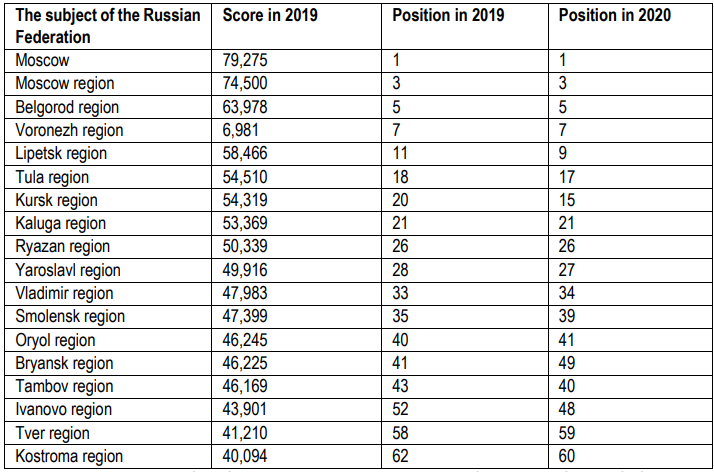
From Table 1 compiled according to the rating agency "RIA RATING" it can be seen that between the first place in the ranking of regions of the Central Federal District of Moscow and the closing this list in the ranking of the Kostroma region. The gap in points is 39,181 points. At the same time, the first three subjects of thedistrict of Moscow, Moscow and Belgorod regions have points: 79,275, respectively; 74,500; 63,278 points. And closing the list of regions Ivanovo, Tver and Kostroma regions had respectively: 43,901; 41,210; 40,094 points. Thus, by regions presented at the beginning of the list, the gap in points is 15,297 points, while this gap between the Tver and Kostroma regions (closing the list of regions of the Central Federal District) is onlypoints. A similar situation has developed in other Federal districts of the Russian Federation (Volchik&Maslyukova: 2019, pp.1444-1455).
According to the RIA Rating agency, the average rating point of the Central Federal District regions in the 2019 Rating was 53.33, which is 0.08 points higher than in 2018. The rating score decreased only in seven of the eighteen regions included in the Central Federal District, and in two of the regions the decrease did not exceed 1 point, in two regions two points; in one 4 points and in the Kursk region - 5 points). In the remaining 10 regions, the value of the rating point increased. The leader in rating score growth (+ 2.05 points) was the Moscow region, which remained in 3rd place in the overall rating. In eight more regions of the Central Federal District, the rating score increased, but not more than 1 point (Copeland: 2018, pp.209-223).
A significant gap in the number of points in the studied regions causes the need to clarify the data presented by the RIA Rating agency and also to conduct calculations to assess the population’s quality of Russian Federation region’s life. We believe that a more detailed analysis of generalizing indicators of the life quality and population regions social protection, which have an equal population size and many other values close in magnitude, achieved indicators characterizing the level of population social protection, is necessary.
We selected the Yaroslavl and Tver regions located nearby as the object of study. These regions are characterized by almost the same population size, natural landscape, and the potential for economic development. They are located in the same federal district and border each other. It is important to note that each of the areas under consideration has large reserves for building and developing the potential for population social protection. As can be seen from Table 1 in 2019, the Yaroslavl region in the ranking moved 1 point lower. The Tver region moved from 59 to 58 places or one point higher. Between these regions there is a large gap in points – 8,706 and in the occupied places in the rating calculated by the RIA RATING agency. According to the rating in 2019, the Yaroslavl region had a score of 49.916 and 28th place in the ranking of the Tver region 41,210 points and 58th place in the ranking (Ferguson & Greer: 2018, pp.126-141).
Such a gap in the estimated values of the indicators makes it necessary to further study the population’s life quality in the Yaroslavl and Tver regions and expand the range of indicators that allow us to give a deeper assessment of the population social protection policy effectiveness of the analyzed regions based on their value calculation. In addition, this will make it possible to more reliably assess, on the basis of a indicators system, the social protection potential effectiveness of the Yaroslavl and Tver regions, to calculate their dynamics and determine the development vector. The data are shown in Table 2 (Mariana: 2008).
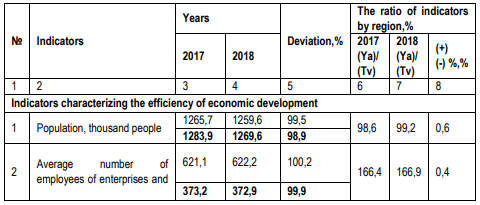
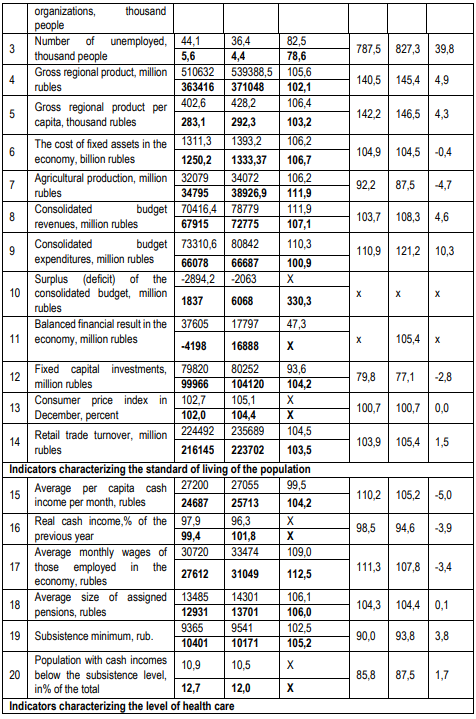
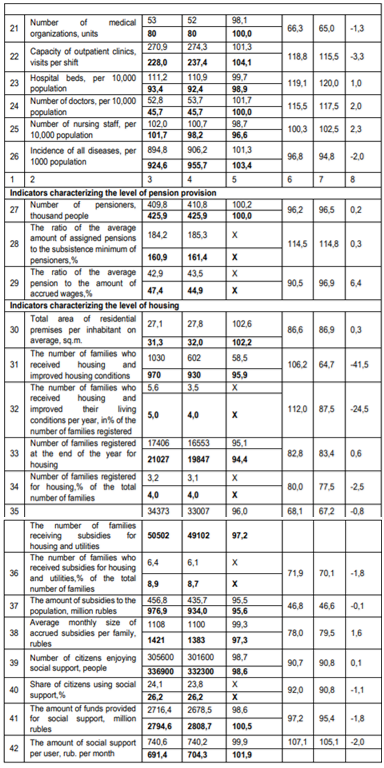
From the indicators presented in table 2 for assessing the population social protection potential effectiveness of the Yaroslavl and Tver regions, we can draw a preliminary conclusion that both regions are developing evenly. At the same time, according to many achieved values of indicators, the regions have equal scores of them. For the remaining indicators, the regions have opportunities and conditions for their improvement. However, as can be seen from Table 1, the Yaroslavl region occupied 27th place in the ranking in 2018, and the Tver region 59th place. This necessitates a deeper analysis of the data in Table 2 (Perbawasari et al.: 2019, pp.309–320).
First of all, we propose to evaluate the dynamics of the achieved values of indicators in order to determine the vector of development of the social potential of the analyzed regions and assess the development perspective of each region. Then it is important to carry out a comparative analysis of each indicator of the potential of the Yaroslavl region in relation to its achieved value in the Tver region. This will establish priorities for the development of each of these regions according to data for 2017 and 2018. In addition, taking into account the ratio of the achieved indicators to each of the regions, it becomes possible to develop proposals for improving the structure of social potential and the areas of its formation, use and development in the future (Strauss: 2018, pp.21-48). According to Table 2, we will evaluate in the following sequence:
-
Efficiency of economic development;
-
The standard of living of the population;
-
The level of public health;
-
The level of pension provision for the population; The level of housing provision of the population.
RESULTS
Assessment of the dynamics of indicators of population social protection of the Yaroslavl and Tver regions for 2017-2018 years.
Assessment of the efficiency of economic development.
From table 2 characterizing indicators of economic development efficiency of the Yaroslavl region, it can be seen that in 2018, compared to 2017, the number of employees in the economy increased by 0.2%; at the same time, the number of registered unemployed decreased by 17.5%. Retail turnover increased by 4.5%. It is positive that the growth rate of expenditures of the consolidated budget is 1.6 percentage points lower than the growth rate of budget revenues.
Some indicators of the economy of the Yaroslavl region are characterized by negative dynamics, so thepopulation of the region decreased by 0.5%. In 2018, a deficit of the consolidated budget of 2063 million rubles was allowed, investments in fixed assets decreased by 6.5%, the consumer price index grew by 2.4 percentage points, and the settled financial result in the economy decreased 2.11 times.
The situation in the Tver region was slightly different in 2018. Gross regional product; gross regional product per capita increased 3.3 times the surplus of the consolidated budget from negative in 2017 to 16,888 million rubles. In 2018, the settled financial result increased, investments in fixed assets increased by 4.2% and retail turnover increased by 3.5%. At the same time, there was a decrease in the population of the region and the average annual number of employees in the economy (Wiryawan: 2011).
Assessment of the standard of living of the population.
Considering the groups of indicators characterizing the standard of living of the population of the Yaroslavl region (table 2), it can be concluded that in 2018, compared to 2017, an increase in the average monthly nominal wages of workers in the economy by 9.0 was noted. Average per capita cash income decreased by 0.5% compared to 2017. At the same time, the share of the population with monetary incomes below the subsistence minimum remained at the same level, it is difficult to assess positively and an increase of 2.5% in the subsistence minimum, since its dependence on real incomes of the population of the Yaroslavl region is not shown.
Quite high growth in the analyzed period was achieved in terms of indicators characterizing the standard of living of the population in the Tver region. So, in 2018, compared to 2017, average per capita cash income increased by 4.2% and real disposable cash income increased by 24 percentage points; the average monthly nominal accrued salary of workers in the economy increased by 12.5% and the average amount of assigned pensions increased by 6.0%. The share of the population with monetary incomes below the subsistence minimum decreased by 0.7 percentage points.
Assessment of public health.
According to this group of indicators, the unsatisfactory situation in the Yaroslavl region has developed in the field of characterizing the state in healthcare. Despite the fact that in 2018 compared to 2017, the capacity of outpatient organizations for visits per shift increased slightly (by 1.3%); the number of average medical personnel decreased by 1.3% and, most importantly, the incidence of the population as a whole in the region also increased by 1.3%:.
A similar situation in health care has developed in the Tver region. In 2018, only one indicator of sixanalyzed improved in this region, this is an increase in the capacity for visits per shift in outpatient organizations by 4.1%. At the same time, the number of hospital organizations and the number of doctors has not changed. However, the incidence rates of the population worsened - its growth in 2018 was 3.4%. Thenumber of average medical personnel decreased (by 1.1%) and the number of hospital beds decreased by 1.1%.
Assessment of the level of pension provision of the population.
In 2018, there was an improvement in the ratio of the average size of assigned pensions with the subsistence minimum of the population and the accrued wages, the growth was 1.1 and 0.6 percentage points, respectively. In addition, the number of pensioners increased by 0.2%.
Similar changes in pension provision occurred in the Tver region. Of this group of indicators, in 2018 there was an increase of 0.5 percentage points in the ratio of the average amount of assigned pensions to the amount of accrued wages; the number of pensioners remained at the same level in 2018; the value of the ratio of the average size of pensions to the amount of accrued wages can also be considered acceptable, since its growth in 2018 was 12.5%, which is significantly higher than the growth of pensions. Thus, for all analyzed indicators in the Yaroslavl and Tver regions in the pension provision of the population, the situation can be recognized as meeting the requirements of pension legislation in the Russian Federation.
Assessment of the level of housing provision of the population.
In 2018, in the Yaroslavl region, there was an increase in the total area of housing premises per average resident (by 2.6%). In 2018, out of 13 indicators in the Yaroslavl region, only 5 had a positive vector. At the same time, 8 indicators made their decrease.
The indicators of housing provision of the population in the Tver region are more positively characterized. By 2.2%, the total area of housing, which is on average per resident, has increased. There was a decrease in the number of registered families for housing, families receiving subsidies for housing and communal services, and the number of citizens enjoying social support.
At the same time, there was a decrease in the number of families who received housing (by 4.1%); by42.9 million rubles, or by 4.4% the number of subsidies to the population decreased. In general, in this section, positive results were achieved in 8 indicators and in 5 of 13 indicators there was a decrease in the level of housing supply in the Tver region.
From the above data analysis, it can be seen that there are positive results in the activities of the Yaroslavl and Tver regions. So, according to the group of indicators characterizing the efficiency of economic development in the Yaroslavl region, out of 14 indicators in 2018, 9 achieved growth, in the Tver region the value of 11 indicators out of 14 increased. According to the second group of 6 indicators characterizing the standard of living of the population of the Yaroslavl region, only two provided growth, 2 indicators decreased, and 2 changes did not occur. It is characteristic that in the Tver region in all six indicators there was an increase.
The health situation in the analysed regions is characterized by unsatisfactory indicators. The growth of indicator values in the Yaroslavl region occurred only in 2 out of 6 indicators and in Tver in one indicator. There are certain shortcomings in the implementation of the pension system in the Yaroslavl and Tverregions, where of the 3 indicators analyzed, in our opinion, only 2 of these are subject to assessment (paragraphs 28 and 29), which in fact have changed albeit slightly, but positively. So the ratio of the size of pensions changed by 0.5 and 0.6 percentage points in the Yaroslavl region and by 0.6 percentage points in the indicator (p. 28) in the Tver region.
The difficult situation in the Yaroslavl and Tver regions has developed in the housing supply of the population. Positive results include only indicators for improving housing conditions, respectively, by 2.6 and 2.2%, as well as an increase in subsidies for housing and social support. In addition to these three indicators, the situation in 2018 in the analyzed regions did not improve.
In the Yaroslavl region as a whole, the value of 42 indicator (21; 2; 3; 4; 5; 6; 7; 8; 9; 14; 17; 18; 22; 24;28; 29; 30; 33; 34; 36; 39; 40) has improved from 21 indicators. At the same time, in 18 indicators there wasa deterioration in their values and in 3 indicators the values did not change. Of the 42 indicators in the Tver region, 25 were positive (3; 4; 5; 6; 7; 8; 9; 19; 11; 12; 14; 15; 16; 17; 18; 19; 20; 22; 28; 30; 33; 36; 39; 41;41). In 12 indicators there was a decrease and in 5 indicators their value remained the same.
Based on the data of the assessment of the dynamics of indicators characterizing the effectiveness of population regions regions social protection, it can be concluded that evaluation indicators of the Tver region are more preferable. So, according to the dynamics of indicators, steady growth in 2018 was noted in the Yaroslavl region by 50% or 21 indicators. In the Tver region there were 25 or 59.5% of such indicators. The importance in the Yaroslavl region in the field of population social protection in 18, and in the Tver region in 12 indicators has worsened. Consequently, in the Yaroslavl and Tver regions, the value of 3 and 4 indicators, respectively, did not change.
DISCUSSION
Analysis of the magnitude and dynamics of indicators of population social protection of the Yaroslavl and Tver regions.
The analysis showed that the Yaroslavl and Tver regions have almost equal opportunities for social development. So, in 2018, the Tver region was the leader in population; produced more by 4854.9 million rubles, agricultural products, there was a decrease in expenses and a surplus of the consolidated budget was formed. In the Tver region by 23,686 million rubles. in 2018, investments in fixed assets were higher than in the Yaroslavl region and lower by 0.7 p.p. the consumer price index as of December 2018. In addition, the Tver region leads in indicators characterizing the standard of living of the population.
At the same time, out of 6 analyzed indicators characterizing the level of health care in 2018, the Tver region was in the lead only in terms of the number of medical organizations. We can note as positive the results achieved in terms of indicators characterizing the level of pension provision. In 2018, the number of pensioners increased in the region, there was an increase in the average amount of assigned pensions.
Indicators characterizing the level of housing supply in the Tver region are significantly better than in the Yaroslavl region. By 4.2 square meters more than the total area of housing, which is on average per resident of the region, is almost one and a half times higher than the number of families who received housing.
Of the 42 analysed indicators for assessing the effectiveness of population social protection of the areas under consideration, there were 25 such indicators in the Tver region and 22 in the Yaroslavl region. It is characteristic that in the Tver region there are large growth reserves for such indicators as: the number of people employed in the economy, and, therefore, the gross regional product; wages, the quality of health care and other important indicators of the effectiveness of the formation and use of the potential of population social protection.
Significant reserves for improving the effectiveness of population social protection are also available in the Yaroslavl region. In particular, the region has opportunities to stabilize and increase the number and employment of the population, increase labor productivity, etc. The elimination of these and other shortcomings will allow, on the basis of technical re-equipment, improved use of personnel, savings in resources and other factors, to increase the volume of gross output and accelerate the renewal of fixed assets and ensure increased productivity. These measures will positively affect the increase in revenues of the consolidated budget and the elimination of its deficit; implementation of measures to improve the standard of living of the population; improving health care; and pensions; housing conditions of the low-income population of the Yaroslavl region, etc.
Comparing data on the state of population social protection in the Yaroslavl and Tver regions for 2017-2018, it can be concluded that in many indicators the Tver region showed higher values of their size, dynamics and prospects for a possible increase in the potential for social development. However, as noted above in terms of rating compiled by the rating agency RIA "RATING" in 2019, the Yaroslavl region took 28th place,and the Tver region 58. Accordingly, in 2018, the regions occupied 27th and 59th places. Consequently, even according to the rating agency in the Tver region, there has been a positive trend in the growth of indicators of population social protection and strengthening the social potential of the region. This means that the Tver region has the opportunity to take a higher place in the ranking that characterizes the population’s life quality and, based on the development of the social potential of the region, approach the level of the Yaroslavl region in the rating of the RIA Rating agency.
It is important to note that the administration of the Tver region is taking measures to increase the level of social protection of the population of the region, this is especially important at the present time, because in 90 years when the lack of effective measures to build the socio-economic potential of the country during the restructuring period led to negative consequences in the public administration of population social protection. Foreign policy, socio-demographic and economic factors had a great influence on these processes. Such as the complication of international relations, the imposition of economic sanctions, low economic growth, a decrease in the birth rate and an increase in the mortality rate of the country's population.
Currently, the situation in the country has improved significantly, therefore, among the measures to stabilize the social environment and improve the living standards of the country's population, state regulation of socio-economic processes should come first. This follows from the decree of the President of the Russian Federation V.V. Putin in the Address to the Federal Assembly of Russian Federation of 15.01.2020, in which he recognized the need to ensure the improvement of state regulation of population social protection. Based on these provisions, government impact should include the following main areas:prevention of crisis phenomena in the economy and achievement of stabilization of the socio-economic state of the country;regulating the economy by strengthening price control, improving taxation and channeling investment into industry;improving the use of the created economic potential of the country, raw materials, material, financial andlabor resources, the introduction of progressive technologies.development of socio-economic potential in each region capable of solving not only current, but also promising socio-economic problems.reducing unemployment and increasing the income of the country's population;the development of digitalization as the main key to global competition to achieve leadership positions and set the tasks of creating better living conditions for people and doing business (Mishustin: 2020).
Formation of a unified digital identification system for the creation of a joint digital platform, as well as an information system - data protection and standards for document management, which should be introduced in the trusting universal interstate sphere and other measures that contribute to increasing the level of population social protection.
CONCLUSION
The effectiveness of the use and development of social potential depends on the balance of its components, the impact of the economic opportunities of the region and the actions of administrative bodies that ensure the dynamics of population social development. It is extremely important to take into account that social development is carried out under the influence of a combination of market (economic), productive, financial, legal and humanitarian factors. Within the framework of these factors, the degree of satisfaction of the social security needs of the population of the region is formed, creating prerequisites for optimizing social potential and increasing its impact on economic potential, creating and developing profitable types and directions of production and economic activity.
The management of socio-economic potential in the regions requires major changes. First of all, it is necessary to clarify the concept of an object and a subject of management, since the management systemitself can contain the characteristics of both the object and the subject of management and have many levels of management, including such as internal and external management of resource, information flows, and commercial structures.
At present, there is a need for a deeper analysis of the formation and use of the socio-economic potential of the regions. Such analysis is necessary to more fully solve not only the problems of individual regions, but also their equalization in terms of the life quality of the population. This will reduce migration flows, reduce the concentration of the economy in industrial complexes and reduce the number of city-forming territories. This will lead to an equalization of the socio-economic state of the regions, the implementation of the "ideology" of the formation of the middle class and the provision of necessary assistance in solving many regional problems of business and social development.
One of the directions for developing the potential of population social protection may be our proposed directions for developing the social potential of the Yaroslavl and Tver regions, and methods for assessing the use of social capacity-building and development in the region, allowing for a high degree of accuracy in calculating the dynamics of indicators and, to a certain extent, identifying their orientation and regional disparities in indicators characterizing the level of population social protection, which can disrupt the stability of economic processes; and the natural processes of creating a decent life quality for the people of the region. It is important that the methods of analysis contribute to the reliability of the forecast, with which it is possible to ensure the formation of a sustainable long-term development of the analysed object of study. One of the directions in the study of the effectiveness of social potential management is also the use of rating estimates. This area of social research has received more attention in recent years, as it is not always possible to find and use reliable data in official statistical and other sources when using quantitative analysis methods.
It is important to note that during the adoption of the Constitution of the Russian Federation, it was reflected that the issues of the formation and use of the potential of population social protection need a significant transformation, which includes elements not only of current, but also of perspective planning of the main (basic) indicators that characterize its level. There was a need to redistribute responsibility among the actors of government and repartition resources for social needs, which should be based on a selective normative approach, taking into account the specific and social situation of people, the needs and interests of various groups of people with low levels of social protection, climatic conditions and other factors.
BIODATA
P.I RAZINKOV: PavelIvanovich Razinkov, Doctor of Economics, Professor, Head of the Department of Management, Tver State Technical University. Graduated in 1992 with a doctorate at the Russian Academy of Public Administration under the President of the Russian Federation.
D.V MARTYNOV: Dmitry Valentinovich Martynov, PhD in Technical Sciences, Associate Professor of the Department of Information Systems, Tver State Technical University. Graduated from the Tver State Technical University in 1996 with a degree in Tutomated Information Processing and Management Systems (qualification of a systems engineers). He graduated from the TSTU full-time postgraduate course in the specialty "Automated control systems", received a second higher education in the specialty "Economics and management at the enterprise (mechanical engineering), qualificationeconomist-manager.
O.PRAZINKOVA: Oksana Pavlovna Razinkova, PhD in Economics, Professor, Associate Professor, Professor of the Department of Management, Tver State Technical University. In 1998 shegraduated from graduate school at the Russian Academy of Public Administration under the President of the Russian Federation.
BIBLIOGRAPHY
BEKMETOV, R (2015). “Comparative studies of literature in Russia: Exploration of new paradigms”, Journal of Language and Literature, 6(2), pp.141-145.
BEKMETOV, R, RAMI, I, YUNUSOV, I & BOLDYREVA, O (2019). “«West – East» op-position in Russian literature and philosophy of 1830-1850s: search for civilizational identity”, RevistaGenero&Direito, 8(2), pp.400–410.
COPELAND, S (2018). “Broadcasting Queer Feminisms: Lesbian and Queer Women Programming in Transnational, Local, and Community Radio”. Journal of Radio & Audio Media, 25(2), pp.209-223.
FERGUSON, DA & GREER, CF (2018). “Visualizing a non-visual medium through social media: The semiotics of radio station posts on Instagram”. Journal of Radio & Audio Media, 25(1), pp.126-141.
HUMBATOVA, SI & HAJIYEV, NG (2019). “The role of spending on education and science in sustainabledevelopment”. Entrepreneurship and Sustainability Issues, 7(2), pp.1704-1727. doi:10.9770/jesi.2019.7.2.
KONDRATOVICH, DL (2011). “The role of the state in the socio-economic modernization of the Russian north/ D.L. Kondratovich, Journal Bulletin of the Kostroma State University", 3(4), pp.379-383.
MA, X & MARION, R (2019). “Exploring how instructional leadership affects teacher efficacy: A multilevel analysis”. Educational Management Administration and Leadership, 20(10), pp.1-20. doi:10.1177/1741143219888742
MARIANA, D (2008). The dynamics of local democracy and politics in Indonesia. Bandung: AIPI Publisher Bandung.
MISHUSTIN, MV (2020). “Speech at the plenary session of the international forum Digital Future of the Global Economy" on January 31, in Kazakhstan in the framework of the EAEU https://ria.ru/20200131/1564089638.html as of 20.06.2020
PERBAWASARI, S, SJUCHRO, DW, SETIANTI, Y & NUGRAHAR, AR (2019). “Halal Tourism CommunicationFormation Model In West Java, Indonesia”. GeoJournal of Tourism and Geosites, 25(2), pp.309–320
PODGORNY, VV (2015). “Theoretical and methodological foundations of managing the social development of society” / V.V. Podgorny, Journal Economics and Management 1(11), p.15-20.
RAZINKOV, PI (2017). “The role of the state in the formation of a strategy for the development of the economy of the Russian Federation / P.I. Razinkov, O. P. Razinkova”. Vestnik TVSTU, 3(4), p.131-135.
RAZINKOV, PI (2018). “State management of the labor market: problems and prospects / P.I. Razinkov, O.P. Razinkova”. In the collection: Self-developing environment of a technical university, Materials of the III All- Russian scientific and practical conference, p.3-6.
RAZINKOV, PI (2020). “Assessment of the level of management of the potential of social protection of the population of the region / P.I. Razinkov, O. P. Razinkova, Bulletin of TVGU Series Economics and Management" 1(5), p.136-147.
SAENKO, N, VORONKOVA, O, VOLK, M, & VOROSHILOVA, O (2019). “The social responsibility of a scientist: Philosophical aspect of contemporary discussions”. Journal of Social Studies Education Research, 10(3), pp.332-345.
SOROKINA, N (2014). “Conceptual model of sustainable development of the region based on effective management of its socio-economic potential”. REU Bulletin, 2(5).
STRAUSS, AL (2018). “e Chicago Tradition’s Ongoing eory of Action/Interaction”. In Creating sociological awareness, Routledge, pp.21-48.
VOLCHIK, V & MASLYUKOVA, E (2019). “Trust and development in education and science. Entrepreneurship and Sustainability Issues, 6(3), pp.1444-1455. doi:10.9770/jesi.2019.6.3(27).
WIRYAWAN, H (2011). Mangkunegoro VII and the beginning of broadcasting in Indonesia. Solo: LPSS.