Artículos
Text Structure Teaching on the Development Of Persuasive Writing Skills for High School Students in the United Arab Emirates
Enseñanza de la estructura del texto en el desarrollo de habilidades de escritura persuasiva para estudiantes de secundaria en los Emiratos Árabes Unidos
 SUAD ABDALKAREEM ALWAELY Suad.alwaely@aau.ac.ae
TAR ABDALLAHI tar.abdallahi@aau.ac.ae
SUAD ABDALKAREEM ALWAELY Suad.alwaely@aau.ac.ae
TAR ABDALLAHI tar.abdallahi@aau.ac.ae
Text Structure Teaching on the Development Of Persuasive Writing Skills for High School Students in the United Arab Emirates
Utopía y Praxis Latinoamericana, vol. 25, no. Esp.12, pp. 230-244, 2020
Universidad del Zulia
Received: 15 September 2020
Accepted: 15 November 2020
Abstract: The study aimed to reveal effectiveness of teaching the text structure in developing persuasive writing skills for female student of 8th grade in Abu Dhabi schools. Tests were prepared to measure the performance of study personnel in persuasive writing departments, and a standardwas developed for measuring performance in the test. The study revealed the presence of a statistically significant difference between the arithmetic averages of the performance of the study members in each of the four departments of persuasive writing. This study should collectively be in favor of the experimental group.
Keywords: Effectiveness, persuasive writing, school, text structure..
Resumen: El estudio tuvo como objetivo revelar la eficacia de la enseñanza de la estructura del texto en el desarrollo de habilidades de escritura persuasiva para estudiantes femeninas de octavo grado en las escuelas de Abu Dhabi. Se prepararon pruebas para medir el desempeño del personal de estudio en los departamentos de redacción persuasiva, y se desarrolló un estándar para medir el desempeño en la prueba. El estudio reveló la presencia de una diferencia estadísticamente significativa entre los promedios aritméticos del desempeño de los miembros del estudio, en cada uno de los cuatro departamentos de escritura persuasiva. Este estudio debe estar colectivamente a favor del grupo experimental.
Palabras clave: Efectividad, escritura persuasiva, escuela, estructura del texto..
INTRODUCTION
Teachers of Arabic language exert great efforts in teaching writing in general and deal with it as practical matter, with special procedures and skills and multi patterns. The precise and specific distinction between such types and patterns, and the method of teaching the matrix typing in the teacher guide does not teach the sub skills and procedures that specialize in every writing style and the ensuing divergence in the structure and organizational structure of the written text, its objective and duty. There is no doubt that this disparity is also followed by a difference in the method of writing and a difference in sub-skills and sub-procedures for each type or style of writing.
The importance of writing has increased in contemporary changes, technological developments, (White et al.: 2014, pp.567-587) and digital communications. The students are not only calm in the usual forms but also in electronic devices. Also some researchers confirm that the technological development has given rise to new media tools. Individuals now face various techniques of persuasion and propaganda (Kurudayiglu&Yilmaz: 2014, pp.75-102) and the persuasion is the basic objective of the dialectical writing.
The persuasive or dialectical writing requires multi thinking processes. Some specialists have indicatedthat dialectical writing is an exercise in thinking processes of all kinds, developing Critical and Analytical Thinking (Al-Hashemi and Al-Azzawi 2011). Some previous studies have emphasized the importance of developing thinking skills and controversy and providing opportunities for students to practice research and practical scientific investigations through the computer which participates and contributes to the integration of students in logical scientific arguments and help them to think and develop their dialectical writings. (Squire & Jan: 2007, pp.5–29).
The argument in verbal activity aims to decrease/increase acceptance of the listener or the reader of acontroversial point of view including to provide the reader with group of ideas & suggestions. It aims to justify or refute a particular point of view where the reader takes on the role of a rational judge. In other words, it is the mental dialogue in the interaction between the author and the reader, where the active participation between them contributes to the development of self-awareness of the subject (Kaldjarv: 2009, pp.47- 56). As for the dialectical text, the writer supports his claim and allegation by providing data about such claim and allegation attempting to refute and implement the contradictory claim in a written style. The main goal of the dialectical writing is a novelty or controversy that includes a claim, and counter allegation. Such definition is in concert with the definition of (Coskun&Tiryaki: 2013, pp.101-141). They defined as it is a type of writing in which the writer supports his allegations and put his special data about the subject depending on methods of thinking enhancing, trying to disprove the counter allegations and connecting the subject in such allegation reaching to the conclusion which is convincing others.
The persuasive writing has many skills mentioned in the educational literature i.e. that the student writes in interactive style and get used to the speed in thinking and expression. And to be adjusted with sudden writing situation and to provide persuasive ideas and use suitable expressions like conjunctions and others and to use different writing styles suitable for the controversial writing like the practical style which depends upon clarifying the truth, evidences and proves and logical arguments (Al-Hashemi and Al-Azzawi 2011). And to depend on some actual examples and tangible evidences to prove an idea or disprove other and to depend on the logical Syllogism in projection of his ideas and to argue objectively away from fiction and to use logical conjunctions which relate with the reasons and result (Maron: 2009).
The student during dealing with controversial texts face many difficulties discussed in his study the method of argument, the reasons of problems may the students counter in argument and mentioned that a big percentage of student cannot run logical arguments successfully. The reason of such fact that there are defined characteristics of arguments need more extensive elaboration.
Many foreign studies proved the effectiveness to teaching the text structure for all students from all agesand all different educational levels, starting from primary school, middle school, high school ending with elders graduated students (Ray & Mayer: 2011, pp.67-82). Some studies also confirmed that many students need toclear instructions and information regarding the text structure which may they get use from specially those students with low skills (Ray & Mayer: 2011, pp.67-82). The researchers in this study seek to try to overcome such difficulties in Arabic Teaching reality in teaching the text structure.
The interest in teaching a text structure appeared by the Swiss scientist Ferdinand de Saussure) in his book lectures in General Linguistics which he published in Paris 1916 which resulted emerging the tongue structure in the middle of second decayed in twentieth century which dealt with the literary text from withinIt exceeded the reference exterior which was prepared by a linguistic style in its stillness and stability. The term structure is also created by Saussure, who emphasized that language is a form that consists of a set of structures in which linguistic units are formed, and that language is also a system of relationships.
There is a clear relationship between the structure of the text and dialectical or persuasive writing. The process of forming the text occurs only by using the language according to an organized structure. And that the dialectical text also needs persuasion, so the writer assists in linguistic terms that have an effect on directing the argument or argument in a specific direction. There are theories that provide different approaches to such influential phrases and words. They call this phrase between the word and its dialectic that influences persuasion in words, and of any by words. The persuasive text is one of the richest and most varied texts in vocabulary, as the results of a study of indicated that the student’s vocabulary differs in use according to the type of text, and that the persuasive text is the most informative and varied text in the vocabulary, and exceeds in that that explaining text.
Researchers believe that the relationship of the structure of the text to persuasive or dialectical writing, which is the relationship of the foundation to the branch, it is not possible to write a dialectical text without the availability of an organizational structure or method that frame the controversy that in turn voluntarily influences the language to reach eventually to persuasion. And that the, and that the argument is formed only within a linguistic system, and that the word cannot be understood unless it exists in a linguistic context, and this occurs only within an integrated linguistic text that has its own structure.
Teaching text structure is very important, it helps students understand the text and follows the logical structure in it, to build coherent visualizations and store them in memory and enable to recall and remember the ideas of the text according to a specific hierarchical structure and the ability to determine the rhetorical structure of the text, Create an appropriate organizational chart for each structure, identify the general idea, key ideas and supporting details and put them in organizational charts and clarify the dependency of the details on the main ideas and general ideas. The results of some previous studies in the field of dialectical writing have proven to improve the cognitive and emotional experiences experienced by students during dialectical writing, stimulate their motivation and improve the quality of dialectical writing and their level of mastery after training and increase their confidence in themselves. The results of some studies have also demonstrated the positive effectiveness of some types of textual structure in students' ability to compose dialectical texts.
Researchers find the necessity of teaching the structure of the text, in the light of clear and specific instructions, and in the light of clear and organized procedures and applied skills. Students under the supervision of their teachers conduct analytical operations of reading texts in order to reveal methods of organizing them and know the relationships between their ideas, and distinguishing between its central idea and its supportive main ideas and detailed ideas, and follows the hierarchical organization of the main ideas according to their sequential logical arrangement and knowledge of phrases and words indicating the structure of the text, which helps them to rebuild and compose different styles of new texts.
A group of foreign studies have been conducted that dealt with the effectiveness of teaching the structure of the text in improving dialectical writing, as (O’Halloran: 2012, pp.91–124) conducted a study in London. It is a descriptive procedural definition tool, aiming to focus on one of the sections of the structure and dismantling of the text is the body in order to reach cohesion in it and clarify the book's approach to its organization, and to reveal its tensions, and to determine the pressures that the writer guarantees with his text to persuade the audience at a specific point of opinion on a particular topic, the sequences that help reveal acoherent structure in persuasive texts, and resemble decisive discourse analysis, and a writer whose persuasive text does not guarantee such tensions, his text will appear disjointed, incoherent and lose credibility.
Conducted a study in Estonia which aimed to know the effectiveness of types of text structures in the ability of students to compose dialectical texts and also aimed to provide a comparison between two of the most commonly used text structures, which was deduced from cluster analysis with specialized examples of dialectical structures, and examined the main problem of controversy that lies in visualizing types Of the controversial structures that were used in the composition, including (multiple, coordinative, subordinative), The research methodology dealt with dialectical texts and focused on students' dialectical skills in authorship in the state exam based on the structure of the dialectical text. After the researcher processed the data statistically, it was found that the problem of dialectical structure is that teaching controversy needs to be explained and clarified in more detail and that, despite the fact that the study subjects discussed individual mono arguments, However, most of them neglected the issue of coherence of the text, and a small percentage of them managed to build their logical arguments successfully, while most groups did not write on the structure of the logical argument, as the structure in their dialectical texts was confused and its chaotic paragraphs and some of its important elements are - often - missing. The primary verbs of speech are not typical.
(Macagno& Walton: 2008, pp.525–549) conducted a descriptive study in USA aimed to present graphicaldiagrams of the structure of the dialectical text, to analyze the persuasive definition, and to explain persuasion in emotional terms in persuasive definitions, by applying dialectical diagrams, including two types of arguments (Argument from classification) & (Argument from values) Which aims to modify the emotional moral connotation of the meaning of the term persuasion in a way that contains the implicit argument from the values, and the study deals with treating persuasion that occurs using emotional words and persuasive definitions, a reason in the implied arguments whose dimensions are not perceived by the interviewee as it links the term and its function in the structure of the text, although the interviewee may not be aware that the debate is based on the values of the speakers, and therefore he may not be aware that there are critical questions that should be asked.
In a study conducted by (Coirier&Favart: 2006, pp.305–328) in France, aimed to test the impact of two types of hand writing texts which based upon the superstructure of the text, and organizing the total structure of the text, analyzing its effects on teaching the superstructure and total structure of the text, and writing controversial and narrative writing texts. 120 French-speaking students from the third to the ninth grade participated in the study, and they were chosen male and female together in equal numbers from three public and secondary primary schools, and they were subjected to two complementary experiments using the form of the text project, which includes eleven ideas, which were presented in random order.
The study members were asked to rearrange them consistently when composing the text, and the study came out with a set of results indicating improvement in grades in the conceptual arrangement, and the fluency of writing during the school stages, and students with regard to the conceptual matter in the educational superstructure were more successful, followed by the narrative superstructure, Finally, it is followed by the dialectical superstructure, and the results related to pre-writing indicate that the control was better than the width of the overall structure.
The current study problem stems from our urgent and pressing needs to master dialectical writing morethan ever, because argument and persuasion skills are among the modern functional skills, which prepare the contemporary teacher of the IT era and it enables him to possess the basics of knowledge, critical thinking, inferential and creative thinking skills to build a special knowledge base amidst this huge amount of types of sciences and classes of knowledge, and to adopt personal opinions that he can defend and convince others about, all of which are necessary requirements for dialectical writing.
Through what researchers touched on the importance of writing with its types and patterns, especially the dialectical writing, in exchange for the weakness of students in this important skill, which was emphasized bymany specialists in the Arab educational field, those who indicated that students at various levels of study and university suffer from a clear weakness in the skill and operations of writing. (Khasawna: 2008; Fadlallah: 2003, Alnassar&Alradwan: 2007, pp.57-13). Therefore, it is important to conduct many studies with various approaches, to stand on the causes of weakness, and try to address the problems of students in writing, to reach objective solutions that address the great difficulties that students face in dealing with media texts, especially persuasive ones compared with narrative texts.
The study problem is determined by answering the following question:
Is there an effective teaching of the structure of the text on each of the sections of dialectical writing (introduction, body, conclusion and style of writing) and all of that on the female students of 8th grade in UAE? The study sought to test the following hypothesis: There are no statistically significant differences at the level of significance (a= 0.05) Show the arithmetic mean of the study members performance on each of the dialectical writing sections(introduction, body, conclusion and style of writing) and all of it refer to the change in teaching method (regular, text structure)
The Importance of the Study:
The importance of the current study comes in its attempt to develop a new strategy specifically designed to teach the structure of the text and improve the capacity for analysis and construction processes, by analyzing the structure of reading texts, and defining the organizational approach that writers take in their presentation of the ideas of such texts, and knowing the relationships between ideas. Hence the ability to use that knowledge by rebuilding other similar texts, and providing appropriate training opportunities, to enable study personnel to analyze and build. The importance of the current study also comes from its attempt to develop the knowledge of the study members with the general text structure, and provide them with specific processes and guidelines about two sub structures within the general structure. And their indications and expressions indicating them, which enable the female students from specific public and substructures and to measure the extent of improvement therewith.
Study’s Limits and Limitations:
The current study was limited to female students: the eighth basic class who study in Al-Manara Mixed School in Mohammed Bin Zayed City / Abu Dhabi, by two divisions selected intentionally, for easy access of researchers to them. One type of media textual style is taught, namely the dialectical writing style, two substructures, and related graphical plans, indicators, expressions and key words, namely problem and solution structure, cause and effect structure, and teaching the text structure within reading lessons.
Procedural Definitions: Text Structure:
It is the way the teacher and his approach to present his ideas in terms of purpose, construction, styleand organization of ideas for hierarchy, highlighting the relationships between the general idea and other main ideas and supporting details and distributing them to the sections of the text (introduction, body and conclusion) using the appropriate links between paragraphs and sentences. As for the sub, it is his method and approach to organizing the main ideas within the body of the text based on the writer's purpose. Should the writer's goal is to discuss problems and provide solutions to the same, then he organizes the main ideas in two parts Part of the problem and part of the solution, which is known as the structure of the problem and solution. If his goal is to discuss the causes and their consequences, he organizes the main ideas from two parts, a special part for the cause, and a special part for the result, which is known as the cause and outcome structure, and the focus of the current study focuses on these two structures only: the problem and the solution, cause and result.
Persuasive Writing is:
The student’s ability to formulate a dialectical issue in the form of a hypothesis, present and develop it with detailed supportive ideas, as well as the ability to present a personal opinion on the issue, adopt an opinion or other opinions, justify it, and defend it with relevant logical arguments and proofs, and two-way arguments in support and rejection, and employ Persuasion methods, and providing a solution or solutions to the problem, leading to a conclusion in which the reader is convinced, or leads him to change his opinion.
METHODOLOGY
Study Members:
Two classrooms from the eighth grade of secondary school (64) students were tested intentionally, to represent the study members in two groups, the experimental group, where reading texts were studied according to the text structure, and the control group, where reading texts were studied in the usual way.
Study Tool:
The researchers prepared a test that aims to measure the performance of study individuals in dialectical writing by referring to the Arabic language curriculum adopted by the Ministry of Education for the academic year 2018-2019, and to know the goals of teaching writing for the eighth grade of secondary school, and after looking at the theoretical literature and related previous studies, a number of sentences were selected The phrases and paragraphs are among the contents of the curricula determined for students of the eighth secondary school. Which are appropriate for the indicative indicators related to the style of dialectical writing, and their choice was taken into consideration to be diverse in terms of knowledge, subject matter, ease and difficulty (Ahmad & Sahar: 2019, pp. 1540-1543; Nor et al.: 2017).
Authenticity of the Test
To ensure the validity of the test in measuring the abilities of female students in dialectical writing, and the associated sections, indicators, words and indicative terms, the test was presented to a group of specialists in Arabic language curricula and teaching methods, from faculty members in UAE universities, educational supervisors and teachers in the Ministry of Education where their suggestions and observations were taken on the validity of the chosen written topics, how they relate to the skills of dialectical writing (indicative indicators), the extent of their comprehensiveness, and the integration of their components, and the suitability of linguistic formulation and outputs (Ahmad & Ahmad: 2018, pp. 44-49; Hasanaj&Kuqi: 2019).
Stability of agreement between the two correctors
The researchers confirmed the consistency of the agreement between the first correction and the second correction of the test applied by two experienced and specialized teachers in the Arabic language curricula on a survey sample consisting of (32) female students from the study community and from outside its members, where they corrected the performance of female students and assessed grades, then a stability coefficient was calculated The compatibility between estimating the two corrected parameters using the Holtsey Equation, and the value of each test was (0.88), which is acceptable for the purposes of this test.
Steps of Teaching Text Structure
The researchers developed a set of steps in the light of educational literature, to teach the structure of the text, and they were as follows:
Providing study personnel with mental theory knowledge related to the structure of the text in terms of its concept, its divisions, the importance of its teaching and skills (its indicators) and the expressions andexpressions denoting it. And then teaching reading texts prescribed for the tenth grade which are four texts- Using teaching strategies, methods, methods, activities, evaluation strategies and appropriate tools according to the general text structure (Ahmad & Ahmad: 2019, pp. 746-778; Afrizal: 2018, pp.188).
The two sub-structures of the text: the problem and solution, cause and effect, as follows: Analyze the texts, and provide mental and performance knowledge in the form of drawings and organizational charts about the structures of these texts. B) Providing individual and symbolic training opportunities and tasks (business cards) to practice analytical operations, after which the step of analyzing texts comes in stages to reveal the structure of each of them as follows: A) Divide the text into short sections that represent the sections of this text (the introduction, body and conclusion) and work on one section without combining more than one section in one educational situation and draw the attention of students to skills (indicators) in terms of purpose, structure and style. The terms and expressions used by the author in this section, and after its completion the other section will be taught in the same way and so on. B) Teaching the expressions and expressions indicating the two substructures, by displaying examples of them in lists, and then training them to define them, and defining the general structure and the sub-structures in its light in each text, and drawing their attention to the fact that the expressions and expressions are different from one sub-structure to another, and that they represent contextual clues indicating Structure type. C) Training female students on organizational graphical diagrams, by following the hierarchy of ideas and their interconnection, and defining the general idea, main and general ideas, and how to distribute them to the introduction, body, and conclusion of the text. Finally, the practice of the final evaluation of female students ’work on the worksheets, including their activities and organizational fees, and the teacher can involve female students in the evaluation process through a self- directed evaluation method or by a method of evaluating the work of other colleagues (Dewi: 2019).
Study Variables
Independent Variable`: teaching method has to category: teaching of text structure method and the regular method.
Sub-variable: skills of persuasive writing
Statistical Methods:
1- Arithmetic averages and standard deviations for the performance of the two study groups. 2- Analysis of single variance (ANCOVA).3- Analysis of multiple variances (MANCOVA). 4- Bonferroni Test for dimension comparisons.
Eta Square Indicator for define the effect size for teaching method.
RESULTS
5- To answer the study question, the hypothesis that emerged from it must be examined, verified, and stipulated, "There are no statistically significant differences at the level of statistical significance (a -0.05) Between the arithmetic mean of the performance of the study individuals on each of the sections of dialectical writing (introduction, body, conclusion and style of writing) and on them combined due to the variable method of teaching (regular, text structure). First, it is necessary to determine the significance of the differences between the arithmetic averages for the performance of the post-study individuals on each of the dialectical writing sections (introduction, body, conclusion and style of writing) according to the variable of the teaching method (regular, text structure) and secondly, to determine the significance of the differences between the arithmetic averages of the performance of the post-study members on the choice of dialectical writing combined according to the variable of the teaching method (regular, text structure) and the following is presented.
a) Sections of dialectical writing includes (introduction, body, conclusion and style of writing)
Arithmetic averages and standard deviations for the performance of members of the pre and post study were calculated on the paragraphs of each of the sections of the dialectical writing, according to the variable of the teaching method (regular and text structure) and that is shown in Table 1.
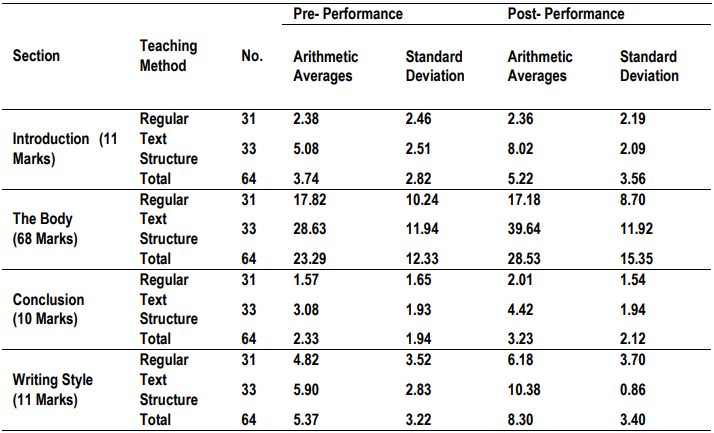
It is noted in Table (1) that there are apparent differences between the arithmetic averages of the performance of individuals in the post-study on each of the sections of dialectical writing according to the variable method of teaching (regular and text structure) and with the aim of isolating (removing) differences (tribal) in the performance of the study members, and knowing the statistical significance of those The apparent differences according to the variable of the teaching method (normal, text structure). (One Way Mancova Method was applied) as detailed in table (2).
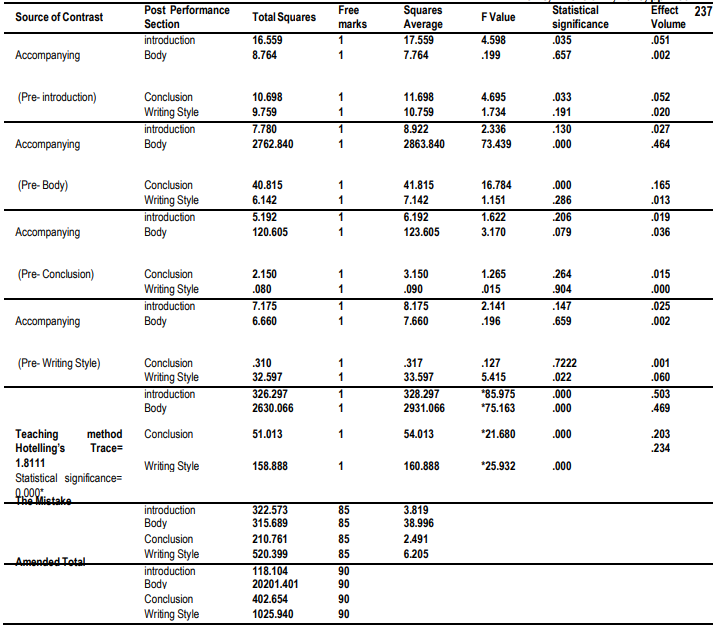
Given the results of the analysis of variance in Table (A), it is clear that there are statistically significant differences at the level of statistical significance (a =0.05) Show the dimensional arithmetic mean for the performance of the study personnel on each of the dialectical writing sections (introduction, body, conclusion and style of writing) Attributed to the variable of the teaching method (regular, text structure) where the values of the statistical significance for each of the departments were less than the statistical significance (a = 0.05) Thus, the null hypothesis was rejected, and the alternative was accepted, which states: There are statistically significant differences at the level of statistical significance (a = 0.05) among the arithmetic mean for the performance of the study individuals on each of the sections of dialectical writing due to the variable method of teaching (regular, text structure) to determine the value of the differences - statistically significant - between the mathematical averages of the students' dimension marks in each section, and according to the variable of the teaching method (regular, text structure) and knowledge of the benefit of those differences, a (Bonferroni) test was used. For dimensional comparisons, where the adjusted arithmetic averages were calculated, to isolate the effectiveness of the performance of the members of the two study groups (control, experimental) in the pre-test, on their performance in the post test, table (A) shows the results:
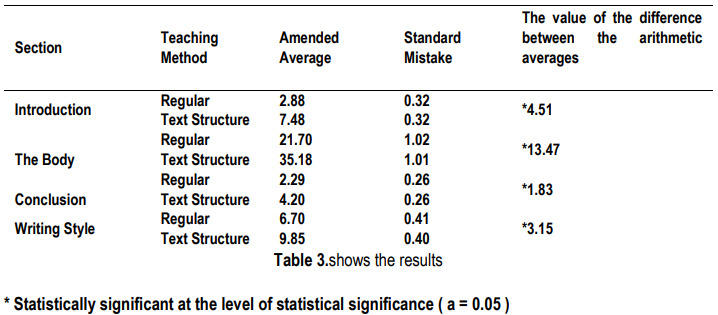
The results shown in Table (3) indicate that there is a statistically significant difference in sections (introduction, body, conclusion and style of writing). Between the performance of female students who studied (the usual) teaching method, and the performance of female students who studied the structure of the text and in favor of the performance of female students studied the text structure.
And to find the effectiveness of the teaching method (regular, text structure) in each section (introduction, body, conclusion and style of writing), calculated (Effect Size) using Eta Square, and we found from table (2)its equals: (0.503, 0.469, 0.234 and 0.234) respectively from the difference in the arithmetic average of study members performance for all sections of dialectical writing adopted for the study.
b) Sections of dialectical Study Al together:
The arithmetic averages and standard deviations of study member's performance were calculated for all sections of dialectical writing all together, in accordance to the change in teaching method (regular, text structure), table (4) shows that.
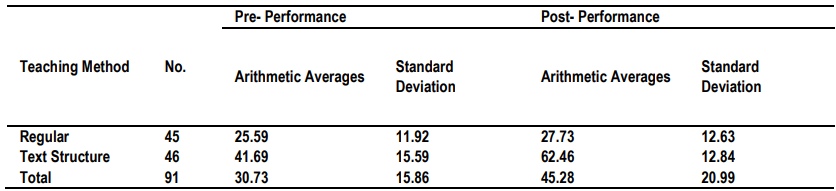
Table (4) existing of apparent differences between the arithmetic for performance doe study members for testing sections of dialectical study all together in accordance to the change in teaching method (regular, text structure in order to isolate (deletion) the pre- differences in performance doe study members for dialectical study and knowing the statistical significance for such apparent differences, (One way Ancova) method was used as detailed in table (5):

* Statistically significant at the level of statistical significance ( a = 0.05 )
By reviewing the result of analyzing the differences table (5) we find differences of statistical significance at statistical significance ( a = 0.05) between the arithmetic averages for the performance of study members in the test of sections of dialectical writing altogether referred to the change in teaching method (regular, text structure) since the value of statistical significance of sections of dialectical writing less than the statistical significance (a = 0.05) thus, the null hypotheses was rejected. And the substitute was accepted which provides that: (there are differences of statistical significance at the statistical significance (a = 0.05) ) between the arithmetic averages for the performance of study members in the test of sections of dialectical writing altogether referred to the change in teaching method (regular, text structure).
In order to determined the value of such differences- the statistical significance between the arithmetic averages of marks of study members of study sections altogether in accordance to the change in teaching method (regular, text structure) and defined in favor of such differences (Bonferroni) test was applied for post- comparisons, where the amended statistical averages were calculated in order to isolate the performanceeffectiveness of two study groups (control & experimental) in the pre-test on their performance in the post- test, table (6) shoes the results:

* Statistically significant at the level of statistical significance ( a = 0.05)
The results shown in Table (3) indicate that there is a statistically significant on sections of dialectical writing altogether between the performance of female students who studied (the usual) teaching method, and the performance of female students who studied the structure of the text and in favor of the performance of female students studied the text structure.
And to find the effectiveness of the teaching method on the sections of dialectical writing altogethercalculated (Effect Size) using Eta Square, and we found from table (5) its equals: (0.603) which means the change in teaching method (regular, text structure) explained approximately (60. 3%) of the difference in the arithmetic average of the performance of study members on the test of sections of dialectical study altogether.
The result of table (3) shows that the amended arithmetic averages of the performance of the students in the control group – after isolation the performance effectiveness on pre-test in each section of the four sections of post dialectical writing were clearly low in comparing with the performance of female student in the experimental group. Which was in comparison with the control group in accordance to the change in regular teaching method in each section of the four sections of post dialectical writing (introduction, body, conclusion and style of writing) : (2.94,21.72, 2.31, 6.71) respectively, and were: (7.45, 35.19, 4.14, 9.86) respectively.
DISCUSSION
The researchers attribute the reason for the poor performance of the students of the control group to their need for clear and specific instructions on the structure of the text by making effective designs for the structure of the reading texts. This result was consistent with the result of a study of which indicated that many students need clear instructions about the text structure; an effective design should be made for the structure of the informational text, based on the individual needs of students.
The researchers also see that the students of the experimental group in their post-performance in the four dialectical writing sections outperform the students of the control group in their learning of reading lessons according to the structure of the text, and to their learning how to track the writer's method and approach in building his text, and how he organized his hierarchy of his ideas, and distributed them to the front of the text, and his body And its conclusion, in addition to deepening the students' awareness of the relationship of these ideas, which are pivotal, main, and detailed altogether In this way, the students were given various opportunities in which they were trained in the processes of analyzing integrated text structures and splitting them into their departments from the introduction, body and conclusion, and defining writing skills in each section, and the indications for each of them, and applying what they learned from the processes of analyzing the texts using special worksheets, and following them in reading classes While providing appropriate feedback which may be effective in developing written skills, which contributed to improving the students’ abilities to rebuild and compose dialectical texts, and this is confirmed by the structural analytical approach,which intends to analyze the total construction to its sub-components, to reveal the existing relationships between them, which must be re-installed In a new holistic construction, different from the previous one, but it may be better and finer, (Clark et al.: 2013, pp.265–271) insist that teaching of processes of organizing informational texts, positively influencing authorship, and that teaching students of the structure by analyzing samples of texts, then applying what they have learned from their writing, improves the process of their written authorship.
By comparing the results of students of the experimental group on the dimensional dialectical writing test in each of the four dialectical writing sections, it is noted that the female students scored the highest arithmetic average in the body (35.19) followed by the writing method (9.86, then the introduction (7.45) and finally the conclusion (4.14) which table (3) shows. Where the researchers attribute the advance in the body That students generally focus - mostly - on the body of a text, and do not pay the same attention to the introduction and conclusion, but may content themselves with the written topic in the body, so most of their misgivings come in one long paragraph, without dividing into an introduction, body, and conclusion, and the reason may also be in focusing The students ’interest in the body is their focus on the goal of the writing style they are writing, and the goal of dialectical writing is to persuade the audience, insisted that the basic goal of the text body is to persuade the audience in particular point of the opinion.
Perhaps the student puts this goal in mind, which is one of the most important skills of the body of thetext, and then works to develop the central general idea that I highlighted in the introduction, and expand it through the main ideas in the body. As (Alnajjar: 2007) assured that the introduction is about the general idea in the subject of the writing, where the body represents the developmental paragraphs which talk about the body of the subject and developing its general idea through the main ideas developed by the writer through the process of developing the body.
As for the writing method, it came in second place after the body. Perhaps the reason for that is that it takes care of the writing style skills in all departments, from the introduction, body and conclusion, and the section that occupies the largest area of the subject of writing is the body, and the attention of the students is focused on him and his skills, they focus - automatically - on a method Writing in it also, especially in presenting ideas within the paragraphs in a logical order and sequence, which increased the mean of the arithmetic.
Perhaps the reason for the low arithmetic mean of the performance of the members of the experimental group in the introduction compared to the body and the style of scribes, is that the nature of the introduction in the dialectical contention differs from other types of writing, in the introduction the issue should be identified and formulated in the form of a hypothesis (allegation) instead of being presented in a general axial idea, The students did not study the writing styles separately including dialectical writing, as the teacher's guide teaches writing skills in general, and applies them to all types of writing without allocating sub-skills, and strategies specific to the structure of the text, and students may face - often - difficulty in formulating the hypothesis in the introduction, and thus their achievement is lower in this section . This result is consistent with the result of the study conducted by (Owusu&Adade- Yeboah: 2014, pp.56-62) which revealed that most students face problem in compositing including building the hypothesis in the introduction, they mentioned that members of their study shall not be able to build the hypothesis or enroll the same in the introduction of their subjects, and that the percentage of members who managed to do the same was very little, since it was (13%) of the grand total.
As for the conclusion, it reached the lowest average arithmetic, and the reason for that can also be attributed to the difference in the conclusion in the other writing, where it requires providing specific skills such as: determining the writer’s conclusion about the issue, or determining the summary of his opinion, or proving the issue, and students may encounter Difficulty in that, because they did not study the various writing styles, including dialectical writing, and this is confirmed by the writing plan outlined in the teacher's guide that teaches writing skill in general, without paying attention to teaching other sub-writing styles, including dialectical writing.
CONCLUSION
Researchers attribute the improvement -specifically- in the style of dialectical writing to the training of female students according to the structure of the text to define the purpose of the book in each of the texts identified in the current study, and in each of its sections and to deepen the awareness of female students that the purpose of the book varies in the transfer of new information, or explanation Understanding, interpretation, analysis, description, influence, or persuasion, along with deepening their understanding of the writer’s role in evidence, arguments, and logical arguments. And relevant citations to strengthen his ideas, which may be effective in improving their dialectical writing skills, which need skill, narration, and organization and this result is consistent with the result of a study of which proved the positive effect of teaching the text structure in enhancing the students ability in compositing dialectical articles. The results of Table (6) showed a statistically significant effect on the test of the dialectical writing sections combined between the performance of students who studied in the usual teaching method, and the performance of students who studied the structure of the text, and in favor of the performance of students who studied the structure of the text.
Such effectiveness may be attributed on sections of dialectical writing altogether to that the teaching of text structure has positive effect in enhancing the dialectical writing to the participated female students. Such result in consist with the result of study of which studied the effectiveness of two types on texts structures The superstructure and the overall structure of the text, on the formation of dialectical texts, and the results indicated the improvement of students ’grades in dialectical writing, and they also agreed on what emphasized That awareness of the structure of the reading text, and how the author cleans up the text, improves the ability to participate in similar organizational processes, by creating special mental representations of the text.
While differed in study of That aimed to know the effectiveness of the types of text structures, on the ability of students to compose dialectical texts, and the results showed that many of the participants’ texts were not based on the basic structure that relies on positive logical arguments, where the dialectical structure appeared turbulent, and the texts lacked organization, so the paragraphs appeared Confused, I lost some of its important elements, and I did not do elementary speech in it typical.The present study, in light of the results it has produced, recommends that:
- Using text structure in enhancing the dialectical (persuasive) skills.
- Conducting more studies in order to define the effectiveness of teaching text structure in enhancing the functional writing.
Pay attention in teaching types of writing and developing its skills among those who teach Arabic language.
BIODATA
S.AALWAELY: She holds a Ph.D in Arabic language curricula and teaching methods, and she is currently working as director of the two master's programs in the College of Education at Al Ain University, and she is a professor. She previously worked at the Hashemite University in Jordan, and she is a member of many scientific committees, and she has a large number of literature and research. Published in educational and scientific journals.
TABDALLAHI: He obtained his Ph.D in Sharia and Islamic studies from Al-Qarawiyyin University in Morocco, and is currently an assistant professor at the College of Education and Human Sciences at Al Ain University in Abu Dhabi. He has participated in a number of conferences and has published a number of research papers in the fields of Islamic studies, Arabic language, and education.
M.I ALHOURANI: Studied in The College of Arts at Yarmouk University in Jordan specializing in literature and criticism, and he is an assistant professor at the College of Education and Human Sciences at Al Ain University, Abu Dhabi headquarters, a member of the Administrative Board of the General Assembly of Heads of Arabic Language Departments, and a member of the Jordanian Writers Association, the Arab Writers Union and the Asia and Africa Writers Union, for him A number of publications and research papers in literary and educational fields.
BIBLIOGRAPHY
AFRIZAL (2018).“TEORI AKUNTANSI (Accounting Theory)”.Salim Media Indonesia (SMI), pp.188.
ALNAJJAR, F (2007). The Artistic Foundations of Writing and Expression, Amman: Safa House for Publishingand Distribution.
AHMAD, I & AHMAD, S. (2019). “The Mediation Effect of Strategic Planning on The Relationship Between Business Skills and Firm’s Performance: Evidence from Medium Enterprises in Punjab”, Pakistan. Opcion, 35(24), 746-778.
AHMAD, I SAHAR. (2019). “Waste Management Analysis from Economic Environment Sustainability Perspective”. International Journal of Scientific & Technology Research 8(12), 1540-1543.
ALNASSAR, S & ALRADHWAN (2007).“the effectiveness of using the five stages of writing in developing the ability of written expression in pupils in the second intermediate class”. The Journal of the Arab Gulf letter (204), pp.57-13.
AHMAD, I & AHMAD, S. (2018). “Multiple Skills and Medium Enterprises’ Performance in Punjab Pakistan: A Pilot Study”. Journal of Social Sciences Research, 7(4), 44-49.
CLARK, S, JONES, C & REUTZEL, D (2013).“Using the Text Structures of Information Books to Teach Writing in the Primary Grades”.Early Childhood Educ J, 4(1), pp.265–271.
COIRIER, P & FAVART, M (2006).“Acquisition of the Linearization Process in Text Composition in Third to Ninth Graders: Effects of Textual Superstructure and Macrostructural Organization”. J Psycholinguist Res. 35, pp.305–328.
COSKUN, E & TIRYAKI, E (2013). “Problems of University Students on Constituting The Structure of ARGrgumentative Text”.AdıyamanÜniversitesiSosyalBilimlerEnstitüsüDergisiTürkçeninEğitimiÖğretimiÖzelSayısı, 6(11),pp.101-141.
DEWI, VI, SOEI, CTL & SURJOKO, FO (2019). “The impact of macroeconomic factors on firms’ profitability (evidence from fast moving consumer good firms listed on Indonesian stock exchange)”. Academy of Accounting and Financial Studies Journal.
FADLALLAH, M (2003). functional writing operations and their applications, teaching and evaluating them, Cairo: Books World, publishing, distribution and printing.
HASANAJ, P & KUQI, B (2019).“Analysis of Financial Statements”.Humanities and Social Science Research.https://doi.org/10.30560/hssr.v2n2p17
KALDJARV, M (2009). “Logical Argumentation On the Basis of State Examination Compositions”.Problems Of Education In The 21st Century, pp.47- 56.
KHASAWNA, R (2008). Foundations of Teaching Creative Writing, Irbid, the World of Modern Books.
KURUDAYIGLU, M & YILMAZ, E (2014). “How Are We Persuaded? Persuasive Text And Structure”. Journalof Theory and Practice in Education.Articles /Makaleler. 10(1),pp.75-102.
MACAGNO, F & WALTON, D (2008).“The Argumentative Structure of Persuasive Definitions”.Ethic Theory Moral Prac, 11, pp.525–549.
MARON, G (2009). Expression techniques and patterns for vector texts.Lebanon: Modern book foundation.
NOR, NHM, NAWAWI, A & SALIN, ASAP (2017).“The influence of board independence, board size andmanagerial ownership on firm investment efficiency”.Pertanika Journal of Social Sciences and Humanities
O’HALLORAN, K (2012). “Electronic deconstruction Revealing tensions in the cohesive structure of persuasion texts”. International Journal of Corpus Linguistics, 17(1), pp.91–124.
OWUSU, E & ADADE-YEBOAH, A (2014). “Thesis Statement: A Vital Element in Expository Essays”. Journal of Language Teaching and Research, 5(1), pp.56-62.
RAY, M & MEYER, B (2011). “Individual differences in children’s knowledge of expository text structures: A review of literature”. International Electronic Journal of Elementary Education, 4(1), pp.67-82.
SQUIRE, K & JAN, M (2007).“Mad city mystery: developing scientific argumentation skills with a place-based augmented reality game on handheld computers, Journal of Science Education and Technology”. 16(1), pp.5– 29.
WHITE, M, HOUCHINS, D, VIEL-RUMA, K & DEVER, B (2014). “Effects of Direct Instruction Plus Procedural Facilitation on the Expository Writing of Adolescents with Emotional and Behaviora Disabilities in Residential Schools”. Education and Treatment of Children.37(4), pp.567-587.