Artículos
Macroeconomic Determinants of the Mortgage Loan
Factores macroeconómicos determinantes del préstamo hipotecario
 E KADOCHNIKOVA kad-ekaterina@yandex.ru
E. BULATOVA bulatovaei@yandex.ru
A. SAFIULLINA alina_s1998@mail.ru
D SUYCHEVA dilyaras@inbox.ru
E KADOCHNIKOVA kad-ekaterina@yandex.ru
E. BULATOVA bulatovaei@yandex.ru
A. SAFIULLINA alina_s1998@mail.ru
D SUYCHEVA dilyaras@inbox.ru
Macroeconomic Determinants of the Mortgage Loan
Utopía y Praxis Latinoamericana, vol. 25, no. Esp.12, pp. 333-345, 2020
Universidad del Zulia
Received: 10 September 2020
Accepted: 05 November 2020
Abstract: This research aims to assess the relationship of macroeconomic indicators and those related to the banking sector of the economy. They will be considered with the volume of mortgage loans granted on the example of the russian economy. It is shown that the increase in the weighted average mortgage rate is correlated with the increase in the volume of mortgage loans; the increase in the average nominal wage contributes to the increase in the volume of mortgage loans. The direct relationship between the volume of mortgage loans and problem mortgage debt can predict the inflating of the "credit" bubble.
Keywords: Inflation, interest rate, linear regression model, mortgage loan, unemployment..
Resumen: Esta investigación tiene como objetivo evaluar la relación de los indicadores macroeconómicos y los relacionados con el sector bancario de la economía. Serán considerados con el volumen de préstamos hipotecarios concedidos en el ejemplo de la economía rusa. Se muestra que el aumento de la tasa hipotecaria promedio ponderada, se correlaciona con el aumento del volumen de préstamos hipotecarios; el aumento del salario nominal medio contribuye al aumento del volumen de préstamos hipotecarios. La relación directa entre el volumen de préstamos hipotecarios y la deuda hipotecaria problemática puede predecir la inflación de la burbuja del "crédito".
Palabras clave: Crédito hipotecario, desempleo, inflación, modelo de regresión lineal, tasa de interés..
INTRODUCTION
The main tool for stimulating the development of the Russian housing market is mortgage lending, which in modern conditions is also developing due to state support in the form of preferential mortgage lending for families with children, residents of the far Eastern Federal district and state programs for subsidizing mortgage loans. The Russian mortgage market has a huge potential that needs to be controlled, preventing the formation of a "mortgage bubble" (Abramkin et al.: 2015, pp.259-263; Bagautdinova et al.: 2017, pp.4908- 4912).
According to the Central Bank of Russia data, the share of the Russian mortgage market, despite high growth rates, is relatively small. In the Russian Federation, the share of mortgages in GDP is 6%, and in other countries, it is evaluated as 25%. But, despite this, it is important to develop mortgages in a high-quality segment with risk control, which, in turn, poses a threat to the entire financial market (Jordi: 2008; Lou & Yin:2014, pp.336–363). In Russia, the mortgage lending market is developing quite rapidly, due to the influence of macroeconomic, political and social factors (Abel & Bernanke: 2010, pp.764). Decreasing oil prices and the purchasing power of the ruble can make significant adjustments to the pace of development of the mortgage lending market in the country (Bulatovaet al.: 2019). In modern conditions, the study of socio- economic phenomena of the mortgage level is conducted on the basis of statistical and mathematical methods, which include a wide range of different methods and techniques that allow making the detailed and complete analysis of the primary information about the object under study, presented in a mathematical format.
Issues of mortgage lending are the subject of numerous discussions in the scientific literature. For this study, a key role in empirically confirming the theoretical arguments in favor of the impact of macroeconomic factors on the volume of mortgage loans granted in Russia was played by an article, in which, using data on large mortgage services in the United States, the author argued the following point of view: the impact of unemployment on mortgage default is insignificant, in contrast to common risk factors, such as high leverage of the borrower or low FICO indicators of the borrower. The research results demonstrated in (Gyourko& Tracy: 2014, pp.87–96) were further developed in (Samerkhanova&Kadochnikova: 2015, pp.55-59). Using the example of the development of the Russian economy, it shows the predominant influence of household income on the dynamics of mortgage loans issued. The authors have identified four groups of determinants of mortgage lending: variables of mortgage loans, housing market and mortgage market participants, macroeconomic variables and money market variables. Empirically, the predominant influence of money market characteristics on the weighted average mortgage rate is shown.
The authors (Gabriel & Rosenthal: 2013, pp.42–50) used year-by-year regression models and fixed-effect panel data analysis models to identify the relationship between the agglomeration economy and mortgage lending. The authors showed that urbanization increases liquidity, improves access to information and credit in the 1990s, but after 2000 the effects dissipate, possibly due to changes in consumer sentiment due to the development of secondary markets and information technologies. This view is presented in the article of (Wadud et al.: 2020, p.101132). The authors also do not find any connections between consumer sentiment and the mortgage rate. However, they show a significant positive impact of the unemployment rate and, in general, a negative impact of income per capita on the level of overdue mortgage loans. The authors of another article (Campbell &Cocco: 2015, pp.1495-1554) used a dynamic decision model for household mortgage lending, which includes income from work, house prices, inflation, and interest rate risk. The article (Agarwal & Liu: 2003, pp.75-84) empirically shows the influence of the unemployment rate on consumers ' propensity to bankruptcy due to macroeconomic fluctuations. A study (Steinbuks&Elliehausen: 2014, pp.47-72) using the example of US legislation shows that legal restrictions reduce the use and attractiveness of a mortgage loan.
Using the findings obtained in the article of, and in the article of (Shao et al.: 2020, p.102530), the impact of administrative decentralization in China on the financial agglomeration of loans in districts was defined. Inthe article of (Diaz-Serrano & Raya: 2014, pp.22–32), a unique set of data on mortgage loans granted in Spain revealed discrimination in terms of higher interest rates for immigrant borrowers.
In the same way as we use a regression model, but we modify it by expanding it through indicators of the banking sector of the economy.
In order to find the most appropriate model for measuring factors of the volume of mortgage loans provided, fairly simple linear models of multiple regression are presented. Ten annual indicators that characterize the banking system and the Russian economy for the period from 2015 to 2020 are used to build models. The usual least squares method is used to evaluate model parameters, and the traditional formal student and Fisher tests are used to verify statistical significance.
The main purpose of the study is to detect and evaluate the value factors of mortgage loans issued in the Russian financial system. The research idea was suggested by the works.
Based on the analysis of the literature, two main research questions were formulated:
- 1. What macroeconomic indicators are related to the volume of mortgage loans granted?
- 2. What economy indicators of the banking sector development contribute to changes in the volume of mortgage loans granted?
The following results were obtained. There was no statistically significant correlation between the volume of mortgage loans and the number of credit institutions, unemployment, inflation, gross domestic product, and the average cost per square meter of housing. Intuitively, we found a statistically significant inverse relationship between the volume of mortgage loans and the weighted average mortgage rate and a direct relationship with nominal wages. This corresponds to theoretical representations of (Brooks: 2008, p.674), as well as conclusions obtained by. However, a direct correlation between the volume of mortgage loans and mortgage debt was confirmed, which in the future may predict the inflating of the "credit" bubble.
The paper consists of an introduction, two main sections, and a conclusion. In the first section, we formulate the linear multiple regression models used and describe the indicators used in the Russian banking system and economy based on a review of the literature regarding the selection of economic indicators that affect the volume of mortgage loans granted. The second section presents the results of evaluating models. The conclusion contains conclusions and recommendations for further research in the field of analytical econometric tools determinants of mortgage lending.
METHODOLOGY
Correlation and regression analysis are popular methods for analyzing and predicting the development of socio-economic phenomena that are closely related to mathematically expressed indicators. It is based on the study of several supposedly interrelated phenomena. In other words, it is assumed that there are cause-and- effect relationships when a change in one variable leads to a change in another.
Correlation analysis allows one to identify the presence and closeness of the connections between the studied phenomena, as well as check the presence or absence of collinear factors. The main purpose of correlation analysis is to obtain information about one variable using another. The correlation coefficient shows the tightness of the linear relationship and changes in the range from -1 to 1. Minus one means a complete linear inverse relationship. The unit is a complete linear positive relationship. Zero – no linear correlation. When there is a positive correlation, an increase in one factor leads to an increase in another, and when there is a negative correlation, the growth of one indicator leads to a decrease in the other.
Regression analysis allows identifying the statistical significance of factors and the difference between the correlation coefficient and zero using a formal Student test.
To build a linear model of multiple regression, quarterly statistical data for 5 years from 01.01.2015 to01.01.2020 were used (Table 1, Table 2).
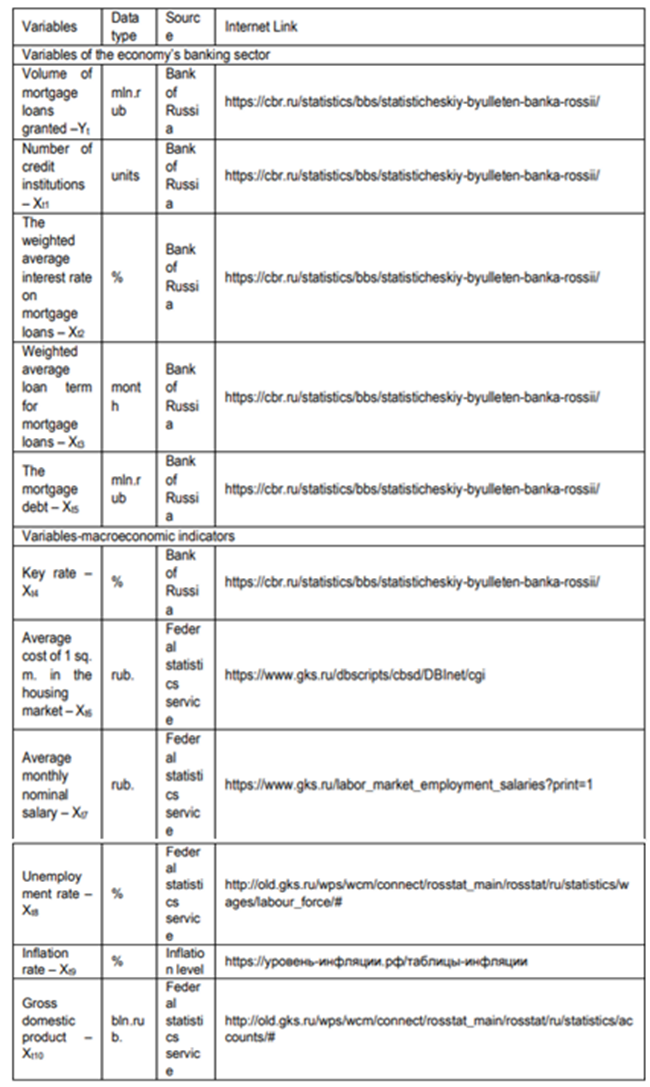
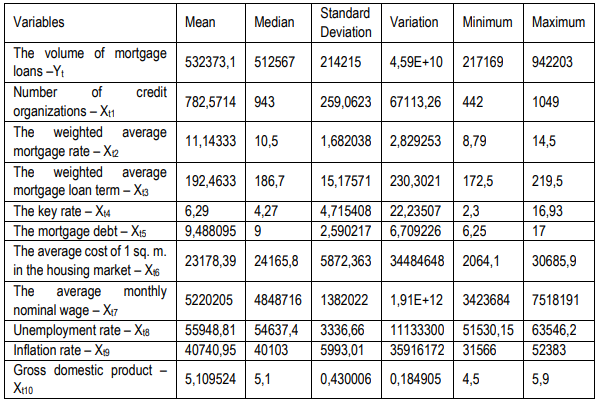
We use the volume of mortgage loans granted in millions of rubles as a dependent variable – Yt.In the econometric literature, the use of time series reference levels to study statistical relationships is discouraged due to the possible false regression (Hamilton: 1994, p.820; Cowpertwai& Metcalfe: 2009, p.262)False regression is a situation when there is no causal connection between the explanatory and dependent variable, but the correlation coefficient between them is close to one in modules, and the equation describing such connection corresponds to the data with high accuracy (Brockwell& Davis: 2016, pp.428; Neusser: 2016, p.42). This situation usually occurs when working with time series, which are characterized bythe presence of a trend, deterministic or random. Such time series are called non-stationary. To avoid false regression in modeling we use absolute increments of time series levels:

To evaluate the model, we use the usual least squares method (Wooldridge: 2013, p.865). Previously, to test the regressors for multicollinearity, we applied the matrix of linear coefficients of pair correlation. Multicollinearity is the presence of a linear connection between the explanatory variables of the model, which distorts estimates of regression parameters. If the modal value of the linear coefficient of paired correlation is greater than 0.7, then such a pair of regressors is considered collinear, and one of the regressors is excluded from the linear model of multiple regression. The final regression model is also freed from statistically insignificant (redundant) regressors.
The adequacy of the regression model is estimated by the coefficient of determination R2:
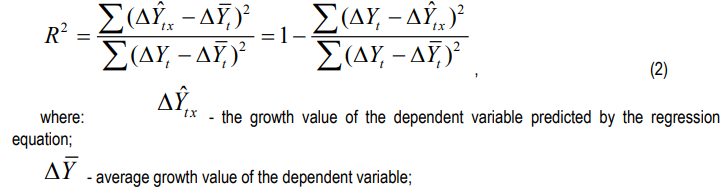
To predict the volume of mortgage loans granted, based on a linear trend, the forecast values of the absolute growth of each regressor of the final model are determined, then the growth of the dependent variable is determined, which is added to the last known initial level of the time series of the volume of mortgage loans granted.
RESULTS
The matrix of linear coefficients of pair correlation, constructed from the initial levels of time series, defined the multicollinearity. After switching to absolute increments of variables, the matrix of linear coefficients of pair correlation showed a practical absence of collinear regressors. Among macroeconomic indicators, the largest direct linear relationship between the increase in the volume of mortgage loans granted (ΔYt) is observed with an increase in the average monthly nominal wage (RΔYtΔXt7 = 0.65091), gross domestic product (RΔYtΔXt10 = 0.53552), and the reverse – with the average price of 1 square meter in the housing market (RΔYtΔXt6 = - 0.41716). Among the indicators of the banking sector of the economy, the greatest inverse linear relationship between the increase in the volume of mortgage loans granted is observed with an increase in the weighted average rate (RΔYtΔXt2 = -0.47070), the weighted average loan term (RΔYtΔXt3 =-0.44382),
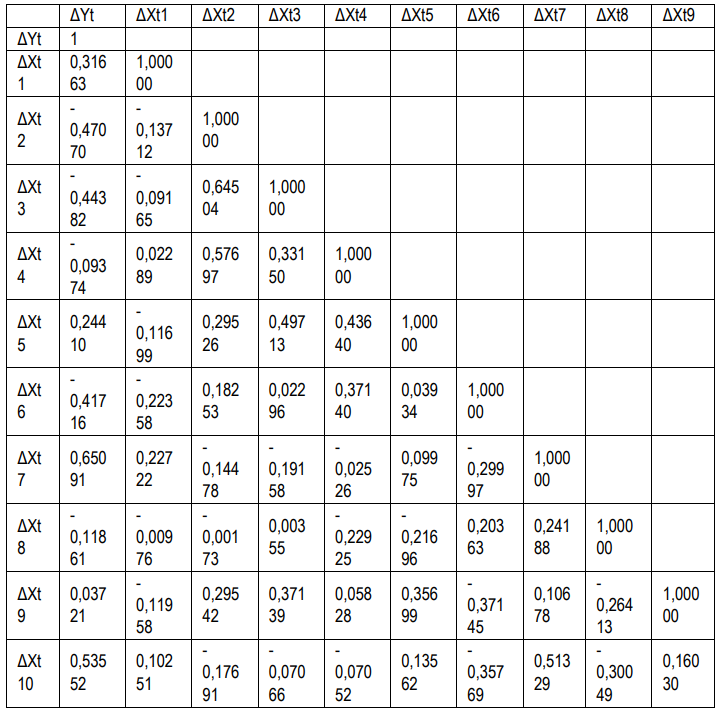
There is also a close direct linear connection between the two pairs of regressors: the weighted average rate and the weighted average loan term (RΔXt2ΔXt3 =0.64504), as well as the weighted average rate and the key rate (RΔXt2ΔXt4 =0.57697). Therefore, we exclude the regressors ΔXt3 and ΔXt4 from further analysis. The results of evaluating linear multiple regression models are summarized in Table 4. In the regression model (1), three regressors were statistically significant: ΔXt2 – increase in the weighted average rate, ΔXt5 – increase in mortgage debt, and ΔXt7 – increase in the average monthly nominal wage. In other words, a linear statistical connection with the increase in the volume of mortgage loans granted was confirmed only for the increments of these variables. In model (2), the multiple correlation coefficient takes the value of 0.8174 and indicates a fairly close joint relationship between the growth of the dependent variable ΔYt (the volume of mortgage loans granted) and the increase in the weighted average mortgage rate (ΔXt2), the increase in debt on mortgage loans granted (ΔXt5), and the increase in the average monthly nominal salary (ΔXt7).
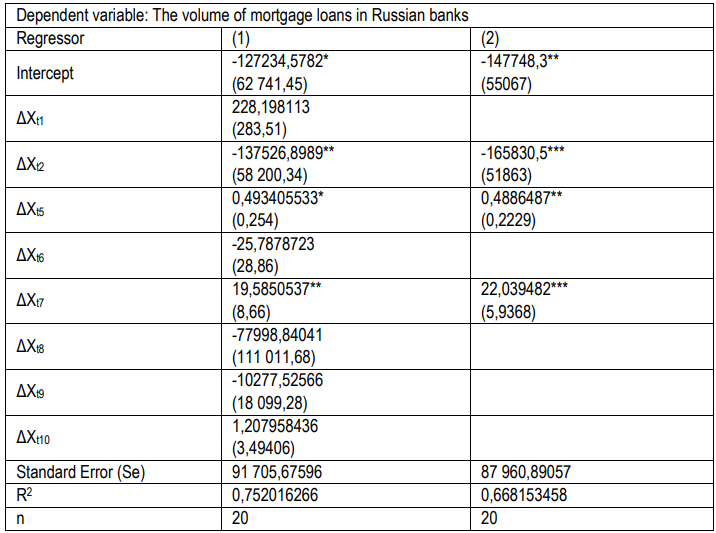
For model (2), the coefficient of determination R2 assumed a value equal to 0.6682, which indicates that this model explains 67% of the variation in the volume increase of mortgage loans granted. The remaining 33% of the growth variation may be due to the influence of other factors that are not taken into account in this model. The indicator of 67% indicates that the model (2) has a good predictive ability, the regressorsΔXt2, ΔXt5, and ΔXt7 in this case are interconnected with the dependent variable ΔYt.
According to the evaluation results, the linear multiple regression model (2) has the following form: ΔYt = –147 748,331 – 165 830,53*ΔXt2 + 0,486*ΔXt5 + 22,039*ΔXt7+ɛt
The signs of coefficients in the regression equation correspond to economic intuition, which is confirmedby the economic interpretation: an increase in the weighted average mortgage rate by 1 percentage point will, all other things being equal, reduce the increase in the volume of mortgage loans granted by an average of 165,830.53 million rubles. An increase in mortgage debt by 1 mln rub will, all other things being equal, lead to an increase in the volume of mortgage loans by an average of 0.486 mln rub. An increase in the average monthly nominal salary by 1 ruble will lead, all other things being equal, to an increase in the volume of mortgage loans granted by an average of 22.039 mln rub.
The forecast of the possible volume of mortgage loans granted, obtained using model (2), is presented in Table 5.

DISCUSSION
This paper is devoted to the regression analysis of mortgage loans granted volume factors in the Russian economy. We proceeded from empirically proven theoretical arguments in favor of the influence of macroeconomic indicators and indicators of the banking sector of the economy on the volume of mortgage loans granted. The paper uses quarterly Russian statistical data from 2015-2020. For the study, we applied practical recommendations by (Neusser: 2016, p.42) on a methodological approach to analyzing the relationships of non-stationary time series. The approach to modeling mortgage credit regressors presented in the study has a number of advantages due to the ability to assess the contribution of each of the considered model factors to the variation in the volume of mortgage loans provided, and to predict changes in the found dependencies in the future. In particular, it allows one to perform a better selection of predictors of mortgage lending and preserve the possibility of meaningful interpretation of modeling results for making practical decisions in the banking sector of the economy.
Figures 1-4 show the forecast of statistically significant predictors and possible volume of mortgage in 2020-2022.
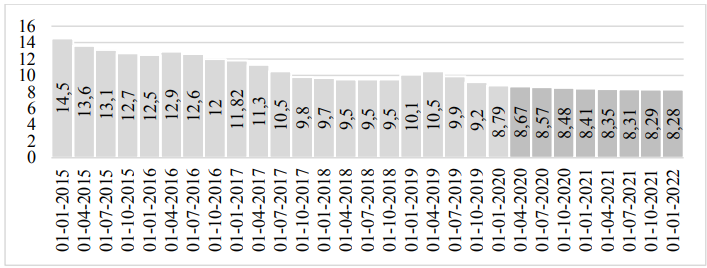
Figure1. The forecast of the average rate on mortgage loans in 2020-2022, %.
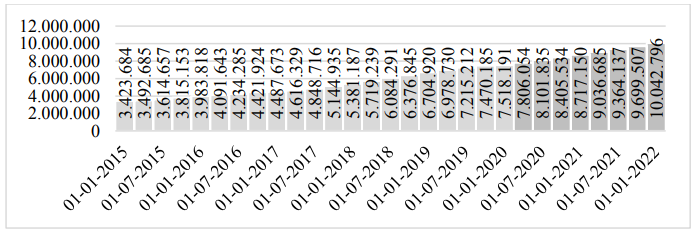
Figure2. The mortgage debt forecast for 2020-2022, million rubles
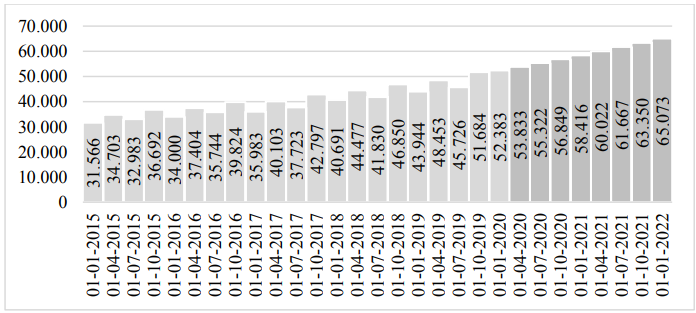
Figure 3. The forecast of the average monthly nominal salary for 2020-2022, rubles.

Figure 4. The forecast of the mortgage loans volume for 2020-2022, million rubles
CONCLUSION
The dynamics of the mortgage loans granted volume has positive dynamic, which indicates that in the future, the market for housing mortgage lending will continue to actively develop and increase. The connections defined predict two main conclusions. First, the lack of correlation between the volume of mortgage loans and most macro-indicators shows possible positive trends for the development of the mortgage market. Second, the direct relationship between the volume of mortgage loans and mortgage debt may indicate the problem of a “credit” bubble.
Acknowledgements
The work is performed according to the Russian Government Program of Competitive Growth of Kazan Federal University.
BIODATA
EKADOCHNIKOVA: Date of birth: 17.09.1973 Positions: Associate Professor, Ph.D. (Associate Professor), Head University / Institute of Management, Economics and Finance / Department of Economic Theory and Econometrics (main), Associate Professor, Ph.D. (Associate Professor), Head University / Institute of Management, Economics and Finance / Department of Economic Theory and Econometrics (part-time employee) Academic Titles: Associate Professor (12/20/2000) Languages: English (Independent Speaker), German (Basic Speaker)
E BULATOVA: Education2000-2004 higher education: Academy of Management TISBI, Kazan, Faculty of Law1991-1996 higher education: Kazan State Agrarian University, economicKnowledge of languagesEnglish (Self-proficient)Positions heldAssociate Professor, Ph.D. (Associate Professor), KFU / Institute of Management, Economics and Finance / Department of Financial Markets and Financial Institutions (main employee)Academic degreescandidate (economic sciences) in specialty 08.00.05 - Economics and management of the national economy (by industries and spheres of activity, ...), the title of the dissertation "Increasing the efficiency of the use of labor resources at agricultural enterprises"
A SAFIULLINA: Positions engineer category 2, Head University / Alexander Butlerov Institute of Chemistry / Department of Physical Chemistry (основнойработник) Research work: 02.00.04 - Physical Chemistry Bachelor of Economics, graduation year 2020.
D SUYCHEVA: Candidate of physical and mathematical Sciences, Associate Professor, Kazan Innovative University named after V. G. Timiryasov
BIBLIOGRAPHY
ABEL, A & BERNANKE, B (2010). “Macroeconomics, (5th ed.)”. Addison Wesley, pp.764.
ABRAMKIN, SA, HAYALEEVA, CS, BAGAUTDINOVA, NG & KARPOVA, NV (2015). “Convergence offinancial politics and regulation on the financial markets to the stimulation of the economy”. Asian Social Science, 11(11),pp.259-263
AGARWAL, S & LIU, C (2003).“Determinants of credit card delinquency and bankruptcy: Macroeconomic factors”. Journal of Economics and Finance, 27(1),pp.75-84
BAGAUTDINOVA, NG, KARASIK, EA, SAFIULLIN, LN & ISMAGILOVA, GN (2017).“Problems of regulationin financial markets”. Journal of Engineering and Applied Sciences,12(19),pp.4908-4912
BROCKWELL, PJ & DAVIS, RA (2016).“Introduction to Time Series and Forecasting”. Springer International Publishing Switzerland, pp.428.
BROOKS, С (2008). “Introductory Econometrics for Finance”. Cambridge University Press, p.674.
BULATOVA EI, POTAPOVA, EA & FATHUTDINOVA, RA (2019).“Monitoring and controlling banking system via financial stability assessment”. International transaction journal of engineering management & Applied sciences & Technologies, 10(16).
CAMPBELL, JY & COCCO, JF (2015).“A Model of Mortgage Default”. Journal of Finance. 70(4),pp.1495-1554
COWPERTWAIT, PSP & METCALFE, AV (2009). “Introductory Time Series with R”. Springer:Science+Business Media, p.262.
DIAZ-SERRANO, L & RAYA, JM (2014). “Mortgages, immigrants and discrimination: An analysis of the interest rates in Spain”. Regional Science and Urban Economics,45,pp.22–32.
GABRIEL, SA & ROSENTHAL, SS (2013).“Urbanization, agglomeration economies, and access to mortgage credit”. Regional Science and Urban Economics, 43,pp.42–50.
GYOURKO, J & TRACY, J (2014).“Reconciling theory and empirics on the role of unemployment in mortgage default”. Journal of Urban Economics, 80, pp.87–96.
HAMILTON, JD (1994).“Time Series Analysis, 1st edition”. Princeton University Press, p.820.
JORDI, G (2008).Monetary policy, inflation, and the business cycle: an introduction to the New Keynesian framework.Princeton University Press.
LOU, W & Yin, X (2014). “The impact of the global financial crisis on mortgage pricing and credit supply”. Journal of International Financial Markets, Institutions & Money. 29, pp.336–363.
NEUSSER, K (2016). “Time Series Econometrics. Springer International Publishing Switzerland”, p.42.
SAMERKHANOVA, AA & KADOCHNIKOVA, EI (2015). “Econometric analysis of the mortgage loans dependence on per capita income”. Asian Social Science.11(11),pp.55-59.
SHAO, S, WANG, Y & YAN, W (2020).“Administrative decentralization and credit resource reallocation: Evidence from China's “Enlarging Authority and Strengthening Counties” reform. 9(7),p.102530
STEINBUKS, J & ELLIEHAUSEN, G (2014).“The Economic Effects of Legal Restrictions on High-Cost Mortgages”. The Journal of Real Estate Finance and Economics, 49, pp.47-72
WADUD, M, ALI AHMED, HJ & TANG, X (2020).“Factors affecting delinquency of household credit in the U.S.: Does consumer sentiment play a role?”North American Journal of Economics and Finance, 5(2),p.101132
WOOLDRIDGE, JM (2013). “Introductory Econometrics”. A modern approach, (5th ed.) Michigan State University: South-Western Cengage Learning, p.865.