Artículos
Digital Transformation of Russia’s Agricultural Sector
Transformación digital del sector agrícola de Rusia
 OKSANA VALERYEVNA VAGANOVA vaganova@bsu.edu.ru
NATALIA EVGENEVNA SOLOVJEVA Soli.evhgy67@gmail.com
RUSLAN VALERYEVICH LESOVIK ruslan_lesovik@mail.ru
LESOVAYA SVETLANA LEONIDOVNA: leon.lesovi.sc5@gmail.com
OKSANA VALERYEVNA VAGANOVA vaganova@bsu.edu.ru
NATALIA EVGENEVNA SOLOVJEVA Soli.evhgy67@gmail.com
RUSLAN VALERYEVICH LESOVIK ruslan_lesovik@mail.ru
LESOVAYA SVETLANA LEONIDOVNA: leon.lesovi.sc5@gmail.com
Digital Transformation of Russia’s Agricultural Sector
Utopía y Praxis Latinoamericana, vol. 25, no. Esp.12, pp. 397-406, 2020
Universidad del Zulia
Received: 17 September 2020
Accepted: 05 November 2020
Abstract: The paper presents a methodical approach to the assessment of agricultural sector transformation in the conditions of intensive penetration of digital technologies into the economy sector. The authors offer a schematic diagram of data collecting and processing in the start-to-finish automated production-and- marketing chain of activity within the agricultural sector. The achievement of these goals will allow increasing the agricultural sector contribution into russian economy, to boost export revenue, and to schedule and aggregate data streams for creation of start-to-finish chains and technologies, from the agricultural production stage to consumption, with a deep integration into allied industries of digital economy.
Keywords: Agricultural sector, digital economy, digital technologies, innovative development, investments..
Resumen: El documento presenta un enfoque metódico para la evaluación de la transformación del sector agrícola en las condiciones de penetración intensiva de las tecnologías digitales en el sector de la economía. Los autores ofrecen un diagrama esquemático de la recopilación y el procesamiento de datos en la cadena de actividad de producción y comercialización automatizada de principio a fin dentro del sector agrícola, incluidos los consumidores, las empresas de ventas, los productores agrícolas y los proveedores. El logro de estos objetivos permitirá aumentar la contribución del sector agrícola a la economía rusa, impulsar los ingresos por exportaciones, y programar y agregar flujos de datos para la creación de cadenas y tecnologías de principio a fin, desde la etapa de producción agrícola hasta el consumo, con una profunda integración en industrias aliadas de la economía digital.
Palabras clave: Desarrollo innovador, economía digital, inversiones, sector agrícola, tecnologías digitales..
INTRODUCTION
Today we witness the formation of digital economy. Apart from providing the national security of any state, the digitalization process enables economy to function effectively in the global economic space. Various factors influence the penetration of digital technologies into real economy. This penetration is a permanent process resulting in an enhanced coherence of infrastructural elements and the emergence of new forms of business ties – beginning with those in science, and furtherly ties in industry and in other spheres (Vaganova: 2016). The formation of digital economy architecture in Russia has become one of the top issues, and it is a popular research object. This phenomenon is studied from various methodological perspectives and in terms of various economy sectors. Moreover, low-tech industries are of interest, as they cannot afford to digitalize their activities in the nearest future. Agriculture is among such low-tech economy sectors. Therefore, this paper aims to provide a methodological ground for the process of agricultural transformation that takes place in the age of rapid penetration of digital technologies into all spheres of real economy.
An analysis of some key concepts is crucial for the research. Failing these concepts, no idea of the digitalization essence and its influence on economic development can be shaped. There are two circumstances determining the practicability of such approach.
First, the scholarly discussion of the issue must be conducted in a language which is clear to opponents, within generally accepted ideas about key definitions of digital technology implementation. Second, there is a need to clarify and adapt these notions in respect to the agricultural sector, which lies at the bottom of our research object (Chupryakova et al.: 2019, pp.358-365).
We have studied works by a number of scholars devoted to digital transformation and revealed somegnoseological gaps. There are various interpretations of “digitalization” essence, which is why it may be understood differently. In order to reveal a common feature in the existing definitions, we have selected three major approaches which could become the quintessence of “digitalization” (See Table 1):
Some options of the “digitalization” definition within three approaches to understanding its essence:
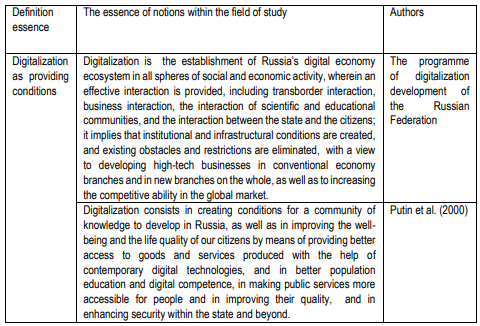
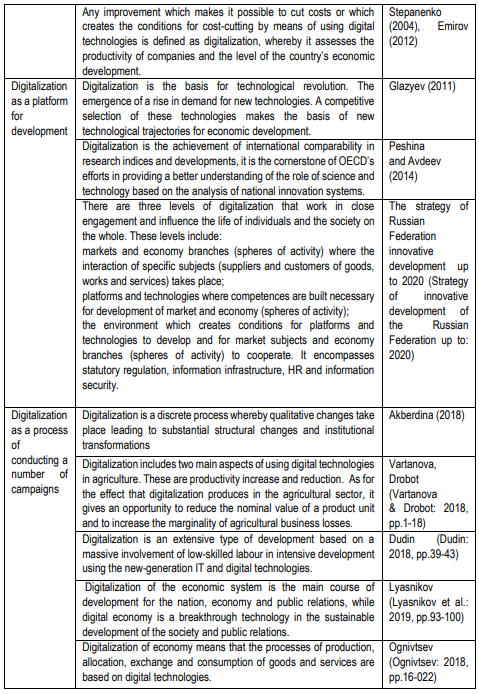
Having studied the opinions of various scholars about digitalization essence in terms of three approaches to its interpretation, we can make our own definition of digitalization in the agricultural sector. It runs as follows: digitalization is the introduction of robotic and artificial intelligence technologies in agricultural operations, contributing to changes in business models and providing new opportunities for an efficient organization of management (Radesky et al.: 2020).
METHODOLOGY
The research methodology is based on the materials of foreign and domestic economists on the problem under study. It should be noted that the scientific study was carried out on the basis of actual materials of the accounts of the Ministry of Agriculture of the Russian Federation and federal statistics, which include a set of universal methods of scientific research such as: analysis, synthesis, monographic approach of the study.
RESULTS
According to the Russian Ministry of Agriculture, Russia takes a solid 15th position in the “agriculture digitalization” ranking. Despite ranking quite high, agricultural subjects are constantly facing a tough competition and a number of problems. These include:
A lack of skilled personnel, A low labour attractivity,
A low life span in rural areas
Population migration from rural areas to urban agglomerations (Skvortsov et al.: 2008, pp.1014-1028).
Attempting to minimize the above-mentioned challenges, the government is developing and implementing agricultural development programmes and projects, both nation-wide and those in separate regions. For instance, on July 28, 2017, the “Digital Economy of the Russian Federation” national programme was approved. It runs: “digital data are a key production factor in all spheres of social and economic activity, which enhances the country’s competitive ability, improves the people’s life quality, provides economic growth and national sovereignty” (The program Digital Economy of the Russian Federation: 2017). The programme attaches priority to geo-positioning system, as well as to systems of agricultural machinery fleet management and precision agriculture. However, despite all the efforts on the part of the government, agricultural digitalization is still poorly developed, as the IT share in this sector equals to 3% and is estimated at as little as 360 billion rubles (Akberdina: 2018, pp.82-99).
The real sector of Russia’s economy increasingly applies contemporary and innovative technologies, such as data collection, storage and processing systems. New data collection technologies based on sensors and satellites are used in the agricultural sector (Shkurko et al.: 2018, pp.320-324). Operational and transactional systems are basic for agriculture, making it possible to improve the qualitative volume of data. The data collected must be processed professionally in order to make accurate and realistic conclusions which will be furtherly used for forecasting the industry’s operations. Fig. 1 shows the basic pattern of data collection and processing in the agricultural production and marketing chain, including sales companies, agricultural producers, suppliers and consumers.
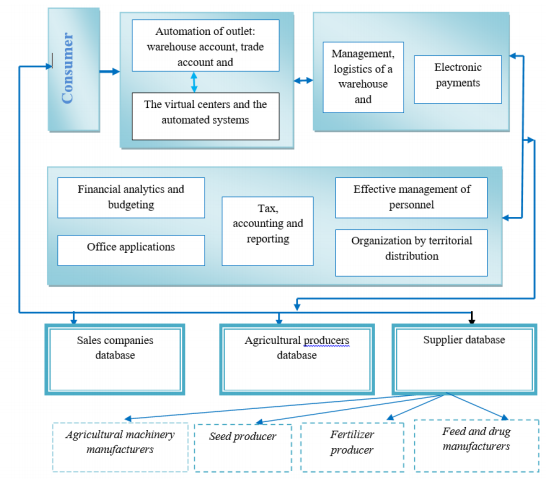
Figure 1. The schematic diagram of data collection and processing in the start-to-finish automated production-and-marketing chain of the agricultural sector
Data collection, storage and processing system enables the agricultural sector to establish integrated cooperation with many other spheres and to develop the following aspects:
- 1. Smart agriculture which includes production and logistics. For this purpose, automated management systems are necessary which involve artificial intelligence and big data. Such technologies make it possible to accelerate the selection process, to improve the organic composition, for example, to reprocess seaweeds or insect biomass or to detect pseudo-cereals, and to adapt nutrition patterns to personal needs.
- 2. The use of unmanned flying vehicles in agriculture. There are quite a lot of companies in Russia which are proactive in this field, such as the Geoscan company (St. Petersburg), Unmanned Technologies LLC (Novosibirsk), Autonomous Aerospace Systems (Krasnoyarsk) and ZALA AERO (Izhevsk). These companies provide a wide range of services for a higher efficiency of the agricultural sector, including:
-
- Making a database of agricultural lands (inventory procedures);
-
- Making digital maps of lands (fields, pastures) and cadaster;
-
- Monitoring of agricultural vehicles (satellites, drones);
-
- Determining the condition of seed stock for crops and fallow lands (geo-botanical works);
-
- Calculating NDVI or plant vegetation index, that is, interpreting (recognizing) satellite images for agricultural purposes or for studying land desertification progress;
-
- Weather monitoring (meteorological activities);
-
- Support and supervision of agrotechnical events (epidemiological works).
The above-listed works are conducted with the help of interactive computerized information system - Decision Support System (DSS) in agriculture, as shown in Fig.2 (Espolov: 2019).
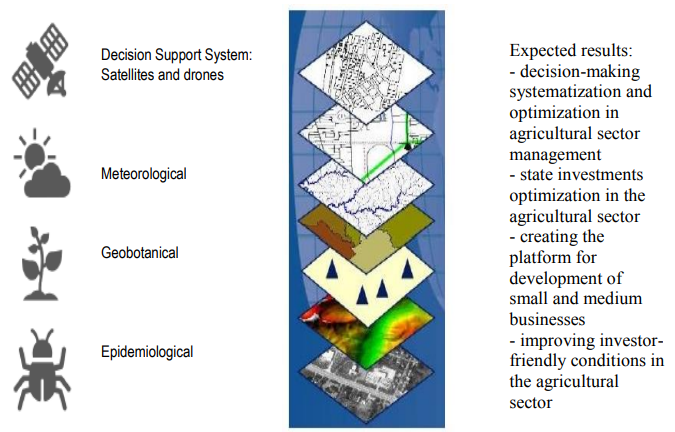
Figure 2. DSS support system in agriculture
The digital transformation of Russia’s agriculture will make it possible to increase productivity and agricultural products consumption volume. First of all, digitalization may help to solve the vehicle availability problem. For the overwhelming majority of agricultural producers, a lack of contemporary mechanization and automation means remains the main reason of a low productivity and, consequently, a high nominal value of product units. Digital transformation will allow for a transition from the “selling agricultural machinery and automation means to become the property of the producer” pattern to the “payment against actual work volume” pattern.
Secondly, as digitalization is a start-to-finish process, it provides an opportunity to establish an informationlink between the needs of a specific end customer and the possibilities of a specific agricultural producer. This will eliminate the many intermediaries who account for up to 80% of the product added value (Soboleva: 2015, pp.282-286).
An integration of these two digitalization factors will make it possible to increase agricultural products consumption in Russia 1.5 times. The boost in consumption will compensate for a reduction of retail prices. Agricultural business marginality will go up, while risks will reduce (Tsvetkov et al.: 2018, pp.45-64).
Speaking about the readiness of the agricultural sector for digital transformation, we should take into consideration several indices which characterize similar agricultural phenomena from different perspectives. Let us resort to expert assessment results:
-
Production profitability in the agricultural sector amounts to about 12.5%;
-
About 4.4 million people are employed in agriculture in rural areas (given a stagnation of a number of workers in rural areas), of which as few as 500 thousand have professional education;
-
About 470 thousand of agricultural vehicles are older than 10;
-
Digitalization may enable crop yield deviation to reduce by about 10%;
-
Average lifespan of agricultural vehicles equals to approximately 15, 000 machine hours.
The above data characterize Russia’s agriculture infrastructural elements which require systemic support from the government. Among these means of support is Russia’s agriculture digitalization programme for 2018to 2025 approved by the government. It provides for an expansion of tractor fleet by 300, 000 units, harvester fleet by 300, 000 units and a 9-fold increase of fertilizers consumption.
To secure efficient operation of the vehicles included in the plan, data on all technological operations should be collected and analyzed throughout the whole production and marketing process, from the field to the counter. A question arises, which is: how can data be obtained and processed straight from the vehicle? There are three sources that make it possible: 1С, Еxcel and sensors or any other IT-relief systems which have been formed at the agricultural company (Teece: 2016, pp.1-40). Still, this approach requires the availability of professionals who can apply digital technologies in agriculture. Today it is unachievable, as there are no specialists who would have cross-discipline competences in agronomy and programming at the same time (Logistics & Supply chain management: 2019, pp.216).
DISCUSSION
According to Russia’s Ministry of Agriculture, there is only one IT specialist per every thousand of agricultural workers. It means that one IT specialist is of a higher value in agriculture than chief agronomist, and that means that entities employing IT specialists automatically become IT-companies which have to develop and implement innovative technologies (software) in order to retain their competitive ability. Besides, it is not only a lack of IT specialists that poses risks, but a possibility that their competence is insufficient.
Consequently, Russian agricultural companies should pay more attention to IT specialists and to investments in new technologies. According to the federal public statistics service, about 800 million rubles were invested in agriculture in 2017 for developing digital technologies. It is only a little, compared to the gross revenue that the country receives from agriculture.
There is no doubt that digitalization will become the main driver of Russian agricultural development. We believe it will allow a number of goals to be achieved in order to improve the country’s competitive ability, including:
-
Increasing harvest volume and quality;
-
Optimization and minimization of capital investments;
-
Reduction of labour capacity and increasing agricultural productivity;
-
Reducing harmful effect on the environment;
-
Reducing the dependence of agricultural efficiency on human factor.
Digital transformation of the agricultural sector will allow agricultural workers to reduce costs by 23%. It has been proved that average cost saving in land management amounts to 11-14% if GPS navigation is used, 8-12% given discriminatory application of fertilizers, and 8-13% if parallel driving systems are used. Hence, given an efficient application of robotized technologies, a total reduction of costs may equal to 40-50%.
In the course of digitalization, agricultural producers often face difficulties when trying to use precision farming technologies. These difficulties result from the integration of new IT-systems into existing business processes, and from the lack of a comprehensive approach to providing transparence of all business processes.
A comprehensive approach to the formation of a digital transformation mechanism for agriculture implies that a number of issues have to be settled which influence the following aspects:
-
Improvement of regulatory framework for developing digital technologies and IT
-
Agricultural machinery renovation and modernization;
-
Financial and insurance markets;
-
Introduction and application of innovative means of agricultural manufacturing;
-
Logistics upgrading: storage, processing and sale of agricultural products;
-
Information infrastructure development in rural areas and provision of information security;
-
Training, retraining and advanced training of agricultural specialists.
Thus, there are some effect-building systemic factors which lay the ground for agricultural sector digitalization. A decentralized pattern is formed which may enable structural changes in various economy sectors to happen; the terms of agricultural products processing and sales are reduced; the resource potential of agricultural subjects is employed; sustainability and adaptability to market conditions is developed; and the agricultural sector becomes stronger in terms of finance.
CONCLUSION
The above research findings enable us to conclude that digital transformation in agriculture, which implies an introduction of digital technologies and platforms into agricultural practices, requires that specific measures need to be taken. Apart from the monitoring of the current condition and actual use of agricultural lands in order to enhance their profitability, an intelligence system for the support of agricultural manufacturing must be developed. Besides, agriculture digitalization should provide a transparence of agricultural products export and import flow.
For the purposes of agricultural sector digital transformation, agricultural companies have to employ specialists with sufficient IT competences. Therefore, it would be reasonable to establish a digital education platform for training the workers to apply new technologies.
The above measures will make it possible to achieve a technological breakthrough in agriculture, to enhance the productivity of agricultural manufacturers and to provide efficient agricultural management due to an improvement of operational planning processes and simulation of development scenarios.
The introduction of digital technologies in agriculture will make it possible to increase the agricultural sector contribution into Russia’s economy, to boost export revenues, as well as to schedule and aggregate data streams for creation of start-to-finish chains and technologies, from the agricultural production stage to consumption, with a deep integration into allied industries of digital economy.
BIODATA
OKSANA VALERYEVNA VAGANOVA: Doctor of Economics in Belgorod State University, Russia. Her research interests includes digitalization in industry and agricultural economy. She has published more than 30 papers in the international conference and journals.
NATALIA EVGENEVNA SOLOVJEVA: Belgorod State university, Department of Finance and Credits. Her research interests includes commercial real east and marketing. She has published more than 10 papers in the highly evaluated journals.
RUSLAN VALERYEVICH LESOVIK: Was graduated from the Faculty of Civil Engineering from the Belgorod State Technological Academy of Building Materials. He is currently a professor at the department of building materials and construction. The theme of his research is “Fine-grained concrete for road construction using waste wet magnetic separation of ferruginous quartzite”.
LESOVAYA SVETLANA LEONIDOVNA: Lecturer at the Department of Russian Language and Natural Sciences, Belgorod State Technological University named after V.G. Shukhov, Russia. She is a postgraduate student at Marketing Department at Belgorod State Technological University named after V.G. Shukhov. Her research emphasizes on Economics and Innovative Systems for Joint Companies.
BIBLIOGRAPHY
AKBERDINA, VV (2018). “Transformation of Russia’s agriculture in the conditions of digitalization of economy”. Izvestiya URGEU, 19(3), pp.82-99. (in Russian).
АКБЕРДИНА, ВВ(2018). “Трансформация промышленного комплекса России в условиях цифровизации экономики”. Journal of new economy, 19(3
CHUPRYAKOVA,O, VOTYAKOVA,I&SAFONOVA,S (2019). “Metaphorics of Advertising Discourse (Based On Cosmetics and Perfume Advertising)”, Journal of research in applied linguistics, 10(4), pp.358-365.
DOROSHENKO, Y.A., TROSHIN, A.S., CHIZHOVA, E.N., SOMINA, I.V., PIVKO, I.S. (2015). “Infrastructuralcomponent of investment-innovative development in small business” (by the example of Belgorod region's agricultural complex). Journal of Applied Engineering Science, 13 (4), pp. 283-292.
DUDIN, MN (2018). “Digitalization as a major factor of increasing the competitive ability of national agriculture. Materials of the international scientific and practical conference: Strategic trends of social and economic systems transformation within digital economy”. Moscow, February 27-28, 2018 – Ed. RAS correspondent member V.A. Tsvetkov, to. t. - m of N, associate professor K.H. Zoidov. – M.: PR RAS, pp.39-43. (in Russian).
EMIROV, ND(2012). “Innovative technologies of management in the social sphere: thesis... Doctors of Economics: 08.00.05”. Emirov Nazim Danilovich; [Presented at: Saint Petersburg State University of Economics and Finance]. - St. Petersburg, 350. (in Russian).
ESPOLOV, TI(2019). “Digitization of the AIC” – a new age requirement Available at: http://kzvesti.kz/kv/thirdband/25528-cifrovizaciya-apk-trebovanie-novogo-vremeni.html (access date: 15.04.2019). (in Russian).
GLAZYEV, SYU, IVANTER, VV, MAKAROV, VL, NEKIPELOV, AD, TATARKIN, AI, GREENBERG, RS, FETISOV, GG, TSVETKOV, VA, BATCHIKOV, SA, YERSHOV, MV, MITYAEV, DA & PETROV, YUA(2011).“On Russian economy development strategy: pre-print”. М: UN of RAS, 48. (in Russian).
LOGISTICS & SUPPLY CHAIN MANAGEMENT (2019). “Theory and practice”. Supply Chain Management: the textbook / Under the editorship of B.A. Anikin and T.A. Rodkina. - Moscow: Prospect, pp.216.
LYASNIKOV, NV, USMANOV, DI, MAGARAMOV, MSH & OMAROVA, ZK(2019). “Features of transitiveeconomies development in a digitalization era (on a comparative example of EEU And BRICS)”. Problems of market economy,pp.93-100. (in Russian).
OGNIVTSEV, SB(2018). “Agricultural sector digital platform concept”. International Agricultural Journal/. 2 (362),pp.16-022. (in Russian).
PESHINA, EV & AVDEEV, PA(2014). “Methodical approaches to the system of national innovative development indicators”. Questions of innovative economy. 4(17), pp.4-21.
PUTIN, V, GEVORKYAN, N, TIMAKOVA, N & KOLESNIKOV, A (2000). “First Person: An Astonishingly Frank Self-Portrait by Russia's President Vladimir Putin”. Public Affairs.
RADESKY, J, CHASSIAKOS, YLR, AMEENUDDIN, N & NAVSARIA, D (2020). "Digital Advertising toChildren." Pediatrics, 146(1).
ROMANOV R.V. (2016) “Interconnection of state support of agriculture with the banking sector”. Bulletin of BSTU named after V.G. Shukhov, 6. pp. 238-241.
SHKURKO,V, MARDIEVA,L, SHCHUKLINA,T&CHUDIN,A (2018). “Poster images in a new linguistic and extralinguistic context”, Amazonia Investiga, 7(12), pp.320-324.
SKVORTSOV, EA, SKVORTSOVA, EG, SANDU, IS & IOVLEV, GA(2008). “The transition of agriculture to digital, intellectual and robotic technologies”. Economy of the region.14(3), pp.1014-1028. (in Russian).
SOBOLEVA,N (2015). “Expanded metaphor and double actualization of phraseological units in advertising texts”, Journal of Language and Literature, 6(1), pp.282-286.
STEPANENKO, DM (2004). “Classification of innovations and its standardization /D.M.Stepanenko”. IInnovations, pp.77-79.
STRATEGY OF INNOVATIVE DEVELOPMENT OF THE RUSSIAN FEDERATION UP TO (2020).“(approvedby the decree of the Government of the Russian Federation of December 8. 2011 (2227-r)”. (Circulation date: 04/15/2019). (in Russian).
TEECE, DJ(2016). “Profiting from Innovation in the Digital Economy: Standards, Complementary Assets, and Business Models in the Wireless World”. Tusher Center on Intellectual Capital. Working Paper Series,pp.1-40. (in Russian).
THE PROGRAM DIGITAL ECONOMY OF THE RUSSIAN FEDERATION (2017).“Decree of the Governmentof the Russian Federation of July 28, 2017”. Available at: URL: http://static.government.ru/media/files/9gFM4FHj4PsB79I5v7yLVuPgu4bvR7M0.pdf (accessed on: 04/15/2019). (in Russian).
TSVETKOV, VA, SHUTKOV, AA, DUDIN, MN& LYASNIKOV, NV (2018). “Digital economy and digital technologies as a vector of national agriculture strategic development”. Moscow University Herald. Economics, 6(1),pp.45-64. (in Russian).
VAGANOVA, OV(2016). Methodological aspects of forming mechanisms of integration interaction of subjects in regional innovative systems the abstract a yew.... Doctors of Economics. St. Petersburg state economic university. St. Petersburg, (in Russian).
VARTANOVA, ML & DROBOT, EV(2018). “Prospects of digitalization of agriculture as a priority direction of import substitution”. Economic relations, 8(1), pp.1-18. (in Russian).