Artículos
Communication of Covid-19 Pandemic Disaster in Indonesia
Comunicación del desastre pandémico Covid-19 en Indonesia
 B RUDIANTO rudianto@umsu.ac.id
Y. HENDRA yanhendra@umsu.ac.id
B RUDIANTO rudianto@umsu.ac.id
Y. HENDRA yanhendra@umsu.ac.id
Communication of Covid-19 Pandemic Disaster in Indonesia
Utopía y Praxis Latinoamericana, vol. 26, no. Esp.1, pp. 46-54, 2021
Universidad del Zulia

This work is licensed under Creative Commons Attribution-NonCommercial-ShareAlike 4.0 International.
Received: 01 December 2020
Accepted: 03 February 2021
Abstract: The focus of this research is to identify communication in the Covid-19 disaster response in Indonesia. It is about how the government communicates to its public. The research method is a qualitative one by analyzing some documents, books, publications, and statements made by officials. This study examined those statements in several mass media, government's official websites, and other publication types. Besides, the printed and held policies known are made in the form of leadership commitment. The involvement of mass media in every development of the activities related to the COVID-19 disaster progress is a way of communication done by the government.
Keywords: National disasters, Covid-19, Indonesia, emergency response..
Resumen: El enfoque de la investigación es identificar la comunicación en la respuesta al desastre de Covid-19 en Indonesia. Se trata de cómo el gobierno se comunica con su público. El método de investigación es cualitativo que analiza algunos documentos, libros, publicaciones y declaraciones realizadas por funcionarios. Este estudio examinó esas declaraciones en varios medios de comunicación, sitios web oficiales del gobierno y otros tipos de publicaciones. La participación de los medios de comunicación en cada desarrollo de las actividades relacionadas con el avance del desastre del COVID-19 es una forma de comunicación que hace elgobierno.
Palabras clave: Desastres nacionales, Covid-19, Indonesia, respuesta de emergencia..
INTRODUCTION
Late in 2019, a mysterious plague broke out in Wuhan, China. Residents of the Hubei province's capital city suffer from a disease with symptoms of acute respiratory inflammation similar to SARS, which was becoming an epidemic in 2002-2003. Signs of difficulty breathing, followed by fever, malaise, dry cough, and pneumonia in some patients (Liu et al.: 2020, pp. 1-6). At the beginning of its spread, people knew it as Wuhan pneumonia, remembering that Wuhan is a cluster of pneumonia spread due to animal markets located close to the city center. However, from the results of in-depth analysis, health experts and researchers believe the mysterious outbreak in Wuhan was a new type of coronavirus. Specifically, the virus named SARS-CoV-2 is the seventh generation of the coronavirus that infects humans.
The WHO (world health organization) has temporarily named the virus with the 2019-nCoV on January12, 2020. One month afterward, WHO gave an official name for this virus with the name Covid-19, which stands for Corona Virus Diseases 2019 (Rasmussen et al.: 2020, pp. 415-426). We are seeing the rapid spread, on March 11, 2019, the WHO set the COVID-19 virus outbreak to become a global pandemic. WHO issued that pandemic status considering the development of the coronavirus's spread within three months, which has infected more than 2.5 million people in 210 countries in Asia, Europe, the United States, and South Africa (Vellingiri et al.: 2020, pp. 1-18; Bhatti and Akram, 2020) view that this outbreak is difficult to stem because of inadequate assessment and risk management in emergencies. Evidently, in two weeks, the number of cases outside China jumped thirteen-fold while the number of affected countries tripled. WHO predicts the possibility of the number of cases; the number of deaths, including affected countries in the next few days and weeks, will jump higher.
Since its inception, Indonesia has been a country highlighted by WHO regarding the threat of the spreadof co-19. Considering Indonesia is a country with a large population, reaching 270 million. According to data from Djalante et al. (Djalante et al.: 2020, pp. 1-6), Indonesia is currently the fourth largest population in the world. Therefore, some parties believe that the coronavirus has entered Indonesia in January 2020. The Indonesian government's response regarding the virus which allegedly originated from bat animals on the fish market in Wuhan quite fast. In early January 2020, the relevant ministers state the threat of the coronavirus. Although at that time, the government believed there were no cases of the coronavirus in Indonesia. As a global pandemic, WHO reminded all governments in the world to take steps to handle and prevent the transmission of this new type of coronavirus?
LITERATURE REVIEW
Covid-19 Pandemic as a Disaster
Seeing that the world is struggling to control the spread of Covid-19, strategic steps are needed to slow the spread of this virus. One of those steps is making Covid-19 an international emergency (Cucinotta & Vanelli: 2020, pp. 157-160). In line with whose statement establishes the coronavirus outbreak as an international emergency status on January 31, 2020, and as a global pandemic on March 11, 2020, the Indonesian government officially established a non-natural national disaster status against the COVID-19 epidemic on April 11, 2020. Several emergency measures then also begin to follow.
The definition of disaster underwent many changes in terms of concept and is very dependent on a multidimensional perspective (Staupe-Delgado: 2019, pp. 1-5). Whereas WHO refers to disasters as any event that causes damage, ecological disturbance, loss of human life, or deteriorating health status or health services at a particular scale that requires a response from outside the community or affected area. Djalante (Djalante: 2018, pp. 1785-1810) added, a disaster always has a significant impact on the social and economic community. Accidents are closely related to the situations and conditions that occur in people's lives.
The coronavirus epidemic is a disaster. Outbreaks of the disease usually occur suddenly, unexpectedly, and for some levels of people, can be controlled. It is uncontrollable because of its sudden and diffuse nature, accompanied by inadequate data and experience in dealing with outbreaks (Zocchi et al.: 2020, pp. 1-9). Besides, because a pandemic or outbreak epicenter is usually cross-social and it tends to spread rapidly throughout regions and borders, a pandemic is categorized as a cross-border crisis, with complex responses. Infectious diseases know no boundaries and can become epidemics, and when they spread globally, they become pandemics.
The term "pandemic" has not been widely defined in medical texts. We can see several key features of a pandemic if we examine the similarities and differences between them. Those key features are broad geographical expansion, disease movement, novelty, severity, high rates of attacks and explosions, minimal population immunity, infection, and transmission. Pandemic-related crises bring enormous negative impacts on the health, economy, society, and security of national and global communities. They have also caused significant political and social interference (Qiu et al.: 2017, pp. 1-11).
We can predict the emergence of a pandemic in advance. An outbreak tends to appear once in tenyears. Neither is the origin of a virus outbreak. The majority of the pandemic of a virus originates from transmission through animals to humans (Ali et al.: 2020, pp. 644-646; Zulifqar et al., 2020, pp. 665-675).
The COVID-19 outbreak proved to be an unprecedented disaster where its spread was very rapid between humans through droplets. Its distribution has reached six continents (Liu et al.: 2020, pp. 1-10), where some of the most affected countries are China, Italy, Iran, and the US in all aspects, especially health, psychology, social, and economics. The impact in terms of health is evident. Due to massive interactions between humans and health levels, different age levels will affect how much a person's resistance to viruses attack this respiratory system. The psychological impact can be stress, frustration, and depression, mainly due to self-quarantine rules. The social implications of this outbreAk are more on the number of people who lost their jobs due to the closure of social access and was followed by difficulties in providing food for families (Buonsenso et al.: 2020, pp. 1-14; Nadeem et al., 2020, PP. 2286).
For high-income countries, especially those already affected by the epidemic, it seems to face these plagues from the perspective of such a massive disaster. Still, in low-income countries, there seem to be two possible scenarios. Specifically, in the worst situation, when COVID-19 is epidemic, the majority of states will not be prepared, with the low resources allocated for the emergency provision of viruses, and the consequences will be catastrophic. In a good scenario, similar to the global SARS-CoV outbreak in 2003, COVID-19 will not affect Africa or South America on a large scale. It indicates that respiratory viruses are spreading more effectively in winter and, therefore, the hemisphere in the south will be affected more slowly (Gennaro et al.: 2020).
The Concept of Disaster Communication
As a national disaster emergency, the co-19 pandemic was handled by the Indonesian government through various policies ranging from the issuance of PerpuGovernment Regulation, etc. In a disaster situation, the communication approach plays a crucial role in reducing uncertainty due to crises. It is related to the pre-or pre-disaster stages, during the emergency response, and the recovery or post-disaster period. Communication has a fundamental function. Communication in a disaster situation is not only needed in a state of disaster emergency but is also essential during pre-disaster. As said that communication is the best way for successful disaster mitigation, preparation, response, and recovery of the situation during a disaster. The ability to communicate messages about the catastrophe to the public, government, media and opinion leaders can reduce risks, save lives, and the effects of disasters. In line with this view, Abunyewah, Gajendran, & Maund (Abunyewah et al..: 2018, pp. 246-253; Aguenane, 2020) state that communication during disasters is the primary tool to reduce the significant impacts on human life and various other properties.
Effective communication with the public is essential for managing outbreaks. Communication during an outbreak is a significant leap for making strategic policies. Besides, maintaining the trust of the media and the general public is very important to ensure compliance with public health measures. To build trust, the government's response to emergencies must appear competent, credible, and orderly. Disasters require many modes and intensities for communication. Social media communication is effective during a disaster crisis. For example, to display progress data related to disasters (Husnayain et al.: 2020, pp. 221-223).
Because disasters have a direct local impact, communication about hazards must start locally. When an accident occurs, emergency calls are made to local emergency services, such as police, fire engines, ambulances, and local authorities. Information is communicated in a complex labyrinth between victims, witnesses, family and friends, and bodies (Moorthy et al.: 2018).
In a state of disaster emergency, communication is needed as a function of management and coordination between the government, victims, the community, volunteers, and the mass media. A proper crisis communication management will make government coordination, and decision-making functions run stable. On the victim side, suffering can be reduced because assistance is quicker and more easily provided with adequate information capital. Families of victims and the wider community are essential to meet the needs of information about the current conditions and conditions of victims, both survivors, and deaths, to avoid anxiety. Volunteers also really need smooth communication with various parties to be able to plunge into the disaster site. Whereas the mass media, in an emergency, requires a credible source of information so that the news disseminated provides benefits to the broader community.
To build excellent communication in disaster management, the government and all elements must work together and make good cooperation. Besides, several significant foundations must be considered if the treatment is to be effective. As Haddow and Kims (Haddow & Kim: 2008) said, there are five main foundations in building effective disaster communication, i.e.:
- 1. Customer Focus, namely, understanding what customers need information, in this case, the community, and volunteers.
- 2. Leadership commitment: Leaders who play a role in emergency response must commit to communicating effectively and actively involved in the communication process.
- 3. Situational awareness, Effective communication is based on the collection, analysis, and dissemination of controlled information related to disasters. The principles of effective communication, such as transparency and trustworthiness, are essential.
- 4. Media partnerships, media such as television, newspapers, radio, and others are essential media to convey information to the public. Collaboration with the media involves the media needs and a trained team trained to collaborate with the media to obtain information and disseminate it to the public.
METHODOLOGY
This research is conducted using qualitative research methods. The aim is to identify the government's disaster communication in handling the covid-19 pandemic in Indonesia. Qualitative research is a subjective one. It depends on the experience of researchers and those investigated in exploring the events at the time the study was conducted. Researchers can then cut it if it does not fit the problem under investigation (Greenhalgh & Taylor: 1997, pp. 740-743). The study's subjects are the policies, attitudes, statements, and steps of the government regarding the handling of co-19 in Indonesia, documented from the mass media, social media, the official government website, videos, books, and other forms of documentation. Data collection has been carried out since March 2, 2020, after the government announced the first patient infected with the coronavirus in Indonesia. The research data obtained were further analyzed qualitatively employing reduction, presentation of data, and conclusions. I am in line with Miles, Huberman, andSaldana's (Miles et al.: 2014) point out that the data analysis techniques in qualitative research consist of three activity streams, namely data reduction, data presentation, and concluding.
RESULTS
Information about the current situation and conditions about disasters is valuable and essential for people in a disaster-affected area. It is especially in how the government focuses on managing and conveying information to the public as customers are. Haddow and Kim (Haddow & Kim: 2008) say the ability to communicate messages about disasters to the public, government, media, and opinion leaders can reduce risk, save lives, and the effects of disasters. In handling covid-19 accidents in the country, the central government.
Although the coronavirus outbreak has spread in various countries since January 2020, the Indonesian government officially announced a positive case in early March 2020. As Head of state, President Joko Widodo, on March 2, 2020, immediately announced the first confirmed patient in Indonesia who tested positive for the virus corona. Accompanied by the Minister of Health, Dr. Terawan, Jokowi from the presidential palace immediately conveyed through the mass media that in Indonesia, there were already two people who were infected by co-19. The two positive patients were mothers and children from Depok city, i.e., patients’ codes 01 and 02. The incident could contain the intention that the information conveyed was so essential and involved the interests of all Indonesian citizens so that the President immediately appeared in public. It can also be interpreted as the President wants to show his leadership commitment to the people of Indonesia in responding to the covid-19 pandemic that is spreading in various countries. Haddow and Kim (Haddow & Kim: 2008) say the ability to communicate messages about disasters to the public, government, media, and opinion leaders can reduce risk, save lives, and the effects of disasters.
After the incident, President Jokowi announced the first positive patient in Indonesia, and the government then appointed a spokesperson to deliver information related to the covid-19 pandemic. The government-appointed Ahmad Yurianto, an official at the Indonesian Ministry of Health as a spokesperson. In practice, this Spokesperson routinely appears before the public through various communication channels, such as print, television, radio, online media, and social media about the development of national disaster management co-19, the development of the number of patients, and information. To accelerate the Covid-19 handling, the Indonesian government posts information about the Covid-19 pandemic on the Task Force's official website, i.e., www.covid19.go.id. The Task Force for the Acceleration of Handling Covid-19 launched the website www.covid19.go.id on Wednesday (05/18/2020). The site is the official source of coronavirus prevention as a cause of Covid-19, which is now a global pandemic. This site contains messages about three important steps people can take during a coronavirus outbreak. How to Reduce the Risk of Transmission, Find the Right Information, and what to do if Illness are three steps. Then, there are statistical data regarding the number of positive cases of COVID-19 being updated in real-time. This data is expected to be a reference for various parties, especially the media partners, in their reporting. There is also a Hoax- Buster that can be used as a reference to determine whether information about Covid-19 is true news or hoax. Educational material contains various public education materials.
The fulfillment of information about COVID-19 by the government becomes an essential part of disaster communication. It is done to reduce uncertainty in emergencies that the community has never experienced before.

Source: Research Results
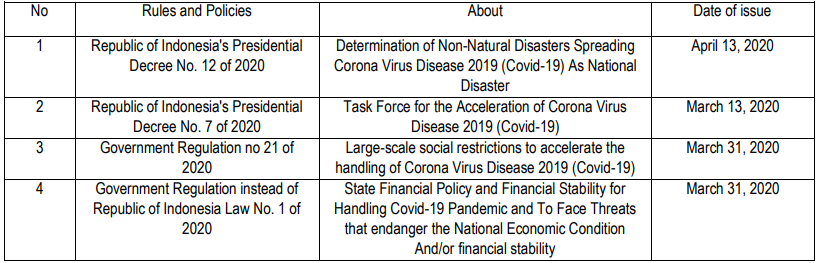
Although Indonesia has often faced significant disasters, in the notes for non-natural accidents in the form of a pandemic, it has never been determined to be a national disaster. Several years ago, during the bird flu outbreak, the government only set out an extraordinary event (KLB), not a national emergency. Regarding the handling of the Covid-19 pandemic outbreak as a national disaster, the central government has adopted several strategic policies, namely, on March 13, 2020, forming a special team called the Task Force for the Acceleration of Corona Virus Handling (Covid-19). The team is led by the Head of the National Disaster Management Agency (BNPB) Lieutenant General Doni Monardo. In its organizational structure, this team consists of a director composed of coordinating ministers. Before this team was formed, the handling of the Covid-19 outbreak was carried out by the National Disaster Management Agency (BNPB).
Emergency budgeting during the pandemic is a policy that must be taken by considering multi-sectoraffected. Therefore the central government issued a budget policy related to the handling of Covid-19. The government is preparing a budget through the 2020 APBN (state budget plan) of Rp 405.1 trillion. The amount of the budget is determined through a Government Regulation in place of Law (Perppu) on Economic Stability in the corona pandemic. The total budget will be allocated to the health sector by Rp 75 trillion for tax incentives and stimulus for business loans of Rp 70.1 trillion. Rp 110 trillion, allocated for social protection, covers the budget of the Workers Card, necessary food supply logistics, and electricity subsidies for customers with 450 VA and 900 VA. The government also distributed Rp. 25 trillion for logistics and food supplies amid the Covid-19 outbreak.
Source: Research results
Generally, Indonesian people who use communication technology devices can easily access information quickly and easily from various sources. The sources were very straightforward to convey the policy, knowledge, and commitment of the government in dealing with the co-19 pandemic in Indonesia. One thing that was observed through the media was the frequent occurrence of coordination between institutions and formal leaders in government. It is related to coordination and collaboration between institutions. Even though the government has determined the existence of the task force structure from the central and regional levels, the determination of the Covid-19 pandemic as a national disaster, implementing disaster management is the Task Force for the Acceleration of Covid-19 Central and Regional Management. This task force is the chief command and control post for the Covid-19 disaster management under the command of the President. The Commander of the Central Task Force is the Head of the BNPB organization.
Meanwhile, the Provincial Task Force is the governor, regent, and mayor. The Deputy Task ForceCommander is filled with elements of the TNI, Polri, and other factors appointed by the Chair of the Task Force. Each region only has one Task Force Command Post as a command, coordination, and information center. The Task Force issues the official data and information about Covid-19 National Disasters. With this command, it is expected that management and coordination will go well.
DISCUSSION
A critical aspect of communication is the concept of reducing uncertainty. Communication itself arises because of the need to minimize possibility so that it can act effectively to protect or strengthen the ego concerned in interacting individually and in groups. Besides bringing certainty, communication also has a significant effect on the response speed of handling. In handling disasters, accurate information is needed by the public and private institutions that have concern for disaster victims.
Regarding the prevention of coronavirus transmission through physical distancing, the government does not impose Lockdown like some other countries, but rather with large-scale social restrictions (PSBB). According to the Government, PSBB was chosen as a form of physical distancing because Indonesia has learned from the experiences of other countries. For Indonesia, Lockdown is considered inappropriate. Physical distancing is indeed the main recommendation in breaking the chain of the spread of this virus. This concept works more or less by giving a distance of 1-2 meters between individuals to avoid transmission through droplets that have dangerous infection distances within a radius of 1 meter (Chen et al.: 2020, pp. 739-742).
CONCLUSION
Government regulations in place of these laws are in line with efforts to systematically assess socio- economic impacts and mitigation. The government's move to reallocate the health budget, for example, has been in line with the analysis conducted by Bruin, Fischhoff, Brilliant, & Caruso (Bruin et al.: 2006, pp. 178- 193), where health budgeting should be prioritized for mitigation simulations, vaccine research, patient medicines, and other related sub-sectors. Likewise, in terms of economic policy, regulations issued have shown an integrated economic stimulus strategy as an effort to minimize the sudden impact of a pandemic.
The Covid-19 pandemic, which likewise happens in Indonesia, makes the government takes several steps in handling and preventing the epidemic.
First: From the disaster communication aspect, the government has done several steps, such as the availability of information as a form of focused service to the public. Besides, the created and implemented policies become a leadership commitment form that a state's public needs in a critical situation.
Second: The media's mass involvement in any kind of activities related to the COVID-19 handling development can also be seen as the disaster communication example, which is done by the government.
In the new situation, the WHO and the national government recommend several ways to prevent virus transmission.
First: Keeping everything clean, doing social distancing or physical distancing, and also other methods.
These methods are often published in various media.
Second: The communication pattern that happened between the government and the public can be seen in multiple ways. The examples are the involvement of mass media, social media, social interaction between the people, and the description of communication-related to this pandemic. These aspects need a suitable communication method.
Communication failure can make the situation becomes worse. Besides, it can also complicate the government and public efforts to reduce the spread of the Covid-19 virus. Usually, a new disaster will appear to follow the accident itself. It is what we called with a communication disaster.
BIODATA
B. RUDIANTO: lecturer at the University of Muhammadiyah Sumatera Utara, teaching in the communication science study program at the Faculty of Social and Political Sciences, as well as the master program in communication science at the Postgraduate Program. A bachelor's degree in communication science was obtained from the University of Muhammadiyah Sumatera Utara in 1999, then earned a master's degree in communication science in 2006 from Padjadjaran University in Bandung. A doctoral degree in communication science was also obtained from Padjadjaran University, Bandung in 2017.
Y. HENDRA: lecturer at the University of Muhammadiyah Sumatera Utara. Completed a bachelor's degree from the faculty of social science and political science at UMSU. Then he earned a master's degree in communication science from Padjadajar University in Bandung. The doctoral degree was obtained from the Postgraduate Program at the State Islamic University of North Sumatra. He currently teaches at the Postgraduate Communication Science Master’s Program at the University of Muhammadiyah Sumatera Utara, Medan.
BIBLIOGRAPHY
ABUNYEWAH, M, GAJENDRAN, T, & MAUND, K (2018). “Conceptual Framework for Motivating Actions towards Disaster Preparedness through Risk Communication”. Procedia Engineering, 212, pp. 246-253.
ALI, SA, BALOCH, M, AHMED, N, ALI, AA, & IQBAL, A (2020). “The outbreak of Coronavirus Disease 2019 (COVID-19)—an emerging global health threat”. Journal of Infection and Public Health, 13(4), pp. 644-646.
BHATTI, A., & AKRAM, H. (2020). The Moderating Role Of Subjective Norms Between Online Shopping Behaviour And Its Determinants. International Journal of Social Sciences and Economic Review, 2(2), 1-09. doi:https://doi.org/10.36923/ijsser.v2i2.52
BRUIN, WB, FISCHHOFF, B, BRILLIANT, L, & CARUSO, D (2006). “Expert judgments of pandemic influenza risks”. Global Public Health, 1(2), pp. 178-193.
BUONSENSO, D, CINICOLA, B, RAFFAELLI, F, SOLLENA, P, & IODICE, F (2020). “Social consequencesof COVID-19 in a low resource setting in Sierra Leone, West Africa”. International Journal of Infectious Diseases, pp. 1-14.
CHEN, RC, CHENG, LTE, LIM, JL, GOGNA, A, ENG, DC, TEO, LZ, & TAN, BS (2020). “Touch Me Not:Safe Distancing in Radiology During Coronavirus Disease 2019 (COVID-19)”. Journal of the American College of Radiology, 17(6), pp. 739-742.
CUCINOTTA, D, & VANELLI, M (2020). “WHO Declares Covid-19 a Pandemic”. Acta Bio-Medica: Atenei Parmensis, 91(1), pp. 157-160
DJALANTE, R (2018). “Review article: A systematic literature review of research trends and authorships on natural hazards, disasters, risk reduction, and climate change in Indonesia”. Natural Hazards and Earth System Sciences, 18, pp. 1785-1810.
DJALANTE, R, LASSA, J, SETIAMARGA, D, SUDJATMA, A, INDRAWAN, M, HARYANTO, B . . .WARSILAH, H (2020). “COVID-19 in Indonesia: Period of January to March 2020”. Progress in DisasterScience, 6, pp. 1-6.
GENNARO, FD, PIZZOL, D, MAROTTA, C, ANTUNES, M, & SMITH, L (2020). “Coronavirus diseases(COVID-19) current status and future perspectives: a narrative review”. International Journal of Environmental Research and Public Health, 17(8).
GREENHALGH, T, & TAYLOR, R (1997). “How to read a paper: the papers that go beyond numbers (qualitative research)”. BMI, 315(7110), pp. 740-743.
HADDOW, D, & KIM, G (2008). “Disaster communications in a changing media world”. London: Elsevier.
HUSNAYAIN, A, FUAD, A, & SU, ECY (2020). “Applications of Google Search Trends for riskcommunication in infectious disease management: A case study of the COVID-19 outbreak in Taiwan”.International Journal of Infectious Diseases, 95, pp. 221-223.
LIU, Y, GU, Z, XIA, S, SHI, B, ZHOU, XN, SHI, Y, & LIU, J (2020). “What are the underlying transmission patterns of the COVID-19 outbreak? An age-specific social contact characterization”. The Lancet, 22, pp. 1- 10.
LIU, YC, KUO, RL, & SHIH, SR (2020). “COVID-19: The first documented coronavirus pandemic in history”.Biomedical Journal, pp. 1-6.
MILES, MB, HUBERMAN, AM, & SALDANA, J (2014). “Qualitative Data Analysis: A Methods Source Book”. California: Sage Publications, Inc.
MOORTHY, R, BENNY, G, & GILL, S (2018). “Disaster communication in managing vulnerabilities”.Malaysian Journal of Communication, 34(2).
QIU, W, RUTHERFORD, S, MAO, A, & CHU, C (2017). “The pandemic and its impact”. Health, Culture, and Society, 9, 1-11.
RASMUSSEN, SA, SMULIAN, JC, LEDNICKY, JA, WEN, TS, & JAMIESON, DJ (2020). “CoronavirusDisease 2019 (COVID-19) and pregnancy: what obstetricians need to know”. American Journal of Obstetricsand Gynecology, 222(5), pp. 415-426.
STAUPE-DELGADO, R (2019). “Analyzing changes in disaster terminology over the last decade”.International Journal of Disaster Risk Reduction, 40, pp. 1-5
VELLINGIRI, B, JAYARAMAYYA, K, IYER, M, NARAYANASAMY, A, GOVINDASAMY, V, GIRIDHARAN, B. . . CHO, S (2020). “COVID-19: A promising cure for global panic”. Science of the Total Environment, 725,pp. 1-18.
ZOCCHI, J, PIETROBON, G, MORETTO, S, BONSEMBIANTE, A, MAZZOLA, F, PETRUZZI, G, PELLINI, R(2020). “Literature in the time of COVID-19: The “phase two””. Oral Oncology, pp. 1-9.