Artículos
Influence of Compensation and Career on Organizational Culture
Influencia de la compensación y de la carrera en la cultura organizacional
 N. VIZANO nick.umb2018@gmail.com
W. UTAMI wiwik.utami@mercubuana.ac.id
S. JOHANES singmin.johanes@mercubuana.ac.id
A .HERAWATI aty.herawati@mercubuana.ac.id
N. VIZANO nick.umb2018@gmail.com
W. UTAMI wiwik.utami@mercubuana.ac.id
S. JOHANES singmin.johanes@mercubuana.ac.id
A .HERAWATI aty.herawati@mercubuana.ac.id
Influence of Compensation and Career on Organizational Culture
Utopía y Praxis Latinoamericana, vol. 26, no. Esp.1, pp. 368-380, 2021
Universidad del Zulia

This work is licensed under Creative Commons Attribution-NonCommercial-ShareAlike 4.0 International.
Received: 12 December 2020
Accepted: 15 February 2021
Abstract: The purpose of this study is to examine the influence of compensation on organizational culture and the influence of career on organizational culture, plus, to study the influence of compensation on turnover intention and to examine its influence on organizational commitment. The results of this study are that compensation and career has a positive and significant effect on organizational culture; compensation and career has a negative and significant effect on turnover intention. On the turnover intention, organizational culture has a negative and significant effect.
Keywords: Career, compensation, organizational culture, turnover intention.
Resumen: El propósito de este estudio es examinar la influencia de la compensación y de la carrera en la cultura organizacional, ademas de, estudiar la influencia de la compensación en la intención de rotación y examinar su influencia en el compromiso organizacional. Los resultados de este estudio muestran que la compensación y la carrera tienen un efecto positivo y significativo en la cultura organizacional; la compensación y la carrera tienen un efecto negativo y significativo en la intención de rotación y la cultura organizacional tiene un efecto negativo y significativo sobre la intención de rotación.
Palabras clave: Carrera, compensación, cultura organizacional, Intención de rotación.
INTRODUCTION
The industrial 4.0 era requires each organization to maintain the ability to compete against other business competitors. Many strategies are carried out by companies, ranging from marketing strategies, production strategies, cost strategies, and so on, including human resource management strategies. In the management of the human resource strategy, various methods are used, starting from improving quality through recruitment or training, but no less important by maintaining the turnover intentions rate. According to (Siswoyo: 2017, pp. 43-67), globalization and growing competition among companies have resulted in a war for talents where companies compete for the recruitment and retention of talented employees. Turnover is generally divided into a voluntary turnover and involuntary. Voluntary turnover intentions are when employees decide to stop working on their own accord (Ghozali & Fuad: 2008, pp. 76-90). Many researchers have identified the factors that influence the desire to switch employees. These factors can be categorized into individual characteristics such as gender, worker age, length of work (Pepe: 2007, p.207), the category of managerial practice in companies. such as job involvement, job performance and salary, and company policy (Chun et al.: 2013, pp. 853-877), job satisfaction categories with different determinants such as the type of job itself, compensation and other benefits and categories related to superiors and coworkers and suitability on an employee-organization fit that is related to the goals and values of the company (Hejase et al.: 2016, pp.32-56).
It is important for organizations to retain talented employees, to maintain productivity and organizational sustainability. In a competitive business climate, employees are an important asset in the organization. Employee commitment determines the performance and survival of the organization. Employees are expected to meet organizational needs and goals. Thus, many organizations have high expectations beyond the capabilities of employees. From an organizational point of view, retaining the best employees is as important as keeping up with technological advances. According to Kuean et al. (2010), it is an open secret that employers compete with each other in the labor market for efficient, creative, and innovative employees to maintain their competitive advantage. Many experts argue that employees are the survival strength of the organization, so the organization must take the initiative to motivate employees in order to improve overall employee performance. Community Research has shown that organizational culture is related to the desire to switch employees.. employees tend to show the intention to move when the organizational culture does not match their expectations. Examines organizational culture, job satisfaction, intention to move, and the mediating role of perceived organizational support. The findings indicate that organizational culture has a significant relationship with intention to move. Job satisfaction is a significant mediator between job stress. job satisfaction positively mediates the relationship between sportsmanship culture and the desire to move. Compensation has a positive and significant effect on job satisfaction. promotion (career) has a positive impact on job satisfaction and is mediated by job satisfaction on turnover intentions.
Organizational culture is related to intention to move, so turnover intention will be reduced if anemployee shows a positive attitude and gives high value to the organizational culture. This finding is supported by previous studies such as Booth et al. (2007); Lok et al. (1999); MacIntosh et al. (2010); Park et al. (2009); Shim, 2010; and Silverthorne, 2004. All of these studies concluded that organizational culture is an integral variable in predicting employee turnover intentions. Also found that organizational culture consists of shared values, beliefs, and assumptions found in employees' work environments. The positive thing can help reduce turnover intention for the work environment because employees in such a work environment will be more optimistic and friendly. Organizational culture as an antecedent of organizational commitment underlies the process by which people identify themselves with various events in their environment and how they are shaped by them in determining their commitment and life goals. The results show that organizational culture statistically affects work stress in organizations. Based on the formulation of the problem in this study, the objectives to be obtained are as follows:
- 1. To assess compensation has a significant effect on work culture
- 2. To examine career has a significant effect on work culture
- 3. To assess that compensation has a significant effect on Turnover Intentions
- 4. To assess Career has a significant effect on Turnover Intentions
- 5. To assess the Organizational Culture influences turnover intentions
METHODOLOGY
The method of analysis in this study used was SEM analysis with the LISREL program. Structural Equation Model (SEM) is a multivariate statistical technique that combines factor analysis and regression analysis. SEM analysis aims to examine the relationships between complex variables to find a comprehensive picture of the overall model. The variables in question consist of latent variables and observational variables. The latent variable is a variable that is formed from several proxies, which are formulated as the observed variable. The observed variable is the variable that is observed and measured, which can be used for The method used in this research is the quantitative method. Data was collected by distributing questionnaires to all permanent employees of the automotive industry in Indonesia (Santoso et al.: 2020, pp. 299-308). The questionnaire was designed closed except for questions/statements about the identity of respondents in the form of a semi-open questionnaire. Each closed question/statement item is given five answer options, namely: strongly agree (SS) score 5, agree (S) score 4, disagree (KS) score 3, disagree (TS) score 2, and strongly disagree (STS) score 1. The method for data processing is by PLS and using SmartPLS software version 3.0 as a tool. Forming a new variable (surrogate variable or latent variable) (Susilo et al.: 2020, pp. 6716-6723).
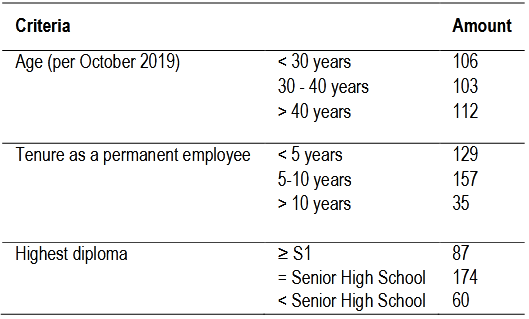
The population in this study were permanent employees of the automotive industry in Indonesia, and The questionnaire was distributed by simple random sampling technique. The results of the questionnaire returned were 351 respondents.
RESEARCH FRAMEWORK
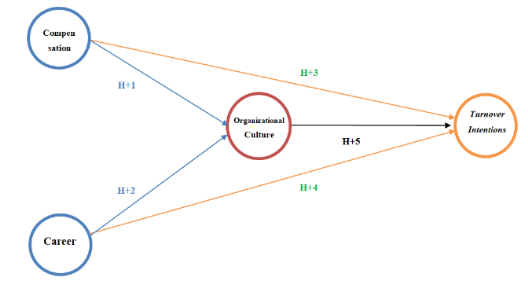
Figure (1). Research Framework
Based on the formulation of the problem in this study, the objectives of the hypothesis are as follows:
H1: Compensation has a positive and significant effect on Organizational Culture
H2: Career has a positive and significant effect on Organizational Culture
H3: Compensation has a positive and significant effect on turnover intention
H4: Career has a positive and significant effect on the Turnover intention
H5:Organizational culture has a positive and significant effect on the Turnover intention
RESULTS
Validity test
Validity is defined as the extent to which the accuracy and accuracy of a measuring instrument in performing its measuring function. Validity is a measure that shows the level of validity or validity of an instrument. An instrument is considered valid if it is able to measure what is desired. In other words, being able to obtain precise data from the variables under study. The validity test used the SPSS program with the Pearson Correlation method, which is correlating each item with the total score of the questionnaire items. The decision for validity:
- If the significance <0.05, then the question item is declared valid.
- If the significance> 0.05 or the negative correlation value, then the question item is declared invalid. The results of the validity test are presented in the following table:
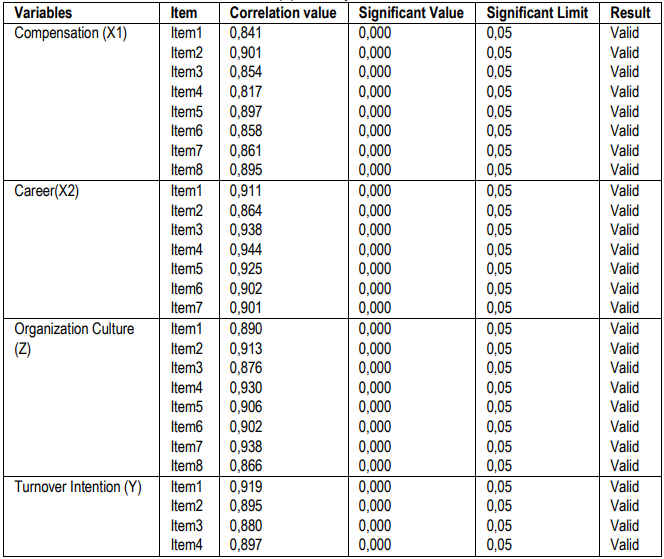
From the table above, it can be seen that all items have a significance value less than 0.05 and all positive correlation values. With this, it can be concluded that the questionnaire items are valid.
Reliability Test
The reliability test was carried out on the question items which were declared valid. A variable is said to be reliable or reliable if the answers to the questions are always consistent. In this study, the variables were declared reliable by looking at the Cronbach's Alpha value for each variable. If the Cronbach's Alpha value for each variable is> 0.6, then the variable is declared reliable. The reliability for each of the result variables is presented in the following table:
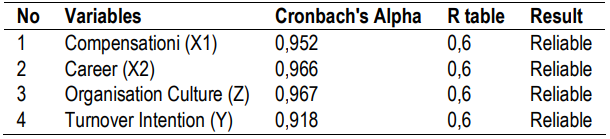
From the data, table 3 shows that the Cronbach`s Alpha value for each variable is above the required value (> 0.6). So it is said that the construct of the statement, which is the variable compensation, communication, work motivation, and employee performance, is declared reliable.
Classic assumption test 1. Normality Test
If the sig value is> 0.05, the data is normally distributed; otherwise, if the sig value <0.05, the data is not normally distributed
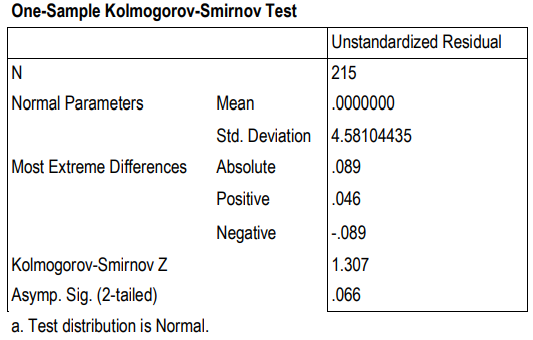
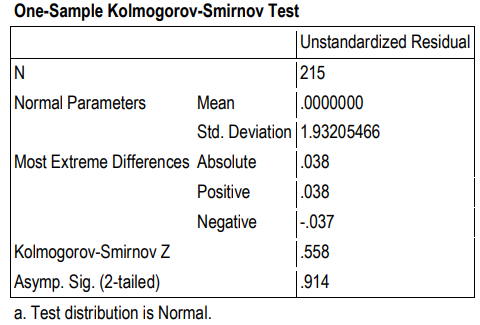
Based on Tables 4 and 5, it can be seen that the sig values> 0.05, namely 0.066 and 0.914, so it can be concluded that the data residuals are normally distributed, and the regression model has met the normality assumption.
2. Multikolonierity Test
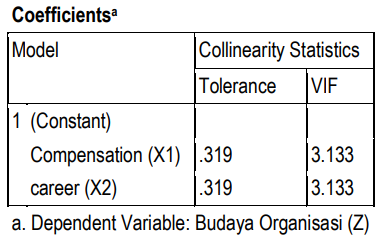
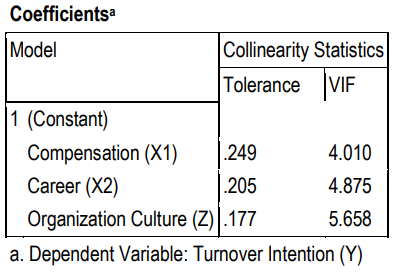
Based on Tables 6 and 7 above, it can be seen that all the independent variables used to show a tolerance value> 0.10 and a VIF value <10; it can be concluded that there is no multicollinearity between the independent variables used in the regression model.
Hypothesis Testing
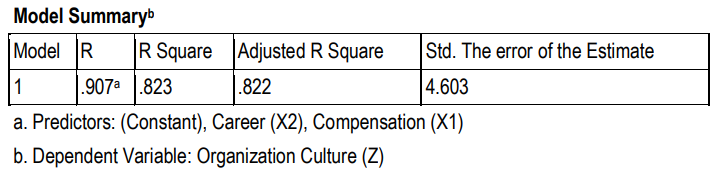
Based on Table 7, it can be seen that the Adjusted R Square value is 0.822, this means that 82.2% of the variation of the organizational culture variable can be explained by the two variations of the independentvariable, namely Career and Compensation, while the remaining 17.8% is explained by other variables. not included in this research model.
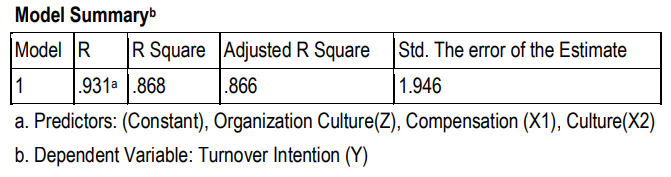
Meanwhile, based on Table 8, it can be seen that the Adjusted R Square value is 0.866, this means that 86.6 % of the variation of the Turnover intention variable can be explained by the three variations of the variable, namely Career, Compensation, and Organizational Culture, while the remaining 13.4% is explained by variables. Other variables are not included in this research model.
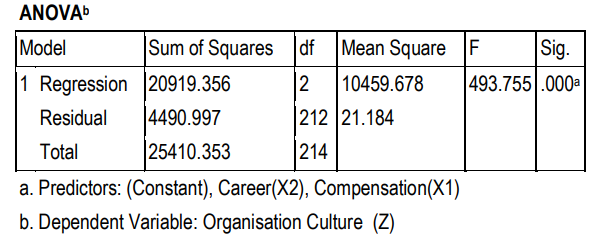
Based on Table 9, it can be seen that the F value counted 493,755 with a probability of 0,000, which means the probability value <0.05, while the results obtained from the F table (df1 = 2, df2 = 212) were 3.038, which means F count> F table (493,755> 3,038) so that the regression model can be used to predict organizational culture or it can be concluded that compensation and career jointly affect organizational culture or the model is appropriate.
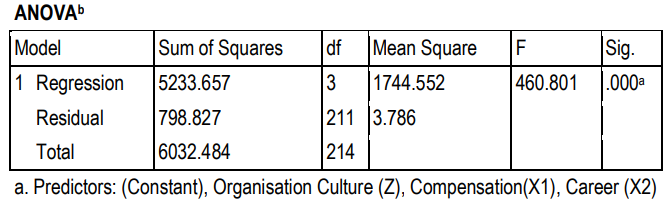
Based on Table 10, it can be seen that the F calculated value is 460.801 with a probability of 0.000, which means the probability value is <0.05, while the results obtained from the F table (df1 = 3, df2 = 211) are 2.647 which means F count> F table (460.801> 2,647), so the regression model can be used to predict turnover intention or it can be concluded that compensation, career, and organizational culture jointly affect turnover intention or the model is correct.
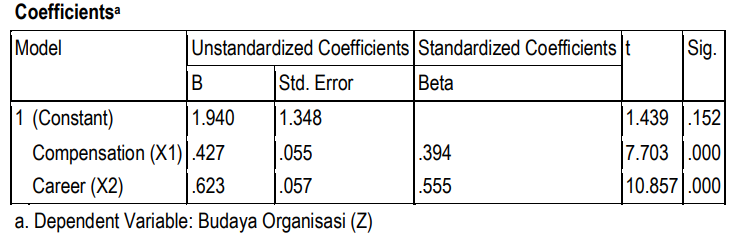
Based on Table 11, it is obtained that the t value of compensation is greater than the value of the t table, namely 7,703> 1,971 and a significance value of 0,000 <0.05, so compensation has a positive and significant effect on organizational culture. The career count t value is greater than the t table value, which is 10.857> 1.971 and a significance value of 0.000 <0.05, so career has a positive and significant effect on organizational culture.
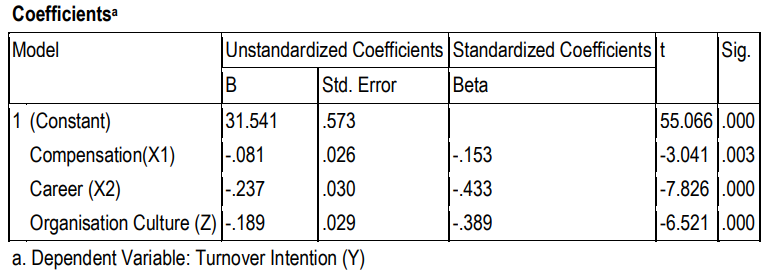
Based on Table 12, it is found that the t value of compensation is greater than the value of the t table, namely -3.041> 1.971 and a significance value of 0.003 <0.05, so compensation has a negative and significant effect on turnover intention. The career count t value is greater than the t table value, which is - 7,826> 1,971 and a significance value of 0,000 <0.05, so career has a negative and significant effect on turnover intention. The t value of organizational culture is greater than the t table value of -6.521> 1.971 and a significance value of 0.000 <0.05, so organizational culture has a negative and significant effect on turnover intention.
DISCUSSION
1) The Effect of Compensation on Organizational Culture
The results of hypothesis testing (H1) have seen that there is an influence between compensation on organizational culture. Through the results of calculations that have been done, the t value is obtained at 7,703 with a significance of the results of 0,000 <0.05. Thus Ha is accepted, and Ho is rejected. This test statistically proves that compensation has a positive and significant effect on organizational culture. This is in line with research conducted by (Agus et al.: 2020, pp. 14054-14069) that compensation has a significant effect on organizational culture (Asbari et al.: 2020, pp. 2008-2027) states that compensation has a significant effect on organizational culture, Santoso (2020) states that compensation has a significant effect on organizational culture, Hyun (2019) that compensation has a significant effect on corporate culture, (Wijaya et al.: 2020, pp. 25-47) states that compensation has a significant effect on organizational culture, (Bernarto et al.: 2020, pp. 13-26) states that compensation has a significant effect on corporate culture, and(Pramono et al.: 2020, pp. 2451-2458) states that compensation has a significant effect on corporate culture.
2) Career Influence on Organizational Culture
The results of hypothesis testing (H2) have seen an influence between compensation on organizational culture. Through the results of calculations that have been done, the t value is 10.857 with a significance of the results of 0.000 <0.05; thus, Ha is accepted, and Ho is rejected. This test statistically proves that career has a positive and significant effect on organizational culture. This is in line with research conducted by (Asbari et al.: 2020, pp. 2008-2027) that career has a significant effect on organizational culture, Santoso (2020) states that career has a significant effect on organizational culture, Hyun (2019) states that career has a significant effect on company culture, (Wijaya et al.: 2020, pp. 25-47) that career has a significant effect on organizational culture, (Bernarto et al.: 2020, pp. 13-26) that career has a significant effect on corporate culture, and (Pramono et al.: 2020, pp. 8101-8134)that career has a significant effect on corporate culture.
3) Effect of Compensation on Turnover Intention
The results of hypothesis testing (H3) have seen that there is an influence between compensation on turnover intention. Through the results of calculations that have been done, the t value is -3.041 with a significance of the result of 0.003 <0.05; thus, Ha is accepted, and Ho is rejected. This test statistically proves that compensation has a negative and significant effect on turnover intention. This is in line with research conducted by (Ong et al.: 2020, pp. 24808-24317)that compensation has a negative and significant effect on Turnover Intention (Asbari et al.: 2020, pp. 6724-6748) that compensation has a negative and significant effect on Turnover Intention, Santoso (2020) that compensation has a negative and significant effect on Turnover Intention. , Hyun (2019) that compensation has a negative and significant effect on Turnover Intention (Wijayanti et al.: 2020, pp. 6370-6390) that compensation has a negative and significant effect Turnover Intention (Bernarto et al.: 2020, pp. 13-26) that compensation has a negative and significant effect on Turnover Intention, and (Harsch & festing: 2019, pp. 249-279) that compensation has a negative and significant effect on Turnover Intention.
4) Effect of Career on Turnover Intention
The results of hypothesis testing (H4) show that there is an influence between career and turnover intention. Through the results of the calculations that have been done, the t value is -7.826 with a significance of the results of 0.000 <0.05; thus, Ha is accepted, and Ho is rejected. This test statistically proves that career has a negative and significant effect on turnover intention. This is in line with research conducted by (Vizano et al.: 2020, pp. 931-937) that compensation has a negative and significant effect on Turnover Intention, (Asbari et al.: 2020, pp. 2008-2027) states that career has a negative and significant effect on Turnover Intention, career has a negative and significant effect on Turnover Intention, career has a negative and significant effect on Turnover Intention, (Wijaya et al.: 2020, pp. 25-47) that career has a negative and significant effect on Turnover Intention, (Bernarto et al.: 2020, pp. 13-26) that career has a negative and significant effect on Turnover Intention, and (Harsch & festing: 2019, pp. 249-279) that career has a negative and significant effect on Turnover Intention.
5) The Influence of Organizational Culture on Turnover Intention
The results of hypothesis testing (H5) have seen that there is an influence between compensation on organizational culture. Through the results of calculations that have been done, the t value is -6.521 with a significance of the result of 0.000 <0.05; thus, Ha is accepted, and Ho is rejected. This test statistically proves that career has a negative and significant effect on turnover intention. This is in line with research conducted by (Vizano et al.: 2020, pp. 931-937) that organizational culture has a negative and significanteffect on Turnover Intention (Asbari et al.: 2020, pp. 19-322) states that organizational culture has a negative and significant effect on Turnover Intention, organizational culture has a negative and significant effect on Turnover Intention. Organizational culture has a negative and significant effect on Turnover Intention (Wijaya et al.: 2020, pp. 25-47) that organizational culture has a negative and significant effect on Turnover Intention, (Bernarto et al.: 2020, pp. 13-26) states that organizational culture has a negative and significant effect on Turnover Intention, and (Pramono et al.: 2020, pp. 8101-8134) that organizational culture has a negative and significant effect on Turnover Intention.
CONCLUSION
Based on the results of the analysis and discussion that has been carried out in the previous chapter, the following conclusions are obtained: (1) Compensation has a significant effect on organizational culture, this means that compensation has an important role in improving organizational culture; (2) Career has a significant effect on organizational culture, this means that career has an important role in improving organizational culture; (3) Compensation has a significant effect on turnover intention, this means that compensation has an important role in reducing turnover intention; (4) Career has a significant effect on turnover intention, this means that career has an important role in reducing turnover intention; (5) Organizational culture has a significant effect on turnover intention, this means that organizational culture has an important role in reducing turnover intention. Suggestions Based on the results of the research and the conclusions in this study, some suggestions that need to be conveyed are: First, for the Company: (a) Compensation provided to employees in the form of allowances beyond the basic salary should be further increased in order to meet the needs of employees; (b) The ability in organizational planning is further enhanced so that the creation of a perception or the same idea and communication can run well; (c) Increasing the ability to have the urge to take risks at work in order to generate a sense of motivation and enthusiasm at work. Second, for the next researcher, it is better to add other variables that are not in this research. So that further research will be more perfect and provide more information.
BIODATA
N.VIZANO: Nico Alexander Vizano, ORCID ID 0000-0001-8487-7632, currently studying in the Doctoral Education Management program at Mercu Buana University. His qualification is a lecturer of Management in Management Faculty, Mercu Buana University, Jakarta Indonesia.
W. UTAMI: Wiwik Utami, Scopus ID 55091214600 , ORCID ID 0000-0002-2313-3346, She was born in Malang 09 april 1960, completed his doctorate at Padjajaran University in 2005. Her qualification is a lecturer of Management in Management Faculty, Mercu Buana University, Jakarta Indonesia.
S. JOHANES: Singmin Johanes, ORCID ID 0000-0002-0947-7257, His qualification is a lecturer of Management in Management Faculty, Mercu Buana University, Jakarta Indonesia.
A. HERAWATI: Aty Herawati, Scopus ID 57207889522 , ORCID ID 0000-0002-6760-9772, She was born in Bandung 26 February 1970, completed his doctorate at IPB in 2016. Her qualification is a lecturer of Management in Management Faculty, Mercu Buana University, Jakarta Indonesia.
BIBLIOGRAPHY
AGUS, P, RATNA SETYOWATI, P, ARMAN, H, MASDUKI, A, INNOCENTIUS, B, PRIYONO BUDI, S, &OTTA BREMAN, S (2020). “The effect of implementation integrated management system ISO 9001, ISO 14001, ISO 22000 and ISO 45001 on Indonesian food industries performance”. Test Engineering and Management, 82(20), pp. 14054-14069.
AGUS, P, RATNA SETYOWATI, P, ARMAN, H, MASDUKI, A, INNOCENTIUS, B, PRIYONO BUDI, S, &OTTA BREMAN, S (2020). The effect of implementation integrated management system ISO 9001, ISO 14001, ISO 22000 and ISO 45001 on Indonesian food industries performance. Test Engineering and Management, 82(20), 14054-14069.
ASBARI, I, B, RUDYPRAMONO, A, P, DYLMOONHIDAYAT, A, VIRZAUTAMAALAMSYAH, P, S, &MIYVFAYZHALL, M (2020). “The effect of work-family conflict on job satisfaction and performance: a study of indonesian female employees”. International Journal of Advanced Science and Technology, 29(3), pp. 6724-6748.
ASBARI, M, WIJAYANTI, L, HYUN, C, C, PURWANTO, A, & SANTOSO, P, B (2020). “How to build innovationcapability in the rac industry to face industrial revolution 4.0”. International Journal of Psychosocial Rehabilitation, 24(6), PP. 2008-2027.
ASBARI, M, WIJAYANTI, L, M, HYUN, C, C, PURWANTO, A, SANTOSO, P, B, BERNARTO, I, ... &FAYZHALL, M (2020). “The role of knowledge transfer and organizational learning to build innovation capability: Evidence from Indonesian automotive industry”. International Journal of Control and Automation, 13(1), pp.19-322.
BERNARTO, I, BACHTIAR, D, SUDIBJO, N, SURYAWAN, I, N, PURWANTO, A, & ASBARI, M (2020).“Effect of transformational leadership, perceived organizational support, job satisfaction toward life satisfaction: evidences from indonesian teachers”. International Journal of Psychosocial Rehabilitation, 21, pp. 13-26.
CHUN, J, S, SHIN, Y, CHOI, J, N, & KIM, M, S (2013). “How does corporate ethics contribute to firm financial performance? The mediating role of collective organizational commitment and organizational citizenship behavior”. Journal of Management, 39(4), pp. 853-877.
GHOZALI, I, & FUAD (2008). “Structural equation modeling: teori, konsep, dan aplikasi dengan program lisrel 8.80”. Badan Penerbit Universitas Diponegoro, 43(2), pp. 76-90.
HARSCH, K, & FESTING, M (2019). “Managing non-family talent: Evidence from german-speaking regions”.German Journal of Human Resource Management, 33(3), pp. 249-279
HEJASE, H, J, HEJASE, A, J, MIKDASHI, G, & BAZEIH, Z, F (2016). “Talent management challenges: an exploratory assessment from Lebanon”. International Journal of Business Management & Economic Research, 7(1) pp. 32-56.
ONG, F, PURWANTO, A, SUPONO, J, HASNA, S, NOVITASARI, D, & ASBARI, M (2020). “Does qualitymanagement system iso 9001: 2015 influence company performance? anwers from indonesian tourism industries”. Test Engineering & Management, 83, pp.24808-24817.
PEPE, M, E (2007). “The strategic importance of talent management (TM) at the yale new haven health system: key factors and challenges of TM implementation”. Organization Development Journal, 25(2), P.207.
PRAMONO, R, LEMY, D, M, PRAMEZWARY, A, SIHOMBING, S, O, PURWANTO, A, & ASBARI, M (2020).“The role of spiritual capital in the hospitality industry”. International Journal of Advanced Science and Technology, 29(05), pp. 8101-8134.
PRAMONO, R, PURWANTO, A, ASBARI, M, KOTAMENA, F, RAMDAN, M, & SIHITE, O, B (2020). “Nanoperspective for mentality revolution methode of indonesian society. International Journal of Advanced Science and Technology, 29(5), pp.2451-2458.
SANTOSO, P, B, MASDUKIASBARI, A, P, LAKSMIMAYESTIWIJAYANTI, C, HYUN, C, SITIMAESAROH,M, GUSLICHIDIR, M, & DHANIELHUTAGALUNG, A, Y (2020). “Working while studying at university in the self-management perspective: an ethnographic study on java ethnic employees”. International Journal of Control and Automation, 13(02), pp. 299-308.
SISWOYO, H (2017). “Metode sem untuk penelitian manajemen dengan amos lisrel pls”. Luxima Metro Media, Jakarta Timur, 6, pp. 43-67. (Siswoyo: 2017, pp. 43-67).
SUSILO, R, BERNARTO, I, & PURWANTO, A (2020). “Effect of trust, value and atmosphere towards patient satisfaction (case study on preama clay of wae laku, indonesia)”. International Journal of Advanced Science and Technology, 29(3), pp. 6716-6723.
VIZANO, N, A, UTAMI, W, JOHANES, S, HERAWATI, A, AIMA, H, SUTAWIJAYA, A, H, ... & ELMI, F(2020). “Effect of career, organizational commitment on turnover intention through mediation of organizational culture: evidence from indonesian companies”. Systematic Reviews in Pharmacy, 11(9), pp. 931-937.
WIJAYA, A, P, BERNARTO, I, & PURWANTO, A (2020). “How to achieve value creation in digital world? the influence of it response on value creation and customer satisfaction”. International Journal of Psychosocial Rehabilitation, 6, PP. 25-47.
WIJAYANTI, L, M, PURWANTO, A, ASBARI, M, HYUN, C, C, SANTOSO, P, B, & PRAMONO, R (2020). “Self-regulation in english language learning: a case study of elementary students in sekolah cikal”. International Journal of Advanced Science and Technology, 29(5), pp. 6370-6390.