Artículos
Factors that affect the behavior of adolescents in Thailand due to the use of mobile phones in their daily life
Factores que afectan el comportamiento de los adolescentes en Tailandia por el uso de teléfonos móviles en su vida diaria
 J. METTATHAMRONG Kkai6688@Gmail.com
Factors that affect the behavior of adolescents in Thailand due to the use of mobile phones in their daily life
Utopía y Praxis Latinoamericana, vol. 26, no. Esp.2, pp. 212-226, 2021
Universidad del Zulia

This work is licensed under Creative Commons Attribution-NonCommercial-ShareAlike 4.0 International.
Received: 27 February 2021
Accepted: 24 March 2021
Abstract: This study aims to examine the structural validity of the mobile phone usage behaviors of the daily life of an adolescent in Thailand. The participants in this study were 400 adolescents. The data analysis techniques used exploratory factor analysis (EFA) and confirmatory factor analysis (CFA). The results of exploratory factor analysis were classified into seven groups of parameters: capacity, communication, social, education, commercial, aesthetic, and entertainment factors with mobile phone usage behaviors.
Keywords: Mobile phone, behavior, adolescent, EFA, CFA.
Resumen: Este estudio tiene como objetivo examinar la validez estructural de los comportamientos de uso de teléfonos móviles en la vida diaria de un adolescente en Tailandia. Los participantes de este estudio fueron 400 adolescentes. Las técnicas de análisis de datos utilizaron análisis factorial exploratorio (EFA) y análisis factorial confirmatorio (CFA). Los resultados del análisis factorial exploratorio se clasificaron en siete grupos de parámetros: capacidad, comunicación, factores sociales, educativos, comerciales, estéticos y de entretenimiento con comportamientos de uso de teléfonos móviles.
Palabras clave: Teléfono móvil, comportamiento, adolescente, EFA, CFA.
INTRODUCTION
The existence of today’s youth is highly dependent on technology and communication. Every day the human desires communication, information exchange, and innovation. Thus the Thai adolescent needs to acclimate to technology, especially current communication technology that they deem indispensable; mobile phones. The mobile phone is used for communication, entertainment, watching movies and playing games, studying by looking up information on the net. The current affordability of mobile phones has proliferated the usage seeing as the Thai adolescent can afford more than one phone. Against this background, the trend of using mobile phones over a period of 6 years 2009-2013 has risen from 34.8 million people (56.8 percent) to46.4 million people (73.3 percent).
Several studies have found out the usage of mobile phones among adolescents as a medium for learning: such as learning vocabulary lessons, English vocabulary lessons, real-time classroom teaching with mobile devices, health and well-being shares to social network friends on Facebook. A mobile phone is rapidly becoming the communication device in adolescents for a gyroscope, microphone, GPS, and camera, and there are enabling the emergence of groups, personal and community, monitoring air or pollutants. A growing convergence of communication technologies and mobile phones has led to the tendency to text, video, play games, music, and graphics. The adolescent uses new technology styles to represent everything postmodern. The adolescent uses a mobile phone, cyber-worlds and new technology respond to their need for playing and entertainment. However, these media on mobile phones have impacted young people, since they spend a lot of time and use more internet in their work on mobile.
This study aims to analyze factors associated with the behaviors of the usage of mobile phones in Thai adolescents. Exploring the behaviors in an adolescent group: How do they use mobile phones and what the effect of the mobile phones usage behavior is this research aims to understand current behavior of adolescents that will be a remedy to the problems such as automobile accidents, mobile phone in study mode reduces the concentration in classrooms, addiction-like behavior, self-esteem (Hong et al.: 2012, pp. 2152-2159), Sleep quality (Liu et al.: 2017, pp. 108-114; Demrc et al.: 2015, pp. 85-92), Mental, physical and emotional problems.
LITERATURE REVIEW
Adolescent behavior
Adolescent behavior is young adults seeking social comparison and feedback, frequently using technology as a mobile phone, Facebook, and Instagram (Nesi et al.: 2017, pp. 12-19). Adolescents engage in familiar and peer relationships with mobile phones. Teens reportedly have access to mobile phones, with 92% of teens going online every day. The increasing usage of mobile phone technology has had an impact on adolescent behavior, such as social influence on the Attitude and Behavioral of Mobile phone Learning (Briz-Ponce et al.: 2017, pp. 612-620). Mobile phones are mainly used for adolescent communication, entertainment, and learning in the classroom. The behavioral intention is influencing to use of YouTube on a mobile phone that predicts perceive usefulness or behavioral satisfaction?. Adolescents use communication on social media to get a vast network of companions. Adolescents use social media as for positive intent of entertainment, comic social connection, while some adolescents are the exact opposite by sharing risky content, persecute in cyber (cyberbullying), self-denigrating by comparison to others (Radovic et al.: 2017, pp. 5-15). Some of the external behavior problems of adolescents use games online, or the internet for communication as molesting, dissoluteness, and some of the internal behavior problems are withdrawal and anxiousness.
Variations in mobile phone usage
The variations of mobile devices and mobile applications are software architecture (Berrocal et al.: 2017, pp. 32-50) and innovative technology that has been a great impacted on the society of adolescents. Mobile device service increased value-added for a phone user to access the internet anytime and anywhere. Theshopping online. The entertainment content on mobile phones impacts repurchase and direct effects on social value, emotional and monetary. Mobile advertisements affect customer’s willingness on products and affect both industry’s and consumer’s dimensions. Mobile phone usage has been transacted to banking and financial services such as funds transfer, purchase ordinary shares, deposits, and withdrawals, among others. Mobile viewing habits are consumer behaviors that adopt mobile TV content interest (Leung & Chen: 2017, pp. 1638- 1649). Mobile phone technologies encourage the learning process and help all users induct information for learning, and Mobile learning can be accounted for the evaluation of e-learning. Sharples (2007) presents the essentials for mobile learning as (i) All of the users participates in mobile technologies because the ascription of students shifting from one area to another (computer room, library, center hall, classroom, etc.); (ii) The apprehension of learning can initiate outside of formal settings; and (iii) it is processed for creating knowledge and skills through executing inside group or community (Sharples: 2007).
Adolescent daily life
The lifestyle of an adolescent uses inevitable technology and mobile phone every day. There are numerous benefits of mobile phone usage and are precious for young people’s lives. Mobile phones, the Internet, and computers are information and communication technologies that have enormously permuted adolescents’ everyday life, So they have become a part of their lifestyle. Mobile phone functions such as multimedia, texting, movies, coordination, and internet usage support adolescents in judging a remedying relationship and friendship. They provide a framework of clarity to change the society that shifts towards personal communication in society, including symbolic of technology, coordination, and social network, public spaces, and mobile youth culture. The communication connects to online weblogs or blogs that are reflective in style and of everyday life. Blog authors apply blogs to create hearsays and reflect on adolescent and their lives.
The factor affecting mobile phone usage behaviors
The mobile phone is essential for humanity. Especially in the adolescent who is born to touch technology and can be said that was the sixth factor of human needs. The factor affecting the mobile phone usage behaviors consists:
The capacity of mobile phone usages such as mobile broadband service and mobile wireless networks is an important technology of a capacity. The operating system affects the marketing value and market power (Kuroda et al.: 2018, pp. 86-95). The capacity of fast movement and processing process is one of the capabilities of a mobile phone (Wu et al.: 2014). The fast processing speed for high-quality panoramic images on a mobile phone is necessary to use a mobile phone. And the fashion accessories are consumers’ choice of mobile phone, especially in the adolescent group select the product’s innovative features.
The Communication of mobile phone usage is communication with each other, such as communication with friends, parents, and relatives. Some scholars mentioned to many adolescents usage mobile phone to connected to their friends. College students use mobile phones to contact their family or members at home. Social and social online is one of the social structures, and young people enable a mobile phone to escape the demands of existing social structures. The fashion values are visible in mobile phone design and social networks, and applications have a direct impact on fashion or information about fashion to this device (Zhang& Juhlin: 2016, pp. 63-84). The mobile phone has become a person’s social network or online social group(Kardos et al.: 2018, pp. 84-88)
Education on mobile phone users to access information and learning resources such as, An English- language blog has been used by texts in the Internet discourse that was data on the internet. The student perceives mobile phones as a tool for facilitating learning and teaching that uses a mobile phone to search for data.
The commercial is to transact via mobile phone such as mobile marketing that was transmitting messages or product advertising to customers via mobile devices. The trends of shopping online are becoming popular, and the interface quality of mobile apps on shopping online is important to purchase intention (Patel et al.: 2020,pp. 300-309). And most people favor using mobile banking because it accesses convenience, transaction convenience, and benefit convenience (Jebrajakirthy & Shankar: 2021, pp. 102323-102325)
Aesthetics are emotional feeling, beauty, beauty from picture and music mania that college students are increasingly using mobile phones because it includes features such as cameras, video cameras, internet access, and many students have created video content and share it. Most adolescents use mobile phones on a daily basis for taking pictures, texting, play games, and so on. Mobile phones are used for listing to music on cycling behavior.
Entertainment on mobile phone apps is relaxation. The activities used to create relaxation for entertainment include: Film and television content were used on mobile phone devices- viewers and Mobile phone use may influence leisure of college students’ behavior (Righy et al.: 2016, pp. 714-721; Lepp: 2014). Nowadays, digital games are designed for elderly users and to develop for rich virtual learning contexts.
METHODOLOGY
Survey design
The population in this research consisted of adolescents in Sakon Nakhon province Thailand, selected from each district. The designing sampling was stratified randomly by methodically going through Sakonnakhon province to each of its 18 districts. The adolescent in this research was a young person who was developing into an adult or a young adult and stratified by the ages between 15-30 years. The number of sampling in each district used accidental sampling adolescents aged between 15-30 years for respondents. A sample of 400 respondents that used questionnaires as research tools, the questionnaires were tried out with 30 samples to measure reliability. The measuring of reliability was the Cronbach’s Alpha that was statistically considered. The Value of Cronbach’s Alpha was between .615 - .814. that the question items were very well.
Data analysis
This research studies behavior of adolescents’ usage of mobile phones. The variables concerned with mobile phone usage behaviors incorporated 26 variables were related to the behaviors of using mobile phones, as presented in Table 6; the 26 variables were used to construct the hypotheses and as standard parameters for the test group classification by the EFA method and CFA to confirm the model structure.
Factor analysis
Factor analysis is a statistical method used to describe correlated variables, studying hypothetical constructs, used to search for observed variables or indicators, used for identifying variables groups observed, measured directly from the indicators. The operation research by the exploratory factor analysis for confirmatory factor analysis method to identify the underlying factor structure. The factor analysis has two foundation types: exploratory factor analysis (EFA) and confirmatory factor analysis (CFA). The Exploratory factor analysis defines the proper number of factors that observed variables explained by correlation to each factor (Muthén et al.: 2017). When the constructs about category relations are discussed by hypotheses, CFA explains their hypotheses. In comparison to CFA with correlated variables and CFA can allow a more explain and parsimonious model.
RESULTS
Descriptive statistics
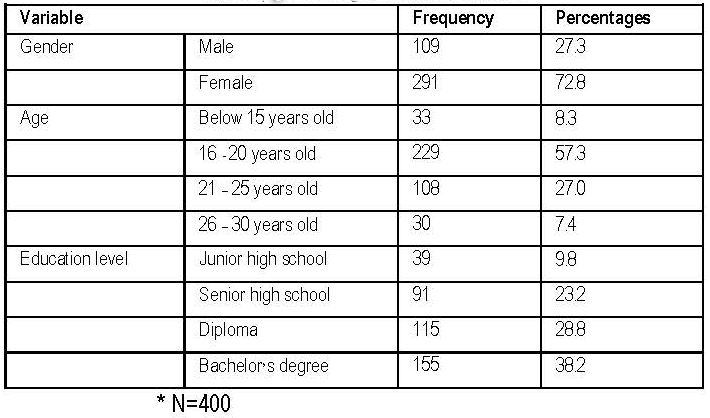
The participants in this study were 400 adolescents in Thailand, including 291 females (72.8%). Most of the age amount 229 persons 16-20 years (57.3%), and most of education level amount of 155 persons is a Bachelor’s degree (38.2%) as shown Table 1.
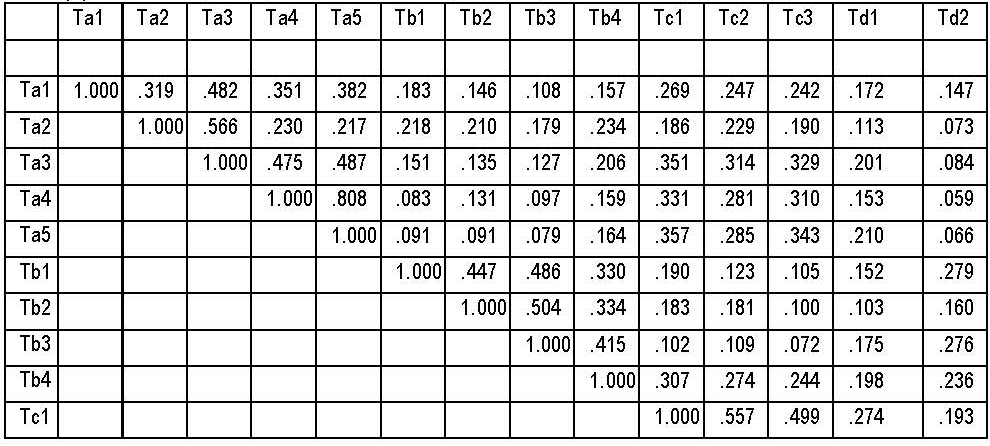
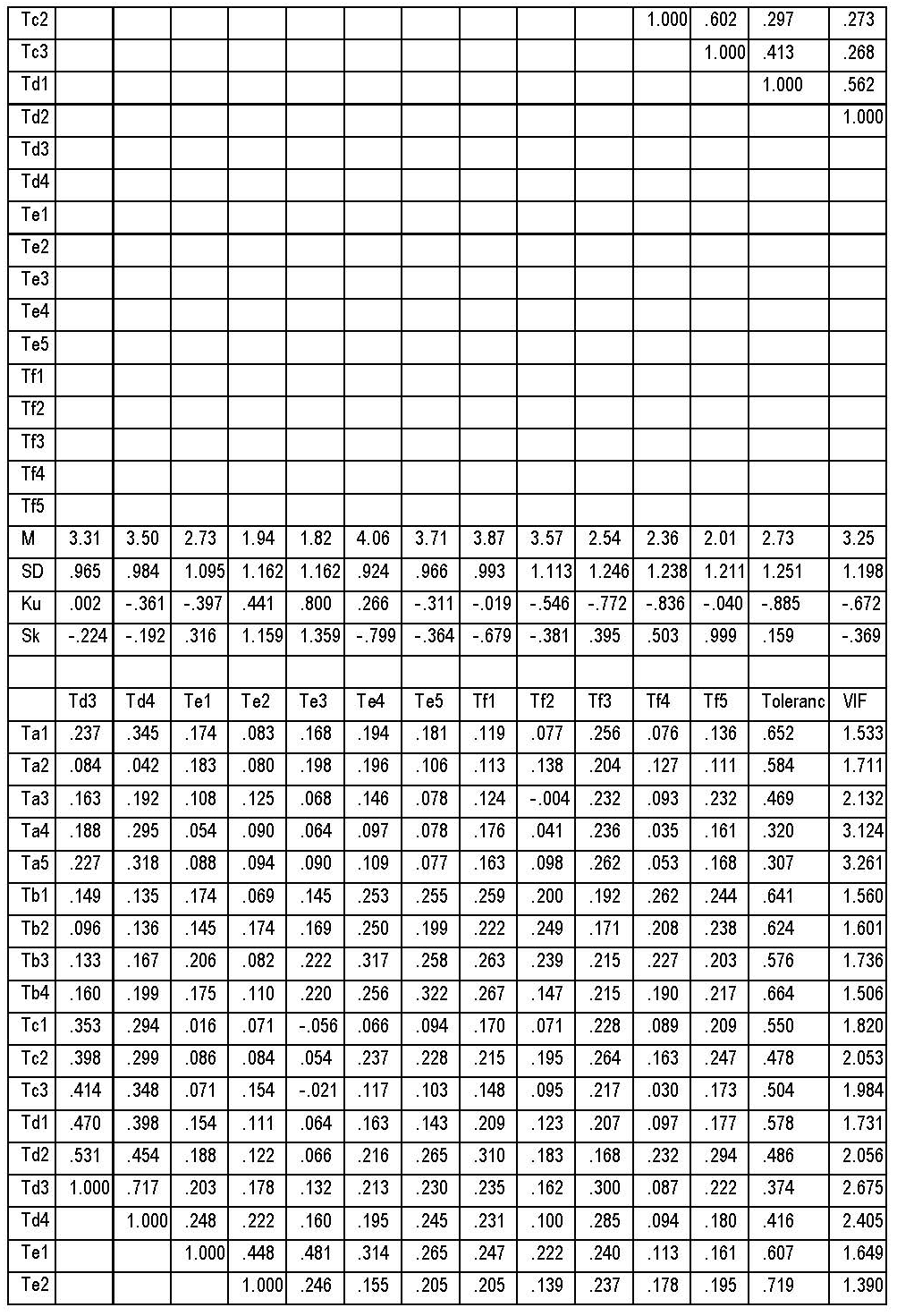
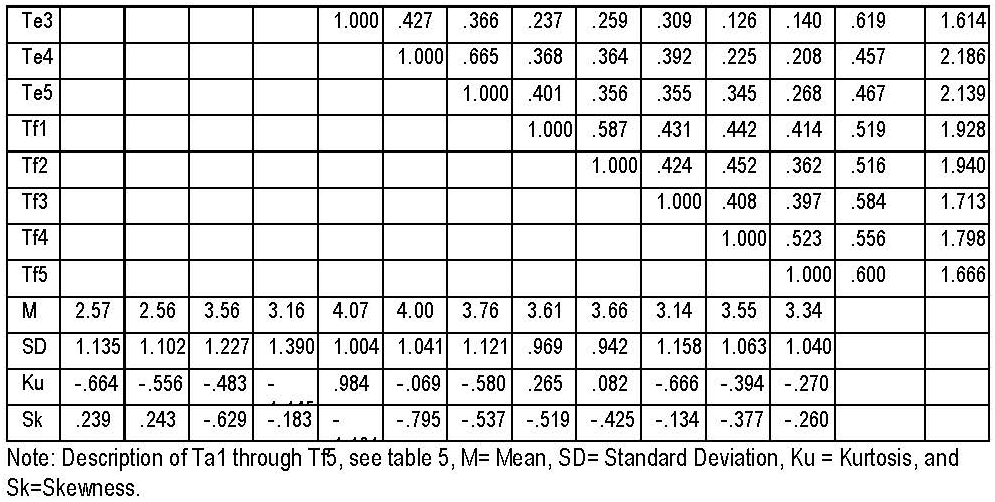
This research considers the development of a measurement model structure for factors associated with mobile phone usage behavior (show Table 2), the 26 observed variables to analysis for the model that all a pairs of a variable by a relationship of each variable which differed from significant at .01. This research presented positive coefficients between .02 - .08, observed variable verified by correlation with the identical direction. Related to the suitability of each part. The analyzed Kaiser-Meyer-Olkin (KMO) index (Kaiser: 1970, pp. 401-415) and Barlett’s test of sphericity. The value in Barlett’s test p<.001 that significant, and the test value of KMO results should higher than .5 (inferior limit); there is the measure for acceptable. The result of this research reports the Kaiser-Meyer-Olkin (KMO) value is .833, which is closer to 1, Chi-square = 4157.288, df=325, and p=.000 as mentioned above the value as expected and the relationship among of observed variables were suitable that be used for factor analysis.
Consideration of the highest average score, 4.07 (SD=1.00), (show Table 2)on parameter Te3 (usage mobile phone or listen to the music). Next on parameter Tb1 average score, 4.06 (SD=.924) (usage mobile to search for data on the internet). In this research, all of the values the Skewness and Kurtosis omit in the acceptable range. The value of VIF and tolerance are indicated each variable does not cause multicollinearity problems.
Exploratory Factor Analysis (EFA)
This research was done using the EFA method for sores obtained from 26 factors associated with mobile phone usage behavior parameters to the classification group. This research is divided into seven groups of Exploratory Factor Analysis in seven distinct names. The first factor, namely capacity. Second Factor, Namely Communication. Third Factor, namely Social. The fourth factor namely Educate. The fifth factor, namely commercial. The sixth factor, namely Aesthetics. And last factor, namely Entertainment.
Reliability
According to Hair et al. (2009), the reliability determined by Cronbach’s alpha should be greater than .07. Considering table 3, the seven variables show Cronbach’s Alpha between .715-.814. Accepting the values/ thus corresponding with the values. The model measurement was tested for reliability as convergent validity and discriminant validity. The instrument for testing the convergent validity measurement of the model used was Composite Reliability (CR) and Average Variance Extracted (AVE), as displayed in table 3. All factors were loading recommended that The CR greater than .70 and AVE greater than .50 are considered acceptable (Hair et al.: 2009).
The instrument for testing the discriminant validity of measurement of the model used was the Maximum Shared Squared Variance (MSV) and the Average Squared Variance (ASV). The results of the MSV and the ASV should be lower than the AVE and CR that the discriminant validity (Hair et al.: 2009). Table 3 presents the results of the MSV and AVE, and they are lower than the AVE and CR value, explaining that the discriminant value holds. Therefore, Both convergent validity (CR, AVE) and discriminant validity (MSV, AVE) results indicate a measurement model was suitable.
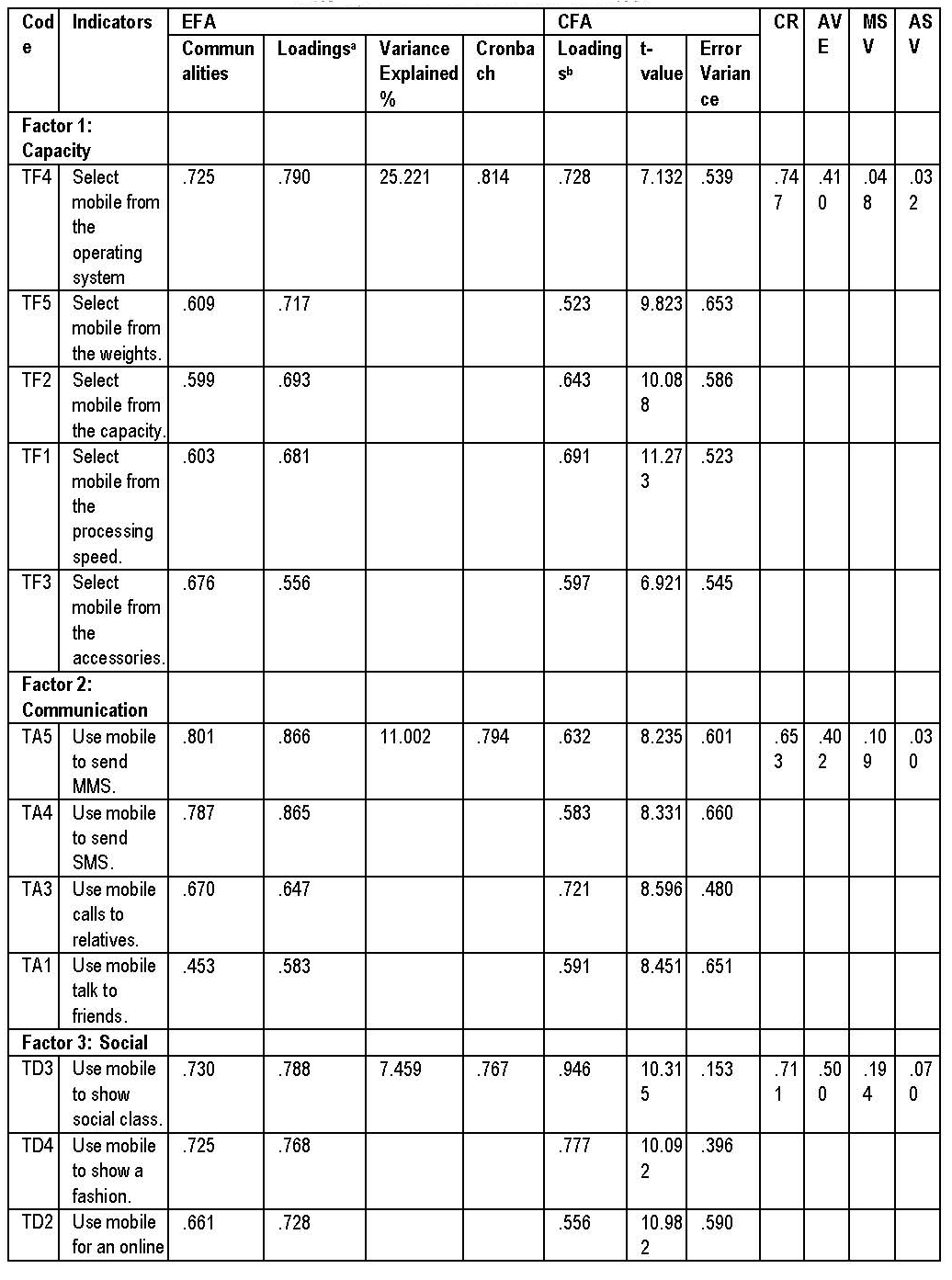
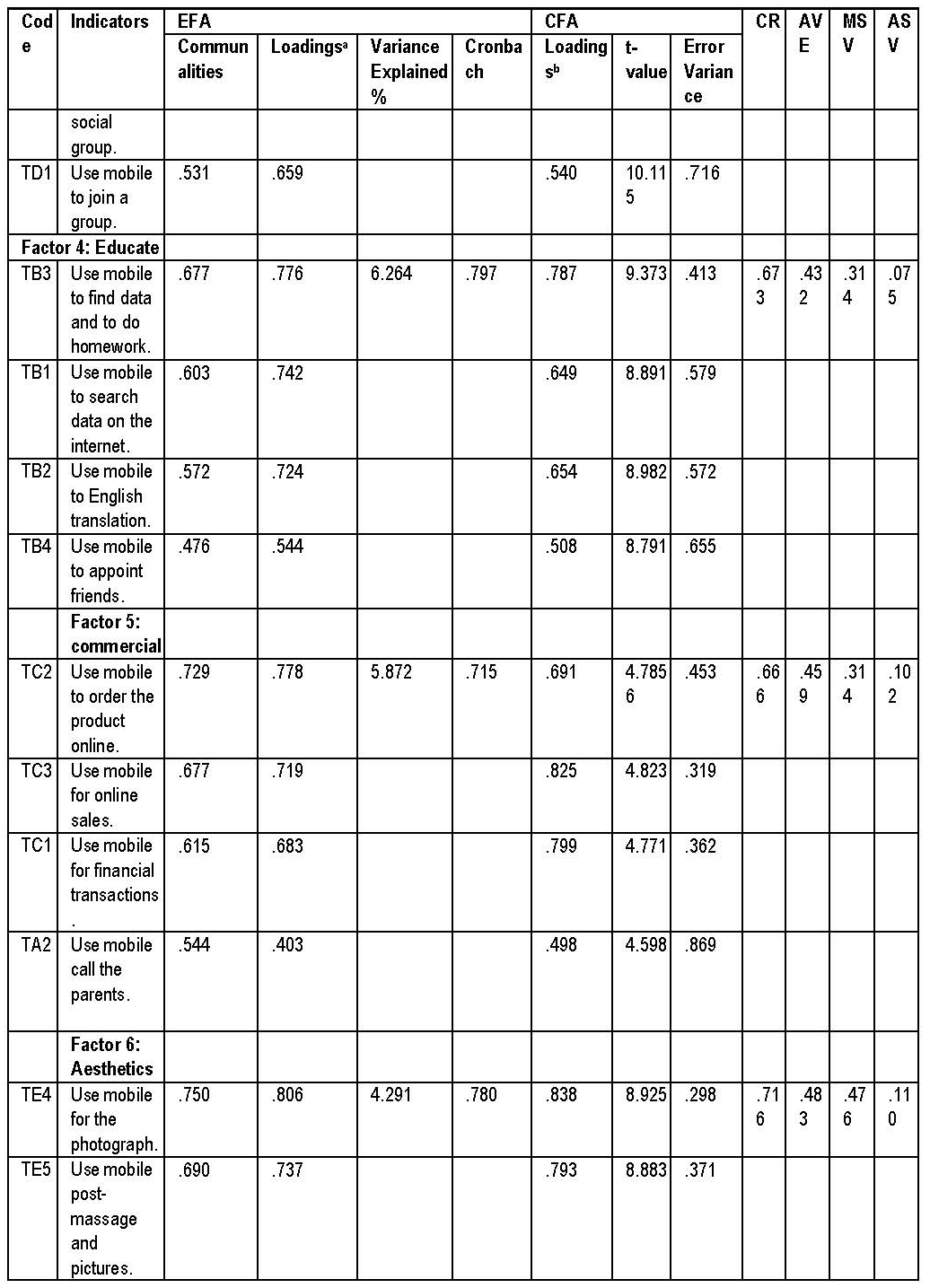
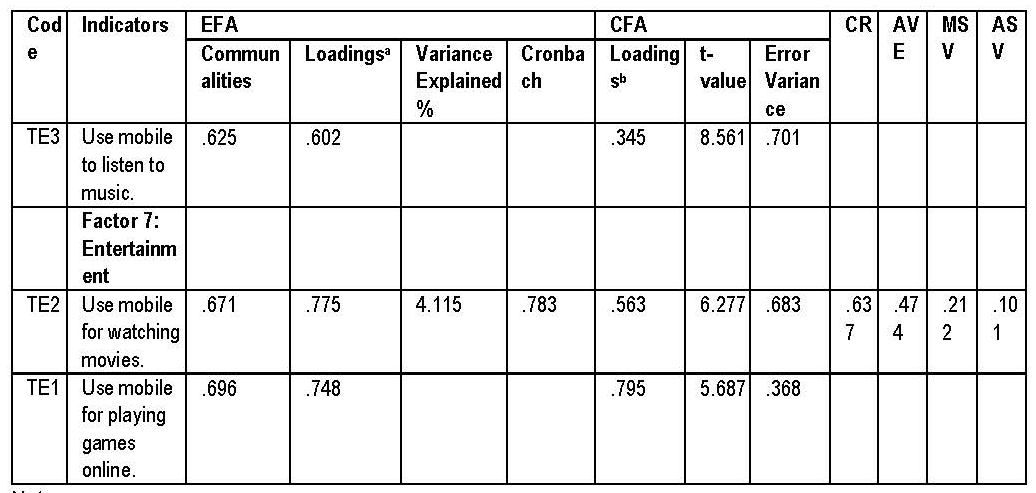
Notes: an EFA Loading .5 is accepted. bAll CFA loadings are significant .01Composite Reliability (CR), Average Variance Extracted (AVE), Maximum Shared Square Variance (MSV), and Average Shared Squared Variance (ASV)
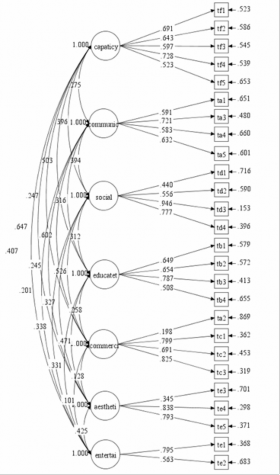
Figure 1. Structural of the Factors associated with Mobile phone Usage Behaviors
Model fit indices
The results of this research are findings on the factors associated with mobile phone usage, EFA and CFA used program Mplus 7. Based on 400 respondent, fig 1 shows goodness-of-fit statistics as: Chi-square = 347.986, degree of freedom (df) = 247, p-value <.000, root mean square error of approximation (RMSEA) =.031, Tucker Lewis Index (TLI) = .969, comparative fit index (CFI) = .976, standardized root mean square residual (SRMR) = .038. the above mentioned that can be compared to form suggested value as χ2(df) should be p>.05. The criteria were indicative of acceptable as CFI > .90, TLI > .90, RMSEA < .08, SRMR < .10. Consequently, all statistical values can be accepted, except the Chi-square because χ2 value is sensitive to large sample size; this value tends to reject the hypothesis. With the value of statistics, it can be concluded that the model has a good fit (Delbosc & Currie: 2012, pp. 302-309).
CONCLUSION
In Thailand, mobile phone technology continues to evolve especially mobile phones with advanced features and applications which integrate internet technology. In this study, we aimed to examine the structural validity of the mobile phone usage behaviors and daily life of an adolescent in Thailand based on 26 parameters. The first step was classifying the parameters into groups by the EFA method. The EFA categorizes parameters into seven groups from 26 parameters. The seven groups of parameters include capacity, communication, social, education, commercial, aesthetic, and entertainment. The results show the 26 parameters are indicated to measuring the quality of the seven factors at the significance level .01. Likewise, the loadings of CFA in this study can be useful for improving mobile phone usage behaviors.
The mobile phone usage behaviors in the daily life of adolescents in Thailand consider seven behaviors for usage or applied to mobile phone. The first factor to be considered in the behavior of adolescent mobile phone usage is capacity, as in an Android application (Singh et al.:, 2017). That Android system is a powerful system, likely to use and supported. Individual technology acknowledgment decisions to technologies for use populations and context. The emerging mobile technology being favored is IOS, while Android has the way usage of people (Cheah et al.: 2017). The physical limits of mobile phone devices taken into consideration are battery, slow wireless connection, and low processor speed. These factors are actualized to the web for mobile phone devices. The mobile device is movable, habitually connected, personal, and a small screen. These are multimedia tools for usage. Features of mobile phones that adolescents tend to consider as important are battery life, video camera, storage memory, mp3 player, photo camera, Bluetooth, clock, and calendar. Many people want to use an all-in-one mobile phone, the hybrid of mobile phone supporting calculator, alarm clock, calendar, digital camera, and other functions. As above is the capability of the mobile phone. Nowadays, the mobile phone brings all of the things for a human to be integrated into the mobile phone.
The second factor is communication interchange between two or more persons. The communication behavior for an adolescent in Thailand uses a mobile phone to contact one another; in terms of face-to-face communication, the increasing popularity of the social interaction pass through mobile phone use and social context in face-to-face communication on mobile phone influenced by the action of looking. In Japan, the most public favorite usage of mobile phones converts from telephonic communication to email. Phoning and Texting are remain prominent in mobile communication and lifestyle. (Karnowski & Jandura: 2014, pp. 184-193). The communication by the usage of mobile phone from the perspective of the scholars are consistent with this research. Right now, Communication using phoning and texting are remaining popular because the mobile phone becomes the most important factor for human life.
The third factor is the social factor. It relates to the activities of a group of people with a relationship, and the mobile phone provides a network for such. Social interactions that the youth would like to use for communication, such as email, text messaging, and instant messaging. They allow the conversational nature of the interaction. One more concept is social commerce that permits them to participate in the marketing and communities or selling online. There is social behavior on a mobile phone and supported by applications, such as social networks, wikis, and blogs (Kim & Park: 2013, pp. 318-332). The usage of mobile phones is applied by education, that is, the integration of technology into education. Because the scholarly perspectives discuss the usage of mobile phones to adaptive education and provide quick access to learning, exchange of knowledge, and the exchange of information is convenient and fast, Therefore are consistent with this research.
The fourth factor is education. Education on a mobile phone is an adolescent usage of mobile phones for learning, searching, and self-directed learning via the internet. Education usage on a mobile phone facilitates students to modify the transfer of and build their knowledge and skill access to information and to meet their educational goals (Ariffin et al.: 2018). Mobile learning base on the activity that technologies support an entrance to information, knowledge management, education exchange, and delivery of both learning and knowledgematerials. Mobile learning takes into account the widespread usage of personal and knowledge-sharing technology. The activity is a tool for supporting learners to their goals of converting their skills and knowledge. Mobile learning can be demarcated into two dimensions of tool activity: (1) technology layer and (2) semiotic layer.
The fifth is commercial that is an agreement for the exchange of goods or services. Commercial behaviors on mobile phone users exchange goods, trade, or trading activities online. According to Shareef et al.: (2018) study a consumer adoption of mobile banking services. The result showed that it impels the factor of consumers’ behavior to adopt mobile banking to transaction service and interaction. Shopping on a mobile phone is another transaction behavior between buyers and sellers. Mobile phone capacity includes consumers to entrance, store and a new way to the information on social shopping, assist consumers in changing the experience of shopping on a mobile phone (Fuentes & Svingstedt: 2017). Likewise, in Thailand, Shopping online is very popular. Most adolescents access Facebook shops via mobile phone because Facebook service has lived sales that lead to purchase.
The sixth factor is aesthetic, meaning beautiful, decoration, or photography for beauty. There uses a mobile phone for aesthetic such as selfie by self and decoration of pictures an application of mobile camera to capture food and images.
And the seventh factor is entertainment that means to enjoy using mobile phones and technology that makes fun. Entertainment is something in the individual that reflects on behavior or individual fondness. The actual usage of a mobile phone includes five functions a smartphone such as entertainment, transaction, content delivery, and promotion. The hybrid mobile phone links interpersonal to mass communication that adolescent users used for getting entertainment and news. Leong et al.: (2013) presented exploring to revealed and perceived usefulness, social influence, perceived ease of usage, and perceived enjoyment positively implicated with consumers’ behavioral intention to use of mobile entertainment. Mobile entertainment can be defined as any free time activity that launches usage by a personal device (Leong et al.: 2013, pp. 2109-2121). However, All of the variables in this research show the behavior of using mobile phones to interest, and it is the essential human factor. Especially, this study discovers the mobile phone behavior about anesthetics that love to use the mobile phone to take pictures, take a picture of the meal and taking photos of tourist attractions post on social media. As mentioned above, it is an important mobile phone behavior of adolescents in Thailand.
BIODATA
J. METTATHAMRONG: The current affiliation of Mettahamrong is Rajamangala University of Technoloty Isan Sakonnakhon Campus, Phang Khon, Sakonnakhon, Thailand; E-mail: Kkai6688@Gmail.com; ORCID: http://orcid.org/0000-0003-2389-2155
BIBLIOGRAPHY
ARIFFIN, S, A, SIDEK, S, F, & MUTALIB, M, F, H, (2018). "A Preliminary Investigation of Malaysian Student's Daily Use of Mobile Devices as Potential Tools for STEM in a Local University Context". Int. J. Interact. Mob. Technol., 12(2), pp. 80-91.
BERROCAL, J, GARCIA-ALONSO, J, VICENTE-CHICOTE, C, HERNÁNDEZ, J, MIKKONEN, T, CANAL, C, &MURILLO, J, M, (2017). "Early analysis of resource consumption patterns in mobile applications". Pervasive and Mobile Computing, 35, pp. 32-50.
BRIZ-PONCE, L, PEREIRA, A, CARVALHO, L, JUANES-MÉNDEZ, J, A, & GARCÍA-PEÑALVO, F, J, (2017)."Learning with mobile technologies–Students’ behavior". Computers in Human Behavior, 72, pp. 612-620.
CHEAH, W, CHINHONG, P, & HALIM, A, A, (2017). "Agent-oriented requirement engineering for mobile application development". International Journal of Interactive Mobile Technologies, 11(6), pp. 322-48.
DELBOSC, A, & CURRIE, G, (2012). "Modelling the causes and impacts of personal safety perceptions on public transport ridership". Transport Policy, 24, pp. 302-309.
DEMIRCI, K, AKGÖNÜL, M, & AKPINAR, A, (2015). "Relationship of smartphone use severity with sleep quality, depression, and anxiety in university students". Journal of behavioral addictions, 4(2), pp. 85-92.
FUENTES, C, & SVINGSTEDT, A, (2017). "Mobile phones and the practice of shopping: A study of how young adults use smartphones to shop". Journal of Retailing and Consumer Services, 38, pp. 137-146.
HAIR, J, F, (2009). Multivariate data analysis.
HONG, F,-Y, CHIU, S,-I, & HUANG, D,-H, (2012). "A model of the relationship between psychological characteristics, mobile phone addiction and use of mobile phones by Taiwanese university female students". Computers in Human Behavior, 28(6), pp. 2152-2159.
JEBARAJAKIRTHY, C, & SHANKAR, A, (2021). "Impact of online convenience on mobile banking adoption intention: A moderated mediation approach". Journal of Retailing and Consumer Services, 58, pp. 102323-102325.
KAISER, H, F, (1970). "A second generation little jiffy". Psychometrika, 35(4), 401-415.
KARDOS, P, UNOKA, Z, PLÉH, C, & SOLTÉSZ, P, (2018). "Your mobile phone indeed means your social network: Priming mobile phone activates relationship related concepts". Computers in Human Behavior, 88, pp. 84-88.
KARNOWSKI, V, & JANDURA, O, (2014). "When lifestyle becomes behavior: A closer look at the situational context of mobile communication". Telematics and Informatics, 31(2), pp. 184-193.
KIM, S, & PARK, H, (2013). "Effects of various characteristics of social commerce (s-commerce) on consumers’ trustand trust performance". International Journal of Information Management, 33(2), pp. 318-332.
KURODA, T, KOGUCHI, T, & IDA, T, (2019). "Identifying the effect of mobile operating systems on the mobile services market". Information Economics and Policy, 46, pp. 86-95.
LEONG, L,-Y, OOI, K,-B, CHONG, A, Y,-L, & LIN, B, (2013). "Modeling the stimulators of the behavioral intention to use mobile entertainment: does gender really matter?". Computers in Human Behavior, 29(5), pp. 2109-2121.
LEPP, A, (2014). "The intersection of cell phone use and leisure: A call for research". Journal of Leisure Research, 46(2), pp. 218-225.
LEUNG, L, & CHEN, C, (2017). "Extending the theory of planned behavior: A study of lifestyles, contextual factors, mobile viewing habits, TV content interest, and intention to adopt mobile TV". Telematics and Informatics, 34(8), pp. 1638-1649.
LIU, Q,-Q, ZHOU, Z,-K, YANG, X,-J, KONG, F,-C, NIU, G,-F, & FAN, C,-Y, (2017). "Mobile phone addiction andsleep quality among Chinese adolescents: A moderated mediation model". Computers in Human Behavior, 72, pp. 108-114.
MUTHÉN, B, O, MUTHÉN, L, K, & ASPAROUHOV, T, (2017). Regression and mediation analysis using Mplus". Muthén & Muthén Los Angeles, CA.
NESI, J, MILLER, A, B, & PRINSTEIN, M, J, (2017). "Adolescents' depressive symptoms and subsequent technology-based interpersonal behaviors: A multi-wave study". Journal of Applied Developmental Psychology, 51, pp. 12-19.
PATEL, V, DAS, K, CHATTERJEE, R, & SHUKLA, Y, (2020). "Does the interface quality of mobile shopping apps affect purchase intention? An empirical study". Australasian Marketing Journal (AMJ), 28(4), pp. 300-309.
RADOVIC, A, GMELIN, T, STEIN, B, D, & MILLER, E, (2017). "Depressed adolescents' positive and negative use of social media". Journal of adolescence, 55, pp. 5-15.
SHAREEF, M, A, BAABDULLAH, A, DUTTA, S, KUMAR, V, & DWIVEDI, Y, K, (2018). "Consumer adoption ofmobile banking services: An empirical examination of factors according to adoption stages". Journal of Retailing and Consumer Services, 43, pp. 54-67.
SHARPLES, E, M, (2007). "Big issues in mobile learning: report of a workshop by the kaleidoscope network of excellence".
SINGH, A, K, PRAJAPATI, A, K, KUMAR, V, & MISHRA, S, (2017). "Usage analysis of mobile devices". Procedia computer science, 122, pp. 657-662.
WU, W, WANG, Y, GOMES, J, B, ANH, D, T, ANTONATOS, S, XUE, M, KRISHNASWAMY, S, (2014). "Oscillationresolution for mobile phone cellular tower data to enable mobility modelling". Paper presented at the 2014 IEEE 15th International Conference on Mobile Data Management.
ZHANG, Y, & JUHLIN, O, (2016). "Fashion in mobile phone design—the emergence of beautification, desirability and variation through institutional collaboration". Fashion Practice, 8(1), pp. 63-84.