Artículos
Change of business environment: competitive advantage of the international market
Cambio del entorno empresarial: ventaja competitiva en el mercado internacional
 I. SADALIA isfentisadalia@gmail.com
H. MUHARAM hardjum@gmail.com
A. MULYANA asep.mulyana@fe.unpad.ac.id
I. SADALIA isfentisadalia@gmail.com
H. MUHARAM hardjum@gmail.com
A. MULYANA asep.mulyana@fe.unpad.ac.id
Change of business environment: competitive advantage of the international market
Utopía y Praxis Latinoamericana, vol. 26, núm. Esp.3, pp. 10-17, 2021
Universidad del Zulia
Recepción: 26 Abril 2021
Aprobación: 30 Mayo 2021
Abstract: This study explores how the dimensions of entrepreneurship and entrepreneurial finance affect competitive advantages in Sumatra Utara. The study was conducted among the Handicraft Associations of Sumatera Utara. Risk-taking and competitive aggressiveness is negatively related to differentiation and cost leadership strategies. Both cost differentiation and leadership strategies are positively related to performance. This study shows results that help comprehensively understand the implementation of entrepreneurial policies on SME performance. It recommends that the SMEs in Sumatera Utara should pay proper attention to the expansion of their tourism business in other cities such as Semarang and Bandung.
Keywords: Entrepreneurial orientation, entrepreneurial finance, SME performance, competitive advantage.
Resumen: Este estudio explora cómo las dimensiones del espíritu empresarial y las finanzas empresariales afectan las ventajas competitivas en Sumatra Utara. El estudio se realizó entre las Asociaciones de Artesanos de Sumatera Utara. La asunción de riesgos y la agresividad competitiva se relacionan negativamente con las estrategias de diferenciación y liderazgo de costos. Tanto la diferenciación de costos como las estrategias de liderazgo están relacionadas positivamente con el desempeño. Se muestran resultados que ayudan a comprender de manera integral la implementación de políticas empresariales sobre el desempeño de las PYMES. Se recomienda que las PYMES de Sumatera Utara presten la debida atención a la expansión de su negocio turístico en otras ciudades como Semarang y Bandung.
Palabras clave: Orientación emprendedora, financiamiento emprendedor, desempeño PYME, ventaja competitiva.
INTRODUCTION
Creative industries play a role in creating jobs and contributing to human resource development. Even with its contribution to national income, creative industries are less studied than large companies. Creative industries provide many opportunities to develop their businesses, but they fail to develop the competitive advantages needed to achieve the opportunities.
Creative industries often have problems with resources and capital or entrepreneurial finance flexibilityand adaptability in facing changes that lead to greater uncertainty for creative industries. Therefore, entrepreneurs must be innovative and initiative in anticipating uncertainty. Entrepreneurs with entrepreneurial orientation should be more active in giving attention to and effort in obtaining opportunities in international markets. The characteristics of entrepreneurial orientation are risk-taking, proactive, and innovation (REZAZADEH & NOBARI: 2018, pp. 479-507). So, Indonesian companies are required to have such competitive advantages not only to face the free market in ASEAN but also to survive or even grow on a global scale. To have competitive advantages, companies must improve their competitive capabilities (Hendijani & Saei: 2020, pp. 176-197).
To optimize the company's capability, related organizational culture must be maintained (Brettel et al.: 2015, pp. 868-885). This is supported by a lot of evidence showing that entrepreneurial orientation and SME performance are positively related (Semrau et al.: 2016, pp. 1928-1932). Competitive advantages are the ability of a company to strengthen the beneficial value of products for customers more than its competitors (Satyagraha, 1994). Competitive advantages are also effective for small and medium enterprises (SMEs). This shows that some advantages can encourage SMEs to survive in a crisis. This increasingly tight competition requires companies to have competitive advantages to survive and develop their business with the consideration that entrepreneurial activities continuously develop entrepreneurial cultures as a capability to enter world markets.
LITERATURE REVIEW
With the rise of the globalized world economy, the construction markets in most countries have begun to enter the world market. (Woodcock et al.: 1994, pp. 253-273) explained that the right strategy to enter the international market is one of the most important international business strategies because it influences the success of the overall investment.
In an increasingly tight competition environment, innovation determines the performance of companies. Sustainable innovation in a company is a basic requirement to have competitive advantages (Bhegawati & Yuliastuti: 2019, pp. 71-89). To obtain business opportunities, an entrepreneur needs a proactive and initiative action by developing, introducing, and improving his/her companies’ products or services 1. (Nakku et al.: 2020, pp. 2-31). Proactive companies tend to be initiators and will gain market positions with competitive advantages such as abnormal returns, distribution channels, and brand recognition.
Risk-taking explains the uncertainty in a large investment in a business with a high probability of failure. At the same time, it also allows entrepreneurs to profit and succeed (Calic & Shevchenko: 2020, pp. 204-220). All companies will face risks at a certain level. The range is from safe risks that involve low uncertainty and small resource commitments to high risks which involve high uncertainty and large resource commitments.
To maintain business development in Indonesia, both entrepreneurs and the government need to contribute to invest capital and strengthen regulations (Southiseng & Walsh: 2010, pp. 57-72). The programs include assistance programs such as financial support and credit, technical and training, consultation services, infrastructure support, market research (Ombi et al.: 2018, pp. 117-130). Thus, this research will focus on financing support for SMEs to strengthen their businesses by ensuring their competitiveness in the market.
Competitive advantages can be obtained in various ways, such as by offering unique products or services, offering products or services at minimum cost, and focusing on specific segments. Companies need variousstrategies to have competitive advantages (Abidin et al.: 2014, pp. 15– 32). Competitive strategies aim to reach favorable and defensible positions against the factors that determine industrial competitions (Porter: 2011, pp. 96-120).
Market orientations in small companies prove a strong and consistent influence from the entrepreneurial orientation on various performance indicators of SME performance (Pelham & Wilson: 1996, pp. 27-43). Pelham and Wisonargue that in an environment with tight competition, some SMEs will compete by market- oriented activities and behaviors, while other companies compete by cost control and discount.
METHODOLOGY
The research focused on Creative Industry. 150 of 300 random creative industry entrepreneurs with international market orientations in North Sumatra were chosen as samples by the Slovin method. The data were collected by a survey method. The questionnaires were closed questions with modified Likert-scale options. To analyze the data, this study used structural equation modeling-partial least squares (SEM-PLS) involving WarpPLS software.
RESULTS
he validity and reliability testing based on Loading Factors and Average Variance Extracted (AVE) and Reliability Testing based on Composite Reliability (CR) yield some results (See Tables 1 and 2).
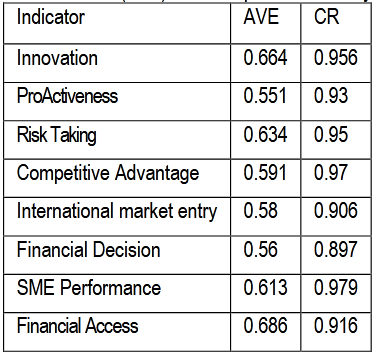
Based on the AVE values, the recommended AVE value is above 0.5 (Mahfud and Ratmono, 2013). All AVE values> 0.5 mean that they are valid. Based on CR values, the recommended CR value is above 0.7 (Mahfud and Ratmono, 2013). All CR values> 0.7 mean that they are reliable.
To evaluate the relationship between variables, hypothesis testing must be performed on the path coefficient between variables. The testing of this hypothesis is intended to prove the truth of the alleged previous research and to test the direct and indirect effects (see Table 2).
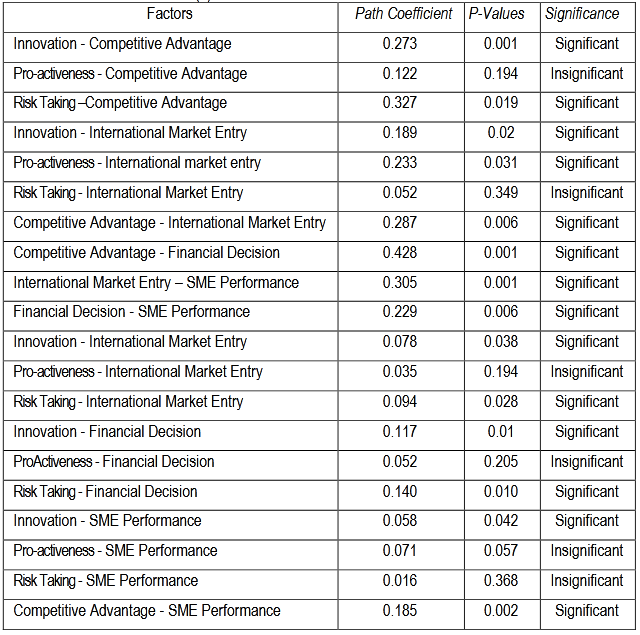
Table 2 indicates that innovation and risk-taking positively and significantly affect competitive advantages. Pro-activeness positively and insignificantly affects competitive advantages. Innovation and pro-activeness positively and significantly affect international market entry. Risk-taking positively and insignificantly affects international market entry. Competitive advantages positively and significantly affect international market entry and financial decisions. International market entry and financial decisions positively and significantly affect SME performance.
Indirectly, innovation positively and significantly affects international market entry through competitive advantages. Pro-activeness positively and insignificantly affects international market entry through competitive advantages. Risk-taking positively and significantly affects international market entry through competitive advantages. Innovationpositively and significantly affects financial decisions through competitive advantages. Pro-activeness positively and insignificantly affects financial decisions through competitive advantages. Risk- taking positively and significantly affects financial decisions through competitive advantages. Innovation positively and significantly affects SME performance through the international market entry. Pro-activenesspositivelyandinsignificantly affects SME performance through the international market entry. Risk-taking positivelyandinsignificantly affects SME performance through the international market entry. Competitive advantages positively and significantly affect SME performance through financial access.
DISCUSSION
This research indicates that several entrepreneurial orientation factors are important in influencing proactive companies to anticipate changes in needs in the market. Entrepreneurial orientation includes innovation, proactivity, and organizational risk-taking tendencies (Yamin: 2020, pp. 313-326; Wiklund & Dean: 2005, pp. 71-91). This is in line with the research findings of (Du et al.: 2018, pp. 1583-1595), indicating that manufacturing companies in different industries show that customers are much involved in developing new products for company integration that will have an impact on customers. Besides, customers need to have an impact on fewer profits and a decrease in overall market share. Therefore, this result is in line with (Swink & Song: 2007, pp. 203-217).
Innovation has a positive and significant correlation with competitive advantages and international market entry. This is proven by the company's ability to produce innovative products to reach a larger market. Companies that have innovative product creativity can outperform competitors so that they have a competitive advantage. A competitive advantage is achieved by having unique products, competitive product prices, and inimitable products. SME entrepreneurs can implement business strategies by producing more unique, attractive, and value-added handicraft products to enter the export market to increase competitive advantage. This result is in line with Bhegawati & Yuliastuti (2019).
The international market entry shows a significant positive correlation with SME performance. Several studies stated that to minimize weaknesses in the internationalization process, the government and communities can mediate to connect SMEs and potential buyers in the international market (Alikhanov & Khudiyev: 2020, pp. 620-626). Competitive advantages are not only beneficial for business owners but also for improving knowledge, special skills, and resources for SMEs. A strategy in entering the international market is used by companies to increase company values (Zeebaree & Siron.: 2017, pp. 43-52). In the future, the important role of business organizations in comprehensive economic growth can be carried out from a cultural perspective and national network. This result is in line with Gitau et al. (2016). Therefore, according to the previous research, the government’s support for financial access is to improve the competitiveness of SMEs in Indonesia (Agyapong: 2010, pp. 196-205).
From the above discussions, with entrepreneurial orientation, the ability of SMEs to identify the opportunities is about being able to take advantage of areas, which often become their main market for the number of entrepreneurs in the context of their private businesses. By considering additional factors in internal systems such as networking systems/partnerships, as well as external factors such as economic change, consumer preference, and competitive intensity, a more comprehensive understanding can be achieved. SMEs with entrepreneurial orientation can gain more insight by exploring regulations, program support, training, and infrastructure from financial access. Then, these internal and external considerations depend on further analysis, such as the specific organizational contexts(e.g.company size, age, and owned industry). (Brettel et al.: 2015, pp. 868-885)
CONCLUSION
This study shows that the relationship between entrepreneurial orientation, financial access, competitive advantage, and international market entry is in line with the previous research. Therefore, companies need to increase domestic and international sales, both among producers or between producers and the community.
Besides, they also need to increase consumer protection, improve fair business competition, and be more innovative. This study also indicates that competitive advantages in North Sumatra significantly affect international market entry. This is to explain that the more SME entrepreneurs explore the international market, the more competitive advantages of their business will increase.
This study suggests that SMEs in North Sumatra, Semarang, and Bandung should run their business by using innovation and proactivity and should take risks outperforming in the international market. So, they can achieve optimal results, improve performance, and have high competitiveness, especially to face the Asean Economic Community.
ACKNOWLEDGMENT
This research entitled “Change of Creative Business Environment to Competitive Advantage and International Market Entry” is supported by the University of North Sumatra, which provides TALENTA funding in 2019. It is a great fortune to work with lecturers from Diponegoro University and Padjajaran University through collaborative research.
BIODATA
I. SADALIA: Isfenti Sadalia as a professor at Economics and Business Faculty, the University of North Sumatra. Her research interests include Financial management, investment management, entrepreneurship, islamic banking, and behavioral finance.
H. MUHARAM: Harjum Muharam is a lecturer of Management at the Faculty of Economics and Business, Diponegoro University, Indonesia. His research interests include Financial Market Integration, Indonesia Government Bond, Islamic Finance, Islamic Capital Market, and Financial Risk Management.
A. MULYANA: Asep Mulyana is a senior lecturer at the Management and Business Department, Padjajaran University. His research interests include entrepreneurship, small and medium enterprise management, and consumer behavior.
BIBLIOGRAPHY
ABIDIN, N, Z, ADROS, N, A & HASSAN, H (2014). “Competitive strategy and performance of quantity surveyingfirms in Malaysia.” Journal of Construction in Developing Countries, 19(2), pp. 15– 32.
AGYAPONG, D (2010), “Micro, small and medium enterprises activities, income level and poverty reduction in Ghana -A synthesis of related literature”. International Journal of Business and Management, 5(12), pp. 196- 205.
ALIKHANOV, A & KHUDIYEV, N (2020). “Testing of fdi and non-oil fdi inflows in azerbaijan using dunning'seclectic model”. Economic and Social Development: Book of Proceedings, 3, pp. 620-626.
BHEGAWATI, D, A, S & YULIASTUTI, I, A, N (2019). “Effect of product innovation and entrepreneurial orientation on competitive advantage in the coconut shell craft industry in karangasem regency”. Jurnal Ilmiah Manajemen dan Bisnis, 4(1), pp. 71-89.
BRETTEL, M, CHOMIK, C & FLATTEN, T, C (2015). “How Organisational culture influences innovativeness, proactiveness, and risk-taking: fostering entrepreneurial orientation in smes”. Journal of Small Business Management. 53(4), pp. 868-885.
CALIC, G & SHEVCHENKO, A (2020). “How signal intensity of behavioral orientations affects crowdfunding performance: The role of entrepreneurial orientation in crowdfunding business ventures”. Journal of Business Research, 115, pp. 204-220.
DU, L, ZHANG, Z & FENG, T (2018). “Linking green customer and supplier integration with green innovationperformance: The role of internal integration”. Business Strategy and the Environment, 27(8), pp. 1583-1595.
HENDIJANI, R & SAEI, R, S (2020). “Supply chain integration and firm performance: the moderating role ofdemand uncertainty”. Cogent Business & Management, 7(1), pp. 176-197.
NAKKU, V, B, AGBOLA, F, W, MILES, M, P & MAHMOOD, A (2020). “The interrelationship between SME government support programs, entrepreneurial orientation, and performance: A developing economy perspective”. Journal of Small Business Management, 58(1), pp. 2-31.
OMBI, N, AMBAD, S, N, A, & BUJANG, I (2018). “The effect of business development services on small medium enterprises (SMEs) performance”. International Journal of Academic Research in Business and Social Sciences, 8(3), pp. 117-130.
PELHAM, ALFRED M, & DAVID T, WILSON (1996). “A Longitudinal Study of the Impact of Market Structure, Firm Structure, Strategy, and Market Orientation Culture on Dimensions of SmallFirm Perfomance”, Journal of the Academy of Marketing Science, 24, pp. 27-43.
PORTER, M, E (2011). “Competitive advantage of nations: creating and sustaining superior performance”.Simon And Schuster. 2(202), pp. 96-120.
REZAZADEH, A & NOBARI, N (2018). “Antecedents and consequences of cooperative entrepreneurship: A conceptual model and empirical investigation”. International Entrepreneurship and Management Journal, 14(2), pp. 479-507.
SEMRAU, T, AMBOS, T, KRAUS, S (2016). “Entrepreneurial orientation and sme performance across societalcultures: an international study”. Journal of Business Research. 69(50), pp. 1928-1932.
SOUTHISENG, N & WALSH, J (2010). “Competition and management issues of SME entrepreneurs in Laos: Evidence from empirical studies in vientiane municipality, Savannakhet and Luang Prabang”. Asian Journal of Business Management, 2(3), pp. 57-72.
SWINK, M & SONG, M (2007).”Effects of marketing manufacturing integration on new product developmenttime and competitive advantage”. Journal of Operations Management, 25, pp. 203-217.
WIKLUND, J & DEAN, S (2005). “Entrepreneurial orientation and small business performance: a configurationalapproach”. Journal of Business Venturing. 20(1), pp. 71-91.
WOODCOCK, C, P, BEAMISH, P, W & MAKINO, S (1994). “Ownership-based entry mode strategies andinternational performance”. Journal of International Business Studies, 25(2), pp. 253-273.
YAMIN, M (2020). “Examining the role of transformational leadership and entrepreneurial orientation on employee retention with moderating role of competitive advantage”. Management Science Letters, 10(2), pp. 313-326.
ZEEBAREE, M, R & SIRON, R, B (2017).”The Impact of entrepreneurial orientation on competitive advantage moderated by financing support in smes”. International Review of Management and Marketing, 7(1), pp. 43-52.