Artículos
Attitudes toward women´s leadership: Development and validation of a new scale in the Saudi society
Actitudes hacia el liderazgo de la mujer: desarrollo y validación de una nueva escala en la sociedad saudita
 E. A ALZEIBY eaalzoaby@pnu.edu.sa
Attitudes toward women´s leadership: Development and validation of a new scale in the Saudi society
Utopía y Praxis Latinoamericana, vol. 26, núm. Esp.3, pp. 60-75, 2021
Universidad del Zulia
Recepción: 26 Abril 2021
Aprobación: 30 Mayo 2021
Abstract: The research sample consisted of (1000) male and female members of the administrative and educational staff and female students at Princess Nourah bint Abdulrahman University (PNU) in Riyadh, Kingdom of Saudi Arabia. The descriptive approach was used. When calculating Pearson’s correlation coefficient, it was found that all Paragraphs correlation values with the total score of the tool are statistically significant and with a high to a very high degree. According to Cronbach’s Alpha reliability, the results confirmed that the study tool has a high degree of reliability in its various dimensions.
Keywords: Attitudes, women’s leadership, developing, validation, saudi society.
Resumen: La muestra de investigación está compuesta por (1000) miembros masculinos y femeninos del personal administrativo y educativo, además de estudiantes femeninas de la Universidad Princess Nourah bint Abdulrahman (PNU) en Riyadh, Reino de Arabia Saudita. Se utilizó el enfoque descriptivo. Al calcular el coeficiente de correlación de Pearson, se encontró que todos los valores de correlación de los párrafos con la puntuación total de la herramienta son estadísticamente significativos y con un grado de alto a muy alto. Según la fiabilidad Alpha de Cronbach, los resultados confirmaron que la herramienta de estudio en sus diversas dimensiones tiene un alto grado de fiabilidad.
Palabras clave: Actitudes, liderazgo femenino, desarrollo, validación, sociedad saudita.
INTRODUCTION
The quantitative and qualitative changes in different areas of life have had significant impacts on Saudi society as individuals or groups in updating the personal and constructive perception of society. Women's issues have had a focus, whether as part of the causes or consequences of those changes. Though women’s leadership has become an increasingly common issue in recent years, female leaders remain significantly underrepresented in industries worldwide. Still, men are much more likely than women to be leaders. (Al Karim: 2020, pp. 426-455). However, gender stereotyping has a complex role in shaping the relationship between women and leadership, even though women constitute the majority of university enrollees and graduates in the current time (Cheung & Hlpern: 2010, p. 182)
Regardless of the high levels of academic preparedness and the high rates of Saudi women enrolling in higher/postgraduate education, which had a qualitative and quantitative impact on women's workforce, thisupward thrust stays horizontal and does not rise vertically similarly. Saudi Arabia is still an example of a country with a low level of female labor force participation, with an average of less than (15%) of the Saudi female population (Burztun et al.:2020). Thus, we cannot ignore the benefit of educated women in building a sustainable economic future for the kingdom; therefore, it is important to address the hidden gender discrimination that is rooted within societal and organizational contexts in relation to recruiting and selecting individuals for leadership positions (Bursztyn et al.: 2020, pp. 2997-3029).
Thus, women in leadership positions are still under the gender theory trap. The analyst of this theory in explaining the bias toward female leaders finds that it includes two descriptive and hypothetical aspects of these gender roles, and two types of obstacles facing women follow this analysis. The first bias is resulting from the descriptive aspect of the gender role of women includes the perception that women have fewer leadership capabilities than men in the field. Stereotyping connected to genders has negative employment implications and blocks women’s advancement in recruitments (Elamin & Omair: 2010, pp. 746-766).
The second bias is resulting from the hypothetical aspect of the gender role of women, which implies thata woman’s behavior as a leader is evaluated less favorably than a man because it violates her gender role asa female when she performs the leadership behavior. Rather, her leadership chances become less becauseof conflicting expectations of the role (Al‐Yateem et al.: 2020, pp. 17-23).
The impact of that gender discrimination is evident from one country to another and from one job toanother. There are social, cultural, and institutional differences that affect the number of women in leadership. The report published by the International Labour Organization showed an increase in the number of female managers in mid-level and senior management positions in the last two decades. The report showed the average rate of female managers in 108 countries; Saudi Arabia ranked 103rd with (7.1%) score. (Kutlu & Akbulul: 2020, pp. 1-9).
Women face greater barriers and rely on different strategies for development than males. Data regarding women's academic leadership in Saudi Arabia are conflicting. However, a study by Al-Tamimi reported that they do not progress well in academia for reasons such as family responsibilities. Therefore, research on female leadership has become an important field of study and focuses on answering the following questions: Can women be leaders in their field? Why do few women hold leadership positions in top management? Is the role of male and female managerial leaders different in the organization? Researchers often assume that women's characteristics and behavior are "inappropriate" for leadership positions. On the contrary, women - despite their consistency with their social upbringing, have given more significance to their non-public / circle of relatives existence than their professional lifestyles compared to the price in their task (Al-Moamary et al.: 2020, pp. 99-104).
Therefore, we find researchers have focused on addressing the obstacles and barriers that prevent the development of women in the field of leadership. The most important barriers are expressed in artificial or invisible barriers that prevent the development of women within the institution. It is clear that ceilings and walls exist in most workplaces, such as the structure of the female professional mentality, personal stereotypes together with socially determined and gender stereotypes, have a complex impact on unlocking the female employment potential and play a role in impeding ladies' professional development (Busygina et al.: 2019, pp. 1143-1147).
Rather, the female herself contributes to the impact of this glass ceiling through her attitudes and mindset in the attitudes of her counterpart, the female in a leadership position, as these women have expressed their belief in the ability of women to succeed in leadership. Still, they're not willing to work underneath a woman's leadership, which performs a role in limiting the development of women in leadership positions(Buchanan et al.: 2012, pp. 33-46). Society no longer accepts the truth that women the skills and competencies required to work in a leadership or management position, which negatively affects their ability to develop in managerial jobs (Gupta et al.: 2020, pp. 1-17).
Much like these invisible glass ceilings that obstruct women's development in leadership, attitudes are forming non-material hypothetical formations that are inferred through the impact they leave. And due to the fact, these attitudes determine the behavior and explain it. They’re evident inside the man or woman, behavior,words, actions, and interaction of a person with others in line with the prevailing culture in his/her society and facilitate his selection-making in exclusive psychological conditions. Due to the fact, that psychological attitudes represents a is a driving force for the individual either with the support of these environmental stimuli to which she is exposed as a result of the situations she experiences and thus serves as a reference to her relative stability, (PATEL et al.: 2018, p. 98).
LITERATURE REVIEW
The problem of the study
By reviewing the reality of attitudes towards female leadership scales at some stage in records, we find that there are four scales that were all designed in the Nineteen seventies of the remaining century to assess attitudes towards women in managerial roles. The WAMS is one of the most broadly used of these scales. Notwithstanding this prevalence of this scale, it suffers from few issues related to the psychometric properties: the sample that was implemented when constructing it, which was(undergraduate students). This raises concerns about the appropriateness of its application in the actual work environment. Studies also confirmed that (WAMS) scale differed in terms of the degree of validity and reliability according to the research sample. It became more reliable for managers than students and females more than males (Crino et al.:1981, pp. 866- 876). It was also noted that the validity of WAMS was affected by the gender factor and the change of subculture to which it was applied (Cordano et al.: 2003, pp. 141-143).
Furthermore, among the observations that the scale suffers from is associated with the veracity of the content of the phrases that it contains. We find that some of the phrases do not directly relate to women in leadership roles but rather to women's work in general. Other phrases are related to the general gender roles and women's competencies and do not include women's strengths in the leadership position and their capabilities. Besides what we mentioned, we cannot forget the fact that the scale is old, and there are changing conditions that surrounded its construction regarding the work of women leaders in the seventies of theultimate century(Aycan et al.: 2012, pp. 426-455; Cordano et al.: 2002, pp. 51-60).
Furthermore, to the WAMS scale, the ATWAM scale became observed to measure attitudes toward women in leadership and MATWES scale of managerial attitudes toward women. Both were used to measure attitudes toward women in leadership positions. However, these two scales suffer from a few problems related to construction and psychometric properties, and that they were not of the same prevalence as the (WAMS) scale. For ATWAM, its stability was examined on a small sample, and it also forces the difficulty to choose between specific alternatives. As for the (MATWES) scale, it was constructed to measure male attitudes only towards female leadership, and the sample was students, as is the case of (WAMS) scale. The age of these two measures is not considered a strength considering the changing perceptions and abilities women have acquired in the leadership position over 25 years. The fourth scale is the SDI-Scheil's Descriptive Index (SDI) which does not directly measure the attitudes towards women as a leader but rather focuses on the similarity in traits, in addition to the fact that it was applied to a very small sample of students (24) male and female students (Busse & Poell: 2020, pp. 180-204).
Despite these standards, they are still widely used in the current studies. The WAMS scale -which was the most popular in the past, is also still the most common use among the four scales in recent studies and in many societies, as in the study, which sought to define stereotypical perceptions of women as managers between men and women in three countries, namely the United States of America, China, and Chile. The study was applied to a sample of (636) male and female students. The results revealed more positive perceptions of women as managers among American and Chilean men than Chinese men.
In another study that aimed to highlight the need to support women in the main employment in Ghana and in leadership, employees in the public sector showed a more positive attitude towards female managers than private-sector employees. Female employees and younger employees showed more positive attitudes towards female managers than male and elderly employees. The study sample consisted of (120) bothgenders employees of the public and private sectors(Arkoful & Agyemang: 2014, pp. 241-253).
In the study that aimed to assess the attitudes towards women managers in Pakistan, the study revealed that there is a disparity in the attitudes towards female managers with some personal factors such as gender, age, education, religious orientation, and some organizational factors such as organizational ownership, the nationality of the organization, and the sector. The study was applied to a sample of male and female employees in the banking, education, and communications sectors, whose number reached (218) individuals. (Batool & Tahir: 2015, p. 10(4))
Furthermore, a recent study between the United States of America and the Netherlands in which the (WAMS) scale was used revealed more positive attitudes towards women as managers than men in the two countries. The study results concluded the impact of gender and the local culture of society on individual attitudes towards women as leaders. The sample of the study consisted of (166) male and female students from the Administration Department (Chullen et al.: 2017, pp. 24-42).
As for the MATWES scale, it has been used in recent studies as well, and in different societies, as in the study whose, results in showing that there are significant differences as each of the women and men in Turkey have a negative attitude towards female managers compared to their Pakistani counterparts. Women's attitudes towards managers in Turkey were more negative than men's, unlike Pakistani women who showed positive attitudes more than Turkish women towards female managers. The last result of this study showed that Pakistani men had shown more positive attitudes towards female managers than Turkish men. The sample of the study consisted of (219) members of the university staff of various degrees from both countries(Güney et al.: 2006, pp. 194-211).
Among the attitudes towards women as a manager or leader scales which were constructed recently in different societies, we find the (ATWoM) scale in the study of (Aycan et al.:2012, pp. 426-455). It was constructed from (27) phrases in (14) negative phrases and (13) positive phrases. The response on the scale was according to the Likert scale of seven. Higher scores on the scale indicate positive attitudes towards women as a leader. The study sample were (456) Turkish employees of both genders in (23) organizations and (312) students of both genders. The psychometric properties of the scale were compared to those of (WAMS) scale, the Cronbach’s alpha coefficient reached (0.91) for the employee sample, and (0.90) for the student sample compared to (0.89) and (0.81) respectively when applying the (WAMS) scale to the same sample.
Statement on Preceding Studies:
Through the review of previous studies, we found –to the best of the researcher's knowledge- that there is infancy in psychological scales that are related to attitudes towards women’s leadership as it is shown in the last point that most of these available scales focused on measuring the attitudes towards women’s various skills which reflects their ability to take on leadership work or focused on women in general. In addition to that, some scales were directed towards jobs, such as supervisory jobs or in the government sector, which may have characteristics and nature that do not apply to leadership roles and other work environments. It is also noted that most of these scales are for western communities and designed a long time ago, along with the notes that were mentioned above in terms of the size and type of the sample. Anyhow, despite that, there is a widespread development and use of such scales, which gives an indication of the need to develop modernscales that meet the Arabic libraries' need of attitudes towards women’s leadership scales with acceptable psychometric properties, and that might face the dissatisfaction of other scales were some of them do not adequately assess contemporary issues in women leadership.
The problem of the current study can be determined in the main question:
What are the psychometric characteristics in attitudes towards women’s leadership scale?
This includes answering the following questions:
- 1. What is the validity coefficients of the attitudes towards women’s leadership scale?
- 2. What is the reliability coefficients of the attitudes towards women’s leadership scale?
- 3. What is the type of attitude towards women’s leadership (negative or positive) for members ofSaudi society of both genders?
- 4. Are there statistically significant differences in the averages of the attitudes towards women’sImportar listaleadership due to the variable of genders?
Objectives of the Study:
- 1. Designing a scale to measure individuals' attitudes towards women’s leadership.
- 2. Verify the psychometric properties of the scale.
- 3. Determine the type of attitude towards women’s leadership (negative or positive) for members of the Saudi society of both genders.
- 4. Identify the statistical differences in individuals’ attitudes towards women’s leadership according toImportar listathe gender variable.
The Importance of the Study:
The importance of the current study is due to:
- 1. Designing a codified Arab tool to reveal attitudes towards women’s leadership in the Saudi society to support decision-makers in the leadership field in general and in the academic leadership field by providing quantitative indicators of the current situation and aspects of improvement.
- 2. Meet the academic research need for studies concerned with scales that contribute to improving practices according to the psychometric characteristics of constructing scale tools by identifying the component dimensions of the attitude towards women’s leadership and the degree of their connection with each other.
- 3. Reveal the type of attitude towards women’s leadership and its degree in Saudi society institutions ingeneral in terms of agreement and disagreement.
- 4. Reveal the influence of the gender factor as one of the demographic characteristics that influence theImportar listaformation of attitudes towards women’s leadership.
METHODOLOGY
The researcher used the descriptive method in the style of survey studies due to its relevance to the nature of this study. This methodology seeks to find correlation coefficients based on the data obtained from the current study that was used in the survey and the correlational relationships to solve the research problem.
The Study Population:
The study population consisted of all academic staff, administrative staff, and female students in the Saudi community at the end of the second semester for the academic year (2018-2019).
The Study Sample:
The total study sample consisted of (1000) participants from the academic staff and the administrative staff and a sample of PNU students chosen randomly from the study population. After completing the survey, the results of the data collection reached (916) male and female participants. (Table 1) shows the distribution of the study sample according to gender and nature of work.

Study Tool
Due to the lack of a scale in this area in Saudi society -to the best of the researcher's knowledge- women in a leadership position. Thus, this study constructed a scale to achieve the objectives of the study by reviewing the Arab global and overseas, and being familiar with the scales which have been addressed in distinctive, a scale was designed to measure attitudes woman as a leader, and the researcher undertook the following steps in developing it to be suitable for the characteristics of the observed population and meet the requirements for clinical standards.
- 1. Define the meaning of attitudes towards women’s leadership.
- 2.
Figuring out the dimensions of attitudes towards women’s leadership scale (ATWLS) and formulate the dimensions’ paragraphs.
The following become taken under consideration in paragraphs formation:
• The content of the paragraph should be clear and direct.
• The paragraph should be short.
• The paragraph expresses the study topic and does not endure more than one meaning.
- 3. Measuring method: Likert’s approach was adapted in constructing the scale as it is easy for construction and correction, and the degrees of the scale are highly reliable. The scale’s paragraphs were constructed in positive and negative directions according to the five-points scale, and the paragraph’s weights were given as follows: (Strongly agree: Five degrees, agree: Four degrees, sometimes: Three degrees, disagree: two degrees, strongly disagree: one degree).
So, each of these dimensions consists of a number of paragraphs that explain the individuals' attitudes towards it. The scale also included a number of positive paragraphs and a number of negative phrases regarding the attitudes towards female leadership.
+Correction of the scale / its negative and positive phrases/calculation of its total score
Each paragraph of the scale has (5) responses, which are (strongly agree, agree, sometimes, disagree, strongly disagree). The participants must choose what is commensurate with their attitude towards this phrase. The response (strongly disagree) gets one score, the response (disagree) gets two degrees, the response (sometimes) gets three degrees, the response (agree) gets 4 degrees, and the response (strongly agree) gets 5 degrees in the case of the (positive) paragraph such as Women in leadership work have the ability to make the right decisions.
On the other hand, (negative) paragraphs is the opposite, whereby the response (strongly agree) gets one score, the response (agree) gets two, the response (sometimes) gets 3 degrees, the response (disagree) gets four, and the response (strongly disagree) gets 5. An example of negative phrases: I agree with the opposite opinion regarding the presence of academic women in leadership work. This is shown in the below figure:
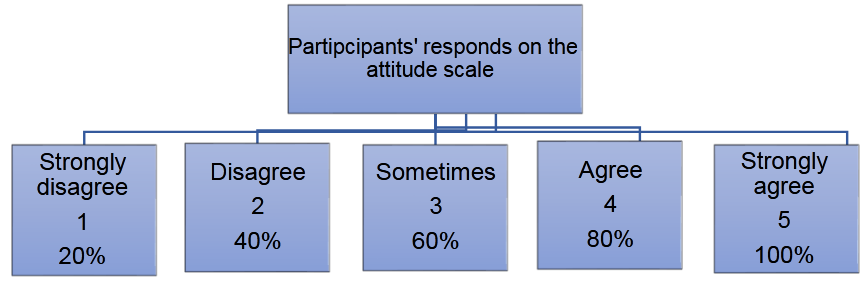
Figure (1). Ranks of the Attitudes towards Women’s Leadership Scale
- 1. Positive attitudes towards academic women’s leadership: this includes paragraphs that are characterized by supporting women’s leadership. It includes paragraphs for this direction (2-3-6- 8-12-14-15-17-18-21-23- 26-27-29-32-37).
- 2. Negative attitudes towards academic women’s leadership: this includes paragraphs that are characterized by disagreeing on women’s leadership. It includes paragraphs for this direction (1-4-5-7- 9- 10-11-13-16-19- 20-22- 24- 25-28-30-31-33-34-35-36-38-39 -40).
The last version of the scale consists of (40) phrases, distributed into (six) dimensions, each of which represents several paragraphs ranging between (5- 8) paragraphs. These dimensions are as follow:

Scale Grading
The researcher relied on the results’ interpretations of the (five-point Likert) method, which determines the degree of the respondents’ agreement or disagreement on the items of the scale. The score is determined by giving different weights for the responses to respond in a graded continuum way that includes five points. The paragraphs were either positive or negative, and weights were given to the paragraph as follows: (Stronglyagree: five degrees, agree: four degrees, sometimes: three degrees. disagree: two degrees. Strongly disagree: one degree). The participants must choose what is commensurate with their attitudes towards thisparagraph. On the other hand, (negative) paragraph is the opposite, whereby the response (strongly agree) gets one score, the response (agree) gets two, the response (sometimes) gets 3 degrees, the response (disagree) gets four, and the response (strongly disagree) gets 5. An example of the negative paragraph: I agree with the opposite opinion regarding the presence of academic women in leadership work.
In order to recognize the estimates of the sample and to determine (the attitudes towards women’s leadership) according to the value of the arithmetic average (the maximum of the minimum was calculated and divided by 3) (5 - 1 = 4), then it was divided by 3 to obtain the correct cell length (4 / 3 = 1.33), and then this value was added to the minimum value in the survey (or the beginning of the survey, which is the correct one) in order to determine the maximum of this cell, and thus the length of the cells became as follows:

Study Application Procedures
The researcher conducted the study procedure according to the following steps:
• Conducting an inventory of the study population, represented by the academic and administrative staff of both genders and students at Princess Nourah bint Abdulrahman University.
• Constructing a study scale after the researcher is acquainted with a set of tools used in such a study.
• The validity of the scale was verified by presenting it to seven arbitrators.
• Distributing the study’s scale to the study sample at the end of the second semester of the academicyear (2018-2019).
Statistical Treatment:
The data has been processed statistically by using descriptive statistics by extracting numbers, arithmetic means, standard deviations, and coefficient of variation of the participants and their responses on the scale. The study hypotheses were examined through the following statistical tests: (t-test), OneWay Analysis of Variance, and Tukey's range test. The reliability coefficient Cronbach’s alpha and the half segmentation factor were used to calculate the reliability of the instrument along with the Test-Retest method. The Pearson Correlation coefficient was used to ensure the validity of the scale in the computer by using the Statistical Packages for Social Sciences (SPSS) program.
RESULTS
The results of the first question: What are the validity parameters of the attitudes towards women’sleadership scale?
To answer the first question, the validity of the scale was calculated in two ways:
First: the content validity: to ensure the content validity, the researcher used the veracity of the arbitrators by presenting the scale in its initial form to (7) experienced and competent judges in order to ensure the validity of the tool for what it was prepared for, the validity of the paragraph’s grammar, the correct domain for each paragraph, and the suitability of the axes to the attitudes towards women's leadership scale.
Through the opinions and proposals of the referees, the indexes of the scale were preserved, while theparagraphs were asked for an amendment. This was agreed upon by (85%) of them. Some paragraphs were omitted based on the arbitrators’ suggestion because they are not suitable for measurement. Thus, the scale contains (40) paragraphs instead of (43).
Second: Construct Validity: The construct validity was verified by calculating a matrix of correlation between the paragraphs of the tool with the total degree of the study tool, as it is shown in Table (4), which showed that all the values of the correlation coefficients for the paragraphs with the total degree for each dimension in the tool are statistically significant, which indicates the validity of the construction of the tool's paragraph and that can be added to the attitudes towards women's leadership scales. Furthermore, the correlation coefficient between the degrees of the scale dimensions with the total degree and the dimensions with each other were calculated in Table (4).

The data in Table (4) indicated that all the values of the paragraphs’ correlation with the overall score of the tool are statistically significant and have a high to a very high degree, which indicates the construction validity of the paragraphs of the tool. Not only that, but this scale can be one of the attitudes towards women leadership scales from the point of view of the academic staff, the administrative staff, and students at Princess Nourah bint Abdulrahman. The correlation coefficient between the degrees of the scale dimensions with the total degree and the dimensions with each other is shown in table (5).

The data in Table (6) indicate that all the values of the correlation between the degrees of the scale dimensions with the total degree and the dimensions with each other are statistically significant and positively high to a very high degree, which indicates the construction validity of the tool’s dimensions and this scale can be one of the attitudes towards female academic leadership scales from the point of view of the academic staff, the administrative staff and students at PNU. By observing these coefficients, we find that they ranged between (0.886) and (0.457), which are statistically significant. This indicates that the dimensions of the scale (six) are consistent with each other and with the total degree.

The data in Table (7) indicate that the study tool, with its various dimensions, has a high degree of reliability by using the (split-half) method. The degrees of reliability on the axes ranged between (63%) and (90%), which is a high degree of reliability. As for the total score, the reliability value reached (94%), which is a very high degree of reliability.
• Third: The Cronbach’s Alpha method: The researcher calculated the reliability of the overall score and all the dimensions score of the attitudes towards academic female leadership scale. The reliability of the study tool with its different dimensions was calculated by using Cronbach’s Alpha reliability. The results are shown in Table (7).Importar lista

The data presented in table (8) indicate that the study tool -with its various dimensions- has a high degree of reliability, as the degrees of reliability on the scale axes ranged between (69%) and (90%), which is a high degree of reliability. As for the total score, the reliability value reached (95%) expressing a very high degree of reliability.

It is evident from the previous table that the degree of the attitudes towards women’s leadership was average, as the arithmetic mean of the total score of the study sample was (3.30) and a standard deviation of (0.61). The results also show that the degree of difference (uncertainty) reached (0.18), and this indicates a high degree of certainty and confidence of the respondents' in their answers, i.e., a small degree of difference, as a result of the decrease in the coefficient of variation for these dimensions over the overall score. The results also show that the dimension of a woman's ability to do leadership work came in the first place with a high degree with an arithmetic mean of (3.89) and a standard deviation of (0.64) and a coefficient of variation of (0.22) expressing a high degree of certainty. Leadership works came in the second place with a high degree as well, with an arithmetic average of (3.76), a standard deviation of (0.73), and a different coefficient of (0.19) expressing a high degree of certainty, while the dimension of women's leadership style came third in a medium degree with an arithmetic average of (3.24) and a deviation A standard of (0.61) and a variation coefficient of (0.19) expressing a high degree of certainty. The fourth place was for the dimension of gender differences in leadership work with a medium degree with an arithmetic mean of (3.03) and a standard deviation of (0.73) and a variation factor of (0.24), expressing a high degree of certainty. Refusing of women to take up leadership work came in the fifth place with a medium degree with an arithmetic mean of (2.98) and a standard deviation of (0.64) and a different coefficient of (0.22), expressing a high degree of certainty, while the sixth place was for the woman’s physiological characteristics with a medium degree, and an arithmetic means of (2.90), a standard deviation of (0.84), and a coefficient of variation of (0.24) expressing a high degree of certainty. The results also show that the coefficient of variation ranged between (0.50) and (0.20) on all paragraphs. This indicates a high degree of certainty and confidence of the participants in their answers, i.e., a small degree of difference due to the low coefficient of variation for these dimensions on all paragraphs.
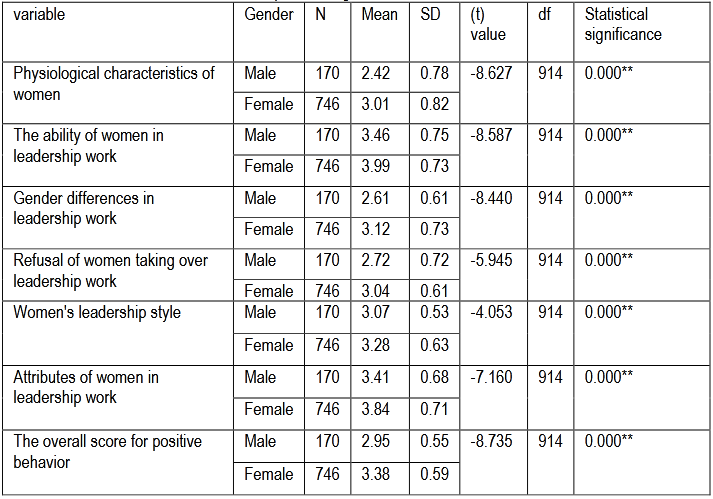
It appears from table (9) that there are statistically significant differences in the averages of the attitudes towards women's leadership according to the gender variable in favor of females on the overall score of the attitude towards women’s leadership and other dimensions. The arithmetic mean on the total score for males was (2.95), while females’ arithmetic mean is (3.38). The (t) value is (-8.735) at the level of significance (0.000). Accordingly, the first null hypothesis was rejected on the total score and other dimensions.
DISCUSSION
The new scale designed in this study aimed to overcome the problems in previous scales. (ATWLS) has several strengths. First, items directly tapped the attitudes toward women in leadership positions. Therefore, the means were content valid. All items had normal distributing and high item-total correlations. Items were written in short paragraphs with clear wording to make them easier to understand and respond to. Each item presents a single attitude statement. Second, the results indicated that (ATWLS) is a reliable and valid scale that can be used in future research and in applied settings. When calculating Pearson’s correlation coefficient, it was found that all Paragraphs correlation values with the total score of the tool are statistically significant and with a high to a very high degree. According to Cronbach’s Alpha reliability, the results confirmed that the study tool in its various dimensions has a high degree of reliability.
The study revealed that in Saudi Arabia, both males and females showed a positive picture andperceptions toward attitude toward women in a leadership position with an average degree (M=3.30, S.D=0.61). The results on the dimensions of (ATWLS) indicated a high acceptance of women's ability to do leadership work which came in the first place with a high degree (M=3.89, S.D=0.64). To further investigate that weather attitude towards women in leadership positions differ based on demographic variables such as gender, results indicate that women favored their fellow women in leadership positions (M=3.38, S.D=0.59) compare to male (M=2.95, S.D=0.55), indicating statically significant differences in the averages of the attitude toward women in academic leadership positions according to gender. This outcome can be explained according to the social identity theory that it helps women to maintain their in-group identity. Social identity will argue favorability toward women serving in managerial positions by women themselves, which has been proved by the results of this study.
CONCLUSION
Women in Saudi Arabia encounter familial, cultural, and organizational barriers in their career path, which might preclude them from achieving and occupying leadership positions. Despite these barriers, women might face attitudinal problems. This study was initiated to develop an up-to-date, reliable, and valid scale of attitude toward women leadership (ATWLS). For that purpose, a sample of (1000) male and female participants completed the scale developed by the researcher. The findings of the study highlighted the reliability and validity of the new scale designed to overcome the problems of previous scales. The findings as well highlighted the critical role that gender plays in the formation of attitudes toward women in a leadership position. It revealed an average degree toward women in the leadership position for both genders with significant differences according to gender variable in favor of female on the overall score and other dimensions.
As with other research, this study has certain limitations. First, the results of the study cannot be generalized to other countries and cultures. Second, the study intended to develop and maintain only attitudes but not real behaviors toward women in academic leadership positions. The question related to whether the behavior is affected by these attitudes or not? It needs to be investigated in real-life conditions and not only in the university and in different social sectors as well.
ACKNOWLEDGMENT
This research was funded by the Deanship of Scientific Research at Princess Nourah bint Abdulrahman University through the Fast-track Research Funding Program.
BIODATA
E. A. ALZEIBY: Ebtesam A.Alzeiby (PhD) is currently an associate professor in Psychology Department, College of Education, Princess Nourah bint Abdulrahman University, Saudi Arabia. Her research interests include well-being, cyberpsychology, and psychological measures. Her research has appeared in the International Journal of Therapy and Rehabilitation (2019), Child Care in Practice (2018) and Technological Forecasting & Social Change (2021)
BIBLIOGRAPHY
AL KARIM, R (2020). “Muslim women and centered leadership practices”. European Journal of Work and Organizational Psychology, 21(3), pp. 426-455.
AL-MOAMARY, M, S, AL-KADRI, H, M, AL-MOAMARY, S, M, & TAMIM, H, M (2020). “The leadership authenticityof women in the academic setting”. Health Professions Education, 6(1), pp. 99-104.
AL‐YATEEM, N, ALMARZOUQI, A, DIAS, J, SAIFAN, A, & TIMMINS, F (2020). “Nursing in the united arabemirates: current challenges and opportunities”. Journal of Nursing Management, 1, pp. 17-23.
ARKOFUL, H, K, DOE, F, & AGYEMANG, C, B (2014). “Attitude of private and public sector employees towards female managers in ghana”. International Journal of Human Resource Studies, 4(3), pp. 241-253.
AYCAN, Z, BAYAZIT, M, BERKMAN, Y, & BOratav, H, B (2012). "Attitudes towards women managers: development and validation of a new measure with turkish samples”. European Journal of Work and Organizational Psychology, 21(3), pp. 426-455.
BATOOL, S, & TAHIR, M (2015). "Attitude towards female manager in pakistan, evidence from banking, education,and telecom sector”. Dialogue (Pakistan), p. 10(4).
BUCHANAN, F, R, WARNING, R, L, & TETT, R, P (2012). “Trouble at the top: women who don’t want to work for a female boss”. Journal of Business Diversity, 12(1), pp. 33-46.
BURSZTYN, L, GONZÁLEZ, A, L, & YANAGIZAWA-DROTT, D (2020). “Misperceived social norms: womenworking outside the home in saudi arabia”. American Economic Review, 110(10), pp. 2997-3029.
BUSSE, R, & POELL, N (2020). “Sex role stereotyping revisited–the case of german future managers”. Women's Studies, 49(2), pp. 180-204.
BUSYGINA, A, L, DENISOVA, O, P, SHTRIKOVA, D, B, KRAVCHENKO, O, D, & KUZMENKO, V, I (2019).“Barriers in professional development of women”. Humanities & Social Sciences Reviews, 7(4), pp. 1143- 1147.
CHEUNG, F, M, & HALPERN, D, F (2010). "Women at the top: powerful leaders define success as work+family in a culture of gender”. American Psychologist, 65(3), p. 182.
CHULLEN, C, L, ADEYEMI-BELLO, T, & VERMEULEN, E (2017). “A comparative analysis of attitudes towards women as managers in the US and Netherlands”. Journal of Leadership, Accountability and Ethics, 14(2), pp. 24- 42.
CORDANO, M, SCHERER, R, F, & OWEN, C, L (2002). “Attitudes toward women as managers: sex versus culture”. Women in Management Review, 17(2), pp. 51-60.
CORDANO, M, SCHERER, R, F, & OWEN, C, L (2003). “Dimensionality of the women as managers scale: factor congruency among three samples”. The Journal of Social Psychology, 143(1), pp. 141-143.
CRINO, M, D, WHITE, M, D, & DESANCTIS, G, L (1981). “A comment on the dimensionality and reliability of thewomen as manager scale (wams)”. Academy of Management Journal, 24(4), pp. 866-876.
ELAMIN, A, M, & OMAIR, K (2010), "Males' attitudes towards working females in Saudi Arabia". Personnel Review, 39(6), pp. 746-766.
GÜNEY, S, GOHAR, R, AKINCI, S, K, & AKINCI, M, M (2006). “Attitudes toward women managers in Turkey and Pakistan”. Journal of International Women's Studies, 8(1), pp. 194-211.
GUPTA, A, BATRA, S, & GUPTA, V, K (2020). “Gender, culture, and implicit theories about entrepreneurs: a cross-national investigation”. Small Business Economics, 13, pp. 1-17.
KUTLU, G, & AKBULUT, Y (2018). "Attitudes towards female managers in hospitals: Case study of Turkey”.International Journal of Healthcare Management, 12, pp. 1-9.
PATEL, S, BACHU, R, ADIKEY, A, MALIK, M, & SHAH, M (2018). "Factors related to physician burnout and itsconsequences: a review”. Behavioral Sciences, 8(11), p. 98.