Carátula del artículo
Information system´s implementation on governance quality and its impact on university organization performance
Implementación de sistemas de información en la calidad de gobernanza y su impacto en el rendimiento de la organización universitaria
 U. HAYATI
University of Padjadjaran, Indonesia
S. MULYANI sri.mulyani@unpad.ac.id
University of Singaperbangsa Karawang, Indonesia
D.E. SUKARSA
University of Padjadjaran, Indonesia
S. WINARNINGSIH srihadi.winarningsih@unpad.ac.id
University of Padjadjaran, Indonesia
Utopía y Praxis Latinoamericana, vol. 26, núm. Esp.3, pp. 91-108, 2021
Universidad del Zulia
Recepción: 26 Abril 2021
Aprobación: 30 Mayo 2021
INTRODUCTION
University, as part of the national education system, has a strategic role in educating the nation and advancing science and technology while also applying humanity values of culture and the sustainable empowerment of the Indonesian people. Increasing the nation's competitiveness in facing the challenge of globalization in all fields requires higher education institutions that are able to develop science and technology. University is an education unit that organizes higher education (Pendidikan: 2013, pp. 1-3).
The number of universities registered among the top 500 in the world has been determined as an indicator of the performance of strategic objectives to measure the quality and level of competitiveness of Indonesian universities at the international level. It builds awareness of the importance of the ranking of Indonesian universities among world universities. In 2018, out of the four universities targeted to achieve this program performance indicator (IKP), only three universities succeeded in realizing it (Windarto et al.: 2018, pp. 411- 418).
At the national level, the accreditation assessment conducted by BAN-PT is an indicator of university performance. The latest 2019 data related to university accreditation shows that most universities in Indonesia still have accreditation C and B, while accreditation A was achieved by 96 universities or 4.2% of the total universities in Indonesia (BAN-PT, 2019). These data also show that the performance of universities in national-level assessment is not yet optimal.
In a smaller scope, universities in Indonesia are divided into 14 regions. Region IV (West Java, Banten) is the region with the highest number of accredited universities compared to the 13 other regions throughout Indonesia. However, region IV also has the most C-accredited universities compared to other regions. In terms of the distribution of universities in West Java, 17 universities are accredited A (14 West Java, 3 Banten), 129 are accredited B (101 West Java, 28 Banten), 219 are accredited C (173 West Java, 46 Banten).
Based on data from BAN-PT, in November 2019, the percentage distribution of universities on a nationalscale and West Java is dominated by universities accredited C and B. Universities with accreditation A on a national scale are 102 (4.45 %), and within West Java are 14 (4.86%). Meanwhile, universities with accreditation B nationally are 894 (39.02%), and in West Java, it is 101 (35.07%). Furthermore, universities with C accreditation nationally are 1,295 (56.53%), and in West Java, 173 (60.07%). These data indicate that the performance of universities on both the national and West Java scale is currently still not optimal even though universities play a significant role (Haroki et al.: 2019, pp. 108-115).
To ensure the achievement of strategic objectives, a concept of university governance implementation is considered to be ideal, known as Good University Governance (GUG). GUG can be realized with internal control in an organization because the entire process of activities aims to provide adequate confidence in achieving organizational goals through effective and efficient activities (Kapoh et al.: 2017, pp. 213-223).
The involvement of information systems is essential for universities to achieve Good University Governance. In terms of managing data on academic activity, it needs to be processed quickly and accurately (Aswati et al.; 2015, pp. 79-86). IT plays a vital role in various aspects, including research quality, teachingquality, innovation, facility, and internationalization. Another function of IT is to support teaching and learning activities using electronic learning methods or e-learning and facilitate access to learning materials (Ibda & Rahmadi: 2018, pp. 1-21).
The involvement of information technology in the world of education is no longer considered optional but has become a necessity that must be adopted by universities. The importance of using information technology in the globalization era is demanded to meet the increasing need to be competitive and provides many benefits in its application (Fachri et al.: 2018, pp. 19-34).
In their implementation, information systems and information technology in private universities have twogroups of problems, namely technical and non-technical (Murtadho & Wahid: 2016, pp. 17-21). The technical aspects related to the system itself, namely the quality of the technical information system. In contrast, the non-technical aspects are associated with the perceptions of users of an information system that cause them to accept or refuse to use an information system that has been developed.
The National Standards for university governance implementation, including education, research, and community service, are outlined in the Regulation of the Minister of Technology Research and Higher Education No. 44 of 2015. The establishment of this Standard guarantees the achievement of university goalsand provides guidance for universities to achieve high-quality education following established criteria, also can surpass these criteria gradually. Each university must fulfill the Standards as the basis for granting Higher Education establishment licenses to open study programs, the basis for the implementation of the Three Pillars of Higher Education (Tri Dharma Perguruan Tinggi), as well as the internal and external quality assurance systems. These Standards are evaluated and refined in a planned, directed, and sustainable manner, following the demands of local, national, and global changes.
LITERATURE REVIEW
Information System Implementation Success
According to Aswati et al. (2015), an information system is a system within an organization that compiles daily transaction processing in support of operational activities, as part of managerial behaviors and strategic activities, in order to provide reports in the form of activity information to related parties. The utilization of information systems in a university will be a factor in university success and progress. Many tasks can be carried out using information systems such as educational information systems that manage teaching and learning schedule data, lecturers, students, and student grades. The existence of an information system will also greatly facilitate the activities of the university related to data processing.
The success of an information system can be seen through the quality of the system, the information provided, the level of use, and satisfaction of use, as well as other aspects that indicate how much influence, is obtained by the existence of such an information system (Rahayu et al.: 2018, pp. 34-46).
In this study, the definition of the success of an information system, based on the literature (Aswati et al.; 2015, pp. 79-86; Dorothy et al.: 2014, pp. 209-222; Rahayu et al.: 2018, pp. 34-46; Sulindawaty: 2015, pp. 76-81) is that there is a significant influence from the application of the system in organizations in the form of interconnected components in collecting, processing, storing and distributing information that supports operational activities namely managerial (decision making) or supervisory. The dimensions for assessing an information system according to the updated D&M IS Success Model is system quality, information quality, service quality, user satisfaction, system use, and net benefit (Delone, & Mclean: 2003, pp. 9-30).
Good University Governance (GUG)
According to Wijatno (2009), GUG is the application of the basic principles of the concept of GG (Good Governance) in the system and process of governance of universities based on the values of higher education. Good governance practices at university can provide benefits, namely improving the organization's personnel performance. GG can encourage all organization constituents to act as expected (Wijatno: 2009, pp. 120- 135).
Good University Governance (GUG) is explained as implementing the basic principles of GG in the governance system and processes in the university. The implementation is processed by several adjustments based on values include in conducting education. The similarity of GUG and Good Corporate Governance (GCG) is on efficiency and effectiveness, while The difference lies in the vision and mission, wherein university, the actors are professors and students, and knowledge is the commodity (Sari et al.: 2017, pp. 157- 166).
Based on the literature (Januri et al.: 2018, pp. 27-31; Sabandar et al.: 2018, pp. 8-20; Sari et al.: 2017, pp. 157-166; Wijatno: 2009, pp. 120-135), in this research context, GUG is defined as the implementation of GG principles in the governance system and processes of higher education institutions. According to Wijatno (2009), the Good University Governance model is measured by: 1. Transparency; 2. Accountability; 3. Responsibility; 4. Independence; 5. Fairness.
Organization Performance
Performance is an achievement or level of success achieved by an individual or an organization carrying out work in a certain period. Performance can also be interpreted as the achievement in conducting services for the community in a given time (Aditama & Widowati: 2017, pp. 283-295). According to Ridla (2016), in general, performance is defined as a complete view of the state of an institution over a certain period and is aresult or achievement that is influenced by the operational activities of the institution in utilizing its resources.
In this study, the definition of the Performance of Organization based on the literature (Aditama & Widowati: 2017, pp. 283-295; Ridla: 2016, pp. 55-73) is the result of work that is influenced by various factors and resources to achieve organizational goals within a specified period. The performance evaluation of university organizations in Indonesia was conducted by Leiber (2019). The dimensions of the assessment include input, process, output, and outcome. There are 20 indicators used in this study within four dimensions, namely: 1. Input; 2. Process; 3. Output; 4. Outcome.
Hypothesis Development
H1: Information system implementation success has a positive effect on the Quality of University Governance.
Tajuddin's research (2015) reveals that an Information System (IS) is needed for private universities to achieve GUG. This research was conducted to see the efficiency of IT grants and the success of their implementation, as well as the right leadership to achieve GUG in PTS in East Java. The results of this study indicate that transformational leadership has no effect on user satisfaction. There is no influence between the quality of the system, information, and services on individual impacts, and there is no influence between user satisfaction with GUG. In addition, there is a transformational leadership effect, user satisfaction with individual impact. There is an influence between the quality of the system, information, and services on consumer satisfaction, and there is an influence between the individual impact on GUG.
Rachmawati's research (2019) aims to examine the relationship between the implementation of accounting IS and the governance of Rural Banks (BPRs). PLS-SEM was used for the analysis of 145 rural bank data registered with the Association of Regional-Owned Banks in Central Java, Indonesia. The results of the study found the bookkeeping system, financial reporting, and budgeting system implementation positively influenced the good corporate governance of rural banks, while the International Finance Standard Reporting (IFRS) for the implementation of Small and Medium Enterprises (UKM) did not significantly affect corporate governance. Good of the rural banks.
H2: University Governance quality has a positive effect on university performance.Mudashiru, Bakare, Babatunde, & Ishmael's (2014) research aims to look at the relationship between CG and organizational performance. This study adopted a quantitative methodology, and the primary data were analyzed using the Karl Pearson correlation technique and regression analysis. The results showed that board skill, the large board size, longer serving CEOs, management skills, audit committee independence size of the audit committee, foreign ownership, institutional annual general meetings and ownership, dividend policy have a positive effect on organizational performance.
The research of Muktiyanto, Rossieta, & Hermawan (2015) aims to prove the alignment between GUG and performance directly and indirectly through an intermediary variable: the choice strategy. In the context of higher education in Indonesia, testing the structural equation model proves that there is an alignment of the GUG model on higher education performance as evidenced by R2 = 0.72, and the total estimated value of GUG at performance is 85.10%.
Amilin's research (2016) aims to analyze the effect of implementing GUG principles on managerial performance. Managerial performance refers to participatory budget management practices. The population of this research is all work units in the UIN Syarif Hidayatullah Jakarta, with a sample of 60 people who work on budget management. The results showed that the application of GUG principles had an effect on managerial performance.
Wahyudin, Nurkhin, & Kiswanto's (2017) research aims to analyze the development of the GUG model on the financial management performance of PT. The study population was all state universities in Central Java Province and Yogyakarta Special Region. The number of samples was 77 units using the purposive sampling technique. Data analysis using SEM Model based on Path Analysis. The results showed that GUG was proven to have an effect on organizational structure, planning management, and financial management performance.
Gunawan, Haming, Zakaria, & Djamareng's research (2017) aims to examine and analyze the effect of organizational commitment, competence, and governance on employee performance and quality of assetmanagement in Makassar City Government Regional Work Units (SKPD). The research data were analyzed using SEM through Analysis of Moment Structures (AMOS) Ver.18. The results showed that organizational commitment, competence, and GG have a significant effect on employee performance. Organizational commitment has a negative and significant effect on the quality of asset management, whereas competence, GG, and employee performance have a positive and significant effect on asset management quality.
H3: Information system implementation success has a positive effect on performance through University Governance quality.
Sykes, Venkatesh, & Johnson (2014) conducted research on enterprise system implementation and employee job performance. Enterprise system is one of the implementations of new Information Systems (IS). This research was conducted on 87 employees, with data collected before and after the implementation of the ERP system module in the business units of large organizations. This study found that workflow advice andsoftware advice was related to job performance.
Arisman & Fuadah's (2017) study aims to investigate the factors that affect organizational performance using accounting information systems through customer satisfaction and integrated information systems. . Research respondents were 447 companies listed on the Indonesian Stock Exchange with a total of 176 responses that had complete data. The results showed that knowledge of management systems and management control systems had a significant effect on user satisfaction and the integration of information systems. Information system integration and user satisfaction have a significant positive relationship with performance.
 Figure 1. Conceptual Framework
METHODOLOGY
Research Object: The independent variable in this study is the Success of Information System Implementation, while the dependent variable is the Performance of University Organizations and Good University Governance (GUG) as an intervening variable. The method used is quantitative analytic, with a deductive method (Gunawan: 2013, pp. 32-49).
The population of this research is Universities in West Java, including 163 universities with accreditation B and C, 60 universities with accreditation B, and 103 universities with accreditation C. Data analysis uses Structural Equation Modelling (SEM) using statistical analysis tools in the form of Lisrel software 8.7.
RESULTS
Profile of Respondents
The distribution of questionnaire data was carried out in the 3rd week of March 2020 through the Google application by sending a questionnaire link to universities in West Java.
The study population was 274 universities in West Java with B and C accreditation. This study used a sample size using a purposive sampling method, making it easier to select respondents to be the sample because researchers were able to select respondents more specifically in the sampling process. With the Slovin formula, it is found that the number of samples used in this study is 163 universities, with details of 60 universities accredited B and 103 universities accredited C.
The demographic profile of the respondents is presented in the form of a description of gender, age, education level, functional position, and years of service at the relevant PT.
The male gender was 98 respondents or 60.1% of the total respondents, while the female gender was 65 respondents or 39.9% of the total respondents. The data shows that the total participation of male respondents is higher than that of women by a ratio of almost 2: 1.
The majority of respondents were over 40 years old, as many as 94 respondents or 57.7% of the total respondents. Age up to 40 years is 69 respondents or 42.3% of the total respondents
The level of education is divided into four strata; the majority of respondents with a Bachelor's degree (S1/ Bachelor's degree) were 82 people or 50.3% of the total respondents. The least education of respondents is Strata 3 (S3 / Doktor), namely 12 people or 7.4% of the total respondents and Diploma as many as 15 people or 9.2% of the total respondents. The level of education for Strata 2 (S2 / Masters) was 54 people, or 33.1% of the total respondents
The work period determines the level of the respondent's experience. Based on the working period of the respondents, which are categorized into four groups, the majority of respondents have a working period of 5 to 10 years. Namely, there are 65 people or 41.25% of the total respondents. Respondents with a working period of fewer than five years, there were 45 people or 27.6% of the total respondents and 29 people working 11 to 20 years or 17.8% of the total respondents. Meanwhile, there were only 24 respondents with a working period of more than 20 years, or 14.7% of the total respondents.
Descriptive Statistic
The Success of Information Systems
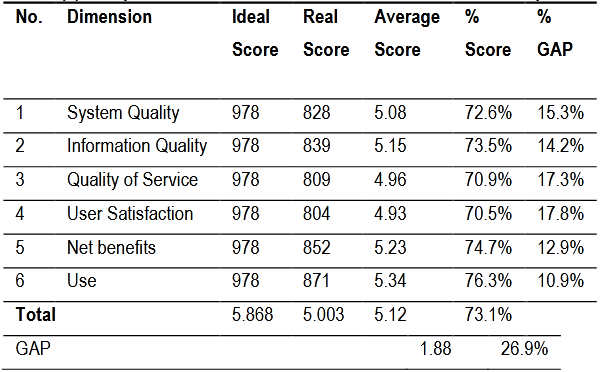
Table (1). Analysis of Variable Scores for the Success of Information Systems
 Source: Data processing results (2020)
The respondent's assessment of Information System Implementation Success has an average score of5.12. Based on the average value of its dimensions, the highest rating is in the Use dimension with an average score of 5.34, while the lowest rating is in the User Satisfaction dimension with an average score of 4.93.
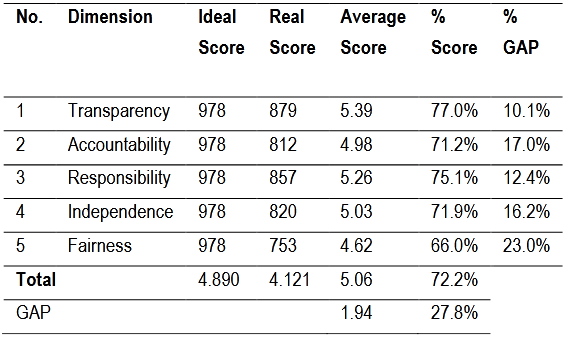
The University Governance Quality
The respondent's assessment of the Quality of University Governance has an average score of 5.06. Based on the average dimensions, the highest rating is in the Transparency dimension, with an average score of 5.39, while the lowest rating is in the Fairness dimension, with an average score of 4.62.
Performance of Organization
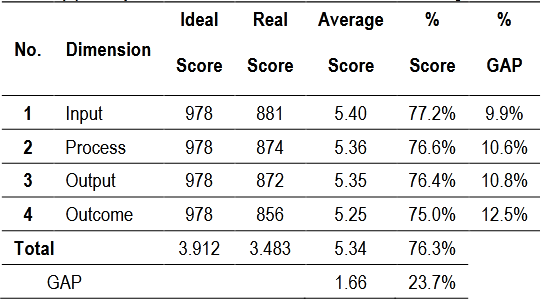
Table (3). Analysis of Variable Scores of Performance of Organization
 Source: Data processing results (2020)
The respondent's assessment of the Performance of Organization has an average score of 5.34. Based on the average dimensions, the highest assessment is in the Input dimension with an average score of 5.40, while the lowest assessment is in the Output dimension with an average score of 5.25.
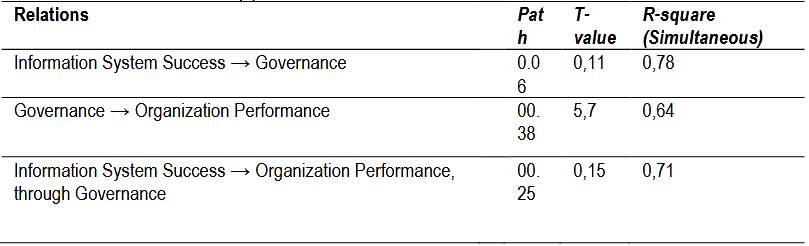
Table (4). Results of Path Coefficient and Statistical Tests
 Source: Data processing results (2020)
Table 4 shows that information systems success influences governance / GUG by 78% and 22% influenced by other factors. Governance / GUG affects the Performance of the Organization by 64%, and other factors influence the remaining 36%. The success of Information Systems influences the Performance of Organizations through governance by 71%, and other factors influence the remaining 39%.
This study has latent variables, namely the Success of Information System Implementation, the Quality of University Governance, and the Performance of University Organization as measured by 3-4 observed variables/indicators. Furthermore, the measurement of each indicator is made through the respondents' responses to statements on the questionnaire
Instrument Validity and Reliability
1) Variable of Information System Implementation Success (KIS)
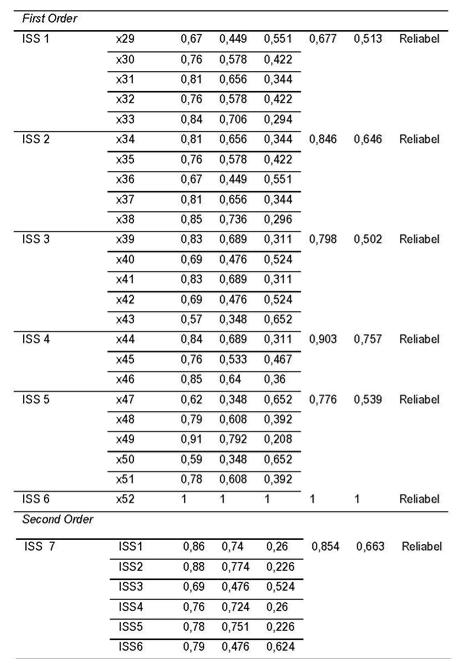
The variable of Information System Implementation Success is measured by 6 (six) dimensions consisting of 24 indicators. The following shows the results of the CFA test with the second-order model for the Information System Implementation Success variable. Based on the results of the CFA test, the value of RMSEA = 0.000 <0.08, and all indicators have a loading factor above 0.5, so it can be concluded that each indicator is valid as a measuring tool for the variable of Information Systems Implementation Success. For more details, see Table 5.
Table (5). Test Results of Validity and Reliability Variables of Information System Success (ISS)
 Source: Data processing results (2020)
In the second-order test results of the Information System Implementation Successfulness variable, all dimensions have a loading factor above 0.5 so that all dimensions are valid in measuring the Information System Implementation Success variable. Based on the results of the loading factor, it can be seen that the ISS2 dimension has the highest loading factor value so that it is the strongest in reflecting the Information System Implementation Success variable, while the ISS3 dimension has the lowest loading factor value so that this dimension is the weakest dimension in reflecting the Information System Implementation Success variable. For the CR value of 0.854> 0.7 and the VE value of 0.663> 0.5 so that it is reliable. This shows that these dimensions have consistency in measuring the variables of Information Systems Implementation Success.
2) Variable Quality of Higher Education Governance (QHEG)
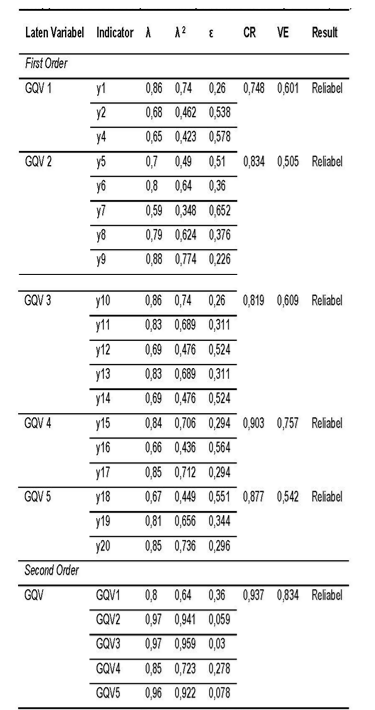
The Quality of Higher Education Governance is measured by 5 (five) dimensions consisting of 20 indicators. The results of the CFA test with the second-order model for the Quality of Higher Education Governance variable, based on the results of the CFA test, it can be seen that there are indicators that have a loading factor below 0.5, namely y3, so it must be reduced from the model. After reduction, the results of the CFA test show that all indicators have a loading factor above 0.5, but the RMSEA value = 0.102> 0.08 so that it is necessary to carry out re-specification.
Based on the results of CFA testing after respecification, the value of RMSEA = 0.074 <0.08, and all indicators have a loading factor above 0.5, so it can be concluded that each indicator is valid as a measuring tool for the variable of Information Systems Implementation Success. For more details, see Table 6.
Table (6). Test Results of Validity and Reliability of Governance Quality Variables (GQV)
 Source: Data processing results (2020)
In the second-order test results, the Quality of Higher Education Governance variable, all dimensions have a loading factor above 0.5 so that all dimensions are valid in measuring the Quality of Higher Education Governance variables. Based on the results of the loading factor, it can be seen that the GQV2 dimension has the highest loading factor value compared to other dimensions, so that it is the strongest in reflecting the Quality of Higher Education Governance variables. The CR value is 0.937> 0.7 and the VE value is 0.834>0.5 so it is reliable. This shows that these dimensions have consistency in measuring the Quality of Higher Education Governance variables.
3) Organizational Performance Variable (OPV)
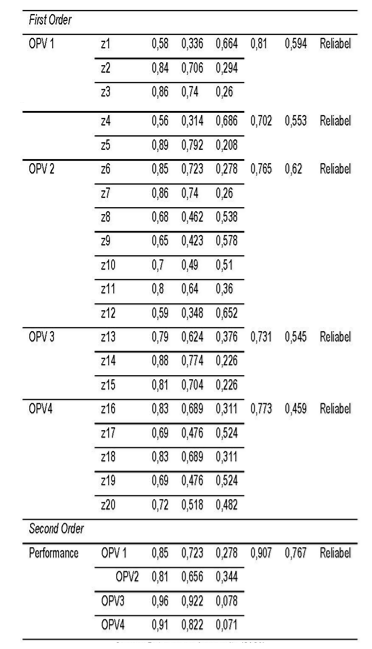
Organizational Performance Variables are measured by 4 (four) dimensions consisting of 20 indicators. The results of the CFA test with the second-order model for the Organizational Performance variable based on the results of the CFA test all indicators have a loading factor above 0.5 and an RMSEA of 0.024 <0.08 so that it can be concluded that each indicator is valid as a measuring tool for the Organizational Performance variable. For more details, see Table 7.
Table (7). Results of Validity and Reliability Test of Organizational Performance Variables (OPV)
 Source: Data processing results (2020)
In the second-order test results for the Organizational Performance variable, all dimensions have a loading factor above 0.5 so that all dimensions are valid in measuring the Organizational Performance variable. Based on the results of the loading factor, it can be seen that the OPV3 dimension has the highest loading factor value compared to other dimensions, so that it is strongest in reflecting the Organizational Performance variable. The CR value is 0.907> 0.7 and the VE value is 0.767> 0.5 so it is reliable. This shows that these dimensions have consistency in measuring the Organizational Performance variable.
The goodness of Fit Model Testing
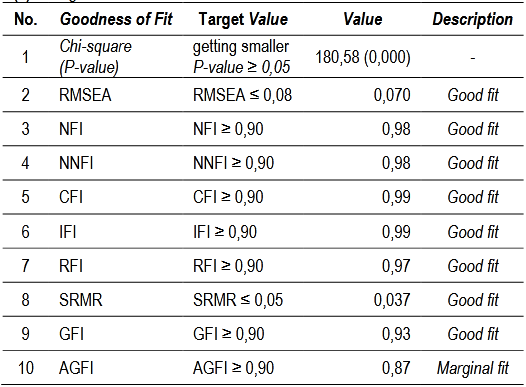
For the full model, SEM testing is carried out with 2 (two) types of testing, namely model suitability, and model hypothesis testing. SEM full model testing is used to see the feasibility of the model or the suitability of the model. Evaluation of the good fit of the structural equation model by comparing the recommended fit index values as presented in Table 8.
Table (8). The goodness of Fit Index Results or Evaluation of Structural Model Fit Indices
 Source: Data processing results (2020)
Based on Table 8, it can be seen that the overall model fit test results based on the RMSEA of 0.070 are fit, as well as almost all other GOF indices that have met the fit criteria so that they can be continued at the next analysis stage. After testing the suitability of the model, then testing the research hypothesis through a structural model.
Research Hypothesis Testing
- 1.
The effect of Information System Implementation Success on the University Governance Quality Value Results: t_count=1.99 so H0 rejectedImportar listaConclusion: Information System Implementation Success has a positive effect on University Governance.
- 2.
The effect of University Governance Quality on the Organization PerformanceValue Results: t_count=5.70 so H0 rejectedConclusion: The Quality of University Governance has a positive effect on the Performance of the Organization.
- 3.
The effect of Information System Implementation Success on the Organization Performance through the University Governance QualityValue Results: t_count=2.99 so H0 rejected
Conclusion: Information System Implementation Success has a significant positive effect on the organization's performance through the University Governance Quality.
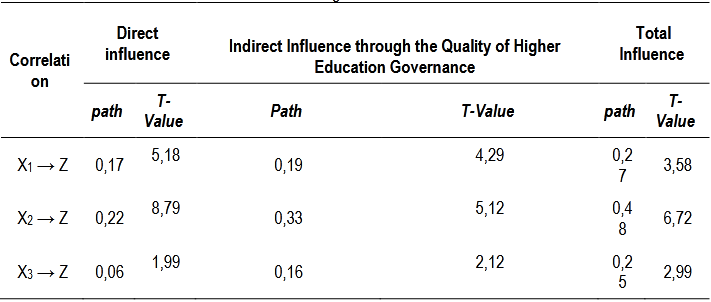
Table ( 9). Summary of Statistical Tests Results for Indirect Effect through Quality of Higher Education
 Source: Data processing results (2020)
The value of the path coefficient of Information System Implementation Success (X3) on Organizational Performance (Z) through the Quality of Higher Education Governance (Y) is 0.16 in a positive direction. This means that the higher or better the success of Information Technology, which is mediated by the Quality of Higher Education Governance, the Organizational Performance will increase. Judging from the value of the path coefficient, the total effect of the Success of Information System Implementation on Organizational Performance through the Quality of Higher Education Governance is 0.25 higher than the direct effect of the Success of Information System Implementation on Organizational Performance of 0.06. For this reason, it can be concluded that the Success of Information System Implementation is able to improve the Quality of Higher Education Governance on Organizational Performance.
 Figure 2. Full Model-Loading Factors
DISCUSSION
Table 4 shows that System Information success affects governance / GUG by 78%, and 22% is influenced by other factors. Governance / GUG affects Organizational Performance by 64%, and the remaining 36% is influenced by other factors. The success of Information System affects organizational performance through governance by 71%, and the remaining 39% is influenced by other factors. Based on the hypothesis test, it is known that the value of tcount = 2.99 so that H0 is rejected so that the Success of Information System Implementation has a positive effect on the Quality of Higher Education Governance.
The results of the path coefficient significance test on the structural model show hypothesis testing that the Success of Information System Implementation has a positive effect on the Quality of Higher Education Governance. This is evidenced by the tcount of 2.99 exceeding the 1.96 thresholds at the 95% significancelevel. Successful Information System Implementation has 6 (six) dimensions, namely: System Quality (KS), Information Quality (KI), Service Quality (KL), User Satisfaction (KP), Net Benefits (MB), and Usage (USE).
Based on the ranking of each loading factor value, the dimensions that best reflect the Success of Information System Implementation are information quality (0.88), system quality (0.86), usage (0.79), net benefits (0.78), satisfaction. users (0.76) and service quality (0.69).
Verificatively, the dimension of information quality has been shown to affect the Quality of Higher Education Governance based on the indicators used. This is in line with the results of the score on the dimension of information quality that all indicators get a fairly good response. This shows that a university in West Java understands the effect of system complexity on the management of PT. For this reason, improving the Quality of Higher Education Governance can be reflected through improving the quality of information so that it can handle the number of transactions at universities that must be carried out in a short span of time.
Furthermore, the dimension of system quality has been shown to affect the Quality of Higher Education Governance based on the indicators used. This is consistent with the results of the score on the dimension ofsystem quality that all indicators get a fairly good response. This shows that universities in West Java understand the effect of the complexity of the quality system on the implementation of education on campus. For this reason, improving the Quality of Higher Education Governance can be reflected through increasing system resources so that they can handle the large number of organizational units managed by the entity and seek clarity of information as a source of determining educational policy.
The dimension of service quality is also proven to affect the quality of higher education governance, although only based on indicators; this shows that universities in West Java understand the effect of service quality on the implementation of educational hearing. For this reason, improving the Quality of Higher Education Governance can be reflected through the preparation of service programs to be more systematic so as to bridge the many complaints that occur.
Furthermore, the dimensions of use have been shown to affect the Quality of Higher Education Governance based on the indicators used. This is in line with the results of the score on the dimensions ofuse that all indicators get a pretty good response. This shows that universities in West Java understand the influence of complexity of use by stakeholders on the implementation of education on campus. For this reason,improving the Quality of Higher Education Governance can be reflected through increasing system resources so that they can handle the large number of organizational units managed by the entity and seek clarity of information as a source of determining educational policy.
The dimensions of user satisfaction have been shown to affect the quality of higher education governance based on the indicators used. This is in line with the results of the score on the dimensions of user satisfaction that all indicators get a pretty good response. This shows that universities in West Java understand the influence of the complexity of user satisfaction, namely the stakeholders in the implementation of education on campus. For this reason, improving the Quality of Higher Education Governance can be reflected through increasing system resources so that they can handle the large number of organizational units managed by the entity and seek clarity of information as a source of determining educational policy.
The net benefit dimension is also proven to be able to affect the Quality of Higher Education Governance, although only based on indicators; this shows that universities in West Java understand the effect of net benefits on the implementation of educational hearings. For this reason, improving the Quality of HigherEducation Governance can be reflected through the preparation of service programs to be more systematic so as to bridge the many complaints that occur.
The six dimensions of Information System Implementation Success in this study are proven to affect the Quality of Higher Education Governance. The results of this study provide empirical evidence that the Success of Information Systems Implementation has a positive effect on the Quality of Higher Education Governance. It can also be interpreted that the Quality of Higher Education Governance can be improved if it is supported by dealing with problems of Successful Information System Implementation which is reflected in the dimensions of System Quality (KS), Information Quality (KI), Service Quality (KL), User Satisfaction (KP). Net Benefits (MB) and Usage (USE).
Information System, which is part of IT, is an important part of using IT. The use of Sistem Information in an organization can help make it easier for the organization to run its business. To make it easier to processinformation from various System Information that an organization has, integrated System Information is required.
Integrated System Informasi can provide support in providing integrated data and information in all related organizational units. The implementation of an integrated Information System in an organization will bring changes in the organization. Acceptance and rejection of the adoption and implementation of System Information will occur and cause turmoil in the organization. To see the extent to which users are ready to adopt integrated System Information, an evaluation of the process is required. To see the extent to which users are ready to adopt an integrated Information System, an evaluation of the process is required. Human (human), organization (organization), and technology (technology) variables are the main and fundamental things that influence the successful adoption and implementation of System Information in an organization.
Based on data analysis, the results of this study are in accordance with previous research, which explains that the successful implementation of information systems is one of the factors that affect the quality of higher education governance (Tajuddin, 2015; Rachmawati, 2019). Based on the results of this study, it is answeredthat the successful implementation of high information systems can improve the quality of higher education governance.
CONCLUSION
Based on the phenomena, the formulation of study, the hypothesis, and the results of the study conducted at universities in West Java, the conclusions are as follows:
- 1.
Information System Implementation Success has a positive influence directly on University Governance.
- 2.
University Governance directly has a positive influence on Organization Performance.
- 3.
Information System Implementation Success has a positive influence indirectly on the Organization's Performance (through University Governance).
Based on the results, the discussion, and the conclusion in this study, researchers suggest Universities with accreditation B and C must improve Information System Implementation Success. Therefore, they can improve Governance Quality directly, and accordingly have an impact on improving University performance. Besides that, the indicators of Governance Quality must also be a concern to improve the university organization's performance.
BIODATA
U. HAYATI: University of Padjadjaran, Indonesia / ORCID: https://orcid.org/0000-0002-6856-377X
S. MULYANI: University of Singaperbangsa Karawang, Indonesia / ORCID: https://orcid.org/0000-0001-6744- 8991 / Email: sri.mulyani@unpad.ac.id
D.E. SUKARSA: University of Padjadjaran, Indonesia / ORCID: https://orcid.org/0000-0002-6856-377X
S. WINARNINGSIH: University of Padjadjaran, Indonesia / ORCID: https://orcid.org/0000-0002-6856-377X / Email: srihadi.winarningsih@unpad.ac.id
BIBLIOGRAPHY
ADITAMA, P, B, & WIDOWATI, N (2017). “Analisis kinerja organisasi pada kantor kecamatan blora”. Journal of Public Policy and Management Review, 6(2), pp. 283-295.
ASWATI, S, MULYANI, N, SIAGIAN, Y, & SYAH, A, Z (2015). “Peranan sistem informasi dalam perguruan tinggi”. Jurnal Teknologi dan Sistem Informasi, 1(2), pp. 79-86.
DELONE, W, & MCLEAN, E (2003). “The delone and mclean model of information system success: a ten- year update”. Journal of Management Information System, 19 (4), pp. 9-30.
DOROTHY, L, SATOTO, K, I, & NURHAYATI, O, D (2014). “Perancangan dan implementasi sistem informasi perpustakaan di program studi teknik lingkungan fakultas teknik UNDIP”. Jurnal Teknologi dan Sistem Komputer, 2(4), pp. 209-222.
FACHRI, M, NUGROHO, H, & WIKUSNA, W (2018). “Sistem pendukung keputusan untuk adopsi teknologi informasi di perguruan tinggi menggunakan metode analytical hierarchy process (AHP)”. E-Proceeding of Applied Science, 4(3), pp. 19-34.
GUNAWAN, I (2013). “Metode penelitian kualitatif”. Jakarta: Bumi Aksara, 143, pp. 32-49.
HAROKI, M, R, AJIE, H, & DUSKARNAEN, M, F (2019). “Pengembangan sistem repositori dokumen akreditasi institusi perguruan tinggi di universitas negeri jakarta”. Jurnal Pendidikan Teknik Informatika dan Komputer, 3(2), pp. 108-115.
IBDA, H, & RAHMADI, E (2018). “Penguatan literasi baru pada guru madrasah ibtidaiyah dalam menjawab tantangan era revolusi industri 4.0”. Journal of Research and Thought of Islamic Education, 1(1), pp. 1-21.
JANURI, SARAGIH, F, & SARI, N (2018). “Factors affecting good university governance: the concept of theoretical”. International Journal of Scientific Engineering and Research (IJSER), 6(2), pp. 27-31.
KAPOH, O, M, ILAT, V, & WARONGAN, J, D, L (2017). “Analisis pelaksanaan sistem pengendalian internal pada inspektorat kabupaten minahasa utara”. Jurnal Riset Akuntansi Going Concern, 12(2): pp. 213-223.
LEIBER, T (2019). “A general theory of learning and teaching and a related comprehensive set of performance indicators for higher education institutions”. Quality in Higher Education, 11(1), pp. 35-75.
MURTADHO, M, A, & WAHID, F (2016). “Permasalahan implementasi sistem informasi di perguruan tinggi swasta”. Jurnal Ilmiah Teknologi Sistem Informasi, 2(1), pp. 17-21.
PENDIDIKAN, M (2013). “Peraturan menteri pendidikan dan kebudayaan republik Indonesia”. Nomor, 66, pp. 1-3.
RAHAYU, F, S, APRILIYANTO, R, & PUTRO, Y, S, P, W (2018). “Analisis kesuksesan sistem informasi kemahasiswaan (SIKMA) dengan pendekatan model delone dan mclean”. Indonesian Journal of Information System (IJIS), 1(1), pp. 34-46.
RIDLA, M, R (2016). “Analisis balanced scorecard pada kinerja perguruan tinggi swasta islam di kopertais wilayah iii yogyakarta (studi kasus di sekolah tinggi islam terpadu yogyakarta”. Jurnal Manajemen Dakwah, 1(4), pp. 55-73.
SABANDAR, S, Y, TAWE, A, & MUSA, C, I (2018). “The implementation of good university governance in the private universities in makassar (indonesia)”. Espacios, 39(02), pp. 8-20.
SARI, N, GHOZALI, I, & ACHMAD, T (2017). “The effect of internal audit and internal control system on public accountability: the empirical study in indonesia state universities”. Technology, 8(9), pp. 157-166.
SULINDAWATY (2015). “Implementasi sistem informasi akademik berbasis web pada sekolah menengah pertama (smp) swasta nusa penida medan”. Jurnal Mantik Penusa, 18(2), pp. 76-81.
WIJATNO, S (2009). “Pengelolaan perguruan tinggi secara efisien, efektif, dan ekonomis”. Jakarta: Salemba Empat, 11, pp. 120-135.
WINDARTO, A, P, LUBIS, M, R, & SOLIKHUN, S (2018). “Implementasi JST pada prediksi total laba rugi komprehensif bank umum dan konvensional dengan backpropagation”. Jurnal Teknologi Informasi dan Ilmu Komputer, 5(4), pp. 411-418.