Received: 10 May 2015
Accepted: 09 April 2016
Funding
Funding source: Young Lives is funded from 2001 to 2017
Funding source: Netherlands Ministry of Foreign Affairs from 2010 to 2014
Abstract: The percentage of Latin American teenage women, including Peruvian, reporting having had sex is increasing. There are few studies in Latin America aimed at identifying the predictors of this behavior. This study uses a unique longitudinal dataset from Peru to explore which individual, family and community variables, and changes of these over time, predict sexual behavior by age 15. Results show that early sexual initiation was positively associated with being a male, having a mother with less than complete secondary education, an increase in his/her family wealth over time, being overage in school and reporting drinking alcohol frequently or sexual behavior in his/her group of friends. Peer relations were significant only for boys, while relations with parents were so only for girls. Finally, 11% of participants did not know if their last sexual partner used protection.
Keywords: Sexual behavior, adolescence, Peru, longitudinal studies.
Resumen: El porcentaje de las adolescentes latinoamericanas, incluyendo las peruanas, que reportan haber tenido relaciones sexuales se ha incrementado. Existen pocos estudios en la región que identifiquen los predictores de esta conducta. El presente estudio utiliza una base longitudinal de datos del Perú para explorar las variables individuales, familiares y comunitarias a lo largo del tiempo que predicen las conductas sexuales a los 15 años de edad. Los resultados muestran que la iniciación sexual temprana está relacionada positivamente con el sexo masculino, tener una madre sin secundaria completa, un aumento en la riqueza de su familia, extraedad en la escuela y reportar consumir alcohol frecuentemente o conductas sexuales de su grupo de amigos. Las relaciones con pares fueron significativas solo para los hombres (asociación positiva), mientras que las relaciones con los padres lo fueron solo para las mujeres (asociación negativa). El 11% de los participantes reportan desconocer si su última pareja sexual utilizó protección.
Palabras clave: Conducta sexual, adolescencia, Perú, estudios longitudinales.
Adolescence is a stage in life characterized by rapid growth and/or changes in the physical, cognitive and socio emotional domains. Thus, for example, adolescents typically show increasing independence from parents and assign greater importance to peer relations. All of these changes are associated with adolescents increasingly taking different decisions on their own, one of them being sexual initiation. Cunningham, McGinnis, García-Verdú, Tesliuc and Verner (2008), and the Pan American Health Organization [PAHO] (2010) show that the percentage of female youths who had their first sexual intercourse by age 15 has grown over time in Latin America.
Studies show evidence of different risks that might result from early sexual initiation. Statistics from the Demographic Health Surveys for Latin American countries from 2000 to 2013 indicate that the percentage of females aged 15 to 19 who had sexual intercourse before the age of 15 ranged from 6% to 17%. Also, the percentage of sexually active female who used a condom during the last high risk sexual intercourse (with a non-marital, non-cohabiting partner) ranged from 11% to 59%i. One of the most common risk behaviors is having unprotected sexual intercourse, which could lead to unwanted pregnancies and sexually transmitted diseases (STD) (Potard, Courtois & Rusch, 2008). Teenage pregnancy and STD's are common problems found in almost every country (Ruiz-Canela, López-del Burgo, Carlos, Calatrava, Osorio & de Irala, 2012). Social scientists have long considered unwanted teenage pregnancy as a negative outcome, given for example that in the short to mid-term teenage pregnancy is associated with an increase in the likelihood of dropping out of school (Shuger, 2012; UNICEF, 2012). In addition, sexually transmitted diseases are highly correlated with risky sexual behaviors. Several international agencies concerned with AIDS prevention, including the Joint United Nations Programme on HIV/AIDS (UNAIDS), have developed indicators of risky behaviors, such as having had sex before the age of 15ii, having had more than one sexual partner in the past twelve monthsiii and not using a condom during their last sexual intercourseiv. In addition, important life-cycle patterns in the labour market have been identified because of early sexual initiation (Chevalier & Viitanen, 2003; Hofferth, 1987; United Nations Population Fund [UNFPA], 2013). For example, teenage mothers have a significantly lower probability of entering labour force in the years following birth. Finally, in the long run teen mothers earn less than women who delayed childbearing.
In Peru, the patterns are similar to those found at the international level: the percentage of teenage women reporting never having had sex went from 82% in 1986 to 69% in 2014 according to the Peruvian Demographic and Health Surveys. In addition, this same survey indicates that by 2014, 25% of women aged 15 to 19 who reported having had sex stated having had more than one sexual partner, and most of them did not use a condom during their last sexual intercourse. A study developed by DEVIDA (2008) with a nationally representative sample of high school students in Peru showed that 11% of adolescents in high school were sexually active, with boys more sexually active than girls (15% and 7% respectively). Understanding the predictive factors associated with this behavior is thus an important policy issue, but should also help understand the psychology of adolescents in the region. This study centers on predictive factors on sexual engagement by age 15, although we have no data on risky sexual behavior.
De te rminants of adolescents’ sexual initiation
There have been numerous international studies on the determinants of adolescent sexual behaviors. Many of them classify the determinants into three groups: individual, family, and context. We realize however that many of the variables within each group could be connected to the other two through social processes in any given environment.
A study on the determinants of early sexual intercourse, with a sample of Malaysian teenagers, showed that the main predictors were individual factors (i.e. sexual abuse during childhood, attitudes toward premarital sex, viewing pornography and previous alcohol and drug use; Nik Farid, Che' Rus, Dahlui & Al Sadat, 2013). Also among individua l factors, adolescents’ age has been pointed out as an important determinant of sexual behavior in different regions (Lalor, O’Regan & Quinlan, 2003; Pilgrim & Blum, 2012). In addition, there is evidence that higher academic scores are associated with a lower likelihood of having sex before age 16 and getting pregnant or a STD at this age (Choi, 2007).
The literature has also studied adolescents’ perceptions, reasons for, and feelings associated with sexual initiation (Busse, Fishbein, Bleakley, & Hennessy, 2010; Givaudan, Van De Vijver, & Poortinga, 2005). For example, condoms may not be used because wearing them would suggest a lack of trust in the partner (Flórez, 2005; Marston & King, 2006) and not using contraception was partially explained by unfounded beliefs about their secondary effects, skepticism about their efficacy and perception of invulnerability (Flórez, 2005).
Related to the above, Problem Behavior Theory suggests that risk behaviors are related and have common psychosocial causes that can threaten adequate adolescent development (Jessor, 1991; Jessor & Turbi, 2014; Madkour, Farhat, Halpern, Godeau & Gabhainn, 2010; Nik Farid et al., 2013; Sanchez, Grogan-Taylor, Castillo, Caballero & Delva, 2010). For example, alcohol drinking in 7th grade was related with risk behaviors such as early sexual relationships, unprotected sexual intercourse and subsequent alcohol abuse (Stueve & O'Donnell, 2005). A comparative study of five countries (Scotland, Finland, France, Poland and United States) considers early sexual initiation as a risk behavior and also reports that it is strongly related to substance use, while negatively associated with school attachment (Madkour et al., 2010).
Concerning family-related factors, household socioeconomic status, family structure (i.e. having a one-parent family, family disruption), parental education and parent-child relationship are strong determinants of sexual behavior among teens (Flórez, 2005; Goicolea, Wulff, Öhman & San Sebastian, 2009; Jessor & Turbin, 2014; Madkour et al., 2010; Oman, Vesely & Aspy, 2005). Certain types of family behaviors, such as substance abuse, mental health problems and child sexual abuse also predicted sexual behavior (Goicolea et al., 2009; Nick Farid et al., 2013; Pilgrim & Blum, 2012). For Cameroon, Dimbuene and Defo (2011) have pointed out that it is not only family structure that matters (i.e. two parents, one, or none present at home), but also the interactions and control that parents exert on their children.
There is also evidence on the positive relationship between adult supervision and sexual initiation. Studies in different countries have found that more parental supervision on teenagers' free time or being enrolled in school is associated with less sexual relationships among adolescents (Rosenberg et al., 2015; Ruiz-Canela et al., 2012; Samad, Hairi & Ismali, 2016). For example, a longitudinal study in rural South Africa found that pregnancy occurred more frequently on holidays than during the school term (Rosenberg et al., 2015).
Finally, contextual characteristics like social norms and beliefs have been found to be linked with sexual activity (Pilgrim & Blum, 2012; Uchudi, Magadi & Mostazir, 2012). A study developed in Nigeria showed that age of sex initiation varied according to geopolitical differences (Uthman, 2008). The author explained that regions in Nigeria differentiate among each other on religion, traditional and cultural beliefs, ethnic groups, and economic development and education levels, and these community contextual characteristics had an influence on sexual initiation. Similar results were found in a survey of 20 Sub- Saharan African countries, where Uchudi et al. (2012) explained how contexts where sexual norms were more permissive (i.e. accepting polygyny) had an influence on individuals having multiple partners. For Peru, regional characteristics may also matter. For example, national statistics in Peru refer that teenage pregnancy (between age 15 and 19) has increased in 1.1% in the last four years; most of Peruvian pregnant teenagers live in rural areas (22.5%) and in the jungle (24.9%) (Demographic and Health Survey [ENDES], 2015).
In regards to the social context, several studies have found a positive relationship between socioemotional characteristics and behaviors and early sexual initiation (Ethier et al., 2004; Laflin, Wang & Barry, 2008; McLeod & Knight, 2010). For example, Ethier et al. (2004) found that lower self-esteem is related to earlier sexual initiation, a history of risky partners, and to unprotected sex McLeod and Knight (2010) analyzed two types of socioemotional problems: internalized (e.g. depression and dependency) and externalized (e.g. hyperactivity and antisocial behavior). Even though both are related with sexual initiation before age 15, the authors found that only externalizing problems are significant predictors of early sexual initiation when both are introduced simultaneously in the analysis. In addition, perceptions of their friends’ attitudes and behaviors is important for adolescents (Potard et al., 2008; Ruiz-Canela et al., 2012). A study of French teenage students showed that perceiving that their friends had liberal attitudes towards sex is a predictor for having an early sexual initiation, but having experienced peers would be a protective factor that encourages teenagers to use a condom in their first sexual intercourse (Potard et al., 2008).
Also in regards to the social context, in a study of Malaysian teenagers, female adolescents with a stronger peer attachment were less likely to have had sex, while it was the opposite for male adolescents (Samad, Hairi & Ismali, 2016). These authors also found that no matter which sex, peer pressure was strongly associated with early sexual initiation in Malaysian adolescents. The authors explain that adolescents believe they will be more respected by their peers if they engage in sexual relationships. Eruklar and Ferede (2009) found similar results. Their study was carried out with out-of-school girls aged 10-19 years old in low-income urban areas of Ethiopia. They found that being socially excluded (described as having few or no friends, not having a support network and not being a member of an organized group), was a strong predictor for both being in a coerced sexual relationship and for having an early sexual initiation (Eruklar & Ferede, 2009). Regarding gender differences, it has been found that there is more pressure on boys to have sexual relations by adolescence (Lalor et al., 2003; Potard et al., 2008).
In regards to studies on sexual behavior among adolescents in Peru, beyond the epidemiological data reported above, Chirinos, Brindis, Salazar, Bardales and Reategui (1999) describe the knowledge, attitudes and sexual behavior of women (aged 12 to 19) in high schools in Lima. Some of the main reported reasons for having sexual intercourse were love, fear of losing a partner, getting closer to the partner, and peer pressure. They found that 7.8% in the sample had had sexual intercourse, at an average age of 13.7 years for sexual initiation. Girls who had repeated a grade or lived in single-parent families were more likely to have had sex (bivariate analysis only). Bayer, Cabrera, Gilman, Hindin and Tsui (2014) found gender as an important predictor for sexual initiation: male adolescents in Lima were more likely to have had sexual behaviors. Their results also showed that peer support and higher family education are predictors for later sexual initiation.
As shown above, sexual intercourse is starting at earlier ages, often unprotected and resulting in teenage pregnancies. Even though this is an important area of policy in Peru (Roundtable, 2012) and other countries in Latin America, there is very little empirical research, and most of the data is epidemiological, or the analysis cross-sectional. This study describes patterns of sexual behaviors and explores the longitudinal determinants in a sample of 15-year-old boys and girls from Peru. According to Marston and King (2006), Mueller et al. (2010) and Puente et al. (2011), in the analysis of determinants of behavior it is important to distinguish between men and women, especially during adolescence. Given this and the different gender patterns of early sexual initiation, as shown above, in this paper we will report an analysis for the whole sample and for boys and girls separately. The statistical analysis presented below cannot establish cause and effect associations but will help to identify which longitudinal factors are associated with sexual behavior.
Based on the studies presented above, we address the following research questions and predictions:
· What are the factors that predict sexual initiation by age 15 in Peru? The predictors are based on the individual, family and contextual variables identified in the studies reported above, whenever they were available in the data set, as well as changes over time.
· Are there heterogeneous effects on the risk factors of early sexual initiation by gender? Based on the literature, we expect that boys will show an earlier sexual initiation than girls, and we also expect variations in the way family and context variables may be relevant for boys and girls.
Methods
Data
The data analyzed here comes from the Young Lives (YL) longitudinal study. This study aims at understanding the causes and consequences of childhood poverty on two cohorts of children across four countries: Ethiopia, India, Peru and Vietnam. In this study, we use the data from the Older Cohort -OC- (children born around 1994) in Peru. The other three countries did not include a module on sexual behaviors. Young Lives has information from children and their families collected in four rounds of household surveys. In this study we used the first three: data collected in 2002 (when children in the OC were around 8), in 2006 and in 2009.
In the first round of surveys, the OC started with a sample of 714 children. In Round 3 (2009), 678 adolescents from the original sample were surveyed. The remaining children dropped out of the study, moved out of the country, could not be located, or died. The original sample is not nationally representative, but in round 1 it included children from 20 localities randomly selected across the country (households were also selected randomly). Using the Peruvian OC dataset of YL made it possible to recover information on adolescents and their households over time, allowing us to include variables at different stages in life as potential determinants of adolescent´s sexual behaviors.
The third round of data collection of the Peruvian OC questionnaire included a self-administered section including several aspects of teenage behaviors such as emotional well-being, tobacco, alcohol and drug consumption, and sexual behavior. It also included information reported by children about risky behaviors of their closest friends, which was used in the analysis. Fieldworkers explained participating adolescents that they should respond to this part of the questionnaire privately, placing the survey inside an envelope. The adolescent and at least one parent gave consent to all data collection procedures. This study and the specific procedures were approved by an Ethics Board at the University of Oxford and another one at the Instituto de Investigación Nutricional (Nutritional Research Institute) in Peru. All surveys and data sets are available from the Young Lives website (http://www.younglives.org.uk/what-we-do/researchmethods, http://www.younglives.org.uk/what-we-do/household-and-child-survey-1).
From the sample of 678 adolescents in Round 3, 653 children answered the confidential questionnaire and 599 answered the items related with age of sexual initiation and use of contraceptive methods; the empirical analysis is made on the basis of the latter. We ran different t-tests in order to compare the demographic characteristics of the original sample (n=718) with the analytical sample (n=599) and we did not find statistically significant differences between them.
Variables
The main dependent variable is: Ever had sex: dummy variable coded 1 if the adolescent had sex and 0 if he/she never had sex.
The demographic (individual) variables were:
-
Adolescent’s sex: dummy variable coded 1 if the adolescent is male and 0 otherwise.
-
Age: age in months for each adolescent.
-
Mother tongue: dummy variable coded 1 if the adolescent’s mother tongue is Spanish and 0 otherwise.
-
Father´s educational level: dummy variable coded 1 if the father has complete secondary or more and 0 otherwise.
-
Mother’s educational level: dummy variable coded 1 if the mother has complete secondary or more and 0 otherwise.
The variables used from Round 1 (2002) are:
-
Both parents at home: dummy variable coded 1 if both parents were living at home and 0 otherwise.
-
Number of siblings: indicates the number of siblings of each adolescent.
-
Wealth Index: continuous variables ranging from 0 to 1, formed by the aggregation of housing quality, access to consumer durables and access to basic services.
-
Social Capital: dummy variable coded 1 if the number of social programs (i.e.: Mother´s club, Communal kitchen) in which parents participated was above the overall mean and 0 if below
The variables used from Round 2 (2006) are:
-
Works for pay: dummy variable coded 1 if the adolescent did any type of work for pay in the last 12 months and 0 otherwise.
-
Vocabulary score: the adolescent’s standardized score in the Peabody’s Picture and Vocabulary Test (Spanish version) which measures the vocabulary acquisition of the child (Dunn, Padilla, Lugo and Dunn, 1986). The score was standardized by the team, based on the YL sample (Cueto, Leon, Guerrero & Muñoz, 2009). The reliability index was 0.952.
-
Relationship with parents: dummy variable coded 1 if the child´s score in the scale was above the overall mean, which means a good relationship with parents, and 0 if below. The scale was composed of thirteen questions that asked about the relationship with their parents (i.e. I always feel beloved by my parents/guardians).
-
Relationship with friends: dummy variable coded 1 if the child´s score in the scale was above the overall mean, which means a good relationship with friends, and 0 if below. The scale was composed of four questions (e.g., You find it difficult to speak with the other kids in your class).
-
Time without adult supervision: continuous variable that indicates the number of hours in a week that he/she spends without adult supervision according to the adolescent.
The variables used from Round 3 (2009) are:
-
Place of residence: dummy variable coded 1 if the adolescent lives in an urban area and 0 if in a rural area.
-
Highlands: dummy variable coded 1 if the adolescent lives in the Andean region and 0 otherwise.
-
Jungle: dummy variable coded 1 if the adolescent lives in the Jungle and 0 otherwise (the default for this and the above variable is living on the Coast of Peru).
-
At normative grade at school: dummy variable coded 1 if the adolescent was at the normative grade in school for his/her age (at least 3rd year of secondary education) and 0 if behind the normative grade.
-
Excluded by friends: dummy variable coded 1 if the child´s score in the scale was above the overall mean, which means the child felt excluded by friends and 0 if below. The scale was composed of nine items (e.g., They make me feel uncomfortable when they were close to me or look at me improperly).
-
Socio-emotional skills: composite score obtained from five items from the Emotional Symptoms subscale of the One-sided self-rated Strengths and Difficulties Questionnaire for 11-17 year olds (Goodman, 2005) included in the individual questionnaire. Internal consistency (Cronbach’s Alpha) analysis for this scale was 0.643.
-
Smokes tobacco: dummy variable coded 1 if the adolescent reported smoking tobacco frequently (at least once a month) and 0 otherwise.
-
Drinks alcohol: dummy variable coded 1 if the adolescent reported drinking alcohol frequently (at least once a month) and 0 otherwise.
-
Uses drugs: dummy variable coded 1 if the adolescent reported having ever consumed an illegal drug and 0 if not.
-
Knowledge about sexual topics: composite score obtained from five items related with sex related facts (i.e.: A healthy-looking person could not spread diseases through sex).
-
Reports closest friends smoked tobacco: dummy variable coded 1 if the adolescent reported that their friends smoke tobacco frequently (at least once a month) and 0 otherwise.
-
Reports closest friends drink alcohol: dummy variable coded 1 if the adolescent reported that their friends drink alcohol frequently (at least once a month) and 0 otherwise.
-
Reports closest friends had engaged in sexual activities: dummy variable coded 1 if the adolescent reported that their friends had engaged in sexual activities and 0 otherwise.
Additionally, we included variables where we could estimate changes over time that could be associated with the probability of being sexually active by age 15. These variables were:
-
Wealth index: difference between wealth indexes in rounds 3 and 1.
-
Both parents at home: dummy variable coded 1 if one of the parents did not live at home between rounds 2 and 3 and 0 otherwise.
-
Works for pay: dummy variable coded 1 if the adolescent started to work for money in round 3 in comparison with round 2 and 0 otherwise.
-
Time without adult supervision: difference between the number of hours the adolescent spent without adult supervision in rounds 3 and 2.
-
Number of siblings: difference between the number of siblings in rounds 3 and 1.
Statistical Model
For the analysis of the predictive factors on the dependent variable, we used a nonlinear logit regression model. The nonlinear models make it possible to identify which variables are linked with the probability that the analysed event occurs. Specifically, the model is:

p : probability of event Y (ever had sex) occurs or p (Y=1)
p/(1-p) : occurrence ratio for event Y
ln [p/(1-p)] : log odds ratio (logit)
Ij : matrix with individual variables
Fj : matrix with family variables
Gj : matrix with context variables
Vj : matrix with time-variant variables
Ԑj : random error
Finally, the same model was estimated for males and females; the statistical software STATA 12.0 was used for the analysis.
Results
By the time Round 3 survey was administered, youth responding the survey were 15.1 years old on average, with half a year standard deviation; 17.1% of them reported having had sexual intercourse. We also asked these adolescents about the method used in their last sexual encounter: 65% reported using a condom, 10% reported using other methods, 14% said they had not used any protection and a surprising 11% said they did not know if their partner had used any method of protection. While we do not have additional data to explain the latter result, it seems plausible that they do not know because they trusted in their partner to use a contraceptive method or did not dare to ask. This would indicate lack of communication between partners, a result that has been reported in the international literature (Chirinos et. al., 1999; Flórez, 2005; Marston & King, 2006). In this study, we did not have enough statistical power to study the determinants of protected sexual behavior, which would seem a highly relevant analysis for program design. This variable should be available from Round 4 of Young Lives, administered by the time children were 18 years of age. Table 1 presents the descriptive statistics of the sample used in the empirical analysis.
Descriptive statistics
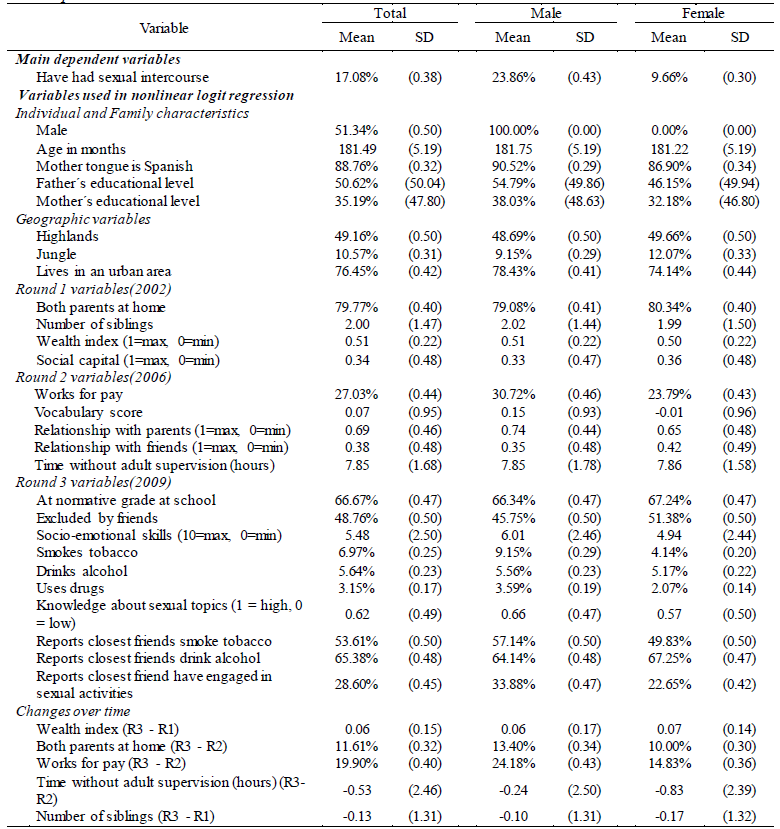
Note. N = 603
As is common in the literature regarding determinants of sexual behavior among adolescents, our multivariate analysis is based on a model for binary dependent variables (Blum et al., 2000; Levine, 2001; Pacula et al., 2001). Table 2 reports the coefficients from the Logit estimation. We have classified the predictive variables in the model as individual, family and contextual, as per our literature review above. However, it should again be noted that this classification is not necessarily exclusive (e.g. an individual variable such as being at the normative grade in school is also related to family and contextual influences), although for purposes of analysis and discussion we think it is helpful.
Predictive variables of ever having had sex among 532 teenagers, Young Lives study, Peru, 2002-2009
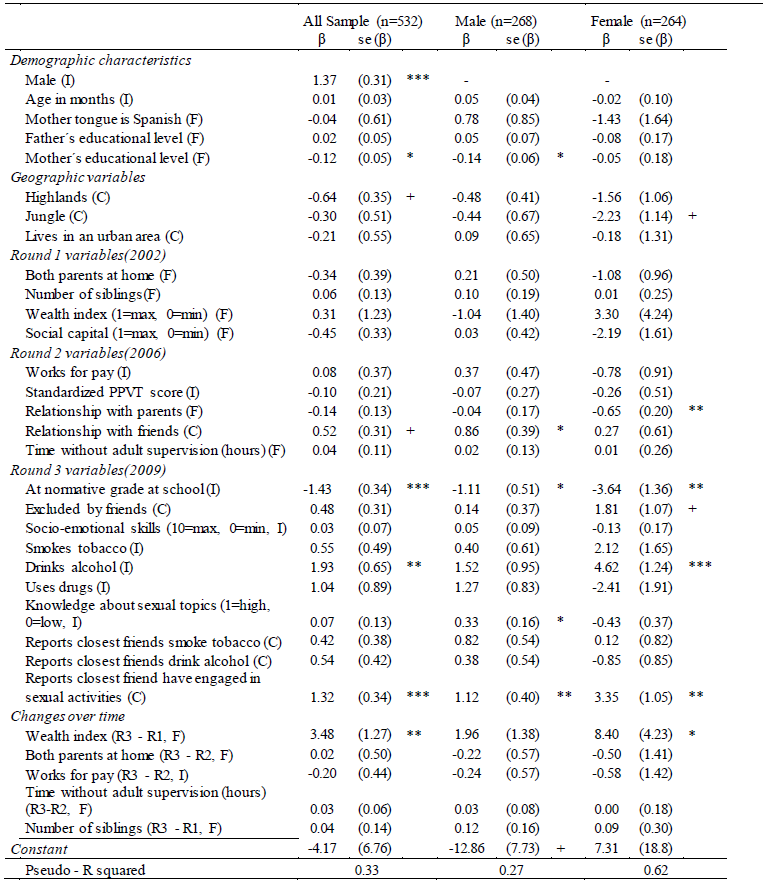
*** p<0.001, ** p<0.01, * p<0.05, + p<0.10 Note: For each predictive variable, I refers to an individual variable, F for family variable and C for contextual variable (place of residence or social context). We run collinearity test (Variance Inflation Factor) in order to check for possible collinearities, given that we are using s everal dichotomous variables. The results showed no problem in terms of collinearity (mean VIF: 1.55).
We describe here briefly the results as they appear in Table 2. In regards to demographic variables, sex (male) and lower maternal education were associated with having had sex for the whole sample. For geographic variables, we found a marginally negative association for the whole sample for living in the highlands, and only for women a marginally negative association with living in the jungle.
None of the Round 1 variables (administered around the time children were between 8 years old) were associated with having had sexual intercourse by age 15. From the Round 2 variables (administered by the time children were age 12), relationship with friends was associated positively with having had sex for the whole sample (but only significant for boys); at this age also, we found a negative association with relationship with parents, but only for women. Several Round 3 variables were associated with sexual initiation: we found a negative effect of being at the normative grade in school for both sexes. In addition, for the whole sample we found that reporting drinking frequently alcohol was associated with having had sex (but non-significant for boys). For both sexes, having friends who had had sex was positively associated with the dependent variable. Knowledge of sexual topics was associated positively with having had sex but only for men. Feeling excluded by friends was positively associated with having had sex but only for females. Finally, among those variables were we could estimate changes over time, we found that increments in the wealth index from round 1 to round 3 was positively associated with the probability of having had sex; the effect was significant for the whole sample and for females, but not for males.
Discussion
This study aimed to identify variables that predicted having had sexual intercourse by the age of 15 years in a sample of Peruvian adolescents. This is an important addition to the existing literature in Peru and Latin America given that international trends show an increase in adolescent sexual behavior, which is associated with unwanted teenage pregnancy and sexually transmitted diseases, among other unwanted outcomes. Understanding which factors predict sexual behavior, using a longitudinal design, may help design or reorient programs for this age group. Below we discuss the predictive weight of the variables by the group they belong to, according to the literature reviewed above (i.e. individual, family and contextual). First, we turn to the variables that were significant for the whole sample and then to the heterogeneous effects (i.e. differences between males and females).
At the individual level, the study results show that men are more prone to be initiated in sexual intercourse by age 15. This is a pattern that has been observed in other countries (Hofferth, 1987; Kann et al., 2014; Kirby & Lepore, 2007; Lalor et al., 2003; Potard et al., 2008; Puente et al., 2011) and in Lima (Bayer et al., 2014). Also at the individual level, we found that being at the normative grade for age in school had a negative association with having had sex by the age of 15. The explanations might be varied, for example, these may be smarter kids. Students with higher academic scores have been found to delay sexual initiation (Choi, 2007). However, given that the receptive vocabulary scores from Round 2 were not associated with sexual behavior, we suggest that our result may be explained by higher levels of responsibility. To suggest this might be a viable interpretation goes our result that youngsters who reported reporting drinking alcohol were more likely to have had sexual relations. This would be in line with Problem Behavior Theory predictions (Jessor, 1991) However, neither smoking tobacco nor using drugs were statistically significant. These results are partially in agreement with the results of Madkour et al. (2010), who found that in five industrialized countries, consuming alcohol and tobacco were associated with sexual relations for both boys and girls at age 15. In addition, previous studies show that non-sexual risky behaviors like smoking, drinking alcohol or drugs consumption are many times encouraged by peers (Ruiz et al., 2012). This would all seem to suggest that sexual initiation may be related to consumption of alcohol, tobacco and drugs by the child and peers, but the specific associations may vary in specific groups and by the age of children. It would seem nevertheless important to consider these associations in future studies and policy interventions, for boys and girls. Age was not significantly associated with sexual behavior in this study, but this is most likely due to the small variation in age within our sample.
Regarding family variables, maternal education (i.e. having completed secondary or more) is significantly associated with sexual initiation for the whole sample. These results are similar to other studies, where authors found parental education, together with other family related factors, to be associated with early sexual initiation (Flórez, 2005; Goicolea et al., 2009; Jessor & Turbin, 2014; Madkour et al., 2010; Oman et al., 2005). The other family variable with a significant coefficient was changes in family wealth between the ages of 8 and 15. We included this variable, as wealth in Peru tends to be a predictor of several outcomes. However, we have found no relevant references and thus would deserve more research.
In regards to contextual variables, we found one result related to area of residence that was marginally statistically significant for the whole sample (living at the highlands), while living at the jungle was significant at a marginal level only for girls. These results suggest that there might be a low association between regional variables and sexual initiation. The social context does seem to matter however. For example, reporting friends who had engaged in sexual behaviors was positively associated with ever having sex. In addition, we found a marginal effect for the whole sample for having good relationships with friends (positive association). These two results may be related with previous studies that have found that perceiving liberal attitudes in friends is associated with earlier sexual initiation, as well as the role of peer pressure (Potard et al., 2008; Ruiz-Canela et al., 2012).
Some of the heterogeneous effects were commented above, but we highlight a few more here. As shown in Table 2, reporting good relations with parents by the age of 12 was negatively correlated with having had sex by age 15 but only for girls. The influence of parents is in line with international findings regarding the influence of family variables on adolescent sexual behavior (Flórez, 2005; Goicolea et al., 2009). The parent’s effect might be driven by counselling and advice. This is in contrast with the result mentioned above whereby at this age relations with friends was a positive predictor of sex by age 15. Peer pressure has been found to be a significant predictor for Peru and other countries before (Chirinos et al., 1999; Lalor et al., 2003; Potard et al., 2008). Given that being sexually initiated gives adolescents some “authority” or “status” because of having experienced adult activities, it can raise respect from peers (at least for boys) and hence increase the likelihood of being accepted in a social group. For girls however, we found that feeling excluded from the group was positively associated with sexual behavior, suggesting that peer pressure might also have an influence for them. We also found that higher scores in sexual knowledge was associated with sexual initiation but only for boys. However, many youngsters could not answer very simple questions about pregnancy or STD. Finally, it is worth noting that our set of variables were more predictive of girls than boys’ behavior (Pseudo R-squared of 0.62 versus 0.27). This poses a challenge to better understand the predictive factors of boys.
In regards to the predictive value of the long-term variables included in the model, none of the variables collected by the age children were eight years old predicted sexual behavior by age 15, while several Round 3 predictors had a significant coefficient. This is a result that should be read carefully though, given that Round 3 was also the time at which we asked about sexual initiation. Thus, we do not know which one precedes the other. However, as many of these are key variables in the literature about sexual behavior determinants, we have included them in the analysis.
This study has some limitations beyond those mentioned above. Of all predictive factors we considered that might predict early sexual initiation before age 15, only a few were significant, and more often for girls as mentioned above. Even though previous studies show that parental absence, adult supervision, and socio-emotional skills are often associated with early sexual initiation, our study did not find these variables to be statistically significant. We are not ruling out the importance of these variables, but suggest alternative explanations. For example, the instruments may not have captured well these domains. In addition, it may be that these factors show an effect at older ages. Analyzing sexual behavior at age 15 is relevant as the age for sexual consent is 14 years in many Latin American countries (Sedletzki, 2016). However, many studies collect information on sexual initiation when adolescents are between 16 and 19 years old (Bayer et al., 2008; Eruklar & Ferede, 2009; McLeod & Knight, 2010; Rosenberg et al., 2015; Samad et al., 2016). A study with older adolescents could complement the information included here. In addition, the power of the statistical analysis decreases when the sample is split into males and females.
In spite of these limitations, this study provides relevant information with longitudinal data to describe sexual initiation in Peruvian adolescents, pointing out that some factors, individual, family and context, predict sexual behaviors. Like many other developing countries, given the patterns reported above, teenage sexual behavior is an area that needs serious attention in Peru. Also, the proportion of babies born to teenage mothers presents with policy challenges for these mothers and their babies. National Curriculum states that students are expected, among other competences, to accomplish a responsible way of living their sexuality as part of their construction of identity (Ministry of Education, 2016). Topics of sexual behavior are introduced in the curriculum from fifth grade of elementary school and secondary (schooling in Peru starts at age 6, and there are five years of secondary). Unfortunately, the Young Lives surveys do not include data on school factors associated with sexual behavior, nor are there any empirical studies on the impact of these educational practices. This is an interesting topic for further research.
In regards to policy directions, prevention programs may use information from studies such as this one in their designs. Several studies have found education programs to have an effect on early sexual behaviors. A national program assessed in South Africa was effective in reducing HIV and pregnancy risk by communicating key information (life skills education) to youth aged 14-24 years (Magnani, MacInture, Karim, Brown & Hutchinson, 2003). Vivo, Lopez-Peña and Saric (2012) published a literature review on effective programs to decrease teenage pregnancy, reduce sexually transmitted diseases, and decrease the frequency of risky sexual behaviors. Their review is mostly based on programs in the US, given the lack of data in other countries. Some of their findings seem coherent with data presented here (i.e. the importance of involving individual, peers and families, and the association between sexual initiation and consumption of substances). They suggest the need for integrated, and not single component programs (i.e. just providing condoms). In addition, a related study in Peru found that the predictors of sexual behaviors are not always the same as for other potentially risky behaviors, such as drug, alcohol and tobacco consumption (Cueto, Saldarriaga & Muñoz, 2011). Therefore, we suggest that integrated programs are needed for preventing early sexual initiation in Peru. Even though we need a better examination on knowledge as preventing early sexual initiation, based on our results and previous information, these programs should be implemented at around age 12 and should have a systematic approach in which better relationships with parents, peers and school could be worked out along with communicating knowledge on sexual topics.
Acknowledgement
This study was supported by the Young Lives Study. Young Lives is funded from 2001 to 2017 by UK aid from the Department for International Development (DFID), and co-funded by the Netherlands Ministry of Foreign Affairs from 2010 to 2014. More information on the study is available at www.younglives.org.uk. Javier Escobal and Fernando Andrade gave helpful advice in the analysis of data. Inka Barnett and Michael Bourdillon provided useful comments to a preliminary version of this paper. Silvana Freire and Maria Cristina Vasquez helped edit this paper, and Víctor Saldarriaga helped with preliminary analysis, as well as Selene Cueva. To all of them we are grateful.
References
Bayer, A., Cabrera, R., Gilman, L., Hindin, M. & Tsui, A. (2014). Family and peer support matter for precoital and coital behaviors among adolescents in Lima. Journal of Adolescence, 37(8), 1309– 1318. doi: 10.1016/j.adolescence.2014.09.010
Blum, R. W., Beuhring, T., Shew, M. L., Bearinger, L. H., Sieving, R. E., & Resnick, M. D. (2000). The effects of race/ethnicity, income, and family structure on adolescent risk behaviors. American Journal of Public Health, 90(12), 1879-1884. doi: 10.2105/AJPH.90.12.1879
Busse, P., Fishbein, M., Bleakley, A. & Hennessy, M. (2010). The Role of Communication with Friends in Sexual Initiation. Communication Research 37(2), 239–255. doi: 10.1177/0093650209356393
Chevalier, A., & Viitanen, T. K. (2003). The long-run labour market consequences of teenage motherhood in Britain. Journal of Population Economics, 16, 323-343. doi: 10.1007/s001480200125
Chirinos, J. L., Brindis, C. D., Salazar, V. C., Bardales, O. T., & Reátegui, L. R. (1999). Perfil de las estudiantes adolescentes sexualmente activas en colegios secundarios de Lima, Perú [Profile of sexually active adolescent students in high schools in Lima, Peru]. Revista Médica Herediana,10(1), 49-61. Retrieved from http://www.scielo.org.pe/pdf/rmh/v10n2/v10n2ao2.pdf
Choi, Y. (2007). Academic achievement and problem behaviors among Asian pacific islander american adolescents. Journal of Youth and Adolescence 36, 403–415. doi: 10.1007/s10964-006-9152-4
Cueto, S., Leon, J., Guerrero, G., & Muñoz, I. (2009). Psychometric characteristics of cognitive development and achievement instruments in Round 2 of Young Lives. Young Lives Technical Note No. 15.
Cueto, S., Saldarriaga, V. & Muñoz, I. (2011). Conductas de riesgo entre adolescentes peruanos: un enfoque longitudinal. In GRADE (Editor), Salud, Interculturalidad y Comportamientos de Riesgo, (pp. 119- 165). Lima: GRADE.
Cunningham, W., McGinnis, L., García-Verdú, R., Tesliuc, C., & Verner, D. (2008). Youth at Risk in Latin America and the Caribbean. Washington DC: World Bank. Retrieved from http://siteresources.worldbank.org/INTLACREGTOPLABSOCPRO/Resources/YouthatriskinLA C.pdf
Demographic and Health Survey [ENDES]. (2015). Instituto Nacional de Estadística e Informática [National Institute of Stadistics and Informatics].
DEVIDA (2008). II Estudio Nacional: Prevención y Consumo de Drogas en Estudiantes de Secundaria [II National Study: Prevention and Drug Use in High School Students]. Lima: Comisión Nacional para el Desarrollo y Vida sin Drogas.
De Silva, M.J & Harpham, T. (2007). Maternal social capital and child nutritional status in four developing countries. Health & Place, 13, 341-355.
Dimbuene, Z. T., & Defo, B. K. (2011). Risky sexual behavior among unmarried young people in Cameroon: another look at family environment. Journal of Biosocial Science, 43(2), 129-153. doi: 10.1017/S0021932010000635
Dunn, L., Padilla, E., Lugo, D. & Dunn, L. (1986). Manual del Examinador para el Test de Vocabulario en Imágenes Peabody (Peabody Picture Vocabulary Test) – Adaptación Hispanoamericana (Hispanic-American Adaptation), Minnesota: AGS.
Eruklar, A. & Ferede, A. (2009). Social exclusion and early or unwanted sexual initiation among poor urban females in Ethiopia. International Perspectives on Sexual and Reproductive Health. 35(4), 186-93. doi: 10.1363/ipsrh.35.186.09.
Ethier, K., Kershaw, T., Lewis, J., Milan, S., Niccolai, L. & Ickovics, J. (2004). Self-esteem, emotional distress and sexual behavior among adolescent females: Inter-relationships and temporal effects. Journal of Adolescent Health 38 (3), 268-274. Doi: 10.1016/j.jadohealth.2004.12.010
Flórez, C. E. (2005). Factores socioeconómicos y contextuales que determinan la actividad reproductiva de las adolescentes en Colombia [Socioeconomic and contextual determinants of adolescent reproductive activity in Colombia]. Revista Panamericana de Salud Pública, 18(6), 388–402. doi: 10.1590/S1020-49892005001000002.
Givaudan, M., Van De Vijver, F., & Poortinga, Y. (2005). Identifying precursors of safer-sex practices in Mexican adolescents with and without sexual experience: An Exploratory Model. Journal of Applied Social Psychology 35 (5), 1089-1109. doi: 10.1111/j.1559 1816.2005.tb02161.x
Goicolea, I, Wulff, M., Öhman, A., & San Sebastian, M. (2009). Risk factors for pregnancy among adolescent girls in Ecuador’s Amazon basin: a case-control study. Revista Panamericana de Salud Pública, 26(3), 221–8. doi: 10.1590/S1020-49892009000900006
Goodman, R. (2005). One-sided self-rated Strengths and Difficulties Questionnaire for 11-17 year old.Retrieved from: http://www.sdqinfo.com/py/sdqinfo/b3.py?language=Englishqz(UK)
Hofferth, S. L. (1987). Factors affecting initiation on sexual intercourse. In Hayes C.D., Hofferth S.L. (Eds.), Risking the future: Adolescent sexuality, pregnancy, and childbearing. Working Papers; Vol. 2, (pp. 7-35). Washington, DC: National Academy Press.
Jessor, R. (1991). Risk Behavior in Adolescence: A Psychosocial Framework for Understanding and Action. Journal of Adolescent Health, 12, 597-605. Retrieved from http://www.colorado.edu/ibs/jessor/pubs/1991_Jessor_JAH_RiskBehaviorinAdolescence.pdf
Jessor, R., & Turbin, M. (2014). Parsing protection and risk for problem behavior versus pro-social behavior among US and Chinese adolescents. Journal of Youth Adolescence 43, 1037–1051. doi: 10.1007/s10964-014-0130-y.
Kann, L., Kinchen, S., Shanklin, S. L., Flint, K.H., Hawkins, J., Harris, W. A., Zaza, S. (2014). Youth Risk Behavior Surveillance — United States, 2013. Morbidity and Mortality Weekly Report [MMWR], 63(4), 1-168. Retrieved from http://www.cdc.gov/mmwr/pdf/ss/ss6304.pdf
Kirby, D., & Lepore, G. (2007). Sexual and risk protective factors: factors affecting teen sexual behavior, pregnancy, childbearing and sexually transmitted disease: Which are important? Which can you change? Washington, DC: The National Campaign to Prevent Teen and Unplanned Pregnancy.
Laflin, M., Wang, J. & Barry, M. (2008). A longitudinal study of adolescent transition from virgin to nonvirgin status. Journal of Adolescent Health 42, 228–236. doi:10.1016/j.jadohealth.2007.08.014
Lalor, K., O'Regan, C. & Quinlan, S. (2003). Determinants of sexual behavior. Irish Journal of Sociology, 12(2), 21-133.
Levine, P. B. (2001). The sexual activity and birth-control use of American teenagers. In Gruber J., (ed.). Risky Behavior among Youths: An economic analysis (pp. 167-218). University of Chicago Press.
Madkour, A. S., Farhat, T., Halpern, C. T., Godeau, E., & Gabhainn, S. N. (2010). Early Adolescent Sexual Initiation as a Problem Behavior: A Comparative Study of Five Nations. Journal of Adolescent Health 47, 389-398. doi: 10.1016/j.jadohealth.2010.02.008
Magnani, R., MacInture, K., Karim, A., Brown, L. & Hutchinson, P. (2003). The impact of life skills education on adolescent sexual risk behaviors in KwaZulu-Natal, South Africa. Journal of Adolescent Health 36 (4), 289-304. doi: 10.1016/j.jadohealth.2004.02.025
Marston, C., & King, E. (2006). Factors that shape young people's sexual behavior: a systematic review. The Lancet, 368(4), 158-86. doi: 10.1016/S0140-6736(06)69662-1
McLeod, J. & Knight, S. (2010). The association of socioemotional problems with early sexual initiation. Perspectives on Sexual and Reproductive Health 42 (2), 93-101. doi: 10.1363/4209310
Ministry of Education, (2016). Currículo Nacional de la Educación Básica [National Curriculum for Basic Education]. Lima: Ministry of Education.
Mueller, T., Gavin, L., Oman, R., Vesely, S., Aspy, C., Tolma, E., & Rodine, S. (2010). Youth Assests and Sexual Risk Behavior: Differences between Male and Female Adolescents. Health, Education and Behavior, 37(3), 343-356. doi:10.1177/1090198109344689
Nik Farid, N., Rus, S., Dahlui, M. & Al-Sadat, N. (2013). Determinants of sexual intercourse initiation among incarcerated adolescents: a mixed-method study. Singapore Medical Journal 54(12), 695-7. doi: 10.11622/smedj.2013244
Oman, R.F., Vesely, S.K. & Aspy, C.B. (2005). Youth assets and sexual risk behavior: The importance of assets for youth residing in one-parent households. Perspectives on Sexual and Reproductive Health, 37(1), 25–31. doi: 10.1363/psrh.37.25.05
Pacula, R. L., Grossman, M., Chaloupka, F. J., O’Malley, P., Johnston, L. D., & Farrelly, M. C. (2001). Marijuana and Youth. In Gruber J, (eds.). Risky Behavior among Youths: An economic analysis (pp. 271 - 326). University of Chicago Press.
Pan American Health Organization [PAHO] (2010). Adolescent and Youth: Regional Strategy and Plan of Action. Washington D.C.: PAHO.
Pilgrim, N. A., & Blum, R. W. (2012). Protective and risk factors associated with adolescent sexual and reproductive health in English-speaking Caribbean: a literature review. Journal of Adolescent Health, 50(1), 5-23. doi:10.1016/j. jadohealth.2011.03.004
Potard, C., Courtois, R. & Rusch, E. (2008). The influence of peers on risky sexual behavior during adolescence. The European Journal of Contraception and Reproductive Health Care, 13(3), 264- 270.
Puente, D., Zabaleta, E., Rodríguez-Blanco, T., Cabanas, M., Monteagudo, M., Pueyo, M.J., Bolíbar, B. (2011).Gender differences in sexual risk behavior among adolescents in Catalonia, Spain. Gaceta Sanitaria, 25(1), 13–19. doi: 10.1016/j.gaceta.2010.07.012
Roundtable Against Poverty in Peru [Mesa de Concertación para la Lucha contra la Pobreza], (2012). Prevención del embarazo adolescente en el Perú. Por una mejor calidad de vida de las y los adolescentes [Prevention of teenage pregnancy in Peru. For a better quality of life for adolescents]. Lima: INNPARES.
Rosenberg, M., Pettifor, A., Miller, W., Thirumurthy, H., Emch, M., Afolabi, S. …Tollman, S. (2015). Relationship between school dropout and teen pregnancy among rural South African Young women. International Journal of Epidemiology, 44 (3), 928-936. doi: 10.1093/ije/dyv007
Ruiz-Canela, M., López-del Burgo, C., Carlos, S., Calatrava, M., Osorio, A., & de Irala, J. (2012). Familia, amigos y otras fuentes de información asociadas al inicio de las relaciones sexuales en adolescentes de El Salvador [Family, friends and other sources of information associated with the onset of sexual intercourse among adolescents in El Salvador]. Revista Panamericana de Salud Pública, 31(1), 54–61. doi:10.1590/S1020-49892012000100008
Samad, S., Hairi, N., & Ismali, M. (2016). Role of individual, family, and peers in sexual initiation among late adolescents attending institutions of higher learning in Malaysia. Asia Pacific Journal of Public Health, 28 (4), 313-324. doi: 10.1177/1010539516645158
Sanchez, N., Grogan-Kaylor, A., Castillo, M., Caballero, G., & Delva, J. (2010). Sexual intercourse among adolescents in Santiago, Chile: a study of individual and parenting factors. Revista Panamericana de Salud Pública, 28(4), 267–74. doi:10.1590/S1020-49892010001000005
Sedletzki, V. (2016). Legal minimum ages and the realization of adolescents’ rights. UNICEF. Retrieved from: http://www.unicef.org/lac/20160406_UNICEF_Edades_Minima_Eng(1).pdf
Shuger, L. (2012). Teen Pregnancy and High School Dropout: What Communities are Doing to Address These Issues. Washington, DC: The National Campaign to Prevent Teen and Unplanned Pregnancy and America’s Promise Alliance.
Stueve, A. & O'Donnell, L. (2005). Early alcohol initiation and subsequent sexual and alcohol risk behaviors among urban youths. American Journal of Public Health 95 (5), 887-893. doi: 10.2105/AJPH.2003.026567
Uchudi, J., Magadi, M. & Mostazir, M. (2012). A multilevel analysis of the determinants of high-risk sexual behavior in Sub-Saharan Africa. Journal of Biosocial Science, 44 (3), 289-311. doi: 10.1017/S0021932011000654
United Nations Children’s Fund [UNICEF] (2012). Progress for Children. A report card on adolescents. NewYork:UNICEF.Retrievedfrom: http://www.unicef.org/media/files/PFC2012_A_report_card_on_adolescents.pdf
United Nations Population Fund [UNFPA] (2013). Motherhood in Childhood. Facing the challenge of adolescence pregnancy. New York: UNFPA. Retrieved from: http://indonesia.unfpa.org/application/assets/publications/EN-SWOP2013-final.pdf
Uthman, O. (2008). Geographical variations and contextual effects on age of initiation of sexual intercourse among women in Nigeria: a multilevel and spatial analysis. International Journal of Health Geographics, 7 (27), 12. doi: 10.1186/1476-072X-7-27
Vivo, S., López-Peña, P., & Saric, D. (2012). Salud sexual y reproductiva para jóvenes. Revisión de evidencia para prevención [Sexual and reproductive health for young. Evidence review for prevention]. Washington, DC: Inter American Bank for Development.
Notes
