Artículos

Esta obra está bajo una Licencia Creative Commons Atribución 4.0 Internacional.
Recepción: 13 Mayo 2020
Aprobación: 15 Abril 2022
DOI: https://doi.org/10.30849/ripijp.v56i1.1301
Abstract: In this article, we discuss the process of implementing a pilot program of the treatment of sex offenders in Uruguay. We implemented an intervention-research based on the case study method delimited in terms of institutional and thematic scenarios; a national public institution whose main objective is the socio-labor and community inclusion of formerly incarcerated people. The data collection took place between February and October 2018, through group interviews with the technical team of the program and semi-structured interviews with the directorate. We present the analyzed theoretical and technical dimensions involved in the implementation of a community-based program for sexual offenders, according to two analytical lines: the specificity of the approach towards sexual offenders and the conceptions of the key institutional actors surrounding sexual violence.
Keywords: Sexual violence, Sexual offenders, Community Treatment, Case study.
Resumen: En este artículo discutimos el proceso de implementación de un programa piloto de tratamiento de ofensores sexuales en Uruguay. Implementamos una investigación-intervención basada en el método de estudio de caso, delimitado en términos de escenarios institucionales y temáticos; una institución pública nacional cuyo principal objetivo es la inserción socio-laboral y comunitaria de personas anteriormente encarceladas. La recolección de datos se llevó a cabo entre febrero y octubre de 2018, a través de entrevistas grupales con el equipo técnico del programa y entrevistas semidirigidas con la dirección. Presentamos las dimensiones teóricas y técnicas analizadas implicadas en la implementación de un programa comunitario para delincuentes sexuales, de acuerdo con dos líneas analíticas: la especificidad del enfoque hacia los delincuentes sexuales y las concepciones de los actores institucionales relevantes en torno a la violencia sexual.
Palabras clave: Violencia sexual, Ofensores sexuales, Tratamiento comunitario, Estudio de caso.
Introduction
This article analyzes the process of the implementation of a treatment program with sex offenders in Uruguay, coordinated between a government agency in charge of the social and community inclusion of formerly incarcerated persons and an academic program with an outstanding track record in the field of studies of sexuality, gender violence, and health.
We use the term sexual offender, proposed by the International Association for the Treatment of Sexual Offender (IATSO, 2020), to refer to those who have committed a sexual offense. We also take into account their basic and ethical principles to later use in the treatment. In Uruguay, sexual crime refers to all sexual behaviors exercised with coercion concerning physical, verbal, visual or contact aspects, called sexual abuse, aggravated sexual abuse (rape), commercial and non-commercial sexual exploitation (Chapter VI. Criminal Rules, Law No. 19580 Violence against women based on gender, 2017; Law 17815, Commercial or non-commercial sexual violence against children, adolescents or the disabled, 2004).
Sexual violence is considered an expression of gender violence because of its relationship with the social inequalities of power between men and women. Nowadays, it constitutes a social problem in terms of human rights and public health, being one of the most complex issues for the development of interventions and comprehensive approaches. Sexual violence has gained increasing visibility in our country in recent years (Magnone et al., 2016; PAHO, 2013). As Inés Hercovich (1992) has pointed out, the block of images on sexual violence that operates in the cultural collective imagination makes it difficult to see the variability of its manifestations as well as to recognize the various profiles of sexual offenders.
The World Health Organization defines sexual violence as “any sexual act, the attempt to consummate a sexual act, unwanted sexual comments or innuendoes, or actions to market or otherwise use a person’s sexuality through coercion of another person, regardless of their relationship with the victim, in any field, including the home or workplace” (WHO, 2011 p. 2). This includes various expressions, such as sexual intercourse under coercion in a relationship or while dating, rape by strangers, systematic links during armed conflicts, sexual harassment, sexual abuse of children, commercial and non-commercial sexual exploitation and trafficking, early marriages, grooming or cyberbullying -in social networks-, among others. At a global level, the evidence shows that men commit most sexual assaults and, in some countries, almost one in four women report having been victims of sexual violence by their partners. In turn, up to a third of adolescents have suffered forced sexual initiation (WHO, 2002).
Regarding official information, in the period between January and September 2019 in Uruguay, there were 975 complaints of sexual violence in all of its forms, which means an increase of 204% for the same period in 2018 (Observatory of Criminality and Violence of the Ministry of the Interior, 2019). In 2018, 99 criminal proceedings were initiated for sexual abuse and aggravated sexual abuse, and 23 for commercial and non-commercial sexual exploitation of children, adolescents, or people with disabilities throughout the country (Department of Statistics, Judiciary, 2018).
The Uruguayan state has developed a national policy and devices for the care of victims of gender-based violence, which, despite limitations, is an important public response that attempts to address those most affected. Public programs of caring and treatment for children, adolescents, and women victims of gender and sexual violence have been implemented (MIDES, 2017). More recently, in the national health system, there are protocols for assistance to victims of sexual violence that are implemented in public services, however, they are still poorly understood by the population. (MSP, SIPIAV & UNICEF, 2018).
The public policies of the Uruguayan state for the attention towards sexual offenders is recent. In 2016, the Ministry of the Interior promoted the development of policies to encourage the reintegration and social inclusion of people released in coordination with other social, public security, and citizen coexistence policies contained in Law 19,355 of said year. In this framework, an agreement between this Ministry and the Psychology Faculty of the Universidad de la República is being carried out with its first objective being the training of technicians for the care and treatment of formerly imprisoned sex offenders. Subsequently, the second objective is the technical assistance in the design and implementation of a program of comprehensive care for sexual offenders. The work process took place between September 2016 and October 2018. To guide these objectives, we rely on the recommendations of international organizations on basic principles for the management of sexual crime: a) interventions must be based on evaluation and re-evaluation of risk, b) the factors involved must be specific to criminal behavior, c) the specialized promotion of intervention agents, and d) possibilities for community participation (United Nations, 2013). Taking into account the requirements of the public body, we implement an intervention-research to achieve the defined objectives.
In this article, we present the results of the work carried out with a focus on the last phase that took place between February and October 2018, which addressed the commissioning of the pilot program for the treatment of sexual offenders. This program is implemented in a community and post-penitentiary environment without a direct relationship with criminal justice, which presents particular challenges for professionals and the institution. The most relevant one is its foundational character in our country, as it is the first public program aimed at this population to reduce recidivism. The program has a voluntary nature, and is accessible through an institution of the state that works with the social reintegration of people released from prison.
This requires the institution to modify some of its work modalities, manage coordination, design, and relationship with other public organizations of the state, with the academy and with civil society organizations. This sums with the aforementioned incorporation of theoretical-technical approaches that were not included in the disciplinary training of the professionals of the technical team. In particular, the management of standardized instruments for the assessment of risk and detection of specific needs related to sexual crime and the design of theoretical-practical tools from cognitive approaches, psychoeducation and guidelines from Positive Psychology proposed by the GLM (Hanson & Yates, 2013; Marshall, et al., 2015).
Treatment of sex offenders
International literature indicates that the category of sex offender refers to a heterogeneous group of people with different profiles based on different emphasis: sexual motivation and interest, psychosocial functioning, and psychological aspects (González er al., 2004; Herrero, 2013; Larrotta and Rangel-Noriega, 2013; de Almeida et al., 2013). A general classification based on the review of publications (Robertiello & Terry, 2007) groups them into: a) rapists, which can be distinguished by their sexual, sadistic or financial motivation, also, those motivated by the exercise of power/control and opportunists are distinguished; b) sexual abusers of children, intrafamilial and extrafamilial, which share manipulative and preparative characteristics towards victims within what is called abusive dynamics; c) female sex offenders, of which little information is reported although it is established that abusive acts perpetrated by women usually occur in the context of an interpersonal or caregiving relationship (with children or the older people), by professors/teachers or accompanying or under coercion of a male aggressor (such as situations of commercial sexual exploitation and trafficking); d) juvenile sexual offenders, with psychosocial characteristics of isolation and difficulties in establishing links, abuse to peers and children, and e) cyber offenders, which include production and distribution of child pornography, grooming, online chat search of children and adolescents, exchange of pornographic images (sometimes to children), and concertation of meetings.
Regarding the etiology of sexual aggression, Marshall (2001) proposes a comprehensive approach to biological, socio-cultural, and early childhood experiences (disorders of attachment, subjective differentiation with the other), as well as factors of disinhibition and opportunity. The author points out that offensive sexual exercise can be considered a coping mechanism in situations of crisis and stress.
Throughout the world, significant progress has been made in the last two decades in the development of intervention and treatment models based on the effectiveness of reducing the risk of recidivism (Hanson & Morton-Bourgon, 2005; Redondo, et al., 2007; Ward, et al., 2007; Yates, 2013). Treatment programs for sex offenders began in Canada and the United States in the 1980s, with implementation extended to a few developed countries. Many of these programs are applied in prisons and some in the community itself. They include diverse approaches such as psychotherapy, pharmacological intervention, and relapse prevention. At an international level, the cognitive-behavioral approach is the one with the most considerable acceptance and development (Yates, 2013). Within this framework, the intervention model, RNR model (risk, need, and responsivity), has shown a 35% reduction in recidivism in sex offenders, as reported by meta-analytic studies on 500 studies surveyed since 1990 (Andrews & Bonta, 2010). It is an intervention model adopted from the theoretical approach towards the rehabilitation of delinquency in general that is based on three principles:
-
Assessment of the risk of recidivism and treatment possibilities according to three levels of risk: high, moderate, and low; the model also stipulates both static factors (linked to the subject’s history) that are difficult to modify and dynamic factors (habits, values, cognitions, self-control, interpersonal conflicts). Dynamic factors usually refer to “criminogenic needs” (Andrews & Bonta, 2010). For risk assessment, specific scales are implemented that allow examining the presence of dynamic and static factors and define the possibilities and intensity of treatment;
-
The principle of need shows the areas of treatment and is linked to the risk assessment: attitudes, thoughts about criminal behavior, personality, social and family situation;
-
The principle of responsivity adds how the intervention should be designed, identifying specific responses according to strengths, abilities, motivation, personality, and socio-demographic characteristics (gender, age, ethnicity) of the subjects. The importance of the therapeutic relationship and position of the operator is recognized, understanding that cognitive-behavioral intervention is an essential component of the penitentiary and post-prison treatments.
The authors show that the differentiation of sexual offenders into risk levels allows a better classification to define the proper and appropriate treatment for specific needs and avoid over-intervention in low-risk offenders.
On the other hand, in line with a perspective of possibility of change and agency of subjects who commit sex crimes, Ward & Stewart (2003) propose a good lives model (GLM) as a theoretical framework that postulates the ability of subjects to enable their own goals and to give up aggressive behaviors and improve adherence to treatment. The model indicates the tendency of the subjects to form “primary goods” or needs that include various areas of development: life (health, sexual satisfaction), knowledge and education, work, autonomy, interpersonal relationships, community relations, spirituality, among others, that allow the intervention of care programs to be singled out. They recommend that the treatment is adapted to the particular plan of the good life of the offender and its associated risk factors, including personal and social strengths, interests, values, and circumstances.
While it is possible to observe differences in approach between both models, they can be understood as complementary. The central point of both is located in the discussion of the achievement of changes and motivational aspects to desist from crime (Andrews, et al., 2011; Looman & Abracen, 2013).
Additionally, evidence indicates that sex offender treatment requires trained professionals with program fidelity to reduce recidivism (Tyler, Gannon & Olver, 2021).
Method
We designed and implemented an intervention-research based on a case study method from a qualitative research approach (Denzin & Lincoln, 2018; Gergen, 2014) which seeks to understand the process of implementing a treatment program for sex offenders under a state agency in Uruguay. The study we conducted is based on the articulation between intervention and research to postulate a perspective that integrates these dimensions into “praxis-oriented research that derives working knowledge from specific goal-directed action” (Gergen, et al., 2015, p .5).
Within this framework, we propose to give relevance to a critical research position that privileges the perspective of the participants’ agency, the commitment to transforming knowledge, and the problematization of power relations within the framework of the research processes (Lenta, Longo, & Zaldúa, 2019; Vargas-Monroy, Montenegro & Pujol, 2016). These components are part of this particular research design that favors key participants a technical team composed of eight professionals responsible for carrying out the implementation of a community treatment program with sexual offenders.
Most prominently, action researchers break the boundary between scientists and society by actively joining with outside groups to achieve shared ends. In all of these cases, there is an abiding sense that our knowledge is not about you, but with you. (Gergen et al., 2015, p.7)
We base the project on the case study method (Fishman & Messer, S. 2013; Yin, 2018) since its purpose is knowledge and action over a particular field, defined in terms of institutional and thematic scenarios. The case study is carried out in a national public institution whose main objective is the socio-labor and community insertion of ex-jailed persons. The methodological research strategy we designed was articulated with the intervention by advising the pilot design and implementation process of a sexual offender treatment program promoted by the previously mentioned institution. The data collection took place between February and October 2018. Before that, during the years 2016 and 2017, at the request of the public body and within the framework of the agreement with the Psychology Faculty, we had conducted training activities with the technical team on sexual violence and attention to sexual offenders.
During 2018, we had ten group interviews with the organization’s team, two per month, with a duration of two hours. We also conducted semi-structured interviews with the directorate every month. During these group interviews, theoretical and practical dimensions of a community treatment program with sexual offenders were addressed. The technical team of the institution in charge of this program is formed by eight professionals, five women and three men, with an age range between 25 and 35 years. Six of them are psychologists, and two are social workers. Within the framework of this team, we agreed to form pairs (preferably mixed) that would individually address cases related to crimes of sexual violence.
To carry out this study, we have the endorsement of the Research Ethics Committee of the Psychology Faculty of the Universidad de la República, which regulates research activities with human beings through the national Decree CM 515 (Executive Power, 2008). The participants took part in an informed and voluntary manner after signing a consent in which the objectives of the research were explained, along with information regarding the confidentiality and encryption of the information produced (APA, 2017). We requested permission to record the interviews , as well as to take some notes in a field diary. Sometimes, we shared the records with the participants as a way to generate instances of co-analysis of the information produced, under an ethic of transparency (Levitt et al., 2018).
As an initial step for the data analysis strategy, we consider the underlying protocol of action designed by the technical team, which is organized in four phases: reception, risk assessment, the intervention itself, and evaluation/monitoring. Based on the available evidence, we carried out, together with the technical team, a program design with emphasis on risk assessment, incorporating specific sexual violence instruments available and adapted in Spanish (Hilterman & Andrés-Pueyo, 2005; Loinaz et al., 2015), and a review of recent literature on community treatments from the RNR and GLM approaches and cognitive-behavioral techniques.
The treatment program is based on evidence that proposes comprehensive interventions regarding sexually violent behaviors, in a community context and voluntary participation (Mc Cartan & Richards, 2021). It is aimed at people over 18 years old who have served time for a sexual offense and have been released from prison within a six-month period.
Theoretically, the program assumes the principles of the RNR model in terms of risk assessment and management, the detection of specific needs and the focus on the commitment and motivation of participants as well as technical conditions that promote it. It also incorporates emerging strengths-based approaches and analysis of crime desistance factors (Farmer, McAlinden & Maruna, 2015).
A four-phase model is proposed:
-
Phase 1: reception-assessment, which aims to identify the psychological, social and cultural aspects of the person assisted, the factors and circumstances that influenced the criminal behavior, and assesses the level of risk of recidivism through the application of the SVR-20 instrument (Hilterman & Andrés-Pueyo, 2005).
-
Phase 2: diagnosis, with the purpose of defining an intervention plan adjusted to the risk, needs and potential of each participant. A comprehensive history is taken (personal, family, educational, social, occupational and health); identification of dimensions of the life project that need to be strengthened, decision making on behaviors and situations to be modified.
-
Phase 3: intervention, with the objective of defining strategies and techniques for the treatment of the factors that have an impact on the sexual offense. It focuses on the restructuring of attitudes, cognitive and behavioral processes that enable change and the development of social and personal skills (Bandura, 1989). In parallel, coordination actions are implemented at the socio-community level and management of family support networks.
-
Phase 4: follow-up: observation, monitoring and analysis of achievements and obstacles.
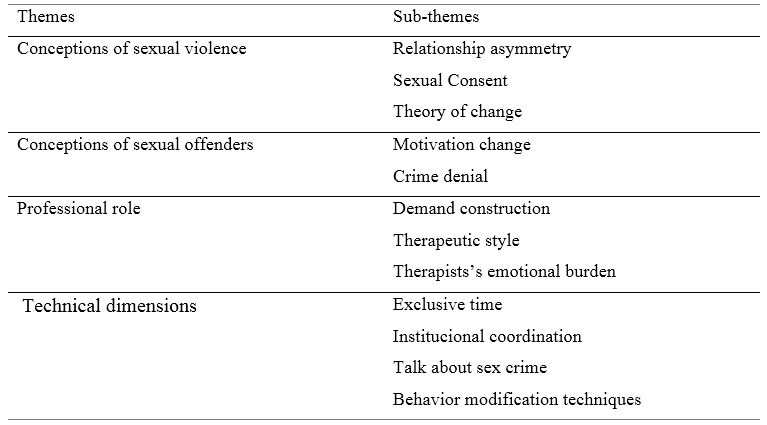
Through thematic analysis, we analyzed the empirical evidence corpus composed of documents and interview reports, from the group interviews and semi-structured interviews with the directorate. These corpus had been recorded for later transcription, coding, systematization, and inductive analysis by identifying common patterns in emerging issues (Terry et al., 2017). The coding process consisted of identifying recurrent themes that emerged in the professional team's group meetings. The codes were organized into four thematic areas: a) conceptions of sexual violence/influential factors, b) conceptions of sexual offenders, c) professional roles, and d) technical dimensions of intervention.
The most crucial analytical axis refers to the theoretical and technical dimensions necessary to implement a community-based treatment program with sexual offenders.
Themes and sub-themes
Results
In this article, we present results on the theoretical-technical dimensions present in the implementation of a community-based treatment program with sexual offenders, based on two analytical lines: a) the specificity of the approach with sexual offenders and b) the conceptions of sexual violence present in the key institutional actors. We consider the analysis of documents, the material of group interviews, and semi-directed interviews conducted in the public body between February and October 2018 in an integrated way.
The institutional aspects offer a legitimacy framework, both towards the community and towards the professionals who carry out a program of treatment of these characteristics. In the process of its implementation, the effort of the directorate to achieve an institutional articulation with other state agencies aims to allow the access of information that makes an adequate risk assessment of the sex offender and also make evident the connection of the program with other areas of social reintegration (work, family, education). Likewise, the directorate seeks to provide physical space and more significant dedication of professionals to the program, as well as necessary conditions for the development of a new and specific program in the institution.
Theoretical-technical dimensions to a treatment program for sexual offenders
a) The specificity of work with sex offenders
A first issue to highlight is the working conditions of the technical team assigned to the program, whose members do not have an exclusive dedication to this task, which was carried out within the framework of other responsibilities in the institution. According to professionals, the lack of time for the study and analysis of cases undermines the efficient development of the program. “We do not have time to attend sex offenders, we need to dedicate more time and if we have to work with other things we cannot” (Group interview, April 20, 2018).
The technical approach workers focus on is the monitoring and accompaniment for the social insertion of the offenders, without granting them a specific psychological treatment, according to the crime of sexual violence committed. In this sense, our main challenge has been to incorporate the specificity of the treatment of sexual crimes in the approach with sexual offenders. In a similar way, in group interviews, we noted that the professionals “lost sight” of the specificity that is involved in the assessment and psychological intervention with this population, equating their approach to the care provided to people who committed other crimes (thefts, prey, omissions). Also, manifestations of grief and discouragement were registered when referring to the difficulties involved in specific work with this population compared to others: “we feel much pressure,” “it is denser when we speak, unlike others,” “every step you take has to have a justification” (Group interview, August 10, 2018).
A member of the technical team raised again the inquiry of what the objectives of the program are. The rest of the classmates answer that to avoid recidivism, to live better, not to hurt others. From the Psychology Faculty team, we point out the need to address their criminal sexual behavior, what they did, without overthinking it. Resistance is perceived by the team when talking about sexual crimes. (Excerpt from Field Journal of Group Interview, March 16, 2018).
One of the essential components for the development of the program is to have a system of registration and information of the sex offenders that guarantees confidentiality and privacy, adequate for the planning and systematic management of each case. In this sense, difficulties were observed in how to carry out the clinical records and their usefulness for the technical decision making for the treatment.
Technicians discuss the problem of recording, the time it takes them, and how they do it. One of them explains that it depends on who does it; for example, he says that in his case, he divides the information according to the areas he addresses. At that point, the others agree, and the premise arises: “It is the same as with the rest of the population we see.” From there, they discuss whether the records or the treatment are differential and specific, but they fail to reach any agreements (Excerpt from Field Journal of Group Interview, September 7, 2018).
Access to verified and quality information through inter-institutional cooperation at the state level are critical elements for the care of sexual offenders, bearing in mind the complexity of this type of population. Having accurate information about the profile of the sexual offender and their criminal conduct, testimonies of the victim (s) or other technical reports available in public bodies, favors an adequate risk assessment and allows to guide the technical intervention and its intensity. This aspect is considered relevant by the professional team, although generally, there are significant restrictions on access to information.
A pair of technicians expressed when they viewed record X: ‘this changed our profile.’ One could compare that version with the one that they had, and they were different. This changed which person was the one who made the complaint and created contradictions (Excerpt from Field Journal of Group Interview, September 7, 2018).
The tendency of sexual offenders to deny the crime committed or the presence of cognitive distortions (minimization, justification) and its incidence in treatment is known. Several authors have focused on the study of this relationship with diverse but coincidental results regarding its influence on adherence to treatment (Levenson & Macgowan, 2004; Maruna & Mann, 2006; Ware et al., 2018). Denial of crime, as well as erroneous and distorted thoughts and beliefs about abusive sexual behavior, are factors that can influence and maintain criminal behavior (Marshall et al., 2009), this being highly frequent in sexual offenders. This aspect has significant relevance and mainstreams, in our opinion, the entire intervention. Getting the offender to recognize the crime he committed and assume his responsibility is a specific technical challenge of working with this population. For the professional team, this attitude of the offenders creates obstacles but also challenges in the intervention.
The problem they face is the non-assumption of the crime at the beginning of the intervention. So it is proposed that it is a step by step process, and it is transversal to the entire intervention. It is not the same to recognize the conduct as the crime; a distinction is raised (Excerpt from Field Journal of Group Interview, April 20, 2018).
“Ask or not,” “what for?” (Group interview, April 20, 2018) if they always deny what they did,” stated the professionals, with expressions linked to feelings of fear of what may arise from those questions, maintenance of limits, and the difficulty in developing strategies to reverse these denial positions. This pertains to their own therapeutic style: what to say, how to ask, and how to stimulate the narrative of experiences. At the same time, the technical team manages to visualize different strategies to modify the denial position of the sex offender: “there is the one who does not want to talk, but also the one who says something and others who eventually say, maybe yes, something happened” (Group interview, May 18, 2018).
They identify different motivations of the offenders that attend the program, which differ from those commonly heard in other users of the institution, generally related to the need for job placement. Most sex offenders express the need to have a listening space about their life situation after the crime: “they come because they like to talk” (Group interview, August 24, 2018). In addition to this, they visualize that the treatment must be adjusted to the particularities of each sexual offender and that they should not necessarily, at the beginning of the procedure, make a detailed account of their criminal behavior.
A technical pair explains a case that they have been working on, and they indicate that the last interview was excellent because, among other things, the person ended up asking: “and what if I am guilty of what I did?” They are amazed by this and consider it an achievement (Excerpt from Field Journal of Group Interview, June 29, 2018).
A professional exposes a case and says that regarding the sexual crime, the person says little and is avoidant, they pose it with discouragement. She then argues that, since that person is about to travel to the place where the events occurred for a procedure, he told her that he wanted to work on impulsivity and guilt. The others express that this is very good (Excerpt from Field Journal of Group Interview, July 27, 2018).
Finally, an essential dimension because of its technical implications is the construction of the therapeutic or working alliance between the professional and the user. In this regard, in the interviews with the technical team, there were concerns about the modalities of conducting the interviews, the questions to be asked, the time to ask them in order not to hinder the work alliance.
At the end of the meeting, a member of the technical team expresses their insecurity when working, and explains how they understand that it is more complicated than working with other types of crimes since it begs for another form of approach. She feels some pressure when intervening; she argues that, in these cases, they must ask themselves why they ask, and with the supervision of other crimes, this does not happen. There is also a fear present of user abandonment of the treatment (Excerpt from Field Journal of Group Interview, August 10, 2018).
B) Conceptions about sexual violence and sexual offenders
Several years ago, Hercovich (1992) coined the term ’block of images’ to refer to the dominant representation of sexual violence and the sexual offender or, noting that this representation is imposed as the only reality, making it impossible to recognize the variability of characteristics and expressions of sexual violence and its perpetrators. According to Hercovich, we imagine that sexual violence is generated by an unknown attacker, at night, on the street (in public), and that the woman caused the situation either because of her clothes, because she was alone in the street, or because of the night. This representation blocks and inhibits the possibility of recognizing the different ways in which sexual violence is expressed.
In the initial stage of program implementation, it was observed in the professionals that conceptions of sexual violence that contradict the basic principles of its definition prevailed. We refer to how a situation of violence is configured in terms of power asymmetries between the perpetrator and the victim, preventing the ability to give consent.
A new case is presented. This is a case of rape; however, the technician, when presenting the case at the technical team meeting, uses the expression: ‘they had sexual relations’ with the victim, who is 20 years younger than the offender, with severe mental health problems and a sex worker. The Psychology Faculty team is concerned to hear this and asks: ‘Did the user say that with those words?’ to which the technician responds, ‘no, I'm saying that.’ (Excerpt from Field Journal of Group Interview, March 16, 2018).
These conceptions of sexual violence make it difficult to identify the strategies used by sexual offenders to find their victims, focused on detecting situations of vulnerability in their victims. Sex offenders in the process of treatment in the program confess that they search for “partners” on the internet; they offer themselves as “help and protection” towards young or unknown people by making their home available; they establish superficial affective relationships with women—some with small children—, they seek contact with who their victims are and are interested in work activities that involve contact and care of vulnerable populations (elderly, children).
A technical pair states that the person they were working with led a teenager that was living in the streets to live at their home. They look very anxious because they say they do not know how to handle this; they wonder how to deal with this situation (Excerpt from Group Interview Field Diary, July 27, 2018).
These aspects show one of the fundamental areas of work with sexual offenders: the identification of specific psychological needs associated with interpersonal relationships, intimate and affective deficits. It is necessary to reinforce the specialized technical training that allows for correcting the difficulties, fears, and assumptions of the professionals for the approach of the modalities of the sexual crime, their particular form of expression, the strategies of the offenders, and their emotional, cognitive and behavioral manifestations.
Discussion
As researchers at a public university, we are driven by our ethical-political commitment to the production of quality knowledge about relevant social problems that require specific contributions from Psychology. In the case of the prevention of sexual violence, we have prioritized treatment with sex offenders as a strategy to reduce the recurrence of such crimes and protect the human rights of potential victims. In this sense, we understand how relevant it is to link scientific knowledge produced from Psychology with public policy through the design, implementation, and evaluation of technical interventions based on an ethical approach to the commitment to human rights.
In the political and social sphere, various measures to deal with sexual violence are discussed. The increase in criminal penalties for sex offenders, including life imprisonment, has been proposed. Others hint that the death penalty should be applied. It is crucial to oppose this scenario with an alternative that is committed to the social reintegration of this population, based on the fact that we are facing a problem that is, at the same time, individual and social. Therefore, together with a policy of comprehensive treatment of sexual offenders, the Uruguayan State must deepen its policies of gender equality and transformation of inequitable power relations that are at the base of sexual violence as an expression of gender violence. In terms of theoretical-technical challenges, in our context, the need to deepen the articulation between the risk approach and models that emphasize processes focused on the motivation to change for the better, on strengths, and the construction of life projects far from crime is evident. A public community program with people released from prison with different profiles who attend voluntarily meets this articulation with proposals that use a wide range of work techniques to carry out the management of each case adequately.
This work process involves agreeing with the institution and its technical team, the characteristics of the device, the approach that supports it, the diagnostic and evaluation instruments, the ways of recording the information, and the analysis of the results. One relevant aspect is the incorporation of technical strategies into the program for the achievement of an adequate work alliance that promotes more significant commitment and adherence to treatment, including how communication with users is established (Willis et al., 2013). The concept of adherence to treatment is related to aspects such as cooperation, collaboration, therapeutic alliance, or adhesion. It involves a set of behaviors that includes the acceptance of being part of a treatment program, putting into practice the given indications, as well as incorporating them into daily life (Zaldivar, 2003). Attendance to the program itself is not an indicator of adherence, but rather the person’s commitment and motivation to change that should be considered. That is, successful rehabilitation increases as the professional and the person attended can form a working relationship in collaborative terms (Mcgrath, 2016).
Group interviews with the technicians about the design of the treatment program allowed us to identify beliefs and opinions about the possibilities of change for sex offenders, particularly in the face of the offenders' recurrent denial of the crime. This reality points to the relevance of incorporating motivational techniques from the initial stages of the intervention. This aims to transform the factors that are linked to the stigma that hinders the recognition of sexual crime, the particularities of their lives and their link to the desistance from the crime, as substantial aspects of the intervention (Maruna, 2001; Maruna and Mann, 2006).
This means attending to the technical capabilities of professionals, but also to their beliefs and conceptions about sexual violence and sexual offenders. Likewise, it is necessary to consider the social-preventive scope that a community treatment program has. In our case, the technical team has gone through a review of their conceptualizations about sexual violence, training in theoretical frameworks of reference and modeling of their therapeutic style.
The design and implementation of a treatment program with sexual offenders within the framework of a public policy presents enormous challenges and demands. In this process of intervention-research, we proposed a strategy that bets on the link between the implementation of public policy and the production of scientific knowledge in the field of sexual violence. The challenge of combining a research process with professional intervention has allowed us to contribute to the design and systematization of a pilot program of community treatment for sexual offenders, a pioneer in our country. In future research, it is necessary to define and implement an evaluation and monitoring system appropriate for this type of public program that analyzes its results and impact in terms of reduced recidivism and social insertion of ex-jailed sex offenders.
These results also have important implications for intervention. From our perspective, the definition of a program with these characteristics requires commitment and political will from decision-makers and the personnel assigned to its technical implementation. It is crucial to consider its viability and sustainability in the medium and long term as a state policy regarding prevention and attention of sexual violence. In our country, obstacles are visible and must be addressed to advance in the sustainable implementation of a program of these characteristics. We refer to the collaboration between state agencies to attend the passage from the penitentiary system to the community, coordination with probation devices, access to information management systems, among others.
Likewise, the results shine a light on the theoretical and technical training needs of professionals who implement a program with these characteristics. This implies the importance of having a solvent technical position and conceptions and therapeutic style in tune with the population and specific objectives of the program: profiles of sexual offenders, denial and minimization of crime and motivation for change, with particular attention to community-based treatments (Collins et al., 2010). These factors are linked to the principle of the responsivity of the RNR model, which has little development in research and which has established its close relationship with the effectiveness of treatments (Looman et al., 2005).
Through this intervention-research, we have been able to systematize the process of design and implementation of a pioneering program in Uruguay for the community treatment of sexual offenders. Given the characteristics of the research, a case study, the possibilities of transferring the information produced are linked to the specific aspects of the program, and the work process we do.
In the implementation of this intervention-research, we face challenges related to the changes of authorities in the public body with the ensuing uncertainty about the continuity of the program, as well as the absence of team members in group scheduled interviews that overlap with other work activities.
Conclusion
The design and implementation of a sexual offender psychological treatment program with a community approach require taking into account multiple dimensions related to technical issues about this population, and also to the social and institutional conditions for its development. The intervention-research implemented so far has demonstrated the need for the training of professional-technical personnel to deal with sexual offenders; the resistances and difficulties of professionals for technical intervention— which express the resistances that can be observed at a social level— and the complexities involved in the relationship between a public body and an academic institution to develop a public policy on a socially sensitive and controversial issue.
References
American Psychological Association (2017). Ethical principles of psychologists and code of conduct (pp. 1-16). Washington, DC: APA.
Andrews, DA & Bonta, J. (2010). Rehabilitating criminal justice policy and practice. Psychology, Public Policy, and Law, 16 (1), 39-55. http://dx.doi.org/10.1037/a0018362
Andrews, DA; Bonta, J. & Wormith, S. (2011). The risk-need-responsivity (RNR) model does adding the Good Lives Model contribute to effective crime prevention? Criminal Justice and Behavior, 38, 735 -755. http://dx.doi.org/10.1177/0093854811406356
Bandura, A. (1989). Human agency in Social Cognitive Theory. American Psychologist, Vol 44 (9), 1175-1186 https://doi.apa.org/doi/10.1037/0003-066X.44.9.1175
Collins, E., Brown, J. & Lennings, C. (2010). A qualitative review of community treatment with sex offenders: Perspective of the Offender and the Expert. Psychiatry, Psychology and Law, 17 (2), 290-303. https://doi.org/10.1080/13218710903421282
Denzin, N. & Lincoln, Y. (Eds.). (2018). The SAGE handbook of qualitative research. London: SAGE
de Almeida, A., Eyland, S., Ware, J., Galouzis, J. & Kevin, M. (2013). Internet sexual offending: overview of potential contributing factors and intervention strategies. Psychiatry, Psychology and Law, 20 (2), 168-181. http://dx.doi.org/10.1080/13218719.2011.633328
Farmer, M., McAlinden, AM & Maruna, S. (2015). Understanding desistance from sexual offending: A thematic review of research findings. Probation Journal, Vol 62(4), 320-335 https://doi.org/10.1177%2F0264550515600545
Fishman, DB, & Messer, SB (2013). Pragmatic case studies as a source of unity in applied psychology. Review of General Psychology, 17, 156–161. http://dx.doi.org/10.1037/a0032927
Gergen, KJ (2014). Pursuing excellence in qualitative inquiry. Qualitative Psychology, 1, 49–60. http://dx.doi.org/10.1037/qup0000002
Gergen, KJ, Josselson, R., & Freeman, M. (2015). The promises of qualitative inquiry. American Psychologist, 70, 1–9. http://dx.doi.org/10.1037/a0038597
González, E., Martínez, V., Leyton, C. & Bardi, A. (2004). Características de abusadores sexuales. Rev SOGIA , 11 (1 ), 6 -14.
Hanson, RK & Morton-Bourgon, K. (2005). The characteristics of persistent sexual offenders: a meta-analysis of recidivism studies. Journal of consulting and clinical psychology, 73 (6), p. 1154-1163. http://dx.doi.org/10.1037/0022-006X.73.6.1154
Hanson, RK, & Yates, PM. ( 2013). Psychological treatment of sex offenders. Current Psychiatry Reports, 15, 1-8. DOI 10.1007/s11920-012-0348-x
Hercovich, I. (1992). De la opción “sexo o muerte” a la transacción “sexo por vida”. Ana M. Fernández (comp.) Las mujeres en la imaginación colectiva. Una historia de discriminación y resistencias. Argentina: Paidós, 63-68.
Herrero, O. (2013). ¿Por qué no reincide la mayoría de los agresores sexuales? Anuario de Psicología Jurídica, 23, 71-77 https://doi.org/10.5093/aj2013a11
Hilterman, E. & Andrés- Pueyo, A. (2005). SVR-20 Manual de valoración del riesgo de violencia sexual. Adaptación versión española. España: Universidad de Barcelona.
International Association for the Treatment of Sexual Offenders (2020). Standards of care for the treatment of adult sexual offenders. https://www.iatso.org/index.php/iatso/standards-of-care
Instituto Nacional de Estadísticas (2013) Encuesta de Violencia Basada en Género y Generaciones. http://www.ine.gub.uy/encuesta-de-violencia-basada-en-genero-y-generaciones-evbgg-2013
Larrotta, R. & Rangel-Noriega, K. (2013). Agresor sexual. Aproximación teórica a su caracterización. Informes psicológicos, 13 (2), 103-120.
Lenta, M. M., Longo, R.G. & Zaldúa, G. (2019). Estrategias de mujeres ferroviarias frente a las violencias de género. Una experiencia desde la Psicología Social Comunitaria. Revista Interamericana de Psicologia/Interamerican Journal of Psychology (IJP), 53 (2), 195-207.
Levenson, JS & Macgowan, MJ (2004). Engagement, Denial, and Treatment Progress Among Sex Offenders in Group Therapy. Sexual Abuse: A Journal of Research and Treatment, 16 (1), 49-63. http://dx.doi.org/10.1177/107906320401600104
Levitt, HM, Bamberg, M., Creswell, JW, Frost, DM, Josselson, R., & Suárez-Orozco, C. (2018). Journal article reporting standards for qualitative primary, qualitative meta-analytic, and mixed methods research in psychology: The APA Publications and Communications Board task force report. American Psychologist, 73 (1), 26-46. http://dx.doi.org/10.1037/amp0000151
Ley N°17815 (2004) Violencia sexual comercial o no comercial contra niños, adolescentes o incapaces.Uruguay: Poder Legislativo. https://legislativo.parlamento.gub.uy/temporales/leytemp2450953.htm
Ley N° 19580 (2017) Violencia hacia las mujeres basada en género. Uruguay: Poder Legislativo. https://www.impo.com.uy/bases/leyes/19580-2017
Looman, J. & Abracen, J. (2013). The risk need responsivity model of offender rehabilitation: is there really a need for a paradigm shift? International Journal of behavioral consultation and therapy, 8 (3-4), 30 -36 http://dx.doi.org/10.1037/h0100980
Loinaz, I.; Nguyen, T.; Navarro, J.C. & Andrés-Pueyo, A. (2015). RSVP Protocolo para la valoración del riesgo de violencia sexual. Adaptación al español. España: Universidad de Barcelona.
Looman, J., Dickie, I. & Abracen, J. (2005). Responsivity Issues in the Treatment of Sexual Offenders. Trauma, Violence and Abuse, 6 (4), 330-353. https://doi.org/10.1177%2F1524838005280857
Magnone, N., Pacci, G. & Calce, C. (2016). Diagnóstico prospectivo en brechas de género y su impacto en el desarrollo. Violencias de Género. Montevideo: Oficina de Planeamiento y Presupuesto. Presidencia de la República. https://www.opp.gub.uand/sites/default/files/inline-files/Genero_violencias.pdf
Maruna, S. (2001). Making good: How ex-convicts reform and rebuild their lives. Washington, DC: American Psychological Association. https://psycnet.apa.org/doi/10.1037/10430-000
McCartan, KF. & Richards, K. (2021). The integration of people convicted of a sexual offence into the community and their (risk) management. Current Psychiatry Report, 23(8):52. https://doi.org/10.1007/s11920-021-01258-4
Marshall, WL (2001). Agresores Sexuales. España: Ariel.
Marshall, WL, Marshall, LE, Serran, GA & O'Brien, MD (2015). Rehabilitating Sexual Offenders. A strength-based approach. 2nd. Ed. Washington DC: APA Books.
Marshall, WL, Marshall, LE, Serran, GA & O'Brien, MD (2009). Self-esteem, shame, cognitive distortions and empathy in sexual offenders: their integration and treatment implications. Psychology, Crime, and Law, Vol. 15 (2,3 ), 217-234.
Maruna, S. & Mann, RE (2006) A fundamental attribution error? Rethinking cognitive distortions. Legal and Criminological Psychology, 11 (2), 155-177. https://doi.org/10.1348/135532506X114608
Mcgrath, RJ (2016) Clinical strategies for evaluating sexual offenders. A. Phenix HM Hoberman (eds.) Sexual Offending. New York: Springer Science + Business Media.
Ministerio de Desarrollo Social (2017). Violencia Basada en género: desde el ámbito privado a la agenda pública. Cuadernos del Sistema de Información de Género Nº 7, Montevideo: MIDES, INMUJERES.
Ministerio del Interior. (2019) Presentación de cifras anuales de violencia de género de 2018. Uruguay: Observatorio de Criminalidad y Violencia. https://www.minterior.gub.uy/index.php?option=com_content&view=article&id=6283
United Nations (2013). Introduction guide to the prevention of recidivism and social reintegration of criminals. NY. www.unodc.org
WHO (2002) World Report on Violence and Health. http://www.who.int/violence_injury_prevention/violence/world_report/es/summary_es.pdf
WHO (2011) Sexual violence. http://apps.who.int/iris/bitstream/10665/98821/1/WHO_RHR_12.37_spa.pdf
Pan American Health Organization. (2013). Understand and embroider violence against women. Sexual violence Washington, DC: PAHO.
Poder Judicial (2018). Procesos concluidos en los juzgados letrados con competencia en materia penal en el nuevo Código del Proceso Penal (CPP, 2017). Uruguay: Departamento de Estadísticas.
Redondo, S., Pérez, M. & Martínez, M. (2007). El riesgo de reincidencia en agresores sexuales: investigación básica y valoración mediante el SVR-20. Papeles del Psicólogo, 28(3), 187-195.
Robertiello, G. & Terry, G. (2007). Can we profile sex offenders? A review of sex offender typologies. Aggression and violent behavior, 12, 508-518. https://doi.org/10.1016/j.avb.2007.02.010
Roth, Wl & Von Unger, H. (2018). Current Perspectives on Research Ethics in Qualitative Research. Forum: Qualitative Social Research, 19 (3), Art. 33. https://doi.org/10.17169/fqs-19.3.3155
Terry, G., Hayfield, N., Clarke, V. & Braun, V. (2017). Thematic Analysis In W. Staiton Rogers & C. Willig (Eds), The SAGE Handbook of Qualitative Research in Psychology (pp. 17-37). London: SAGE.
Tyler, N., Gannon, T.A & Olver, M.E (2021). Does treatment for sexual offending work? Current Psychiatry Reports, 23, 51. https://doi.org/10.1007/s11920-021-01259-3
Vargas, L., Montenegro, M., & Pujol, J. (2016). Miradas, formas de hacer y relaciones en la constitución de una investigación crítica. Universitas Psychologica, 14(5), 1833-1852. https://revistas.javeriana.edu.co/index.php/revPsycho/article/view/15610
Ward, T. & Stewart, C. (2003). Criminogenic needs and human needs: A theoretical model. Psychology, Crime & Law, 9, 125-143. https://doi.org/10.1080/1068316031000116247
Ward, T., Mann, R. & Gannon, T. (2007). The good lives model of offender rehabilitation: Clinical implications. Aggression and Violent Behavior, 12, 87-107. https://psycnet.apa.org/doi/10.1016/j.avb.2006.03.004
Ware, J., Blagden, N. & Harper, C. (2018). Are categorical deniers different? Understanding demographics, personality, and psychological differences between denying and admitting individuals with sexual convictions. Deviant Behavior. UK: Routledge, 1-14. https://doi.org/10.1080/01639625.2018.1558944
Willis, GM, Yates, PM, Gannon, TA & Ward, T. (2013). How to Integrate the Good Lives Model into Treatment Programs for Sexual Offending: An Introduction and Overview. Sexual Abuse: A Journal of Research and Treatment, 25 (2), 123-142. https://doi.org/10.1177/1079063212452618
Yates, PM (2013). Treatment of sexual offenders: research, best practices, and emerging models. International Journal of Behavioral consultation and therapy, 8 (3-4 ), 89-95. http://dx.doi.org/10.1037/h0100989
Yates, P. & Ward, T. (2008). Good lives, self-regulation and risk management: an integrated model of sexual offenders assessment and treatment. Sexual abuse in Australia and New Zealand, 1 (1 ), 2 -19.
Yin, RK (2018). Case study research: Design and methods. Thousand Oaks, CA: Sage.
Zaldivar, D. (2003). Adherencia terapéutica y modelos explicativos. Salud para la vida. www.infomed.sld.cu
Notes
Notas de autor
* Correspondence about this article should be addressed to Raquel Galeotti-Galmés: galeotti@psico.edu.uy
