Artículos
Analysis of the Associations Between Emotional Memory and Performance in Tasks with Cognitive Demand in Preschoolers
Análisis de las Asociaciones Entre Memoria Emocional y Desempeño en Tareas con Demanda Cognitiva en Preescolares
Analysis of the Associations Between Emotional Memory and Performance in Tasks with Cognitive Demand in Preschoolers
Revista Interamericana de Psicología/Interamerican Journal of Psychology, vol. 56, núm. 3, pp. 1-26, 2022
Sociedad Interamericana de Psicología

Esta obra está bajo una Licencia Creative Commons Atribución 4.0 Internacional.
Recepción: 18/09/2021
Aprobación: 01/09/2022
Abstract: Background. Emotional and cognitive processing are interconnected. Several researchers studied the association between different cognitive control processes and emotional memory, defined as the long-term storage of information accompanied by activating factors that will later favor its recall. Moreover, cognitive control processes include functions that regulate and coordinate attention, memory, language, inhibitory control, and planning. Method. Since these processes are susceptible to change during development, this study analyzed the associations between emotional memory (free recall and recognition) and cognitive processes (evaluated through Corsi and Stroop tasks) at 4 and 4.5 years of age in children from households with different socio-environmental conditions. Results. Significant correlations were found between: a) free recall of negative images and Stroop performance at 4 and 4.5 years; b) free recall of neutral images and Corsi performance at 4 years; c) recognition of negative and positive images and Stroop performance at 4.5 years; d) recognition of neutral images and socio-environmental conditions at 4.5 years. Conclusions. The results of this investigation allow us to highlight the fundamental relationship between the variables studied in this age of life cycle. These processes are closely linked and need to be analyzed together to provide a greater understanding of their mutual influences throughout child development.
Keywords: emotional memory, cognitive processes, development, processing, preschoolers.
Resumen: Antecedentes. El procesamiento emocional y cognitivo están interconectados. Varias investigaciones estudiaron la asociación entre diferentes procesos de control cognitivo y la memoria emocional, definida como el almacenamiento a largo plazo de información que se encuentra acompañada por factores activantes que posteriormente favorecerán su recuerdo. Además, los procesos de control cognitivo incluyen funciones que regulan y coordinan la atención, la memoria, el lenguaje, el control inhibitorio y la planificación. Método. Dado que estos procesos son susceptibles de cambiar durante el desarrollo, este estudio analizó las asociaciones entre la memoria emocional (recuerdo libre y reconocimiento) y los procesos cognitivos (evaluados a través de tareas de Corsi y Stroop) a los 4 y 4,5 años de edad en niños de hogares con diferentes condiciones ambientales. Resultados. Se encontraron correlaciones significativas entre: a) el recuerdo libre de imágenes negativas y el desempeño de Stroop a los 4 y 4,5 años; b) el recuerdo libre de imágenes neutras y el desempeño de Corsi a los 4 años; c) el reconocimiento de imágenes negativas y positivas y el desempeño de Stroop a los 4,5 años; d) el reconocimiento de imágenes neutras y las condiciones socioambientales a los 4,5 años. Conclusiones. Los resultados de esta investigación permiten resaltar la relación fundamental entre las variables estudiadas en esta edad del ciclo vital. Estos procesos están íntimamente ligados y necesitan ser analizados en conjunto para brindar una mayor comprensión de sus influencias mutuas a lo largo del desarrollo infantil.
Palabras clave: memoria emocional, procesos cognitivos, desarrollo, procesamiento, preescolares.
Introduction
Cognition and emotion are closely linked. One of the ways to address this interaction is through the study of emotional memory. Emotional events are better remembered than trivial ones (Brainerd et al., 2010; Christianson, 1992; Quas & Lench, 2007). Emotions would function as a filter system for selecting the events that are going to be stored in memory in a more durable way (Rodrigues et al., 2004; Roozendaal & McGaugh, 2011). Specifically, emotional memory is the result of storing information that was accompanied by stressful or activating factors (or alert stimuli), which would contribute to the easy fixation of the memories (Bradley, 2014; Cordon et al., 2013). It is a type of long-term memory on information with emotional valence, either positive or negative (Bermúdez-Rattoni & Prado-Alcalá, 2001; Guzmán-Ramos et al., 2018; Justel et al., 2013; Siller-Pérez et al., 2018). Compared to other types, emotional memory is characterized by being persistent, relatively stable, and because its recovery can be both explicit (or conscious) and implicit (or unconscious) (Cocenas-Silva et al., 2013).
The emergence and development of emotional memory begin in the early stages of life and present significant changes at the preschool stage (Bauer et al., 2012). There are investigations in children indicating that emotions facilitate memory (Adelman & Estes, 2013; Kensinger & Ford, 2020) because it captures attention and provides an interpretive framework that facilitates the integrated processing of the whole aspects of an experience (Kensinger, 2009; Laney et al., 2004). The accuracy of emotional memories is significantly related to emotional knowledge in children, which consists of an accurate understanding of the expressions, feelings, and functions of discrete emotions (Izard et al., 2011). This suggests that the emotion and memory relationship would not be explained as simply maturation and that individual differences also play a key role in the recovery of those memories (Channell & Barth, 2013). In a previous study, we analyzed the emotional memory of images with different valence in 4- and 5-years-old children and found a differential performance analyzing the memory by considering the children’s appraisal of each image, compared to its inherent valence (Ruetti et al., 2019). Although a prevalence of negative memories was found, performance was higher when evaluating memory considering the children's emotional appraisal of the image, instead of the valence given by the task. These results emphasized the need to incorporate information from emotional appraisal when analyzing the performance of preschoolers. In the present work, we maintained this methodological approach to the evocation of emotional memory. Like other types of memory, the emotional is susceptible to being modified both by the influence of internal or individual factors, as well as by the context or socio-environmental variations (Cordon et al., 2013; Principe et al., 2017). The mediation theory suggests that emotional events recruit cognitive resources such as attention, distinctive processing, and organization, more than neutral events, resulting in a memory advantage for emotional stimuli (Talmi et al., 2007).
In another way, cognitive control processes allow us to process information and regulate thoughts and actions to respond adaptively according to objectives or tasks specific (Braver, 2012; Cáceres Nieto, 2015; Chiew & Braver, 2011; Medaglia, 2019; Palenciano et al., 2017). The cognitive control processes include all functions that regulate and coordinate the memory, the language, and the skills related to the action (Botvinick & Braver, 2015). This requires the ability to inhibit distracting stimuli or conflict, the maintenance of information, self-monitoring of behavior, and flexible modification of thoughts and behaviors towards a target (Medaglia, 2019). Several studies mention the relevance of analyzing cognitive control processes in conjunction with emotions (Hendricks & Buchanan, 2015; Whitmer & Gotlib, 2012). A recent meta-analysis suggests that brain regions commonly associated with cognitive control processes also play an important role in emotional processing (Song et al., 2017). In the preschooler stage, different types of cognitive control processes such as attention, inhibitory control, working memory, and cognitive flexibility are developed and integrated (Diamond, 2013; Garon et al., 2008; Kensinger, 2009). In this sense, preschoolers who had better performance in executive functions had higher scores on the assessment of socio-emotional skills and fewer behavioral problems (Rhoades et al., 2009). This study showed that children who received training in executive functions had significantly higher scores in socio-emotional skills than those who received no training.
Specifically, working memory is the ability to maintain and manipulate relevant information online to perform a task (Diamond, 2013; Schelble et al., 2012; Sdoia et al., 2019). It also allows retaining a quantity of limited information to generate possible solutions, while it is no longer perceptually present (Baddeley & Hitch, 1994; Bergman Nutley et al., 2011; D’Esposito & Postle, 2015). Moreover, different investigations found that the emotional valence of stimuli modulates working memory. The negative emotional valence (negative photographs) reduced brain activation related to this process (Perlstein et al., 2002). This result would suggest that the emotional valence may difficult the performance on working memory tasks. Various investigations addressed the interaction of working memory and irrelevant emotional context for the task. Performance in the spatial, but not verbal, working memory task was significantly affected, which can be explained by competition for limited resources of visual-spatial attention in the presence of threat (Lavric et al., 2003). By contrast, Gray (2001) found that spatial working memory performance improved during a negative mood, while verbal working memory performance improved during a positive mood (Gray, 2001). Shackman et al. used a similar procedure and demonstrate a reduction in the performance of spatial, but not verbal, working memory during the threat presented (Shackman et al., 2006).
On the other hand, inhibitory control implies the ability to ignore disturbance, remain concentrated, and avoid a dominant response to favor a more appropriate one based on context demands (Diamond, 2006). The interaction between inhibitory control and emotions was explored during child development. Children with better emotional competence tended to exhibit a better inhibitory control ability, greater solving problem capacity, and less impulsivity (Silkenbeumer et al., 2016; Zelazo et al., 2003, 2010). Additionally, inhibitory control can influence children’s emotions. For example, some studies found that children who had better inhibitory control ability (using Day/Night task), had the best performance of emotional competence (Fox et al., 2001; Fox & Calkins, 2003; Liew, 2012).
From a contextual perspective, socio-environmental conditions (i.e., conversation with parents) modulate children’s performance in learning and emotional memory tasks (Principe et al., 2017). For example, the memories of children with negative emotional valence situations (e.g., natural disasters, abuse episodes) improved their performance during a memory task (Haden et al., 2001). The mechanisms by which socio-environmental conditions can affect cognitive processes development include fundamentally maternal education (maximum number of years of schooling), parents’ mental health (depressive, anxiety, and social disorders), family stress, supportive social networks availability, quantity and quality of learning stimulation at home (Bradley & Corwyn, 2002; Gershoff et al., 2010; Hughes et al., 2009). Different investigations show that stressful situation response is one significant mediator of the environmental effect on cognitive development, as well as the opportunities to acquire learning from the preschool stage (Blair et al., 2011; Shonkoff et al., 2012).
Other studies analyze the performance in cognitive tasks of vulnerable populations. In particular, the stress caused by economic and social deprivation favors the appearance of negative emotional states and makes their regulation more difficult. This state of chronic stress could lead to parenting practices that are less receptive to the socioemotional needs of children, which could have an impact even at a cognitive level (Lacunza et al., 2009). In this sense, differences were found in sequential skills in 4- and 5-years-old children (Lacunza et al., 2010), and in a verbal working memory task in 8-years-old children (Ruiz & Del Río, 2012) based on poverty levels. For example, malnourished and non-malnourished children presented analogous sequential and simultaneous cognitive abilities. Meanwhile, 4- and 5-years-old with a lower level of poverty (characterized by parents with higher than primary schooling and stable, low-skilled occupations), handled information better serially and temporally, compared to their embedded peers in contexts of greater poverty (characterized by parents with a minimum educational level and unstable occupations or social plans) (Lacunza et al., 2010). In this sense, in a previous study, we compare the performance of an emotional memory task on preschoolers from different socio-environmental conditions (Ruetti et al., 2019). However, no differences were found between the groups by dividing them into favorable and unfavorable socio-environmental conditions. Taken together, these findings point to the need to further investigate the role of socio-environmental variations on the interaction between cognitive performance and emotions.
Despite the recent investigation on the study of the relationship between emotional memory, cognitive control processes, and socio-environmental conditions, developmental studies are not available to date. Therefore, the present study aimed to describe the associations between emotional memory with working memory, cognitive inhibition, and socio-environmental condition of the children’s home. Because the correlations evaluated may not be uniform during the preschool stage, the purpose is to describe the correlations between the variables above mentioned at two stages of development (i.e. 4 and 4.5 years of age). According to the information gathered, we can formulate some hypotheses. Our first hypothesis is that emotional memory will be positively correlated with working memory and inhibitory control at both ages. Our second hypothesis is that the socio-environmental conditions at home will be positively correlated with the three cognitive processes, also at both moments. Finally, we expect these correlations to be stronger at 4.5 than at 4 years of age.
Methods
Participants
An incidental sample of 34 children (15 girls) 4-years-old participated in the study. All children were native Spanish speakers and attended at a public kindergarten in the southern region of the Autonomous City of Buenos Aires (Argentina). The children participated in other tasks carried out by the researchers of this work. We controlled to spend enough time between tasks (one week of interval time) to avoid any possible effect on the performance. The children included in the sample had no developmental disorders in terms of their perinatal and postnatal health history.
Informed consent was obtained from parents/caregivers, and ethical approval was obtained from the Ethical Review Committee of Cemic (Directorate of Research. Av. Galván 4102, 1st Floor, C1431FWO, Autonomous City of Buenos Aires. Protocol N° 961), and by the Responsible Conduct Committee of the Faculty of Psychology of the University of Buenos Aires. The study was conducted according to American Psychological Association ethical standards (1992) and international and national children's rights laws respected by the Ethical Research Involving Children Project (Graham et al., 2015). Once the authorization was obtained from the school institutions where the activities were carried out, information meetings were organized for parents in which they had the opportunity to interact with the members of the research group, who informed them about the objectives and activities of the study, and then gave them a written informed consent with the same content. Consequently, they were invited to participate and to authorize the participation of their children, for which the signing of informed consent for each of the evaluations was a necessary condition.
Instruments
Emotional memory. This task includes two components (Ruetti et al., 2019):
Component A. Emotional Appraisal Task. This component assesses the attribution of emotional expressions to emotional images. The instrument consisted of two sets of stimuli. The first set was composed of 15 images with different valences (five negatives, five positives, and five neutrals) that were obtained from Development Affective Photographs System for children (DAPS; Cordon et al., 2013). All the images were in color, they had people (i.e., children, women), animals (i.e., dogs, cockroaches), objects (i.e., book, cup), or people performing actions (i.e., children playing with a ball, girl jumping the rope). These images were presented in counterbalanced order on a tablet or a notebook. The second set consisted of three images (in white and black) with emotional expressions (happy, sad, or neutral faces). Children observed the images of the first set and then had to chose one expression to show how they felt when they saw the images. The three images of the faces appeared on a sheet, which the children had available while they watched each image. Each photograph lasted on the screen until the children chose a face, and decided to move forward with the images, that is, the time varied among the children, but lasted approximately 2 seconds. The faces with emotional expressions were available all the time for the children to decide which one to choose. The participants did not have a time limit to decide. The choice was made by pointing with one finger, at one of the three faces with emotional expressions. Before beginning the task, the participants observed two example images. The variable of interest was children's appraisal response to images that had different valences (negative, positive, or neutral). This variable can be defined as the attribution of valence by each child to each visual stimuli with different emotional contents and could take values between 0 and 15.
Component B. Emotional Memory Test. This second session was after a delay of 7-10 days, and children were requested to evoke those images observed in session 1. The first phase consisted of evaluating free recall and the second phase was the recognition one, where we asked the children to identify the 15 previously valued images from a set of 30 images. The variables of interest were (1) Free recall: number of images of each valence evoked after the 7-10 days. (2) Recognition: number of images recognized from the previous task. Each image evoked (free recall) or recognized (recognition) in session 2 was considered positive, negative, or neutral based on the valence given by the child in session 1 (Ruetti et al., 2019). The variables of interest were determined considering 0 as a minimum value and depending on the previous task’s maximum value, with a ceiling of 15. All variables were calculated as a proportion of the total recognized images of each valence.
Corsi Blocks Task. This task was designed to evaluate visuospatial working memory (Fracchia et al., 2016; Pickering, 2001). During administration, the child must watch, remember, and reproduce a sequence of lights (from one to eight, lighting time = 1000 ms), which are turned on inside a series of boxes arranged randomly in the apparatus. Each child reproduces the sequence by pointing to the light-containing boxes. Each block included five trials; difficulty levels increased with the number of lights and ranged from one to eight possible lights. The criterion for finishing the assessment was three consecutive errors; for this reason, the number of performed trials for each child varied according to their performances. We scored 1 if the sequence was correct and did not add/remove any lights; and 0 if the sequence was not correct, added or removed lights, or the child did not respect the order to wait for the “now” command. The variable of interest was the correct/incorrect proportion.
Day and Night Stroop Test for Children. This test requires inhibitory control ability, and the generation and memorization of two rules (Gerstadt et al., 1994). A set of 16 cards with two drawings is used for the test: (1) a yellow sun on a white background; and (2) a crescent moon and white stars on a dark gray background. The child had to say “day” each time he/she saw the drawing of the moon, and “night” each time he/she saw the sun. Two initial pre-test trials were administered, and then 16 trials in which they were successively and randomly shown the cards. If the child did the pre-test correctly, the test would begin. If he/she made a mistake, the pretest was repeated up to two more times, trying to make sure the child understood the instructions. The interval between trials was 30 seconds. The variable of interest was the number of correct answers, that could take values between 0 and 16.
Characterization of socio-environmental conditions. The questionnaire informed about parents’ education and occupational levels, housing and overcrowding conditions, and unsatisfied basic needs indicators (Boltvinik, 1995). This information was obtained from the report of the families in individual interviews with the researchers. This scale was used in previous studies in Argentina (Lipina et al., 2004, 2005; Prats et al., 2017; Segretin et al., 2009, 2014). Scores were assigned directly to mothers and fathers for educational and occupational backgrounds; however, only the higher score was considered for the total scores. For housing conditions, scores were assigned based on the type of dwelling, floor, water, bathroom, ceiling, walls, and home property. The parental education and occupation subscales could take values between 0 and 12; the housing subscale had a range of 3-12 points, and the crowding subscale had a range of 0-9 points. The variable of interest was the total score and was obtained by the sum of the previous ones. Higher scores indicated better socio-environmental conditions at home.
Procedure
The evaluations were realized in four individual sessions (Figure1), and each session lasted approximately 15 minutes. Before each session, an operator asked teachers to authorize children to leave the classroom. Once in the evaluation room, each child sat down with an operator, who showed the items to be used, to familiarize with them before starting. This process was repeated six months after the first evaluation. Hence, each child was assessed twice: the first time at 4-years-old, and the second time at 4.5-years-old. To estimate the age of the participants in each of the evaluations, scholar age was considered (depending on the scholar room they attended).
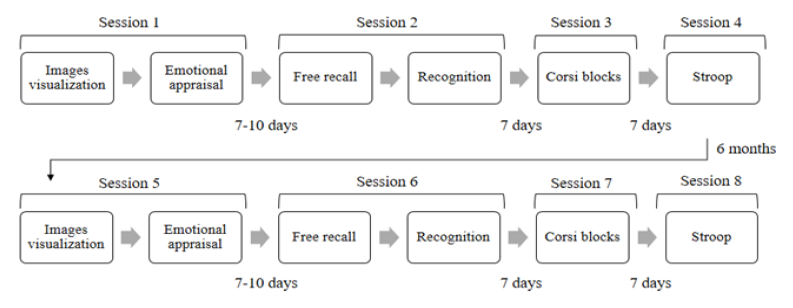
Figure 1
Assessment sessions for children
Data analysis
We performed descriptive analyses of variables of interest, which included mean, median, standard deviation, standard error, and sample size. Then, we evaluate the normality using the Shapiro-Wilk. However, we used non-parametric statistics since this assumption was not verified. To analyze the relationship between interest variables (free recall, recognition, Corsi scores, Stroop scores, socio-environmental scores), we performed Spearman correlations at the two moments of development (ages 4 and 4.5). Alpha value was settled at .05. Finally, considering the limited sample sizes, pos hoc power analyses were calculated. All analyses were performed using SPSS software (version 21.0).
Results
First, a descriptive analysis of the variables studied was carried out at 4 and 4.5 years. Sample sizes, medians, 25th and 75th percentiles, minimum and maximum values, and interquartile ranges were calculated for all variables (Table 1).
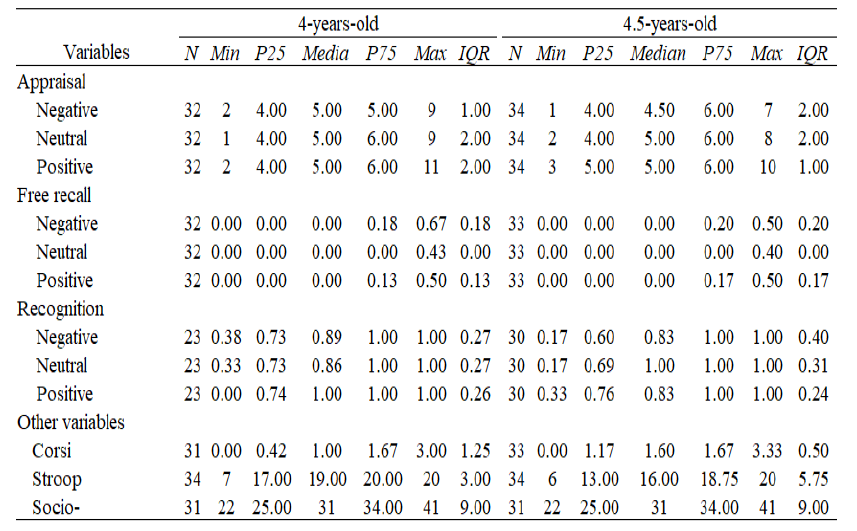
Then, we analyze correlations between evocation in the emotional memory task, obtained through free recall and recognition, with the performance in the Corsi and Stroop tasks, and socio-environmental conditions at 4 and 4.5 years.
Correlations at 4 years of age
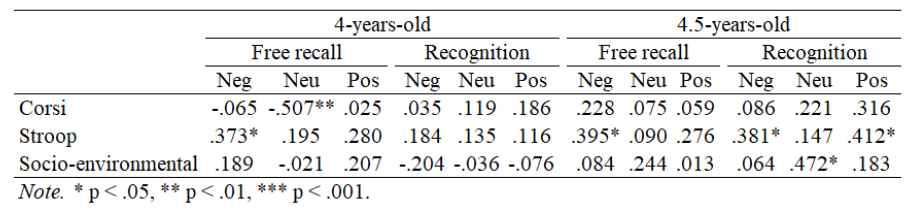
Only two correlations regarding free recall were statistically significant at this age. On the one hand, free recall of negative images was positively correlated with performance on Stroop task (rS = .373, p = .035, 1 - β = .57). On the other hand, free recall of neutral images showed a negative correlation with performance on the Corsi task (rS = -.507, p = .004, 1 - β = .84). None of the recognition variables was significantly correlated with any cognitive process o socio-environmental condition score at this age.Table 2shows the corresponding statistics of these correlations.
Correlations at 4.5 years of age
At this age, we found a few more correlations. First, Stroop performance was the only variable that correlated significantly with free image recall (negative images: rS = .395, p = .023, 1 - β = .64).
Regarding to recognition variables, we found positive correlations between recognition of negative (rS= .381, p = .038, 1 - β = .56) and positive images (rS = .412, p = .024, 1 - β = .64) and Corsi performance. In addition, the recognition of the neutral images correlated significantly with the socio-environmental conditions score (rS = .472, p = .013, 1 - β = .72).
Discussion
This study analyzes the correlations between emotional memory (free recall and recognition), cognitive control processes (specifically, Corsi and Stroop tasks), and socio-environmental conditions of children at different moments (4- and 4.5-years-old). We established several hypotheses but they were only partially fulfilled. Our first hypothesis proposed the existence of a positive correlation between emotional memory variables and performance in tasks with cognitive demand at both ages. We consider this hypothesis partially fulfilled since we found significant correlations between free recall of negative images and Stroop performance, both at 4 and 4.5 years; free recall of neutral images and Corsi performance at 4 years; and negative and positive image recognition and Stroop performance at 4.5 years. The second hypothesis proposed a positive correlation between the variables of the cognitive processes evaluated and the socio-environmental conditions of the household, also at both ages. This hypothesis is fulfilled to a lesser extent since we only found that recognition of neutral images was correlated with socio-environmental conditions at 4.5 years. Finally, the third hypothesis proposed that the correlations found would be stronger at 4 than at 5 years of age. Although few significant correlations were found, a greater number of statistically significant correlations can be observed at 4.5 years than at 4 years. However, the only significant correlation that remained at both 4 and 4.5 years was the free recall of negative images with Stroop performance, and in this case, a slightly stronger correlation was observed at 4.5 years than at 4 years of age. Regarding performance in this cognitive task, at 4.5 years of age correlations were found that were not present at 4 years (i.e. with recognition of images with negative and positive valence). Finally, at the age of 4, a correlation was observed between the free recall of neutral images and the Corsi performance, which was not found at 4.5 years of age. Taking all these results together, we can consider that the third hypothesis was also only partially fulfilled.
Therefore, when analyzing the correlations between emotional memory and cognitive control processes, it could be observed that these associations vary between 4 and 4.5 years. A possible explanation for these variations would be related to the processing modality of each particular process (Moffitt et al., 2011). Specifically, the emotional memory task used in this study and the Corsi task allows us to analyze the relationship between both types of memory, despite the distinction of being a long-term memory in the first one, and a very short term in the second one. In this case, both types of memory share the visual information processing modality, hence it could be thought that the stimuli encoding is similar in both paradigms (Chamberlain et al., 2006; Kensinger & Corkin, 2003). However, associations between both showed only at the age of 4 for the free recall variable. This demonstrates that the development pathways between these two types of memories were linked only at that age and about evaluation form with higher cognitive demand.
The relationship between emotions and inhibitory control in children was analyzed in the literature through the study of emotional competence and its association with performance in executive functions (Kwok et al., 2015; Healy et al., 2018; Lantrip et al., 2015; Smith et al., 2014). However, the causal relationship between both processes is not clear yet (Li et al., 2020), due to the limited evidence from experimental studies on this topic. On the one hand, there are studies in which children's emotional competence involved different systems such as affective, attentional, and self-control (Zelazo & Carlson, 2012), and which indicate that children's emotional competence development requires the ability to inhibit internalization, and modifies the emotional action provoked (Silkenbeumer et al., 2016). On the other hand, inhibitory control can influence emotional competence, since children with better executive functions abilities perform better in emotional regulation strategies (García-Andres et al., 2010). In this regard, in the present study, the association found between children's performances could be understood by linking emotional competence involved in the emotional memory task and inhibitory control capacity present in the Stroop task. Additional studies are required to explore whether this relationship can be causal, as it is suggested (Li et al., 2020).
The association between memory and inhibitory control in preschoolers has already been addressed through other paradigms (Traverso et al., 2020). In this case, the associations between emotional memory and Stroop task at both 4 and 4.5 years, and the two types of evaluation, may be linked to the processing modality of visual information that both tasks share. However, the Stroop task requires participants to keep in mind solving rules to complete the task at their response time. So, variations in associations between performances of these tasks could be explained in terms of the cognitive requirements present in both development stages (Traverso et al., 2020).
On the other hand, preschoolers’ behavior can be associated with different aspects of home socio-environmental conditions (Coke & Moore, 2017). Among the factors that might relate to children’s emotional responses, we can mention talks on emotional aspects (Ornaghi et al., 2011; Rieffe & Wiefferink, 2017; Van Bergen & Salmon, 2010; Waters et al., 2019), maternal storytelling styles (Doan & Wang, 2010; Wang, 2019) and culture to which they belong (Wang, 2008, 2019; Waters et al., 2019). For example, differential patterns were found in children’s responses to the Stroop task according to the socio-economic level of the families, and selective associations were also found between socio-economic indicators and cognitive performance, evidencing maternal education and conditions of housing as the main predictors of Stroop task responses (Arán Filippetti et al., 2021).
Based on our results, socio-environmental conditions were associated with variations in the expression of emotional memory of preschoolers only in the recognition variable. An adverse environment was not found to affect the expression of emotional memory obtained through free recall. This could be due to the different cognitive demands of the evaluation phases, where a high demand would prevent the expression of variations in performance due to the floor effect evidenced in participants (Whyte et al., 2017). Similar to what occurs in the literature, the results of this work show associations between the family and home indicators, and performance in an emotional memory task (Arán Filippetti et al., 2021).
Different limitations are present in this work. On the one hand, the responses obtained through free recall present a floor effect that does not allow analyzing the associations between emotional memory performance (assessed in this way) and the performance obtained in the other tasks. On the other hand, this study presents a limited sample size, which leads to moderate power of analysis. Although there is no certainty in this regard, it is possible that by increasing the sample size, effects that were not detected in this study but are detailed in the literature can be observed. Finally, additional research is required to elucidate the mechanism underlying the associations explored in this work. This will require studies that compare the performance of the proposed tasks in groups of children of different ages.
In conclusion, the results of this investigation allow us to highlight the fundamental relationship between the variables studied in this age of life cycle, and that these processes are closely linked and need to be analyzed together to provide a greater understanding of their mutual influences throughout child development (Braver et al., 2010; Espinet et al., 2012; Obradovic & Boyce, 2009; Miyake & Friedman, 2012; Scruggs & Mastropieri, 2013; van Noordt & Segalowitz, 2012). These findings provide evidence for the need to address cognitive and emotional processing in an integrated manner during child development.
Conflicts of Interest:
The authors declare that the research was conducted in the absence of any commercial or financial relationships that could be construed as a potential conflict of interest.
Acknowledgments
This research was supported by CONICET, Ministry of Research (Buenos Aires City Government), and the National Fund for Scientific and Technical Research (Grant PICT 2014-3134).
References
Adelman, J. S., & Estes, Z. (2013). Emotion and memory: A recognition advantage for positive and negative words independent of arousal. Cognition, 129(3), 530-535. https://doi.org/10.1016/j.cognition.2013.08.014
American Psychological Association (1992). Ethical principles of psychologists and code of conduct. American Psychologist, 47(12), 1060-1073.
Arán Filippetti, V., Richaud, M. C., Krumm, G., & Raimondi, W. (2021). Cognitive and socioeconomic predictors of Stroop performance in children and developmental patterns according to socioeconomic status and ADHD subtype. Psychology & Neuroscience, 14(2), 183-206. https://doi.org/10.1037/pne0000224
Baddeley, A. D., & Hitch, G. J. (1994). Developments in the concept of working memory. Neuropsychology, 8(4), 485. https://doi.org/10.1037/0894-4105.8.4.485
Barrett, L. F. (2006). Are emotions natural kinds? Perspectives on Psychological Science, 1(1), 28-58. https://doi.org/10.1111/j.1745-6916.2006.00003.x
Bauer, P. J., Leventon, J. S., & Varga, N. L. (2012). Neuropsychological assessment of memory in preschoolers. Neuropsychology Review, 22(4), 414-424. https://doi.org/10.1007/s11065-012-9219-9
Bergman Nutley, S., Söderqvist, S., Bryde, S., Thorell, L. B., Humphreys, K., & Klingberg, T. (2011). Gains in fluid intelligence after training non‐verbal reasoning in 4‐year‐old children: A controlled, randomized study. Developmental Science, 14(3), 591-601. https://doi.org/10.1111/j.1467-7687.2010.01022.x
Bermúdez-Rattoni, F., & Prado-Alcalá, R. A. (2001). Memoria: Dónde reside y cómo se forma [Memory: Where it resides and how it is formed]. Editorial Trillas.
Blair, K. S., Smith, B. W., Mitchell, D. G., Morton, J., Vythilingam, M., Pessoa, L., Fridberg, D., Zametkin, A., Nelson, E. E., Drevets, W. C., Pine, D. S., Martin, A., & Blair, R. J. R. (2007). Modulation of emotion by cognition and cognition by emotion. Neuroimage, 35(1), 430-440. https://doi.org/10.1016/j.neuroimage.2006.11.048
Blair, M., Vadaga, K. K., Shuchat, J., & Li, K. Z. (2011). The role of age and inhibitory efficiency in working memory processing and storage components. Quarterly Journal of Experimental Psychology, 64(6), 1157-1172. https://doi.org/10.1080/17470218.2010.540670
Boltvinik, J. (1995). Evolución y magnitud de la pobreza en México. Una visión basada en dos metodologías [Evolution and magnitude of poverty in Mexico. A vision based on two methodologies]. Reunión-diálogo sobre perspectivas sociales de México en el mediano plazo. Centro Tepoztlán. April 29.
Bradley, M. M. (2014). Emotional memory: A dimensional analysis. In S. H. M. van Goozen, N. E. Van de Poll, & J. A. Sergeant, S. H. M. van Goozen, & J. A. Sergeant (Eds.), Emotions (pp. 111-148). Psychology Press.
Bradley, R. H., & Corwyn, R. F. (2002). Socioeconomic status and child development. Annual Review of Psychology, 53(1), 371-399. https://doi.org/10.1146/annurev.psych.53.100901.135233
Brainerd, C. J., Holliday, R. E., Reyna, V. F., Yang, Y., & Toglia, M. P. (2010). Developmental reversals in false memory: Effects of emotional valence and arousal. Journal of Experimental Child Psychology, 107(2), 137-154. https://doi.org/10.1016/j.jecp.2010.04.013
Brainerd, C. J., Reyna, V. F., & Ceci, S. J. (2008). Developmental reversals in false memory: A review of data and theory. Psychological Bulletin, 134(3), 343-382. https://doi.org/10.1037/0033-2909.134.3.343
Braver, T. S. (2012). The variable nature of cognitive control: a dual mechanisms framework. Trends in Cognitive Sciences, 16(2), 106-113. https://doi.org/10.1016/j.tics.2011.12.010
Braver, T. S., Cole, M. W. & Yarkoni, T. (2010). Vive Les differences! Individual variation in neural mechanisms of executive control. Current Opinion in Neurobiology, 20(2), 242-250. https://doi.org/10.1016/j.conb.2010.03.002
Cáceres Nieto, V. (2015). La influencia de las emociones sobre los procesos de atención y memoria [The influence of emotions on the processes of attention and memory]. Retrieved from: https://uvadoc.uva.es/bitstream/handle/10324/14539/TFG-G%201351.pdf?sequence=1
Chamberlain, S. R., Müller, U., Blackwell, A. D., Robbins, T. W., & Sahakian, B. J. (2006). Noradrenergic modulation of working memory and emotional memory in humans. Psychopharmacology, 188(4), 397-407. https://doi.org/10.1007/s00213-006-0391-6
Channell, M. M., & Barth, J. M. (2013). Individual differences in preschoolers’ emotion content memory: The role of emotion knowledge. Journal of Experimental Child Psychology, 115(3), 552-561. https://doi.org/10.1016/j.jecp.2013.01.012
Chiew, K. S., & Braver, T. S. (2011). Positive affect versus reward: emotional and motivational influences on cognitive control. Frontiers in Psychology, 2, 279. https://doi.org/10.3389/fpsyg.2011.00279
Christianson, S. A. (1992). Remembering emotional events: Potential mechanisms. In S. A. Christianson (Ed.). The handbook of emotion and memory. Research and Theory (pp. 307-340). Psychology Press.
Cocenas-Silva, R., Bueno, J. L. O., & Droit-Volet, S. (2013). Emotion and long-term memory for duration: Resistance against interference. Behavioural Processes, 97, 6-10. https://doi.org/10.1016/j.beproc.2013.03.010
Coke, S. P., & Moore, L. C. (2017). Factors Influencing Female Caregivers’ Appraisals of Their Preschoolers' Behaviors. Journal of Pediatric Health Care, 31(1), 46-56. https://doi.org/10.1016/j.pedhc.2016.01.006
Cordon, I. M., Melinder, A. M., Goodman, G. S., & Edelstein, R. S. (2013). Children’s and adults’ memory for emotional pictures: Examining age-related patterns using the Developmental Affective Photo System. Journal of Experimental Child Psychology, 114(2), 339-356. https://doi.org/10.1016/j.jecp.2012.08.004
D’Esposito, M., & Postle, B. R. (2015). The cognitive neuroscience of working memory. Annual Review of Psychology, 66, 115-142. https://doi.org/10.1146/annurev-psych-010814-015031
Diamond, A. (2006). The Early Development of Executive Functions. In E. Bialystok & F. I. M. Craik (Eds.), Lifespan cognition: Mechanisms of change (pp. 70-95). Oxford University Press. https://doi.org/10.1093/acprof:oso/9780195169539.003.0006
Diamond, A. (2013). Executive functions. Annual Review of Psychology, 64, 135-168. https://doi.org/10.1146/annurev-psych-113011-143750
Doan, S. N., & Wang, Q. (2010). Maternal discussions of mental states and behaviors: Relations to emotion situation knowledge in European American and immigrant Chinese children. Child Development, 81(5), 1490-1503. https://doi.org/10.1111/j.1467-8624.2010.01487.x
Eisen, M. L., Goodman, G. S., Diep, J., Lacsamana, M. T., Olomi, J., Goldfarb, D., & Quas, J. A. (2019). Effects of interviewer support on maltreated and at-risk children’s memory and suggestibility. International Journal on Child Maltreatment: Research, Policy and Practice, 2(1), 55-78. https://doi.org/10.1007/s42448-019-00016-7
Espinet, S. D., Anderson, J. E., & Zelazo, P. D. (2012). N2 amplitude as a neural marker of executive function in young children: an ERP study of children who switch versus perseverate on the dimensional change card sort. Developmental Cognitive Neuroscience, 2, S49-S58. https://doi.org/10.1016/j.dcn.2011.12.002
Fox, N. A., & Calkins, S. D. (2003). The development of self-control of emotion: Intrinsic and extrinsic influences. Motivation and Emotion, 27(1), 7-26. https://doi.org/10.1023/A:1023622324898
Fox, N. A., Henderson, H. A., Rubin, K. H., Calkins, S. D., & Schmidt, L. A. (2001). Continuity and discontinuity of behavioral inhibition and exuberance: Psychophysiological and behavioral influences across the first four years of life. Child Development, 72(1), 1-21. https://doi.org/10.1111/1467-8624.00262
Fracchia, C. S., Giovannetti, F., Gili, J., Lopez-Rosenfeld, M., Hermida, M. J., Prats, L. M., Segretin, M. L., & Lipina, S. J. (2016). Individuality and Self-regulation in Preschoolers. Diskurs Kindheits-und Jugendforschung/Discourse. Journal of Childhood and Adolescence Research, 11(4), 457-471. https://doi.org/10.3224/diskurs.v11i4.25604
Garon, N., Bryson, S. E., & Smith, I. M. (2008). Executive function in preschoolers: a review using an integrative framework. Psychological Bulletin, 134(1), 31. https://doi.org/10.1037/0033-2909.134.1.31.
Gershoff, E. T., Grogan‐Kaylor, A., Lansford, J. E., Chang, L., Zelli, A., Deater‐Deckard, K., & Dodge, K. A. (2010). Parent discipline practices in an international sample: Associations with child behaviors and moderation by perceived normativeness. Child Development, 81(2), 487-502. https://doi.org/10.1111/j.1467-8624.2009.01409.x
Gerstadt, C. L., Hong, Y. J., & Diamond, A. (1994). The relationship between cognition and action: performance of children 312-7 years old on a Stroop-like day-night test. Cognition, 53(2), 129-153. https://doi.org/10.1016/0010-0277(94)90068-X.
Graham, A., Powell, M. A., & Taylor, N. (2015). Ethical research involving children: Putting the evidence into practice. Family Matters, 96, 23-28. https://doi.org/10.3316/aeipt.207884
Gray, J. R. (2001). Emotional modulation of cognitive control: Approach-withdrawal states double-dissociate spatial from verbal two-back task performance. Journal of Experimental Psychology: General, 130(3), 436-452. https://doi.org/10.1037/0096-3445.130.3.436
Guzmán-Ramos, K., Venkataraman, A., Morin, J. P., Osorio-Gómez, D., & Bermúdez-Rattoni, F. (2018). Differential requirement of de novo Arc protein synthesis in the insular cortex and the amygdala for safe and aversive taste long-term memory formation. Behavioural Brain Research, 342, 89-93. https://doi.org/10.1016/j.bbr.2018.01.006
Healy, S. A., Im-Bolter, N., & Olds, J. (2018). Executive function and emotional, behavioral, and social competence problems in children with epilepsy. Journal of Child and Family Studies, 27(8), 2430-2440. https://doi.org/10.1007/s10826-018-1079-3
Hendricks, M. A., & Buchanan, T. W. (2015). Individual differences in cognitive control processes and their relationship to emotion regulation. Cognition and Emotion, 30(5), 912-924. https://doi.org/10.1080/02699931.2015.1032893
Hughes, C., Ensor, R., Wilson, A., & Graham, A. (2009). Tracking executive function across the transition to school: A latent variable approach. Developmental Neuropsychology, 35(1), 20-36. https://doi.org/10.1080/87565640903325691
Izard, C. E., Woodburn, E. M., Finlon, K. J., Krauthamer-Ewing, E. S., Grossman, S. R., & Seidenfeld, A. (2011). Emotion knowledge, emotion utilization, and emotion regulation. Emotion Review, 3(1), 44-52. https://doi.org/10.1177/1754073910380972
Justel, N., Psyrdellis, M., & Ruetti, E. (2013). Modulación de la memoria emocional: una revisión de los principales factores que afectan los recuerdos [Modulation of emotional memory: a review of the main factors affecting memories]. Suma Psicológica, 20(2), 163-174. https://doi.org/10.14349/sumapsi2013.1276
Kensinger, E. A. (2009). What factors need to be considered to understand emotional memories? Emotion Review, 1(2), 120-121. https://doi.org/10.1177/1754073908100436
Kensinger, E. A., & Corkin, S. (2003). Memory enhancement for emotional words: Are emotional words more vividly remembered than neutral words? Memory & Cognition, 31(8), 1169-1180. https://doi.org/10.3758/BF03195800
Kensinger, E. A., & Ford, J. H. (2020). Retrieval of emotional events from memory. Annual Review of Psychology, 71, 251-272. https://doi.org/10.1146/annurev-psych-010419-051123
Kwok, S. Y., Yeung, J. W., Low, A. Y., Lo, H. H., & Tam, C. H. (2015). The roles of emotional competence and social problem-solving in the relationship between physical abuse and adolescent suicidal ideation in China. Child Abuse & Neglect, 44, 117-129. https://doi.org/10.1016/j.chiabu.2015.03.020
Lacunza, A. B., & Contini de González, N. (2009). Las habilidades sociales en niños preescolares en contextos de pobreza [Social skills in preschool children in poverty contexts]. Ciencias Psicológicas, 3(1), 57-66.
Lacunza, A. B., Contini, N., & Castro Solano, A. (2010). Las habilidades cognitivas en niños preescolares. Un estudio comparativo en un contexto de pobreza [Cognitive Skills in Preschoolers. A Comparative Study in a Context of Poverty]. Acta Colombiana de Psicología, 13(1), 25-34.
Laney, C., Campbell, H. V., Heuer, F., & Reisberg, D. (2004). Memory for thematically arousing events. Memory & Cognition, 32(7), 1149-1159. https://doi.org/10.3758/BF03196888
Lantrip, C., Isquith, P. K., Koven, N. S., Welsh, K., & Roth, R. M. (2016). Executive function and emotion regulation strategy use in adolescents. Applied Neuropsychology: Child, 5(1), 50-55. https://doi.org/10.1080/21622965.2014.960567
Lavric, A., Rippon, G., & Gray, J. R. (2003). Threat-evoked anxiety disrupts spatial working memory performance: An attentional account. Cognitive Therapy and Research, 27(5), 489-504. https://doi.org/10.1023/A:1026300619569.
Leventon, J. S., Stevens, J. S., & Bauer, P. J. (2014). Development in the neurophysiology of emotion processing and memory in school-age children. Developmental Cognitive Neuroscience, 10, 21-33. https://doi.org/10.1016/j.dcn.2014.07.007.
Li, Q., Liu, P., Yan, N., & Feng, T. (2020). Executive function training improves emotional competence for preschool children: The roles of inhibition control and working memory. Frontiers in Psychology, 11, 347. https://doi.org/10.3389/fpsyg.2020.00347
Liew, J. (2012). Effortful control, executive functions, and education: Bringing self‐regulatory and social‐emotional competencies to the table. Child Development Perspectives, 6(2), 105-111. https://doi.org/10.1111/j.1750-8606.2011.00196.x.
Medaglia, J. D. (2019). Clarifying cognitive control and the controllable connectome. Wiley Interdisciplinary Reviews: Cognitive Science, 10(1), e1471. https://doi.org/10.1002/wcs.1471
Miyake, A. & Friedman, N. P. (2012). The nature and organization of individual differences in executive functions: Four general conclusions. Current Directions in Psychological Science, 21(1), 8-14. https://doi.org/10.1177/0963721411429458
Moffitt, T. E., Arseneault, L., Belsky, D., Dickson, N., Hancox, R. J., Harrington, H., Houts, R., Poulton, R., Roberts, B. W., Ross, S., Sears, M. R., Murray Thomson, W., & Caspi, A. (2011). A gradient of childhood self-control predicts health, wealth, and public safety. Proceedings of the National Academy of Sciences, 108(7), 2693-2698. https://doi.org/10.1073/pnas.1010076108
Nelson, N. L., & Russell, J. A. (2016). Building emotion categories: Children use a process of elimination when they encounter novel expressions. Journal of Experimental Child Psychology, 151, 120-130. https://doi.org/10.1016/j.jecp.2016.02.012
Obradović, J. & Boyce, W. T. (2009). Individual differences in behavioral, physiological, and genetic sensitivities to contexts: Implications for development and adaptation. Developmental Neuroscience, 31(4), 300-308. https://doi.org/10.1159/000216541
Ornaghi, V., Brockmeier, J., & Gavazzi, I. G. (2011). The role of language games in children’s understanding of mental states: A training study. Journal of Cognition and Development, 12(2), 239-259. https://doi.org/10.1080/15248372.2011.563487
Palenciano, A. F., Díaz-Gutiérrez, P., González-García, C., & Ruz, M. (2017). Neural mechanisms of cognitive control/Mecanismos neurales de control cognitivo. Studies in Psychology, 38(2), 311-337. https://doi.org/10.1080/02109395.2017.1305060
Pegg, S., Dickey, L., Mumper, E., Kessel, E., Klein, D. N., & Kujawa, A. (2019). Stability and change in emotional processing across development: A 6‐year longitudinal investigation using event‐related potentials. Psychophysiology, 56(11), e13438. https://doi.org/10.1111/psyp.13438
Perlstein, W. M., Elbert, T., & Stenger, V. A. (2002). Dissociation in human prefrontal cortex of affective influences on working memory-related activity. Proceedings of the National Academy of Sciences, 99(3), 1736-1741. https://doi.org/10.1073/pnas.241650598
Pickering, S. J. (2001). The development of visuo-spatial working memory. Memory, 9(4-6), 423-432. https://doi.org/10.1080/09658210143000182
Prats, L., Segretin, M.S., Fracchia, C., Kamienkowski, J., Pietto, M., Hermida, J., ... & Lipina, S. (2017). Asociaciones entre factores individuales y contextuales con el desempeño cognitivo en preescolares de hogares con Necesidades Básicas Insatisfechas (NBI). Cuadernos de Neuropsicología/Panamerican Journal of Neuropsychology, 11(2).
Principe, G. F., Trumbull, J., Gardner, G., Van Horn, E., & Dean, A. M. (2017). The role of maternal elaborative structure and control in children’s memory and suggestibility for a past event. Journal of Experimental Child Psychology, 163, 15-31. https://doi.org/10.1016/j.jecp.2017.06.001
Quas, J. A., & Lench, H. C. (2007). Arousal at encoding, arousal at retrieval, interviewer support, and children's memory for a mild stressor. Applied Cognitive Psychology: The Official Journal of the Society for Applied Research in Memory and Cognition, 21(3), 289-305. https://doi.org/10.1002/acp.1279.
Ramírez, V. A., & Ruetti, E. (2021). Memoria emocional en niñas y niños preescolares de diferentes condiciones socioambientales [Emotional memory in preschool children of different socio-environmental conditions]. Revista de Psicología, 20(1), 157-177. https://doi.org/10.24215/2422572Xe097
Ramírez, V. A., Lipina, S. J., & Ruetti, E. (2021). Individual and Socio-environmental Differences in Autobiographical Emotional Appraisal of Preschoolers. Journal of Experimental Child Psychology, 201, 104982. https://doi.org/10.1016/j.jecp.2020.104982
Rhoades, B. L., Greenberg, M. T., & Domitrovich, C. E. (2009). The contribution of inhibitory control to preschoolers’ social-emotional competence. Journal of Applied Developmental Psychology, 30(3), 310-320. https://doi.org/10.1016/j.appdev.2008.12.012
Rieffe, C., & Wiefferink, C. H. (2017). Happy faces, sad faces: Emotion understanding in toddlers and preschoolers with language impairments. Research in Developmental Disabilities, 62, 40-49. https://doi.org/10.1016/j.ridd.2016.12.018
Rodrigues, S. M., Schafe, G. E., & LeDoux, J. E. (2004). Molecular mechanisms underlying emotional learning and memory in the lateral amygdala. Neuron, 44(1), 75-91. https://doi.org/10.1016/j.neuron.2004.09.014
Roozendaal, B., & McGaugh, J. L. (2011). Memory modulation. Behavioral Neuroscience, 125(6), 797-824. https://doi.org/10.1037/a0026187
Rothermund, K., & Koole, S. L. (2018). Three decades of Cognition & Emotion: A brief review of past highlights and future prospects. Cognition and Emotion, 32(1), 1-12. https://doi.org/10.1080/02699931.2018.1418197
Ruetti, E., Mustaca, A., & Bentosela, M. (2008). Memoria emocional: efectos de la corticosterona sobre los recuerdos [Emotional memory: effects of corticosterone on memories]. Revista Latinoamericana de Psicología, 40(3), 461-474.
Ruetti, E., Segretin, M. S., Ramírez, V. A., & Lipina, S. J. (2019). Role of emotional appraisal in episodic memory in a sample of Argentinean preschoolers. Frontiers in Psychology, 10, 2556. https://doi.org/10.3389/fpsyg.2019.02556
Ruiz, N. C., & Del Río, P. (2012). Memoria de trabajo verbal y su relación con variables socio-demográficas en niños colombianos [Memory of verbal work and its relationship with socio-demographic variables in Colombian children]. Acta Colombiana de Psicología, 15(1), 99-109.
Schelble, J. L., Therriault, D. J., & Miller, M. D. (2012). Classifying retrieval strategies as a function of working memory. Memory & Cognition, 40(2), 218-230. https://doi.org/10.3758/s13421-011-0149-1
Scruggs, T.E. & Mastropieri, M.A. (2013). PND at 25: Past, present, and future trends in summarizing single-subject research. Remedial and Special Education, 34(1), 9-19. https://doi.org/10.1177/0741932512440730
Sdoia, S., Di Nocera, F., & Ferlazzo, F. (2019). Memory for positional movements as a component of the visuospatial working memory. Cognitive Processing, 20(3), 363-369. https://doi.org/10.1007/s10339-019-00917-y
Segretin, M.S., Lipina, S.J. & Petetta, D.R. (2009). Consideraciones metodológicas y conceptuales para el análisis de predicción del desempeño escolar en base a indicadores del contexto hogareño y escolar”. Revista Iberoamericana de Evaluación Educativa, 2, 104-123. Retrieved from: http://www.rinace.net/riee/numeros/vol2-num2/art6.pdf
Segretin, M.S., Lipina, S.J., Hermida, M.J., Sheffield, T., Nelson, J.M., Espy, K.A., et al. (2014). Predictors of cognitive enhancement after training in a sample of Argentinean preschoolers from diverse socioeconomic backgrounds. Frontiers in Developmental Psychology, 13, A205.https://doi.org/10.3389/fpsyg.2014.00205
Shackman, A. J., Sarinopoulos, I., Maxwell, J. S., Pizzagalli, D. A., Lavric, A., & Davidson, R. J. (2006). Anxiety selectively disrupts visuospatial working memory. Emotion, 6(1), 40. https://doi.org/10.1037/1528-3542.6.1.40
Shonkoff, J. P., Richter, L., van der Gaag, J., & Bhutta, Z. A. (2012). An integrated scientific framework for child survival and early childhood development. Pediatrics, 129(2), e460-e472. https://doi.org/10.1542/peds.2011-0366
Silkenbeumer, J., Schiller, E. M., Holodynski, M., & Kärtner, J. (2016). The role of co-regulation for the development of social-emotional competence. Journal of Self-regulation and Regulation, 2, 17-32. https://doi.org/10.11588/josar.2016.2.34351
Siller-Pérez, C., Fuentes-Ibañez, A., Sotelo-Barrera, E. L., Serafín, N., Prado-Alcalá, R. A., Campolongo, P., Roozendaal, B., & Quirarte, G. L. (2018). Glucocorticoid interactions with the dorsal striatal endocannabinoid system in regulating inhibitory avoidance memory. Psychoneuroendocrinology, 99, 97-103. https://doi.org/10.1016/j.psyneuen.2018.08.021
Smith, M. J., Horan, W. P., Cobia, D. J., Karpouzian, T. M., Fox, J. M., Reilly, J. L., & Breiter, H. C. (2014). Performance-based empathy mediates the influence of working memory on social competence in schizophrenia. Schizophrenia Bulletin, 40(4), 824-834. https://doi.org/10.1093/schbul/sbt084
Song, S., Zilverstand, A., Song, H., Uquillas, F. D. O., Wang, Y., Xie, C., Cheng, L., & Zou, Z. (2017). The influence of emotional interference on cognitive control: A meta-analysis of neuroimaging studies using the emotional Stroop task. Scientific Reports, 7(1), 1-9. https://doi.org/10.1038/s41598-017-02266-2
Talmi, D. (2013). Enhanced emotional memory: Cognitive and neural mechanisms. Current Directions in Psychological Science, 22(6), 430-436. https://doi.org/10.1177/0963721413498893
Talmi, D., Schimmack, U., Paterson, T., & Moscovitch, M. (2007). The role of attention and relatedness in emotionally enhanced memory. Emotion, 7(1), 89. https://doi.org/10.1037/1528-3542.7.1.89
Traverso, L., Viterbori, P., Malagoli, C., & Usai, M. C. (2020). Distinct inhibition dimensions differentially account for working memory performance in 5-year-old children. Cognitive Development, 55, 100909. https://doi.org/10.1016/j.cogdev.2020.100909
Ursache, A., Blair, C., Stifter, C., & Voegtline, K. (2013). Emotional reactivity and regulation in infancy interact to predict executive functioning in early childhood. Developmental Psychology, 49(1), 127. https://doi.org/10.1037/a0027728
Van Bergen, P., & Salmon, K. (2010). Emotion-oriented reminiscing and children’s recall of a novel event. Cognition and Emotion, 24(6), 991-1007. https://doi.org/10.1080/02699930903093326
van Noordt, S. & Segalowitz, S.J. (2012). Performance monitoring and the medial prefrontal cortex: a review of individual differences and context effects as a window on self-regulation. Frontiers in Human Neuroscience, 6, 197. https://doi.org/10.3389/fnhum.2012.00197
Wang, Q. (2008). Emotion knowledge and autobiographical memory across the preschool years: A cross-cultural longitudinal investigation. Cognition, 108(1), 117-135. https://doi.org/10.1016/j.cognition.2008.02.002
Wang, Q. (2019). Culture in the organization of autobiographical memory. In J. Mace (Ed.), The Organization and Structure of Autobiographical Memory (pp. 72-92). Oxford University Press.
Waters, T. E., Camia, C., Facompré, C. R., & Fivush, R. (2019). A meta-analytic examination of maternal reminiscing style: Elaboration, gender, and children’s cognitive development. Psychological Bulletin, 145(11), 1082-1102. https://doi.org/10.1037/bul0000211
Whitmer, A. J., & Gotlib, I. H. (2012). Switching and backward inhibition in major depressive disorder: the role of rumination. Journal of Abnormal Psychology, 121(3), 570- 578. https://doi.org/10.1037/a0027474
Whyte, A. R., Schafer, G., & Williams, C. M. (2017). The effect of cognitive demand on performance of an executive function task following wild blueberry supplementation in 7 to 10 years old children. Food & Function, 8(11), 4129-4138. https://doi.org/10.1039/C7FO00832E
Zelazo, P. D., & Carlson, S. M. (2012). Hot and cool executive function in childhood and adolescence: Development and plasticity. Child Development Perspectives, 6(4), 354-360. https://doi.org/10.1111/j.1750-8606.2012.00246.x
Zelazo, P. D., Müller, U., Frye, D., Marcovitch, S., Argitis, G., Boseovski, J., Chiang, J. K., Hongwanishkul, D., Schuster, B. V., Sutherland, A., & Carlson, S. M. (2003). The development of executive function in early childhood. Monographs of the Society for Research in Child Development, 68(3), I-151.
Zelazo, P. D., Qu, L., & Kesek, A. C. (2010). Hot executive function: Emotion and the development of cognitive control. In S. D. Calkins & M. A. Bell (Eds.), Child Development at the Intersection of Emotion and Cognition (pp. 97-111). American Psychological Association. https://doi.org/10.1037/12059-006
Notas de autor
Correspondence about this article should be addressed Eliana Ruetti: elianaruetti@gmail.com