Artículos

Esta obra está bajo una Licencia Creative Commons Atribución 4.0 Internacional.
Recepción: 05/11/21
Aprobación: 01/09/22
Abstract: Previous studies show that the type of content and format of messages employed in campaigns about COVID-19 can influence the attitudes and behaviors of the population, increasing their commitment and engagement with measures to contain the disease. This study describes two experiments with 998 Brazilian adults, which main objective was to investigate whether behavioral intentions that contribute to the fight against COVID-19 would be significantly influenced by videos that address the disease from different strategies: one message was informative only, and the other was framed to mobilize empathy in viewers. The results indicate that exposure to both messages contributed to an increase in behavioral intentions of participants, when compared to others who formed a control group. Data also suggest that socioeconomic conditions are an important factor to consider when analyzing the effects of these messages on people’s behavior. We discuss the importance of considering the scientific evidence regarding the format and content of messages aired to the population. We also discuss the need to implement initiatives to protect people in more vulnerable socioeconomic conditions, so that actions in the field of Health Education may effectively contribute to combat the pandemic.
Keywords: pandemic, behavioral attitudes, prevention measures, health education, Brazil.
Resumo: Estudos anteriores mostram que o tipo de conteúdo e o formato de mensagens empregadas em campanhas sobre a COVID-19 podem influenciar as atitudes e comportamentos da população, aumentando seu compromisso e engajamento com as medidas de contenção da doença. No presente trabalho foram realizados dois experimentos com 998 adultos brasileiros, cujo objetivo principal foi investigar se as intenções comportamentais que contribuem para o combate à COVID-19 seriam significativamente influenciadas por vídeos que abordam a doença, a partir de diferentes estratégias: uma mensagem era apenas informativa e a outra era enquadrada para mobilizar empatia nos espectadores. Os resultados indicam que a exposição às duas mensagens contribuiu para elevar as intenções comportamentais dos participantes, quando comparados a outros que formaram um grupo controle. Os dados sugerem ainda que as condições socioeconômicas se constituem num importante fator a ser considerado, quando se analisam os efeitos destas mensagens no comportamento das pessoas. Discute-se a importância de se considerar as evidências científicas a respeito do formato e conteúdo das mensagens transmitidas à população, mas também a necessidade de implantação de iniciativas de proteção a pessoas em maior condição de vulnerabilidade socioeconômica, para que as ações no âmbito da Educação em Saúde contribuam efetivamente no combate à pandemia.
Palavras-chave: pandemia, atitudes comportamentais, medidas de prevenção, educação em saúde, Brasil.
Introduction
The COVID-19 pandemic was a serious global health crisis that led several nations to employ non-pharmacological intervention measures, as directed by the health authorities (World Health Organization, 2020). Despite the immunization program efficacy to reduce the number of cases and deaths, non-pharmacological measures should remain in force for a long time, given the high circulation rate of the virus, emergence of new variants, and slow pace of vaccination that varies greatly among countries (Young et al., 2021).
Although distancing measures have proven effective in curbing the disease spread, they entail huge social, psychological, and economic impacts on societies. It also strikes health systems, and the public sentiment for adherence to these measures (Habersaat et al., 2020). The epidemiological effects of physical distancing tend to be smaller in the poorest countries and can worsen the living conditions of the most vulnerable populations, such as informal workers, and it is up to the government to adapt intervention strategies to their local realities (Barnett-Howell et al., 2020). It is of paramount importance, thus, that government sectors reinforce interventions and activities targeted at the population, in order to raise individual and collective awareness (World Health Organization, 2020).
One important factor that should be considered is the way that communication between government agents and the public is established. In the pandemic context ambiguous messages can significantly affect people’s perception on the disease, and exacerbate the state of misinformation in the public, hindering their ability to make choices that reduce exposure to risk (Zhang et al., 2020; Heydari et al., 2021). When public authorities provide insufficient information and lack of clear directions about the severity of the pandemic, this condition constitute a stressor that favors disengagement from health measures (Brooks et al., 2020). On the other hand, communication is more effective to mobilize people when it is objective, credible, open, and promotes action (Loss et al., 2021).
In addition to the format of the information passed on by the government, another relevant aspect involves the way communication can influence people’s decision-making in the field of public health (Heffner et al., 2021). For example, people were more likely to adhere to the vaccination process for Avian Influenza and seek additional information about vaccine when text messages sent to them focused more on the benefits of immunization for other individuals (loved ones and strangers), rather than for themselves (Kelly & Hornik, 2016). Another example of research comparing different types of messages showed that both a message involving fear content (threat) and a prosocial message could motivate people to stay home, however, the fear stimulus was perceived as exciting and unpleasant by the participants, while the prosocial stimulus was reported as pleasant and causing moderate excitement (Heffner et al., 2021).
The evidence produced in those studies suggests that prosocial clippings in media pieces are preferable, as they positively mobilize individuals and not necessarily cause anxiety, which can be an aggravating factor in the face of the anxiogenic symptoms already present in the pandemic setting (Brooks et al., 2020). Prosocial frame of messages makes people take on the responsibility for the well-being of others (Venkateswaran, 2020). The explanation of the effects of prosocial framing on the helping behavior would rest on the motivational component produced by the empathy aroused in viewers (Coyne et al., 2018; Ding & Lu, 2016; Spinrad & Eisenberg, 2014; Hoffman, 2000).
Regarding the COVID-19 pandemic context, however, it was found that an empathetic message in text format was not enough to increase the intention to practice physical distancing, when compared to a message exclusively with educational content about the disease (Favero & Pedersen, 2020). The authors, however, suggest that this result may be related to the intensity of the prosocial appeal used, considering the low number of situational cues with the potential to induce empathy available in a written text, compared to other media such as videos and posters.
Pfattheicher et al. (2020) observed that young German adults’ motivation to adhere to virus control measures increased much more when technical information about pandemic control measures was associated with a video with empathetic content, compared to a control condition and another in which only the technical information was presented. However, that this study was done at a time when the pandemic was still in its early stages, and scientific knowledge about the disease was in its infancy.
Regarding the Brazilian reality, the challenges to face the pandemic were and continue to be enormous (Campos, 2020). They start with the high social inequality in the country, which affects income, access to health services, sanitation, and housing conditions, and exposes the poorest population more sharply to the impacts of COVID-19 (Bezerra et al., 2020). The efforts to disseminate and implement measures to cope with the disease have run into public demonstrations of opposition by politicians and authorities, such as the current president of the country, Jair Bolsonaro (Campos, 2020) For several times, the president of Brazil has positioned himself against the measures to restrict the movement of people adopted by state governors and city mayors, minimized the real risk of COVID-19, defended the use of preventive treatments through drugs whose effectiveness has not been scientifically proven, and raised doubts about the effectiveness of vaccines (Boschiero et al., 2021). This contradiction between the negationist stance adopted by the president of the republic and other politicians, on the one hand, and the recommendations by the WHO and scientists, on the other, may have influenced the population’s engagement to the measures of physical distancing (Campos, 2020; Boschiero et al., 2021).
One might wonder whether the effects of empathy on attitudes toward the COVID-19 pandemic observed in the study of Pfattheicher et al. (2020) could also occur in the Brazilian context. In the present study we sought to conduct a replication of Pfattheicher et al.´s study, investigating whether behavioral intentions that contribute to the fight against COVID-19 would be significantly influenced by videos that address the disease from different strategies: one more focused on the suffering of victims’ relatives, and another emphasizing technical information about the pandemic. We also tested whether specific socioeconomic factors of the Brazilian reality could influence the possible effects of the messages conveyed by the videos on the motivation to engage in caregiving behaviors toward the disease. To this end, two experiments were conducted, which will be described next.
For experiment I, we hypothesized that having a stimulus will generate greater motivation for appropriate behavior to prevent the spread of the disease than having no stimulus at all. And that the video with an empathic message will generate greater motivation for behavior than the informational message. For experiment II, in addition to testing the hypothesis of eliminating the effects of repeating the measurement in the pre- and post-test design, we maintain the two hypotheses of experiment I.5
Experiment I Method
Participants
446 participants responded to the survey; however, 34 protocols were excluded from the analyses because respondents were minors, because of repetitions in the answers, or because of errors in completing some of the check items. The final sample was composed of 403 respondents from the five regions of Brazil (Northeast = 50.4%, Southeast = 38.2%, South = 8.4%, North = 2%, and Center-West = 1%), with ages ranging from 18 to 78 years (M = 29.70; SD = 11.03), mostly women (67.7%), with different levels of education (Incomplete Elementary School: 0.2%, Complete Elementary School = 1.5%, High School = 49.6%, Undergraduate Degree = 25.8%, and Graduate Degree = 22.8%), and family income ranging between up to one (9.4%) to more than five Brazilian minimum wages (33.5%). Among participants, 28.8% belonged to risk groups for COVID-19, i.e., they had some health condition associated with higher mortality from the disease or were older than 65 years of age.
Instruments
Two short videos taken from an Internet portal were used as experimental stimuli: the first one, of informational nature (duration 2 min and 38 seconds), was produced by the Brazilian Ministry of Health using animations to explain what COVID-19 is, its characteristics, symptoms, consequences, forms of transmission, and health actions necessary to combat the disease (https://www.youtube.com/watch?v=LwUjglzIUhc). The second video, of empathetic nature, is a documentary (duration of 2 minutes and 3 seconds) produced by the EPTV in 2020, which presents reports of two women describing the suffering arising from the loss of their family members to COVID-19, and a third person who talks about the health condition of her fiancé, hospitalized in serious condition because of the disease (https://www.youtube.com/watch?v=xXJDrw-MaV0&feature=youtu.be). This second video is considered an empathic stimulus because it meets the following criteria: it features someone in grief, the narrative involves interpersonal relationships, and it is a realistic and affect-laden account (Shen, 2015). To test the effects of experimental manipulation, participants were asked how moved they felt after watching the videos (1 = Not at all moved to 5 = Fully moved), and how effective they believed that video could be in mobilizing people to practice physical distancing (1 = Not at all effective to 5 = Fully effective).
As measures of behavioral intentions, the following dependent variables were considered: (A) length of time (in months) that the participant reported they were still willing to maintain a more rigorous physical distancing (0 = I am no longer willing to maintain more rigorous distancing to 6 = I am willing to maintain more rigorous distancing for six months or more), the intention to (B) wear masks and to (C) sanitize hands when away from home, and finally, (D) the intention to leave home to do nonessential activities, assessed through eight items that asked about things the participant intended to do in the coming days (1. Visit family members who do not live with them, 2. Visit or meet friends to have some fun, 3. Going to bars, restaurants, or snack bars, 4. Going to shopping malls, stores, or commercial centers, 5. Traveling to other cities for leisure, 6. Practicing collective physical activities, 7. Go to parties and celebrations with other people, and 8. Attend mass or religious services with other people). To measure variables B, C, and D, five-point scales were used (1 = I certainly will not do this; 5 = I certainly will do this).
Each participant was also asked to answer four items to indicate their own real conditions to practice physical distancing (1 = No conditions; 5 = Total conditions), taking into consideration economic-financial factors and others related to their profession, the domestic environment (physical structure and sanitary conditions of the residence), their own health, and that of their family members. Other three items assessed how much respondents were restricted from their nonessential contacts with other people in different periods of 2020 (1 = Not at all; 5 = Completely restricted). The sums of the scores on the first four items and the last three items were used, respectively, to compose a measure of actual conditions of practicing physical distancing, and another measure of the degree to which nonessential contacts were restricted throughout 2020.
Participants’ sociodemographic data (age, gender, education, household income, and place of residence) were also collected, and three check and attention items were included (e.g.: “This is a probe item only, please tick item 2").
Procedures
The study followed a quasi-experimental design, with measurement of the dependent variables at two time points (pre- and post-test), and random assignment of each participant to one of three experimental conditions: Control (no presentation of any stimulus: n = 127; 65.4% female), Information (presentation of the Ministry of Health video: n = 128; 65.4% female), and Empathy (presentation of the news report with accounts of COVID-19 victims: n = 148; 70.9% female). The Allocate.monster tool (https://allocate.monster/) was used to randomize participants between conditions.
Participants accessed the survey link, read and filled out the Free and Informed Consent Form, and only then responded to the form. Data were collected over a 14-week period between December 2020 and February 2021 using an electronic questionnaire produced on Google Forms and disseminated via social media and email. Participants responded at their convenience using the device they had available. The researchers pre-tested the video and form and confirmed their compatibility with tablets, smartphones, and computers. The study was approved by a human research ethics committee prior to its start (CAAE: 33660820.2.0000.8267, opinion no. 4,294,751).
Data analysis
The Kolmogorov-Smirnoff test indicated that the data followed a non-Gaussian distribution (p < .005) and, therefore, non-parametric tests were used in the analyses. The scores of the four dependent variables at pre- and post-test were compared using Wilcoxon’s test. The Mann-Whitney and Kruskal-Wallis tests were used to compare two experimental groups and to compare the three groups, respectively. To evaluate the effects of physical distancing and restriction of nonessential contacts over 2020 on the dependent variables, and the effect size was calculated from the equation Importar  (Rosenthal, 1991).
Results
Participants in the Empathy condition (M = 4.20; SD = .84) indicated that they were more moved by watching the video in this condition than participants in the Information condition (M = 3.51; SD = 1.12). This points out to the effectiveness of the experimental manipulation in mobilizing empathic feelings in participants (U = 6102.50; z = -5.32; p < ,001; r = .44). In contrast, no differences were found between these two conditions regarding the evaluation about the effectiveness of videos in stimulating the practice of physical distancing between people.
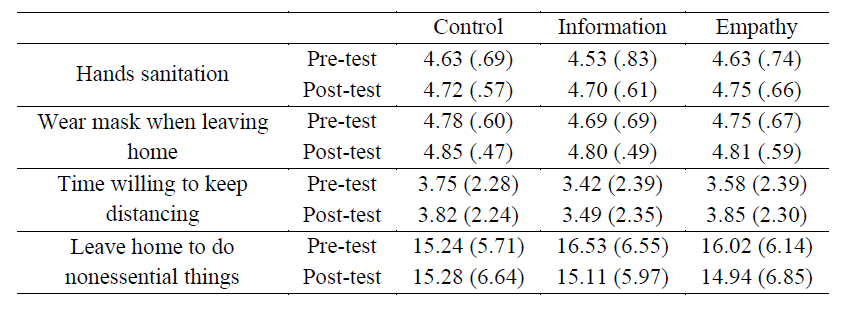
None of the four dependent variables significantly varied between the two test moments in the control condition (see Table 1). On the other hand, in the Empathy condition the scores of all dependent variables significantly varied between the pre- and post-tests: Time I would still be willing to maintain a stricter physical distance (z = -3.20; p = .001; r = .28), Intention to sanitize hands (z = -2.61; p = .009; r = .22), Wear masks when leaving home (z = -2.00; p = 046; r = .17) and, leaving home to do nonessential things (z = -5.54; p < .001; r = .48). In the Information condition, only the values referring to the DV intention to sanitize hands (z = -3.19; p = .001; r = .26) and to the DV leave home to do nonessential things (z = -6.14; p < .001; r = .50) varied significantly between the two moments of testing (Table 1).
Means (standard deviation) of the dependent variables by virtue of the experimental condition and testing moment
Significant associations were observed between the scores of the dependent variables in the post-test, the stated condition of practicing physical distancing, and restriction of nonessential contacts throughout 2020 (Table 2). Furthermore, the higher the scores on the variables that measured the overall condition of practicing physical distancing, the higher also were the scores on the variables assessing the practice of physical distancing at different periods of 2020 (ρ = .48; p < .001).
To further analyze the associations between stated general conditions and degree of restriction of nonessential contacts with behavioral intentions, participants were categorized according to the median value on the first two variables (17 and 13, respectively) as follows: up to the median = Less conditions, and Less degree of restriction; above the median = More conditions to practice physical distancing, and Greater degree of restriction. Next, the post-test scores of these two groups were compared, both overall and within each experimental condition.
Associations between the dependent variables and the conditions of practicing physical distancing in Experiment I (post-test) and Experiment II
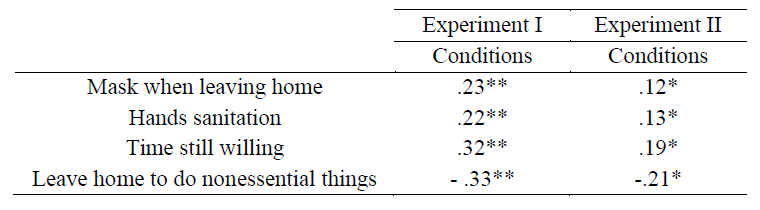
Note. * All correlations are significant at the level of .005 (2-tailed). ** Correlation is significant at the level of .001 (2-tailed).
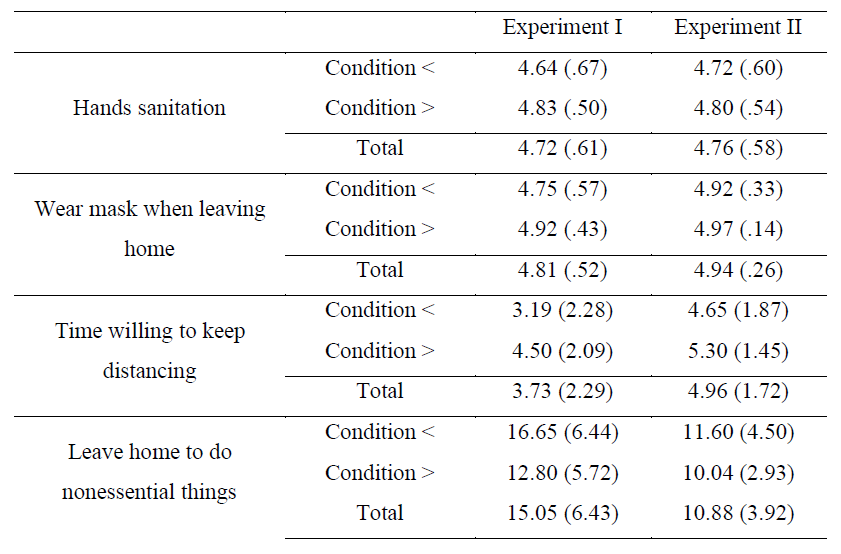
Initially, it was observed that, regardless of condition, participants who reported being more able (n = 167) to practice physical distancing had more favorable post-test scores for pandemic containment measures than participants who were less able to do so (n = 236) (Table 3): Intention to leave home to do nonessential things (U = 11506.50; z = - 7.13; p < .001; r = .35), time that one would be willing to maintain stricter distancing (U = 13438.00; z = - 5.67; p < .001; r = .27), Intention to sanitize hands (U = 17111.50; z = - 3.15; p = ,002; r = .11) and to wear a face mask when leaving home (U = 16861.50; z = - 4.17; p < .001; r = .12).
Means (standard deviations) in Experiments I (post-test) and II as a function of the condition of practicing physical detachment
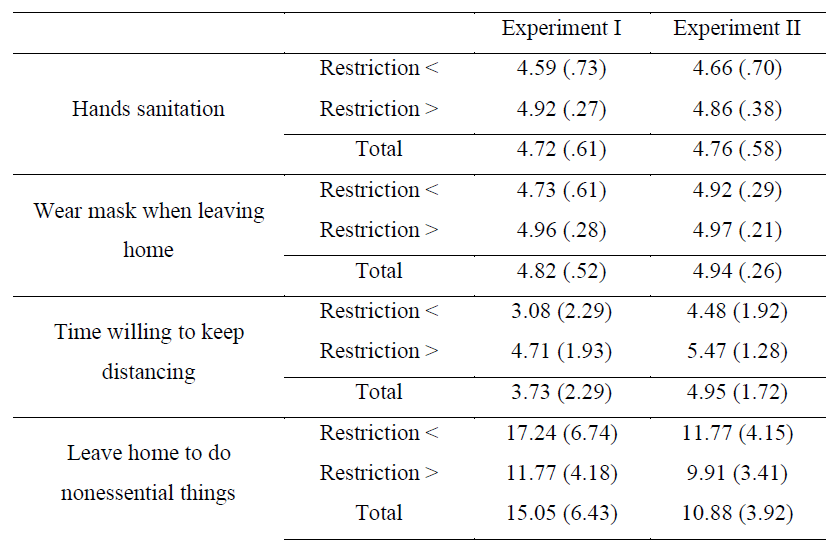
Finally, post-test scores on the four dependent variables were found to be significantly different among participants who report having more or less restricted nonessential contacts at different periods of the pandemic (Table 4): intention to sanitize hands (U = 15054.00; z = -5.42; p < .001; r = .19) and to wear masks when leaving home (U = 16138.00; z = -4.93; p = .009; r = .14), time that would still be willing to maintain a stricter detachment (U = 11652.00; z = -7.13; p < .001; r = .34) and intention to leave home to do nonessential things (U = 9074.50; z = -9.10; p < .001; r = .45).
Means (standard deviations) in Experiments I (post-test) and II as a function of the restriction of nonessential contacts during the pandemic
Discussion
The analyses suggest that both types of messages (informative and empathetic) influenced the behavioral intentions of respondents, once after viewing the videos participants expressed higher intention to adopt the measures to contain the COVID-19 pandemic, compared to the intention reported by the control condition participants. These results suggest that the promotion on TV or Internet campaigns presenting information about the disease and its consequences can be an effective strategy to motivate behaviors that contribute to the containment of the virus among people. In addition, the data showed that despite the presentation of the two types of videos (empathy and informational) having good indices of effect size, in the case of the empathy condition the scores of all dependent variables varied significantly between the pre- and post-tests. On the other hand, in the Information condition, only the values referring to two of the dependent variables varied significantly between the two testing moments.
Previous studies confirm this hypothesis, demonstrating that messages that arise empathy can stimulate the adoption of caring measures, leading viewers to feel connected to the suffering of other individuals (Peng et al., 2020). The efficacy of empathetic messages in motivating behavioral changes has also been evidenced in other contexts, such as anti-smoking campaigns (Shen, 2015) and in public service announcements against domestic violence (Kim & Muralidharan, 2019).
Regarding specifically the context of the COVID-19 pandemic, previous studies suggest that empathic mobilization, induced by prosocial messages, increases motivation to follow health recommendations, and to contribute for disease control by highlighting the possibility that their own actions will bring protection not only to themselves, but also benefits to the collectivity (Ceylan & Hayran, 2021; Jordan et al., 2020; Petrocchi et al., 2021). In this sense, the exhibition of empathetic messages can promote in people a sense of social responsibility, which would lead to greater propensity to follow public health measures that contribute to the containment of the disease. One aspect to be highlighted is the way these messages are presented. Our findings suggest that the situational clues available in the videos may make the suffering of the victims more evident, compared to messages that use only written text to stimulate empathy (Favero & Pedersen, 2020).
Overall, data produced in this first experiment goes in the same direction as the study of Pfattheicher et al. (2020), conducted with participants from Germany. Analyses indicate that in the Brazilian context the possible effects of messages with empathic video content may be mediated by the actual conditions people have to adhere to the recommendations by health authorities.
In the Brazilian socioeconomic reality, among the 89 million of individuals employed, more than 33 million are self-employed or have no formal employment contract (Instituto Brasileiro de Geografia e Estatística [IBGE], 2021). This explains why the decision making of these people does not take into account only prosociability, due to the need to maintain their own survival. This condition makes it difficult to adhere to health recommendations, especially regarding physical distancing measures.
In addition to these discrepancies in relation to financial stipends, the immunization process in Brazil had a late start, when compared to other countries. It is noteworthy that with the slow-paced vaccine coverage in Brazil, the economic reopening in the country has been hampered, further worsening the financial situation of the poorest layer of the population. Thus, this scenario requires not only that immunization reaches a higher level, but also that more comprehensive public policies are adopted, providing actual conditions for the most vulnerable citizens to adhere to measures to contain the virus while it is still necessary. This is an indispensable condition not only for Brazil, but also for other developing countries, in which people have to take the risks of being contaminated in order to work and ensure their daily livelihood (Barnett-Howell et al., 2021).
In the current study, although the results point to possible influence of the experimental stimuli on behavioral intentions towards the Covid-19 pandemic, the use of a pre- and post-test type design produces some limitations, such as repeating the measures of the dependent variables before and after the presentation of the experimental stimuli, which may sensitize participants to the real aims of the study (Wilson & Putnan, 1982). In this way, participants may create theories about the study and seek to tailor their behavior to its possible aims, which influences post-test measures (Nichols & Maner, 2008). In order to observe whether the results of Experiment I would be replicable at a different time of the pandemic and seeking to eliminate the possible effects of the pre-post-test design, a second study was conducted, which adopted an independent group design with a single post-test measure.
Experiment II Method
Participants
The survey form was answered by 625 individuals; however, 30 protocols were excluded because of errors in filling out the check items, because of repetition in responses, or because the respondent was a minor (n = 1). The final sample was composed of 595 participants (67.6% women), with ages ranging from 18 to 71 years (M = 32.81; SD = 11.55), from five Brazilian regions (Southeast: 56.3%, South: 17.8%, Northeast: 17.5%, Midwest: 5.9% and North: 2.5%), with different levels of education (Elementary School: 0.2%, High School: 35.5%, Undergraduate Degree: 32.3% and Graduate Degree: 32.1%). Income varied between up to one (5.5%) and above five Brazilian minimum wages (48.7%). In addition, 32.8% of the participants were classified as being in the risk group for COVID-19.
Each participant was randomly assigned to one of three experimental conditions via the Allocate.Monster tool: Control (31.3%), Empathy (32.4%), and Information (36.3%).
Instruments and Procedures
The same instruments and procedures were used as in Experiment I, with the difference that now participants answered questions referring to the dependent variables only once, right after the presentation of the experimental stimuli. Participants in the control condition, in turn, answered these questions right after collecting their sociodemographic and health data.
Data Analysis
Data were collected between March 08 and April 04, 2021. Similar to the first experiment, the main dependent variables were the intention to leave the house to do nonessential things, to sanitize hands with soap and water or alcohol gel, and to wear masks when leaving home, as well as the time (in months) that the participant indicated he/she was still willing to practice more rigorous physical distancing. Since the Kolmogorov-Smirnov test pointed out to a non-Gaussian distribution of data in these variables, non-parametric tests were employed for data analysis.
Results
Similarly to what had occurred in Experiment I, participants reported being more moved when watching the video in the empathy condition (M = 4.19; SD = .85) than those in the information condition (M = 3.21; SD = 1.27): U = 11581.50; z = -8.04; p < .001; r = .38. There were no differences in the assessment of how effective the videos could be in motivating people to practice physical distancing in the coming weeks.
When it comes to differences in the dependent variables as a function of experimental condition, only regarding the intention to sanitize hands when leaving home a significant difference was identified (z = 7.52; p = .023; r = .009). Pairwise comparisons showed that the mean scores of this variable were lower in the control condition than in the Empathy (U = 16472.50; z = -1.96; p = .050; r = .07) and Information (U = 18027.50; z = -2.57; p = .010; r = .08) conditions, with no differences between the latter two conditions.
In addition, significant correlations were identified between the dependent variables and the conditions of practicing physical distancing (Table 2). Conditions to practice physical distancing were also associated with nonessential contact restriction at different time periods in 2020 and 2021 (ρ = .42; p < .001).
Following the same procedures adopted in Experiment I, participants were ranked according to the median in the overall score of conditions to practice physical distancing (more conditions > 22 < less conditions), and in the degree of restriction of nonessential contacts throughout the pandemic (least restriction > 17 < greatest restriction). In general, it was again observed that participants with more conditions to practice distancing (n = 277) significantly differed from those with less conditions (n = 318), in relation to the four dependent variables. The former group indicated to be more favorable to the adoption of measures that contribute to fighting the pandemic (Table 3): intention to sanitize hands (U = 40982.50; z = -2.16; p = .031; r = .05) and to wear masks when leaving home (U = 42215.00; z = -2.46; p = .014; r = .03), time they would still be willing to keep a stricter distance (U = 35689.50; z = -4.82; p < .001; r = .16), and intention to leave home to do nonessential things (U = 34956.50; z = -4.24; p < .001; r = .17).
Participants who reported practicing greater restriction of nonessential contacts throughout the pandemic were also found to indicate greater intention to comply with measures to combat the spread of COVID-19 (Table 4): intention to sanitize hands (U = 30842.50; z = -4.33; p < .001; r = .26), and to wear masks when leaving home (U = 42256.50; z = -2.60; p = .009; r = .03), time that would still be willing to maintain a stricter distance (U = 31718.50; z = -7.18; p < .001; r = .24), and intention to leave home to do nonessential things (U = 28053.00; z = -4.33; p < .001; r = .31).
In an attempt to compare the results of the two experiments together, it was observed that, regardless of the experimental condition, participants in Experiment II had more favorable mean scores than those in Experiment I (Table 3) in all dependent variables, except for the intention to sanitize hands when leaving home: face mask use (U = 108991.50; z = -5.18; p < .001; r = .07), leaving home to do nonessential things (U = 66041.50; z = -12.15; p < .001; r = .38), and time that would still be willing to maintain a more rigorous physical distance (U = 83450.50; z = -9.07; p < .001; r = .25). Finally, respondents in Experiment II were found to have higher scores (MConditions = 21.16; SD = 3.30; MRestriction = 17.12; SD = 1.99) on the Conditions measures of practicing distancing (U =36473.50; z = -18.76; p < .001; r = .59) and restricting nonessential contacts (U =16321.50; z = -23.29; p < .001; r = .73) than did participants in Experiment I (MConditions = 16.83; SD = 3.30; MRestriction = 12.62; SD = 1.99).
Discussion
The results of the second experiment indicate that the influence of the messages presented in the videos were not as comprehensive with respect to disease containment measures as those observed in Experiment I. That was so because only the intention to sanitize hands increased after the presentation of the videos with empathic message and with informational content, when compared to the control condition.
In this regard, we initially highlight the pre-existing differences in the profiles of the respondents who composed Experiments I and II: the participants of Experiment II were, in general, better able to practice physical distancing than those who composed the sample of the first study; in addition, they stated that they were already practicing with greater intensity the protective measures, compared to the participants of Experiment I, regardless of their exposure to the videos. Thus, this profile may have generated a ceiling effect on the scores of the dependent variables, neutralizing or diminishing the possible influence of the experimental stimuli on behavioral intentions in Experiment II.
Another factor that may be associated with the differences in responses between the two studies is the fact that the experiments were conducted at different times during the pandemic. It is understood that the scenario of prolonged exposure to the virus may have contributed to the general population feeling saturated in the face of the high numbers of cases, “naturalizing” the seriousness of the situation and leading to lower impact of the type of video on attitudes and behaviors. As Slovic (2007) suggests, when people are exposed to large numbers of cases involving risks to individuals, these numbers may fail to arise emotions that mobilize helping behaviors. In this sense, due to exposure to the high numbers of COVID-19 cases accumulated over the months, the videos may not have been sufficient to motivate people to adopt the containment measures in the period when Experiment II was conducted.
Furthermore, taking into consideration the overall results found in Experiment II, it can be inferred that at the end of the first wave of the pandemic in Brazil, although people maintained a vigilant attitude toward the seriousness of the situation, their behaviors were no longer as consistent with measures to prevent contagion. This tendency seems to have intensified during the following months of the pandemic, and it was verified that people in better economic condition continued to restrict contacts. Those who were less well-off continued to demonstrate attitudes that were inconsistent with the containment measures. This is justified by the fact that these more vulnerable individuals needed to travel to their jobs away from home in order to preserve their own economic survival (De Groot & Lemanski, 2021; Komatsu & Menezes-Filho, 2020).
One aspect that also deserves attention refers to the differences between the influences of the messages in Experiment I and II, which can also be explained by the type of design of the studies. In the case of Experiment I, with the use of a design with pre- and post-test measures, the exposure of the stimulus at the first moment may have led to the sensitization of people in relation to the objective of the study, helping respondents to say that they followed sanitary measures more than those who took part in Experiment II. Furthermore, since the practice of these measures is considered a prosocial behavior, which is indicated in the literature as a type of behavior that brings good reputation to those who practice it (Kawamura et al., 2021), if the purpose of the study was understood in the pre-test, there is a possibility that the respondents responded under the effect of social desirability.
The results of Experiment II corroborate those of the first study by reinforcing the influence that socioeconomic conditions have on whether or not individuals adhere to measures to contain the pandemic. Aspects such as housing conditions, the presence of health care devices, and poverty are some of the determinants of compliance with restraint measures, so that although the effects of health crises affect all people, their impacts affect the segments of society in different ways (De Groot & Lemanski, 2021; Chu et al., 2020) and accentuate social and economic problems that permeate the Brazilians (Kantamneni, 2020; Calmon, 2020).
Taking into account that people’s adherence to the virus containment measures is influenced by their access to economic resources, it becomes essential to plan for social support strategies based on the principles of equity (Komatsu & Menezes-Filho, 2020; Calmon, 2020), through intersectoral and comprehensive public policies. In Brazil, the Food Purchase Program, a public policy created by Law No. 10,696 of July 2, 2003, stands as an instrument with potential to be used to address issues such as food insecurity of families in poverty. In this sense, such a program may be a strategy to be employed in the context of the pandemic of COVID-19, because, besides strengthening the local economy, it also promotes access to quality food to the most vulnerable populations (Sambuichi et al., 2020).
Conclusions
Our findings showed that the use of audiovisual stimuli with an empathic message had a greater influence on the behavioral intentions of Brazilians in the face of the Covid-19 pandemic than the audiovisual stimulus with only an informative message. The results indicate that exposure to both messages contributed to an increase in behavioral intentions of participants, when compared to others who formed a control group. Data also suggest that socioeconomic conditions are an important factor to consider when analyzing the effects of these messages on people’s behavior.
This research has some limitations, including the fact that only the intentions to practice protective measures were evaluated, and not the actual behavior of people. Furthermore, the measures were collected immediately after the presentation of the videos, and the possible effects of the intervention were not verified sometime after exposure to the stimuli. Thus, it is suggested that future studies investigate the actual behaviors of people after exposure to the videos and analyze the duration of their effects in a follow-up study. It is also suggested that future replications consider the effects of the pre- and post-test design, to better control for possible effects resulting from social desirability. Other limitations of the research refer to its experimental design: a neutral video was not used for the control group, the videos were not analyzed by independent judges and there was no control over the type of device (computer, tablet, cell phone, etc.) used by participants tp watch the videos.
Despite these limitations, this study presents advances that can contribute to the planning of public policies, as well as to the formulation of informative campaigns directed at the population. It is noteworthy that the potential of this research lies in the presentation of evidence that demonstrates that motivating people is not enough to engage them in actions to contain the virus. Especially in countries with similar realities to Brazil, it is essential to provide conditions for the population which already faces other problems such as underemployment and hunger, to adhere to non-pharmacological measures to combat the pandemic, such as the use of masks, hand hygiene, and, above all, physical distancing.
Conflicts of Interest:
The authors declare that the research was conducted in the absence of any commercial or financial relationships that could be construed as a potential conflict of interest.
Data availability statement:
The data that support the findings of this study are open available in the Open Science Framework repository at https://osf.io/y4w7f/?view_only=ed62dbfc1d3940e8ac81d3b620ae445e
Acknowledgments
Funding: This work was supported by the Brazilian National Council for Scientific and Technological Development - CNPq. Partial financial support was received from Instituto de Psicologia da Universidade de São Paulo (USP).
References
Barnett-Howell, Z., Watson, O. J., & Mobarak, A. M. (2021). The benefits and costs of social distancing in high- and low-income countries. Transactions of the Royal Society of Tropical Medicine and Hygiene, 115(7), 807–819. http://doi.org/10.1093/trstmh/traa140
Bezerra, A. C. V., Silva, C. E. M. D., Soares, F. R. G., & Silva, J. A. M. D. (2020). Fatores associados ao comportamento da população durante o isolamento social na pandemia de COVID-19. Ciência & Saúde Coletiva, 25(suppl.1), 2411-2421. http://doi.org/10.1590/1413-81232020256.1.10792020
Boschiero, M. N., Palamim, C. V. C., Ortega, M. M., Mauch, R. M., & Marson, F. A. L. (2021). One year of coronavirus disease 2019 (COVID-19) in Brazil: a political and social overview. Annals of global health, 87(1). http://doi.org/10.5334/aogh.3182
Brooks, S. K., Webster, R. K., Smith, L. E., Woodland, L., Wessely, S., Greenberg, N., & Rubin, G. J. (2020). The psychological impact of quarantine and how to reduce it: rapid review of the evidence. The Lancet, 395(10227), 912-920. http://doi.org/10.1016/S0140-6736(20)30460-8
Calmon, T. V. L. (2020). As condições objetivas para o enfrentamento ao COVID-19: abismo social brasileiro, o racismo, e as perspectivas de desenvolvimento social como determinantes. NAU Social, 11(20), 131-136. http://doi.org/10.9771/ns.v11i20.36543
Campos, G. W. D. S. (2020). O pesadelo macabro da Covid-19 no Brasil: entre negacionismos e desvarios. Trabalho, Educação e Saúde, 18(3). http://doi.org/10.1590/1981-7746-sol00279
Ceylan, M., & Hayran C. (2021). Message framing effects on individuals' social distancing and helping behavior during the COVID-19 Pandemic. Front Psychol, 22(12), 579164. http://doi.org/10.3389/fpsyg.2021.579164
Chu, I. Y. H., Alam, P., Larsan H. J., & Lin, L. (2020). Social consequences of mass quarantine during epidemics: a systematic review with implications for the COVID-19 response. Journal of Travel Medicine 27(7), 1-14. http://doi.org/10.1093/jtm/taaa192
Coyne, S. M., Padilla-Walker, L. M., Holmgren, H. G., Davis, E. J., Collier, K. M., Memmott-Elison, M. K., & Hawkins, A. J. (2018). A meta-analysis of prosocial media on prosocial behavior, aggression, and empathic concern: a multidimensional approach. Developmental Psychology, 54(2), 331-347. http://doi.org/10.1037/dev0000412
De Groot, J., & Lemanski, C. (2021). COVID-19 responses: infrastructure inequality and privileged capacity to transform everyday life in South Africa. Environment and Urbanization, 33(1), 255–272. http://doi.org/10.1177/0956247820970094.
Ding, F., & Lu, Z. (2016). Association between empathy and prosocial behavior: A systematic review and meta-analysis. Advances in Psychological Science, 24(8), 1159-1174. http://doi.org/10.3724/SP.J.1042.2016.01159
Favero, N., & Pedersen, M. J. (2020). How to encourage “Togetherness by Keeping Apart” amid COVID-19? The ineffectiveness of prosocial and empathy appeals. Journal of Behavioral Public Administration, 3(2), 1-18. http://doi.org/10.30636/jbpa.32.167
Habersaat, K. B., Betsch, C., Danchin, M., Sunstein, C. R., Böhm, R., Falk , A., Brewer, N. T., Omer, S. B., Scherzer, M., Sah , S., Fischer , E. F., Scheel , A. E., Fancourt, D., Kitayama, S ., Dublé, E., Leask , J., Dutta, M., MacDonald, N. E., Temkina, A..., & Butler, R. (2020). Ten considerations for effectively managing the COVID-19 transition. Nature Human Behaviour, 4(7), 677-687. http://doi.org/10.1038/s41562-020-0906-x
Heffner, J., Vives, M. L., & FeldmanHall, O. (2021). Emotional responses to prosocial messages increase willingness to self-isolate during the COVID-19 pandemic. Personality and Individual Differences, 170 (15), 110420. http://doi.org/10.1016/j.paid.2020.110420
Heydari, S. T., Zarei, L., Sadati, A.K., Moradi, N., Akbari, M., Mehralian, G., & Lankarani, K. B. (2021). The effect of risk communication on preventive and protective Behaviours during the COVID-19 outbreak: mediating role of risk perception. BMC Public Health, 21. http://doi.org/10.1186/s12889-020-10125-5
Hoffman, M. L. (2000). Empathy and moral development. implications for caring and justice. Cambridge University Press. http://doi.org/10.1017/CBO9780511805851
Instituto Brasileiro de Geografia e Estatística. (2021). Indicadores IBGE: Pesquisa Nacional por Amostra de Domicílios Contínua. Trimestre Móvel. fev-abr, 2021.https://biblioteca.ibge.gov.br/visualizacao/periodicos/2421/pnact_2021_1tri.pdf.
Jordan, J. J., Yoeli, E., & Rand, D. G. (2020). Don’t get it or don’t spread it? Comparing self-interested versus prosocial motivations for COVID-19 prevention behaviors. PsyArXiv. http://doi.org/10.31234/osf.io/yuq7x
Kawamura, Y., Ohtsubo, Y., & Kusumi, T. (2021). Effects of cost and benefit of prosocial behavior on reputation. Social Psychological and Personality Science, 12(4), 452- 460. http://doi.org/10.1177%2F1948550620929163
Kelly, B. J., & Hornik, R. C. (2016). Effects of framing health messages in terms of benefits to loved ones or others: an experimental study. Health Communication, 31(10), 1284-1290. http://doi.org/10.1080/10410236.2015.1062976
Kim, E., & Muralidharan, S. (2019). The role of empathy and efficacy in public service announcements. Journal of Advertising Research, 60(4), 452-466. http://doi.org/10.2501/JAR-2019-039.
Komatsu, B. K., & Menezes-Filho, N. (2020). Simulações de impactos da COVID-19 e da renda básica emergencial sobre o desemprego, renda, pobreza e desigualdade (Policy Paper, Nº 43). Retrieved from: Instituto de Ensino e Pesquisa. https://www.insper.edu.br/wp-content/uploads/2020/04/Policy-Paper-v14.pdf
Loss, J., Boklage, E., Jordan, S., Jenny, M. A., Weishaar, H., & El Bcheraoui, C. (2021). Risk communication in the containment of the COVID-19 pandemic: challenges and promising approaches. Bundesgesundheitsblatt, Gesundheitsforschung, Gesundheitsschutz, 64(3), 294-303. http://doi.org/10.1007/s00103-021-03283-3
Nichols, A. L., & Maner, J. K. (2008). The good-subject effect: Investigating participant demand characteristics. The Journal of General Psychology, 135(2), 151-166. https://doi.org/10.3200/GENP.135.2.151-166
Peng, L., Shen, L., Vanderbilt, R. R., Kim, Y & Foley, K. A. (2020). The impact of fear versus state empathy on persuasion and social stigma. Media Psychology, 23(1), 1-24. https://doi.org/10.1080/15213269.2018.1535321.
Petrocchi, S., Bernardi, S., Malacrida, R., Traber, R., Gabutti, L., & Grignoli, N. (2021). Affective empathy predicts self-isolation behaviour acceptance during coronavirus risk exposure. Scientific Reports, 11(1). https://doi.org/10.1038/s41598-021-89504-w.
Pfattheicher, S., Nockur, L., Böhm, R., Sassenrath, C., & Petersen, M. B. (2020). The emotional path to action: empathy promotes physical distancing and wearing of face masks during the COVID-19 Pandemic. Psychological Science, 31(11), 1363–1373. https://doi.org/10.1177/0956797620964422.
Rosenthal, R. (1991). Meta-analytic procedures for social research. Sage Publications.
Sambuichi, R. H. R., Almeida, A. F. C. S. D., Perin, G., Spínola, P. A. C., & Pella, A. F. C. (2020). O Programa de Aquisição de Alimentos (PAA) como estratégia de enfrentamento aos desafios da COVID-19. Revista de Administração Pública, 54(4), 1079-1096. https://doi.org/10.1590/0034-761220200258
Shen, L. (2015). Targeting smokers with empathy appeal antismoking public service announcements: a field experiment. Journal of Health Communication, 20(5), 573-580. https://doi.org/10.1080/10810730.2015.1012236.
Slovic, P. (2007). Psychic numbing and genocide. American Psychological Association. http://www.apa.org/science/about/psa/2007/11/slovic
Spinrad, T. L., & Eisenberg, N. (2014). Empatia, comportamento pró-social e desenvolvimento positivo nas escolas. In Furlong, M.J., Gilman, R., & Huebner, E.S. (Eds.), Manual de psicologia positiva nas escolas. (p. 82–98). Routledge.
Venkateswaran, T. V. (2020). Tale of two videos: Frame and narrative structure analysis of two COVID-19 communication social media messages. Journal of Scientific Temper, 8, 18-37.
Wilson, V. L., & Putnam, R. R. (1982). A meta-analysis of pretest sensitization effects in experimental design. American Educational Research Journal, 19(2), 249–258. https://doi.org/10.3102/00028312019002249
World Health Organization. (2020). Considerations for implementing and adjusting public health and social measures in the context of COVID-19. https://www.who.int/publications/i/item/considerations-in-adjusting-public-health-and-social-measures-in-the-context-of-covid-19-interim-guidance
Young, G., Xiao, P., Newcomb, K., & Michael, E. (2021). Interplay between COVID-19 vaccines and social measures for ending the SARS-CoV-2 pandemic. arXiv preprint. https://arxiv.org/abs/2103.06120
Zhang, L., Li, H., & Chen, K. (2020, March). Effective risk communication for public health emergency: reflection on the COVID-19 (2019-nCoV) outbreak in Wuhan, China. Healthcare, 8(1). https://doi.org/10.3390/healthcare8010064
Notes
Notas de autor
Correspondence about this article should be addressed Leonardo Rodrigues Sampaio: leorsampaio2012@gmail.com
