2023
571
15112021
11072022
 José Luis Rojas-Solís jlrojassolis@gmail.com
Benemérita Universidad Autónoma de Puebla, México
Christian Alexis Romero-Méndez
Universidad Autónoma de Nuevo León, México
Abstract: The possible bi-directionality of violence in young couples is a heavily debated topic in the scientific literature, which is why it requires greater specification in its analysis. This study is aimed at identifying the motives, context and response to dating violence behavior using a quantitative approach. A sample of 539 Mexican adolescents was used with a profile of victims and perpetrators. The results indicated jealousy as being the main motive why different forms of dating violence are committed and suffered, as well as noting that most of these violent acts usually arise in the middle of an argument. Furthermore, a similar percentage of men and women could use violence as a form of self-defense to other forms of violence exerted by their partner. In conclusion, more studies are needed to analyze the motives and context of violent acts and determine whether mutual violence arises as a form of self-defense or as a way to gain power and control over the other party.
Keywords: Dating violence, bidirectional, motives, adolescents.
Resumen: La posible bidireccionalidad de la violencia en parejas jóvenes es un aspecto muy debatido dentro de la literatura científica por lo que requiere una mayor especificación en su análisis. En ese sentido el presente estudio, a través de un enfoque cuantitativo, se encaminó en identificar los motivos, el contexto y las respuestas ante las conductas de violencia en el noviazgo en una muestra de 539 adolescentes mexicanos, con perfil de víctimas y perpetradores. Los resultados indicaron que los celos fueron el principal motivo por el que se cometen y sufren distintas formas de violencia en el noviazgo, también, que la mayoría de estos actos violentos suelen surgir en medio de una discusión. Por último, que un porcentaje similar de hombres y mujeres podrían utilizar a la violencia como una manera de autodefensa a la violencia ejercida por su pareja. Como conclusión, es necesario que más estudios analicen los motivos y el contexto de los actos violentos y determinar si la violencia mutua surge como una manera de autodefensa o como una forma de obtener poder y control sobre la otra parte de la pareja.
Palabras clave: Violencia en el noviazgo, bidireccional, motivos, contexto, adolescentes.
Artículos
Analysis of motives, context and bidirectionality of dating violence in young couples
Análisis sobre motivos, contexto y bidireccionalidad de las conductas violentas en el noviazgo de jóvenes
José Luis Rojas-Solís jlrojassolis@gmail.com
Christian Alexis Romero-Méndez
Received: 15 November 2021
Accepted: 11 July 2022
Violence is a multifaceted phenomenon that receives its definition in accordance with the context in which it occurs. In this sense, you can find gender violence, which implies asymmetric power relations that cause different types of violence in different contexts affecting mainly women but with the possibility that there are male victims ( Zambrano et al., 2017).
This is how a subtype of this form of violence can also be found in relationships. These involve those acts that cause physical, sexual, and psychological damage among the members of a couple who maintain an affective-sexual relationship. This concept can be used to refer to violence that occurs in adults, where there is a consolidated marriage, to that which arises in less formal young relationships such as courtship ( Batiza, 2017). In this regard, note that to refer to violence in young couples, the term dating violence is commonly used ( Peña et al., 2019).
Dating violence refers to the perpetration of psychological, physical, or sexual violence by a partner in a dating or previous romantic relationship, in the present or past, either in person or through electronic means ( Centers for Disease Control and Prevention, 2014). In this sense, scientific literature has chosen to consider three main types of violence due to the characteristics of dating relationships that differentiate them from marital violence, since in the latter other types of violence such as economic violence can occur; while in young couples this is not usually so common because adolescents usually still depend on their caregivers or guardians ( Peña et al., 2019).
In this order, psychological violence has been considered difficult to detect because the consequences are not usually visible and where the most common acts are criticism and insults ( Wincentak et al., 2017). As well as some controlling behavior, such as checking the partners cell phone ( Aizpitarte & Rojas-Solís, 2019). Alternatively, in physical violence there is the use of force manifested in hitting, shoving, and pulling ( Ramos et al., 2021). According to authors such as Esquivel-Santoveña et al. (2020), it can also be accompanied by psychological violence and controlling behavior.
Regarding sexual violence, both in the national and international context, it has been pointed out that its perpetration is greater from men to women, among other reasons because men can use it as a way to reaffirm their masculinity ( Romero-Méndez et al., 2021). Simultaneously, it is convenient to point out that there is a great problem of conceptual delimitation to what is considered sexual violence because only the act of rape tends to be understood as such. However, it is a continuum that involves more behaviors such as blackmail, pressure, or acts such as kisses and caresses without consent ( Wincentak et al., 2017).
However, regarding the prevalence of violent behavior in Mexico, the National Institute of Statistics and Geography ( INEGI, 2018) indicates that psychological violence is the type of violence that is most frequently exercised since it was reported that 40.1% of women have experienced on at least one occasion, behaviors such as insults, threats, and humiliation among others in their relationships.
Perhaps, due to the figures on the prevalence of this phenomenon both nationally and globally, it has been classified as an important public health problem ( Bott et al., 2019; Pérez-Ruiz et al., 2020). Adjacently, in recent decades, there has been a great boom around the different theoretical and ideological positions used to explain their characteristics and associated factors. In this way currently two great perspectives analyze the dynamics of violence both in the adult couple and in dating relationships in adolescents ( Reed et al., 2010; Riesgo et al., 2019): The first is based on feminist theory emphasizing a unidirectional position that considers men as the only perpetrators and women as the only victims of violence ( Ferrer-Pérez and Bosch, 2019); while the second perspective, called bidirectional, does not assign permanent roles between victims and perpetrators ( González et al., 2020) and analyzes violence from an interactional approach considering that both men and women can assume the roles of victims and perpetrators of violence ( Pérez-Ruiz et al., 2020).
In line with the aforementioned, in recent decades, empirical antecedents have suggested the bi-directionality of violence in young couples. This heavily debated topic points to the need for further development in its analysis, mainly due to its lack of specification and little contextualization ( López & Frías, 2020; Reed et al., 2010; Spencer et al., 2020). This is how much of the discrepancies are based on how research suggests that both sexes can be perpetrators of violence based on the prevalence and frequency with which violent behaviors are exercised, but omitting the context and reasons why women would also assume the role of perpetrators ( López y Frías, 2020; Palmetto et al., 2013). Furthermore, from the feminist perspective, it has been suggested that women tend to exercise violence as a form of self-defense against the violent acts of their partner, while men would perpetrate violence to exert power and control over them ( Dardis et al., 2015; Gidycz & Dardis, 2014; Rodriguez, 2015; Walker et al., 2018). Therefore, the violence in self-defense or in response to the violence of their male partner should not make them accretive to the adjective of abusers ( Langhinrichsen-Rohling et al., 2012; Saunders, 1986). As Benítez et al. (2017) mentioned, in this case, adolescent women would exercise violence unintentionally.
However, it is important to mention that the empirical evidence has not been consistently along the lines of this assumption, even showing contradictory results ( Elmquist et al., 2016). Favoring in recent decades, more specific distinctions in the study of the dynamics of violence in couples ( López & Frías, 2020; Spencer et al., 2020). These focused on the analysis, among other aspects, of the context of why men and women commit and suffer violence ( Rodríguez, 2015; Rodríguez-Franco et al., 2022).
One of the main antecedents lies in the study of Makepeace (1986) who analyzed the main reasons for committing physical violence in university men and women, and found that anger was the most common incentive. A decade later Foshee (1996) using a sample of adolescents classified self-defense violence as a motivation for intimate partner violence and found that this was the main reason for women to commit violence toward their male partners. Molidor and Tolman (1998) using a sample of 635 adolescents between 13 and 18 years old reported that 21% of men and 10% of women included in their sample perpetrated violence, pointing to jealousy as the main reason. However, close to 55% of women indicated that due to the effects of alcohol on their partner, violent behavior had occurred. Additionally, in another study by Shorey et al. (2010) with university students, 29 motives for physical violence were evaluated. Men and women stated that the expression of feelings such as anger or revenge were the most common incentives, interesting data were also found showing that physical violence could occur because it was sexually exciting.
Alternatively, note that the motives for committing violence have also been explored in couples who are in concubinage or in free union. In a study conducted by Babcock et al. (2019) it was found that 27% of physical violence by men and more than 22% of physical violent acts committed by women occurred in self-defense. Recently Calvete et al. (2021), in their validation of an instrument that aims to find the reasons and reactions of dating violence in adolescents, they found that jealousy and anger were the most common reasons.
On the reasons why violence arises in relationships, there is great variability in the results obtained that may be due to the fact that there is still no homogeneity in the methodology, measurement and development of constructs for the determination of the reasons for the perpetuation of violence against a partner ( Langhinrichsen-Rohling et al., 2012). It can be mentioned that a large part of the instruments used to evaluate the reasons are elaborated by the same authors ( Bair-Merritt et al., 2010) thus generating a greater diversity of responses. Likewise, numerous studies focus mainly on evaluating power, control, and self-defense as motives because they have been aimed at contrasting the two main assumptions of the perpetration of violence by men, for power; and in the case of women, for self-defense ( Langhinrichsen-Rohling et al., 2012). Additionally, the most of the research focuses on the reasons for the use of physical violence, perhaps because it is considered easier to identify ( Rodríguez, 2015). As a result, the need to obtain more quantifiable data to identify the reasons underlying the perpetration of violence in relationships has been highlighted ( Calvete et al., 2021; Langhinrichsen-Rohling et al., 2012; Rodríguez-Franco et al., 2022). This would allow a better understanding of the correlation between men and women ( Elmquist et al., 2016; Kelley et al., 2015).
Due to the former, there is a need for studies aimed at understanding the dynamics of dating violence in adolescents who are victims and perpetrators. Preceding this, the first objective of this study was to determine the frequency with which men and women commit and suffer violence in their dating relationships. The second objective aims to identify the main reasons and their context for which the types of verbal, control, and physical violence arise. As well as their own and their partners' responses to these acts of violence. To meet these objectives, this work was aimed at answering the following research questions:
From the perspective of the participants in the study. From your perspective, how does your partner usually respond to acts of violence perpetrated by the respondent?
An empirical study that was carried out from the positivist paradigm, a quantitative approach was used with a non-experimental cross-sectional design, ex post facto and retrospective, with an exploratory and descriptive scope.
539 adolescents participated from four public institutions in the state of Puebla (Mexico), aged between 13 and 19 (x̄=15.78; SD=1.59), it should be noted that 306 (56.8%) were female and 233 (43.2%) male. Although these educational institutions were in urban areas, 20.8% of adolescents came from a rural area. Moreover, 260 (48.2%) of the participants were in a current dating relationship with an average duration in months of 9.17 (SD=8.94), while 279 (51.8%) had a past relationship with an average length in months of 7.44 (SD=8.28).
It should also be noted that the participants were obtained as a subsample derived from a total sample of N= 785 adolescents. The selection of the sample was non-probabilistic and non-representative and under the following inclusion criteria:
(1) Adolescents who indicated having been victims and perpetrators of violence in their dating relationships, that is, they have obtained an average greater than zero in the perpetration and reception of dating violence ( Riesgo et al., 2019).
(2) Heterosexual.
(3) Adolescents in school.
Through a self-developed questionnaire, information was collected on the sex, age, area of origin, and educational institution of the participants; questions were also added to learn about their dating relationships.
The Violence in Adolescent Dating Relationship Inventory instrument was applied, validated for the Mexican population ( Aizpitarte & Rojas-Solís, 2019). It is made up of 38 reagents that evaluate dating violence both committed and suffered. It is divided into three dimensions: (1) psychological/verbal violence (5 items), (2) psychological/ control violence (8 items), where there is behavior that deprives the couple of their social circles and that can be exercised in person as well as through technological means, (3) direct/serious violence (6 items), where serious behaviors such as physical and sexual violence are found. The frequency of these behaviors is evaluated through a Likert scale ranging from 1 to 10 where: 1=Never and 10=Always.
The reliability obtained in its validation through Cronbach's alpha index in each subscale was higher than .80, specifically for the psychological/verbal violence committed was .82 and .91 in its suffered modality. In the case of the psychological/ control dimension in the modality of both committed and suffered, both obtained .93. Finally, the subscales of direct/serious violence showed a reliability of .93 in its committed modality and .87 in the suffered modality.
To know who most frequently initiated arguments and violent behaviors in their dating relationships, the following reagents were formulated: If there are discussions, who initiates it normally? And if there is violence (verbal, control or physical), who initiates it normally? both with the following response options: 0 = Nobody, 1 = Me, 2 = My partner, 3 = Both, 4 = There are no arguments or violence (verbal, control, or physical).
To find the main reasons why the participants had discussions and perpetrated and suffered the types of verbal, control and physical violence, the following items were elaborated: What are the motives for their discussions?; in your case, what is usually the main reason for violence?; and in the case of your partner, what is usually their main motive for exercising violence?, these last two included response options such as: 1 = Jealousy, 2 = To control, 3 = Wanting to win the argument, 4 = To provoke, 5 = Because we are playing, 6 = For sexual play, 7 = For revenge, among others.
In this work the context refers to the moment in which the behaviors of violence arise. In this sense, to identify when the behaviors of violence (verbal, control and physical) occurred, as well as the responses of themselves and their partners, the following questions were elaborated:
When does violence arise? with the options: 1=After a discussion, 2=in the middle of a discussion, 3=out of nowhere and at any moment during the day, 4=there is no violence (verbal, control, or physical), and 5=Other.
How do you respond? With the anchors of: 1=Defend myself with equal violence (verbal, control, or physical) 2=Defend myself with greater violence (verbal, control, or physical), 3=Do nothing, 4=Leave the location, 5=Attempt to speak, 6=There is no violence (verbal, control, or physical), 7=Other.
How does your partner respond? With the following response alternatives: 1=Defend yourself with equal violence (verbal, control, or physical), 2=Defend yourself with greater violence (verbal, control, or physical), 3=Do nothing, 4=Leave the location, 5=Try to talk, 6=No violence (verbal, control, or physical), and 7=Other.
This last question was added particularly for the control type of violence. In what context does dating violence occur? with the following response options: 1=Only through social networks and/or cellular, 2=Only face-to-face, 3=Both ways (social networks and/or cellular and face-to-face), 4=Both ways, but especially by social networks and/or cellular, 5=Both ways, but especially face-to-face, 6=There is no control, and 7=Other.
A meeting was held with the authorities of each educational institution to whom permission was requested to conduct the research. Once the institutional consent was obtained, the questionnaire was shared with the students online through the Google forms platform, the approximate time to be completed was 15 to 20 min.
The data were processed through the JASP Program version 16.0. First, reliability and normality analyses were performed using the Cronbach alpha index and the Kolgomorov Smirnov test, respectively. Likewise, the main descriptive statistics were obtained for each subscale of dating violence and to determine whether men or women more frequently committed or suffered from the different forms of dating violence. Inferential analyses were performed through the parametric analysis of Student's t-test, although that the distribution of the data turned out to be different from the normal this was used to strengthen the analyses ( García-Méndez and Rivera-Ledesma, 2020). To determine the effect size, the criteria indicated by Cohen (1998) were considered: .01=small effect, .06=moderate effect and .14=large effect. Finally, the frequency distribution in each response option was calculated regarding the context and motives for suffering or perpetrating dating violence.
The consent of the parents was obtained through the authorities of the educational institutions. Moreover, the participants of the study were asked for their informed consent, they were also explained of the voluntariness, confidentiality and anonymity of their participation. Elements that were explicitly presented verbally and, in a section, included in the form, which integrated the option to continue with the investigation or, in case of having a refusal as a response, to abandon it were also explained. All of the above was done in accordance with the guidelines established by the Declaration of Helsinki ( Manzini, 2000), the Code of Ethics of the APA (2017) and the Mexican Society of Psychology (2010). Finally, it is pertinent to note that no compensation was granted for participation in the study.
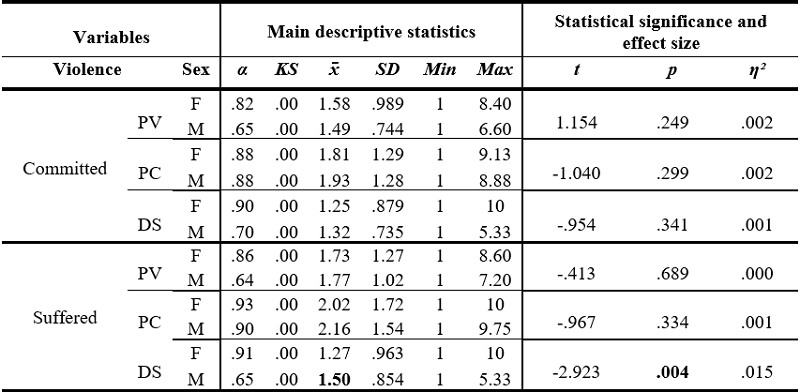
Foremost, the main descriptive statistics and the differences by sex in each dimension of dating violence are presented ( Table 1). In general, it was observed that the internal consistency of the subscales implemented was good. Although the frequency of violence could be considered low, the suffered isolation control type obtained greater frequency in men and women compared to the other forms of dating violence. Lastly, student's t-test analysis allowed the identification of statistically significant differences only in the severe and direct violence suffered. Were men scored higher compared to women, although the effect size was small (Cohen 1998).
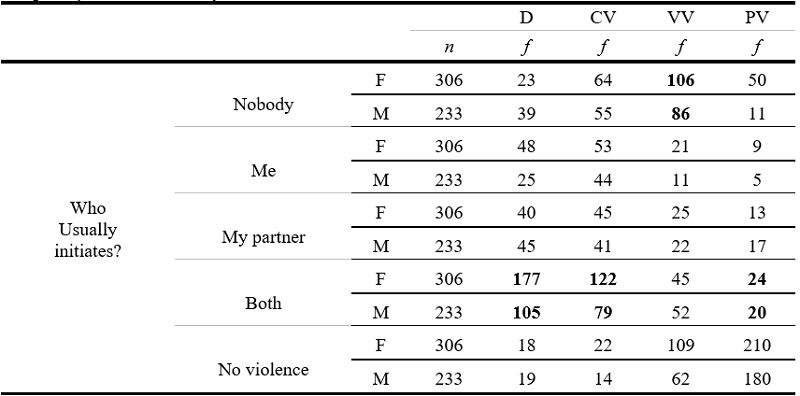
In Table 2, the response of the participants to the question of who normally initiates the discussions and violence are shown. According to the results it was found that most of the women and men pointed out that discussions, control, and physical violence are usually initiated by both parties.
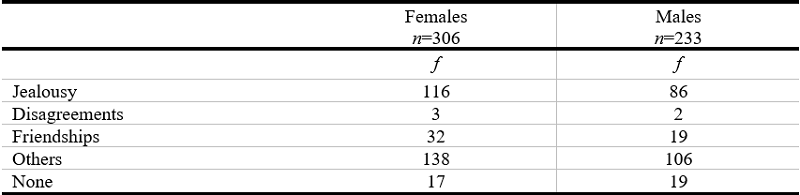
In this same manner, we sought to identify the reasons why the discussions between adolescents arose. As can be seen in Table 3, jealousy was the most indicated option by men (36.9%) and women (37.9%); it should also be noted that in the option others, the participants, tended to include specific situations rather than motives.
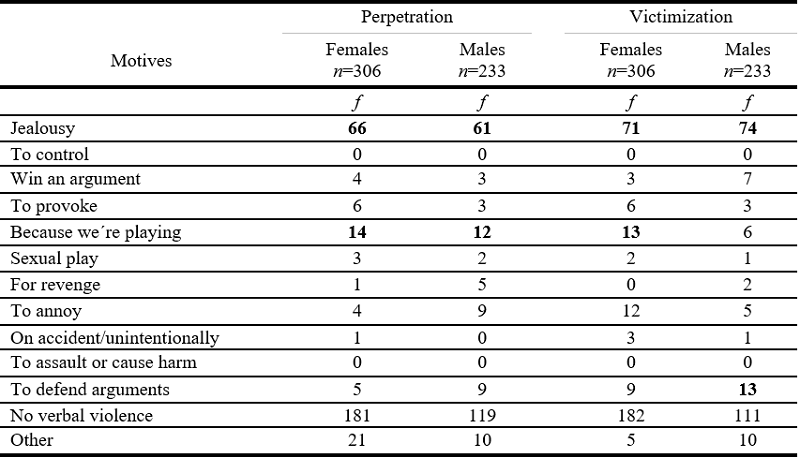
Subsequently, the motives, context, and responses of oneself and the couple to the acts of violence were identified. Following this order of ideas, the responses of adolescents for verbal violence are seen bellow, starting with the reasons ( Table 4). It was found that jealousy was the most marked option between women and men, it is also relevant to mention that a higher percentage of men (31.7%) pointed out that jealousy is the main reason for suffering verbal violence compared to women (23.2%). Followed by jealousy, it was found that because we are playing was the second option that adolescents pointed out as the reason to perpetrate and suffer violence.
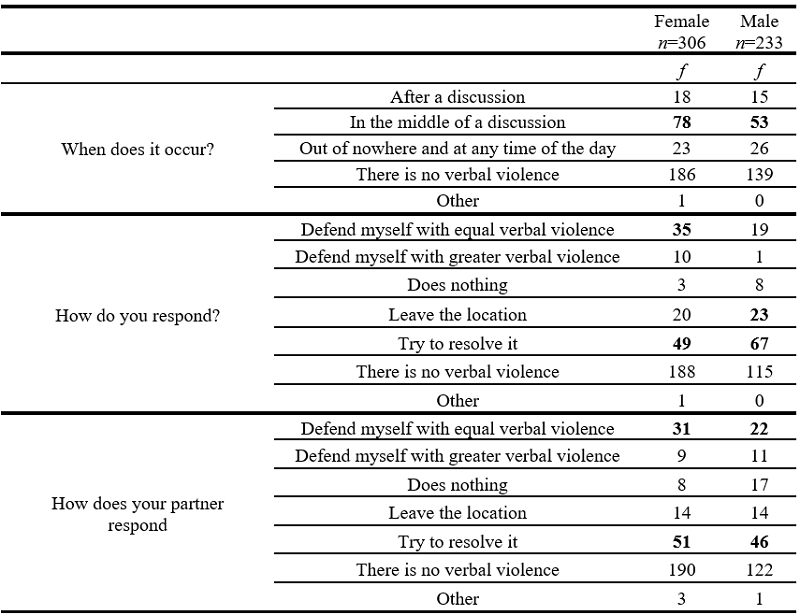
Regarding the context in which acts of verbal violence arise ( Table 5) it was found that in the middle of an argument was the most marked option in both women (25.4%) and men (22.7%). In terms of their own and their partners´ response, it was found in the first place that trying to talk and secondly defending myself with equal verbal violence were the alternatives that most adolescents mentioned as either their own or their partners response.
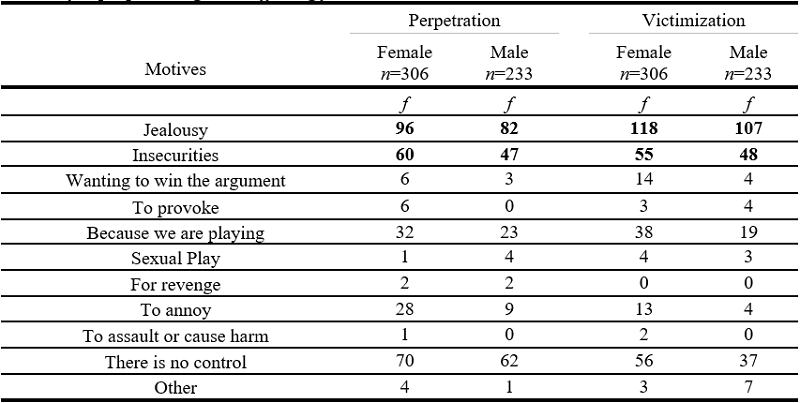
However, with regard to control violence ( Table 6), it was identified that the main reason for perpetrating and suffering from it in both men and women was jealousy. It should also be noted that in this option higher percentages were presented as a higher motive for victimization in men (45.9%) than in women (38.5%). The second most prominent option was insecurities for both perpetration and victimization.
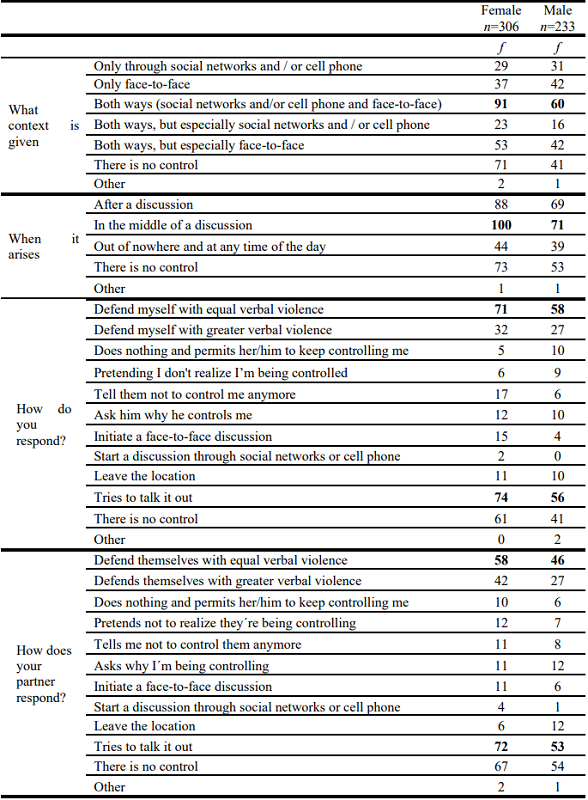
Continuing with control-type violence ( Table 7), it was found that the majority of women (29.7%) and men (25.7%) indicated that this type of violence arises through two channels: social networks/cellphone and face-to-face. Additionally, it was found that the majority of women (32.6%) and men (30.4%) indicated that it arises in the middle of an argument. Regarding their own responses to this type of violence, it was identified that the majority of women (24.1%) indicated trying to resolve it. However, a similar percentage of women indicated as a response that they defend themselves with equal control (23.2%) and in men the majority indicated that they respond with equal control (24.8%). Likewise, a similar percentage (24.0%) indicated that they try to resolve it. Regarding the partners response, the majority of women (23.5%) and men (25.7%) indicated that their partner tries to talk it out. Secondly women (18.9%) and men (19.7%) reported that their partners defend themselves with equal control.
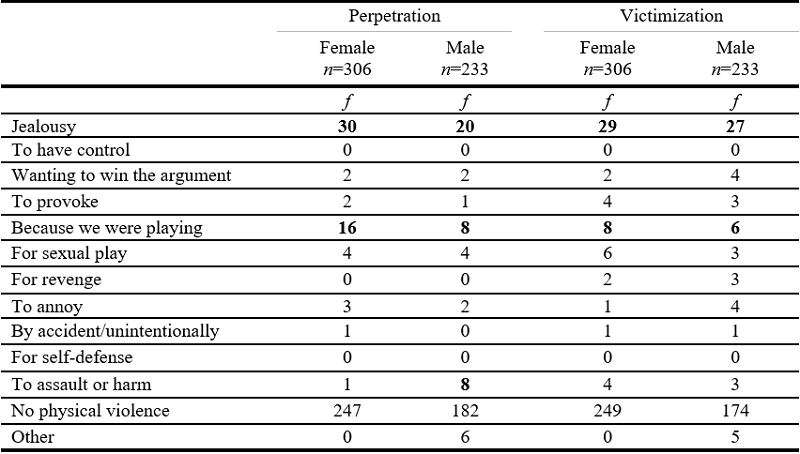
However, the last type of violence analyzed for the motives of its perpetration and victimization is physical violence ( Table 8). Based on the obtained results it was found that again, the majority of adolescents pointed out that jealousy is usually the main reason for perpetrating and suffering physical violence. In the same manner a higher percentage was presented, as a motive for the victimization of men (11.5%) compared to women (9.4%). As a second incentive, both for perpetration and for victimization in men and women the result was: because we are playing.
Regarding the context of their own and their partners´ responses to physical violence ( Table 9), it was identified that it frequently arises in the middle of a discussion. This, in agreement with most women (25.4%) and men (22.7%). In terms of the responses that arise to this type of violence, both their own and that of their partner, it was found that trying to talk it out and defend oneself with equal physical violence were the alternatives most mentioned by both sexes.
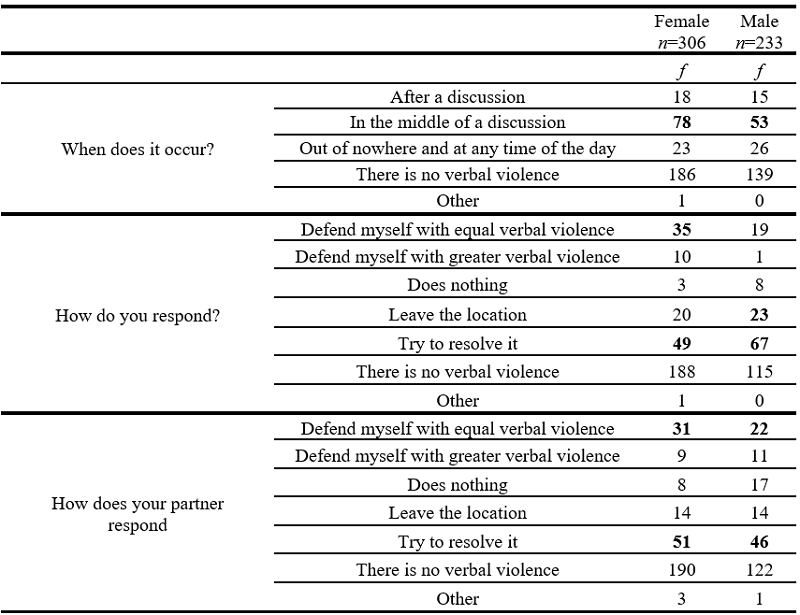
This paper first aimed to determine the frequency with which men and women commit and suffer violence in their dating relationships. Secondly, with an objective to identify the main reasons and the context in which the types of verbal, control, and physical violence arise, as well as their own and their partners' responses to these acts of violence. In this sense, in response to the first question ( What is the type of violence that adolescents perpetrate and suffer most frequently from in their dating relationships?) it was found that the psychological/control was the type of violence that was committed and suffered most frequently, in agreement with data supported by other studies carried out in young people and adolescents ( Gómez & Rojas-Solís, 2020: Romero-Méndez et al., 2021).
Likewise, for this particular type of violence, adolescents were asked how it was exercised and most of them indicated the following: social networks and/or cell phone and face-to-face. This coincides with other research that shows that the violence of control can also be exercised through technological means ( Javier-Juárez et al., 2021) and that could be explained due to the ease of access and use adolescents have with technological media and social networks ( Durán & Martínez-Pecino, 2015). Therefore, it should be stressed that the findings obtained are relevant for future evaluations of the phenomenon and, above all, in the implementation of prevention and treatment programs. Mostly because controlling behaviors are often omitted in favor of psychological, physical and sexual violence.
In response to the second question ( What are the main reasons why men and women commit and suffer from different forms of dating violence?) it was found that, for all forms of dating violence, jealousy was the main reason for committing and suffering violence. These results were in accordance with what was found in other research carried out in adolescents ( Borrajo & Gámez-Guadix, 2015; Calvete et al., 2021). One possible explanation is that jealousy (as cognitive distortion) is commonly used to justify violent acts ( Borges & Spanó, 2017). This situation has favored adolescents confusing them with signs of affection and love ( Peña et al., 2019) and thus even facilitating jealousy to be normalized ( Marcos & Isidro, 2019).
Additionally, it was found that specifically for control-type violence, insecurities were the second reason that most adolescents indicated to commit or suffer this type of violence. This finding also echoed in some empirical antecedents that have pointed to this variable as a manifestation of anxious attachment, suggesting that people with this type of attachment generate an excessive need to find security in their partner ( Mende et al., 2019). As well as when faced with the feeling of rejection or lack of disposition, they can generate feelings of insecurity manifested mainly in the exercise of controlling behavior, jealousy and obsession ( Guzmán et al., 2015; Rodríguez et al., 2015).
Then the playful aspect ( Because we are playing) was identified as the third option most indicated by adolescents for committing and suffering control-type violence. It was also the second most indicated for committing and suffering verbal and physical violence. These are findings that are in agreement with other studies conducted on young people. These studies have identified the context of play where acts of violence can arise and, in some cases, be justified ( Frías, 2016; Foshee et al., 2007; Gonzalez-Mendez & Hernandez-Cabrera, 2009; Muñoz-Rivas et al., 2021). The importance of these data lies in the fact that adolescents could be minimizing violent acts, such as slapping or kicking, by considering them as part of a game, as a strategy to avoid interpreting the event as a violent one ( Gómez & Rojas-Solís, 2020; Rodriguez, 2015).
In the case of the third research question (In what context do acts of verbal, control, and physical violence usually occur in courtship?) the participants pointed out that for all types of violence (verbal, control, and physical) these used to occur in the middle of an argument. Which is similar to what was obtained in other research conducted with the adult population such as that of Rodríguez and Córdova (2009) and in adolescent population ( Peña et al., 2019). The latter report that discussions are usually a common problem in relationships, likewise the authors found that discussions tended to become verbal violence and even physical violence, thus warning of a possible dynamic or cycle of violence where discussions could be the starting point or a precedent towards the exercise of violence.
In addition to this, the study included two reagents, the first of them inquired about who normally initiated the discussions, and most of the adolescents indicated that they both did. The second reactive sought to know about the main reasons why an argument was initiated, so according to the answers obtained they highlighted jealousy again as the main reason. A finding supported by other studies in adolescents ( Borrajo & Gámez-Guadix, 2015; Peña et al., 2019). Where some of these jealous behaviors that encourage discussions are exemplified, most are related to interactions on social networks, such as the partner receiving/giving likes to photos or publications of other people.
Continuing on the fourth question, aimed at identifying how adolescents respond to the violent acts of their partners. In general, Trying to talk it out was the option most mentioned by adolescents, an event that could be positive, since research conducted in adult populations has found that this strategy of reflection/communication negatively predicts psychological violence ( Méndez & García, 2015). However, in the population of young people and adolescents, it is not expected that this type of reaction will be the most used because according to Alegría and Rodríguez (2017), men and women tend to respond to the violent actions of their partners.
On the other hand, the second most noted option in the sample of women was: Respond with equal violence (verbal, control, or physical), something that could be partially corroborated with other studies, especially a qualitative approach such as that carried out by Black and Weisz (2005). In their study, they found that adolescents tended to think that if men hit, they could too. This fact could indicate that women use violence as a form of self-defense, although it is not usually the most appropriate option ( Bair-Merritt et al., 2010).
In the case of men, the majority indicated defending themselves with equal violence specifically of a control type, which could suggest that both women and men can use violence as a response to defend themselves against violence exerted by their partners ( Dardis et al., 2015). These results could differ from what is proposed by some feminist studies that indicate that only women use violence as a form of self-defense against violence exerted by their male partner ( Benítez et al., 2017; Walker et al., 2018). Despite this, it is necessary to recognize what has been mentioned by some authors, such as Calvete et al. (2021), who state that dating violence exercised as self-defense continues to be a controversial issue, which could well be clarified through qualitative research techniques.
Furthermore, it is convenient to comment that, as a second option for psychological and physical violence, most men indicated Leaving the location as a response to the violence of their partners. This is a finding that is echoed in other studies carried out on adult populations ( Méndez et al., 2013). Where it was found that men used more avoidance strategies compared to females. In this sense, it is relevant to mention these data because the use of a passive coping style, in this case, that of avoidance, could predict the violence received in relationships ( Méndez & García, 2015). According to Moreno-Méndez et al. (2019), when a teenager retreats, his partner may perceive this behavior as frustrating and express emotional responses and violent behaviors.
Concerning the above, it was also intended to find, from the perspective of the participating adolescents, how their partners used to respond to the violent acts exercised by the respondents. According to the answers obtained it was identified that the majority of men and women tries to resolve it. This could corroborate the results discussed in the fourth research question; thus, this strategy is favorable since it would avoid an escalation of violence ( Hernández, 2010). Moreover, it is relevant to note that the second most important option is to defend themselves with equal violence, whether it be verbal, control, or physical. The rates of adolescents who chose this option were similar, which could contrast with what was found in other studies conducted with adult populations such as Babcock et al. (2019). This study found that women were more likely than men to report that their partner's violence had been committed in self-defense.
However, among other adjacent and important findings to discuss, it was found that within the dynamics of two-way violence the frequency with which the different types of dating violence are committed and suffered could be considered low. Furthermore, it is relevant to mention the importance of providing these data, since research has focused on describing this problem based on prevalence, which in several investigations is usually high. Thus, omitting more specific and important aspects such as the intensity or frequency of violent behaviors ( Rodríguez et al., 2018).
Based on the results previously stated the following conclusions are presented:
In the first place, it was found that psychological/ control violence is the type of violence that adolescents commit and suffer most frequently from. As well as that this type of violence can be exercised in two ways (face-to-face and cell phone/social networks) which could indicate that new forms of dating violence have emerged along with technological media and social networks and require greater attention from part of the scientific community.
In a second conclusion, it was found that jealousy was the main reason for adolescents to commit and suffer dating violence. Data that is alarming because jealousy in romantic relationships has also been associated with more serious events that can even threaten the life of the partner.
It was also found that the moment in which acts of violence usually occur (verbal, control, and physical) is in the middle of an argument. This is of great relevance for preventive actions, especially in the understanding that inadequate conflict resolution tactics or poorly managed discussions could lead to acts of violence. Finally, a pattern was identified between the responses of adolescents to violent acts where the majority indicated that both they and their partners tried to talk it out, and followed by this, another percentage indicated that they defended themselves with equal violence (verbal, control, and physical). The latter could indicate that both men and women can use violence as a form of self-defense or in response to the violent acts of their partners.
The scientific community has focused on determining the bi-directionality of violence through the frequency with which men and women exercise and suffer the different types of violence. however, a specific study is usually left aside to determine the reasons and situations for which violent behaviors can occur. In this sense, this study aimed to conduct an analysis focused on this phenomenon in a population of adolescents who indicated living a dynamic of bidirectional violence, something that has not commonly been implemented in previous research. This identified the main reasons why adolescents may commit and suffer violence. As well as the time in which these acts may occur. This is in agreement with what has recently been mentioned by some authors, such as Rodríguez-Franco et al. (2022), who emphasizes the important need to explore the context, the different scenarios, and reactions that could explain the exercise of mutual violence in adolescents and this manner determine if it arises as a method of self-defense or if it is intentionally exercised.
The first limitation is found in the exploratory and descriptive scope of the study, which does not allow to infer causal relationships. likewise, the selection of the non-probabilistic and non-representative sample prevents the generalization of the obtained results. Another limitation is found in the lack of control of the social desirability of the responses of the participants. Without detriment to the above, it is also necessary to point out some strengths of this research. The analysis of the motives, context, and responses to violent acts that occur in dating relationships also stands out, aspects that are not commonly evaluated in the study of the phenomenon. Without forgetting that this research was conducted in a sample of adolescents selected with the profile of victims and perpetrators who allowed a more specific analysis of this phenomenon.
As for the future lines of research, it would be convenient to continue with the aspects evaluated in this study. This could be used to obtain a completer and more comprehensive picture of dating violence and collaborate in the efforts made to prevent and treat this problem.
1 Correspondence about this article should be addressed José Luis Rojas-Solís: jlrojassolis@gmail.com
