Artículos
Received: 23 November 2021
Accepted: 21 December 2022
DOI: https://doi.org/10.30849/ripijp.v57i2.1741
Abstract: Autism spectrum disorder (ASD) is a disease whose diagnostic characteristics require a significant change in daily life and family dynamics. Incorporating parents or caregivers into the treatment and ensuring their well-being becomes important for the development of the person with ASD. A construct that is associated with these issues is parental self-efficacy. Thus, the objective of the recent study is to identify studies with the topic "parental self-efficacy in the context of ASD" and the psychometric instruments used and characterise them. To this end, a bibliographic review was carried out with studies indexed in PubMed, PsycINFO, Web of Sciences and CAPES Magazines that addressed the topic and used a psychometric instrument to evaluate self-efficacy. Bibliometric analysis of the data and thematic categorical content analysis were carried out. The results point to three thematic foci in the analysis of parental self-efficacy in the context of ASD with constructs related to parental cognition as the main variables. Most of the instruments used for evaluation are related to parental self-efficacy in the general context, with only two specific instruments identified for ASD. The need to carry out more studies in the area and to have specific instruments for ASD is emphasised.
Keywords: Autism spectrum disorder, parental self-efficacy, psychometric instruments, literature review.
Resumen: El trastorno del espectro autista (TEA) es una enfermedad cuyas características diagnósticas exigen un cambio importante en la vida cotidiana y en la dinámica familiar. Incorporar a los padres o cuidadores al tratamiento y garantizar su bienestar, por tanto, cobra importancia para el desarrollo de la persona con TEA. Un constructo que se asocia a estas cuestiones es la autoeficacia parental. Así, el objetivo del presente estudio es identificar estudios con el tema "autoeficacia parental en el contexto del TEA" y los instrumentos psicométricos utilizados y caracterizarlos. Para ello, se realizó una revisión bibliográfica con estudios indexados en las bases de datos PubMed, PsycINFO, Web of Sciences y Revistas CAPES que abordaran el tema y que utilizaran un instrumento psicométrico para evaluar la autoeficacia. Se realizó el análisis bibliométrico de los datos y el análisis de contenido categorial temático. Los resultados apuntan a tres focos temáticos en el análisis de la autoeficacia parental en el contexto de los TEA con constructos relacionados con la cognición parental como principales variables relacionadas con la misma. La mayoría de los instrumentos utilizados para la evaluación están relacionados con la autoeficacia parental en el contexto general, identificándose sólo dos instrumentos específicos para el TEA. Se enfatiza la necesidad de realizar más estudios en el área y de contar con instrumentos específicos para el TEA.
Palabras clave: Trastorno del espectro autista, autoeficacia parental, instrumentos psicométricos, revisión bibliográfica.
Introduction
Autism spectrum disorder (ASD) is a neurodevelopmental disorder that has gained great relevance over time. Characterized by persistent deficits in social communication and restricted and repetitive behaviour patterns (American Psychiatric Association [APA], 2014), ASD has had considerable growth in diagnoses in recent decades. A study carried out in the United States showed that one in every 68 children is diagnosed with ASD (Christensen et al., 2016), and given the increase in cases that are observed not only there, but worldwide, it is necessary to investigate the aspects that involve such a diagnosis.
One of the important aspects to be studied when it comes to ASD is the family context. Due to its diagnostic characteristics, children with autism demand special attention with specific care, so it is necessary to readjust the daily life and family environment of people who live with them, in particular, parents or caregivers (Tambaquim, Vieira, Razera & Ciasca, 2015; Sprovieri & Assumpção Jr., 2001; Fávero-Nunes & Santos, 2010). In addition, the fundamental role of the family as a promoter of development for the individual with ASD is highlighted, which makes parents and primary caregivers important parts of their treatment (Volkmar & Wiesner, 2019; Kuperstein, Biazus, & Pires, 2018).
A construct that appears linked to this context is that of parental self-efficacy. Bandura (1977; 1997) conceptualizes self-efficacy as the belief in the personal capacity to organize and execute an action to generate certain results. The belief of personal effectiveness, according to the author, is the main basis of action and plays a crucial role in maintaining the self-regulation of motivation, that is, it acts in the regulation of behaviours of choice, effort and persistence in actions and activities.
Parental self-efficacy is characterized by the feeling of competence in the role of caregiver, or the judgment about how well one can perform specific tasks related to the parental context (Kuhn & Carter, 2006). Coleman and Karraker (1998) present as some prerequisites for the development of parental self-efficacy the knowledge of adequate responses to childcare, the confidence in their own abilities, and the belief that the child will respond to the practices and the existence of a network of support that can support.
Certainly, it has been identified that self-efficacy in mothers of children in early childhood is a central mediator of the relationships between competence in care and other factors, such as depression, child difficulties, and the need for support (Teti & Gelfand, 1991). Thus, it is evident that the assessment of parental self-efficacy in parents of people with ASD is extremely beneficial both for the quality of life of parents or caregivers, as well as for enhancing the development and care of the individual. Therefore, the aim of the present study was to identify and characterize studies on the topic of "parental self-efficacy in autistic spectrum disorder".
Method
Data collect
Searches were performed in the PubMed, PsycInfo, Web of Science and CAPES Journals databases by crossing the Boolean AND operator of the descriptors "self-efficacy", "parental", "parents", "parent", "parenting,” “autism,” “autism spectrum disorder” and “asd,” as well as their respective counterparts in Portuguese, being the first fixed descriptor for all the crossings performed. In total, 12 crosses of descriptors in English and Portuguese were performed, namely: “self-efficacy AND parental AND autism”; “self-efficacy AND parents AND autism”; “self-efficacy AND parent AND autism”; “self-efficacy AND parenting AND autism”; “self-efficacy AND parental AND autism spectrum disorder”; “self-efficacy AND parents AND autism spectrum disorder”; “self-efficacy AND parent AND autism spectrum disorder”; “self-efficacy AND parenting AND autism spectrum disorder”; “self-efficacy AND parental AND asd”; “self-efficacy AND parents AND asd”; “self-efficacy AND parent AND asd”; and “self-efficacy AND parenting AND asd”.
The selection and reading of the studies were carried out independently by the two researchers, to control bias in the data surveys. The inclusion criteria for the studies contemplated: a) articles that, according to the reading of the title, referred/related to parental self-efficacy in ASD; b) articles that, according to the reading of the abstract, referred to parental self-efficacy in the ASD; c) articles that, according to the full reading, referred to parental self-efficacy in the ASD; d) articles published between 1990 and 2019; e) articles available in full, in Portuguese or English; f) articles that explicitly sought, among their objectives, to assess the parental self-efficacy of parents or caregivers of people with ASD, according to the reading of the abstracts; and g) articles that explicitly sought, among their objectives, to assess the parental self-efficacy of parents or caregivers of people with ASD, according to the full reading. The only exclusion criterion adopted was repetition in the databases.
Data analysis procedure
First, bibliometric information referring to the year, country, journal of publication and language was collected. Afterwards, the articles were submitted to a categorical content analysis to identify the central themes of the selected articles (Bardin, 1977). Therefore, a floating reading was carried out in relation to the context of the research and its objectives, constructs considered by the study, description of the sample, measures for assessing parental self-efficacy, research results and main limitations.
Results
A total of 14,265 results were found in all investigated platforms, with 11,374 in CAPES Periodicals, 1,031 results in PsycInfo, 971 in Web of Science and, finally, 851 results in PubMed. After reading the titles of all the studies collected in each database, those that mentioned in their title the terms "parental self-efficacy" or "autism/autistic spectrum disorder/ASD" were selected, as well as their correspondents in English. generated a total of 243 studies in CAPES Journals, 63 in PsycInfo, 94 in Web of Science, and 60 studies in PubMed, excluding results copied within platforms. The isolated data from each database that were collected separately were joined and then performed the exclusion of those copied between them. Thus, a total of 277 articles were selected for reading the abstracts, in which the inclusion criteria were applied. After reading the abstracts, 55 articles were separated to read the full text, and of these, 25 articles were selected for the analyses performed in this study because they fit among the criteria mentioned. These data are condensed in Figure 1 by through a flowchart. Twenty-four articles were not included because they did not fit the analysis profile corresponding to the objectives of this study.
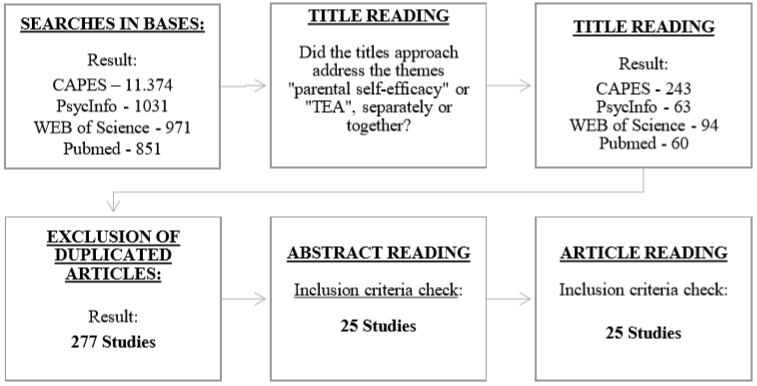
Figure 1
Methodological path for selecting studies for the literature
Analysis of bibliometric data
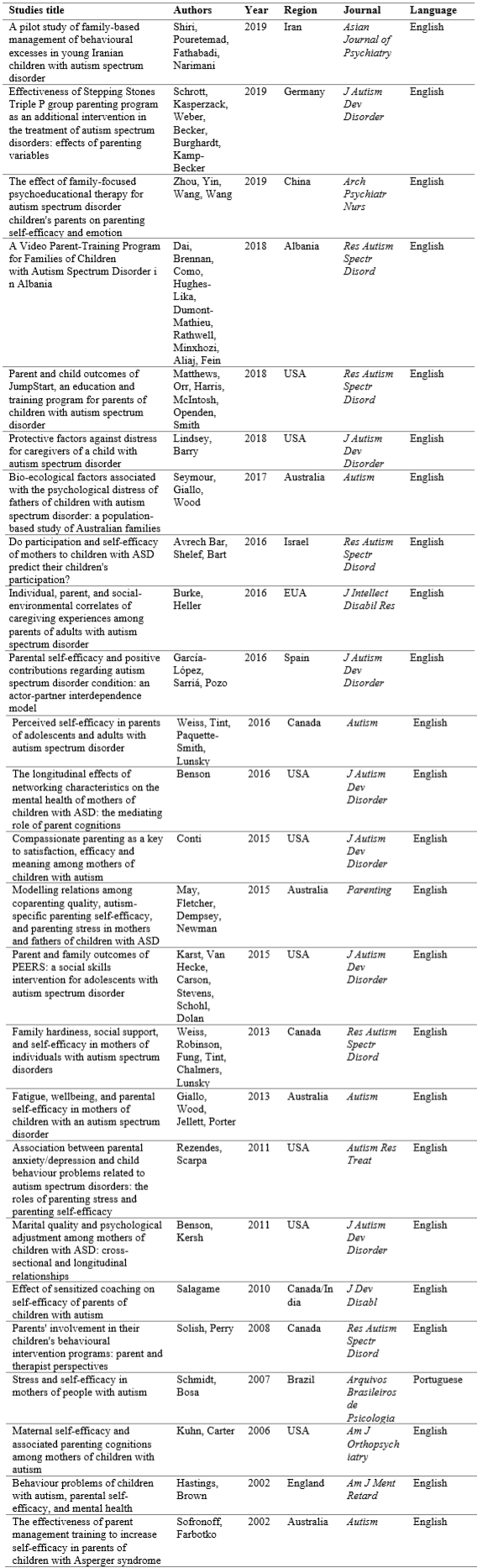
The articles were published between 2002 and 2019. The year with the highest volume of publications was 2016 and 2018 (n = 4). It was possible to observe a considerable increase in the number of publications on parental self-efficacy in the context of ASD from the beginning of the last decade, with at least one publication on the topic per year from 2015 onwards.
The country with the highest number of associated publications was the United States (n = 9). A publication was carried out in partnership with universities from different countries (Salagame, 2010). Only one study was published in Portuguese (Schmidt & Bosa, 2007), while the others were published in English. The journal with the highest number of publications was the Journal of Autism and Developmental Disorders (n = 7), followed by Research in Autism Spectrum Disorder (n = 5) and Autism (n = 4). Figure 2 presents the detailed bibliometric information of the articles analysed in this study.
Bibliometric information from the studies surveyed by the review
Content analysis
Context and objectives of the study
To facilitate the framing of the analysed articles in contexts of studies, three categories of analysis were created according to the reading of the studies, namely: a) focus on parental cognitions; b) focus on parental outcomes; and c) focus on ASD interventions. The first category of analysis focused on the investigation of parental cognitions associated with parental self-efficacy. Parental cognitions are considered a set of products, which may include beliefs, values, expectations, and psychological processes, such as attribution of causality and self-perception, related to human development and parenting (Silva & Magalhães, 2011). The second category is associated with studies focused on how other variables are related to the parental self-efficacy variable and how these relationships affect the perception of their parental outcomes. Finally, the last category of analysis focused on studies that were concerned with evaluating intervention programs for people with ASD and how parents relate to these programs.
The category “focus on parental cognitions” had the highest number of studies analysed, with a total of 13 articles (Rezendes & Scarpa, 2011; Hastings & Brown, 2002; Seymour, Giallo, & Wood, 2017; Avrech Bar , Shellef, & Bart, 2016; Schmidt & Bosa, 2007; Weiss, Robinson, Fung, Tint, Chalmers, & Lunsky, 2013; Giallo, Wood, Jellett, & Porter, 2013; Burke & Heller, 2016; Kuhn & Carter, 2006; May, Fletcher, Dempsey, & Newman, 2015; Weiss, Tint, Paquette-Smith, & Lunksy, 2016; Lindsey & Barry, 2018; Benson, 2016). Eight studies were counted in the category "focus on interventions in ASD" (Shiri, Pouretemad, Fathabadi, & Narimani, 2019; Dai et al., 2018; Salagame, 2010; Schrott, Kasperzack, Weber, Becker, Burghardt, & Kamp-Becker, 2019; Matthews, Orr, Harris, McIntosh, Openden, & Smith, 2018; Karst, Van Hecke, Carson, Stevens, Schohl, & Dolan, 2015; Zhou, Yin, Wang, & Wang, 2019; Sofronoff & Farbotko, 2002). Finally, the category “focus on parental outcomes” had four studies (Conti, 2015; Benson & Kersh, 2011; García-López, Sarriá, & Pozo, 2016; Solish & Perry, 2008).
Regarding the study objectives, all articles had as one of their objectives to assess parental self-efficacy in the context of ASD. In general, the studies had very heterogeneous objectives, apart from those that make up the category Focus on interventions with ASD. Studies with this focus sought to assess an already established parental training program (Schrott et al., 2019; Dai et al., 2018; Salagame, 2010) or to provide evidence of the effectiveness of an intervention program that was being developed (Shiri et al., 2018; al., 2019; Matthews et al., 2018).
Other objectives that were explored by the articles included assessing symptoms of anxiety and depression and their relationship to behaviour problems (Rezendes & Scarpa, 2011), exploring self-efficacy as an intervention variable (Hastings & Brown, 2002), identifying factors related to parenting (Seymour et al., 2017), assess parental compassion and self-image in relation to self-efficacy and parental satisfaction (Conti, 2015), assess association in groups and its relationship with self-efficacy and participation by parents and children (Avrech Bar et al. ., 2016), assess the relationship between stress and self-efficacy (Schmidt & Bosa, 2007), assess family resilience in relation to social support and self-efficacy (Weiss et al., 2013), investigate the relationship between fatigue and depression, anxiety and factors demographic and parental factors (Giallo et al., 2013), investigate how individual, parental and socioeconomic factors relate to the experience of caregivers (Burke & Heller, 2016), check the relationship between marital quality and maternal outcomes (Benson & Kersh, 2011) assess self-efficacy and its relationship with other parental cognitions (Kuhn & Carter, 2006), assess the relationship between coparenting, self-efficacy and stress (May et al., 2015), propose a new study model to analyse positive parental contributors (García-Lopez et al., 2016), assess protective factors in relation to stress (Lindsey & Barry, 2018), and, finally, assess social entanglement and its relationship to resources cognitive and social adjustment (Benson, 2016).
Sample description
Table 1 shows data regarding gender, age of participants and age of children of participants who predominated in the studies. Most studies were performed with female participants (96%), with only one study conducted with an exclusive sample of parents (Seymour et al., 2017).
Reported characteristics of participants in selected articles
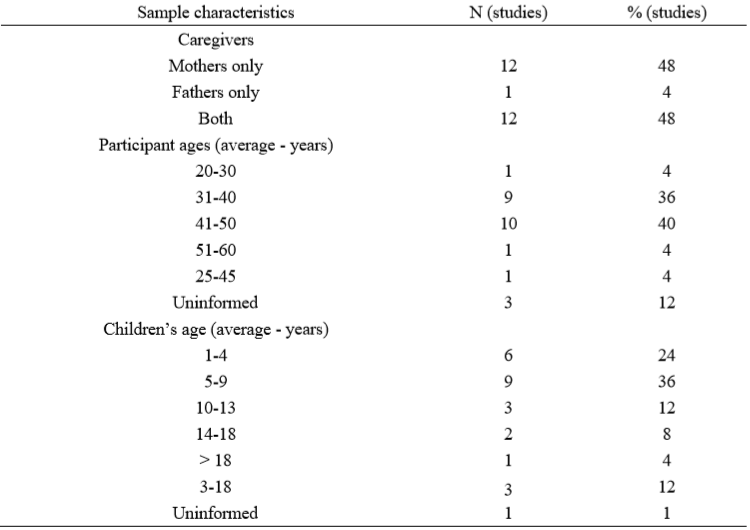
The average age of most parents and/or caregivers who participated in the selected studies at the time of data collection was around 31 and 50 years, with only one study with a mean age below (Dai et al., 2018) and one above average of the range described (Burke & Heller, 2016). One study reported only the age range of the participants, from 25 to 45 years (Avrech Bar et al., 2016) and three other studies did not report the age of the participants (Schrott et al., 2019; Solish & Perry, 2008; Schmidt & Bosa, 2007).
The average age of the children of the study participants was within the range of five to nine years old, followed by the range of one to four years old, and a single study had the participation of parents with adult children with ASD (Burke & Heller, 2016). Three studies included the participation of parents of children in quite different age groups, ranging from three to twelve years old (Schrott et al., 2019) and four to eighteen years old (García-Lopez et al., 2016; Conti, 2015).
Main constructs associated with parental self-efficacy
The most evaluated construct along with parental self-efficacy in the studies was parental stress (n = 13), followed by psychopathological symptoms (e.g.: depression, anxiety) and children's behaviour problems (n = 5) and social support (n = 4). Knowledge about ASD, access to services and family well-being appeared as study variables in three articles. Satisfaction was an analysis variable in two studies. Other variables that appeared in only one study were: nuisance, maternal agency, guilt, and parental cognitions in general.
Measures used to assess parental self-efficacy
A total of 15 different psychometric measures used to assess parental self-efficacy were tracked, whose names and other information are condensed in Figure 3.
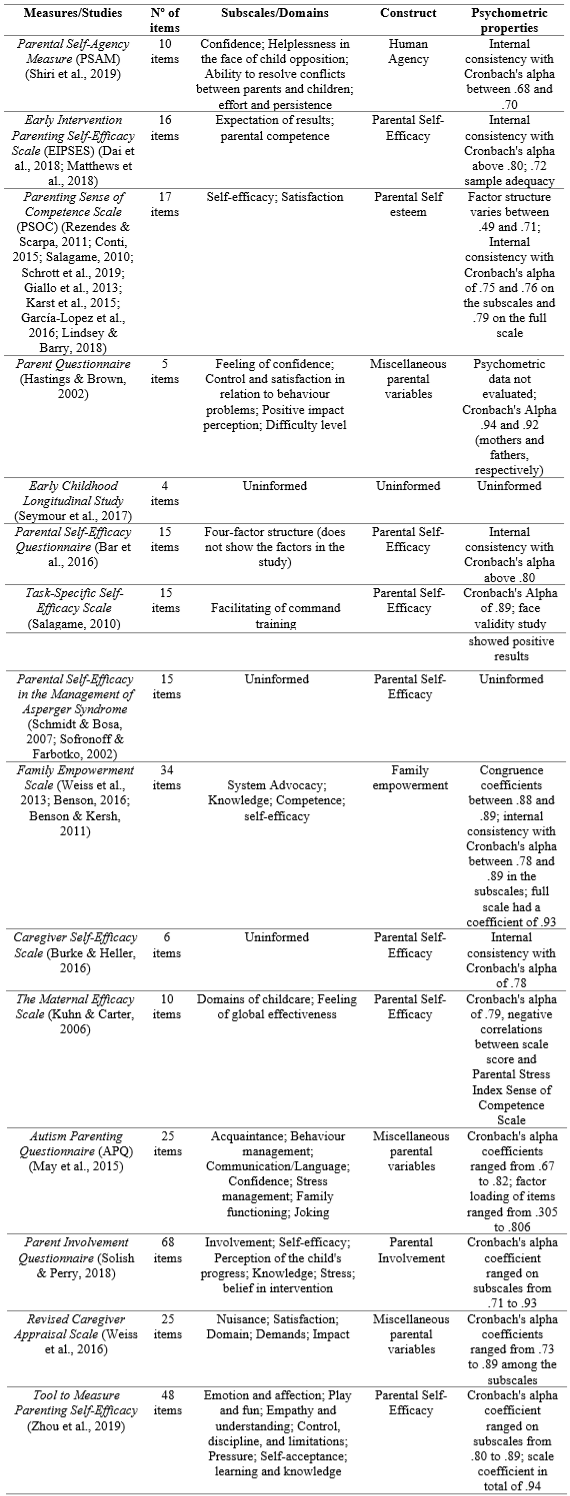
Figure 3
Measures used to assess self-efficacy in selected article
The most used measure to assess parental self-efficacy in studies (n = 8) (Rezendes & Scarpa, 2011; Conti, 2015; Salagame, 2010; Schrott et al., 2019; Giallo et al., 2013; Karst et al., 2015; García-Lopez et al., 2016; Lindsey & Barry, 2018) was the Parenting Sense of Competence Scale (PSOC), and the second most used measure to perform this assessment in the studies (n = 3) was the Family Empowerment Scale (FES) (Weiss et al., 2013; Benson & Kersh, 2011; Benson, 2016).
Two other measures that were used in more than one study were the Early Intervention Parenting Self-Efficacy Scale (EIPSES) (Dai et al., 2018; Matthews et al., 2018) and the Parental Self-Efficacy in the Management of Asperger Syndrome (Schmidt & Bosa, 2007; Sofronoff & Farbotko, 2002). The first measure is intended to assess parental self-efficacy involving the early intervention of their children, without specifying the type and treatment group, and for the study carried out by Dai et al. (2018), a revised and adapted version for the Republic of Albania was used, which had only 10 items. The second measure describes fifteen common behaviour problems in children with Asperger syndrome and asks parents to a) indicate whether the behaviour occurred in the last month, and b) rate their confidence in dealing with the behaviour described. The Parental Self-Efficacy in the Management of Asperger Syndrome was the only measure used in this study that clearly and specifically proposed to assess parental self-efficacy in the context of ASD.
Other limitations reported by the authors included the lack of a control group for the study (n = 3) (Shiri et al., 2019; Schrott et al., 2019; Karst et al., 2016), the need to review measure (n = 3) (Solish & Perry, 2008; Weiss et al., 2016; Benson, 2016) and low response rate by participants (n = 2) (Solish & Perry, 2008; Burke & Heller, 2016). Other limitations appeared punctually, such as the time of application of the intervention (Zhou et al., 2019), the form of recruitment of participants and method of application of the measures (Weiss et al., 2016), the age range of the children of the participants (Matthews et al., 2018), complexity of analysed variables (Giallo et al., 2013), conceptual similarities between constructs (Weiss et al., 2013), limitations in data analysis processes (Hastings & Brown, 2002 ), parents who participated in the study already have normal levels of parental self-efficacy (Schrott et al., 2019), and concessions made during the execution of the evaluated intervention program (Dai et al., 2018). One article did not describe the limitations of the study (Schmidt & Bosa, 2007).
Study results
Given the variety of themes among the studies found and the different objectives outlined in most of them, the results presented were focused on the assessment of self-efficacy and the factors with which they were related. In this way, the results of studies with common objectives will be presented first, and then those of the other investigated studies. It is important to emphasize that the results of the studies apply to parents of children diagnosed with ASD.
Studies referring to the assessment of parental self-efficacy with a focus on interventions for ASD, in general, presented comparable results regarding the perception of self-efficacy in the sample of participating parents. All eight articles reported positive changes in relation to the construct, with an increase in their perception after the intervention period. Some studies also reported maintenance of increased levels of parental self-efficacy a few months after the application of the intervention during follow-up (Shiri et al., 2019; Dai et al., 2018; Salagame, 2010; Schrott et al., 2019; Matthews et al., 2018; Karst et al., 2015; Zhou et al., 2019; Sofronoff & Fabortko, 2002). Solish and Perry (2008) pointed out that parental self-efficacy can be a predictor of parental involvement in training programs for parents of children with ASD.
The study by Rezendes and Scarpa (2011) presented self-efficacy as a partial mediator of the relationship between stress and parental depression/anxiety. In addition, child behaviour problems were associated with a decreased parental perception of effectiveness. Other studies have also assessed the mediating role of parental self-efficacy in this context, such as Hastings and Brown (2002), who identified a mediating role of self-efficacy in relation to child behaviour problems and anxiety/depression in mothers and a moderating role in problems of child behaviour and anxiety in parents. Weiss et al. (2013) identified a mediating role for self-efficacy between the accumulation of stressors and family resilience. Self-efficacy was also presented as a significant potentiating factor in the effects of the actor-partner interdependence model on the psychological adaptation of parents (García-Lopez et al., 2016).
The predictors of parental self-efficacy identified in studies were compassionate parenting (Conti, 2015), marital quality (Benson & Kersh, 2011) and the variables age of the child, immigration status, number of social barriers to be faced, perception of discomfort and experience with service systems (Weiss et al., 2016). The quality of coparenting was presented as a mediator of the relationship between self-efficacy and parental stress (May et al., 2015), while social entanglement did not significantly change self-efficacy in mothers of children with ASD (Benson, 2016).
Some studies sought to investigate the association of parental self-efficacy with other variables. Child behaviour problems were positively associated with decreased parental self-efficacy (Rezendes & Scarpa, 2011), and the association between self-efficacy and lower frequency of internalizing child behaviours was also associated with lower levels of stress in mothers (Lindsey & Berry, 2018). The maternal agency was positively associated with self-efficacy, while the guilt construct was negatively associated. Knowledge about ASD, however, showed no association (Kuhn & Carter, 2016). Self-efficacy was also negatively correlated with stress and depression (Kuhn & Carter, 2006; Burke & Heller, 2016) and maternal and child participation, except frequency of child participation (Avrech Bar et al., 2016). Self-efficacy also showed the potential to influence anxiety symptoms in mothers (García-Lopez et al., 2016), but it was not a relevant variable when its association with maternal fatigue was verified (Giallo et al., 2013). Finally, greater strength was identified in the relationship between self-efficacy and stress in mothers, while in fathers, the relationship between self-efficacy and quality in co-parenting was stronger (May et al., 2015).
Parents of children with ASD were significantly more likely to experience impoverished levels of self-efficacy and other variables (Seymour et al., 2017), and mothers of young people with ASD were less likely to be perceived as effective in managing communication with their children (Schmidt & Bosa, 2007). One last interesting result found by May et al. (2015) was the presentation of the measure Autism Parenting Questionnaire as valid and reliable for the assessment of parental self-efficacy in the specific context of ASD.
Discussion
This study aimed to identify and characterize studies on parental self-efficacy in the context of ASD. Bibliometric data show a significant increase in publications from the mid-1910s onwards, especially at the international level, which demonstrates the growing interest that the area has received over the five years. Most of the studies analysed came from the United States and the countries that make up the United Kingdom, but there is a growing interest in the area in distinct parts of the world, such as in Europe, Latin America, and Asia, although studies are scarce in these regions.
A single article analysed was published in Portuguese, being the only Brazilian. However, when performing a simple search with the descriptors parental autism self-efficacy on Google Scholar, it is possible to verify a second study on the topic carried out by Tabaquim et al. (2015). The study aimed to identify the relationship between the pattern of independence of the child with ASD and the caregiver's level of self-efficacy. Even so, it can be said that research on the subject in Brazil is incipient.
There is a certain variation in the approaches given by the authors of the analysed studies, but a relative predominance in the investigation of self-efficacy together with other parental cognitions associated with ASD, such as thoughts and attitudes towards issues such as stress, satisfaction, and child behaviour problems, which is justified by the need for readjustment and new demands of these families (Pinto et al., 2016). The focus on ASD interventions also had a substantial number of studies analysed, in which most of which were implemented by parents.
Parental stress was the most studied construct along with parental self-efficacy by the authors. In fact, this is one of the most prominent themes concerning family dynamics in ASD, both its effects on family well-being (Karst & Van Hecke, 2012; Fávero & Nunes, 2005) and its interaction with other variables, such as ASD symptomatology and child behaviour problems (Miranda et al., 2019), need for support (Hodgetts et al., 2016; Semensato & Bosa, 2013) and parental beliefs (Semensato & Bosa, 2017). This predominance in the relationship between variables can also be observed in the studies analysed, since behaviour problems, psychopathological symptoms and social support were other constructs that were prominent.
The most used measure to assess parental self-efficacy was the Parenting Sense of Competence Scale, validated by Johnston and Mash (1989), which presents the self-efficacy and parental satisfaction factors as components of the self-esteem construct, used to assess the sense of parental competence. However, Launeanu (2016) points out that self-esteem would be a different construct, even though the perception of competence is one of its component aspects. The second most used measure, the Family Empowerment Scale, aims to assess the concept of family empowerment. In a psychometric analysis of the measure, Singh et al. (1995) presents the two dimensions of analysis proposed by the measure: level of empowerment and how empowerment is expressed. The concept of empowerment that the authors bring defines it as “a process in which individuals gain control over their lives through interpersonal influence and social environments” (p. 85), and some divergences can be raised about the concept defined by Bandura (1977; 1997). Both measures mentioned were used based on specific subscales that compose them.
Other measures, such as the Parent Involvement Questionnaire and the Revised Caregiver Appraisal Scale, also had only efficacy/competence-related subscales used to assess self-efficacy in their studies. One measure used, the Early Childhood Longitudinal Study, did not present details about its purpose of assessment or whether the items chosen for measuring self-efficacy are components of a subscale, therefore, it is not possible to know, by name or description carried out in the study, the what the measure is intended to assess and why it was used to measure self-efficacy by the study authors.
Except for one, all measures that aim to assess parental self-efficacy raised in this study do so for the general population. The only measures with a clear and specific objective to assess self-efficacy in the context of ASD was the Parental Self-Efficacy in the Management of Asperger Syndrome, created by Sofronoff and Farbotko (2002) specially to verify the effectiveness of a parental training program in increasing the perception of the effectiveness of parents of children with Asperger syndrome in managing difficult behaviours. The same measure was used, in its translated version, in the study carried out by Schmidt and Bosa (2007), however, neither of the two studies present the measure’s psychometric properties. In fact, when performing a quick search on Academic Google with the name of the measure, it is not possible to identify studies of psychometric validity and accuracy of the aforementioned scale. Given this, despite being a specific measure for parental self-efficacy in the context of ASD, it cannot be considered valid and accurate for its purpose. This result converges with the finding made by May et al. (2015), which indicates the inexistence of specific measure for the assessment of parental self-efficacy in the specific context of ASD. However, the same authors indicate that the Autism Parenting Questionnaire, a measure used by them in their study, can be considered valid and reliable for such an assessment, even if it is not specifically and proposed.
The objectives of the studies, especially those focusing on parental cognitions, were quite diverse, and the results obtained from them demonstrate that self-efficacy is a very versatile construct in the investigation of the intricacies of family dynamics in the context of ASD, whether by association, prediction, mediation, or correlation with other variables. The studies that involved the evaluation of an intervention program aimed at parents had similar objectives and results, to aggregate with studies about evidence-based interventions. Although the results analysed are related to parental self-efficacy, it is noteworthy that the perception of efficacy is directly and indirectly associated with family well-being (Rezendes & Scarpa, 2011; Hastings & Brown, 2002; Weiss et al., 2013; García-López; et al., 2016; Kuhn & Carter, 2006; Burke & Heller, 2016). It is important to emphasize that most studies reported limitations regarding sample size, homogeneity, and bias, which may make it unrepresentative for all families of people with ASD and the results not generalizable. It is also noteworthy that, due to the study design of most articles analysed being cross-sectional, it is not possible to measure causality between the analysed variables and self-efficacy.
Among the limitations of the present study, the fact that some terms used are not included in the dictionaries of the researched databases is highlighted, such as the terms asd, autism, parental and parent, which are not included in the Medical Subject Heading Terms (MeSH) dictionary, from PubMed. Another important limitation is related to the Portuguese counterparts of some descriptors, such as parenting and parent. For the first, the parenting correspondent was used, although the terminology vocabulary Virtual Health Library (VHL) has parenting styles as the corresponding terminology in Portuguese. This change was made by considering the term parenting more comprehensive than that suggested by the VHL and is adopted by other descriptor dictionaries, such as the Health Sciences Descriptors (DeCS). Concerning the second descriptor, due to its characteristic of gender neutrality, both the term mother and the term father were used as correspondents in Portuguese, also supported by DeCS, which makes this gender distinction. Finally, due to the number of articles found and the objectives employed, the review carried out in this study can be considered exploratory, which makes it difficult to go deeper into some points. Therefore, it is suggested that in future studies the relationships between self-efficacy and the related variables pointed out by the studies be deepened and that more attention is given to the psychometric properties and validation studies of the measure used to assess parental self-efficacy.
Concerning the fact that no psychometric measure for the Brazilian context was found in the present review, Costa e Silva et al. (2022) started the process of developing a novel measure to assess parental self-efficacy in parents of children with ASD between six and twelve years old. Although evidence of content validity showed satisfactory results, the Parenting Self-Efficacy Scale for Autism Spectrum Disorder (PSES-ASD) still needs to undergo testing for other evidence of validity. Therefore, a vast area of research regarding the development of new psychometric measures also needs to be investigated in the future.
Conclusion
Although the interest in investigating the perception of parental self-efficacy in the context of ASD has increased considerably in academic productions in recent years, it is still considered that there are few studies investigating this theme. In addition, despite the note made by May et al. (2015), it is reaffirmed that there is still no psychometric instrument that proposes to assess parental self-efficacy in the context of ASD in a clear and specific way.
The absence of a measure specifically tailored for parents of children with ASD has implications for both clinical and academic settings. For clinicians, having a measure to assess parental self-efficacy could be helpful to guide counsellors and clinical psychologists through parental orientation sessions, parent-mediated interventions for children with ASD, and individual or group therapeutical interventions for the parents themselves. The use of psychological measures to provide therapists with feedback on patient progress is partially supported by studies (e.g., Lambert et al., 2001), as it provides them with the information they would not typically gather through their interaction with the clients/patients. Moreover, Maruish (2003) highlights how psychological testing can help quickly identify psychological problems, plan, and monitor treatment for many conditions, such as depression, anxiety, and other psychopathological symptoms.
Similarly, the academic setting, especially quantitative design researchers, benefits from psychometric measures to evaluate outcomes and report results that can be referenced for guidelines, policies and implementation of different interventions. Although this study showed that many measures for parental self-efficacy are available for researchers, the use of a specifically tailored measure for a certain group with specific needs can reach more accurate results compared to generalised tools. It is concluded, then, that there is still a vast field of studies to be deepened in the investigation of self-efficacy in parents of people with ASD, especially at the national level.
References
American Psychiatric Association [APA] (Ed.). (2014). Manual Diagnóstico e Estatístico de Transtornos Mentais—DSM-5 (5o ed). Artmed.
Avrech Bar, M., Shelef, L., & Bart, O. (2016). Do participation and self-efficacy of mothers to children with ASD predict their children’s participation? Research in Autism Spectrum Disorders, 24, 1–10. https://doi.org/10.1016/j.rasd.2016.01.002
Bandura, A. (1977). Self-efficacy: Toward a unifying theory of behavioral change. Psychological Review, 84(2), 191–215. https://doi.org/10.1037/0033-295X.84.2.191
Bandura, A. (1997). Self-efficacy: The Exercise of Control. W.H. Freeman and Company.
Bardin, L. (1977). Análise de Conteúdo. Edições 70.
Benson, P. (2016). The Longitudinal Effects of Network Characteristics on the Mental Health of Mothers of Children with ASD: The Mediating Role of Parent Cognitions. Journal of Autism and Developmental Disorders, 46. https://doi.org/10.1007/s10803-016-2699-3
Benson, P. R., & Kersh, J. (2011). Marital quality and psychological adjustment among mothers of children with ASD: Cross-sectional and longitudinal relationships. Journal of Autism and Developmental Disorders, 41(12), 1675–1685. https://doi.org/10.1007/s10803-011-1198-9
Burke, M., & Heller, T. (2016). Individual, parent, and social-environmental correlates of caregiving experiences among parents of adults with autism spectrum disorder: Caregiving for adults with ASD. Journal of Intellectual Disability Research, 60(5), 401–411. https://doi.org/10.1111/jir.12271
Çattık, M., & Aksoy, V. (2018). An Examination of the Relations among Social Support, Self-Efficacy, and Life Satisfaction in Parents of Children with Developmental Disabilities. TED EĞİTİM VE BİLİM, 43. https://doi.org/10.15390/EB.2018.7246
Christensen, D. L., Braun, K. V. N., Baio, J., Bilder, D., Charles, J., Constantino, J. N., Daniels, J., Durkin, M. S., Fitzgerald, R. T., Kurzius-Spencer, M., Lee, L.-C., Pettygrove, S., Robinson, C., Schulz, E., Wells, C., Wingate, M. S., Zahorodny, W., & Yeargin-Allsopp, M. (2018). Prevalence and Characteristics of Autism Spectrum Disorder Among Children Aged 8 Years—Autism and Developmental Disabilities Monitoring Network, 11 Sites, United States, 2012. Morbidity and Mortality Weekly Report. Surveillance Summaries (Washington, D.C.: 2002), 65(13), 1–23. https://doi.org/10.15585/mmwr.ss6513a1
Coleman, P. K., & Karraker, K. H. (1998). Self-Efficacy and Parenting Quality: Findings and Future Applications. Developmental Review, 18(1), 47–85. https://doi.org/10.1006/drev.1997.0448
Conti, R. (2015). Compassionate Parenting as a Key to Satisfaction, Efficacy and Meaning Among Mothers of Children with Autism. Journal of Autism and Developmental Disorders, 45(7), 2008–2018. https://doi.org/10.1007/s10803-015-2360-6
Costa e Silva, M. R. V., Roama-Alves, R., & Ciasca, S. (2022) Parenting Self-Efficacy Scale for Autism Spectrum Disorder: Evidence of Content Validity. Psychology, 13, 514-531. https://doi.org/10.4236/psych.2022.134034
Dai, Y. G., Brennan, L., Como, A., Hughes-Lika, J., Dumont-Mathieu, T., Carcani-Rathwell, I., Minxhozi, O., Aliaj, B., & Fein, D. A. (2018). A video parent-training program for families of children with autism spectrum disorder in Albania. Research in Autism Spectrum Disorders, 56, 36–49. https://doi.org/10.1016/j.rasd.2018.08.008
Dunn, W., Cox, J., Foster, L., Mische-Lawson, L., & Tanquary, J. (2012). Impact of a contextual intervention on child participation and parent competence among children with autism spectrum disorders: A pretest-posttest repeated-measures design. The American Journal of Occupational Therapy: Official Publication of the American Occupational Therapy Association, 66(5), 520–528. https://doi.org/10.5014/ajot.2012.004119
Dias, I. S. (2010). Competências em educação: Conceito e significado pedagógico. Psicologia Escolar e Educacional, 14(1), 73–78. https://doi.org/10.1590/S1413-85572010000100008
Fávero, M. A. B., & Santos, M. A. dos. (2005). Autismo infantil e estresse familiar: Uma revisão sistemática da literatura. Psicologia: Reflexão e Crítica, 18(3), 358–369. https://doi.org/10.1590/S0102-79722005000300010
Favero-Nunes, M. A., & Santos, M. A. dos. (2010). Itinerário terapêutico percorrido por mães de crianças com transtorno autístico. Psicologia: Reflexão e Crítica, 23(2), 208–221. https://doi.org/10.1590/S0102-79722010000200003
Fleury, M. T. L., & Fleury, A. (2001). Construindo o conceito de competência. Revista de Administração Contemporânea, 5(spe), 183–196. https://doi.org/10.1590/S1415-65552001000500010
García-López, C., Sarriá, E., & Pozo, P. (2016). Parental Self-Efficacy and Positive Contributions Regarding Autism Spectrum Condition: An Actor–Partner Interdependence Model. Journal of Autism and Developmental Disorders, 46(7), 2385–2398. https://doi.org/10.1007/s10803-016-2771-z
Giallo, R., Wood, C. E., Jellett, R., & Porter, R. (2013). Fatigue, wellbeing and parental self-efficacy in mothers of children with an autism spectrum disorder. Autism: The International Journal of Research and Practice, 17(4), 465–480. https://doi.org/10.1177/1362361311416830
Hastings, R. P., & Brown, T. (2002). Behavior problems of children with autism, parental self-efficacy, and mental health. American Journal of Mental Retardation: AJMR, 107(3), 222–232. https://doi.org/10.1352/0895-8017(2002)107.0222:BPOCWA.2.0.CO.2
Johnston, C., & Mash, E. J. (1989). A Measure of Parenting Satisfaction and Efficacy. Journal of Clinical Child Psychology, 18(2), 167–175. https://doi.org/10.1207/s15374424jccp1802_8
Karst, J. S., Van Hecke, A. V., Carson, A. M., Stevens, S., Schohl, K., & Dolan, B. (2015). Parent and family outcomes of PEERS: A social skills intervention for adolescents with autism spectrum disorder. Journal of Autism and Developmental Disorders, 45(3), 752–765. https://doi.org/10.1007/s10803-014-2231-6
Kuhn, J. C., & Carter, A. S. (2006). Maternal self-efficacy and associated parenting cognitions among mothers of children with autism. The American Journal of Orthopsychiatry, 76(4), 564–575. https://doi.org/10.1037/0002-9432.76.4.564
Kuperstein, A. L., Biazus, F. C., & Pires, L. C. V. C. (2018). A família como parte importante da equipe do diagnóstico à intervenção precoce da criança com transtorno do espectro autista. In: Rotta, N. T., Bridi Filho, C. A., & Bridi, F. R. S. (Orgs.). Plasticidade cerebral e aprendizagem: abordagem mustidisciplinar. Artmed.
Lambert, M. J., Whipple, J. L., Smart, D. W., Vermeersch, D. A., Nielsen, S. L., & Hawkins, E. J. (2001). The effects of providing therapists with feedback on patient progress during psychotherapy: are outcomes enhances? Psychotherapy Research, 11(1), 49-68. https://doi.org/10.1080/713663852
Launeanu, M. S. (2016). Response Processes as a Source of Validity Evidence in Self-Report Measures: Theoretical and Methodological Implications [Doctoral Thesis]. University of British Columbia.
Lindsey, R. A., & Barry, T. D. (2018). Protective Factors Against Distress for Caregivers of a Child with Autism Spectrum Disorder. Journal of Autism and Developmental Disorders, 48(4), 1092–1107. https://doi.org/10.1007/s10803-017-3372-1
Maruish, M. E. (2014). The use of psychological testing for treatment planning and outcomes assessment (3rd Ed). Routledge.
Matthews, N. L., Orr, B. C., Harris, B., McIntosh, R., Openden, D., & Smith, C. J. (2018). Parent and child outcomes of JumpStartTM, an education and training program for parents of children with autism spectrum disorder. Research in Autism Spectrum Disorders, 56, 21-35. https://doi.org/10.1016/J.RASD.2018.08.009
May, C., Fletcher, R., Dempsey, I., & Newman, L. (2015). Modeling Relations among Coparenting Quality, Autism-Specific Parenting Self-Efficacy, and Parenting Stress in Mothers and Fathers of Children with ASD. Parenting: Science and Practice, 15, 119–133. https://doi.org/10.1080/15295192.2015.1020145
Miranda, A., Mira, A., Berenguer, C., Rosello, B., & Baixauli, I. (2019). Parenting Stress in Mothers of Children With Autism Without Intellectual Disability. Mediation of Behavioral Problems and Coping Strategies. Frontiers in Psychology, 10, 464. https://doi.org/10.3389/fpsyg.2019.00464
Pinto, R. N. M., Torquato, I. M. B., Collet, N., Reichert, A. P. da S., Souza Neto, V. L. de, Saraiva, A. M., Pinto, R. N. M., Torquato, I. M. B., Collet, N., Reichert, A. P. da S., Souza Neto, V. L. de, & Saraiva, A. M. (2016). Autismo infantil: Impacto do diagnóstico e repercussões nas relações familiares. Revista Gaúcha de Enfermagem, 37(3). https://doi.org/10.1590/1983-1447.2016.03.61572
Rezendes, D. L., & Scarpa, A. (2011). Associations between Parental Anxiety/Depression and Child Behavior Problems Related to Autism Spectrum Disorders: The Roles of Parenting Stress and Parenting Self-Efficacy. Autism Research and Treatment, 2011, 395190. https://doi.org/10.1155/2011/395190
Salagame, D. K. K. (2010). Effect of Sensitized Coaching on Self-Efficacy of Parents of Children with Autism. Journal of Developmental Disabilities, 16(2), 44–51. https://oadd.org/wp-_JoDD_content/uploads/2010/01/4107_JoDD_16-2_44-51_RajSalagame_v9f.pdf
Schmidt, C., & Bosa, C. (2007). Estresse e auto-eficácia em mães de pessoas com autismo. Arquivos Brasileiros de Psicologia, 59(2), 179–191. http://pepsic.bvsalud.org/pdf/arbp/v59n2/v59n2a08.pdf
Schrott, B., Kasperzack, D., Weber, L., Becker, K., Burghardt, R., & Kamp-Becker, I. (2019). Effectiveness of the Stepping Stones Triple P Group Parenting Program as an Additional Intervention in the Treatment of Autism Spectrum Disorders: Effects on Parenting Variables. Journal of Autism and Developmental Disorders, 49(3), 913–923. https://doi.org/10.1007/s10803-018-3764-x
Semensato, M. R., & Bosa, C. A. (2013). A família das crianças com autismo: Contribuições empíricas e clínicas. In C. Schmidt (Ed.), Autismo, educação e transdisciplinaridade (pp. 81-103). Papirus.
Semensato, M. R., & Bosa, C. A. (2017). Crenças Indicativas de Resiliência Parental no Contexto do Autismo. Psicologia: Teoria e Pesquisa, 33. https://doi.org/10.1590/0102.3772e33416
Seymour, M., Giallo, R., & Wood, C. E. (2017). Bio-ecological factors associated with the psychological distress of fathers of children with autism spectrum disorder: A population-based study of Australian families. Autism, 22(7), 825-836. https://doi.org/10.1177/1362361317709971
Shiri, E., Pouretemad, H., Fathabadi, J., & Narimani, M. (2019). A pilot study of family-based management of behavioral excesses in young Iranian children with autism spectrum disorder. Asian Journal of Psychiatry, 47, 101845. https://doi.org/10.1016/j.ajp.2019.101845
Singh, N. N., Curtis, W. J., Ellis, C. R., Nicholson, M. W., Villani, T. M., & Wechsler, H. A. (1995). Psychometric Analysis of the Family Empowerment Scale. Journal of Emotional and Behavioral Disorders, 3(2), 85–91. https://doi.org/10.1177/106342669500300203
Silva, R. A., & Magalhães, C. M. C. (2011). Crenças sobre práticas: Estudo sobre mães primíparas de contexto urbano e não-urbano. Journal of Human Growth and Development, 21(1), 39–50. http://pepsic.bvsalud.org/pdf/rbcdh/v21n1/05.pdf
Sofronoff, K., & Farbotko, M. (2002). The effectiveness of parent management training to increase self-efficacy in parents of children with Asperger syndrome. Autism: The International Journal of Research and Practice, 6(3), 271–286. https://doi.org/10.1177/1362361302006003005
Solish, A., & Perry, A. (2008). Parents’ involvement in their children’s behavioral intervention programs: Parent and therapist perspectives. Research in Autism Spectrum Disorders, 2(4), 728–738. https://doi.org/10.1016/j.rasd.2008.03.001
Sprovieri, M. H. S., & Assumpção Jr, F. B. (2001). Dinâmica familiar de crianças autistas. Arquivos de Neuro-Psiquiatria, 59(2A), 230–237. https://doi.org/10.1590/S0004-282X2001000200016
Tabaquim, M. de L. M., Vieira, R. G. de S., Razera, A. P. R., & Ciasca, S. M. (2015). Autoeficácia de cuidadores de crianças com o transtorno do espectro autista. Revista Psicopedagogia, 32(99), 285–292. http://pepsic.bvsalud.org/pdf/psicoped/v32n99/02.pdf
Weiss, J. A., Robinson, S., Fung, S., Tint, A., Chalmers, P., & Lunsky, Y. (2013). Family hardiness, social support, and self-efficacy in mothers of individuals with Autism Spectrum Disorders. Research in Autism Spectrum Disorders, 7(11), 1310–1317. https://doi.org/10.1016/j.rasd.2013.07.016
Weiss, J. A., Tint, A., Paquette-Smith, M., & Lunsky, Y. (2016). Perceived self-efficacy in parents of adolescents and adults with autism spectrum disorder. Autism: The International Journal of Research and Practice, 20(4), 425–434. https://doi.org/10.1177/1362361315586292
Zhou, Y., Yin, H., Wang, M., & Wang, J. (2019). The effect of family-focused psychoeducational therapy for autism spectrum disorder children’s parents on parenting self-efficacy and emotion. Archives of Psychiatric Nursing, 33(1), 17–22. https://doi.org/10.1016/j.apnu.2018.08.002
Author notes
1 Correspondence about this article should be addressed Mariana Costa e Silva:Mariana.Costa-E-Silva@city.ac.uk
Conflict of interest declaration
