Artículos
Performance of business incubators and accelerators according to the regional entrepreneurship ecosystem in Spain
Desempeño de las incubadoras y aceleradoras de empresas en función al ecosistema emprendedor de las regiones de España
 Juan Luis Santos juan.santosbartolome@ceu.es
Performance of business incubators and accelerators according to the regional entrepreneurship ecosystem in Spain
Investigaciones Regionales - Journal of Regional Research, no. 43, pp. 41-56, 2019
Asociación Española de Ciencia Regional

This work is licensed under Creative Commons Attribution-NonCommercial 4.0 International.
Received: 25 April 2018
Accepted: 17 December 2018
Abstract: This article assesses how the regional entrepreneurship ecosystem can explain the performance of business incubators and accelerators in Spain. It additionally considers the importance of a systemic approach where the interrelations between business incubators and accelerators with the entrepreneurship ecosystem are central and innovative. This kind of relationship is assed quantitatively, for the first time in Spain, by using the regional entrepreneurship and development index (REDI) of the European Commission related to the performance of a wide public database of business incubators and accelerators. Results show a positive association between a higher REDI and a better performance of the business incubators and accelerators in those regions. This allows for making suggestions both for regional and entrepreneurship policy.
Keywords: business incubation, entrepreneurship, regional development.
Resumen: Este artículo evalúa cómo el ecosistema de emprendimiento regional puede explicar el desempeño de las incubadoras de empresas y aceleradoras en España. Además, considera la importancia de un enfoque sistémico en el que las interrelaciones entre las incubadoras de empresas y las aceleradoras con el ecosistema empresarial sean fundamentales e innovadoras. Este tipo de relaciones se cuantifica por primera vez en España utilizando el índice regional (REDI) de la Comisión Europea mediante una amplia base de datos de las incubadoras y aceleradoras de empresas. Los resultados muestran una asociación positiva entre un REDI más alto y un mejor desempeño de las incubadoras de empresas y aceleradoras en esas regiones. Esto permite hacer sugerencias tanto para la política regional como de emprendimiento.
Palabras clave: incubación de empresas, emprendimiento, desarrollo regional.
1. Introduction
The entrepreneurship ecosystem is an increasingly relevant concept that focuses on the importance of the local and regional resources, institutions and networks that have a key role in entrepreneurship (Malecki, 2018). This research aims to test if the process of creation of added value by business incubators and accelerators is to some extent related to the different surrounding business and regional environment. It analyzes how open innovation and synergies strategies depend on the regional development and regional entrepreneurship structures as an ecosystem. Thus, the analysis stem both from the business strategy literature and from the regional development one (Acs, Stam, Audretsch and O’Connor, 2017), gathering new concepts such as the entrepreneurial milieu (Fischer and Nijkamp, 2009); or emerging regional entrepreneurship systems with the combination of human capital, knowledge and new firms’ formation (Quian, Acs and Stam, 2013).
The analysis of how the neighboring environment and agents determine the success of new companies shows the importance of a regional scope (Stough, 2016). However, literature often neglects the role of context in entrepreneurship and usually focuses on the individual characteristics of firms, paying little attention to the systemic approach of business incubation (Alvedalen and Boschma, 2017). Thus, this analysis aims to cover a gap between the role of the context in a wide scope of enterprises and not only on individual ones and shows for the first time the case of business incubators in Spain. Thus, it combines a macro (institutional approach) shown in the entrepreneurship features of European regions with the micro analysis provided by the business incubators results. It also emphasizes this relationship as an innovative process.
This article uses data for fourteen indicators that are included in the regional entrepreneurship development index of the European regions (REDI) to describe the regional entrepreneurship ecosystem and relates it to an aggregated variable that represents the average performance at regional level of Spanish business incubators and accelerators built up from a public database of Funcas. This data is a convenient resource to study Spanish business incubators as it is the most comprehensive database in this field of research.
Main findings show a positive association between advanced regions as described in the REDI through its components or pillars, with the performance of Spanish business incubators and accelerators (from now on BIAs). Thus, this article provides empirical results to prior theoretical approaches such as the one of Stough (2016). The present research provides evidence of the influence of the entrepreneurship ecosystem on the performance patterns of BIAs and delimits its effect. The main characteristics of entrepreneurship ecosystems with a positive effect on the performance of BIAs are market agglomeration, opportunity perception, entrepreneurs’ abilities and business freedom.
The article is divided into five sections. A review of previous related works is carried out in the second section where some contributions on the concept of the entrepreneurship ecosystem and its relationship with the performance of business incubators and accelerators are found. The empirical analysis is presented in sections three and four, concerning the methodology and the main findings. The methodological framework makes use of the measurement made by the European Commission of the regional entrepreneurship and development ecosystem for all the European regions (REDI) on a NUTS 2 level (European Commission, 2014). Section four shows how REDI pillars as well as other variables of the characteristics of BIAs impact on the performance of BIAs in the Spanish regions. Finally, conclusions and proposals for economic policy and for further research appear in the last section.
2. Business incubation, innovation and the regional entrepreneurship ecosystem
According to the European Commission, we are in a transition stage from a model of a managerial economy to an entrepreneurial one where knowledge is replacing physical capital, individuals embedded in regions are increasingly more important than large firms, new and small firms play a prominent role and entrepreneurship policy is more important than industrial policy (European Commission, 2014). In this period of transformation, the ecological perspective of Economics gains importance (Georgesque-Rogen, 1971; Daly, 1991; Daly and Farley, 2004), and according to it, new companies benefit in the form of entrepreneurship ecosystems.
The entrepreneurship ecosystem (Isenberg, 2010) is a recent concept and there is a growing interest in the economic and management literature about its characterization and importance. It is defined as an open innovation context integrated by thirteen elements: leadership, government, culture, successful stories, human capital, financial capital, entrepreneurial organizations, education institutions, infrastructure, economic clusters, networks, support services and early customers. In this new model, there is a transition from the quantity of entrepreneurship to the quality of it and the entrepreneurship ecosystems are a good context to reflect this new context (Stam, 2015).
The influence of environmental factors on entrepreneurial success is described by Suresh & Ramraj (2012). In fact, the entrepreneurship ecosystem can be viewed from the perspective of endogenous growth due to the existence of interrelated factors (Romer, 1994; Lucas, 1988) or from the perspective of regional development (Stough, 1998 & 2016). In the first approach, business incubators and accelerators promote human capital, innovation and knowledge, but they also need a certain level of these variables to display a good performance. Acs and Armington (2004) show the divergence of economic and business performance of several cities according to their differences of entrepreneurship, with a focus on the impact on business incubation on the entrepreneurship ecosystem. The second approach emphasizes on culture, governance and institutions to explain the existence of clusters of high growth firms in different regions (Brown & Mason, 2017). Entrepreneurial capital promotes growth (Audretsch and Thurik, 2014), allowing for the creation of a higher number of new enterprises (Porter, 1990) and increases competition (Cohen & Keppler, 1992). Entrepreneurial ecosystems contribute to create and maintain the dynamic local process creating a virtous circle (Feldmand, Francis and Bercovitz, 2005; Malecki, 2009).
A remarkable approach is the one that connects entrepreneurship with the innovation system (Sternberg, 2007; Ylinenpää, 2009; Acs et al., 2014; Levie et al., 2014). Link and Siegel (2007) state that innovation, entrepreneurship and technological change are related to the entrepreneurship ecosystem having a role in business incubation and acceleration. Therefore, incubators and accelerators can also be affected in their performance by the entrepreneurship and regional development context. Otherwise, business incubation takes place in different and connected environments that make up the entrepreneurship ecosystem and that shape the entrepreneurship ecosystem (Fernández Fernández, Blanco Jiménez & Cuadrado Roura, 2015) as a source of the open innovation. Business incubators and accelerators are innovative structures that participate in this innovative ecosystem by providing quality knowledge intensive business services and by generating good practices in this process of provision. Business incubators play a role in innovation (Ayers and Harman, 2009). In fact, entrepreneurs are gaining importance with the “privatization” of the entrepreneurship policy, diminishing the importance of the public sector which has become a “feeder” of the ecosystem, rather than a “leader” (Feld, 2012; Stam, 2015).
Within this field of the innovation analysis, two essential theoretical sub approaches appear and condition the efficacy and expansion of innovation inside the entrepreneurship ecosystem. These sub approaches are basic in our research since they allow us to measure quantitatively the influence of the entrepreneurship ecosystem on business incubators and accelerators performance and its future potential.
One sub approach is the analysis of the boosting elements of business incubation in the context of the entrepreneurship ecosystem. Among them, networking is an outstanding element, since it reinforces the entrepreneurship ecosystem (Jones, Suoranta, and Rowley, 2013b; Alvedalen and Boschma, 2017). Networking is present not only during the incubation and acceleration processes but also after the graduation of the nurtured companies, so these processes continue feeding the entrepreneurship ecosystem.
The other sub approach focuses on the permeability of the entrepreneurship ecosystems with respect to the boosting factors since it influences the performance of business incubation structures. This permeability is more feasible and successful in an open innovation context where different environments and processes are more interrelated and good practices create other good practices (Blind, 2010). The effectiveness of business incubators is influenced by their capability of acquisition of knowledge (Studdard, 2006) approaching their individual strategies to those of the entrepreneurship ecosystem (Adner, 2006).
Following this theoretical exposition the methodological approach in the next section will make use of the regional entrepreneurship and development index of the European Commission, whose elements can be considered either elements of expansion promoting the expansion of the entrepreneurship ecosystem (mainly networking, competition and globalization) or elements that promote the permeability of innovation inside the entrepreneurship ecosystem (technology adoption, product innovation, process innovation among others), or both of them.
3. Methodological Approach
The elements of the regional entrepreneurship ecosystem are partially measured by the regional entrepreneurship and development index (REDI) of the European Commission for all European regions through 14 pillars. These pillars quantify the variables with available information at regional level that influence development and entrepreneurship. The 14 pillars seem to correspond roughly with the concept of entrepreneurship ecosystem and are the following:
- 1. Opportunity Perception combines variables about market agglomeration and the opportunity recognition of individuals in the region.
- 2. Start-up Skills considers variables about the quality of education and the psychology of potential entrepreneurs.
- 3. Risk Acceptance includes variables about the tolerance of failure of entrepreneurs.
- 4. Networking allows entrepreneurs to learn successful and failure stories and improve their behaviour to increase the rate of success of their new businesses.
- 5. Cultural Support combines the regional opinion about entrepreneurs and the personal freedom and variables such as corruption index and personal freedom.
- 6. Opportunity Startup includes the opportunity motivation of potential entrepreneurs with the business environment of the region measured through the business freedom and the quality of regional government.
- 7. Technology Adoption considers the percentage of new businesses that are technology-intensive or in creative sectors, and the employment level in knowledge-intensive and high-technology companies.
- 8. Human Capital includes the percentage of entrepreneurs with higher education and the training and life-long learning levels of the workforce.
- 9. Competition measures the number of competitors of new companies and how distinctive their business strategies are.
- 10. Product Innovation incorporates the novelty degree of products and the capacity of companies to generate these new products measured through patents and scientific publications.
- 11. Process Innovation measures the technology innovation of companies and the percentage of R&D of the regional GDP.
- 12. High Growth combines the percentage of businesses that are growing at high rates and the number of clusters in the region.
- 13. Globalization considers the percentage of companies that export and the transport network of the region (railways, highways and airports).
- 14. Financing allows companies to exploit their growth potential and measures both formal and informal financing alternatives.
This article aims to show to what extent the regional scores in each of the pillars (variables of the entrepreneurship ecosystem) influence the performance patterns of business incubators and accelerators for the case of Spain.
First, a general analysis of the REDI pillars in Europe and Spain is performed using the NUTS2 level, which divides the European Union into 125 regions. As can be seen in Figure 1, in general the median value of the 14 pillars is lower in the 17 Spanish regions than in the 125 regions of the European Union. The only pillars with a higher median value for the Spanish regions are cultural support (5) and human capital (8). Other pillars have a much lower value, such as high growth (12) and globalization (13). In these two cases the upper edge of the interquartile range for the Spanish regions is lower than the lower edge for the first quartile of the set of Europeans regions. Therefore, 75% of the Spanish regions are in a worse position than the worst 25% European regions for pillars 12 and 13.
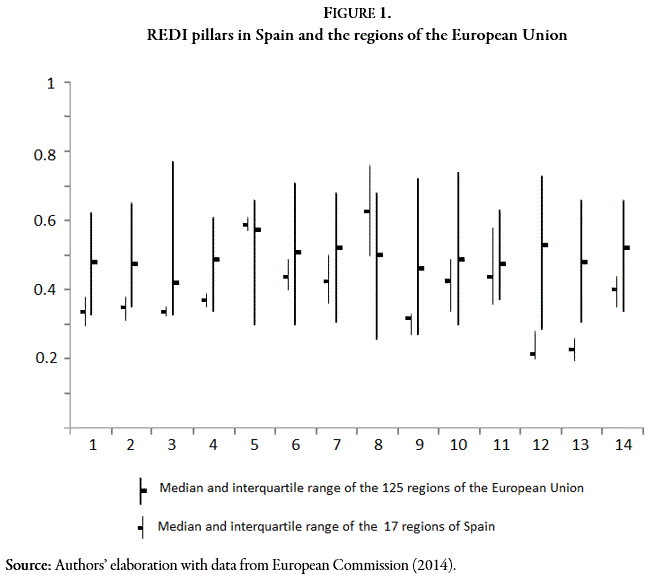
Figure 1.
REDI pillars in Spain and the regions of the European Union
Source: Authors’ elaboration with data from European Commission (2014).
Figure 1 also shows that the interquartile range for Spain is considerably smaller, but it also reflects that Spanish regions are more homogeneous than European regions, as it would be expected when regions of the same country are analyzed. The greatest interregional differences are found in the pillars of human capital (8) and process innovation (11) while in the pillars of risk acceptance (3), networking (4) and cultural support (5) the values of the Spanish regions do not show substantial differences.
Knowing the European and Spanish regional configuration of the entrepreneurship ecosystems with the 14 variables from REDI, the next step is to carry out the analysis that relates these regional ecosystems with microdata of the performance of business incubators and accelerators from the Spanish ranking of Funcas (Blanco et al., 2017), a private non-profit organization created and financed by the saving banks for the promotion and publication of research and studies on economic issues. This ranking is based on a study that takes place every two years and collects information about business accelerators and incubators in the most comprehensive survey of this kind in Spain. The latest microdata available is from the survey of 2016/2017 that includes 92 business incubators and accelerators. This database is accessible upon request.
This microdata have been worked out to build a variable that explains performance of BIAs. This variable consists of three elements having the same weight (between zero and three):

The variables have been chosen because they cover the pro-active external actions (networking) and pro-active internal ones (provision of specialists, mentors and monitoring). The availability of these services increases the permeability of their results on entrepreneurship in the neighboring areas and make them more efficient not only for the hosted entrepreneurs and start-ups, but for the entrepreneurship ecosystem thanks to increased connectivity.
The average number of employees at the time of the graduation of hosted companies is a measure of the efficiency of BIAs in two ways: it measures entrepreneurship success through employment creation by the firms hosted in the BIAs and it allows new companies to have a higher survival rate and a higher rate of growth (Segarra & Teruel, 2007; Prats & Merino, 2015). In this way this article studies if a succeeding entrepreneurship ecosystem promotes the growth of businesses thanks to the availability of better BIAs. At the same time, well-performing BIAs are a true picture of a nourishing entrepreneurship ecosystem. Still is unclear if BIAs increase the survival rate of companies with international conflicting evidence for countries such as Germany (Schwartz, 2013) and United States (Hackett & Dilts, 2008). A recent article suggests the company size is more important than the role of incubators, but BIAs might play a positive role in some sectors and for companies with enough size (Mas-Verdú, Ribeiro-Soriano, & Roig-Tierno, 2015).
Networking is a variable that takes values from 0 to 3 representing the frequency of networking events. 0 if there are no networking services, 1 if there are one or two networking events annually, 2 for quarterly networking events, and 3 for monthly ones. Networking allows BIAs to take advantage of the entrepreneurship ecosystem and increases the positive effects on companies that use BIAs services as described in the literature (Jones, Suoranta & Rowley, 2013b).
The availability of other services (monitoring, specialists and mentors) is also represented with three Boolean variables. When a BIA monitors the companies, has specialists or mentors the variable takes 1 or 0 otherwise. Thus, the value of other services is between zero and three.
Finally, the average employees of new companies is a variable that takes also values from zero to three. 0 is an average of less than four employees, 1 is for an average between four and six, 2 is for an average number between seven and nine, and 3 is for an average number equal or higher than 10. The original data source does not include the exact figures due to the inability of BIAs to provide this number.
According to this specification of the three elements (networking, other services, average number of employees) the performance can adopt values from zero to nine. The distribution found in Figure 2 is compatible with two underlying normal distributions with averages around two and seven. These two normal distributions represent two different populations: over-performing and underperforming BIAs.
The 92 BIAs studied in this article are located in fourteen different regions of Spain as shown in Table 1. The regions with a higher number of incubators and accelerators are Cataluña, Comunidad de Madrid, Andalucía and Comunitat Valenciana. There are three regions without BIAs in this research: Cantabria, Extremadura and Baleares. The observations are sufficiently distributed throughout Spain to consider the results valid to the regional entrepreneurship ecosystems of the country. Out of the 92 BIAs 71 of them are business incubators and 21 are accelerators. 7 are public-private consortiums, 51 are created thanks to the public initiative and 34 are privately owned.
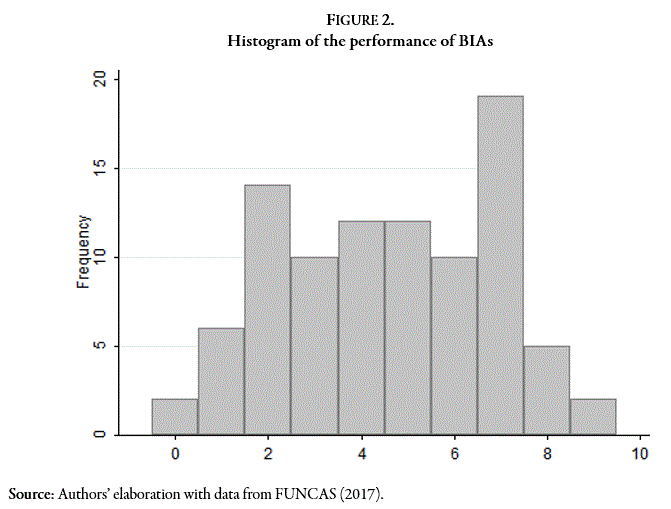
Figure 2.
Histogram of the performance of BIAs
Source: Authors’ elaboration with data from FUNCAS (2017).
| Region | Number of BIAS | Business incubators | Accelerators | Public-private consortium | Public initiative | Private initiative |
| Andalucía | 9 | 6 | 3 | 3 | 5 | 1 |
| Aragón | 4 | 3 | 1 | 1 | 2 | 1 |
| Principado de Asturias | 1 | 1 | 0 | 0 | 1 | 0 |
| Canarias | 3 | 3 | 0 | 0 | 3 | 0 |
| Castilla - La Mancha | 8 | 6 | 2 | 0 | 5 | 3 |
| Castilla y León | 4 | 4 | 0 | 0 | 3 | 1 |
| Cataluña | 19 | 15 | 4 | 1 | 12 | 6 |
| Comunitat Valenciana | 9 | 4 | 5 | 1 | 2 | 6 |
| Galicia | 6 | 4 | 2 | 0 | 2 | 4 |
| Comunidad de Madrid | 10 | 10 | 0 | 0 | 5 | 5 |
| Región de Murcia | 8 | 8 | 0 | 0 | 6 | 2 |
| Comunidad Foral de Navarra | 3 | 1 | 2 | 0 | 2 | 1 |
| País Vasco | 6 | 4 | 2 | 1 | 1 | 4 |
| La Rioja | 2 | 2 | 0 | 0 | 2 | 0 |
| TOTAL | 92 | 71 | 21 | 7 | 51 | 34 |
4. Main findings
An ANOVA analysis is conducted to compare the effect of every REDI pillar on the performance of business incubators and accelerators to show the relationship between the regional entrepreneurship ecosystem and the effectiveness of BIAs.
| Factor name | Degrees of freedom | Sum square | Mean square | F value and significance | Bartlett's test value and significance | Correlation sign | ||
| REDI 1 | 10, 81 | 95.784 | 9.578 | 2.06 | * | 12.008 | + | |
| REDI 2 | 11, 80 | 134.224 | 12.202 | 2.89 | ** | 11.198 | + | |
| REDI 3 | 7, 84 | 103.404 | 14.772 | 3.37 | ** | 8.089 | + | |
| REDI 4 | 6, 85 | 34.762 | 5.793 | 1.13 | 3.693 | + | ||
| REDI 5 | 8, 83 | 106.748 | 13.343 | 3.03 | ** | 10.412 | + | |
| REDI 6 | 13, 78 | 149.218 | 1.478 | 2.77 | ** | 12.880 | + | |
| REDI 7 | 11, 80 | 132.711 | 12.064 | 2.84 | ** | 11.107 | + | |
| REDI 8 | 10, 81 | 135.311 | 13.531 | 3.25 | ** | 10.591 | + | |
| REDI 9 | 7, 84 | 98.506 | 14.072 | 3.16 | ** | 4.881 | – | |
| REDI 10 | 12, 79 | 148.913 | 12.409 | 3.03 | ** | 13.559 | + | |
| REDI 11 | 12, 79 | 137.184 | 11.432 | 2.70 | ** | 13.065 | + | |
| REDI 12 | 7, 84 | 88.544 | 12.649 | 2.77 | * | 5.197 | + | |
| REDI 13 | 10, 81 | 99.851 | 9.985 | 2.17 | * | 9.644 | – | |
| REDI 14 | 11, 80 | 141.868 | 12.897 | 3.12 | ** | 13.172 | + | |
As it can be seen in Table 2, thirteen REDI groups out of fourteen, show a significant difference of BIAs performance. Only REDI 4, regional networking, does not show a significant difference of means in BIAs performance. The null hypothesis of Bartlett's test of homogeneity of variances is accepted the fourteen times. The sign of the correlation between REDI pillars and BIAs performance is positive in all the cases except for two (9: Globalization and 13: Competition). It seems that BIAs perform better in regions that are not so highly globalized and competitive ecosystems where they can be very useful promoting entrepreneurship.
But there are also some determinants that can qualify the studied performance of BIAs. Table 3 presents the results of models 1 to 5 where each of the determinants is measured and model 6 considers the variables of the first five models.
Model 1 measures the differences in the performance level between enterprise incubators and accelerators. Incubators tend to work with projects in the first stages while accelerators incorporate more mature projects, so the performance of incubators is significantly lower, as it could be expected. The companies graduated from incubators are smaller and incubators in Spain have on average fewer services as mentors, specialists and networking.
| Model 1 | Model 2 | Model 3 | Model 4 | Model 5 | Model 6 | |||||||
| Enterprise incubator | -1.101 | * | 0.988 | |||||||||
| (0.524) | 0.6706 | |||||||||||
| Public-private consortium | -1.819 | * | -1.249 | * | ||||||||
| (0.890) | 0.551 | |||||||||||
| Public initiative | -1.696 | ** | -0.878 | * | ||||||||
| (0.475) | 0.440 | |||||||||||
| Lean startup | 2.414 | *** | 2.180 | *** | ||||||||
| (0.406) | 0.602 | |||||||||||
| Business plan | -1.522 | *** | -1.340 | * | ||||||||
| (0.528) | 0.628 | |||||||||||
| Other requirements | 0.892 | 0.383 | ||||||||||
| (0.468) | 0.502 | |||||||||||
| Constant | 5.400 | *** | 5.676 | *** | 3.286 | *** | 5.740 | *** | 4.152 | *** | 4.088 | *** |
| (0.447) | (0.368) | (0.299) | (0.457) | (0.331) | 0.793 | |||||||
| F | 4.42 | 6.83 | 35.32 | 8.32 | 3.62 | 8.53 | ||||||
| Adj R-squared | 0.0468 | 0.1136 | 0.2738 | 0.0744 | 0.028 | 0.3759 | ||||||
| Mean VIF | 1 | 1.11 | 1 | 1 | 1 | 1.53 |
Note: Coefficient and standard error in brackets presented for each variable included in each model. * significant at 0.05. ** significant at 0.01 level. *** significant at 0.001 level.
Source: Authors’ elaboration with data from FUNCAS (2017).Model 2 concerns the impact of the ownership of incubators and accelerators on their results. Private-owned ones is the omitted variable and they show a better performance than both public-owned and those that are managed by a public-private consortium. Public initiatives and public-private consortiums do not show a significantly different performance, but the later ones tend to have slightly lower results in Spain.
Model 3 checks the importance of following the lean startup methodology (Ries, 2011). Incubators and accelerators that make use of this technique show better results (increases performance 2.4 units). This methodology could either improve the results directly or be followed by organizations that have unmeasured beneficial characteristics that increase the probability of following this methodology.
Models 4 and 5 verify if the requirements to become part of the incubator or accelerator play a role in the performance. The main requirement is to have a business plan for the project. This requirement is found to be active in incubators and accelerators that have a worse performance than the ones that do not require business plan to candidate projects (decreases performance 1.5). This could be an indicator of flexibility and experience: More flexible incubators and accelerators do not require business plans from the participants because they have enough experience to evaluate the projects with other variables. On the other hand, novel incubators and accelerators need to establish objective requirements due to the lack of experience in evaluating business projects. Finally, the existence of other requirements does not significantly improve the performance, as shown in model 5 (increases performance 0.9).
If all the BIAs specific determinants are included in the model, the sign of the variables effects on the performance does not change. In model 6, the dummy variable that adopts the value 1 for business incubators and 0 for accelerators loses its significance. This shows that despite incubators and accelerators having a different purpose and hence performance, these differences can be explained with other variables that have a higher effect on the performance of BIAs.
Both incubators and accelerators prepare companies for growth by providing guidance. The differences in the mechanisms of achieving this growth make incubators more suitable to companies in the startup phase while accelerators are more important in a later stage when identity and long-term strategic planning are more important to the businesses. Despite these differences both incubators and accelerators use the same kinds of tools to achieve their goals, such as networking events, mentorship programmes, monitoring and the availability of specialists (Cohen & Hochberg, 2014). These similarities allow computing the variable about the performance previously described for both incubators and accelerators, but also makes it possible to check if the differences in performance appear because of the nature of the BIAs or their categorization.
Once the specific variables of BIAs have been studied it can be determined that those with have a higher effect on the performance are ownership, methodology and the requirement of a business plan. It is then possible to analyze the importance of the 14 pillars of REDI on the BIAs performance. Models 7 to 20 incorporate each of the pillars individually and the results are shown in Table 4.
It is notable that the variable lean start-up is always significant in the fourteen models of Table 4. This methodology for developing business is followed by BIAs that show a higher performance. Other specific variables of BIAs are not significant when the components of regional entrepreneurship ecosystem are incorporated into the analysis.
| Model 7 | Model 8 | Model 9 | Model 10 | Model 11 | Model 12 | Model 13 | |||||||||
| (REDI 1) | (REDI 2) | (REDI 3) | (REDI 4) | (REDI 5) | (REDI 6) | (REDI 7) | |||||||||
| REDI pillar (see model) | 4.245 | * | 3.515 | 25.27 | ** | 6.726 | 10.52 | * | 6.029 | ** | 4.387 | ** | |||
| (1.823) | (2.657) | (8.864) | (7.778) | (5.28) | (2.225) | (1.674) | |||||||||
| Public-private consortium | -1.257 | -1.285 | -1.092 | -1.352 | -1.243 | -1.169 | -1.177 | ||||||||
| (0.769) | (0.786) | (0.762) | (0.788) | (0.778) | (0.763) | (0.765) | |||||||||
| Public initiative | -0.62 | -0.665 | -0.656 | -0.74 | -0.681 | -0.697 | -0.596 | ||||||||
| (0.447) | (0.458) | (0.438) | (0.455) | (0.449) | (0.439) | (0.443) | |||||||||
| Lean startup | 2.133 | *** | 2.076 | *** | 2.067 | *** | 2.075 | *** | 1.837 | *** | 1.674 | *** | 2.081 | *** | |
| (0.42) | (0.428) | (0.411) | (0.434) | (0.43) | (0.423) | (0.414) | |||||||||
| Business plan | -0.675 | -0.721 | -0.66 | -0.766 | -0.846 | -0.947 | * | -0.983 | |||||||
| (0.466) | (0.476) | (0.459) | (0.477) | (0.467) | (0.431) | (0.462) | |||||||||
| Constant | 2.734 | ** | 3.11 | * | -4.247 | 2.025 | -1.567 | 2.403 | * | 2.334 | * | ||||
| (0.99) | (1.289) | (3.164) | (3.077) | (3.285) | (0.993) | (1.039) | |||||||||
| F | 10.72 | 9.6 | 11.55 | 9.3 | 10.19 | 11.31 | 11.17 | ||||||||
| Adj R-squared | 0.3482 | 0.3209 | 0.367 | 0.3131 | 0.3355 | 0.3616 | 0.3584 | ||||||||
| VIF mean | 1.16 | 1.17 | 1.16 | 1.16 | 1.17 | 1.19 | 1.16 | ||||||||
| Model 14 | Model 15 | Model 16 | Model 17 | Model 18 | Model 19 | Model 20 | |||||||||
| (REDI 8) | (REDI 9) | (REDI 10) | (REDI 11) | (REDI 12) | (REDI 13) | (REDI 14) | |||||||||
| REDI pillar (see model) | 3.671 | ** | 1.537 | 1.814 | 2.325 | * | 1.97 | -0.924 | 3.379 | ||||||
| (1.125) | (3.133) | (1.286) | (1.165) | (2.21) | (2.907) | (2.132) | |||||||||
| Public-private consortium | -1.128 | -1.316 | -1.227 | -1.284 | -1.318 | -1.386 | -0.716 | ||||||||
| (0.75) | (0.794) | (0.788) | (0.776) | (0.79) | (0.798) | (0.451) | |||||||||
| Public initiative | -0.629 | -0.752 | -0.704 | -0.778 | -0.742 | -0.779 | -0.716 | *** | |||||||
| (0.432) | (0.456) | (0.453) | (0.446) | (0.455) | (0.458) | (0.451) | |||||||||
| Lean startup | 1.86 | *** | 2.054 | *** | 2.074 | *** | 1.903 | *** | 2.041 | *** | 1.977 | *** | 1.998 | *** | |
| (0.407) | (0.439) | (0.427) | (0.423) | (0.429) | (0.44) | (0.423) | |||||||||
| Business plan | -0.583 | -0.777 | -0.659 | -0.72 | -0.776 | -0.816 | -0.844 | ||||||||
| (0.455) | (0.48) | (0.483) | (0.468) | (0.476) | (0.477) | (0.471) | |||||||||
| Constant | 2.032 | * | 4.06 | ** | 3.623 | *** | 3.476 | *** | 4.026 | *** | 4.924 | *** | 3.205 | *** | |
| (0.965) | (1.313) | (0.917) | (0.817) | (0.895) | (1.065) | (1.068) | |||||||||
| F | 12.32 | 9.14 | 9.67 | 10.24 | 9.31 | 9.1 | 9.83 | ||||||||
| Adj R-squared | 0.3835 | 0.309 | 0.3228 | 0.3368 | 0.3134 | 0.3079 | 0.3268 | ||||||||
| VIF mean | 1.17 | 1.17 | 1.18 | 1.15 | 1.15 | 1.17 | 1.15 | ||||||||
Note: Coefficient and standard error in brackets presented for each variable included in each model. * significant at 0.05. ** significant at 0.01 level. *** significant at 0.001 level.
Source: Authors’ elaboration with data from European Commission (2014) and FUNCAS (2017).Thirteen out of the fourteen REDI pillars show a positive impact on the performance. Only the pillar 13 – Globalization – shows a negative non-significant relationship with the performance (it decreases performance 0.924) as it was anticipated in the analysis of variance presented in Table 2. Out of the thirteen remaining pillars there are seven that have a significant individual relationship with the performance. They are the following:
-
1. Opportunity perception: Market agglomeration and entrepreneurs referring opportunity recognition increase the performance of BIAs.
-
3. Risk Perception: Regions with entrepreneurs who respond better to risk and failure relate to higher performing BIAs.
-
5. Cultural support includes attitudes towards entrepreneurs, level of corruption and personal freedom. Where this pillar of REDI is higher BIAs tend to perform better.
-
6. Opportunity startup: Regions with higher business freedom locate BIAs with higher performance.
-
7. Technology Adoption: Regions with a higher portion of new businesses in creative or technology-intensive sectors show the best-performing BIAs.
-
8. Human Capital quantifies the education and training of entrepreneurs. Regions with entrepreneurs with higher human capital also show BIAs with higher performance.
-
11. Process innovation includes the research and development expense as a percentage of the GDP. The best performing BIAs are located in regions with a higher value in this pillar of REDI.
As it can be seen in Figure 1, most of them are those in which the Spanish regions have an equivalent or better result than the EU regions studied in the report by the European Commission. The pillars with comparatively better results for the Spanish regions are 5, 6, 7, 8, 10 and 11. All of them except for one are individually significant.
Finally, the combined effects of the significant pillars of REDI in models 21 to 23 are tested in Table 5. In model 21 only the seven REDI pillars that showed a significant individual effect are included in the regression model. Only pillar 6, Opportunity startup, has a significant effect on the performance and pillar 1, Opportunity perception, has a positive effect that is close to the significance at 0.05 level (p-value 0.079). REDI pillars are different measures of the same variables, that’s why model 21 presents collinearity in its regressors, as it is seen with a high VIF value.
Model 22 includes at the same time the REDI pillars and the BIAs specific variables and obtains a similar result: only pillar 6 shows a significant effect. Following the lean startup methodology and the requirement of a business plan to enter in the BIAs are the only two variables specific to each observation in the survey that are significant. This model shows some degree of multicollinearity. Models 21 and 22 are presented in Table 5 to show how model 23 includes the regressors.
In the last model, only REDI 6 and REDI 1 are included, since the first one has always had a significant result and the second one is close to the significance level in Model 21 and it is individually significant in Model 7. Model 23 has a higher adjusted coefficient of determination than model 6 (Table 3). Therefore, it is possible to conclude that some of the components of the regional entrepreneurship ecosystems influence the performance of BIAs in a way that cannot be explained by the specific attributes of business incubators and accelerators.
| Model 21 | Model 22 | Model 23 | ||||
| REDI 1. Opportunity perception | 15,726 | 8,944 | 5,682 | ** | ||
| (8,853) | (7,880) | (1,738) | ||||
| REDI 3. Risk Perception | -25,421 | -3,136 | ||||
| (28,518) | (25,934) | |||||
| REDI 5. Cultural support | -9,490 | -12,225 | ||||
| (9,763) | (8,477) | |||||
| REDI 6. Opportunity startup | 12,201 | ** | 9,839 | ** | 7,630 | *** |
| (4,215) | (3,711) | (2,155) | ||||
| REDI 7. Technology Adoption | -9,095 | -2,178 | ||||
| (8,174) | (7,314) | |||||
| REDI 8. Human Capital | 3,771 | 0,328 | ||||
| (3,210) | (2,976) | |||||
| REDI 11. Process innovation | 2,836 | 1,763 | ||||
| (2,468) | (2,168) | |||||
| Enterprise incubator | 0,833 | |||||
| (0,547) | ||||||
| Public-private consortium | -0,948 | |||||
| (0,748) | ||||||
| Public initiative | -0,641 | |||||
| (0,445) | ||||||
| Lean startup | 1,968 | *** | 1,891 | *** | ||
| (0,522) | (0,395) | |||||
| Business plan | -1,109 | * | -0,890 | * | ||
| (0,549) | (0,437) | |||||
| Other requirements | 0,243 | |||||
| (0,473) | ||||||
| Constant | 8,235 | 4,848 | 3,184 | |||
| (8,934) | (7,959) | (7,96) | ||||
| F | 4,440 | 6,030 | 17,090 | |||
| Adj R-squared | 0,209 | 0,418 | 0,414 | |||
| VIF mean | 9.40 | 6.29 | 1.11 | |||
Note: Coefficient and standard error in brackets presented for each variable included in each model. * significant at 0.05. ** significant at 0.01 level. *** significant at 0.001 level.
Source: Authors’ elaboration with data from European Commission (2014) and FUNCAS (2017).5. Conclusions and further research
This article analyses how the entrepreneurship ecosystem at a regional has an effect in the performance of Spanish business incubators and accelerators (BIAs) as entrepreneurship individual structures.
Several of the elements that are included in the entrepreneurship ecosystem are found in the regional entrepreneurship and development index (REDI) of the European Commission. This indicator is used for the empirical analysis. The REDI consists of 14 pillars which measures the capability and degree of development of the entrepreneurial ecosystem.
A variable that tries to replicate BIAs performance is created. It has a wide coverage since it depends on pro-active external actions (networking) and pro-active internal ones (provision of specialists, mentors and monitoring). The average number of employees of new companies is also included in the performance to indicate an increase in the survival rate and entrepreneurship success through employment creation by the firms hosted in the BIAs.
The empirical analysis is twofold: first, an ANOVA searches for a significant relationship between the entrepreneurship ecosystem and the BIAs performance. It is remarkable that BIAs seem to perform better in regions that are not so highly globalized and there is less competition. A possible explanation is that more competitive and globalized regions would need fewer services from BIAs because they are easily available in agglomeration economies. Less competitive and globalized regions would have better performing BIAs to overcome the lack of existence of the services provided in the local environment.
Several regression models relate the REDI ranking in each of its pillars and a good performance of BIAs. Results show several stylized facts: first, BIAs performance is determined by their own characteristics (table 1). The ownership has an effect in the performance: the best-performing BIAs are private ones, followed by private-public ones, being public BIAs the worst-performing ones. Accelerators have a higher performance than incubators. BIAs that follow this start-up methodology show a higher performance than those without it. Some requirements, such as the need of having a business plan before being hosted in BIAs, are related with a lower performance, though other requirements do not affect BIAs performance.
Seven out of the total 14 REDI are individually significant: opportunity perception (1), risk perception (3), cultural support (6), opportunity startup (7), technology adoption (8), human capital (11) and process innovation (11). Opportunity perception and opportunity startup seem to have the highest effect in BIAs performance in the combined model.
Results show the importance of a high degree of competition and flexible regulation policies to promote entrepreneurship. These measures would not only have a positive effect in the creation of new business but also would help to achieve a better system of innovative services, since business incubation delivers knowledge-intensive business services and promotes good business practices. As seen in previous works (Fernández Fernández, Blanco Jiménez & Cuadrado Roura, 2015), Spain’s culture has been traditionally less receptive to entrepreneurship. Some positive policies could imply an effective strategic networking, involving as many stakeholders as possible.
References
Acs, Z. J., & Armington, C. (2004). Employment, growth and entrepreneurial activity in cities. Regional Studies, 38, 911-927.
Acs, Z. J., Autio, E., & Szerb, L. (2014). National systems of entrepreneurship. Measurement issues and policy implications. Research Policy, 43(3), 476-494.
Acs, Z.J., Stam, E., Audretsch, D. B., & O’Connor, A. (2017). The lineages of the entrepreneurial ecosystem approach. Small Business Economics, 49, 1-10.
Adner, R. (2006). Match your innovation strategy to your innovation ecosystem. Harvard business review, 84(4), 98-110.
Alvedalen, J., & Boschma, R. (2017). A critical Review of Entrepreneurial Ecosystems Research: Towards a Future Research Agenda. European Planning Studies, 25(6), 887-903.
Audretsch, D., & Thurik, R. (2004). A model of entrepreneurial economy. International Journal of Entrepreneurship Education, 2(2), 143-146.
Ayers, S., & Harman, P. (2009). Innovation and entrepreneurship: The role of business incubation. Enterprise Development and Microfinance, 20(1), 12-26.
Blanco Jiménez, F.J., Polo García-Ochoa, C., Teresa Fernández Fernández, M.T., de Vicente Oliva, M.A., Manera Bassa, J., & Ackerman Vaisman, B. (2017). Los servicios que prestan los viveros de empresas en España. Ranking 2016/2017. FUNCAS.
Blind, K. (2010). The Role of Standards for Trade in Services: hypotheses and first insights. In F. Gallouj & F. Djiellal (Eds.), The Handbook of Innovation and Services: a multi-disciplinary perspective. Chap. 22. Cheltenham, UK: Edward Elgar.
Brown, R. & Mason, C. (2017). Looking inside the spiky bits: A critical review and conceptualization of entrepreneurial ecosystems. Small Business Economics, 49, 11-30.
Cohen, W.M., & Klepper, S. (1992). The trade-off between firm size and diversity in the pursuit of technological progress. Small Business Economics, 4, 1-14.
Cohen, S, & Hochberg, Y. (2014). Accelerating Startups: The Seed Accelerator Phenomenon. Robinson School of Business Working Paper.
Daly, H. (1991). Steady State Economics (2nd ed.). Washington D.C.: Island Press.
Daly, H.; & Farley, J. (2004). Ecological Economics: Principle and Applications. Washington D.C.: Island Press.
European Commission (2014). REDI: The Entrepreneurship and Regional Development Index-Measuring Regional Entrepreneurship. Belgium: European Commission, InfoRegio.
Feldman, M.P., Francis, J., & Bercovitz, J. (2005). Creating a cluster while building a firm: Entrepreneurs and the formation of industrial clusters. Regional Studies, 39, 129-141.
Fernández Fernández, M.T., Blanco Jiménez, F.J., & Cuadrado Roura, J.R. (2015). Business Incubation: innovative services in an entrepreneurship ecosystem. The Service Industries Journal, 35(14), 783-800.
Fischer, M. M., & Nijkamp, P. (2009). Entrepreneurship and regional development. In R. Capello & P. Nijkamp (Eds.), Handbook of regional growth and development theories (pp. 182-198), Cheltenham: Edward Elgar.
Georgesque Rogen, N. (1971). The Entropy Law and the Economic Process. Cambridge, Harvard University Press.
Hackett, S.M., & Dilts, D.M. (2008). Inside the black box of business incubation: Study Bscale assessment, model refinement, and incubation outcomes. Journal of Technology Transfer, 33, 439–471.
Isenberg, D.J. (2010). How to start an entrepreneurial revolution. Harvard Business Review, 88(6), 40-50.
Jones, R., Suoranta, M., & Rowley, J. (2013a). Entrepreneurial marketing: a comparative study. The Service Industries Journal, 33(7-8), 705-719.
Jones, R., Suoranta, M., & Rowley, J. (2013b). Strategic network marketing in technology SMEs. Journal of Marketing Management, 29(5-6), 671-697.
Levie, J., Autio, E., Reeves, C., Chisholm, D., Harrs, J., Grey, S., Ritchie, L., & Cleevely, M. (2014). Assessing regional innovative entrepreneurship ecosystems with the global entrepreneurship and development index: The case of Scotland. Global Entrepreneurship Research Conference, Barcelona.
Link, A. N., & Siegel, D. S. (2007). Innovation, entrepreneurship, and technological change. Oxford, UK: Oxford University Press.
Lucas, R.E. (1988). On the mechanics of economic development. Journal of monetary economics, 22(1), 3-42.
Malecki, E. J. (2009). Geographical environments for entrepreneurship. International Journal of Entrepreneurship and Small Business, 7, 175-190.
Malecki, E. J. (2018). Entrepreneurship and entrepreneurial ecosystems. Geography Compass, 12(3), e12359.
Mas-Verdú, F., Ribeiro-Soriano, D., & Roig-Tierno, N. (2015). Firm survival: The role of incubators and business characteristics. Journal of Business Research, 68(4), 793-796.
Prats, M. A., & Merino, F. (2015). La importancia del tamaño en la empresa española. Información Comercial Española, ICE: Revista de economía, 885, 13-32.
Porter, M. E. (1990). New global strategies for competitive advantage. Planning Review, 18(3), 4-14.
Quian, H., Acs, Z. J., & Stough, R.R. (2013). Regional systems of entrepreneurship: the nexus of human capital, knowledge and new firm formation. Journal of Economic Geography, 13, 559-587.
Ries, E. (2011). The lean startup: How today's entrepreneurs use continuous innovation to create radically successful businesses. Crown Books.
Romer, P.M. (1994). The origins of Endogenous Growth. The Journal of Economic Perspectives, 8(1), 3-22.
Schwartz, M. (2013). A control group study of incubators’ impact to promote firm survival. The Journal of Technology Transfer, 38(3), 302-331.
Segarra, A., & Teruel, M. (2007). Creación y supervivencia de las nuevas empresas en las manufacturas y los servicios. Economía industrial, 363, 47-58.
Stam, E. (2015). Entrepreneurial Ecosystems and Regional Policy: A Sympathetic Critique. European Planning Studies, 23(9), 1759-1769.
Stenberg, R. (2007). Entrepreneurship proximity and regional innovation systems. Tijdschrift voor Economische en Sociale Geografie, 98(5), 652-666.
Stough, R. R. (1998). Endogenous Growth in a Regional Context. Annals of Regional Science, Endogenous Growth Special Edition, 32(1), 1-15.
Stough, R. R. (2016). Entrepreneurship and Regional Economic Development: Some reflections. Journal of Regional Research – Investigaciones Regionales, 36, 129-150.
Studdard, N. L. (2006). The effectiveness of entrepreneurial firm’s knowledge acquisition from a business incubator. International Entrepreneurship and Management Journal, 2(2), 211-225.
Suresh, J., & Ramraj, R. (2012). Entrepreneurial ecosystem: case study on the influence of environmental factors on entrepreneurial success. European Journal of Business and Management, 4(16), 95-101.
Ylinenpää, H. (2009). Entrepreneurship and Innovation Systems: Towards a Development of the ERIS/IRIS Concept. European Planning Studies, 17(8), 1153-1170.
Additional information
JEL classification: L84; L26; O32.
Corresponding author: juan.santosbartolome@ceu.es