Artículos

This work is licensed under Creative Commons Attribution-NonCommercial 4.0 International.
Received: 25 April 2018
Accepted: 19 November 2018
Abstract: In recent years, the topic of trust in public authorities has been extensively analysed, notably with regard to the impact that this has on countries’ development. In this paper, an analysis of three representative European countries (Spain, Denmark, and Belgium) is carried out using data from the European Social Survey. The application of a method based on fuzzy logic and the degree of similarity to the ideal solutions makes it possible to obtain a synthetic indicator of the degree of confidence that the citizens of these respective countries have in the analysed institutions. This analysis is based on six different dimensions, namely: (1) The National Parliament; (2) The Legal System; (3) The Police; (4) The Politicians; (5) The European Parliament; and (6) The United Nations. The results obtained are conclusive for the current situation of the European Union, and in particular for Spain, where there are indications that the current democratic system is being undermined by the lack of trust that citizens have in their respective public authorities and institutions.
Keywords: Trust, Public authorities, Fuzzy logic, TOPSIS.
Resumen: En los últimos años, el tema de la confianza en las instituciones públicas ha sido muy analizado, en particular con respecto al impacto que esto tiene en el desarrollo de los países. En este trabajo, se realiza un análisis de tres países europeos representativos (España, Dinamarca y Bélgica) utilizando datos de la Encuesta Social Europea. La aplicación de un método basado en lógica borrosa y el grado de similitud con las soluciones ideales permite obtener un indicador sintético del grado de confianza que los ciudadanos de estos respectivos países tienen en las instituciones analizadas. Este análisis se basa en seis dimensiones diferentes, a saber: (1) El Parlamento Nacional; (2) El sistema judicial; (3) La policía; (4) Los políticos; (5) El Parlamento Europeo; y (6) las Naciones Unidas. Los resultados obtenidos son concluyentes para analizar la situación actual de la Unión Europea, y en particular para España, donde hay indicios de que el sistema democrático actual está siendo socavado por la falta de confianza de los ciudadanos en sus respectivas autoridades e instituciones públicas.
Palabras clave: Confianza, Instituciones públicas, Lógica borrosa, TOPSIS.
1. Introduction
Confidence in Governments has always been a latent concern in the social sciences. Public confidence is based on the transparency of the actions of various Government institutions (Nunkoo, Ramkissoon & Gürsoy, 2012). Trust is a subjective condition. Nevertheless, it allows the potential and actual capacity for intervention by the different institutional actors to strengthen and boost their effectiveness. Therefore, in the analysis of this condition, citizen participation and institutional change are important variables of the social context (Kadir, 2015).
Confidence in political power is to be understood as a compendium of various tangible and intangible attributes that public or private entities have shaped through Government action, which is perceived by society in a positive or negative way (Fazio et al., 2017). However, it is difficult to measure confidence accurately, since each person in society has a particular way of perceiving it (Clausen, Kraay & Nyiri, 2011). Confidence in public institutions is normally based on the opinions that people have about the intervention of these institutions in the well-being of the community (Olivares, García, Jauregui, Revilla & El Zauahre, 2008).
Confidence in institutions has been one of the most debated topics in the study of democracies, and it is directly related to the development of towns (Clausen, Kraay & Nyiri, 2011; López, Sánchez, & Rojas, 2015). However, confidence in the institutions depends not only on the number of institutions that are important in the social and economic development of modern societies, but also on the set of perceptions (social attributes) that the individuals in society have about these institutions. For this reason, it is necessary to ask a set of individuals about the degree of trust that they have in a set of institutions, and to then apply a methodology that calculates a synthetic indicator which is called the degree of institutional confidence.
In our case, this synthetic indicator is based on the methodology of fuzzy logic (Rajak & Vinodh, 2015) and the TOPSIS method (Mandic, Delibasic, & Radojevic, 2015). The case study analysed is based on the trust perceived by the citizens of three selected European countries: Spain, Denmark and Belgium. The data were obtained from the European Social Survey1. This survey provides baseline information about the confidence that citizens have in six institutions, namely: (1) The National Parliament; (2) The Legal System; (3) The Police; (4) The Politicians; (5) The European Parliament; and (6) the United Nations. Furthermore, it has been taken into account how the individuals in society evaluate the degree of complexity of the proposals made by these institutions. This is done by analysing the response to the question concerning whether a particular policy is too complicated to understand. In this way, it can be determined whether the current perception about institutional trust may be caused by endogenous variables of individuals regarding how they value the complexity of political decisions. It would not be surprising if this segmentation produces significant results, since the relationship between the proximity of the political parties, citizen participation and the degree of institutional trust has already been established (Hooghe & Kern, 2013; Katsanidou & Eder, 2015).
Hooghe & Kern (2013) find that political parties are an essential gear between the citizens and the political system. They show that, regardless of the ideology, the affinity with any political party is closely related to institutional confidence. Katsanidou & Eder (2015) mention that the degree of confidence that citizens have in political parties is strongly related to their level of participation according to its nature, whether by voting, party affiliation, or protesting. Furthermore, it is observed that the degree of confidence in the National Parliament is key in the first level of participation, while lack of confidence explains the last level.
This article has a triple purpose: (1) to propose a method based on the methodology of fuzzy logic and the similarity to the ideal solutions (a Technique for determining the Order Performance by Similarity to the Ideal Solution -TOPSIS) in order to obtain synthetic indicators of confidence in the institutions or public authorities; (2) to analyse to what extent this institutional confidence is affected by nationality or the complexity that political issues have for different people; and (3) to observe to what extent each of the components of the institutional confidence affects the degree of global institutional trust: that is, one can determine whether the political parties have a higher or lower impact in each of the analysed segments. This article aims to complement the existing literature on this subject, and, in addition, the results could be used to see to what extent European citizens are similar or not, according to whether they live in the North or the South of the EU.
The rest of the article is structured as follows. The second section presents a review of the literature. The third section explores the data which have been obtained from the European Social Survey and serve as a database to analyse institutional confidence in some segments. The fourth section describes the methodology used in the calculation of the synthetic indicators of institutional confidence. The fifth section presents the results obtained. And, finally, the last section provides some conclusions and a general discussion.
2. Literature review
The subject of confidence in institutions has emerged recently in the social sciences literature as a major determinant of citizens’ happiness and welfare. Veenhoven (2000) finds a subtle separation between the results observed in the different countries which are more determined by income. Thus, for example, it is economic freedom, and not policy, which determines happiness in less developed countries, in contrast to what happens in rich countries. Frey & Stutzer (2002), in their analysis of the different works on trust in institutions, conclude that these works are mainly limited to the analysis of democracy and political systems, so it is necessary to extend this analysis of confidence to other institutions. Hudson (2006) performs such an extension by using Eurobarometer data which includes 11 different institutions.
Confidence in institutions is a fundamental component that affects interpersonal trust (Coleman, 1988). Social capital is also an important resource that can be used by stakeholders to increase productivity. Social capital has various components: (1) trust and obligations; (2) information channels; (3) standards and sanctions systems. These three dimensions affect welfare because they facilitate or impede the coordination of, and cooperation between, different individuals and social groups. Mishler & Rose (2001) define the confidence in the institutions according to the satisfaction experienced by the individuals. This definition is related to the theory of institutions, which determines how institutional confidence depends on the quality of the institution, in particular that of government institutions, since these have a direct impact on socio-economic variables such as income, employment, education, health care, and even some civil rights. North (1990) argues that institutional confidence in the political and judicial system determines to some extent the effectiveness of interactions between agents who support, or do not support social welfare.
However, it should be taken into account that not all individuals have direct relation with all institutions, which may affect to a greater or lesser extent their individual well-being. So it is necessary to observe that some of the confidence that citizens have in the institutions may be due to indirect knowledge that is determined by the experience of other groups, or by means of communication. There are some theories that hold that institutional trust may change depending on the characteristics of the individuals, since there are people who tend to rely more on their fellows, so they will have a greater inclination to rely more on their institutions. In the same way, the encounters with certain institutions such as the police can be affected by social class and the geographical environment, since these are not the same for a young man living in the outer suburbs of a large city as they are for a pensioner living in a rural setting.
A number of different institutions have been investigated in previous studies that analyse institutional confidence. For example, Paxton (1999) studies institutional confidence in two different dimensions: (1) trust in society from a more informal point of view; and (2) trust in more formal institutions. Mishler & Rose (2001) analyse the following institutional dimensions: the National Parliament, Trade Unions, the Police, the Court System, and the Media. Hudson (2006) analyses 11 different institutions: (1) the United Nations Organization; (2) the European Central Bank; (3) Non-governmental Organisations (NGOs); (4) Justice; (5) the Police; (6) Trade Unions; (7) Companies; (8) Government; (9) Radio; (10) Private Organisations; and (11) the European Union. The author finds that the institutions that have the greatest impact on the well-being of individuals are the National Government, the European Central Bank, Justice, the United Nations, and the European Union. Rodríguez-Pose & von Berlepsch (2014) analyse institutional confidence as the first component of social capital, and, due to problems of multicollinearity between trust in Justice, the Police and the Parliament, decide to use only confidence in Justice because it explains 80 per cent of the institutional confidence, by collapsing the data of six formal institutions to the value of the confidence in Justice. Fazio et al. (2018) measure trust in institutions analysing 6 institutions: (1) ‘‘Italian parliament’’; (2) ‘‘Regional government’’; (3) ‘‘Municipal government’’; (4) ‘‘Political parties’’; (5) ‘‘Legal system’’; and (6) ‘‘Police’’. Meanwhile, Camussi, Mancini, & Tommasino (2018) use two measures of trust: (1) generalized trust; and (2) trust in governments. The authors find that there are higher levels of trust in the northern part of the country.
Confidence in Justice can be approximated by the quality of the Police and the Judicial System. The country’s citizens show confidence when these two institutions operate efficiently and fairly. Jackson et al. (2011) designed a conceptual framework to compare trust in Justice using two dimensions: the Police and the Judicial System. They define confidence in the Police as the public belief that the Police have a proper way of proceeding, and that they are professional and competent to act in the way they do in specific situations. In relation to the Judicial System, trust is related to the very legitimacy of the system which is based on its own need to exist and the justification of its authority to enforce the laws even by coercive measures and punishing those who act illegally. The legitimacy of the institutions emanates from their own approval and sincere recognition of the norms, laws, and resolutions (Mehozay & Factor, 2017; Weber, 1978).
The National Parliament, Politicians and their parties serve as a link between the citizens and the State. The Political parties socialise the politics between citizens; by occupying a space as wide as possible to group and identify their social preferences. Panebianco (1988) argues that Political parties provide a mechanism to add the social preferences of the citizens, so that the Political system can perform the function of representation and guarantor of these preferences. In this sense, it can be said that Political parties must link these social preferences ideologically, which allows citizens to identify outstanding policy issues by keeping a stance in accordance with them. Thus, the political debate has been structured according to different ideologies, which helps the ordinary citizen to make sense of this debate. Dalton et al. (2011) claim that Political parties serve to organise democracy effectively.
However, the performance and the nature of Political parties have changed since the time of ideological movements which represented large sectors of the population. This means that citizens do not feel emotional ties to Political parties (Katz & Mair, 2009). The hierarchy of the steering committees and of the Presidents reached levels unimaginable in the past, when decisions were taken in an almost horizontal manner (Whiteley, 2011). According to Katz and Mair (1995), the professional structure of the political parties, which has been generated in Western countries, is mostly characterised by models that are explained in terms of the ultimate goal, which is to win the elections. This gives individuals access to the power and resources of the Government, at the expense of minimising the burden of ideological content or of the close relationship with the militants. The new Political parties are characterised by a small elite who decide about campaign strategies and tactics which put a premium on governing rather than representing the real interests and identities in society (Enroth, 2017).
It is not clear what will be the results of this loss of sense of belonging to a Political party. In a more general context, Putnam (2000) shows the effect this has on individual happiness. Participation in certain activities where people develop emotional ties is equivalent to a wage increase of 100 per cent or to four years of education. This result has been demonstrated in other studies (Delhey & Dragolov, 2016; Helliwell, 2003; Pichler, 2006). Delhey & Dragolov (2016) find that Europeans are indeed happier and psychologically healthier in more cohesive societies (p. 163). In addition, ideological loss will also have a higher influence on the social preferences for giving more or less freedom to the Government to organise more or fewer activities, and whether or not the economy should be open market oriented (Hetherington, 1998).
To conclude this section, the reader should be aware that the study of institutional confidence depends mainly on the data obtained, either by means of a survey carried out ad hoc for research, or by data collection from different sources.
3. Data
This section presents the data that have been used in this paper, and that have been obtained in the sixth round of the European Social Survey. This survey is carried out every two years, beginning in the year 2002, and, as mentioned above, the data that have been used in the present study correspond to the 2012 sixth round. This survey is characterised by the wide participation of academics in different European countries, which makes it possible to standardise the information obtained on issues that are very difficult to measure, and have a high social interest. In order to determine social indicators, the research objectives include topics such as the interaction of public institutions within Europe, applying the same transnational research model. The surveys allow solid information based on the perceptions and judgments of citizens to be obtained, by generating information for social sciences research of the European Community, which is at the service of the public in general.
The survey covers different themes, such as confidence in the institutions, national identity, ethics, religion, ethnicity, nationality, political commitment, welfare, health, security, socio-political values, demographic composition, morality, social values, education, occupation and social2 capital. The sixth round was conducted in 29 countries, whereby a random representative sample by countries was generated for the population aged over 15 who were residing in private households, in order to ensure that nationality, residence, spoken language at home, or legal status is estimated accurately.
For the purpose of presenting the results of this paper, and, in order to focus more on the methodological proposal than in an in-depth analysis of institutional trust for all the European countries included in the survey, it was decided to consider the analysis in only three countries: Spain (ES), Denmark (DK) and Belgium (BG), which are representative of three types of geographical area. Spain represents the southern European countries which have been mainly characterized by being more affected by the recent financial and euro crisis; Denmark, on the other hand, can be considered the representative of the Northern countries of Europe that have been less affected by the financial and euro crisis; and, finally, Belgium can be considered the representative for the intermediate countries and also because it contains one of the European capitals, Brussels.
According to the purpose of this work, which ascertains the degree of confidence in institutions, the two main questions relating to that module were as follows: institutional trust, and the degree of complexity of the political issues. Thus, for each of the selected individuals in our analysis, we have the following data: (1) the degree of confidence they have in each of the six institutions under analysis, namely: the National Parliament; The Legal System; The Police; The Politicians; The European Parliament; and the United Nations; (2) the degree of complexity that political issues have for them, which is measured on a 5-point verbal Likert scale: never; rarely; occasionally; regularly; and frequently.
It is important to highlight that the rounds performed through the European Social Survey use an 11-point Likert scale (from 0 to 10) with verbal anchors at the ends, where 0 means that the person does not trust in an institution at all and 10 means that the person has full trust.
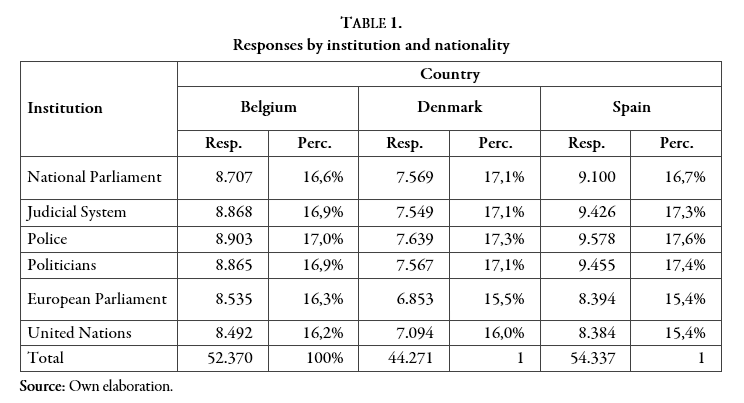
Table 1 shows the number of responses obtained in the module ‘institutional confidence’ for the three analysed countries. It can be seen that around 26,000 citizens responded to the questions about these institutions, emphasising that local institutions have a greater representativeness, while foreign institutions obtained a mean of approximately 2000 responses less. This may be due to two facts that are significantly different: either the respondents may have decided not to answer the question or they really do not know what to answer about the institutions that are more distant and unknown.
Responses by institution and nationality
Source: Own elaboration.
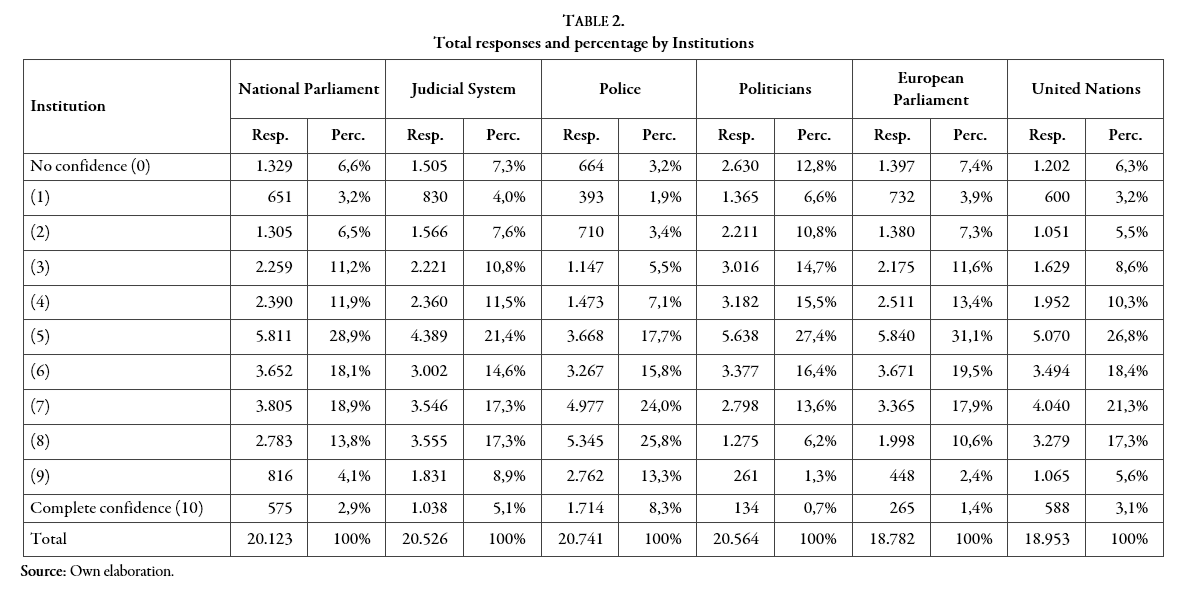
Table 2 shows the total number of responses that each institution received according to the citizens answers, i.e. the frequency table of each one of the Likert evaluations that are represented. It can be seen that there are less citizens who heavily trust politicians, and more citizens who distrust them completely. Considering, an arithmetic mean of the values, it can be seen that the following relationship prevails according the level of trust: citizens experience more trust in the Police, followed by the United Nations, the Judicial System, the National Parliament, the European Parliament, and the Politicians.
4. Methodology
The proposed methodology is to calculate the level of institutional trust is based on the literature of service quality. Lewis and Booms (1983) define the quality of service as a measure of how the service provided fits the expectations of consumers. In other words, one can determine the degree of confidence in the institutions based on how citizens estimate that the policies implemented by the institutions conform to what they expect. Parasuraman et al. (1985) determine that ‘the quality perceived by a consumer in a given service is a function of the magnitude and the direction of the difference between the expected service and the perceived’ (p. 46). According to this conceptual model, institutional trust is determined by the expectations of the citizens about the policies undertaken by institutions in relation to what they actually experience, either directly or indirectly.
This research is based on a questionnaire which evaluates institutional confidence according to an 11-point Likert scale verbally anchored at end points from 0 (no confidence at all) to 10 (complete confidence). There are various statistical methods that can be used to treat this information that is imprecise in nature. In this paper, a hybrid method that integrates the methodology of fuzzy sets with the technique of determining similarity to an ideal solution, TOPSIS3, is proposed to analyse institutional confidence. This method has been applied in the area of business management (Hutchinson, 1998; Xia et al., 2000; Viswanathan, 1999), and is gaining wide acceptance in the analysis of quality of service (Büyüközkan and Çifçi, 2012; Karimi, Azizi, Javanshir and Ghomi, 2015; Sun and Lin, 2009; Tsaur et al., 2002; Yeh and Kuo, 2003).
Total responses and percentage by Institutions
Source: Own elaboration.
These methods resemble the multi-attribute decision models (MDMA) that are based on the theory of multi-attribute value or utility (Keeney and Raiffa, 1993). These models have also been used to rank a set of alternatives (Dyer et al., 1992; Ertuğrul and Karakaşoğlu, 2008; Kannan, de Sousa Jabbour and Jabbour, 2014; Stewart, 1992; Yeh et al., 1999). These methods are especially suitable for solving decision problems where it is really important and necessary to get cardinal preferences or a ranking of the available alternatives. In our case, the institutional confidence of a set of European citizens is ranked according to the nationality and the degree of complexity of the political issues.
The process of subjective assessment is intrinsically imprecise, since interaction with institutions may be direct or not, and because of the type of institutions covered by the question. In the interview, a set of verbal terms is used (from nothing to full trust) in order to value the institutional trust of each institution included in the analysis. The verbal terms have a vague and imprecise nature, although they are often used to represent the preferences or judgments of the interviewees. This vagueness is the origin of the applicability of the theory of fuzzy logic, when it comes to catching the structure of decision-makers’ preferences. Fuzzy set theory helps to measure the ambiguity of concepts that are associated with the subjective judgments of human beings.
The modelling using fuzzy sets is an effective way of formulating decision problems where the available information is subjective and imprecise (Zimmermann, 1996). The subjectivity and vagueness of the process of surveys which reflect the evaluations made by the respondents is then analysed in a more appropriate way through the fuzzy sets. Herrera and Herrera-Viedma (2000) argue that linguistic terms are intuitively easier to use when decision makers express the subjectivity and vagueness of the evaluations, and, for this reason, fuzzy set theory has become a very popular method in the field of social sciences.
Using fuzzy numbers is a very appropriate methodology that properly combines subjective and objective knowledge. Zadeh (1965) stated some basic findings associated with the development of fuzzy sets. Actually, many of the sets found in the real world do not have defined levels that clearly separate the function of belonging to that group. In our case, we can try to assess whether confidence in the Police can be considered one of these blurred sets. If we denote the set of ‘features that mean that confidence in the Police is null’ by W, the question that arises is ‘Why are there citizens who have answered this way?’ Can it be because they have had a direct experience based on an abuse of authority, or because they have recently heard in the news some fact about corruption in the Police force of a given country? The answers to these questions are always logical from the point of view of accurately measuring the level of confidence, and as it is well known there will always be a positive probability of finding a citizen who responds affirmatively to each of these questions.
On the other hand, it seems intuitively clear that a person who has had an unsatisfactory contact with the Police will have a lower confidence than those people who have not had direct contact or have experienced a friendly and professional service by Police officers. Thus, the confidence of the people of this second group will be higher than it is for the first one. Within this context, we can say that ‘the membership of a set’ is a measure that has different degrees of intensity.
Zadeh (1975) and Mamdani and Assilian (1975) established fuzzy logic by introducing the concept of approximate reasoning, and demonstrate that vague statements allow the formation of algorithms that can use vague information to obtain vague inferences. Many fields have benefited from this approach, but most are related to the study of complex human systems, such as those we aim to address in the paper.
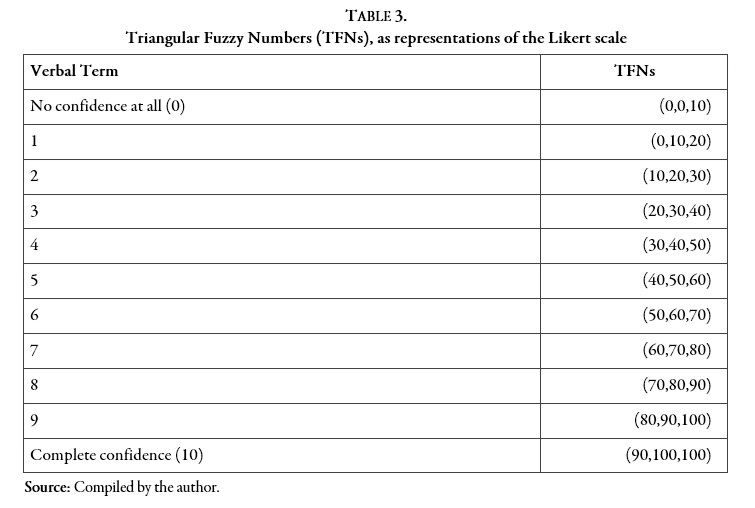
In particular, triangular fuzzy numbers (TFNs) defined by a three real-number vector denoted by are used. Each verbal term is characterised by a TFN to represent its value range, approximated between 0 and 1004, and denoted as , where . is the most probable value of the verbal term, and the extremes are the upper and lower levels used to reflect the ambiguity of the term. Table 3 shows the set of fuzzy triangular numbers that have been chosen in the investigation. One can see that, with the exception of the end points that determine verbally the extreme values of the scale, the range of all the other triangular numbers is equal to 20, and they are symmetrically centred on the most probable value. Likewise, it is observed that the ends are triangular numbers degenerated at those end points, and these two TFNs have a lower range than the other nine levels of intensity (1-9).
Triangular Fuzzy Numbers (TFNs), as representations of the Likert scale
Source: Compiled by the author.
Once each observation is translated to the representative TFN, the algebra can be used to provide more objective information through the arithmetic mean of the TFNs, which is also characterised as a TFN (Buckley, 1985).
To determine the similarity to ideal solutions, it is necessary to clarify the information obtained through the previous step. Thus, the methodology now requires to use some ‘information clarification’ technique that converts fuzzy numbers into real numbers. This procedure involves finding the best value for the non-fuzzy evaluation. There are multiple methodologies to achieve this goal. The ‘middle-of-maximum’, ‘centre-of-area’ and the ‘alpha-cut’ methods (Zhao and Govind, 1991) are some of the approaches that have been used more frequently.
In this work, the clarification technique is defined as a weighted average for the TFN . Chen (1996) proposed this method for its simplicity and because it does not require a prior establishment of a personal judgment from the analyst. The method is based on the proposal made by Kaufmann and Gupta to compare fuzzy numbers, and its logic rests on the definition of the elimination of the fuzziness (Kaufmann and Gupta, 1988).
The multi-attribute assessment characterised by the matrix of clarified information is solved by using the method of optimality, based on the best virtual alternative and the notion of the best answer (Zeleny, 1982). The approach used is known as the TOPSIS method (Hwang and Yoon, 1981). The authors propose TOPSIS logic by defining the positive ideal solution and the negative ideal one. The positive ideal solution is the one that maximises all criteria associated with benefit, and minimises all the criteria associated with cost. While the negative ideal solution is based on the opposite logic, maximising the cost criteria and minimising those associated with benefit. The optimal observation is the one which is closest to the positive ideal solution and farthest from the negative ideal solution. The ranking of the alternatives in TOPSIS is carried out by taking into account ‘the relative similarity of any alternative to the ideal solution’.
An observation is closer to the ideal solution as the similarity ratio approaches 1. A set of alternatives can be classified according to this ratio in descending order. This approach has been widely used in different decision contexts, (see, for example, Athanassopoulos & Podinovski, 1997; Awasthi et al., 2011; Bin et al., 2015; Chang & Yeh, 2001; Chen & Hwang, 1991; Hossain et al., 2015; Hou & Xiao, 2015; Saeida et al., 2015; Yeh et al., 2000; Zeleny, 1998; Zlateva et al., 2015).
The mathematical formulation of the method can be expressed as:
 (1)
(1)
 (2)
(2)
 (3)
(3)
 (4)
(4)
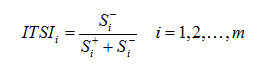 (5)
(5)Where is the information clarified matrix, is a set of all the population segments included in the analysis, and are the positive and negative ideal solutions, and are the Euclidean distances between all the aggregated clarified observations and the positive and negative ideal solutions, and is the institutional trust synthetic indicator for the segment .
Once the researchers have information about the institutional trust indicator, the analysis of the sensibility of the synthetic indicator to changes in the institutional trust performance is also relevant. Elasticity has the origin in physics but it is nowadays a more developed concept in economics and social science. The elasticity values evaluate the sensitivity (which may be positive or negative) of the institutional trust with respect to each institutional trust change. Thus, the elasticity values are usually referred as the percentage change in institutional trust when there is one per cent of change of trust in a particular institution. In mathematical notation, the elasticity can be calculated for each segment . and each institution as:
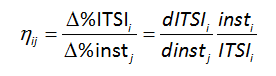 (6)
(6)The analysis of the elasticity might be used by different stakeholders, such as governmental agencies, political parties and policymakers, to determine which institutions are more or less critical in causing a greater impact on institutional trust of the citizens. The elasticity values determine which institutions need to be reformed in order to enhance the trust in institutions, as a way to improve the democracy in the countries under analysis.
5. Results
The TOPSIS ranking is obtained once the clarified information matrix has been calculated for performing the analysis of the ideal solutions, once the worst and best assessment carried out for each one of the analysed segments is carried out. Table 4 shows the positive and negative ideal solutions resulting from the analysis of the segments considered in the study: the total, the Belgian, the Spanish and the Danish citizens, and five segments which are obtained by analysing the response to the degree of complexity that is experienced by the citizens on political issues, as shown by their responses to the choices: (1) never; (2) seldom; (3) occasionally; (4) regularly; (5) frequently. The table is divided into six columns. The six institutions investigated are shown in the first column. The second and third columns show, respectively, the positive ideal vector and the segment that experienced the higher degree of trust. The segment that analyses the complexity of political issues only applies to one institution - the European Parliament. Concerning the rest of the institutions it is shown that nationality (in our case, the Danish) determines mainly the positive ideal solution. When analysing the fourth and fifth columns which, respectively, show the value and segments that have the worst observation of the analysed data set, it is observed that in this worst case, segmentation according to the complexity of the political issues is more frequent, except for the institutions Justice and the Police, whereas the Spaniards and Belgians manifest greater distrust. Finally, the sixth column presents the percentage variation among the ideal solutions, which allows us to obtain a classification of those institutions that are observed as more or less heterogeneous. It can be seen how Politicians have a greater heterogeneity, while the European Parliament presents a greater homogeneity. By analysing the table in a global way, it is obtained that only the Police has an acceptable level of confidence for the all analysed segments.
Ideal solutions
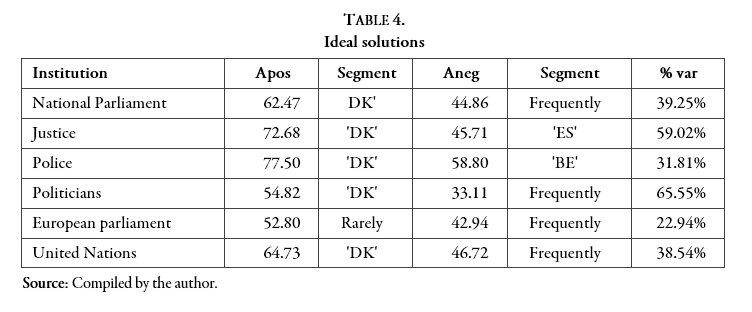
Source: Compiled by the author.
Through the analysis of the values of the ideal solutions, some interesting conclusions can also be drawn. First of all, it can be seen that the best-valued institutions are Justice and the Police, while the worst-rated institutions are the Politicians and the European Parliament. In the Intermediate levels, the National Parliament and the United Nations come. Regarding the negative ideal solution, the Police remains as an institution that inspires more confidence and the Politicians inspire the least. The rest of the institutions present intermediate values.
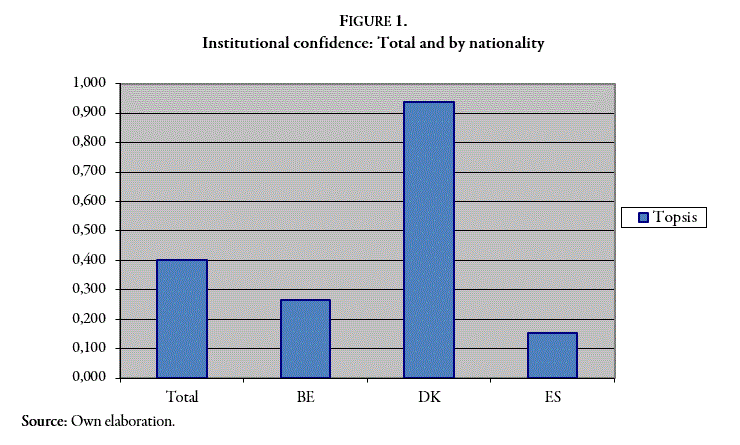
Figure 1.
Institutional confidence: Total and by nationality
Source: Own elaboration.
The TOPSIS indicator serves to obtain the synthetic degree of institutional trust for each of the analysed segments. Figure 1 shows the graph of the results obtained for the total population under investigation, as well as for each of the nationalities. It can be seen by nationality that the Spaniards are those who show less institutional confidence, followed closely by the Belgians, in contrast with the results shown by Danish citizens. This result is consistent with those obtained in other studies, using a different methodology. Thus, for example, Rodríguez-Pose & von Berlepsch (2014) find that the Scandinavian countries show higher levels of endowment of social capital, while the countries of Southern Europe show lower levels of trust in their institutions. These results have also been empirically confirmed by other researches (Marozzi, 2014; van Oorschot et al., 2006).
Figure 2 shows the graph of the results of institutional confidence when segmentation is performed according to the degree of complexity that the citizens experienced regarding political issues. It would be expected that this segmentation would display a decreasing trend regarding the complexity experienced with regard to political issues. However, the functional form is represented by a reversed ‘U’, where the maximum confidence is obtained in the group of citizens who on rare occasions have found the political issues to be complicated. Conversely, those who never found the political issues complicated experience greater institutional distrust. This result is counter-intuitive, and the fact that the question is framed in terms of a negative character (complexity of subjects on political issues) and it is measured with the frequency, where the first verbal term (never) also has a component which can involve negative feelings, and such a double negative may not be understood at all well, so some citizens who replied at this end might mean that they find political themes have a certain complexity. Concerning the segment ‘rarely’, the results are as expected. The degree of knowledge influences the institutional confidence directly. Citizens who considered that political issues are often very complex, logically have a greater distrust in the institutions because they do not understand them completely. For those who have greater knowledge, it is more logical to show a greater confidence. This result can be compared to what is obtained by Freitag (2003), where institutional confidence is positively related to education and income; or to the results of Brewer et al. (2004), where it is concluded that the citizens with a higher level of education typically have a higher level of income and have a higher level of institutional confidence. Putnam (2000) divides society into those who have and those who do not have a good education, and finds that those who do not have shown less confidence, possibly because they are treated with less respect by official institutions.
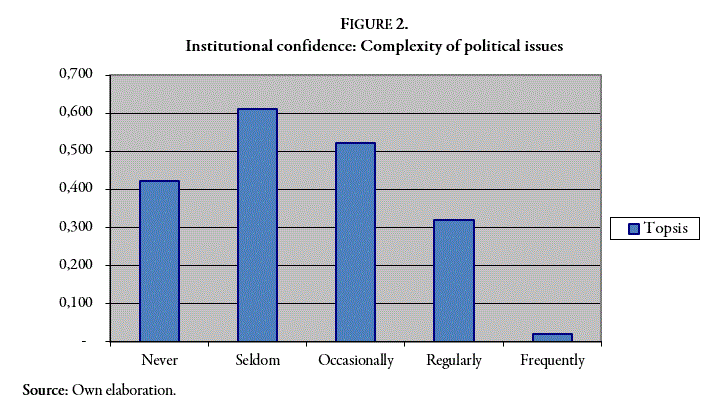
Figure 2.
Institutional confidence: Complexity of political issues
Source: Own elaboration.
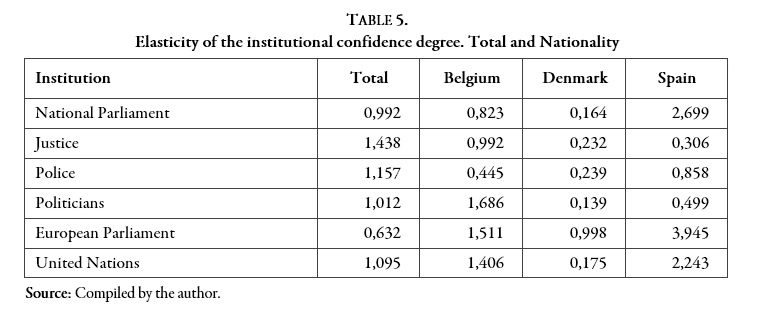
The elasticity evaluates the sensitivity that a variable has to a change of another. In our case, it is supposed that there is a functional dependence between the levels of institutional confidence with respect to each of the institutions involved in the analysis. Thus, for example, the elasticity measures the sensitivity of institutional confidence in the face of a slight variation in the level of confidence of one of the institutions in which the elasticity is derived. Table 5 shows the value of the elasticity of institutional trust for the total number of citizens analysed in this study, and for each nationality.
In general, it can be seen that not all the calculated elasticities show that the degree of institutional trust is inelastic with respect to each of the institutions. Thus, for example, in the first column it can be observed that the analysed citizens present a greater elasticity with respect to Justice, and a lower elasticity with respect to the European Parliament. Considering nationality, when analysing the peculiarities of each one of the segments, it is observed that the results vary widely at the level of each country. Thus, for example, the Belgians are more sensitive to the changes that are experienced regarding their trust in politicians and international institutions, such as the European Parliament and the United Nations. The Danes, who are characterised as being those who express a greater institutional confidence, are very insensitive to possible changes at the level of individual institutions, even though they are more elastic regarding the European Parliament. On the other hand, the Spaniards show the highest values, being very elastic regarding their own National Parliament, and International Institutions.
Elasticity of the institutional confidence degree. Total and Nationality
Source: Compiled by the author.
6. Conclusions
Our analysis is based on the database of the European Social Survey, where the confidence in institutions is measured by analysing six of the most important institutions: (1) The National Parliament; (2) the Legal System; (3) the Police; (4) the Politicians; (5) the European Parliament; and (6) the United Nations. The first four of these institutions are more local for the citizens, and are the pillars of democratic systems in the Western world. The last two are more related to the international scene, having a different scale, because one of the institutions represents the sovereignty of European citizens in the unfinished process of creating a real European State in the image of the United States of America; and the United Nations is an institution that has had as its main priority, since 1945, the maintenance of peace in the world.
In this article, a methodological proposal has been presented to obtain a synthetic index that measures the degree of confidence in the institutions of a group of European citizens residing in Belgium, Denmark, and Spain. These indexes are very necessary to assess to what extent in recent years the democratic countries have been suffering a greater institutional distrust that may jeopardise the proper operation of these institutions. The uncertainty and vagueness of the value judgments expressed in the survey are treated satisfactorily through the use of fuzzy logic, using TFNs.
The results obtained confirm others obtained by previous works, and it is demonstrated that the residents in Denmark have a greater confidence in the institutions than the residents in Belgium and Spain. Furthermore, it is observed how the degree of knowledge that citizens have on political issues significantly influence institutional trust. At the institutional level, it was obtained that the Police and the United Nations are the institutions that have a higher level of confidence, although by analysing the residence of citizens the results are not at all homogeneous. Only the Danes have little confidence in the European Parliament, which shows that Euroscepticism is gradually gaining more followers, and not only in the United Kingdom. In many of the Member Countries, currently there are parties that promote exit from the European Union. In Belgium, the worst ratings are given for the National Parliament and Politicians. The difficulties that exist each time in the formation of the Belgian Government have widened since the elections of 2007. Here, there are territorial disputes between North and South that form two communities (the Flemish and the Walloons) who both have strong cultural roots. Belgium holds the record of 589 days for the time taken to form a Government after the elections in 2010. Therefore, our results are not surprising. The situation observed in Spain goes even beyond that in Belgium as citizens only have confidence in the Police, and Politicians are rated even worse than they are in Belgium. The existing cases of corruption, besides the level of unemployment caused by the financial crisis, have produced a detachment of Spanish society from its institutions. Analysing the latest barometer of public opinion published by the Centre of Sociological Research of Spain, it is very common to see that unemployment, corruption and fraud, economic problems, politicians and the parties are, in general, usually the major concerns of the Spanish people.
The degree of sensitivity shown by the calculation of elasticity can be used as a guide by the politicians from different countries to improve the degree of institutional trust in their country. Thus, for example, Belgium has to concentrate its efforts on improving the confidence generated by its political class, while in Denmark; efforts have to be made from the side of the European Parliament. In Spain, the reforms have to come alongside those of international institutions and the National Parliament. While the effects of the crisis persist, the implementation of reforms that would improve the lives of the citizens will be difficult for any Spanish Government, so it is very likely that the Spanish people will continue to have great institutional distrust.
This study has various limitations, for example, it does not develop any causal relationship model in order to determine to what extent institutional confidence can be affected by other important individual traits like participation, political values, norms, or other socio-political variables of interest. Another limitation arises from the use of the European Social Survey, which has a fixed format, and where researchers cannot make any change in the questionnaire, either including other types of institutions, such as trade unions or other organizations, or even proposing another way of formulating the questions. One of the future research lines could be to extend the database to more countries and segments by making use of the different rounds of the European Social Survey. In addition, a different analysis of institutional trust by including a greater number of institutions could be performed in order to validate to what extent the ones that are closest to the citizens can have more or less influence in the observed degree of confidence.
References
Athanassopoulos, A.D., & Podinovski, V.V. (1997). Dominance and potential optimality in multiple criteria decision analysis with imprecise information. Journal of Operational Research Society, 48(2), 142-150.
Awasthi, A., Chauhan, S. S., Omrani, H., & Panahi, A. (2011). A hybrid approach based on SERVQUAL and fuzzy TOPSIS for evaluating transportation service quality. Computers & Industrial Engineering, 61(3), 637-646.
Bin, Z., Jingsha, H., Na, H., Yixuan, Z., Shiyi, Z., & Jie, J. (2015). Designs and Simulations of Multi-factor in Trust Evaluation. International Journal of Database Theory and Application, 8(1), 235-244.
Brewer, P.R., Gross, K., Aday, S., & Willnat, L. (2004). International Trust and Public Opinion about World Affairs. American Journal of Political Science, 48, 93-109.
Buckley, J.J. (1985). Ranking alternatives. Using fuzzy numbers. Fuzzy Sets and Systems, 15(1), 21-31.
Büyüközkan, G., & Çifçi, G. (2012). A combined fuzzy AHP and fuzzy TOPSIS based strategic analysis of electronic service quality in healthcare industry. Expert Systems with Applications, 39(3), 2341-2354.
Camussi, S., Mancini, A. L., & Tommasino, P. (2018). Does Trust Influence Social Expenditures? Evidence from Local Governments. Kyklos, 71(1), 59–85.
Chang, Y.H., & Yeh, C.H. (2001). Evaluating airline competitiveness using multiattribute decision making. Omega 29(5), 405-415.
Chen, S.J., & Hwang, C.L. (1991). Fuzzy Multiple Attribute Decision Making: Methods and Applications. Springer-Verlag, New York.
Chen, S.M. (1996). Evaluating weapon systems using fuzzy arithmetic operations, Fuzzy Sets and Systems 77(3), 265-276
Clausen, B., Kraay, A., & Nyiri, Z. (2011). Corruption and confidence in public institutions: evidence from a global survey. The World Bank Economic Review, 25(2), 212-249.
Coleman, J. (1988). Social capital in the creation of human capital. American Journal of Sociology, 94, 95–120.
Dalton, R.J., Farrell, D., & McAllister, I. (2011). Political Parties and Democratic Linkage. How Parties Organize Democracy. Oxford: Oxford University Press.
Delhey, J., & Dragolov, G. (2016). Happier together. Social cohesion and subjective well‐being in Europe. International Journal of Psychology, 51(3), 163-176.
Dyer, J.S., Fishburn, P.C., Steuer, R.E., Wallenius, J., & Zionts, S. (1992). Multiple criteria decision making, multiattribute utility theory: the next ten years, Management Science 38(5), 645-653.
Enroth, H. (2017). Cartelization versus representation? On a misconception in contemporary party theory. Party Politics, 23(2), 124-134.
Ertuğrul, İ., & Karakasoğlu, N. (2008). Comparison of fuzzy AHP and fuzzy TOPSIS methods for facility location selection. The International Journal of Advanced Manufacturing Technology, 39(7-8), 783-795.
European Social Survey (2013). ESS Round 6 (2012/2013). Technical Report.
Fazio, G., Giambona, F., Vassallo, E., & Vassiliadis, E. (2018). A Measure of Trust: The Italian Regional Divide in a Latent Class Approach. Social Indicators Research, 140, 209-242.
Freitag, M. (2003). Social Capital in (Dis)Similar Democracies: The Development of Generalized Trust in Japan and Switzerland. Comparative Political Studies, 36(8), 936-966.
Frey, B. S., & Stutzer, A. (2002). What Can Economists Learn from Happiness Research? Journal of Economic Literature, 60, 402–435.
Helliwell, J. (2003). How’s life? Combining individual and national variables to explain subjective wellbeing. Economic Modelling, 20, 331-360.
Herrera, F., & Herrera-Viedma, E. (2000). Linguistic decision analysis steps for solving decision problems under linguistic information. Fuzzy Sets and Systems, 115(1), 67-82.
Hetherington, M. J. (1998). The Political Relevance of Political Trust. American Political Science Review, 92, 791-808.
Hooghe, M., & Dassonneville, R. (2018). A spiral of distrust: A panel study on the relation between political distrust and protest voting in Belgium. Government and Opposition, 53(1), 104-130.
Hooghe, M., & Kern, A. (2013). Party membership and closeness and the development of trust in political institutions: An analysis of the European Social Survey, 2002-2010. Party Politics, 21(6), 944-956.
Hossain, M. S., Zander, P. O., Kamal, M. S., & Chowdhury, L. (2015). Belief‐rule‐based expert systems for evaluation of e‐government: a case study. Expert Systems, 32(5), 563-577.
Hou, J., & Xiao, R. (2015). Identifying critical success factors of linkage mechanism between government and non-profit in the geo-disaster emergency decision. International Journal of Emergency Management, 11(2), 146-168.
Hudson, J. (2006). Institutional trust and subjective well‐being across the EU. Kyklos, 59(1), 43-62.
Hutchinson, M.O. (1998). The use of fuzzy logic in business decision-making. Derivatives Quaterly, 4(4), 53-67.
Hwang, C., & Yoon, K. (1981). Multiple attribute decision making: Methods and application. Springer, New York.
Jackson, J., Bradford, B., Hough, M., Kuha, J., Stares, S., Widdop, S., & Galev, T. (2011). Developing European indicators of trust in justice. European Journal of Criminology, 8(4), 267-285.
Kadir, A. G. (2015). The appearance of government bureaucracy in quantum era. European Journal of Research in Social Sciences, Vol, 3(2), 61-72.
Kannan, D., de Sousa Jabbour, A. B. L., & Jabbour, C. J. C. (2014). Selecting green suppliers based on GSCM practices: Using fuzzy TOPSIS applied to a Brazilian electronics company. European Journal of Operational Research, 233(2), 432-447.
Karimi, M., Azizi, M., Javanshir, H., & Ghomi, S. (2015). A hybrid approach based on SERVQUAL and fuzzy TOPSIS for evaluating banking service quality. Decision Science Letters, 4(3), 349-362.
Katsanidou, A., & Eder, C. (2015). Vote, party, or protest: The influence of confidence in political institutions on various modes of political participation in Europe. Comparative European Politics, 16(2), 290-309.
Katz, R., & Mair, P. (1995). Changing models of party organization and party democracy. The emergence of the cartel party. Party Politics, 1(1), 5-28.
Katz, R., & Mair, P. (2009). The cartel party thesis: A restatement. Perspectives on Politics, 7(4), 753-766.
Kaufmann, A., y Gupta, M. (1988). Fuzzy mathematical models in engineering and management science. Elsevier Science, New York.
Keeney, R., & Raiffa, H. (1993). Decisions with Multiple Objectives Preferences and Value Tradeoffs. New York: Cambridge University Press.
Lewis, R. C., & Booms, B. H. (1983). The marketing aspects of service quality. Emerging perspectives on services marketing, 65(4), 99-107.
López, N., Sánchez, V., & Rojas, J. (2015). Institutional management in a Mexican Higher Education Center during the trust building process from the personal attention approach. Latin American Journal of Educational Studies, 45(1), 109-139.
Mamdani, E., & Assilian, S. (1975). An experiment in linguistic synthesis with a fuzzy logic controller. International Journal of Man-Machine Studies, 7(1), 1-13.
Mandić, K., Delibašić, B., & Radojević, D. (2015). An Application of the Integrated IBA-TOPSIS Model in Supplier Selection. International Journal of Decision Support System Technology (IJDSST), 7(1), 15-30.
Marozzi, M. (2014). Measuring Trust in European Public Institutions. Social Indicators Research, 123(3), 879-895.
Mehozay, Y., & Factor, R. (2017). Deeply embedded core normative values and legitimacy of law enforcement authorities. Journal of Research in Crime and Delinquency, 54(2), 151-180.
Mishler, W., & Rose, R. (2001). What are the Origins of Political Trust? Testing Institutional and Cultural Theories in Post Communist Societies. Comparative Political Studies, 34, 30-62.
North, D. (1990). Institutions, institutional change and economic performance. New York: Cambridge University Press.
Nunkoo, R., Ramkissoon, H., & Gursoy, D. (2012). Public trust in tourism institutions. Annals of Tourism Research, 39(3) 1538-1564.
Olivares, H., García, R., Jauregui, R., Revilla, F., & El Zauahre, M. (2008). Desarrollo endógeno. Instrumento para fortalecer el capital social. Multiciencias, 8, 112-117.
Panebianco, A. (1988). Political Parties. Organizations and Power. Cambridge: Cambridge University Press.
Parasuraman, A., Zeithaml, V A., & Berry, L. L. (1985). A Conceptual Model of Service Quality and Its Implications for Future Research. Journal of Marketing, 49(4), 41-50.
Paxton, P. (1999). Is social capital declining in the United States? A multiple indicator assessment. American Journal of Sociology, 105, 88-127.
Pichler, F. (2006). Subjective quality of life of young Europeans. Feeling happy but who knows why? Social Indicators Research, 75, 419-444.
Putnam, R. (2000). Bowling alone—the collapse and revival of American Community. New York: Simon & Schuster.
Rajak, S., & Vinodh, S. (2015). Application of fuzzy logic for social sustainability performance evaluation: a case study of an Indian automotive component manufacturing organization. Journal of Cleaner Production, 108, 1184-1192.
Rodríguez-Pose, A., & von Berlepsch, V. (2014). Social capital and individual happiness in Europe. Journal of Happiness Studies, 15(2), 357-386.
Saeida Ardakani, S., Nejatian, M., Farhangnejad, M. A., & Nejati, M. (2015). A fuzzy approach to service quality diagnosis. Marketing Intelligence & Planning, 33(1), 103-119.
Stewart, T.J. (1992). A critical survey on the status of multiple criteria decision making theory and practice. Omega 20(5-6), 569-586.
Sun, C. C., & Lin, G. T. (2009). Using fuzzy TOPSIS method for evaluating the competitive advantages of shopping websites. Expert Systems with Applications, 36(9), 11764-11771.
Tsaur, S-H., Chang, T-Y., & Yen, C-H. (2002). The evaluation of airline service quality by fuzzy MCDM. Tourism Management, 23(2), 107-115.
Van Oorschot, W., Arts, W., & Gelissen, J. (2006). Social capital in Europe: Measurement and social and regional distribution of a multifaceted phenomenon. Acta Sociologica, 49(2), 149-167.
Veenhoven, R. (2000). Freedom and Happiness: A Comparative Study in Forty-Four Nations in the Early 1990s. In Diener, E. & Eunkook, M. S. (Eds.), Culture and Subjective Well-Being. (pp. 257–288). Cambridge (Mass.): MIT Press.
Viswanathan, M. (1999), Understanding how product attributes influence product categorization: development and validation of fuzzy set-based measures of gradedness in product categories. Journal of Marketing Research, 36 (1), 75-95.
Weber, M. (1978). Economy and Society. Berkeley: University of California Press.
Whiteley, P. (2011). Is the party over? The decline of party activism and membership across the democratic world. Party Politics, 17(1), 21-44.
Xia, X., Wang, Z., & Gao, Y. (2000). Estimation of non-statistical uncertainty using fuzzy-set theory. Measurement Science and Technology, 11(4), 430-435
Yeh, C.H., & Kuo, Y-L. (2003). Evaluating passenger services of Asia-Pacific international airports. Transportation Research E, 39(1), 35-48
Yeh, C.H., Deng, H., & Chang, Y.H. (2000). Fuzzy multicriteria analysis for performance evaluation of bus companies. European Journal of Operational Research, 126(3), 459-473.
Yeh, C-H., Deng, H., & Pan, H. (1999). Multi-criteria analysis for dredger dispatching under uncertainty. Journal of the Operational Research Society, 50(1), 35-43.
Zadeh, L.A. (1965). Fuzzy sets. Información and Control, 8(3) 338-353.
Zadeh, L.A. (1975). The concept of a linguistic variable and its application to approximate reasoning: I. Information Science, 8(3), 199-249.
Zeleny, M. (1982). Multiple Criteria Decision Making. McGraw-Hill, New York.
Zeleny, M. (1998). Multiple criteria decision making: eight concepts of optimality. Human Systems Management, 17(2), 97-107
Zhao, R., & Govind, R. (1991). Algebraic characteristics of extended fuzzy number. Information Science, 54(1), 103-130.
Zimmermann, H. J. (1996). Fuzzy Set Theory and its Applications, Kluwer Academic Publishers, Boston.
Zlateva, P., Velev, D., & Raeva, L. (2015). A Fuzzy Logic Method for Assessment of Risk Management Capability. International Journal of Innovation, Management and Technology, 6(4), 260-266.
Notes
Additional information
JEL classification: D72; P47.
Corresponding author: jcmartin@daea.ulpgc.es
Acknowledgments: We are grateful to the colleagues in our departments and assistants of some seminars for the received input. We would also like to acknowledge our gratitude to two anonymous reviewers for their helpful comments on an earlier version.
