
This work is licensed under Creative Commons Attribution-NonCommercial 4.0 International.
Abstract:
The paper discusses the origins and emerging ideas of smart specialization, and in particular its translation from a non-spatial concept to an explicitly spatial and regional concept. This discussion is then set in the context of debates regarding the nature, rationale, and role of modern innovation policy, and the governance and institutional issues arising are then examined. We extend this discussion to discuss the experience of these issues in EU regions, and the arguments are then broadened to the potential lessons for other parts of the world which are aiming to enhance their innovation potential.
JEL Classification: L52; O43; R11; R58.
Keywords: innovation, regions, policy, priorities.
Resumen:
Este artículo analiza los orígenes y las ideas emergentes de las estrategias de especialización inteligente, en particular su adaptación desde un óptica no espacial a una óptica explícitamente espacial y regional. Este análisis se enmarca en el contexto de los debates centrados en la naturaleza, objetivo y papel de las nuevas políticas de innovación, así como aspectos relacionados con su gobernanza y proceso institucional. El trabajo extiende la discusión, introduciendo aspectos basados en la experiencia de la implementación de estos procesos en varias regiones europeas, ofreciendo consejos basados en lecciones aprendidas para otras partes del mundo interesadas en implementar estos procesos con el fin de mejorar su potencial de innovación.
Clasificación JEL: L52; O43; R11; R58.
Palabras clave: innovación, regiones, política, prioridades.
1. Introduction
Any policies or development-aid agendas which are aimed at fostering local and regional economic development in under-developed or economically weak regions always face various challenges which need to overcome at least in part in order for a development policy to be effective. In terms of the economy, poorer or economically fragile regions tend to display less diverse economies with lower levels of human capital and lower innovation opportunities than stronger regions. In terms of institutions, weaker or more economically fragile regions tend to display more limited institutional coordination and cooperation possibilities, in part due to mis-aligned incentives and in part due to lower level of public trust. In terms of governance, poorer or economically fragile regions tend to display weaker governance systems and lower levels of governance capacity than stronger regions. Finally, in terms of development relationships, weaker regions tend to display greater levels of dependency on development aid and funding than economically more prosperous regions, and stronger co-dependency relationships with the donor agencies. Moreover, each of these features tend to be intertwined with each other (McCann and Ortega-Argilés, 2015), and local and regional development policies are always faced with the challenge of how to best address each of these individual issues in ways that are not compromised or undermined by one of the other interrelated issues.
Smart specialisation has been proposed as a possible approach to tacking these challenges and although the original ideas underpinning smart specialisation initially emerged from non-spatial ways of thinking it became increasingly apparent that they dovetailed neatly with various ideas emerging from other fields including economic geography, science policy, and development studies (McCann and Ortega-Argilés, 2015). Together, these convergent lines of argument have given rise to a broadly-based consensus within Europe regarding a set of policy principles which can be applied to help foster entrepreneurship and innovation in different development contexts, and in particular in regions which are economically fragile (McCann and Ortega-Argilés, 2013a, b). Regarding innovation one of the problems faced by fragile regions is that they appear to display relatively fewer options for innovation-promotion than more prosperous regions and this also implies that the opportunities for entrepreneurially-driven innovation are fewer and the risk associated with entrepreneurship are relatively higher in weaker regions. Weak demand for innovation stifles development and any resulting entrepreneurial activities tend to be necessity-led rather than demand led. In addition, weaker regions typically face more limited institutional capacity for fostering innovation with fewer governance capabilities, less scope for various policy actions and ironically in many cases, weaker incentives for policy-learning. In terms of development policy these types of weaker regions would therefore appear to be principal candidates for policy support aimed at enhancing innovation and development in lagging regions. However, as far as the efficacy of policy interventions are concerned, ironically such weaker regions also tend to display a more limited ability to absorb policy funding effectively and to transform the financial support to workable and successful policies. This is sometimes known as the «innovation paradox» (Muscio et al., 2015) whereby the economically weaker regions which most need to foster innovation are also less able to absorb policy funds in beneficial ways. The weaknesses arise from the lower institutional capacity and the governance capabilities. These issues are well-known in a wide range of development fields, and they have also been seen repeatedly in the case of the EU, and in particular in many central and eastern European regions. As such, policies aimed at enhancing innovation and entrepreneurially-driven development in weaker countries regions (World Bank, 2010, 2011) need to find ways to address this paradox.
In the specific case of the EU these challenges are well known, and relate in particular to the policy actions and interventions associated with regional policy. The regional and urban policy in the European Union, which is known formally as EU Cohesion Policy (McCann, 2015), faces many of these innovation-related challenges and the smart specialisation approach has been adopted within the recently reformed EU Cohesion Policy architecture in order to help address them. EU Cohesion Policy is one of the western world’s largest, if not the largest, local and regional development policy operating under broadly one overall legal and institutional framework. The aims of the policy are to enhance the long term development of Europe’s economically weaker regions and this is to be undertaken in a context in which variation in regional per capita incomes is almost identical to the variation across all OECD countries (McCann, 2015). EU regions differ enormously in terms of their levels of development, the extent of urbanisation, their industrial structures, environmental features, their population and demographic characteristics, and their institutional and governance systems (European Union, 2013).
The central issue which is always present in every local, regional or national context is the question of how to best design and implement development policies which are most appropriate for fostering good growth in the local setting. Yet, in such a heterogeneous context as the EU regional system there is unlikely to be any particular «one-size-fits-all» approach which is ideally suited to every regional context. Rather, finding ways to best tailor policy actions and interventions to the heterogeneous local contexts is generally regarded as being the most important issue for policy design and delivery (Rodrik, 2007). However, this tailoring must be undertaken in a manner which is consistent with both the goals and also the overall rubric of the policy architecture. Following widespread consultation and reflection the policy has therefore undergone significant changes in recent years aimed at enhancing its efficiency and effectiveness and these changes have been driven by changes in thinking both within the EU and also well beyond the EU. In particular, various shifts in thinking in many different research and analytical fields have converged on certain key themes which need to be addressed in order for development policy to be successful, and these insights have all been incorporated into the reformed EU Cohesion Policy (McCann, 2015). In order to reconcile the potentially conflicting pressures between local tailoring and consistency with the overall policy logic and architecture the EU has adopted the smart specialization approach to policy prioritisation as one of its key conditionalities or non-negotiable elements in the policy agenda. The smart specialisation approach offers a policy-prioritisation framework for thinking about resource allocation issues logic and a way forward for regions making policy choices in difficult and challenging budgetary environments. At the same time, the discipline involved in smart specialisation also helps to foster policy learning and institutional capacity building for good governance (Rodrik, 1999).
In order to understand the role which smart specialisation plays in EU Cohesion Policy and the lessons which the EU experience offers to other parts of the world in the following sections we will examine the key insights, motivating factors and messages of smart specialization. We will need to discuss these in the specific context of the EU regional and urban policy but we will also extend these arguments to broader international settings, aimed at deriving lessons for other parts of the world. The rest of the paper is structured as follows. In the next section we outline the key features and insights of the smart specialisation approach as originally constructed in a nonspatial setting and we then outline its application in an explicitly spatial and regional environment. We then discuss various important issues regarding the modern understanding of the nature and role of regional policy and the governance implications which such debates give rise to. We then examine some of the specific challenges facing EU regions in implementing these policies and we also outline the possible lessons and insights which arise from these experiences for regions in other parts of the world aiming to enhance their innovation potential.
2. The Smart Specialisation Principles
One of the key themes which has emerged out of the process of reflection and reconsideration of the role and nature of EU Cohesion Policy, and indeed one of the most novel elements of the resulting reforms, is that of smart specialisation, which provides a way of establishing policy funding priorities aimed at enhancing local development by building on the underlying local opportunities for entrepreneurially-driven innovation. Smart specialisation puts an economic discipline on the policy prioritisation process, the intention of which is to help countries and regions make the most realistic choices regarding policy interventions and actions which are amenable and appropriate for the local context. In the past, the evidence from numerous development policy examples worldwide demonstrates that regions have made many mistakes in terms of their policy choices, and often this was because policies were chosen on the basis of criteria which were not appropriate or relevant for the local context.
As has already been well documented elsewhere, the broad lines of the smart specialisation argument arose initially out of concerns regarding the slow take-up of new technologies in many EU countries and parts of Europe in comparison to North America (Ortega Argilés, 2012). While many European countries and regions were strong in developing new technologies and techniques in leading technology sec- tors they appeared to be systematically much weaker in adopting and adapting these technologies to a wider range of sectors, activities and locations, beyond the new technology sectors themselves. Expert advice provided to the European Commission policy-makers argued that in the EU case, dislocations between sectors and a lack of synergies between institutions and actors were often at fault in limiting knowledge and technology flows, and finding ways to partially correct for these mis-alignments offered a possible way forward for policies aimed at enhancing entrepreneurship and innovation at the regional level. There are two reasons why this is so important. Firstly, diversification via technology adoption and adaptation is essential for firms to grow and survive. Secondly, diversification and technological upgrading is also essential for regions and localities to grow and develop. In recent decades many regions were attempting to diversify and upgrade their technological base by attracting inward high-technology investors representing sectors or technologies in which the region had little or no previous expertise. Unsurprisingly, in many cases these inward investments failed to flourish beyond the life of any subsidies provided, and therefore a different way of thinking was called for. This is the departure point for the smart specialisation approach.
The original smart specialisation arguments initially developed in a non-spatial setting and was explicitly construed in a knowledge-ecology ecosystems type of perspective (Foray et al., 2009; David et al., 2009). The concept was based on the idea that in order for innovation policies to be effective they must demonstrate certain key features. Firstly, they must encourage and facilitate entrepreneurship —but not simply in terms of encouraging new firm start-ups —but more importantly helping entrepreneurs and risk-takers to find and build on new sources of knowledge in their entrepreneurial activities— a process which is termed «entrepreneurial search». These processes necessarily involve a certain degree of self-discovery (Haussmann and Rodrik 2003) based on experimentation and trial and error and often experimentation is costly and risky for potential entrepreneurs. These costs and risks often imply that entrepreneurs tend to shy away from attempting innovations or new initiatives which appear to be too distant from their core competences and this limits the ability of firms to successfully diversify. Public policy provides a possible way forward for facilitating firm diversification by assisting with the experimentation processes involved in innovation, and also by acting as a potential bridge between different technological, skills or institutional arenas. Secondly, the smart specialisation approach to economic development also emphasised that any successful entrepreneurial activities will need to develop and build on scale in order to generate sufficiently large impacts that help to transform the system. Multiple small and fragmented entrepreneurial actions are unlikely to lead to any significant step-change in innovation outcomes, and therefore finding ways to leverage scale and connections between entrepreneurial actions and initiatives is essential (Foray, 2015). Thirdly, new entrepreneurial actions must be based largely on existing capabilities, skills-sets or knowledge-bases, such that diversification takes place in an incremental manner using existing knowledge and drawing on local strengths. These general principles highlight the importance of fostering development trajectories which are both connected to the existing knowledge ecology but at the same time attempt to re-orient the existing trajectories. In order to achieve this it is essential to ensure that local connections and synergies between institutions and actors are as strong as possible and policy actions draw on all of the available local resources in order to build both scale and concentration (Foray, 2015).
If we translate these principles into the language of economic geography suitable for the regional and local context (McCann and Ortega-Argilés, 2014a, b; 2015) it becomes clear that fostering entrepreneurial actions which are built on technologies, sectors or activities which exhibit both local scale and embeddedness is essential (McCann and Ortega-Argilés, 2015). A platform for entrepreneurial and innovation promotion is critical in order for small and incremental innovations to display sufficiently large scale effects to help transform the existing system, and it is imperative that the mobilization of activities, technologies or sectors with potential scale are prioritised. At the same time activities aimed at the technological upgrading and diversification of the system must also be built around the system’s existing capabilities and skills sets, or rather what is known as «related variety» (Frenken et al., 2007; Frenken and Boschma, 2007), as this maximizes the chances of long run success and learning. Allied to these dimensions, efforts aimed at promoting knowledge connectivity and knowledge spillovers must operate both at fostering greater local intra-regional linkages as well as wider inter-regional and international knowledge linkages. These latter points are especially important in today’s economy where global value chains have reconfigured numerous commercial and production relationships. Identifying those technologies, activities or sectors which are able to better leverage off global value chains is also imperative in order to build scale and connectivity.
These smart specialisation principles give rise to an important policy prioritisation framework which helps policy-makers to base their policy decisions on a strong and workable grounding. Policy-makers are always faced with competing interests, conflicting choices, policy trade-offs and constrained resources and budgets, and determining which activities or sectors or technologies to give priority to often involves difficult decisions. Different interest groups and competing constituencies always wish to access policy funding streams and in situations where there are many interested parties it is often observed that funding and resources become scattered and fragmented across numerous actors and initiatives. This tends to undermine the effectiveness of development policies which seek to foster scale and concentration and finding ways to ensure the concentration of resources on key priorities frequently proves to be a difficulty. However, in the end it is policy-makers who still have to make these difficult choices (Stiglitz et al., 2009), and having a clearly articulated logic on which decisions are being made is critical both in terms of ensuring both good policy-design and also public accountability.
Smart specialisation requires that policy makers: undertake detailed ex ante analyses of the regional and local context based on as much data as can be acquired or generated; involve numerous actors and stakeholders in any consultation or engagement processes including the representatives of small firms and actors as well as large institutions: and come to an agreement regarding a set of priorities for the region which not only dovetail with the region’s existing capabilities (von Tunzelmann, 2010), but which also offer the potential scale opportunities as well as possibilities for diversification around the region’s core competences (Foray et al., 2012). In essence, the smart specialisation approach involves the tailoring of policy actions to the local context, but in a manner which also is cogniscant of the global value-chain impacts of any policy actions. Given that regions are becoming more heterogeneous in character (OECD, 2009a), as are their global value-chain impacts, the need for such policy tailoring becomes ever greater.
These principles provide the best grounding for entrepreneurial-led innovation policies which are designed to encourage initiatives from the «bottom-up» in which the private sector, education sector and civil society actors are all involved in suggesting, leading or trialing possible entrepreneurial initiatives. At the same time, the policies which are chosen to be implemented should also provide opportunities for learning on the part of all actors involved. Any policies which display something of an experimental nature, as is always the case with innovation-related policies, of necessity require policy learning, if the broader lessons from the policy experience are to be beneficial for society. Policy-learning is an essential feature of institutional capacity building and policy innovation which also involves the public sector sharing some of the risks with the private sector is increasingly understood as being critical for fostering innovation (Osborne and Brown, 2013). Policy-learning is not possible without monitoring and evaluation, both of which are essential features of outcome-oriented policy making, and the need for appropriate indicators to allow for an outcome-oriented approach to smart specialisation policy-making was recognised early on in the development of the concept (David et al., 2009). Indeed, these broader themes relating to the importance of both policy tailoring and policy learning reflect a much broader set of debates regarding the most appropriate form of modern regional and regional innovation policies, and these debates have taken on a particular form in the context of the EU. In order to help better tailor regional entrepreneurship and innovation-related policies the EU has already taken steps to identify the underlying features of entrepreneurship across all EU regions, with a particular focus on identifying those local bottlenecks which inhibit entrepreneurial actions 1. However, before we discuss in more detail the role that smart specialisation plays in the overall EU Cohesion Policy reforms and also the insights and implications that the EU experience offers policy in other developing or transitioning countries, it is useful to highlight a few key features of these reforms that all heavily impact on the EU’s smart specialisation agenda. These key features are the place-based logic, the multi-level governance context, and the results-orientation logic of the policy.
3. The Background Discussions: The Place-Based Policy Debates, Outcome-Oriented Policy-Making and the EU Regional Context
In terms of the place-based logic, local and regional development policy requires a raison d’être and standard textbook models tend to view the rationale for industrial or development policy as being based on market failures. However, within the context of regional policy a new line of thinking has emerged over recent years in a variety of international and institutional settings, which is broadly known as the place-based approach (McCann and Rodriguez-Pose, 2011; Barca et al., 2012; Storper, 2013) and which provides profound twists on the standard development approaches. The place-based approach argues that top-down sectoral approaches to local and regional economic development fail to engage with many of the stakeholders, actors and citizens whose on whose knowledge and networks a successful development policy needs to be built. Top down policies traditionally assume that a «one-size-fits-all» policy model or policy framework is broadly workable and that top tiers of government have sufficient knowledge to design and implement such policies effectively. In contrast, the place-based approach assumes that neither of these conditions are fulfilled in many cases, in that government has neither the knowledge nor the expertise to undertake this (OECD, 2009a, b; OECD, 2011a). Moreover, in the eyes of local citizens, central government and top-down policy architectures also often fail on the grounds of salience, credibility and legitimacy (Cash et al., 2003), and the lack of these underpinnings means that many local actors are unlikely to engage seriously with the policy, thereby limiting its efficacy. In particular, smaller local actors and those which are not in dominant monopoly positions are unlikely to engage with a top-down policy, as their interest are unlikely to be responded to due to lack of lobbying power. As such, in order for local development actions and interventions to be effective, it is precisely the smaller and less noticeable actors and institutions which must be engaged with in order for development benefits to be diffused and distributed throughout the local economic system. Indeed, one of the major problems with top-down centrally-organised policies is that of «policy capture», whereby major players are able to shape and influence the policy design and delivery in their own interests. Finding ways to engage with, and mobilise a wide range of small as well as large local actors is therefore essential for ensuring broadly-based development.
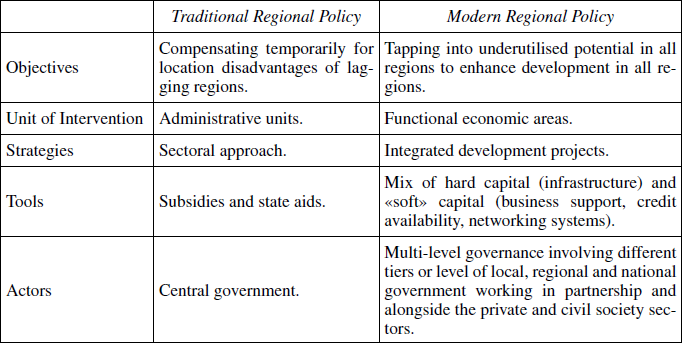
Following the place-based logic, the fostering of development is to be achieved by aligning and coordinating the funding and design of policy interventions between the local, regional, national and EU levels of governance in ways which maximises the «bottom-up» engagement and mobilisation of local actors and stakeholders in the policy process. In the place-based approach (Barca et al., 2012; McCann and Rodriguez-Pose, 2011) the engagement of local stakeholders and actors is regarded as being absolutely central to the effectiveness of development policy. The reason is that the engagement such actors is essential for building on local knowledge in order to exploiting underutilised potential. The policy actions and interventions tend to be a mixture of both «hard»; and «soft» support involving business network and credit-related sources as well as capital and infrastructure investments. Given the logic of economic geography it makes sense to implement these policies at the level of functional urban areas or functional regions so as to best capture any externalities and spillovers rather than simply on the basis of administrative units and the need to move away from a sectoral logic to a more integrated cross-sector, cross-technology, cross-activity logic also involves the design of more integrated projects rather than state aids to industries, as had traditionally been the case.
The one additional, but critical aspect of modern regional and regional innovation policies, is that by moving away from top-down and highly centralised policies these modern policy approaches need to operate in a multi-level governance environment (OECD, 2011b), and in the case of EU regional policy this is an explicit legal requirement. Indeed, multi-level governance is a natural part of the EU interrelationships whereby individual national member states of the EU variously interact with, and also act in conjunction with, the European Union institutions in order to achieve common goals. However, such multi-level governance arrangements also pose various additional sets of challenges regarding the definition and allocation of roles for the different governance tiers and jurisdictions along with their interactions with different types of actors and stakeholders. In the case of regional development policies the multi-level governance issues are in many ways more complex than in other EU policies or programmes because local, city and regional governance bodies are almost always also involved in the policies as well as national governments acting in con- junction with the EU institutions. Yet, interestingly, in the EU case, it is worldwide lessons from the development experience of international institutions (World Bank, 2005; Dreher, 2009) working with transition and developing economies which have heavily shaped and re-shaped the EU approach to development. In particular, the need to implement and enforce conditionalities (World Bank, 2005; Dreher, 2009) on the part of all stakeholders has been enshrined in EU policy along with the need for an outcome-oriented approach (McCann, 2015) to be adopted at all stages of the policy design and delivery process. Indeed, the development of a regional innovation strategy for smart specialisation is now one of the conditionalities for receiving EU regional funding, as is the requirement to develop sets of indicators for monitoring the progress of a policy and to permit the evaluation of the policy.
A key feature of smart specialisation is its explicitly outcome-oriented, or in EU terminology its explicitly results-oriented logic (McCann and Ortega-Argilés, 2013a, b, 2014a, b; 2015). Smart specialisation emphasises the need from the outset to consider and make explicit the intended outcomes and results of the policy as part of the whole approach to policy design and delivery. In other words it makes transparent the whole policy cycle whereby policy priorities and choices are based on the best available data and evidence and explicitly linked to intended outcomes, and these data and intended outcomes themselves determine the types of indicators to be chosen for both the ongoing monitoring of the policy and its ex post evaluation. In other words policy interventions and actions must be designed in a way which allows for appropriate outcome indicators to be chosen (Rodrik, 2004; Barca and McCann, 2011) which will facilitate ongoing policy monitoring and subsequent policy evaluation in the light of the policy’s intended goals. The resulting policy evaluations can use a mixture of both quantitative and qualitative techniques (European Union, 2015) and there is already a large and well established literature (Davies et al., 2000; Cratwright and Hardie, 2012; Pawson, 2006; Link and Vonortas, 2013) on policy and programme evaluation and also on specially the measurement of innovation programmes (Gault, 2013; Technopolis and MIOIR, 2012) which also facilitates with the programme design at the outset, linking ex ante intentions to ongoing actions and to ex post policy evaluation. Importantly, all policy evaluations will be made public on the EU website in English so that opportunities for mutual exchanges and learning are maximised across Europe (European Union, 2015). Moreover, such transparency also helps to mitigate against policies being designed or shaped largely by local political criteria or vested interests instead of being based on the region’s capabilities, assets and potential. Funding is also made available specifically to provide weaker regions whose institutional capacity is low to link up and cooperate with stronger regions whose greater institutional resources, personnel and capabilities can be provided to support the weaker regions» efforts at policy design and delivery. This is also an important forms of technology transfer, again aimed at enhancing the institutional capabilities of the weaker regions and also fostering EU-wide policy learning.
For many European policy makers and decision takers accustomed to the old traditional model of regional policy described above, the requirements of smart specialisation and modern approaches to regional policies, and regional innovation policies in particular, involve quite a new way of working and new lines of thinking. Therefore, in order to help local and regional policy makers in their transitioning to a new approach or more modern approach to regional innovation policy (McCann and Ortega-Argilés, 2013) the EU has set up a «platform» 2 facility to provide a forum for peer-to-peer review, data and policy-learning via debate and engagement. This has proved to be an major success with active participation and engagement from almost every region in the EU, and this is now a crucial feature of institutional capacity building (Rodrik, 1999). Economically weaker regions are able to learn by engaging with more prosperous regions, and sharing ideas and experiences regarding policy design and delivery (Foray and Goenaga, 2013; Foray and Rainaldi, 2013). This aspect of the role of knowledge connectivity and knowledge sharing in building governance capabilities closely reflects one of the key features of the original non- spatial smart specialisation concept (Foray, 2015) which has now been translated into both geographical space and also institutional spaces.
These developments have led to a widespread uptake of the smart specialisation agenda across EU regions and member states and the embodiment of these principles in their EU Cohesion Policy Operational Programmes. At the same time, and as would be expected from the smart specialisation principles, we also see significant variations in priority areas or themes between different regions and regions (McCann and Ortega-Argilés, 2016b). While the uptake in northern European regions has generally been relatively smooth, the policy agenda appears to have been particularly beneficial to many southern European regions in helping improve and enhance the policy settings and their policy design and delivery processes. In contrast, there are still major challenges in central and eastern European regions and member states (McCann and Ortega-Argilés, 2016b), and improving the policy design and delivery in these localities will continue to be an ongoing priority.
4. Lessons for Wider Range of Regions and Countries
The particularities of the EU and its specific experience of reconsidering and reorienting regional development policies around smart specialisation approaches are also instructive for many other parts of the world. Recently there has been a much greater emphasis on fostering innovation in these development contexts (World Bank, 2010, 2011) and many international organisations have long-lasting experience of the types of challenges which are widely evident in policies aimed enhancing local development. In the case of innovation-related policies, enhancing institutional and governance capabilities and synergies is an imperative, as are the need to limit rentseeking and to avoid monopoly interests either capturing the lion’s share of the policy resources or even undermining the policy. Institutional issues are nowadays regarded as being critical for the success or otherwise of development policies (Acemoglu and Robinson, 2013), and finding ways to overcome institutional logjams and misaligned incentives is essential if policies are to make real headway. Rodrik (2014) argues that new ideas and new narratives can offer a powerful way of breaking institutional logjams and overcoming institutional resistance. In the EU context, smart specialisation plays an important role in shifting debates and providing new perspectives on both the rationale for, and the approach to designing, regional development policies which are based around fostering entrepreneurship and innovation (McCann and Ortega-Argilés, 2014b; 2016a). It has been assessed as being both practicable and workable (OECD, 2013; Fraunhofer ISI, 2013) and highlights the centrality of designing policies aimed at facilitating the bottom-up generation of new ideas, initiatives, trials and experiments by diverse actors, and particularly small actors. In other words, the policy focus moves away from a traditional one dominated by big business and top-down centralised policy logic to one which is more embedded, locally relevant and in many ways also a more democratic way of operating. This is also enhanced by the transparency afforded by the requirements for a full public disclosure of all policy and programme evaluations, thereby moving away from a context where policy is derived primarily from a political logic to one which is underpinned by clear intentions and objectives. These features, allied with the possibility for regions to cooperate with each other in their policy design and delivery processes, all contribute to institutional capacity building. Development and governance go hand in hand and smart specialisation provides a way forward for fostering good governance in diverse economic environments in ways which are still entirely consistent with the overall policy logic and architecture (McCann and Ortega-Argilés, 2014b).
Each of these features are highly relevant in a diverse range of environments in many different countries. Many countries face problems of institutional capacity, and contexts where political vested interests and powerful monopoly actors dominate the political and economic landscape. Smart specialisation requires that development policies do engage with such actors, but that the emphasis is very much on the role which newer or smaller entrepreneurial actors can play in revitalising larger incumbents actors and sectors, and not the other way around. For example, in the EU case, large firms are important in as much as they provide important supply-chain possibilities for multiple smaller firms. Finding ways to upgrade the whole regional supply chain across many dimensions rather than simply supporting the investment of the large firm would be an example of a smart specialisation type of logic. As such, the emphasis is very much on smaller and diverse actions and actors and the role which they can play in re-shaping the wider economic and institutional setting. Again, the requirements for using outcome/results indicators along with the transparency requirements for making all policy evaluations public also helps to build trust on the part of the wider public and to foster the engagement of different actors. Finally, the fact that the upgrading of local skills, capabilities and activities via the enhancement of related variety is central to smart specialisation also helps to keep a discipline on the policy design, in that only opportunities which are related to already-existing assets and capabilities are considered. This ensures that policy does not veer too far away from realistic principles and helps to avoid the creation of unrealistic policy expectations, which if unrealized undermine institutional trust. Realistic and appropriate policies for the local context offer the best ways forward for incremental steps toward better development, both in economic and institutional terms. This is true in Europe.
5. Conclusions
Smart specialisation has played an important role in re-shaping EU regional development policies and in forcing a reconsideration of the role which such policies play. This rethinking regarding the links between the policy context, policy design, policy choices and policy intentions has also provided greater clarity regarding the links between policy and governance, between public trust and accountability, and between institutional capabilities, incentives and learning. By adopting a broad systems-type of understanding of technology which moves beyond a purely scientific perspective to one which includes institutions and policy settings, smart specialization also provides policy makers with a powerful set of principles to ensure that their policy choices are well-founded and strongly grounded in realistic and appropriate economic fundamentals.
References
Acemoglu, D., and Robinson, J. A. (2013): Why Nations Fail: The Origins of Power, Prosperity and Poverty, London, Profile Books.
Barca, F., and McCann, P. (2011): Methodological note: Outcome Indicators and Targets - Towards a Performance Oriented EU Cohesion Policy and examples of such indicators are contained in the two complementary notes on outcome indicators for EU2020 entitled Meeting climate change and energy objectivesand Improving the conditions for innovation, research and development. See: http://ec.europa.eu/regional_policy/sources/docgen-er/evaluation/performance_en.htm.
Barca, F., McCann, P., and Rodriguez-Pose, A. (2012) «The Case for Regional Development Intervention: Place-Based versus Place-Neutral Approaches», Journal of Regional Science, 52.1, 134-152.
Cartwright, N., and Hardie, J. (2012): Evidence-Based Policy: A Practical Guide to Doing It Better, Oxford, Oxford University Press.
David, P., Foray, D., and Hall, B. (2009): Measuring Smart Specialisation: The Concept and the Need for Indicators, Knowledge for Growth Expert Group, See: http://cemi.epfl.ch/files/content/sites/cemi/files/users/178044/public/Measuring%20smart%20specialisation.doc.
Davies, H. T. O., Nutley, S. M., Smith, P. C. (2000): What Works? Evidence-Based Policy and Practice in Public Services, Bristol, Policy Press.
Dreher, A. (2009): «IMF Conditionality: Theory and Evidence», Public Choice, 141, 233-267.
Dreher, A. (2015): The Programming Period 2014-2020: Guidance Document on Monitoring and Evaluation, European Cohesion Fund European Regional Development Fund - Concepts and Recommendations, Brussels, Directorate-General for Regional and Urban Policy.
European Union (2014): Investment for Jobs and Growth - Promoting Development and Good Governance in EU Regions and Cities: Sixth Report on Economic, Social and Territorial Cohesion, Brussels, Publications Office.
Foray, D. (2015): Smart Specialisation: Opportunities and Challenges for Regional Innovation Policy, London, Routledge.
Foray, D., and Goenaga, X. (2013): «The Goals of Smart Specialisation», S3 Policy Brief Series No 01/2013, Seville, European Commission Joint Research Centre IPTS.
Foray, D., and Rainaldi, A., 2013, «Smart Specialisation Programmes and Implementation», S3 Policy Brief Series No 02/2013, Seville, European Commission Joint Research Centre IPTS.
Foray, D., David, P., and Hall, B. (2009): «Smart Specialisation - The Concept», Knowledge Economists Policy Brief, No 9, June 2009.
Foray, D., David, P., and Hall, B. (2011): «Smart Specialization: From Academic Idea to Political Instrument, the Surprising Career of a Concept and the Difficulties involved in its Implementation», MTEI Working Paper, École Polytechnique Fédérale de Lausanne.
Foray, D., Goddard, J., Goenaga Beldarrain, X., Landabaso, M., McCann, P., Morgan, K., Neuwelaars, C., and Ortega-Argilés, R. (2012): Guide to Research and Innovation Strategies for Smart Specialisation (RIS 3), S3 Smart Specialisation Platform, IPTS Institute for Prospective Technological Studies, Seville, Joint Research Centre of the European Com- mission. See http://ec.europa.eu/regional_policy/sources/docgener/presenta/smart_specialisation/smart_ris3_2012.pdf.
Fraunhofer ISI (2013): Smart Specialisation Approaches: A New Policy Paradigm on its Way from Policy to Practice. See http://www.isi.fraunhofer.de/isi-media/docs/p/de/vortragsfolien/regionen_cluster/S3_Projekt_final.pdf.
Frenken, K., and Boschma, R. A. (2007): «A Theoretical Framework for Evolutionary Economic Geography: Industrial Dynamics and Urban Growth as a Branching Process», Journal of Economic Geography, 7.5, 635-649.
Frenken, K., Van Oort, F. G., and Verburg, T. (2007): «Related Variety, Unrelated Variety and Regional Economic Growth», Regional Studies, 41.5, 685-697.
Gault, F. (ed.) (2013): Handbook of Innovation Indicators and Measurement, Cheltenham, Edward Elgar.
Haussmann, R., and Rodrik, D. (2003): «Economic Development as Self-Discovery», Journal of Development Economics, 72.2, 603-633.
Link, A. N., and Vonortas, N. S. (eds.) (2013): Handbook on the Theory and Practice of Program Evaluation, Cheltenham, Edward Elgar.
McCann, P. (2015): The Regional and Urban Policy of the European Union: Cohesion, Results- Orientation and Smart Specialisation, Cheltenham, Edward Elgar.
McCann, P., and Ortega-Argilés, R. (2013a): «Redesigning and Reforming European Regional Policy: The Reasons, the Logic and the Outcomes», International Regional Science Review, 36.3, 424-445.
McCann, P., and Ortega-Argilés, R. (2013b): «Transforming European Regional Policy: A Results-Driven Agenda and Smart Specialisation», Oxford Review of Economic Policy, 29.2, 405-431.
McCann, P., and Ortega-Argilés, R. (2013c): «Modern Regional Innovation Policy», Cambridge Journal of Regions, Economy and Society, 6.2, 187-216.
McCann, P., and Ortega-Argilés, R. (2014a): «The Role of the Smart Specialisation Agenda in a Reformed EU Cohesion Policy», Italian Journal of Regional Science, 13.1, 15-32.
McCann, P., and Ortega-Argilés, R. (2014b): «Smart Specialisation in European Regions: Issues of Strategy, Institutions and Implementation», European Journal of Innovation Management, 17.4, 409-427.
McCann, P., and Ortega-Argilés, R. (2015): «Smart Specialisation, Regional Growth and Applications to EU Cohesion Policy», Regional Studies, 49.8, 1291-1302.
McCann, P., and Ortega-Argilés, R. (2016a): «Smart Specialisation, Entrepreneurship and SMEs: Issues and Challenges for a Results-Oriented EU Regional Policy», Small Business Economics, 46.4, 537-552.
McCann, P., and Ortega-Argilés, R. (2016b): «The Early Experience of Smart Specialisation Implementation in EU Cohesion Policy», European Planning Studies, 24.8, 1407-1427.
McCann, P., and Rodríguez-Pose, A. (2011): «Why and When Development Policy Should be Place-Based», OECD Regional Outlook 2011, Paris, Organisation for Economic Cooperation and Development.
Muscio, A., Reid, A., and Rivera León, L. (2015): «An Empirical Test of the Regional Innovation Paradox: Can Smart Specialisation Overcome the Paradox in Central and Eastern Europe?», Journal of Economic Policy Reform. See: http://dx.doi.org/10.1080/17487870.2015.1013545.
OECD (2009a); How Regions Grow, Paris, Organisation for Economic Growth and Development.
OECD (2009c): Regions Matter: Economic Recovery, Innovation and Sustainable Growth, Paris, Organisation for Economic Growth and Development.
OECD (2011a): OECD Regional Outlook 2011. Building Resilient Regions for Stronger Economies, Paris, Organisation for Economic Cooperation and Development.
OECD (2011b): Regions and Innovation Policy, Paris, Organisation for Economic Growth and Development.
OECD (2013): Innovation Driven-Growth in Regions: The Role of Smart Specialisation, Organisation for Economic Growth and Development, December, http://www.oecd.org/sti/inno/smartspecialisation.htm.
Ortega-Argilés, R. (2012): «The Transatlantic Productivity Gap: A Survey of the Main Causes», Journal of Economic Surveys, 26.3, 395-419.
Osborne, S. C., and Brown, L. (eds.) (2013): Handbook of Innovation in Public Services, Cheltenham, Edward Elgar.
Pawson, R. (2006): Evidence-Based Policy: A Realist Perspective, London, Sage.
Rodrik, D. (1999): «Institutions for High Quality Growth: What They Are and How to Acquire Them», Lecture Presented at the IMF Conference on Second Generation Reforms. See http://www.imf.org/external/pubs/ft/seminar/1999/reforms/rodrik.htm and published as Rodrik, D. (2000), NBER Working Paper 7540 and in Roy, K. C., and Sideras, J. (eds.) (2006), Institutions, Globalisation and Empowerment, Cheltenham UK and Northampton, MA, Edward Elgar.
Rodrik, D., 2004, «Industrial Policy for the Twenty-First Century», Working Paper, Kennedy School of Government, Cambridge MA, Harvard University.
Rodrik, D. (2007): One Economics Many Recipes: Globalization, Institutions and Economic Growth, Princeton, Princeton University Press.
Rodrik, D. (2014): «When Ideas Trump Interests: Preferences, Worldviews, and Policy Innovations», Journal of Economic Perspectives, 28.1, 189-208.
Stiglitz, J. E., Sen, A., and Fitoussi, J.-P. (2009): Report by the Commission on the Measurement of Economic and Social Progress. See http://www.stiglitz-sen-fitoussi.fr/en/index.htm.
Storper, M. (2013): Keys to the City: How Economics, Institutions, Social Interaction, and Politics Shape Development, Princeton NJ, Princeton University Press.
Technopolis Group and MIOIR (2012): Evaluation of Innovation Activities: Guidance on Methods and Practices, Brussels, Study Funded by the European Commission Directorate- General for Regional Policy.
Von Tunzelmann, N. (2009): «Regional Capabilities and Industrial Regeneration», in Farshchi, M., Janne, O. E. M., and McCann, P. (eds.), Technological Change and Mature Industrial Regions: Firms, Knowledge and Policy, Cheltenham, Edward Elgar.
World Bank (2005): Conditionality Revisited: Concepts, Experiences and Lessons, Washington DC, World Bank.
World Bank (2010): Innovation Policy: A Guide for Developing Countries, Washington DC, World Bank.
World Bank (2011): Igniting Innovation: Rethinking the Role of Government in Emerging Europe and Central Asia, Goldberg, I., Goddard, J. G., Kuriakose, S., and Racine, J.-L., Washington DC, World Bank.
Notes
Author notes
