Articles
The adjustment of primary schools to shrinking populations: a spatial modelling approach
El ajuste de las escuelas primarias a la disminución de la población: un enfoque de modelado espacial
The adjustment of primary schools to shrinking populations: a spatial modelling approach
Investigaciones Regionales - Journal of Regional Research, núm. 54, pp. 51-64, 2022
Asociación Española de Ciencia Regional

Esta obra está bajo una Licencia Creative Commons Atribución-NoComercial 4.0 Internacional.
Recepción: 24 Enero 2022
Aprobación: 22 Septiembre 2022
Resumen: La adaptación de los servicios de interés general al envejecimiento y la disminución de la población es un reto importante en muchas regiones europeas. Este artículo analiza la respuesta del número de escuelas primarias a los cambios en la población estudiantil en los municipios de Portugal continental para el período de 2007-2016. Se centra en el desfase temporal de este ajuste, los factores territoriales que influyen en él y el papel de efectos de contagio espaciales. El principal hallazgo es que la relación entre el número de escuelas y el número de estudiantes no es directa y solo puede entenderse considerando los contextos geográficos más amplios y las estructuras de dependencia espacial.
Palabras clave: Crecimiento poblacional, escuelas primarias, modelado espacial, Portugal, dependencia espacial.
Abstract: The adjustment of services of general interest to ageing and shrinking populations is a significant challenge in many European regions. This article analyses the response in the number of primary schools to changes in the student population in the municipalities of mainland Portugal between 2007 and 2016. It focuses on the time lag of this adjustment, the territorial factors that influence it and the role of spatial spill-over effects. The main finding is that the relationship between the number of schools and the number of students is not straightforward and can only be understood considering the broader geographic contexts and spatial dependence structures.
Keywords: Population growth, primary schools, spatial modelling, Portugal, spatial dependence.
Introduction
Sustained low fertility rates have led to shrinking and ageing population in many European countries (EUROSTAT, 2020), which is projected to continue in the next decades, considering the inherited age structures (Davoudi et al., 2010; Lutz et al., 2003) and the limited rebound of fertility rates due to postponement (Luci & Thévenon, 2014; Myrskylä et al., 2013). These processes pose major policy challenges, affecting territories’ quality of life in many ways: the presence of vacant housing (Bontje, 2004; Couch & Cocks, 2013; Haase et al., 2013) or brownfields (Jaroszewska, 2019); underused infrastructures (Hollander et al., 2009); the emigration of younger and more qualified age groups (Wolff & Wiechmann, 2018); or image problems (Johnson et al., 2014).
This stresses the importance of local policy responses to decline, namely regarding the different ways local decision-makers react to contracting populations in the provision of services. While it is often assumed that the best policy response to shrinkage is simply “rightsizing” the infrastructure or services (Hollander et al., 2009; Mallach, 2017), which normally implies concentrating them in the more central parts of the territory (Lang, 2012), there are many possible options, which include trivializing it, countering it, accepting it, or utilizing it (Hospers, 2014). There are also very different understandings regarding the minimum acceptable standards that service providers should follow or the right balance between the conflicting goals of maximizing this provision while minimizing costs (Wiechmann & Pallagst, 2012).
In this context, this article analyses the reaction of the number of primary schools to changes in the number of students in the municipalities of mainland Portugal, between 2007 and 2016 (it must be noted that primary education in Portugal refers exclusively to the first cycle of primary education, corresponding to the first four years of level one of the International Standard Classification of Education – EUROSTAT, 2022). Primary schools are an interesting subject for this type of analysis since they are one of the most important services of general interest that are provided at the local scale (Autti & Hyry-Beihammer, 2014; Kearns et al., 2009) and have recently been witnessing a significant number of closures in many European countries (Barakat, 2015; Elshof et al., 2015; Slee & Miller, 2015). In Portugal, in the last decades, there was a very significant decline in the number of public primary schools, obeying a “rationalizing” approach that is assumed by much of the national school planning guidelines (Marques, Tufail, et al., 2021; Wolf et al., 2018) – private primary schools were excluded from this analysis since their opening or closure follows a strict economic rationale and they do not provide any significant degree of territorial coverage, essentially depending on the presence of large, well-off, student populations.
Nonetheless, it has also been noted that, at the local scale, there are many possible responses to declining student populations and that the outcome often results from a negotiation in a multilevel governance framework, where goals and interests are articulated at different scales and in different policy arenas (Cordeiro et al., 2012). In this sense, school planning is the outcome of local micro regulation as much as institutional regulation at the macro scale (Barroso, 2006), where municipalities can implement different strategies (Cordeiro et al., 2014; Wolf et al., 2021). And, while being partly a response to declining student populations, decisions regarding school closures have also been shown to be sensitive to socioeconomic circumstances, cultural and racial factors (Lee & Lubienski, 2017; Lipman, 2009), or student performance (Engberg et al., 2012; Steinberg & MacDonald, 2019). This is also true for the general level of accessibility to primary schools, where socioeconomic factors play a role, in particular leading to higher access for the better-off (Macintyre et al., 2008; Marques, Wolf, et al., 2021). Moreover, the number of schools is influenced by population density, with rural schools being much more susceptible to decreasing student numbers and, thus, closing disproportionally (Amcoff, 2012; Autti & Hyry-Beihammer, 2014; Sørensen et al., 2021). This means that the response of primary school provision to shrinking populations is in no way deterministic and that socioeconomic and territorial factors must be considered jointly with declining (or, occasionally, growing) student numbers.
Accordingly, this article considers the variation in the number of primary schools as a function of the number of students and other explanatory variables, taking into consideration the different factors considered relevant in the literature for explaining the provision of primary schools at the local scale. These variables include population density, as an indicator for the type of settlement, the income of the employed, as indicators of the economic status, and fertility, migrations, and employment, as indicators for locations’ attractiveness and general growth perspectives (as was noted by Marques, Tufail, et al., 2021, territories with higher migration and fertility rates tend to have more positive evolutions in the number of schools).
Two types of analyses were made. First, a time series approach is used to identify the time lag with which changes in the number of students lead to school adjustments. Second, a cross-section model that relates changes in the number of schools over the whole period. In both analyses spatial dependence was modelled, taking into consideration that student enrollment does not follow strict administrative boundaries and also that these kinds of phenomena tend to follow geographic patterns. The remaining article is organized into two sections, where the first one presents the data, the methodology and discusses the results, and the second one presents the conclusions.
Data and empirical analysis
2.1. Data
The main variables for this study are the number of primary schools (PS) and the number of students (Students), which were retrieved from the DGEED (Direção-Geral de Estatísticas da Educação e Ciência datasets available at its website https://www.dgeec.mec.pt/np4/408/). The variables expressing socioeconomic and territorial factors were obtained from the National Statistical Institute and include: residents per km² (PopDens); average income of the employed (AIncome) – total income was not available at the local scale; net migration rates (MigRate), expressing the ratio of the difference between immigrants and emigrants and the inhabitants of a given territory (the yearly migration rates are estimated by the National Statistical Institute, taking into consideration the deaths and births, registered migrants and employment data, among other variables); employment in private firms (Empl), meaning the people employed in the private sector (the total employment and employment rate also includes people employed in the public sector, but were not available at the municipal level for the whole period); and total fertility rates (TFertRate), expressing the number of children that a women would have if she were to keep the current age specific fertility rates throughout her reproductive life. All variables were collected for the 278 municipalities of mainland Portugal, from 2007 to 2016 (the decade for which we have complete values for all variables in the dataset).
For modelling purposes, some original variables were transformed into more meaningful variables, using Neper’s logarithms to obtain less asymmetric distributions (positive variables which include a caps ‘L’ in their names (e.g. LAIncome_AVG, DLEmp_AVG) and, in some cases, calculating the differences between the logarithm (if used) of the value in 2016 and the logarithm of the value in 2007. Otherwise, the average values (in logarithms or not) were calculated between 2007 and 2016 (in sections 2.2. and 2.3 the specific transformations made for each variable for each model are stated). Table 1 presents descriptive statistics for the main transformed variables used in this study.
In Figure 1 it is possible to observe that, in the considered period, the main trend is for primary school closures to largely exceed the opening of new schools and, also, that the municipalities which witness a sharper decrease in the number of primary schools tend to be located in the coastal regions in the North and Centre of the country (Figure 1C). On the other hand, there still is a positive trend in the number of Primary Schools in some municipalities in the centre of Portugal.
In the following subsections, two regression approaches for studying the changes that occur in the number of primary schools are analysed and discussed. The first considers a spatial-temporal model estimated as an SDEM (spatial Durbin error model), to find the temporal lag which better helps to explain the dependent variable. The second approach takes into consideration that the explanatory variables do not have an immediate impact on the explained variable. Therefore, it analyses the changes in the number of primary schools and their relationships with other variables for the whole period for which data is available.
Table 1.
Descriptive statistics for the variables for mainland Portuguese municipalities in 2016
| Variable | Mean | Std | Min | Median | Max |
| PS | 14.270 | 20.385 | 1.000 | 7.000 | 186.000 |
| TFertRate | 1.240 | 0.256 | 0.588 | 1.213 | 2.242 |
| MigRate | -0.131 | 0.396 | -0.820 | -0.210 | 1.462 |
| AIncome | 969.541 | 190.369 | 704.128 | 926.678 | 2323.088 |
| Emp | 11656.640 | 34057.507 | 378.000 | 3682.500 | 501832.000 |
| PopDens | 306.698 | 854.746 | 4.176 | 67.183 | 7490.908 |
| NStudents | 1364.388 | 2521.186 | 53.000 | 481.000 | 26609.000 |
Figure 1.
Cartograms of key variables
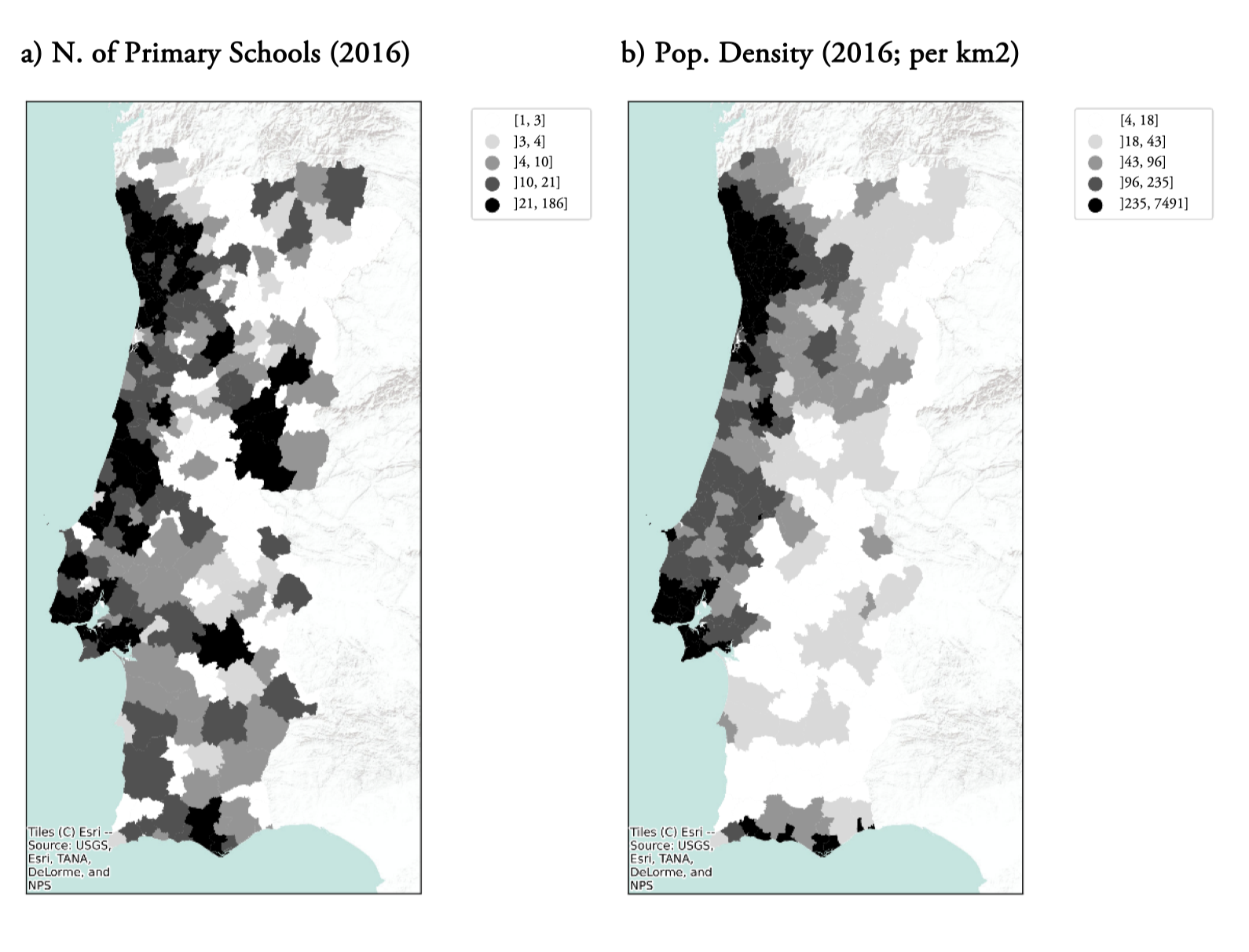
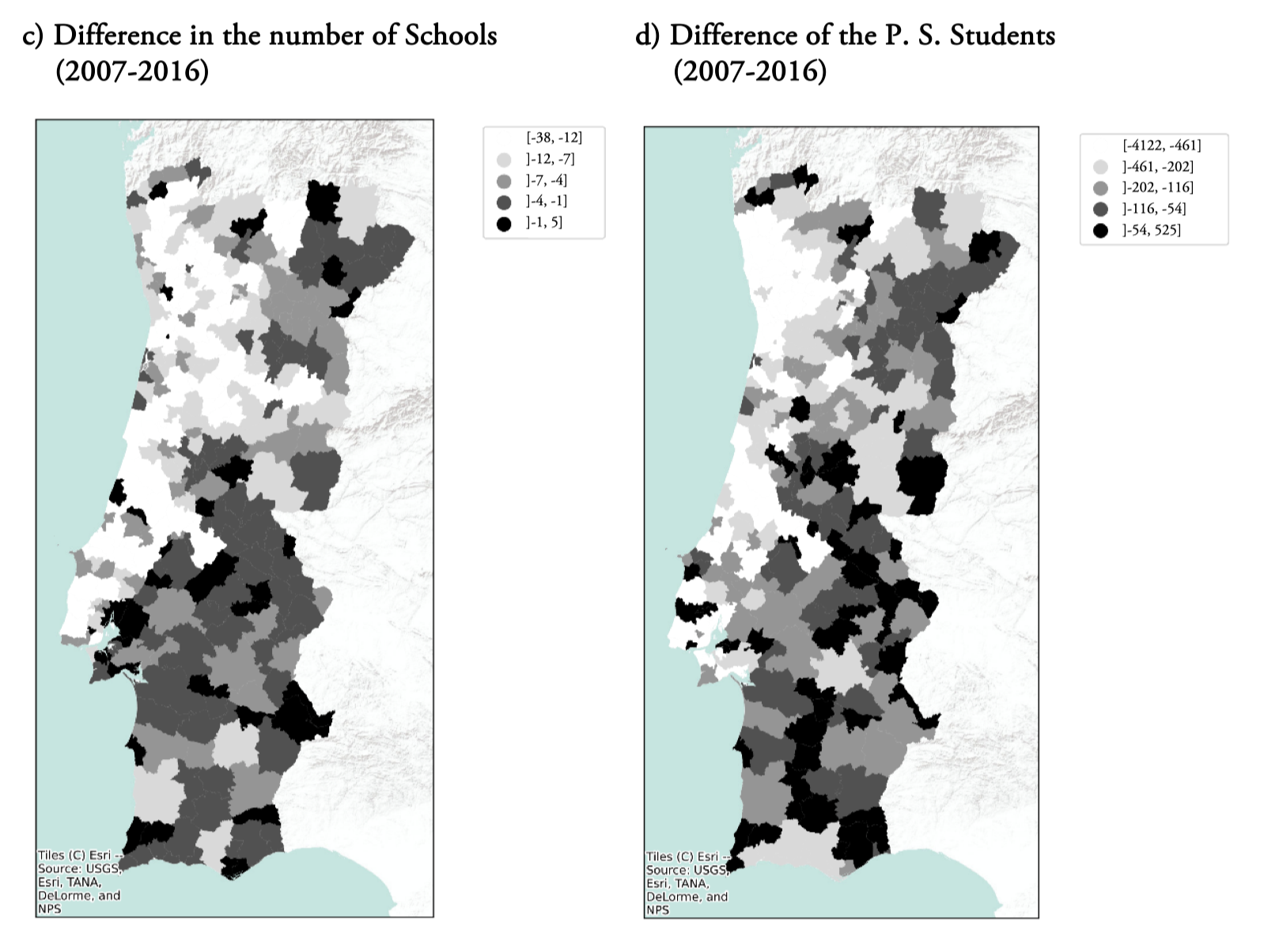
Note: A. Number of Primary Schools in 2016; B. Population Density (per km2) in 2016; C. Difference of number of Schools from 2007 to 2016; D. Difference of the Students enrolled in primary school from 2007 to 2016. The range of colours means the variation of values for each variable from the minimum (clearest) to the maximum (darkest) in quintiles.
2.2. Spatio-temporal model
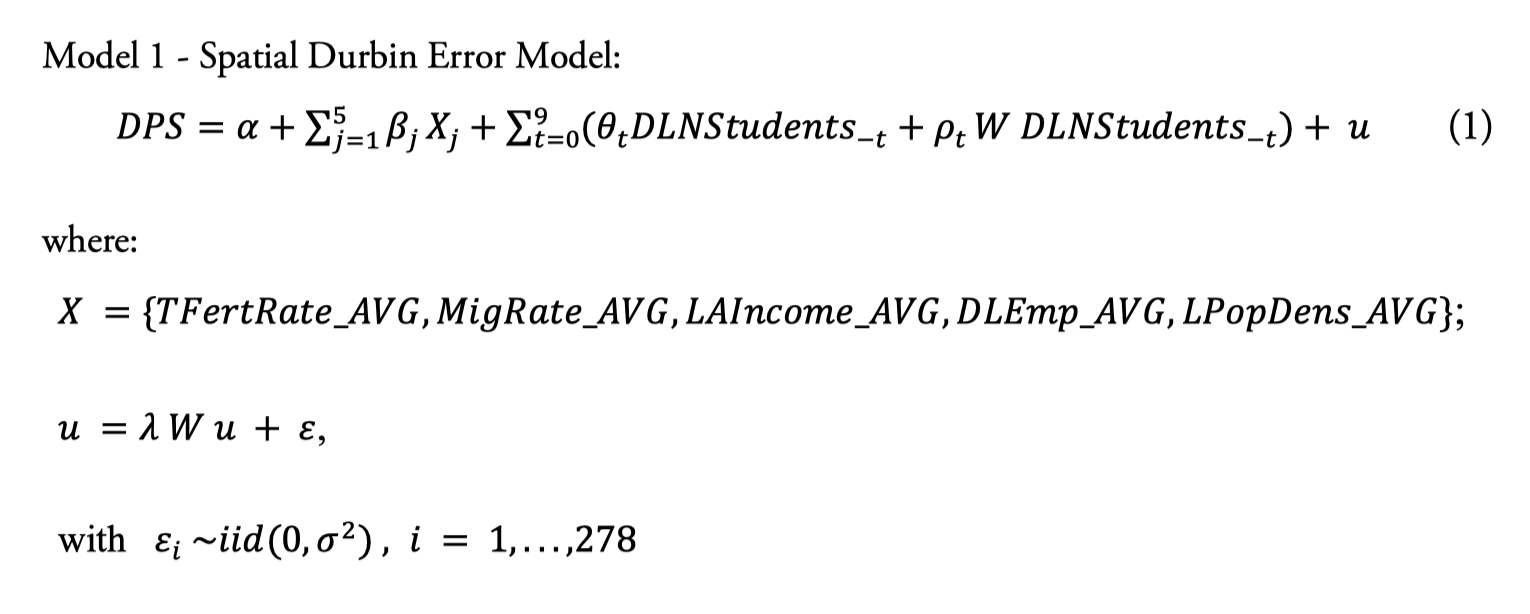
The analysis of the time lag in which changes in the number of students lead to changes in the number of schools was developed with an SDEM (MODEL1), where the explanatory variable was the difference in the number of public primary schools in 2007 and 2016 (DPS). Further explanatory variables were: the average total fertility rate in the period (TFertRate_AVG); the average migration rate in the period (MigRate_AVG); the average of the logarithm of average income in the period (LAIncome_AVG); the average of the differences (in consecutive years) of the logarithm of employment in private firms (DLEmp_AVG); the average of the logarithm of populational density (LPopDens_AVG) and the differences (in consecutive years) of the logarithm of the number of schools’ students (DLNStudents). Since there is a certain degree of mobility between pupils of different municipalities, meaning that the decision to open or close a school can be expected to be influenced by the spatial spillover effect, the spatial lag of changes in the number of students was also included, at level, and with 9 temporal lags, using queen contiguity for the spatial weight matrix. The spatial lag was also applied to the residuals (associated with lambda coefficient).
Model 1 - Spatial Durbin Error Model:
Interestingly, these results reveal few coefficients that are statistically different from zero for an error type I of 0.05 or 0.1 (Table 2). For all mainland municipalities, only the coefficients associated with the variables DLEmp_AVG, LPopDens_AVG, w_DLNStudents_1, w_DLNStudents_3, and w_DLNStudents_7 can be considered statistically different from zero (with a p-value < 0.1).
Table 2.
Spatio-temporal SDEM model to study the changes in the number of schools from 2007 to 2016
| Variable | Coefficient | z-statistic | p-value |
| CONSTANT | 0.317 | 0.115 | 0.909 |
| TFertRate_AVG | 0.272 | 0.641 | 0.521 |
| MigRate_AVG | 0.151 | 1.115 | 0.265 |
| LAIncome_AVG | 0.028 | 0.070 | 0.945 |
| DLEmp_AVG** | 7.271 | 2.850 | 0.004 |
| LPopDens_AVG** | -0.170 | -4.007 | 0.000 |
| DLNStudents_0 | 0.406 | 0.382 | 0.703 |
| DLNStudents_1 | 0.412 | 0.355 | 0.723 |
| DLNStudents_2 | 0.571 | 0.462 | 0.644 |
| DLNStudents_3 | -0.301 | -0.246 | 0.806 |
| DLNStudents_4 | -1.305 | -1.124 | 0.261 |
| DLNStudents_5 | 1.147 | 0.925 | 0.355 |
| DLNStudents_6 | -0.847 | -0.623 | 0.533 |
| DLNStudents_7 | -0.254 | -0.215 | 0.830 |
| DLNStudents_8 | -0.100 | -0.105 | 0.916 |
| DLNStudents_9 | -0.374 | -0.417 | 0.677 |
| w_DLNStudents_0 | 0.410 | 0.815 | 0.415 |
| w_DLNStudents_1* | -1.043 | -1.933 | 0.053 |
| w_DLNStudents_2 | 0.454 | 0.852 | 0.394 |
| w_DLNStudents_3** | 1.539 | 3.082 | 0.002 |
| w_DLNStudents_4 | 0.081 | 0.152 | 0.879 |
| w_DLNStudents_5 | -0.634 | -1.260 | 0.208 |
| w_DLNStudents_6 | -0.327 | -0.538 | 0.591 |
| w_DLNStudents_7** | 1.515 | 2.641 | 0.008 |
| w_DLNStudents_8 | 0.243 | 0.669 | 0.503 |
| w_DLNStudents_9 | -0.324 | -0.912 | 0.362 |
| lambda | 0.005 | 0.251 | 0.802 |
The positive coefficient of the variable DLEmp_AVG is in line with the literature, considering that more urban municipalities with higher employment growth are likely to witness fewer school closures than more rural and less attractive municipalities (Slee & Miller, 2015). However, the significant coefficients also reveal unexpected results. The negative coefficient for LPopDens_AVG, for example, is contrary to previous findings, which considered that most school closures occur in rural settings (Amcoff, 2012; Autti & Hyry-Beihammer, 2014; Sørensen et al., 2021). Most importantly, the number of primary schools would be expected to respond to changes in the number of students in each municipality, and not only to changes in the number of students of the geographic neighbours.
To further complicate the analysis, the spatially lagged coefficients of time lags 3 and 7 are positive, while time lag 1 is negative. This means that there tends to be a contagion effect associated with the enrolment of pupils in neighbouring municipalities in the short and medium-term, while municipalities in geographic locations where there was growth some years ago are likely to have witnessed a consolidation of the school network since then.
While these findings show the many different policy responses to shrinking student populations mentioned in the literature (Cordeiro et al., 2012; Wolf et al., 2018), they also show signs that these responses do not occur in short periods, but are more a consequence of medium to long term, cumulative, trends. This justifies the approach followed in the next section, where a cross-section model was applied to the whole period.
2.3. Cross-section model
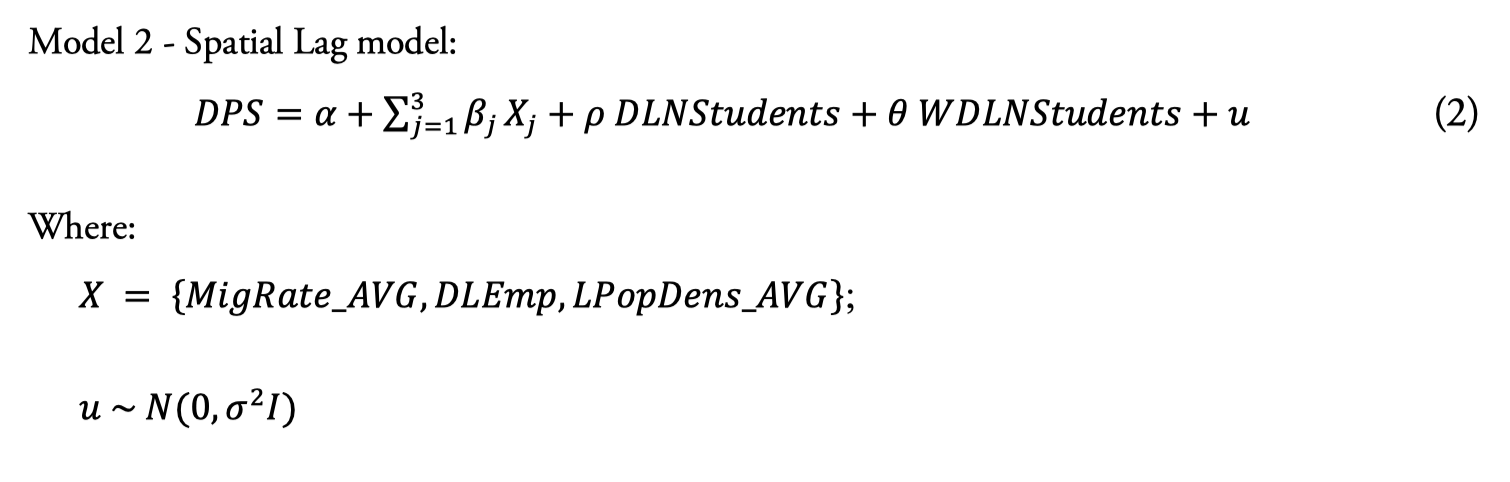
For the cross-section analysis, we used the changes from 2007 to 2016 in the number of schools (DPS), the number of students (DLNStudents), and the employment by private firms (DLEmp). The spatial lag was introduced only for the variable DLNStudents and the remaining variables were considered with their average values from 2007 to 2016. The White robust consistent estimation was used for the variance matrix of coefficients.
This model can be formulated as:
Model 2 - Spatial Lag model:
A specification of this model without the spatial component was also applied (Model 3). The Outputs in Table 3 show the cross-section coefficients' statistics for both models (with and without the spatial lagged independent variable W DLNStudents). The output produced originally with all variables in python showed that residuals cannot be considered normal with the Jarque-Bera statistic (p-value < 0.1). Moreover, the model presented symptoms of multicollinearity (Multicollinearity Condition Number > 10). On the other hand, if the model is reduced to the statistically significant coefficients with a significance of 10%, this solves the problem of multicollinearity (Multicollinearity Condition Number = 8.833).
Relatively to the Ordinary Least Squares model, Model 2 presents a lower AIC (Akaike info criterion – 1790.042 and 1841.926), a lower log-likelihood (-889.021 and -915.963), and a higher
(0.328 and 0.184). The former model reveals a positive impact of the percentual changes of employment in private firms (DLEmp_AVG) to variations in the number of primary schools, in line with the argument made by Slee and Miller (2015) that the major factor in school closures is the inability of some areas to provide work for families within a commuting distance. The spatial lagged variable DLNStudents is positive, meaning that the variation in the number of students in the neighbouring municipalities has a positive influence on the variation in the number of primary schools of a given municipality (Table 3).
Table 3.
Estimation results for cross-section model
| Ordinary Least Squares Estimation (Model 3) | Spatial Lag Model (Model 2) | |
| Variable | Coefficient | |
| Constant | 4.318 (2.993) | 8.975 (5.871) |
| MigRate_AVG | 1.702 (1.728)* | 0.017 (0.017) |
| DLEmp | 2.342 (1.320) | 2.930 (1.732)* |
| LPopDens_AVG | -1.908 (-6.456)** | -2.138 (-7.639)** |
| DLNStudents | 9.370 (3.702)** | 1.196 (0.485) |
| Lagrange Multiplier (lag) | 79.270 (0.000) | |
| Robust LM (lag) | 74.807 (0.000) | |
| Lagrange Multiplier (error) | 22.592 (0.000) | |
| Robust LM (error) | 18.129 (0.000) | |
| Lagrange Multiplier | 97.399 (0.000) | |
| Number of Observations | 278 | |
| R-squared | 0.184 | 0.328 |
| Log-likelihood | -915.963 | -889.021 |
| Akaike info criterion | 1841.926 | 1790.042 |
| Lag coefficient ( ) | 3.864 (6.815)** | |
This stresses the spatial nature of this kind of process, and the need to consider the broader structures of spatial dependence for understanding variations in the number of schools at the local scale (the spatial autocorrelation in school demand has already been observed by Torres and Prior, 2015, while the spatial autocorrelation in demographic variables has been analysed quite extensively by authors such as Carioli et al., 2021, or Castro et al., 2015).
But most importantly, and counterintuitively, the evolution of the number of students and the average population density have no statistically significant relationship with changes in the number of schools (as was noted, low-density, remote, municipalities would be expected to be subject to more school closures). The most plausible explanation for these findings is that in many municipalities the lower threshold of service provision is being approached, considering the many years of school consolidation and the legal obligation to provide this service at a reasonable distance. In other words, some municipalities with very negative values in the number of students cannot close more schools, and most of the more recent consolidation is occurring in municipalities with a higher number of schools. This assumption seems to be confirmed by Figure 2, which shows a negative correlation between the number of primary schools in a municipality, and the evolution of the number of primary schools.
Figure 2.
The number of Primary Schools in 2007 and Changes in the Number of Primary Schools from 2007 to 2016 for the mainland Portuguese municipalities
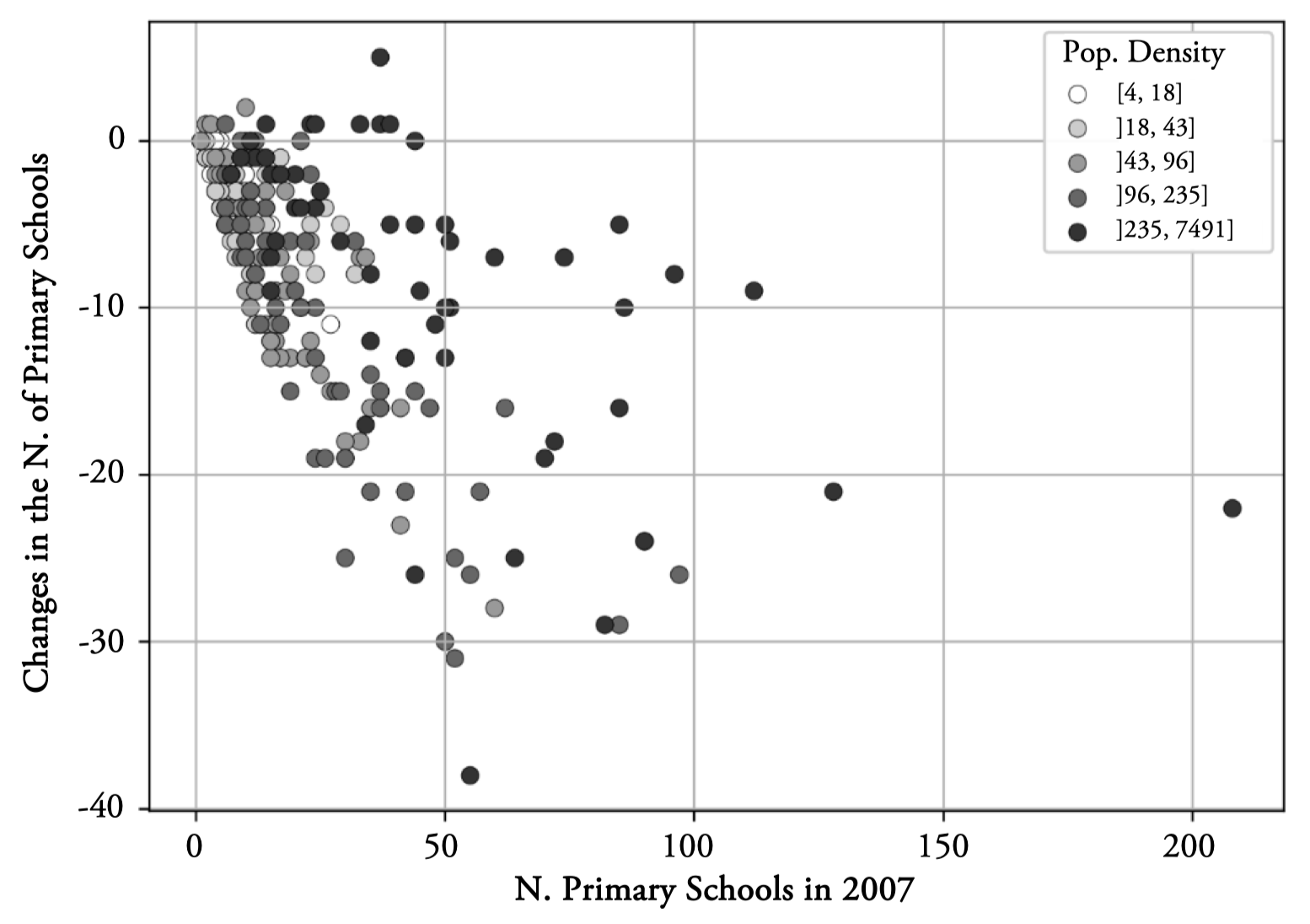
Note: Each coloured ball corresponds to the quintile interval to population density in 2016 from the less dense municipalities (clearer) to the denser municipalities (darker).
2.4. Analysis of the residuals’ spatial autocorrelation
Considering that the error term of the model does not follow a normal distribution and that there is a known spatial dimension in the changes in the number of primary schools at the municipal level, it is worth analysing the spatial autocorrelation in the model’s residuals. And the Moran’s I shows a significant spatial autocorrelation of 0.167 (pseudo-p-value < 0.001) between the residuals of the considered municipalities and their geographic neighbours, using a queen contiguity matrix.
At the local scale, and considering the Local Indicator of Spatial Association (LISA) as defined by Anselin (1995), significant clusters of municipalities with high residuals can mainly be observed in lower-density areas in the northeast and the centre of the country, although a positive cluster is also located in the south of Lisbon, at the Setúbal Peninsula (Figure 1). Significant spatial associations with low residuals mainly occur in the more densely populated coastal areas. This adds evidence to the possibility, discussed in the previous section, that many municipalities have already reached their lower limit in school closures since the more remote and lower-density territories in the interior tend to have a more positive evolution in the number of primary schools than would be expected by their demographic and socioeconomic characteristics.
Figure 3.
LISA Cluster of residuals at left. Moran Local Scatterplot at right
Note: [///] means municipalities with dependent variable values greater than estimated values, considering a significance of 0.05. HH means significant clustering of high with high values, HL high with low, LH low with high, and LL low with low; ns means non-significant values.
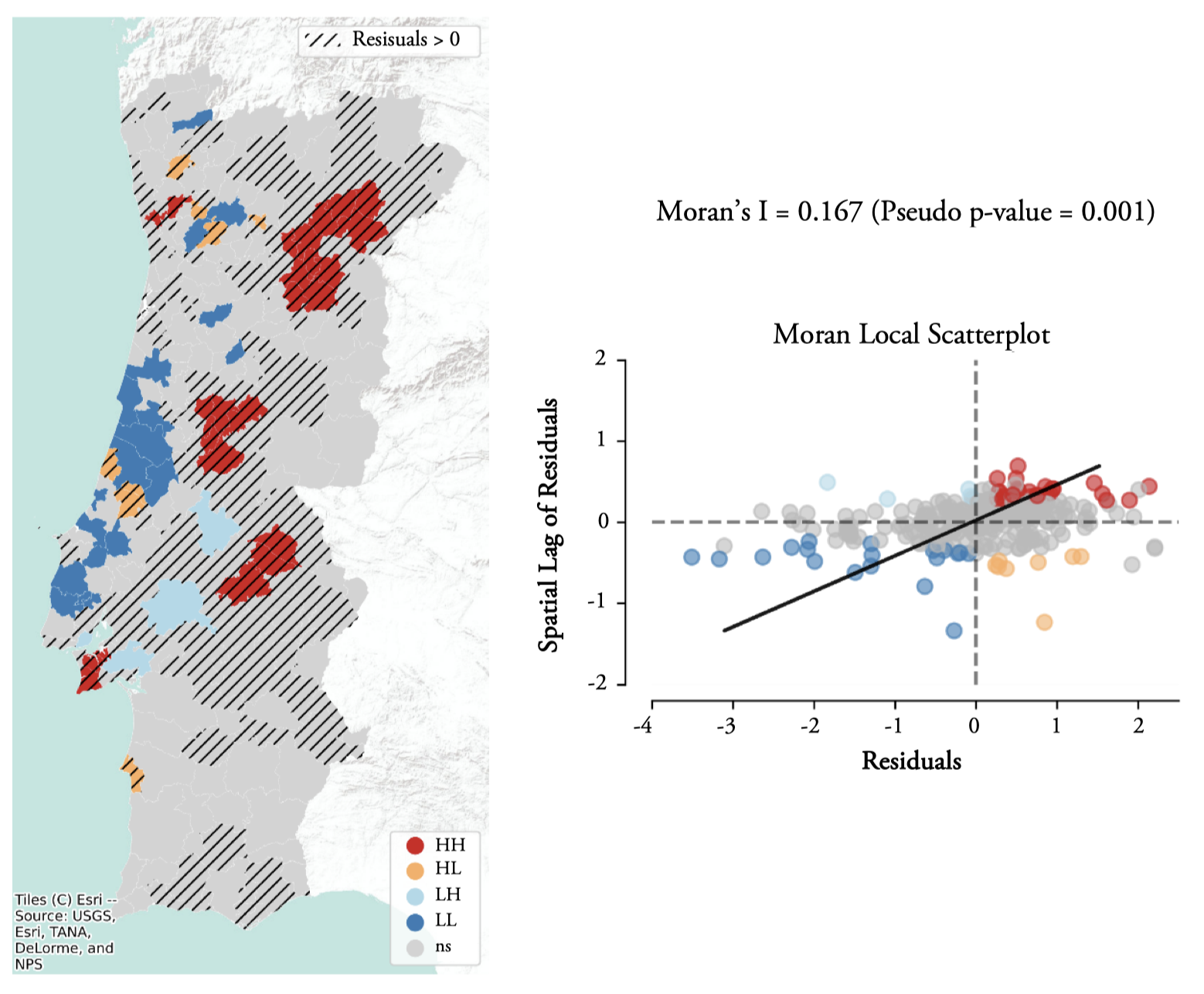
Note: [///] means municipalities with dependent variable values greater than estimated values, considering a significance of 0.05. HH means significant clustering of high with high values, HL high with low, LH low with high, and LL low with low; ns means non-significant values.
Conclusions
Drawing on previous work relating to the way the number of schools is adjusted to the number of students at the local scale (Cordeiro et al., 2014; Marques, Tufail, et al., 2021), this article contributes to understanding the time lag of this adjustment, as well as the different factors and territorial contexts that are relevant for this relationship, through a spatio-temporal and a cross-section spatial error model.
The first major finding of this approach is that the decisions to open or close schools cannot be understood as a consequence of short- or medium-term fluctuations in the number of students, but are the outcome of long-term, multidimensional, processes.
The second finding is that, in each municipality, the number of schools has no statistically significant relationship with the changes that occur in the number of students, but there is a significant relationship between changes in the number of schools and changes in the number of students in the geographic neighbours of the municipalities. The spatial structure in these processes is also visible when considering the residuals of the second model, which show that the tendency for closing more or fewer schools than is estimated by the model follows geographic patterns.
The third finding, which is a consequence of the previous one, is that spatial density has a negative relation with the changes that occur in the number of schools. As was discussed, in declining populations, variations in the number of students only lead to school closures until a certain threshold is attained: minimum standards in school provision guarantee that each municipality retains a small number of schools even when the number of pupils continues to decrease. This finding might also be related to the different rhythms of school network consolidation, where the territories which are declining at the fastest rates are the first ones to witness school closures, which afterwards spreads to the more central locations.
Fourth, while primary schools may be able to influence household location decisions and other service investments (Lehtonen, 2021), this analysis also revealed a positive influence of the changes in the employment provided by private firms on the changes in the number of primary schools.
In short, the planning of primary school facilities must be understood in the context of broader spatial processes. These processes, while providing interesting material for scientific inquiry, also pose significant challenges to their analysis. Given the many factors which influence the number of primary schools, and the slow response to changes in these factors, it could be useful to consider: longer time series (several decades), to better understand the significant temporal lags in variables that can contribute to changes in primary schools; smaller (or different) statistically units, to perceive the clustered economic and demographic dynamics of the territory and their relations with the provision of services of general interest; a more diversified set of variables. It could also be useful to explore the lower limit of school provision, namely considering the degree of spatial accessibility or student-to-school ratios, which the models showed to be important. Finally, it could be interesting to explore the different responses of public and private schools to changes in the socioeconomic and territorial contexts, although the relatively small number of private schools and their absence in many contexts would pose methodological challenges.
Acknowledgements
This work has been supported by Portuguese national funds through the Foundation for Science and Technology, FCT, I.P., in the context of the JUST_PLAN project (PTDC/GES-OUT/2662/20).
References
Amcoff, J. (2012). Do rural districts die when their schools close? Evidence from Sweden around 2000. Educational Planning, 20(3), 47–60.
Anselin, L. (1995). Local indicators of spatial association — LISA. Geographical Analysis, 27(2), 93–115. https://doi.org/10.1111/j.1538-4632.1995.tb00338.x
Autti, O., & Hyry-Beihammer, E. (2014). School closures in rural Finnish communities. Journal of Research in Rural Education, 29(1), 1–17.
Barakat, B. F. (2015). A ‘recipe for depopulation’? School closures and regional population decline in Saxony. Population Space and Place, 21, 735–753. https://doi.org/https://doi.org/10.1002/psp.1853
Barroso, J. (2006). A regulação das políticas públicas de educação: Espaço, dinâmicas e actores. Educa/Unidade de I&D de Ciências da Educação. https://repositorio.ul.pt/handle/10451/5761
Bontje, M. (2004). Facing the challenge in East Germany: The case of Leipzig. GeoJournal, 61, 13–21. https://doi.org/10.1007/s10708-004-0843-7
Carioli, A., Recaño, J., & Devolder, D. (2021). The changing geographies of fertility in Spain (1981-2018). Investigaciones Regionales, 2021(50), 147–167. https://doi.org/10.38191/iirr-jorr.21.015
Castro, E. A., Zhang, Z., Bhattacharjee, A., Martins, J. M., & Maiti, T. (2015). Regional fertility data analysis: A small area Bayesian approach. In Satyanshu K. Upadhyay, U. Singh, D. K. Dey, & A. Loganathan (Eds.), Current Trends in Bayesian Methodology with Applications (No. 2; pp. 203–224). Chapman and Hall/CRC.
Cordeiro, A. M. R., Félix, S., & Santos, L. (2012). Fundos comunitários na requalificação da rede escolar: Estudo de caso da Comunidade Intermunicipal da Região de Coimbra. Revista Portuguesa de Estudos Regionais, 44, 93–109. http://www.apdr.pt/siterper/numeros/RPER44/44.6.pdf
Cordeiro, A. M. R., Martins, H. A., & Ferreira, A. G. (2014). As cartas educativas municipais e o reordenamento da rede escolar no Centro de Portugal: das condições demográficas às decisões políticas. Ensaio: Avaliação e Políticas Públicas Em Educação, 22(84), 581–607. https://doi.org/10.1590/s0104-40362014000300002
Couch, C., & Cocks, M. (2013). Housing vacancy and the shrinking city: Trends and policies in the UK and the City of Liverpool. Housing Studies, 28(3), 499–519. https://doi.org/10.1080/02673037.2013.760029
Davoudi, S., Wishardt, M., & Strange, I. (2010). The ageing of Europe: Demographic scenarios of Europe’s futures. Futures, 42(8), 794–803. https://doi.org/10.1016/j.futures.2010.04.011
Elshof, H., Haartsen, T., & Mulder, C. H. (2015). The effect of primary school absence and closure on inward and outward flows of families. Tijdschrift Voor Economische En Sociale Geografie, 106(5), 625–635. https://doi.org/10.1111/tesg.12172
Engberg, J., Gill, B., Zamarro, G., & Zimmer, R. (2012). Closing schools in a shrinking district: Do student outcomes depend on which schools are closed? Journal of Urban Economics, 71(2), 189–203. https://doi.org/10.1016/j.jue.2011.10.001
EUROSTAT. (2020). Population and population change statistics - Statistics Explained. November 2018, 1–7. http://ec.europa.eu/eurostat/statistics-explained/index.php/Population_and_population_change_statistics%0Ahttp://epp.eurostat.ec.europa.eu/statisticsexplained/
EUROSTAT. (2022, July). ISCED Mappings 2014, https://circabc.europa.eu/ui/group/d14c857a-601d-438a-b878-4b4cebd0e10f/library/e32812c3-2785-4b8d-b796-593987ded52a?p=1&n=10&sort=modified_DESC/
Haase, A., Athanasopoulou, A., & Rink, D. (2013). Urban shrinkage as an emerging concern for European policymaking. European Urban and Regional Studies, 23(1), 103–107. https://doi.org/10.1177/0969776413481371
Hollander, J. B., Pallagst, K., Schwarz, T., & Popper, F. J. (2009). Planning shrinking cities. Progress in Planning, 72(4), 223–232.
Hospers, G.-J. (2014). Policy responses to urban shrinkage: From growth thinking to civic engagement. European Planning Studies, 22(7), 1507–1523. https://doi.org/10.1080/09654313.2013.793655
Jaroszewska, E. (2019). Urban shrinkage and regeneration of an old industrial city: the case of Wałbrzych in Poland. Quaestiones Geographicae, 38(2), 75–90. https://doi.org/10.2478/quageo-2019-0023
Johnson, M. P., Hollander, J., & Hallulli, A. (2014). Maintain, demolish, re-purpose: Policy design for vacant land management using decision models. Cities, 40, 151–162. https://doi.org/10.1016/j.cities.2013.05.005
Kearns, R. A., Lewis, N., McCreanor, T., & Witten, K. (2009). “The status quo is not an option”: Community impacts of school closure in South Taranaki, New Zealand. Journal of Rural Studies, 25(1), 131–140. https://doi.org/10.1016/j.jrurstud.2008.08.002
Lang, T. (2012). Shrinkage, metropolization and peripheralization in East Germany. European Planning Studies, 20(10), 1747–1754. https://doi.org/10.1080/09654313.2012.713336
Lee, J., & Lubienski, C. (2017). The impact of school closures on equity of access in Chicago. Education and Urban Society, 49(1), 53–80. https://doi.org/10.1177/0013124516630601
Lipman, P. (2009). The cultural politics of mixed-income schools and housing: A racialized discourse of displacement, exclusion, and control. Anthropology and Education Quarterly, 40(3), 215–236. https://doi.org/10.1111/j.1548-1492.2009.01042.x
Luci, A., & Thévenon, O. (2014). Does economic advancement ‘cause’ a re-increase in fertility? an rmpirical analysis for OECD countries (1960–2007). European Journal of Population, 30(2), 187–221. https://doi.org/10.1007/s10680-013-9309-2
Lutz, W., O’Neill, B. C., & Scherbov, S. (2003). Europe’s population at a turning point. Science, 299(5615), 1991–1992. https://doi.org/10.1126/science.1103788
Macintyre, S., Macdonald, L., & Ellaway, A. (2008). Do poorer people have poorer access to local resources and facilities? The distribution of local resources by area deprivation in Glasgow, Scotland. Social Science and Medicine, 67(6), 900–914. https://doi.org/10.1016/j.socscimed.2008.05.029
Mallach, A. (2017). What we talk about when we talk about shrinking cities: The ambiguity of discourse and policy response in the United States. Cities, 69, 109–115. https://doi.org/10.1016/j.cities.2017.01.008
Marques, J. L., Tufail, M., Wolf, J., & Madaleno, M. (2021). Population growth and the local provision of services: The role of primary schools in Portugal. Population Research and Policy Review, 40, 309–335. https://doi.org/10.1007/s11113-020-09573-z
Marques, J. L., Wolf, J., & Feitosa, F. (2021). Accessibility to primary schools in Portugal: a case of spatial inequity? Regional Science Policy & Practice, 13, 693–707. https://doi.org/10.1111/rsp3.12303
Myrskylä, M., Goldstein, J. R., & Cheng, Y. hsin A. (2013). New cohort fertility forecasts for the developed world: Rises, falls, and reversals. Population and Development Review, 39(1), 31–56. https://doi.org/10.1111/j.1728-4457.2013.00572.x
Slee, B., & Miller, D. (2015). School closures as a driver of rural decline in Scotland: A problem in pursuit of some evidence? Scottish Geographical Journal, 131(2), 78–97. https://doi.org/10.1080/14702541.2014.988288
Sørensen, J. F. L., Svendsen, G. L. H., Jensen, P. S., & Schmidt, T. D. (2021). Do rural school closures lead to local population decline? Journal of Rural Studies, 87(September), 226–235. https://doi.org/10.1016/j.jrurstud.2021.09.016
Steinberg, M. P., & MacDonald, J. M. (2019). The effects of closing urban schools on students’ academic and behavioral outcomes: Evidence from Philadelphia. Economics of Education Review, 69(January), 25–60. https://doi.org/10.1016/j.econedurev.2018.12.005
Torres, L. Ll., & Prior, D. (2015). Measuring school demand in the presence of spatial dependence: a conditional approach. Universitat Autonoma de Barcelona, Working Paper No. 14/3. https://doi.org/10.2139/ssrn.2539041
Wiechmann, T., & Pallagst, K. M. (2012). Urban shrinkage in Germany and the USA: A comparison of transformation patterns and local strategies. International Journal of Urban and Regional Research, 36(2), 261–280. https://doi.org/10.1111/j.1468-2427.2011.01095.x
Wolf, J., Feitosa, F., & Marques, J. L. (2021). Efficiency and equity in the spatial planning of primary schools. International Journal of E-Planning Research (IJEPR), 10(1), 21–38. https://doi.org/10.4018/IJEPR.2021010102
Wolf, J., Marques, J. L., & Castro, E. (2018). Planning school networks in declining territories: an analysis at the local scale. Spatial Systems: Social Integration, Regional Development and Sustainability, 12th World Congress of the RSAI, 918–928. https://regionalscience.org/2018worldcongress/
Wolff, M., & Wiechmann, T. (2018). Urban growth and decline: Europe’s shrinking cities in a comparative perspective 1990–2010. European Urban and Regional Studies, 25(2), 122–139. https://doi.org/10.1177/0969776417694680
Información adicional
JEL Classification: R53; R58.